Stuarts (1603-1714)
Slide master
• The Stuart monarchs, from James I
onwards, were less successful than
the Tudors.
• They quarreled with Parliament and
this resulted in civil war
• The only king of England ever to be
tried and executed was a Stuart.
• The republic that followed was even
more unsuccessful, and by popular
demand the dead king's son was
called back to the throne.
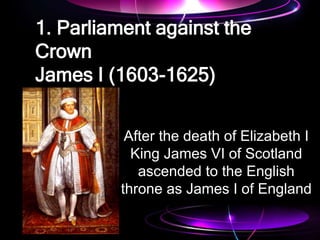
1. Parliament against the
Crown
James I (1603-1625)
After the death of Elizabeth I
King James VI of Scotland
ascended to the English
throne as James I of England
• He seemed an excellent successor:
– 20 years experience as the king of
Scotland
– A moderate Protestant, knowing
how to deal with religious situation
• James was clever and well educated.
• He had been kidnapped by groups of
nobles, and had been forced to give
in to the kirk.
• He started to believe in the divine
right of kings. James I believed that
the king was chosen by god and
therefore only god could judge him.
• Until his death in 1625, James was
always quarrelling with Parliament
over money and over its desire to
play a part in his foreign policy.
• From 1564 – members of the church of
England who wished to eliminate roman
catholic survivals in church ritual, or
substitute a Presbyterian for an Episcopal
form of church government
• They were associated with strict
observance of the Sabbath, moral
inflexibility and abstinence from pleasure.
• Groups of Puritans fled to Holland,
but they were determined to establish
their own communities.
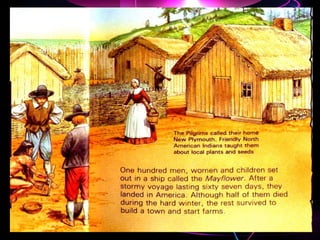
• In 1620 a number of exiles, and
Puritans from England
• They set sail from Plymouth in The
Mayflower for the Americas. These
Pilgrim Fathers founded the New
England colonies.
2. Charles I (1625-1649)
• Charles succeeded James in 1625, a
year which has been seen as a
turning-point in English history.
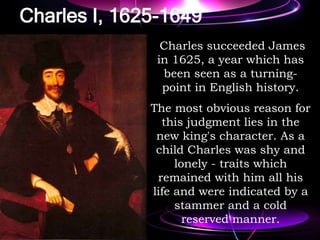
Charles I, 1625-1649
Charles succeeded James
in 1625, a year which has
been seen as a turning-
point in English history.
The most obvious reason for
this judgment lies in the
new king's character. As a
child Charles was shy and
lonely - traits which
remained with him all his
life and were indicated by a
stammer and a cold
reserved manner.
• Charles I found himself quarrelling even
more bitterly with the Commons than his
father had done, mainly over money.
• Finally Charles dissolved and recalled
Parliament several times by virtue to the
raising of taxation and parliamentary rights.
• Charles surprised everyone by being
able to rule successfully without
Parliament.
• There were also people in England, known
as Puritans, who, like the Scottish
Presbyterians, wanted a democratic Church
with no bishops.
• William Laud urged bishops to inspect their
bishoprics and punish anyone who did not
conform.
• Many Puritans fled, thus increasing the
numbers in the New England colonies.
• Laud tried to introduce the new prayer
book in Scotland in 1637,
• A national resistance to the introduction of
bishops and what Scots thought of as
Catholicism.
• In spring 1638 Charles faced a rebel
Scottish army.
• Without the help of Parliament he
agreed to respect all Scottish political
and religious freedoms.
• Civil War (1641-1646): in 1641, at a
moment when Charles badly needed a
period of quiet, Ireland exploded in
rebellion against the Protestant English
and Scottish settlers
• As many as 3,000 people, men,
women and children were killed, most
of them in Ulster.
• The reasons orbited around
1. the crown's disputes with
Parliament;
2. the tensions between Puritans and
the Church of England;
• 3. the locally organised resistance to
the financial, religious and political
policies of the crown
• 4. the increasing, capitalist prosperity
of the gentry and merchants who
challenged the privileges of the
established nobility.
• By 1645 the Royalist army was
unpaid
• As a result soldiers either ran away,
or stole from local villages and farms.
• In the end they lost their courage for
the fight against the Parliamentarians
• at Naseby in 1645 the Royalist army
was finally defeated. In 1646 Charles
surrendered, and was imprisoned.
Republican Britain (The
Commonwealth (1649-1653))
• Several MPs had commanded the
East Anglican gentle man farmer
named Oliver Cromwell.
• He was a country gentleman from
Huntingdonshire converted to
Puritanism at about 30.
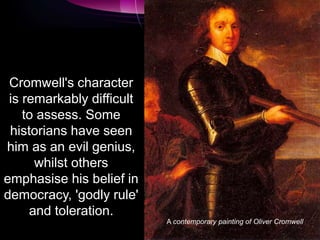
Cromwell's character
is remarkably difficult
to assess. Some
historians have seen
him as an evil genius,
whilst others
emphasise his belief in
democracy, 'godly rule'
and toleration.
A contemporary painting of Oliver Cromwell
• He had created a new "model" army that
had a regular force.
• He invited into his army educated men
who wanted to fight for their beliefs
• Charles continued to encourage rebellion
against Parliament even in prison
• Some army commanders were determined
to get rid of the king.
• These men were Puritans who believed
they could build God's kingdom in England.
• On 31 January 1649, King Charles was
executed.
• From 1649- 1660 Britain was a republic, but
the republic was not a success.
• Cromwell and his friends created a
government far more severe than Charles's
had been.
• The army remained the most powerful force
in the land.
• Disagreements between the army and
Parliament resulted in Parliament's
dissolution in 1653.
• From 1653 Britain was governed by
Cromwell alone. He became "Lord
Protector", with far greater powers than King
Charles had had.
4. Catholicism, the Crown and the
New Constitutional Monarchy
Charles II
• In 1657 Parliament nominated Cromwell's
son, Richard Cromwell (1626-1712), as his
successor.
• The following year, on 3 September 1658,
the Lord Protector died.
• Richard Cromwell quickly realised that he
had not his father's genius and retired to his
farm.
• Charles II was invited to become king
and the Commonwealth and
Protectorate came to an end.
• was attracted to the Catholic Church.
was crowned in 29.05.1660.
• He died in 06.02.1685.
• He was the King of England,
Scotland and Ireland.
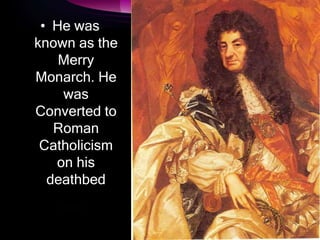
• He was
known as the
Merry
Monarch. He
was
Converted to
Roman
Catholicism
on his
deathbed
• His reign resulted in the first political parties
in Britain.
• The Tories upheld the authority of the
Crown and the Church, and were natural
inheritors of the "Royalist" position.
• The Whigs were not against the Crown, but
they believed that its authority depraved
upon the consent of Parliament.
James II
• James II became king after his
brother's death in 1685.
• James soon tried to remove the laws
which stopped Catholics from taking
positions in government and
Parliament.
• He also tried to bring back the Catholic
Church, and allow it to exist beside the
Anglican Church.
• He also tried to get rid of the Tory gentry
who most strongly opposed him.
• Tories, Whigs and Anglicans did nothing
because they could look forward to the
succession of James’ daughter, Mary.
• Mary was Protestant and married to the
Protestant ruler of Holland, William of
Orange.
The Glorious Revolution
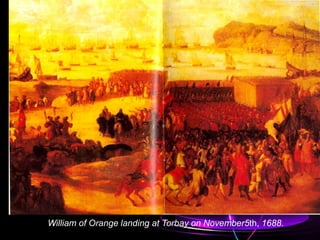
• William decided to accept the invitation
• His tactics were to state that
– he wanted to protect Protestant rights rather
than bidding directly for the crown
– and to avoid a civil war by not provoking full-
scale battles
• William defeated James (who fled, was captured
and allowed to escape to France) without a battle
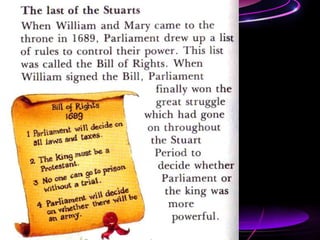
• Uniquely in English history Parliament
agreed to recognize William and Mary as
joint sovereigns
• In return the new monarchs had to accept
• a Bill of Rights, which established the
supremacy of Parliament over the
monarchy.
William of Orange landing at Torbay on November5th, 1688.
Stuarts (1603 1714)
Stuarts (1603 1714)
Stuarts (1603 1714)

Stuarts (1603 1714)

  • 1.
  • 2.
    Slide master • TheStuart monarchs, from James I onwards, were less successful than the Tudors. • They quarreled with Parliament and this resulted in civil war • The only king of England ever to be tried and executed was a Stuart. • The republic that followed was even more unsuccessful, and by popular demand the dead king's son was called back to the throne.
  • 3.
    1. Parliament againstthe Crown James I (1603-1625) After the death of Elizabeth I King James VI of Scotland ascended to the English throne as James I of England
  • 4.
    • He seemedan excellent successor: – 20 years experience as the king of Scotland – A moderate Protestant, knowing how to deal with religious situation
  • 5.
    • James wasclever and well educated. • He had been kidnapped by groups of nobles, and had been forced to give in to the kirk. • He started to believe in the divine right of kings. James I believed that the king was chosen by god and therefore only god could judge him.
  • 6.
    • Until hisdeath in 1625, James was always quarrelling with Parliament over money and over its desire to play a part in his foreign policy.
  • 7.
    • From 1564– members of the church of England who wished to eliminate roman catholic survivals in church ritual, or substitute a Presbyterian for an Episcopal form of church government • They were associated with strict observance of the Sabbath, moral inflexibility and abstinence from pleasure.
  • 8.
    • Groups ofPuritans fled to Holland, but they were determined to establish their own communities. • In 1620 a number of exiles, and Puritans from England • They set sail from Plymouth in The Mayflower for the Americas. These Pilgrim Fathers founded the New England colonies.
  • 10.
    2. Charles I(1625-1649) • Charles succeeded James in 1625, a year which has been seen as a turning-point in English history.
  • 11.
    Charles I, 1625-1649 Charlessucceeded James in 1625, a year which has been seen as a turning- point in English history. The most obvious reason for this judgment lies in the new king's character. As a child Charles was shy and lonely - traits which remained with him all his life and were indicated by a stammer and a cold reserved manner.
  • 12.
    • Charles Ifound himself quarrelling even more bitterly with the Commons than his father had done, mainly over money. • Finally Charles dissolved and recalled Parliament several times by virtue to the raising of taxation and parliamentary rights.
  • 13.
    • Charles surprisedeveryone by being able to rule successfully without Parliament.
  • 14.
    • There werealso people in England, known as Puritans, who, like the Scottish Presbyterians, wanted a democratic Church with no bishops. • William Laud urged bishops to inspect their bishoprics and punish anyone who did not conform.
  • 15.
    • Many Puritansfled, thus increasing the numbers in the New England colonies. • Laud tried to introduce the new prayer book in Scotland in 1637, • A national resistance to the introduction of bishops and what Scots thought of as Catholicism.
  • 16.
    • In spring1638 Charles faced a rebel Scottish army. • Without the help of Parliament he agreed to respect all Scottish political and religious freedoms.
  • 17.
    • Civil War(1641-1646): in 1641, at a moment when Charles badly needed a period of quiet, Ireland exploded in rebellion against the Protestant English and Scottish settlers
  • 18.
    • As manyas 3,000 people, men, women and children were killed, most of them in Ulster.
  • 19.
    • The reasonsorbited around 1. the crown's disputes with Parliament; 2. the tensions between Puritans and the Church of England;
  • 20.
    • 3. thelocally organised resistance to the financial, religious and political policies of the crown • 4. the increasing, capitalist prosperity of the gentry and merchants who challenged the privileges of the established nobility.
  • 21.
    • By 1645the Royalist army was unpaid • As a result soldiers either ran away, or stole from local villages and farms. • In the end they lost their courage for the fight against the Parliamentarians • at Naseby in 1645 the Royalist army was finally defeated. In 1646 Charles surrendered, and was imprisoned.
  • 22.
    Republican Britain (The Commonwealth(1649-1653)) • Several MPs had commanded the East Anglican gentle man farmer named Oliver Cromwell. • He was a country gentleman from Huntingdonshire converted to Puritanism at about 30.
  • 23.
    Cromwell's character is remarkablydifficult to assess. Some historians have seen him as an evil genius, whilst others emphasise his belief in democracy, 'godly rule' and toleration. A contemporary painting of Oliver Cromwell
  • 24.
    • He hadcreated a new "model" army that had a regular force. • He invited into his army educated men who wanted to fight for their beliefs
  • 25.
    • Charles continuedto encourage rebellion against Parliament even in prison • Some army commanders were determined to get rid of the king. • These men were Puritans who believed they could build God's kingdom in England. • On 31 January 1649, King Charles was executed.
  • 26.
    • From 1649-1660 Britain was a republic, but the republic was not a success. • Cromwell and his friends created a government far more severe than Charles's had been.
  • 27.
    • The armyremained the most powerful force in the land. • Disagreements between the army and Parliament resulted in Parliament's dissolution in 1653. • From 1653 Britain was governed by Cromwell alone. He became "Lord Protector", with far greater powers than King Charles had had.
  • 28.
    4. Catholicism, theCrown and the New Constitutional Monarchy Charles II • In 1657 Parliament nominated Cromwell's son, Richard Cromwell (1626-1712), as his successor. • The following year, on 3 September 1658, the Lord Protector died. • Richard Cromwell quickly realised that he had not his father's genius and retired to his farm.
  • 29.
    • Charles IIwas invited to become king and the Commonwealth and Protectorate came to an end. • was attracted to the Catholic Church. was crowned in 29.05.1660. • He died in 06.02.1685. • He was the King of England, Scotland and Ireland.
  • 30.
    • He was knownas the Merry Monarch. He was Converted to Roman Catholicism on his deathbed
  • 31.
    • His reignresulted in the first political parties in Britain. • The Tories upheld the authority of the Crown and the Church, and were natural inheritors of the "Royalist" position. • The Whigs were not against the Crown, but they believed that its authority depraved upon the consent of Parliament.
  • 32.
    James II • JamesII became king after his brother's death in 1685. • James soon tried to remove the laws which stopped Catholics from taking positions in government and Parliament.
  • 33.
    • He alsotried to bring back the Catholic Church, and allow it to exist beside the Anglican Church. • He also tried to get rid of the Tory gentry who most strongly opposed him.
  • 34.
    • Tories, Whigsand Anglicans did nothing because they could look forward to the succession of James’ daughter, Mary. • Mary was Protestant and married to the Protestant ruler of Holland, William of Orange.
  • 35.
    The Glorious Revolution •William decided to accept the invitation • His tactics were to state that – he wanted to protect Protestant rights rather than bidding directly for the crown – and to avoid a civil war by not provoking full- scale battles • William defeated James (who fled, was captured and allowed to escape to France) without a battle
  • 36.
    • Uniquely inEnglish history Parliament agreed to recognize William and Mary as joint sovereigns • In return the new monarchs had to accept • a Bill of Rights, which established the supremacy of Parliament over the monarchy.
  • 37.
    William of Orangelanding at Torbay on November5th, 1688.