Ch 3.4:
Complex Roots of Characteristic Equation
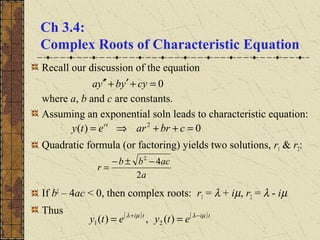
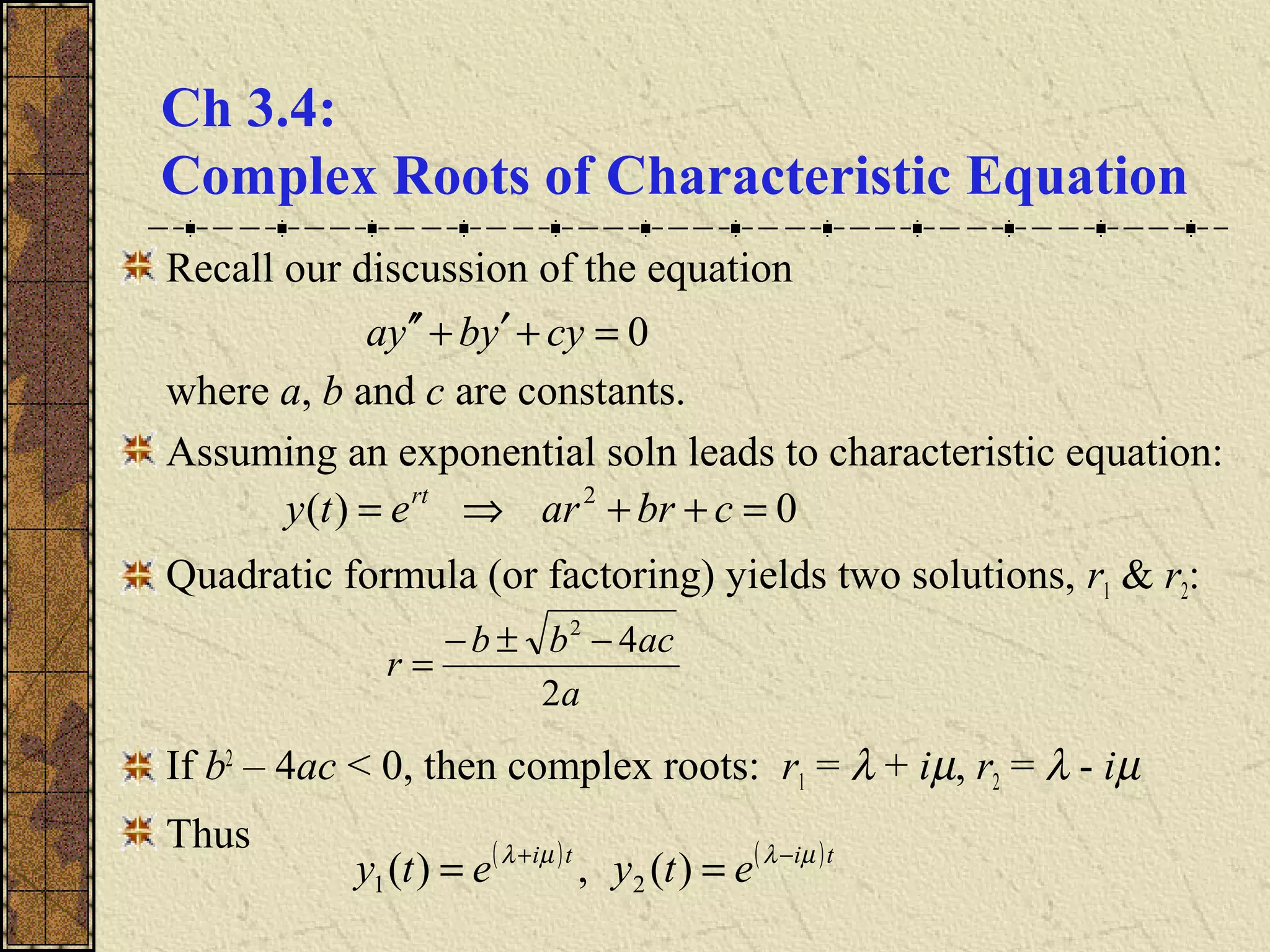
Recall our discussion of the equation
where a, b and c are constants.
Assuming an exponential soln leads to characteristic equation:
Quadratic formula (or factoring) yields two solutions, r1 & r2:
If b2
– 4ac < 0, then complex roots: r1 = λ + iµ, r2 = λ - iµ
Thus
0=+′+′′ cyybya
0)( 2
=++⇒= cbrarety rt
a
acbb
r
2
42
−±−
=
( ) ( )titi
etyety µλµλ −+
== )(,)( 21
Euler’s Formula; Complex Valued Solutions
Substituting it into Taylor series for et
, we obtain Euler’s
formula:
Generalizing Euler’s formula, we obtain
Then
Therefore
( ) ( )
tit
n
t
i
n
t
n
it
e
n
nn
n
nn
n
n
it
sincos
!12
)1(
!2
)1(
!
)(
1
121
0
2
0
+=
−
−
+
−
== ∑∑∑
∞
=
−−∞
=
∞
=
tite ti
µµµ
sincos +=
( )
[ ] tietetiteeee ttttitti
µµµµ λλλµλµλ
sincossincos +=+==+
( )
( )
tieteety
tieteety
ttti
ttti
µµ
µµ
λλµλ
λλµλ
sincos)(
sincos)(
2
1
−==
+==
−
+
Real Valued Solutions
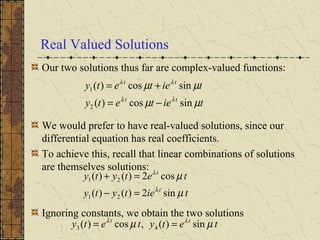
Our two solutions thus far are complex-valued functions:
We would prefer to have real-valued solutions, since our
differential equation has real coefficients.
To achieve this, recall that linear combinations of solutions
are themselves solutions:
Ignoring constants, we obtain the two solutions
tietety
tietety
tt
tt
µµ
µµ
λλ
λλ
sincos)(
sincos)(
2
1
−=
+=
tietyty
tetyty
t
t
µ
µ
λ
λ
sin2)()(
cos2)()(
21
21
=−
=+
tetytety tt
µµ λλ
sin)(,cos)( 43 ==
Real Valued Solutions: The Wronskian
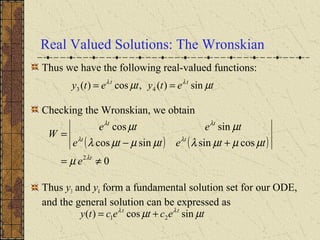
Thus we have the following real-valued functions:
Checking the Wronskian, we obtain
Thus y3 and y4 form a fundamental solution set for our ODE,
and the general solution can be expressed as
tetytety tt
µµ λλ
sin)(,cos)( 43 ==
( ) ( )
0
cossinsincos
sincos
2
≠=
+−
=
t
tt
tt
e
ttette
tete
W
λ
λλ
λλ
µ
µµµλµµµλ
µµ
tectecty tt
µµ λλ
sincos)( 21 +=
Example 1
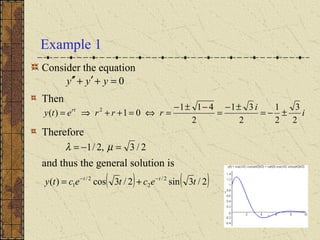
Consider the equation
Then
Therefore
and thus the general solution is
( ) ( )2/3sin2/3cos)( 2/
2
2/
1 tectecty tt −−
+=
0=+′+′′ yyy
i
i
rrrety rt
2
3
2
1
2
31
2
411
01)( 2
±−=
±−
=
−±−
=⇔=++⇒=
2/3,2/1 =−= µλ
Example 2
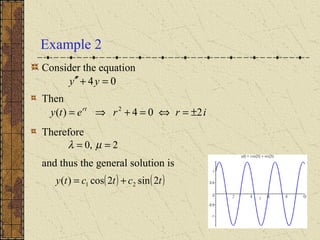
Consider the equation
Then
Therefore
and thus the general solution is
04 =+′′ yy
irrety rt
204)( 2
±=⇔=+⇒=
2,0 == µλ
( ) ( )tctcty 2sin2cos)( 21 +=
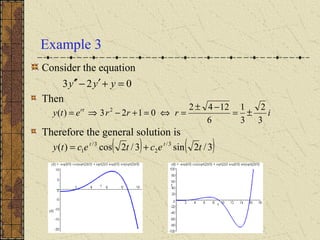
Example 3
Consider the equation
Then
Therefore the general solution is
023 =+′−′′ yyy
irrrety rt
3
2
3
1
6
1242
0123)( 2
±=
−±
=⇔=+−⇒=
( ) ( )3/2sin3/2cos)( 3/
2
3/
1 tectecty tt
+=
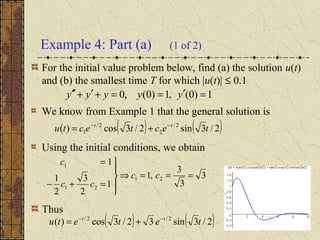
Example 4: Part (a) (1 of 2)
For the initial value problem below, find (a) the solution u(t)
and (b) the smallest time T for which |u(t)| ≤ 0.1
We know from Example 1 that the general solution is
Using the initial conditions, we obtain
Thus
( ) ( )2/3sin2/3cos)( 2/
2
2/
1 tectectu tt −−
+=
1)0(,1)0(,0 =′==+′+′′ yyyyy
3
3
3
,1
1
2
3
2
1
1
21
21
1
===⇒





=+−
=
cc
cc
c
( ) ( )2/3sin32/3cos)( 2/2/
tetetu tt −−
+=
Example 4: Part (b) (2 of 2)
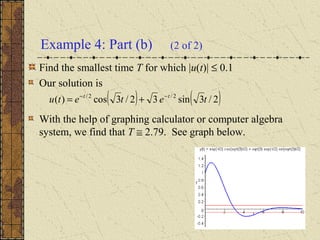
Find the smallest time T for which |u(t)| ≤ 0.1
Our solution is
With the help of graphing calculator or computer algebra
system, we find that T ≅ 2.79. See graph below.
( ) ( )2/3sin32/3cos)( 2/2/
tetetu tt −−
+=
Example 4: Part (b) (2 of 2)
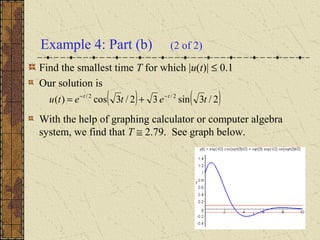
Find the smallest time T for which |u(t)| ≤ 0.1
Our solution is
With the help of graphing calculator or computer algebra
system, we find that T ≅ 2.79. See graph below.
( ) ( )2/3sin32/3cos)( 2/2/
tetetu tt −−
+=

Ch03 4

  • 1.
    Ch 3.4: Complex Rootsof Characteristic Equation Recall our discussion of the equation where a, b and c are constants. Assuming an exponential soln leads to characteristic equation: Quadratic formula (or factoring) yields two solutions, r1 & r2: If b2 – 4ac < 0, then complex roots: r1 = λ + iµ, r2 = λ - iµ Thus 0=+′+′′ cyybya 0)( 2 =++⇒= cbrarety rt a acbb r 2 42 −±− = ( ) ( )titi etyety µλµλ −+ == )(,)( 21
  • 2.
    Euler’s Formula; ComplexValued Solutions Substituting it into Taylor series for et , we obtain Euler’s formula: Generalizing Euler’s formula, we obtain Then Therefore ( ) ( ) tit n t i n t n it e n nn n nn n n it sincos !12 )1( !2 )1( ! )( 1 121 0 2 0 += − − + − == ∑∑∑ ∞ = −−∞ = ∞ = tite ti µµµ sincos += ( ) [ ] tietetiteeee ttttitti µµµµ λλλµλµλ sincossincos +=+==+ ( ) ( ) tieteety tieteety ttti ttti µµ µµ λλµλ λλµλ sincos)( sincos)( 2 1 −== +== − +
  • 3.
    Real Valued Solutions Ourtwo solutions thus far are complex-valued functions: We would prefer to have real-valued solutions, since our differential equation has real coefficients. To achieve this, recall that linear combinations of solutions are themselves solutions: Ignoring constants, we obtain the two solutions tietety tietety tt tt µµ µµ λλ λλ sincos)( sincos)( 2 1 −= += tietyty tetyty t t µ µ λ λ sin2)()( cos2)()( 21 21 =− =+ tetytety tt µµ λλ sin)(,cos)( 43 ==
  • 4.
    Real Valued Solutions:The Wronskian Thus we have the following real-valued functions: Checking the Wronskian, we obtain Thus y3 and y4 form a fundamental solution set for our ODE, and the general solution can be expressed as tetytety tt µµ λλ sin)(,cos)( 43 == ( ) ( ) 0 cossinsincos sincos 2 ≠= +− = t tt tt e ttette tete W λ λλ λλ µ µµµλµµµλ µµ tectecty tt µµ λλ sincos)( 21 +=
  • 5.
    Example 1 Consider theequation Then Therefore and thus the general solution is ( ) ( )2/3sin2/3cos)( 2/ 2 2/ 1 tectecty tt −− += 0=+′+′′ yyy i i rrrety rt 2 3 2 1 2 31 2 411 01)( 2 ±−= ±− = −±− =⇔=++⇒= 2/3,2/1 =−= µλ
  • 6.
    Example 2 Consider theequation Then Therefore and thus the general solution is 04 =+′′ yy irrety rt 204)( 2 ±=⇔=+⇒= 2,0 == µλ ( ) ( )tctcty 2sin2cos)( 21 +=
  • 7.
    Example 3 Consider theequation Then Therefore the general solution is 023 =+′−′′ yyy irrrety rt 3 2 3 1 6 1242 0123)( 2 ±= −± =⇔=+−⇒= ( ) ( )3/2sin3/2cos)( 3/ 2 3/ 1 tectecty tt +=
  • 8.
    Example 4: Part(a) (1 of 2) For the initial value problem below, find (a) the solution u(t) and (b) the smallest time T for which |u(t)| ≤ 0.1 We know from Example 1 that the general solution is Using the initial conditions, we obtain Thus ( ) ( )2/3sin2/3cos)( 2/ 2 2/ 1 tectectu tt −− += 1)0(,1)0(,0 =′==+′+′′ yyyyy 3 3 3 ,1 1 2 3 2 1 1 21 21 1 ===⇒      =+− = cc cc c ( ) ( )2/3sin32/3cos)( 2/2/ tetetu tt −− +=
  • 9.
    Example 4: Part(b) (2 of 2) Find the smallest time T for which |u(t)| ≤ 0.1 Our solution is With the help of graphing calculator or computer algebra system, we find that T ≅ 2.79. See graph below. ( ) ( )2/3sin32/3cos)( 2/2/ tetetu tt −− +=
  • 10.
    Example 4: Part(b) (2 of 2) Find the smallest time T for which |u(t)| ≤ 0.1 Our solution is With the help of graphing calculator or computer algebra system, we find that T ≅ 2.79. See graph below. ( ) ( )2/3sin32/3cos)( 2/2/ tetetu tt −− +=