Solving Quadratic
Equations by
Graphing
Hind saed, Maryam Abbas, Marwa Nasser 10C
Objectives of the lesson:
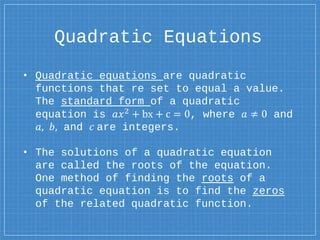
Quadratic Equations
• Quadratic equations are quadratic
functions that re set to equal a value.
The standard form of a quadratic
equation is 𝑎𝑥2
+ bx + c = 0, where 𝑎 ≠ 0 and
𝑎, 𝑏, and 𝑐 are integers.
• The solutions of a quadratic equation
are called the roots of the equation.
One method of finding the roots of a
quadratic equation is to find the zeros
of the related quadratic function.
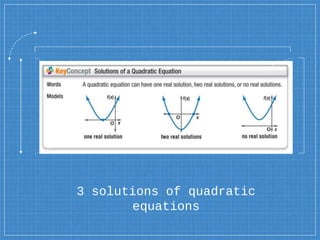
3 solutions of quadratic
equations
The Roots and zeros of the Function
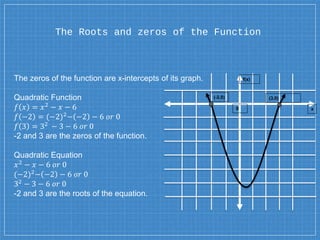
The zeros of the function are x-intercepts of its graph.
Quadratic Function
𝑓 𝑥 = 𝑥2 − 𝑥 − 6
𝑓 −2 = (−2)2
− −2 − 6 𝑜𝑟 0
𝑓 3 = 32 − 3 − 6 𝑜𝑟 0
-2 and 3 are the zeros of the function.
Quadratic Equation
𝑥2 − 𝑥 − 6 𝑜𝑟 0
(−2)2− −2 − 6 𝑜𝑟 0
32
− 3 − 6 𝑜𝑟 0
-2 and 3 are the roots of the equation.
(-2,0)
0
f(x)
x
(3,0)
Example 1: Two Real
Solutions.
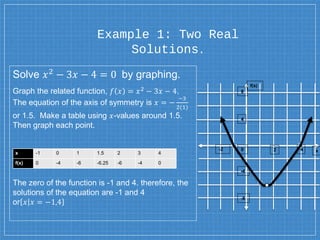
Solve 𝑥2 − 3𝑥 − 4 = 0 by graphing.
Graph the related function, 𝑓 𝑥 = 𝑥2 − 3𝑥 − 4.
The equation of the axis of symmetry is 𝑥 = −
−3
2(1)
or 1.5. Make a table using 𝑥-values around 1.5.
Then graph each point.
The zero of the function is -1 and 4. therefore, the
solutions of the equation are -1 and 4
or 𝑥 𝑥 = −1,4
x -1 0 1 1.5 2 3 4
f(x) 0 -4 -6 -6.25 -6 -4 0
4
-4
2-2
8
4
-8
x
f(x)
0
Example 2 one real solution
▪Solve: 14-x²=6x+23
▪14=x²+6x+23 (add x² to both
sides)
▪0=x²+6x+9 (subtract 14)
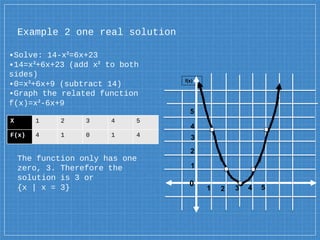
▪Graph the related function
f(x)=x²-6x+9
f(x)
54321X
41014F(x)
The function only has one
zero, 3. Therefore the
solution is 3 or
{x | x = 3} 0
1 2 43 5
1
3
4
5
Example 3, no real solution
▪Use a quadratic equation to
find two real numbers with a
sum of 15 and a product of 63
▪Let x represent one of the
numbers. Then 15-x is the other
number
▪X(15-x)=63
▪15x-x²=63
▪-x²+15x-63=0
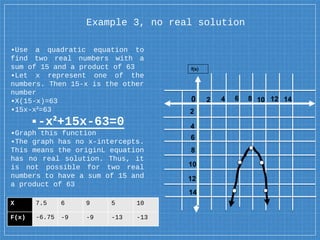
▪Graph this function
▪The graph has no x-intercepts.
This means the originL equation
has no real solution. Thus, it
is not possible for two real
numbers to have a sum of 15 and
a product of 63
f(x)
0 2 4 86 10
8
6
4
2
10
12
12
105967.5X
-13-13-9-9-6.75F(x)
14
14
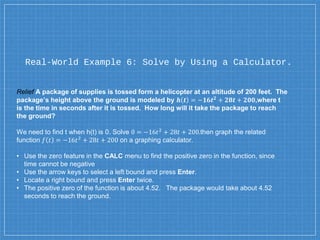
Real-World Example 6: Solve by Using a Calculator.
Relief A package of supplies is tossed form a helicopter at an altitude of 200 feet. The
package’s height above the ground is modeled by 𝒉 𝒕 = −𝟏𝟔𝒕 𝟐
+ 𝟐𝟖𝒕 + 𝟐𝟎𝟎,where t
is the time in seconds after it is tossed. How long will it take the package to reach
the ground?
We need to find t when h(t) is 0. Solve 0 = −16𝑡2
+ 28𝑡 + 200.then graph the related
function 𝑓 𝑡 = −16𝑡2
+ 28𝑡 + 200 on a graphing calculator.
• Use the zero feature in the CALC menu to find the positive zero in the function, since
time cannot be negative
• Use the arrow keys to select a left bound and press Enter.
• Locate a right bound and press Enter twice.
• The positive zero of the function is about 4.52. The package would take about 4.52
seconds to reach the ground.
The End

solving quadratic equations by graphing

  • 1.
    Solving Quadratic Equations by Graphing Hindsaed, Maryam Abbas, Marwa Nasser 10C
  • 2.
  • 3.
    Quadratic Equations • Quadraticequations are quadratic functions that re set to equal a value. The standard form of a quadratic equation is 𝑎𝑥2 + bx + c = 0, where 𝑎 ≠ 0 and 𝑎, 𝑏, and 𝑐 are integers. • The solutions of a quadratic equation are called the roots of the equation. One method of finding the roots of a quadratic equation is to find the zeros of the related quadratic function.
  • 4.
    3 solutions ofquadratic equations
  • 5.
    The Roots andzeros of the Function The zeros of the function are x-intercepts of its graph. Quadratic Function 𝑓 𝑥 = 𝑥2 − 𝑥 − 6 𝑓 −2 = (−2)2 − −2 − 6 𝑜𝑟 0 𝑓 3 = 32 − 3 − 6 𝑜𝑟 0 -2 and 3 are the zeros of the function. Quadratic Equation 𝑥2 − 𝑥 − 6 𝑜𝑟 0 (−2)2− −2 − 6 𝑜𝑟 0 32 − 3 − 6 𝑜𝑟 0 -2 and 3 are the roots of the equation. (-2,0) 0 f(x) x (3,0)
  • 6.
    Example 1: TwoReal Solutions. Solve 𝑥2 − 3𝑥 − 4 = 0 by graphing. Graph the related function, 𝑓 𝑥 = 𝑥2 − 3𝑥 − 4. The equation of the axis of symmetry is 𝑥 = − −3 2(1) or 1.5. Make a table using 𝑥-values around 1.5. Then graph each point. The zero of the function is -1 and 4. therefore, the solutions of the equation are -1 and 4 or 𝑥 𝑥 = −1,4 x -1 0 1 1.5 2 3 4 f(x) 0 -4 -6 -6.25 -6 -4 0 4 -4 2-2 8 4 -8 x f(x) 0
  • 7.
    Example 2 onereal solution ▪Solve: 14-x²=6x+23 ▪14=x²+6x+23 (add x² to both sides) ▪0=x²+6x+9 (subtract 14) ▪Graph the related function f(x)=x²-6x+9 f(x) 54321X 41014F(x) The function only has one zero, 3. Therefore the solution is 3 or {x | x = 3} 0 1 2 43 5 1 3 4 5
  • 8.
    Example 3, noreal solution ▪Use a quadratic equation to find two real numbers with a sum of 15 and a product of 63 ▪Let x represent one of the numbers. Then 15-x is the other number ▪X(15-x)=63 ▪15x-x²=63 ▪-x²+15x-63=0 ▪Graph this function ▪The graph has no x-intercepts. This means the originL equation has no real solution. Thus, it is not possible for two real numbers to have a sum of 15 and a product of 63 f(x) 0 2 4 86 10 8 6 4 2 10 12 12 105967.5X -13-13-9-9-6.75F(x) 14 14
  • 9.
    Real-World Example 6:Solve by Using a Calculator. Relief A package of supplies is tossed form a helicopter at an altitude of 200 feet. The package’s height above the ground is modeled by 𝒉 𝒕 = −𝟏𝟔𝒕 𝟐 + 𝟐𝟖𝒕 + 𝟐𝟎𝟎,where t is the time in seconds after it is tossed. How long will it take the package to reach the ground? We need to find t when h(t) is 0. Solve 0 = −16𝑡2 + 28𝑡 + 200.then graph the related function 𝑓 𝑡 = −16𝑡2 + 28𝑡 + 200 on a graphing calculator. • Use the zero feature in the CALC menu to find the positive zero in the function, since time cannot be negative • Use the arrow keys to select a left bound and press Enter. • Locate a right bound and press Enter twice. • The positive zero of the function is about 4.52. The package would take about 4.52 seconds to reach the ground.
  • 10.