Cryptography and Network Security Third Edition by William Stallings Lecture slides by Lawrie Brown
Chapter 2 –  Classical Encryption Techniques Many savages at the present day regard their names as vital parts of themselves, and therefore take great pains to conceal their real names, lest these should give to evil-disposed persons a handle by which to injure their owners.  — The Golden Bough,  Sir James George Frazer
Symmetric Encryption or conventional /  private-key   / single-key sender and recipient share a common key all classical encryption algorithms are private-key was only type prior to invention of public-key in 1970’s
Basic Terminology plaintext  - the original message  ciphertext  - the coded message  cipher  - algorithm for transforming plaintext to ciphertext  key  - info used in cipher known only to sender/receiver  encipher (encrypt)  - converting plaintext to ciphertext  decipher (decrypt)  - recovering ciphertext from plaintext cryptography  - study of encryption principles/methods cryptanalysis (codebreaking)  - the study of principles/ methods of deciphering ciphertext  without  knowing key cryptology  - the field of both cryptography and cryptanalysis
Symmetric Cipher Model
Requirements two requirements for secure use of symmetric encryption: a strong encryption algorithm a secret key known only to sender / receiver Y  = E K ( X ) X  = D K ( Y ) assume encryption algorithm is known implies a secure channel to distribute key
Cryptography can characterize by: type of encryption operations used substitution / transposition / product number of keys used single-key or private / two-key or public way in which plaintext is processed block / stream
Types of Cryptanalytic Attacks ciphertext only   only know algorithm / ciphertext, statistical, can identify plaintext  known plaintext   know/suspect plaintext & ciphertext to attack cipher  chosen plaintext   select plaintext and obtain ciphertext to attack cipher chosen ciphertext   select ciphertext and obtain plaintext to attack cipher chosen text   select either plaintext or ciphertext to en/decrypt to attack cipher
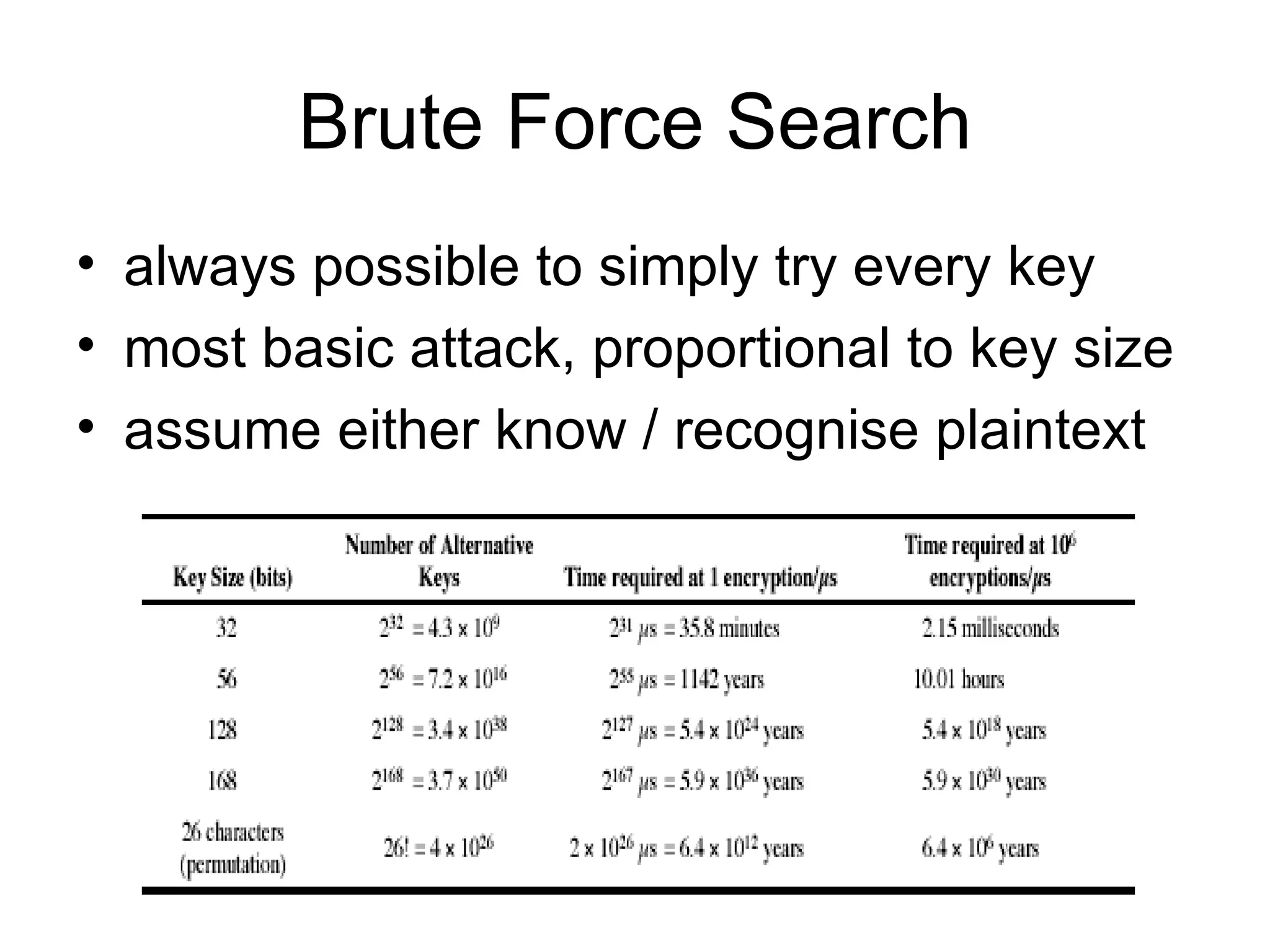
Brute Force Search always possible to simply try every key  most basic attack, proportional to key size  assume either know / recognise plaintext
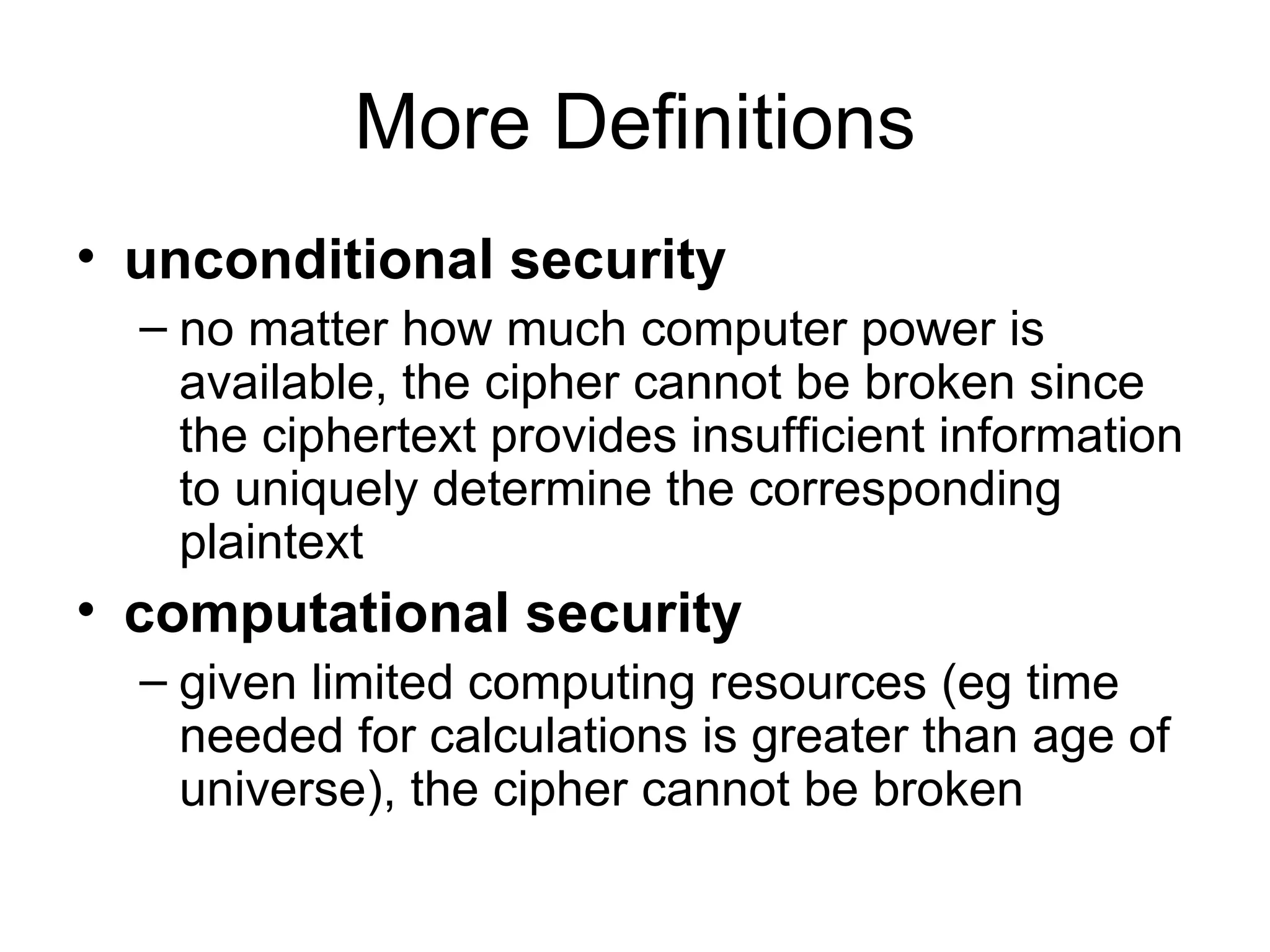
More Definitions unconditional security   no matter how much computer power is available, the cipher cannot be broken since the ciphertext provides insufficient information to uniquely determine the corresponding plaintext  computational security   given limited computing resources (eg time needed for calculations is greater than age of universe), the cipher cannot be broken
Classical Substitution Ciphers where  letters of plaintext are replaced by other letters or by numbers or symbols or if plaintext is  viewed as a sequence of bits, then substitution involves replacing plaintext bit patterns with ciphertext bit patterns
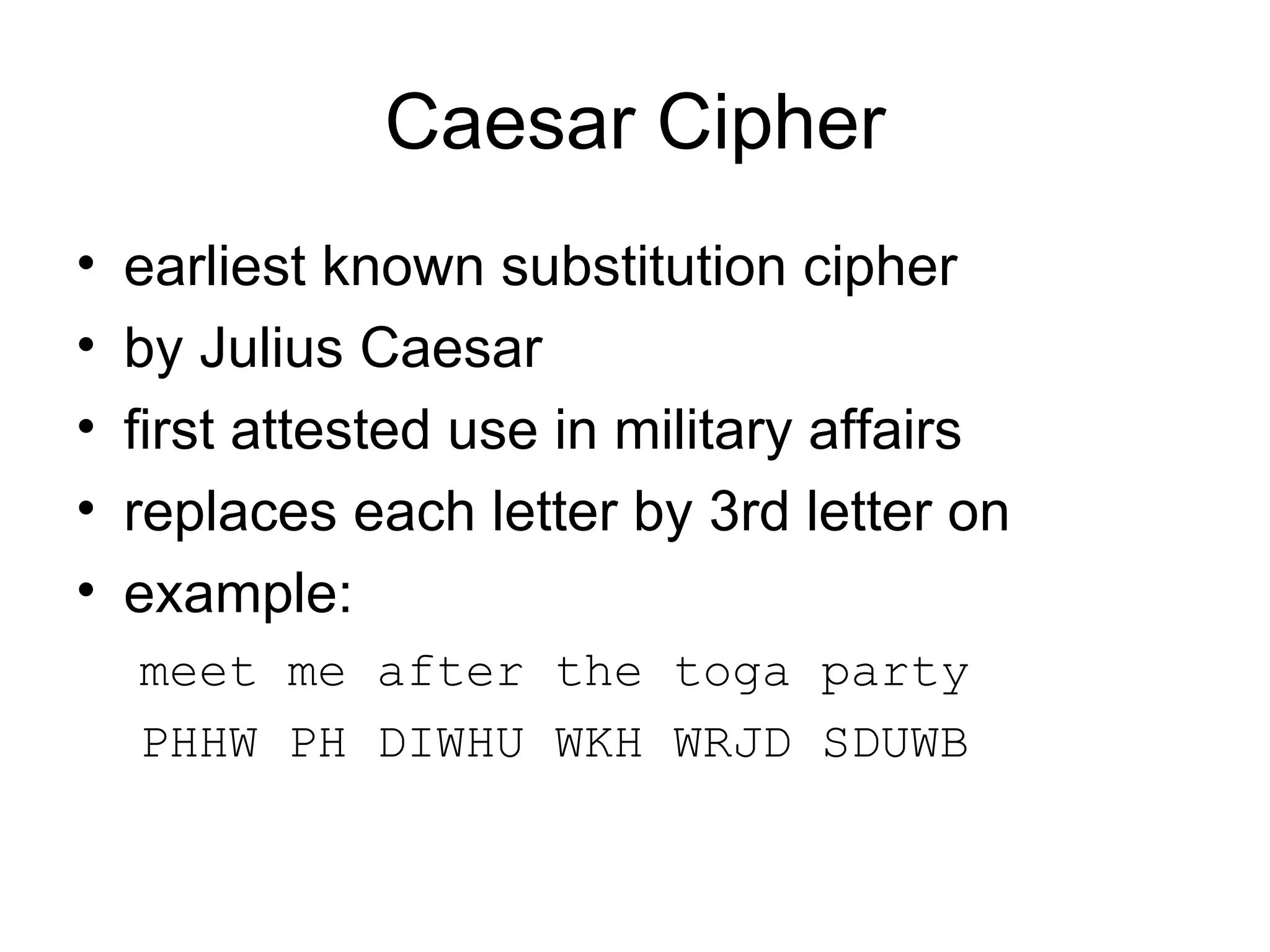
Caesar Cipher earliest known substitution cipher by Julius Caesar  first attested use in military affairs replaces each letter by 3rd letter on example: meet me after the toga party PHHW PH DIWHU WKH WRJD SDUWB
Caesar Cipher can define transformation as: a b c d e f g h i j k l m n o p q r s t u v w x y z D E F G H I J K L M N O P Q R S T U V W X Y Z A B C mathematically give each letter a number a b c d e f g h i j k  l  m 0 1 2 3 4 5 6 7 8 9 10 11 12 n  o  p  q  r  s  t  u  v  w  x  y  Z 13 14 15 16 17 18 19 20 21 22 23 24 25 then have Caesar cipher as: C  = E( p ) = ( p  +  k ) mod (26) p  = D(C) = (C –  k ) mod (26)
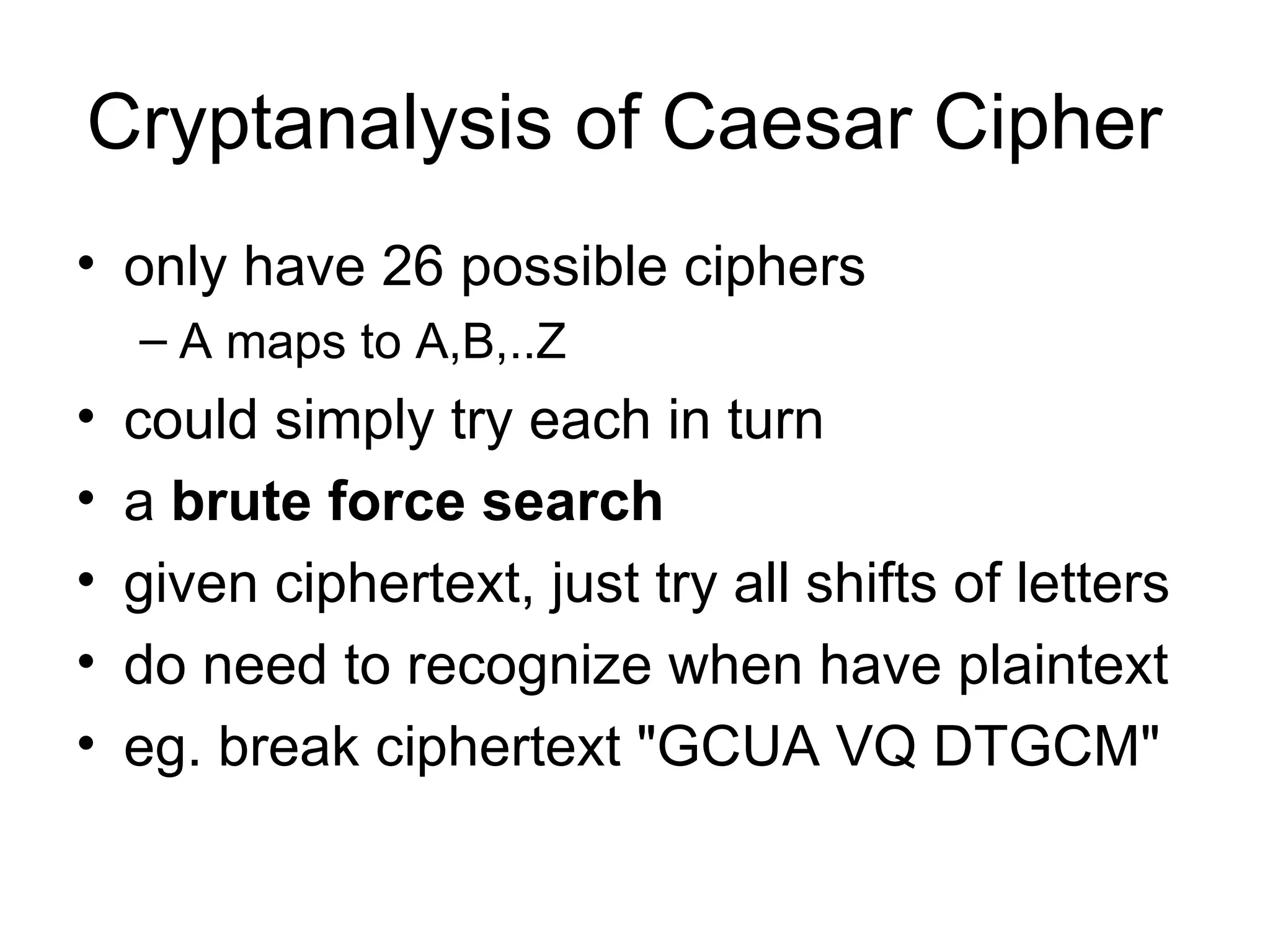
Cryptanalysis of Caesar Cipher  only have 26 possible ciphers  A maps to A,B,..Z  could simply try each in turn  a  brute force search   given ciphertext, just try all shifts of letters do need to recognize when have plaintext eg. break ciphertext "GCUA VQ DTGCM"
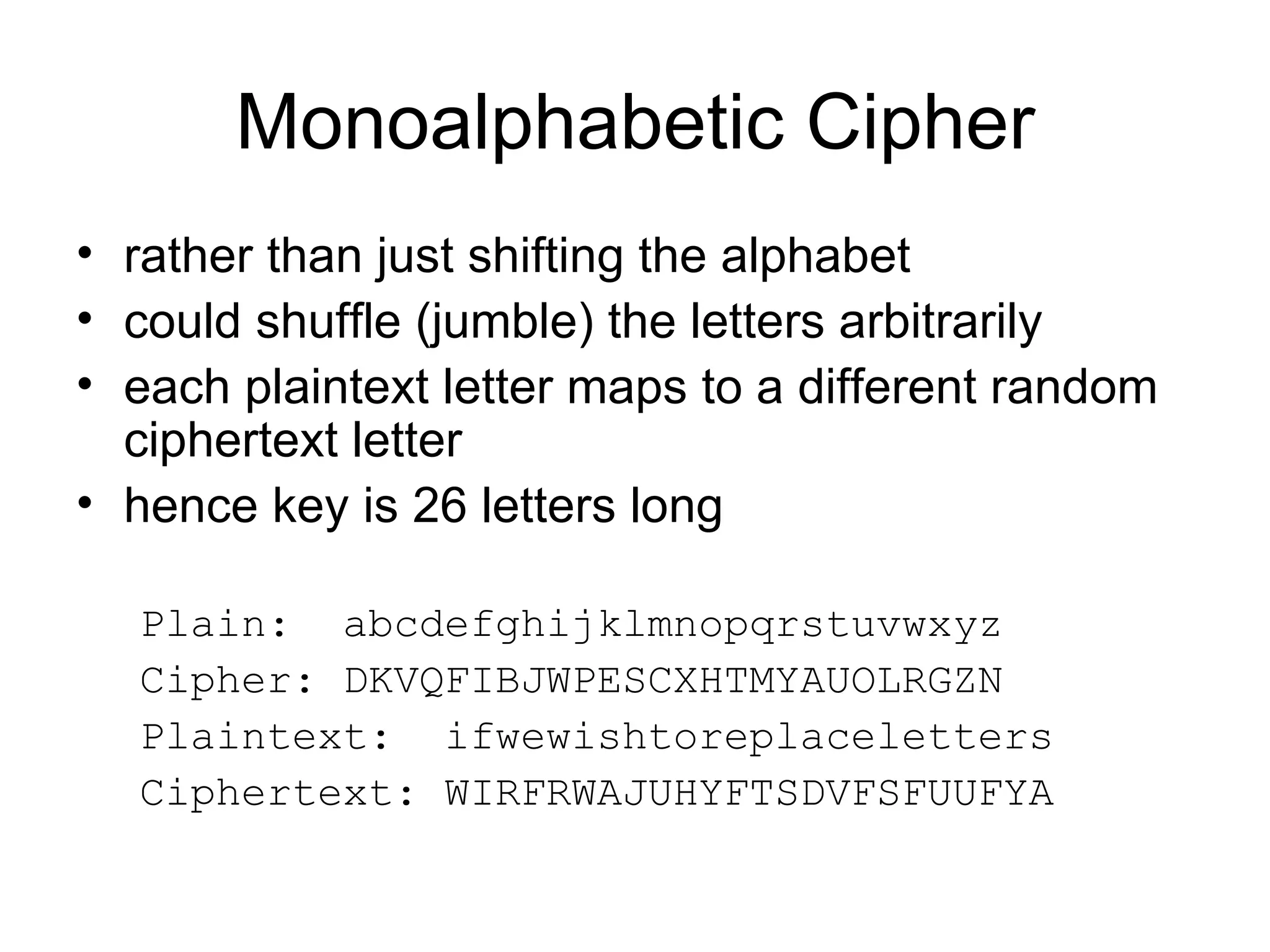
Monoalphabetic Cipher rather than just shifting the alphabet  could shuffle (jumble) the letters arbitrarily  each plaintext letter maps to a different random ciphertext letter  hence key is 26 letters long  Plain:  abcdefghijklmnopqrstuvwxyz  Cipher: DKVQFIBJWPESCXHTMYAUOLRGZN Plaintext:  ifwewishtoreplaceletters Ciphertext: WIRFRWAJUHYFTSDVFSFUUFYA
Monoalphabetic Cipher Security now have a total of 26! = 4 x 1026 keys  with so many keys, might think is secure  but would be  !!!WRONG!!!   problem is language characteristics
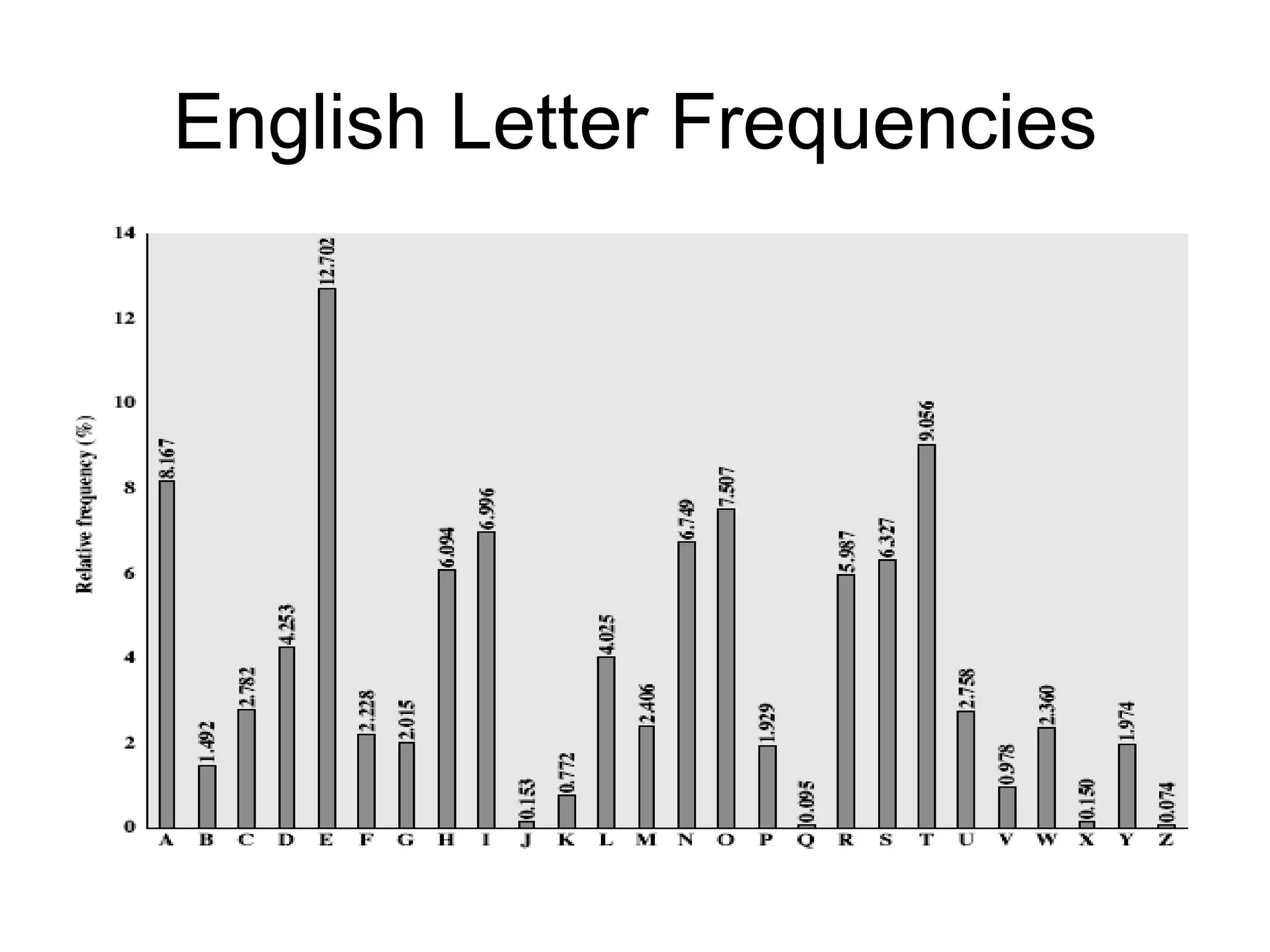
Language Redundancy and Cryptanalysis human languages are  redundant   eg "th lrd s m shphrd shll nt wnt"  letters are not equally commonly used  in English  e  is by far the most common letter  then T,R,N,I,O,A,S  other letters are fairly rare  cf. Z,J,K,Q,X  have tables of single, double & triple letter frequencies
English Letter Frequencies
Use in Cryptanalysis key concept - monoalphabetic substitution ciphers do not change relative letter frequencies  discovered by Arabian scientists in 9 th  century calculate letter frequencies for ciphertext compare counts/plots against known values  if Caesar cipher look for common peaks/troughs  peaks at: A-E-I triple, NO pair, RST triple troughs at: JK, X-Z for  monoalphabetic must identify each letter tables of common double/triple letters help
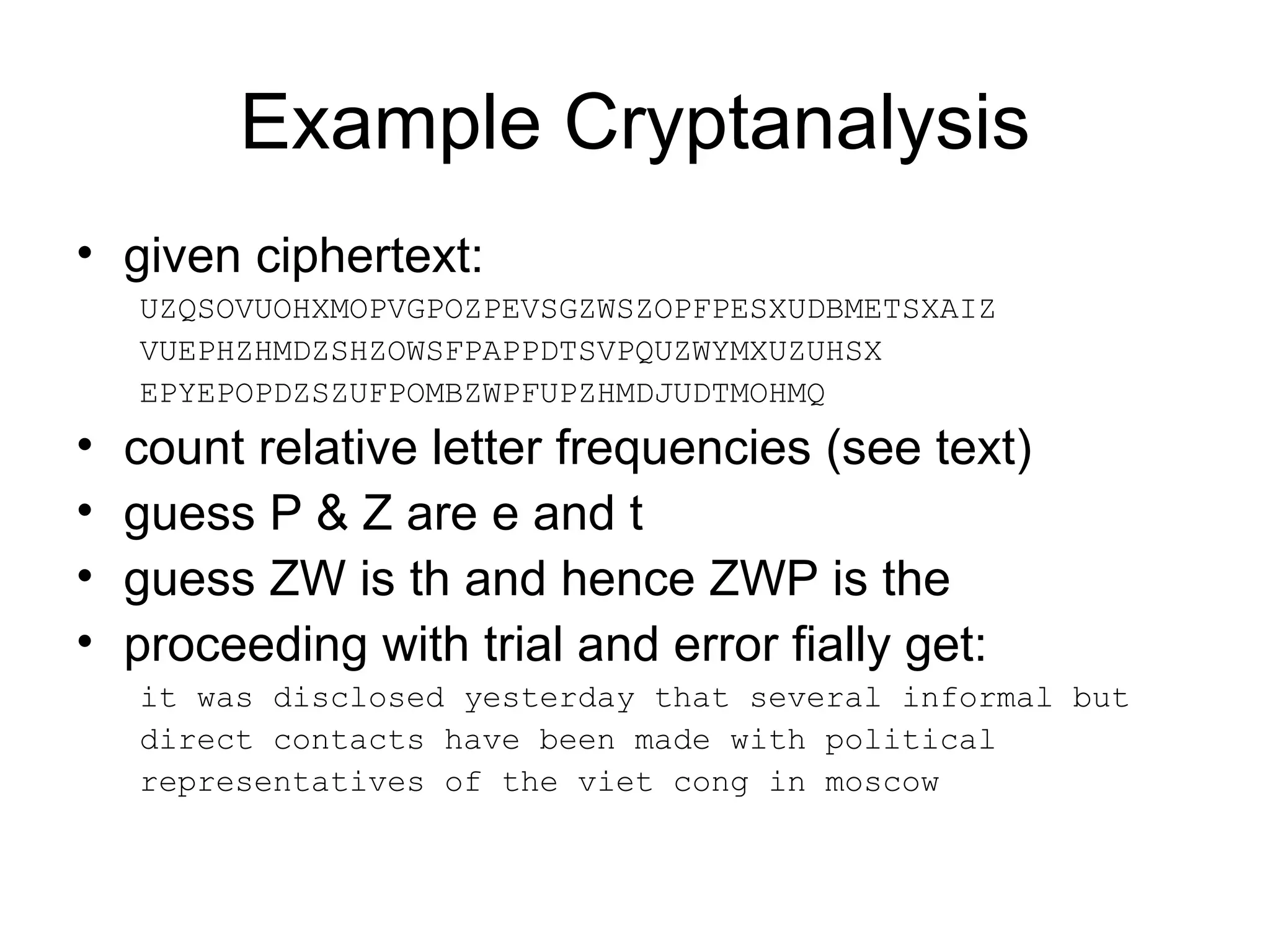
Example Cryptanalysis given ciphertext: UZQSOVUOHXMOPVGPOZPEVSGZWSZOPFPESXUDBMETSXAIZ VUEPHZHMDZSHZOWSFPAPPDTSVPQUZWYMXUZUHSX EPYEPOPDZSZUFPOMBZWPFUPZHMDJUDTMOHMQ count relative letter frequencies (see text) guess P & Z are e and t guess ZW is th and hence ZWP is the proceeding with trial and error fially get: it was disclosed yesterday that several informal but direct contacts have been made with political representatives of the viet cong in moscow
Playfair Cipher not even the large number of keys in a monoalphabetic cipher provides security  one approach to improving security was to encrypt multiple letters  the  Playfair Cipher  is an example  invented by Charles Wheatstone in 1854, but named after his friend Baron Playfair
Playfair Key Matrix a 5X5 matrix of letters based on a keyword  fill in letters of keyword (sans duplicates)  fill rest of matrix with other letters eg. using the keyword MONARCHY MONAR CHYBD EFGIK LPQST UVWXZ
Encrypting and Decrypting plaintext encrypted two letters at a time:  if a pair is a repeated letter, insert a filler like 'X',  eg. "balloon" encrypts as "ba lx lo on"  if both letters fall in the same row, replace each with letter to right (wrapping back to start from end),  eg. “ar" encrypts as "RM"  if both letters fall in the same column, replace each with the letter below it (again wrapping to top from bottom), eg. “mu" encrypts to "CM"  otherwise each letter is replaced by the one in its row in the column of the other letter of the pair, eg. “hs" encrypts to "BP", and “ea" to "IM" or "JM" (as desired)
Security of the Playfair Cipher security much improved over monoalphabetic since have 26 x 26 = 676 digrams  would need a 676 entry frequency table to analyse (verses 26 for a monoalphabetic)  and correspondingly more ciphertext  was widely used for many years (eg. US & British military in WW1)  it  can  be broken, given a few hundred letters  since still has much of plaintext structure
Polyalphabetic Ciphers another approach to improving security is to use multiple cipher alphabets  called  polyalphabetic substitution ciphers   makes cryptanalysis harder with more alphabets to guess and flatter frequency distribution  use a key to select which alphabet is used for each letter of the message  use each alphabet in turn  repeat from start after end of key is reached
Vigenère Cipher simplest polyalphabetic substitution cipher is the  Vigenère Cipher   effectively multiple caesar ciphers  key is multiple letters long K = k1 k2 ... kd  i th  letter specifies i th  alphabet to use  use each alphabet in turn  repeat from start after d letters in message decryption simply works in reverse
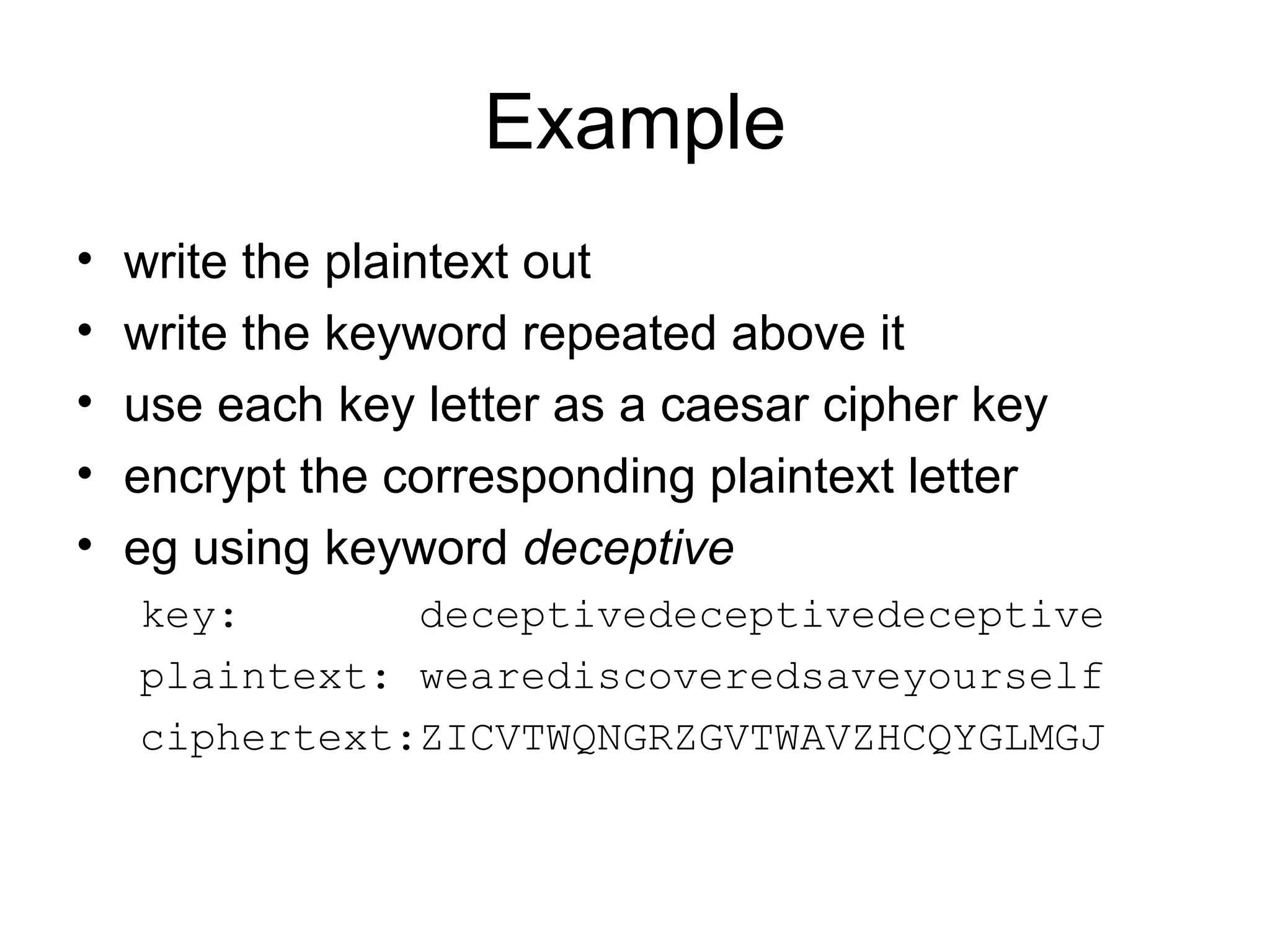
Example write the plaintext out  write the keyword repeated above it use each key letter as a caesar cipher key  encrypt the corresponding plaintext letter eg using keyword  deceptive key:  deceptivedeceptivedeceptive plaintext: wearediscoveredsaveyourself ciphertext:ZICVTWQNGRZGVTWAVZHCQYGLMGJ
Aids simple aids can assist with en/decryption  a  Saint-Cyr Slide  is a simple manual aid  a slide with repeated alphabet  line up plaintext 'A' with key letter, eg 'C'  then read off any mapping for key letter  can bend round into a  cipher disk   or expand into a  Vigenère Tableau  (see text Table 2.3)
Security of  Vigenère Ciphers have multiple ciphertext letters for each plaintext letter hence letter frequencies are obscured but not totally lost start with letter frequencies see if look monoalphabetic or not if not, then need to determine number of alphabets, since then can attach each
Kasiski Method method developed by Babbage / Kasiski  repetitions in ciphertext give clues to period  so find same plaintext an exact period apart  which results in the same ciphertext  of course, could also be random fluke eg repeated “VTW” in previous example suggests size of 3 or 9 then attack each monoalphabetic cipher individually using same techniques as before
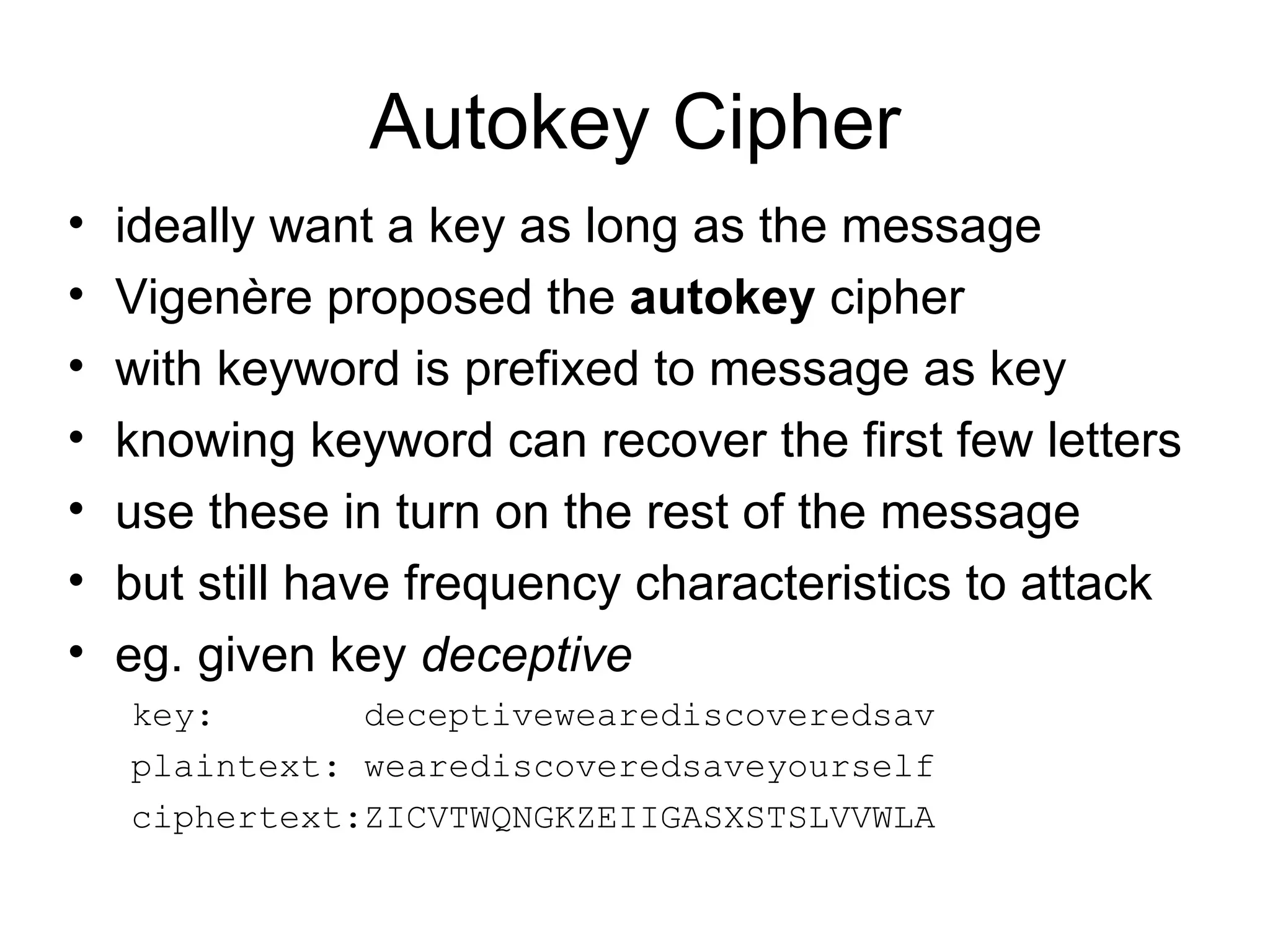
Autokey Cipher ideally want a key as long as the message Vigenère proposed the  autokey  cipher  with keyword is prefixed to message as key knowing keyword can recover the first few letters  use these in turn on the rest of the message but still have frequency characteristics to attack  eg. given key  deceptive key:  deceptivewearediscoveredsav plaintext: wearediscoveredsaveyourself ciphertext:ZICVTWQNGKZEIIGASXSTSLVVWLA
One-Time Pad if a truly random key as long as the message is used, the cipher will be secure  called a One-Time pad is unbreakable since ciphertext bears no statistical relationship to the plaintext since for  any plaintext  &  any ciphertext  there exists a key mapping one to other can only use the key  once  though have problem of safe distribution of key
Transposition Ciphers now consider classical  transposition  or  permutation  ciphers  these hide the message by rearranging the letter order  without altering the actual letters used can recognise these since have the same frequency distribution as the original text
Rail Fence cipher write message letters out diagonally over a number of rows  then read off cipher row by row eg. write message out as: m e m a t r h t g p r y e t e f e t e o a a t giving ciphertext MEMATRHTGPRYETEFETEOAAT
Row Transposition Ciphers a more complex scheme write letters of message out in rows over a specified number of columns then reorder the columns according to some key before reading off the rows Key:  3 4 2 1 5 6 7 Plaintext: a t t a c k p o s t p o n e d u n t i l t w o a m x y z Ciphertext: TTNAAPTMTSUOAODWCOIXKNLYPETZ
Product Ciphers ciphers using substitutions or transpositions are not secure because of language characteristics hence consider using several ciphers in succession to make harder, but:  two substitutions make a more complex substitution  two transpositions make more complex transposition  but a substitution followed by a transposition makes a new much harder cipher  this is bridge from classical to modern ciphers
Rotor Machines before modern ciphers, rotor machines were most common product cipher were widely used in WW2 German Enigma, Allied Hagelin, Japanese Purple implemented a very complex, varying substitution cipher used a series of cylinders, each giving one substitution, which rotated and changed after each letter was encrypted with 3 cylinders have 26 3 =17576 alphabets
Steganography an alternative to encryption hides existence of message using only a subset of letters/words in a longer message marked in some way using invisible ink hiding in LSB in graphic image or sound file has drawbacks high overhead to hide relatively few info bits
Summary have considered: classical cipher techniques and terminology monoalphabetic substitution ciphers cryptanalysis using letter frequencies Playfair ciphers polyalphabetic ciphers transposition ciphers product ciphers and rotor machines stenography

Ch02

  • 1.
    Cryptography and NetworkSecurity Third Edition by William Stallings Lecture slides by Lawrie Brown
  • 2.
    Chapter 2 – Classical Encryption Techniques Many savages at the present day regard their names as vital parts of themselves, and therefore take great pains to conceal their real names, lest these should give to evil-disposed persons a handle by which to injure their owners. — The Golden Bough, Sir James George Frazer
  • 3.
    Symmetric Encryption orconventional / private-key / single-key sender and recipient share a common key all classical encryption algorithms are private-key was only type prior to invention of public-key in 1970’s
  • 4.
    Basic Terminology plaintext - the original message ciphertext - the coded message cipher - algorithm for transforming plaintext to ciphertext key - info used in cipher known only to sender/receiver encipher (encrypt) - converting plaintext to ciphertext decipher (decrypt) - recovering ciphertext from plaintext cryptography - study of encryption principles/methods cryptanalysis (codebreaking) - the study of principles/ methods of deciphering ciphertext without knowing key cryptology - the field of both cryptography and cryptanalysis
  • 5.
  • 6.
    Requirements two requirementsfor secure use of symmetric encryption: a strong encryption algorithm a secret key known only to sender / receiver Y = E K ( X ) X = D K ( Y ) assume encryption algorithm is known implies a secure channel to distribute key
  • 7.
    Cryptography can characterizeby: type of encryption operations used substitution / transposition / product number of keys used single-key or private / two-key or public way in which plaintext is processed block / stream
  • 8.
    Types of CryptanalyticAttacks ciphertext only only know algorithm / ciphertext, statistical, can identify plaintext known plaintext know/suspect plaintext & ciphertext to attack cipher chosen plaintext select plaintext and obtain ciphertext to attack cipher chosen ciphertext select ciphertext and obtain plaintext to attack cipher chosen text select either plaintext or ciphertext to en/decrypt to attack cipher
  • 9.
    Brute Force Searchalways possible to simply try every key most basic attack, proportional to key size assume either know / recognise plaintext
  • 10.
    More Definitions unconditionalsecurity no matter how much computer power is available, the cipher cannot be broken since the ciphertext provides insufficient information to uniquely determine the corresponding plaintext computational security given limited computing resources (eg time needed for calculations is greater than age of universe), the cipher cannot be broken
  • 11.
    Classical Substitution Cipherswhere letters of plaintext are replaced by other letters or by numbers or symbols or if plaintext is viewed as a sequence of bits, then substitution involves replacing plaintext bit patterns with ciphertext bit patterns
  • 12.
    Caesar Cipher earliestknown substitution cipher by Julius Caesar first attested use in military affairs replaces each letter by 3rd letter on example: meet me after the toga party PHHW PH DIWHU WKH WRJD SDUWB
  • 13.
    Caesar Cipher candefine transformation as: a b c d e f g h i j k l m n o p q r s t u v w x y z D E F G H I J K L M N O P Q R S T U V W X Y Z A B C mathematically give each letter a number a b c d e f g h i j k l m 0 1 2 3 4 5 6 7 8 9 10 11 12 n o p q r s t u v w x y Z 13 14 15 16 17 18 19 20 21 22 23 24 25 then have Caesar cipher as: C = E( p ) = ( p + k ) mod (26) p = D(C) = (C – k ) mod (26)
  • 14.
    Cryptanalysis of CaesarCipher only have 26 possible ciphers A maps to A,B,..Z could simply try each in turn a brute force search given ciphertext, just try all shifts of letters do need to recognize when have plaintext eg. break ciphertext "GCUA VQ DTGCM"
  • 15.
    Monoalphabetic Cipher ratherthan just shifting the alphabet could shuffle (jumble) the letters arbitrarily each plaintext letter maps to a different random ciphertext letter hence key is 26 letters long Plain: abcdefghijklmnopqrstuvwxyz Cipher: DKVQFIBJWPESCXHTMYAUOLRGZN Plaintext: ifwewishtoreplaceletters Ciphertext: WIRFRWAJUHYFTSDVFSFUUFYA
  • 16.
    Monoalphabetic Cipher Securitynow have a total of 26! = 4 x 1026 keys with so many keys, might think is secure but would be !!!WRONG!!! problem is language characteristics
  • 17.
    Language Redundancy andCryptanalysis human languages are redundant eg "th lrd s m shphrd shll nt wnt" letters are not equally commonly used in English e is by far the most common letter then T,R,N,I,O,A,S other letters are fairly rare cf. Z,J,K,Q,X have tables of single, double & triple letter frequencies
  • 18.
  • 19.
    Use in Cryptanalysiskey concept - monoalphabetic substitution ciphers do not change relative letter frequencies discovered by Arabian scientists in 9 th century calculate letter frequencies for ciphertext compare counts/plots against known values if Caesar cipher look for common peaks/troughs peaks at: A-E-I triple, NO pair, RST triple troughs at: JK, X-Z for monoalphabetic must identify each letter tables of common double/triple letters help
  • 20.
    Example Cryptanalysis givenciphertext: UZQSOVUOHXMOPVGPOZPEVSGZWSZOPFPESXUDBMETSXAIZ VUEPHZHMDZSHZOWSFPAPPDTSVPQUZWYMXUZUHSX EPYEPOPDZSZUFPOMBZWPFUPZHMDJUDTMOHMQ count relative letter frequencies (see text) guess P & Z are e and t guess ZW is th and hence ZWP is the proceeding with trial and error fially get: it was disclosed yesterday that several informal but direct contacts have been made with political representatives of the viet cong in moscow
  • 21.
    Playfair Cipher noteven the large number of keys in a monoalphabetic cipher provides security one approach to improving security was to encrypt multiple letters the Playfair Cipher is an example invented by Charles Wheatstone in 1854, but named after his friend Baron Playfair
  • 22.
    Playfair Key Matrixa 5X5 matrix of letters based on a keyword fill in letters of keyword (sans duplicates) fill rest of matrix with other letters eg. using the keyword MONARCHY MONAR CHYBD EFGIK LPQST UVWXZ
  • 23.
    Encrypting and Decryptingplaintext encrypted two letters at a time: if a pair is a repeated letter, insert a filler like 'X', eg. "balloon" encrypts as "ba lx lo on" if both letters fall in the same row, replace each with letter to right (wrapping back to start from end), eg. “ar" encrypts as "RM" if both letters fall in the same column, replace each with the letter below it (again wrapping to top from bottom), eg. “mu" encrypts to "CM" otherwise each letter is replaced by the one in its row in the column of the other letter of the pair, eg. “hs" encrypts to "BP", and “ea" to "IM" or "JM" (as desired)
  • 24.
    Security of thePlayfair Cipher security much improved over monoalphabetic since have 26 x 26 = 676 digrams would need a 676 entry frequency table to analyse (verses 26 for a monoalphabetic) and correspondingly more ciphertext was widely used for many years (eg. US & British military in WW1) it can be broken, given a few hundred letters since still has much of plaintext structure
  • 25.
    Polyalphabetic Ciphers anotherapproach to improving security is to use multiple cipher alphabets called polyalphabetic substitution ciphers makes cryptanalysis harder with more alphabets to guess and flatter frequency distribution use a key to select which alphabet is used for each letter of the message use each alphabet in turn repeat from start after end of key is reached
  • 26.
    Vigenère Cipher simplestpolyalphabetic substitution cipher is the Vigenère Cipher effectively multiple caesar ciphers key is multiple letters long K = k1 k2 ... kd i th letter specifies i th alphabet to use use each alphabet in turn repeat from start after d letters in message decryption simply works in reverse
  • 27.
    Example write theplaintext out write the keyword repeated above it use each key letter as a caesar cipher key encrypt the corresponding plaintext letter eg using keyword deceptive key: deceptivedeceptivedeceptive plaintext: wearediscoveredsaveyourself ciphertext:ZICVTWQNGRZGVTWAVZHCQYGLMGJ
  • 28.
    Aids simple aidscan assist with en/decryption a Saint-Cyr Slide is a simple manual aid a slide with repeated alphabet line up plaintext 'A' with key letter, eg 'C' then read off any mapping for key letter can bend round into a cipher disk or expand into a Vigenère Tableau (see text Table 2.3)
  • 29.
    Security of Vigenère Ciphers have multiple ciphertext letters for each plaintext letter hence letter frequencies are obscured but not totally lost start with letter frequencies see if look monoalphabetic or not if not, then need to determine number of alphabets, since then can attach each
  • 30.
    Kasiski Method methoddeveloped by Babbage / Kasiski repetitions in ciphertext give clues to period so find same plaintext an exact period apart which results in the same ciphertext of course, could also be random fluke eg repeated “VTW” in previous example suggests size of 3 or 9 then attack each monoalphabetic cipher individually using same techniques as before
  • 31.
    Autokey Cipher ideallywant a key as long as the message Vigenère proposed the autokey cipher with keyword is prefixed to message as key knowing keyword can recover the first few letters use these in turn on the rest of the message but still have frequency characteristics to attack eg. given key deceptive key: deceptivewearediscoveredsav plaintext: wearediscoveredsaveyourself ciphertext:ZICVTWQNGKZEIIGASXSTSLVVWLA
  • 32.
    One-Time Pad ifa truly random key as long as the message is used, the cipher will be secure called a One-Time pad is unbreakable since ciphertext bears no statistical relationship to the plaintext since for any plaintext & any ciphertext there exists a key mapping one to other can only use the key once though have problem of safe distribution of key
  • 33.
    Transposition Ciphers nowconsider classical transposition or permutation ciphers these hide the message by rearranging the letter order without altering the actual letters used can recognise these since have the same frequency distribution as the original text
  • 34.
    Rail Fence cipherwrite message letters out diagonally over a number of rows then read off cipher row by row eg. write message out as: m e m a t r h t g p r y e t e f e t e o a a t giving ciphertext MEMATRHTGPRYETEFETEOAAT
  • 35.
    Row Transposition Ciphersa more complex scheme write letters of message out in rows over a specified number of columns then reorder the columns according to some key before reading off the rows Key: 3 4 2 1 5 6 7 Plaintext: a t t a c k p o s t p o n e d u n t i l t w o a m x y z Ciphertext: TTNAAPTMTSUOAODWCOIXKNLYPETZ
  • 36.
    Product Ciphers ciphersusing substitutions or transpositions are not secure because of language characteristics hence consider using several ciphers in succession to make harder, but: two substitutions make a more complex substitution two transpositions make more complex transposition but a substitution followed by a transposition makes a new much harder cipher this is bridge from classical to modern ciphers
  • 37.
    Rotor Machines beforemodern ciphers, rotor machines were most common product cipher were widely used in WW2 German Enigma, Allied Hagelin, Japanese Purple implemented a very complex, varying substitution cipher used a series of cylinders, each giving one substitution, which rotated and changed after each letter was encrypted with 3 cylinders have 26 3 =17576 alphabets
  • 38.
    Steganography an alternativeto encryption hides existence of message using only a subset of letters/words in a longer message marked in some way using invisible ink hiding in LSB in graphic image or sound file has drawbacks high overhead to hide relatively few info bits
  • 39.
    Summary have considered:classical cipher techniques and terminology monoalphabetic substitution ciphers cryptanalysis using letter frequencies Playfair ciphers polyalphabetic ciphers transposition ciphers product ciphers and rotor machines stenography