Cryptography and
Network Security
Fifth Edition
by William Stallings
Chapter 5 –Advanced Encryption Standard

"It seems very simple."
"It is very simple. But if you don't know what the key is it's virtually
indecipherable."
—Talking to Strange Men, Ruth Rendell
Origins
• clear a replacement for DES was needed
• have theoretical attacks that can break it
• have demonstrated exhaustive key search attacks

• can use Triple-DES – but slow, has small blocks
• US NIST issued call for ciphers in 1997
• 15 candidates accepted in Jun 98
• 5 were shortlisted in Aug-99
• Rijndael was selected as the AES in Oct-2000
• issued as FIPS PUB 197 standard in Nov-2001
Metrics for Protocol Selection
Highest ratio of actual number of rounds to the number of
breakable rounds
Performance
Simplicity
• Brute force attack is 2^127
• Best known attack is 2^126
• Saving of one bit
The AES Cipher - Rijndael
• designed by Rijmen-Daemen in Belgium
• has 128/192/256 bit keys, 128 bit data
• an iterative rather than feistel cipher
• processes data as block of 4 columns of 4 bytes
• operates on entire data block in every round

• designed to be:
• resistant against known attacks
• speed and code compactness on many CPUs
• design simplicity
AES
Encryption
Process
AES Structure
data block of 4 columns of 4 bytes is state
key is expanded to array of words
has 9/11/13 rounds in which state undergoes:
byte substitution (1 S-box used on every byte)
shift rows (permute bytes between groups/columns)
mix columns (subs using matrix multiply of groups)
add round key (XOR state with key material)
view as alternating XOR key & scramble data bytes

initial XOR key material & incomplete last round
with fast XOR & table lookup implementation
In other words, …
• Substitution:
• Involves XORs with a round key
• There is a process for generating round keys, based on some key schedule

• Also use S-boxes
• Mixes us data in a way that is nonlinear to make it difficult to cryptanalyse

• Plus, Shifts (permutation)
• # rounds depends on key size
• For 128 bits use 10 rounds, for smallest size
AES Structure
Some Comments on AES
1. an iterative rather than feistel cipher
2. key expanded into array of 32-bit words
1. four words form round key in each round

3. 4 different stages are used as shown
4. has a simple structure
5. only AddRoundKey uses key
6. AddRoundKey a form of Vernam cipher
7. each stage is easily reversible
8. decryption uses keys in reverse order
9. decryption does recover plaintext
10. final round has only 3 stages
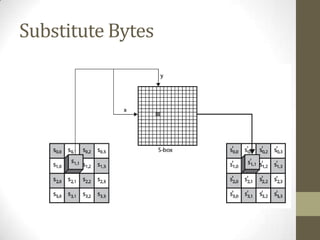
Substitute Bytes
• a simple substitution of each byte
• uses one table of 16x16 bytes containing a
permutation of all 256 8-bit values
• each byte of state is replaced by byte indexed by
row (left 4-bits) & column (right 4-bits)
• eg. byte {95} is replaced by byte in row 9 column 5
• which has value {2A}

• S-box constructed using defined transformation
of values in GF(28)
• designed to be resistant to all known attacks
Substitute Bytes
Substitute Bytes Example
Shift Rows
• a circular byte shift in each each
•
•
•
•

1st row is unchanged
2nd row does 1 byte circular shift to left
3rd row does 2 byte circular shift to left
4th row does 3 byte circular shift to left

• decrypt inverts using shifts to right
• since state is processed by columns, this step
permutes bytes between the columns
Shift Rows
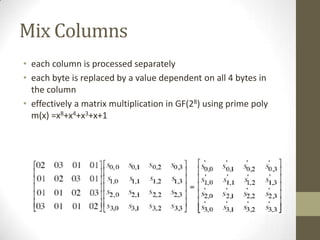
Mix Columns
• each column is processed separately
• each byte is replaced by a value dependent on all 4 bytes in
the column
• effectively a matrix multiplication in GF(28) using prime poly
m(x) =x8+x4+x3+x+1
Mix Columns
Mix Columns Example
AES Arithmetic
• uses arithmetic in the finite field GF(28)
• with irreducible polynomial
m(x) = x8 + x4 + x3 + x + 1
which is (100011011) or {11b}

• e.g.
{02} • {87} mod {11b} = (1 0000 1110) mod {11b}
= (1 0000 1110) xor (1 0001 1011) = (0001 0101)
Mix Columns
• can express each col as 4 equations
• to derive each new byte in col

• decryption requires use of inverse matrix
• with larger coefficients, hence a little harder

• have an alternate characterisation
• each column a 4-term polynomial
• with coefficients in GF(28)
• and polynomials multiplied modulo (x4+1)
• coefficients based on linear code with maximal distance between
codewords
Add Round Key
XOR state with 128-bits of the round key
again processed by column (though effectively a series of byte
operations)
inverse for decryption identical
 since XOR own inverse, with reversed keys

designed to be as simple as possible
 a form of Vernam cipher on expanded key
 requires other stages for complexity / security
Add Round Key
AES Round
AES Key Expansion
takes 128-bit (16-byte) key and expands into array of 44/52/60
32-bit words
start by copying key into first 4 words
then loop creating words that depend on values in previous &
4 places back
 in 3 of 4 cases just XOR these together
 1st word in 4 has rotate + S-box + XOR round constant on
previous, before XOR 4th back
AES Key Expansion
Key Expansion Rationale
• designed to resist known attacks
• design criteria included
•
•
•
•
•
•
•

knowing part key insufficient to find many more
invertible transformation
fast on wide range of CPU’s
use round constants to break symmetry
diffuse key bits into round keys
enough non-linearity to hinder analysis
simplicity of description
AES Example
Key
Expansion
AES Example
Encryption
AES Example
Avalanche
AES Decryption
• AES decryption is not identical to encryption since steps done
in reverse
• but can define an equivalent inverse cipher with steps as for
encryption
• but using inverses of each step
• with a different key schedule

• works since result is unchanged when
• swap byte substitution & shift rows
• swap mix columns & add (tweaked) round key
AES Decryption
Implementation Aspects
• can efficiently implement on 8-bit CPU
•
•
•
•

byte substitution works on bytes using a table of 256 entries
shift rows is simple byte shift
add round key works on byte XOR’s
mix columns requires matrix multiply in GF(28) which works on
byte values, can be simplified to use table lookups & byte XOR’s
Implementation Aspects
can efficiently implement on 32-bit CPU
 redefine steps to use 32-bit words
 can precompute 4 tables of 256-words
 then each column in each round can be computed using 4 table
lookups + 4 XORs
 at a cost of 4Kb to store tables

designers believe this very efficient implementation was a key
factor in its selection as the AES cipher
Summary
• have considered:
•
•
•
•
•

the AES selection process
the details of Rijndael – the AES cipher
looked at the steps in each round
the key expansion
implementation aspects

Cryptography

  • 1.
    Cryptography and Network Security FifthEdition by William Stallings
  • 2.
    Chapter 5 –AdvancedEncryption Standard "It seems very simple." "It is very simple. But if you don't know what the key is it's virtually indecipherable." —Talking to Strange Men, Ruth Rendell
  • 3.
    Origins • clear areplacement for DES was needed • have theoretical attacks that can break it • have demonstrated exhaustive key search attacks • can use Triple-DES – but slow, has small blocks • US NIST issued call for ciphers in 1997 • 15 candidates accepted in Jun 98 • 5 were shortlisted in Aug-99 • Rijndael was selected as the AES in Oct-2000 • issued as FIPS PUB 197 standard in Nov-2001
  • 4.
    Metrics for ProtocolSelection Highest ratio of actual number of rounds to the number of breakable rounds Performance Simplicity • Brute force attack is 2^127 • Best known attack is 2^126 • Saving of one bit
  • 5.
    The AES Cipher- Rijndael • designed by Rijmen-Daemen in Belgium • has 128/192/256 bit keys, 128 bit data • an iterative rather than feistel cipher • processes data as block of 4 columns of 4 bytes • operates on entire data block in every round • designed to be: • resistant against known attacks • speed and code compactness on many CPUs • design simplicity
  • 6.
  • 7.
    AES Structure data blockof 4 columns of 4 bytes is state key is expanded to array of words has 9/11/13 rounds in which state undergoes: byte substitution (1 S-box used on every byte) shift rows (permute bytes between groups/columns) mix columns (subs using matrix multiply of groups) add round key (XOR state with key material) view as alternating XOR key & scramble data bytes initial XOR key material & incomplete last round with fast XOR & table lookup implementation
  • 8.
    In other words,… • Substitution: • Involves XORs with a round key • There is a process for generating round keys, based on some key schedule • Also use S-boxes • Mixes us data in a way that is nonlinear to make it difficult to cryptanalyse • Plus, Shifts (permutation) • # rounds depends on key size • For 128 bits use 10 rounds, for smallest size
  • 9.
  • 10.
    Some Comments onAES 1. an iterative rather than feistel cipher 2. key expanded into array of 32-bit words 1. four words form round key in each round 3. 4 different stages are used as shown 4. has a simple structure 5. only AddRoundKey uses key 6. AddRoundKey a form of Vernam cipher 7. each stage is easily reversible 8. decryption uses keys in reverse order 9. decryption does recover plaintext 10. final round has only 3 stages
  • 11.
    Substitute Bytes • asimple substitution of each byte • uses one table of 16x16 bytes containing a permutation of all 256 8-bit values • each byte of state is replaced by byte indexed by row (left 4-bits) & column (right 4-bits) • eg. byte {95} is replaced by byte in row 9 column 5 • which has value {2A} • S-box constructed using defined transformation of values in GF(28) • designed to be resistant to all known attacks
  • 12.
  • 13.
  • 14.
    Shift Rows • acircular byte shift in each each • • • • 1st row is unchanged 2nd row does 1 byte circular shift to left 3rd row does 2 byte circular shift to left 4th row does 3 byte circular shift to left • decrypt inverts using shifts to right • since state is processed by columns, this step permutes bytes between the columns
  • 15.
  • 16.
    Mix Columns • eachcolumn is processed separately • each byte is replaced by a value dependent on all 4 bytes in the column • effectively a matrix multiplication in GF(28) using prime poly m(x) =x8+x4+x3+x+1
  • 17.
  • 18.
  • 19.
    AES Arithmetic • usesarithmetic in the finite field GF(28) • with irreducible polynomial m(x) = x8 + x4 + x3 + x + 1 which is (100011011) or {11b} • e.g. {02} • {87} mod {11b} = (1 0000 1110) mod {11b} = (1 0000 1110) xor (1 0001 1011) = (0001 0101)
  • 20.
    Mix Columns • canexpress each col as 4 equations • to derive each new byte in col • decryption requires use of inverse matrix • with larger coefficients, hence a little harder • have an alternate characterisation • each column a 4-term polynomial • with coefficients in GF(28) • and polynomials multiplied modulo (x4+1) • coefficients based on linear code with maximal distance between codewords
  • 21.
    Add Round Key XORstate with 128-bits of the round key again processed by column (though effectively a series of byte operations) inverse for decryption identical  since XOR own inverse, with reversed keys designed to be as simple as possible  a form of Vernam cipher on expanded key  requires other stages for complexity / security
  • 22.
  • 23.
  • 24.
    AES Key Expansion takes128-bit (16-byte) key and expands into array of 44/52/60 32-bit words start by copying key into first 4 words then loop creating words that depend on values in previous & 4 places back  in 3 of 4 cases just XOR these together  1st word in 4 has rotate + S-box + XOR round constant on previous, before XOR 4th back
  • 25.
  • 26.
    Key Expansion Rationale •designed to resist known attacks • design criteria included • • • • • • • knowing part key insufficient to find many more invertible transformation fast on wide range of CPU’s use round constants to break symmetry diffuse key bits into round keys enough non-linearity to hinder analysis simplicity of description
  • 27.
  • 28.
  • 29.
  • 30.
    AES Decryption • AESdecryption is not identical to encryption since steps done in reverse • but can define an equivalent inverse cipher with steps as for encryption • but using inverses of each step • with a different key schedule • works since result is unchanged when • swap byte substitution & shift rows • swap mix columns & add (tweaked) round key
  • 31.
  • 32.
    Implementation Aspects • canefficiently implement on 8-bit CPU • • • • byte substitution works on bytes using a table of 256 entries shift rows is simple byte shift add round key works on byte XOR’s mix columns requires matrix multiply in GF(28) which works on byte values, can be simplified to use table lookups & byte XOR’s
  • 33.
    Implementation Aspects can efficientlyimplement on 32-bit CPU  redefine steps to use 32-bit words  can precompute 4 tables of 256-words  then each column in each round can be computed using 4 table lookups + 4 XORs  at a cost of 4Kb to store tables designers believe this very efficient implementation was a key factor in its selection as the AES cipher
  • 34.
    Summary • have considered: • • • • • theAES selection process the details of Rijndael – the AES cipher looked at the steps in each round the key expansion implementation aspects

Editor's Notes

  • #11 Before delving into details, can make several comments about the overall AES structure. See text for details.
  • #14 Show an example of the SubBytes transformation from the text.
  • #19 Show an example of the MixColumns transformation from the text, along with verification of the first column of this example.
  • #20 AES uses arithmetic in the finite field GF(28), with the irreducible polynomial m(x) = x8 + x4 + x3 + x + 1. AES operates on 8-bit bytes. Addition of two bytes is defined as the bitwise XOR operation. Multiplication of two bytes is defined as multiplication in the finite field GF(28). In particular, multiplication of a value by x (i.e., by {02}) can be implemented as a 1-bit left shift followed by a conditional bitwise XOR with (0001 1011) if the leftmost bit of the original value (prior to the shift) is 1.
  • #28 We now work through an example, and consider some of its implications. The plaintext, key, and resulting ciphertext are as follows: Plaintext: 0123456789abcdeffedcba9876543210 Key: 0f1571c947d9e8590cb7add6af7f6798 Ciphertext: ff0b844a0853bf7c6934ab4364148fb9 Table 5.3 shows the expansion of the 16-byte key into 10 round keys. As previously explained, this process is performed word by word, with each four-byte word occupying one column of the word round key matrix. The left hand column shows the four round key words generated for each round. The right hand column shows the steps used to generate the auxiliary word used in key expansion. We begin, of course, with the key itself serving as the round key for round 0.
  • #29 Next, Table 5.4 shows the progression of the state matrix through the AES encryption process. The first column shows the value of the state matrix at the start of a round. For the first row, the state matrix is just the matrix arrangement of the plaintext. The second, third, and fourth columns show the value of the state matrix for that round after the SubBytes, ShiftRows, and MixColumns transformations, respectively. The fifth column shows the round key. You can verify that these round keys equate with those shown in Table 5.3. The first column shows the value of the state matrix resulting from the bitwise XOR of the state after the preceding MixColumns with the round key for the preceding round.
  • #30 In any good cipher design, want the avalanche effect, in which a small change in plaintext or key produces a large change in the ciphertext. Using the example from Table 5.4, Table 5.5 shows the result when the eighth bit of the plaintext is changed. The second column of the table shows the value of the state matrix at the end of each round for the two plaintexts. Note that after just one round, 20 bits of the state vector differ. And after two rounds, close to half the bits differ. This magnitude of difference propagates through the remaining rounds. A bit difference in approximately half the positions in the most desirable outcome.