TETRA – Terrestrial Trunk Radio Service Trunked radio systems many different radio carriers assign single carrier for a short period to one user/group of users taxi service, fleet management, rescue teams interfaces to public networks, voice and data services very reliable, fast call setup, local operation TETRA - ETSI standard formerly: Trans European Trunked Radio point-to-point and point-to-multipoint encryption (end-to-end, air interface), authentication of devices, users and networks  group call, broadcast, sub-second group-call setup ad-hoc (“direct mode”), relay and infrastructure networks call queuing with pre-emptive priorities
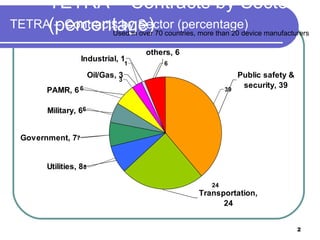
TETRA – Contracts by Sector (percentage) TETRA – Contracts by Sector (percentage) Used in over 70 countries, more than 20 device manufacturers
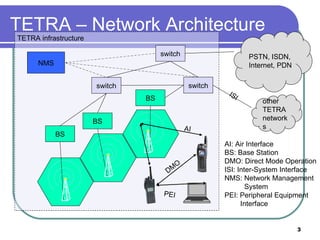
TETRA – Network Architecture TETRA infrastructure BS BS switch switch switch NMS BS other TETRA networks PSTN, ISDN, Internet, PDN DMO ISI PEI AI AI: Air Interface BS: Base Station DMO: Direct Mode Operation ISI: Inter-System Interface NMS: Network Management System PEI: Peripheral Equipment Interface
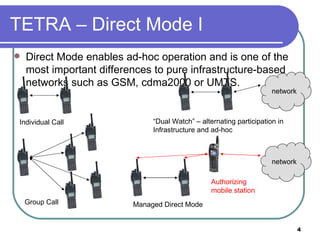
TETRA – Direct Mode I Direct Mode enables ad-hoc operation and is one of the most important differences to pure infrastructure-based networks such as GSM, cdma2000 or UMTS. Individual Call Group Call “ Dual Watch” – alternating participation in Infrastructure and ad-hoc network Managed Direct Mode network Authorizing mobile station
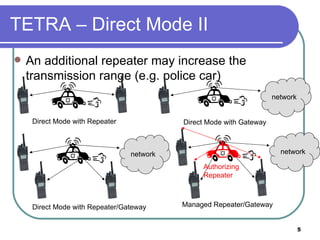
TETRA – Direct Mode II An additional repeater may increase the transmission range (e.g. police car) Direct Mode with Gateway network Direct Mode with Repeater Direct Mode with Repeater/Gateway network Managed Repeater/Gateway network Authorizing Repeater
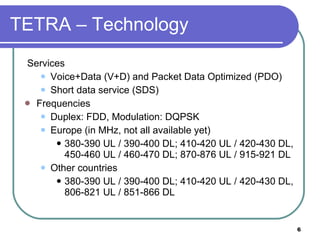
TETRA – Technology Services Voice+Data (V+D) and Packet Data Optimized (PDO) Short data service (SDS) Frequencies Duplex: FDD, Modulation: DQPSK Europe (in MHz, not all available yet) 380-390 UL / 390-400 DL; 410-420 UL / 420-430 DL, 450-460 UL / 460-470 DL; 870-876 UL / 915-921 DL Other countries 380-390 UL / 390-400 DL; 410-420 UL / 420-430 DL, 806-821 UL / 851-866 DL
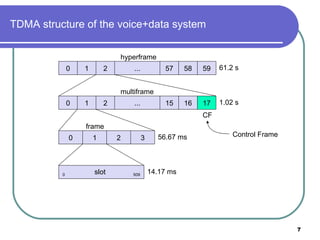
TDMA structure of the voice+data system 0 1 2 57 58 59 ... hyperframe 0 1 2 15 16 17 ... multiframe 0 1 2 3 0   slot  509 frame 14.17 ms 56.67 ms 1.02 s 61.2 s CF Control Frame
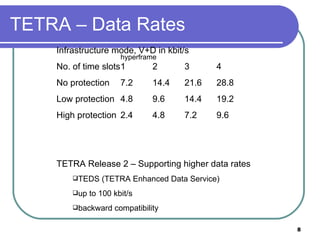
TETRA – Data Rates hyperframe Infrastructure mode, V+D in kbit/s No. of time slots 1 2 3 4 No protection 7.2 14.4 21.6 28.8 Low protection 4.8 9.6 14.4 19.2 High protection 2.4 4.8 7.2 9.6 TETRA Release 2 – Supporting higher data rates TEDS (TETRA Enhanced Data Service) up to 100 kbit/s backward compatibility
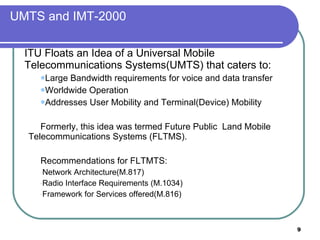
UMTS and IMT-2000 ITU Floats an Idea of a Universal Mobile Telecommunications Systems(UMTS) that caters to:  Large Bandwidth requirements for voice and data transfer Worldwide Operation Addresses User Mobility and Terminal(Device) Mobility Formerly, this idea was termed Future Public  Land Mobile Telecommunications Systems (FLTMS). Recommendations for FLTMTS: Network Architecture(M.817) Radio Interface Requirements (M.1034) Framework for Services offered(M.816)
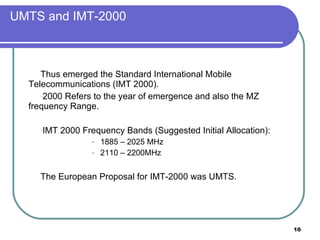
UMTS and IMT-2000 Thus emerged the Standard International Mobile Telecommunications (IMT 2000). 2000 Refers to the year of emergence and also the MZ frequency Range. IMT 2000 Frequency Bands (Suggested Initial Allocation):  1885 – 2025 MHz 2110 – 2200MHz The European Proposal for IMT-2000 was UMTS.
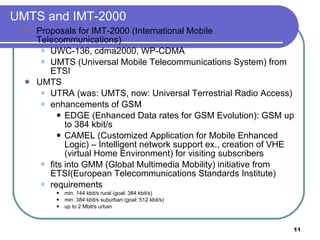
UMTS and IMT-2000 Proposals for IMT-2000 (International Mobile Telecommunications) UWC-136, cdma2000, WP-CDMA UMTS (Universal Mobile Telecommunications System) from ETSI UMTS UTRA (was: UMTS, now: Universal Terrestrial Radio Access) enhancements of GSM EDGE (Enhanced Data rates for GSM Evolution): GSM up to 384 kbit/s CAMEL (Customized Application for Mobile Enhanced Logic) – Intelligent network support ex., creation of VHE (virtual Home Environment) for visiting subscribers fits into GMM (Global Multimedia Mobility) initiative from ETSI(European Telecommunications Standards Institute) requirements min. 144 kbit/s rural (goal: 384 kbit/s) min. 384 kbit/s suburban (goal: 512 kbit/s) up to 2 Mbit/s urban
 
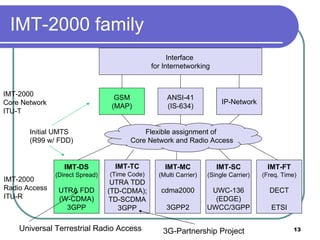
IMT-2000 family IMT-DS (Direct Spread) UTRA FDD (W-CDMA) 3GPP IMT-TC (Time Code) UTRA TDD (TD-CDMA); TD-SCDMA 3GPP IMT-MC (Multi Carrier) cdma2000 3GPP2 IMT-SC (Single Carrier) UWC-136 (EDGE) UWCC/3GPP IMT-FT (Freq. Time) DECT ETSI GSM (MAP) ANSI-41 (IS-634) IP-Network IMT-2000 Core Network ITU-T IMT-2000 Radio Access ITU-R Interface  for Internetworking Initial UMTS (R99 w/ FDD) Universal Terrestrial Radio Access 3G-Partnership Project Flexible assignment of  Core Network and Radio Access
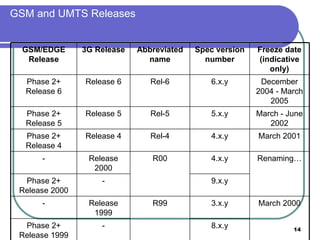
GSM and UMTS Releases 1992 3.x.y Ph1 - Phase 1 1995 4.x.y Ph2 - Phase 2 early 1997 5.x.y R96 - Phase 2+ Release 1996 early 1998 6.x.y R97 - Phase 2+ Release 1997 early 1999 7.x.y R98 - Phase 2+ Release 1998 8.x.y - Phase 2+ Release 1999 March 2000 3.x.y R99 Release 1999 - 9.x.y - Phase 2+ Release 2000 Renaming… 4.x.y R00 Release 2000 - March 2001 4.x.y Rel-4 Release 4 Phase 2+ Release 4 March - June 2002 5.x.y Rel-5 Release 5 Phase 2+ Release 5 December 2004 - March 2005 6.x.y Rel-6 Release 6 Phase 2+ Release 6 Freeze date (indicative only) Spec version number Abbreviated name 3G Release GSM/EDGE Release
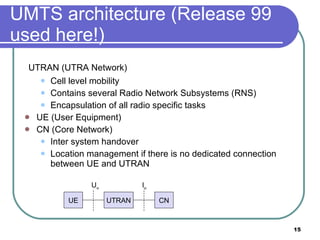
UMTS architecture (Release 99 used here!) UTRAN (UTRA Network) Cell level mobility Contains several Radio Network Subsystems (RNS) Encapsulation of all radio specific tasks UE (User Equipment) CN (Core Network) Inter system handover Location management if there is no dedicated connection between UE and UTRAN UTRAN UE CN I u U u
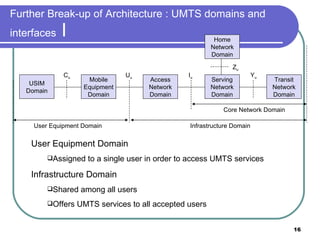
Further Break-up of Architecture : UMTS domains and interfaces  I USIM Domain Mobile Equipment Domain Access Network Domain Serving Network Domain Transit Network Domain Home Network Domain C u U u I u User Equipment Domain Z u Y u Core Network Domain Infrastructure Domain User Equipment Domain Assigned to a single user in order to access UMTS services Infrastructure Domain Shared among all users Offers UMTS services to all accepted users
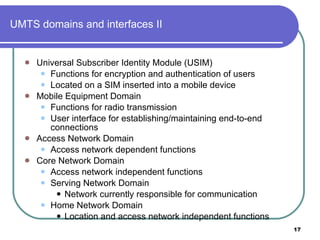
UMTS domains and interfaces II Universal Subscriber Identity Module (USIM) Functions for encryption and authentication of users Located on a SIM inserted into a mobile device Mobile Equipment Domain Functions for radio transmission  User interface for establishing/maintaining end-to-end connections Access Network Domain Access network dependent functions Core Network Domain Access network independent functions Serving Network Domain Network currently responsible for communication Home Network Domain Location and access network independent functions
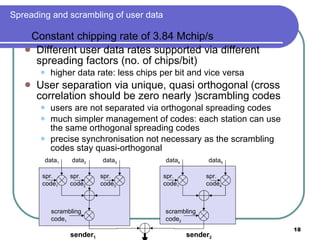
Spreading and scrambling of user data Constant chipping rate of 3.84 Mchip/s Different user data rates supported via different spreading factors (no. of chips/bit) higher data rate: less chips per bit and vice versa User separation via unique, quasi orthogonal (cross correlation should be zero nearly )scrambling codes users are not separated via orthogonal spreading codes much simpler management of codes: each station can use the same orthogonal spreading codes precise synchronisation not necessary as the scrambling codes stay quasi-orthogonal data 1 data 2 data 3 scrambling code 1 spr. code 3 spr. code 2 spr. code 1 data 4 data 5 scrambling code 2 spr. code 4 spr. code 1 sender 1 sender 2
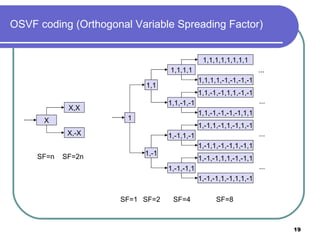
OSVF coding (Orthogonal Variable Spreading Factor) 1 1,1 1,-1 1,1,1,1 1,1,-1,-1 X X,X X,-X 1,-1,1,-1 1,-1,-1,1 1,-1,-1,1,1,-1,-1,1 1,-1,-1,1,-1,1,1,-1 1,-1,1,-1,1,-1,1,-1 1,-1,1,-1,-1,1,-1,1 1,1,-1,-1,1,1,-1,-1 1,1,-1,-1,-1,-1,1,1 1,1,1,1,1,1,1,1 1,1,1,1,-1,-1,-1,-1 SF=1 SF=2 SF=4 SF=8 SF=n SF=2n ... ... ... ...
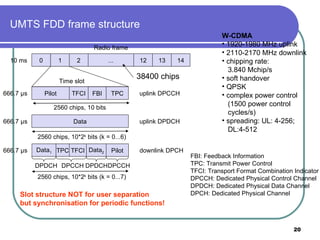
UMTS FDD frame structure W-CDMA 1920-1980 MHz uplink 2110-2170 MHz downlink chipping rate:    3.840 Mchip/s soft handover QPSK complex power control    (1500 power control    cycles/s) spreading: UL: 4-256;    DL:4-512 0 1 2 1 2 1 3 1 4 ... Radio frame Pilot FBI TPC Time slot 6 66.7  µs 10 ms Data Data 1 uplink DPDCH uplink DPCCH downlink DPCH TPC TF C I Pilot 6 66.7  µs 6 66.7  µs DPCCH DPDCH 2560 chips, 10 bits 2560 chips, 10*2 k  bits (k = 0...6) TFCI 2560 chips, 10*2 k  bits (k = 0...7) Data 2 DPDCH DPCCH FBI: Feedback Information TPC: Transmit Power Control TF C I: Transport Format Combination   Indicator DPCCH: Dedicated Physical Control Channel DPDCH: Dedicated Physical Data Channel DPCH: Dedicated Physical Channel Slot structure NOT for user separation  but synchronisation for periodic functions! 38400 chips
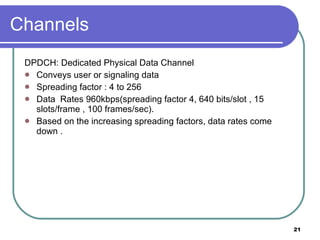
Channels DPDCH: Dedicated Physical Data Channel Conveys user or signaling data Spreading factor : 4 to 256 Data  Rates 960kbps(spreading factor 4, 640 bits/slot , 15 slots/frame , 100 frames/sec). Based on the increasing spreading factors, data rates come down .
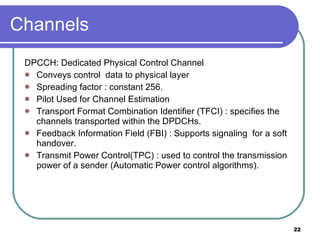
Channels DPCCH: Dedicated Physical Control Channel Conveys control  data to physical layer Spreading factor : constant 256. Pilot Used for Channel Estimation Transport Format Combination Identifier (TFCI) : specifies the channels transported within the DPDCHs. Feedback Information Field (FBI) : Supports signaling  for a soft handover. Transmit Power Control(TPC) : used to control the transmission power of a sender (Automatic Power control algorithms).
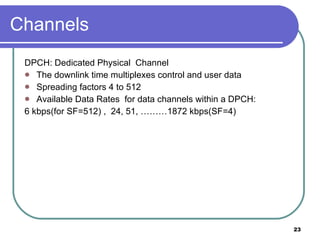
Channels DPCH: Dedicated Physical  Channel  The downlink time multiplexes control and user data Spreading factors 4 to 512 Available Data Rates  for data channels within a DPCH:  6 kbps(for SF=512) ,  24, 51, ………1872 kbps(SF=4)
Typical UTRA-FDD uplink data rates 4 8 16 64 Spreading 15 15 15 15 DPCCH [kbit/s] 960 480 240 60 DPDCH [kbit/s] 384 144 64 12.2 (voice) User data rate [kbit/s]
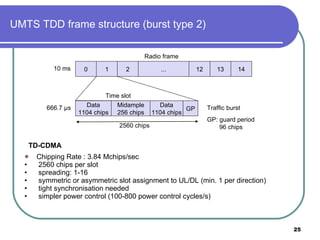
UMTS TDD frame structure (burst type 2) TD-CDMA Chipping Rate : 3.84 Mchips/sec 2560 chips per slot spreading: 1-16 symmetric or asymmetric slot assignment to UL/DL (min. 1 per direction) tight synchronisation needed simpler power control (100-800 power control cycles/s) 0 1 2 1 2 1 3 1 4 ... Radio frame Data 1104 chips Midample 256 chips Data 1104 chips Time slot 6 66.7  µs 10 ms Traffic burst GP GP: guard period 96 chips 2560 chips
UMTS TDD frame structure (burst type 2) If the users have different data rates, the TDD frames can be symmetrical/Unsymmetrical (frame can have same no. of uplink/downlink  slots or a different combination) The system has the capacity to change the up-link/downlink spreading factor as a function of data rates. Guard space can loosen the synchronization needs a bit.  Radio frame
Handover In Line with GSM PLEASE REFER TO THE TEXT

Lecture 10

  • 1.
    TETRA – TerrestrialTrunk Radio Service Trunked radio systems many different radio carriers assign single carrier for a short period to one user/group of users taxi service, fleet management, rescue teams interfaces to public networks, voice and data services very reliable, fast call setup, local operation TETRA - ETSI standard formerly: Trans European Trunked Radio point-to-point and point-to-multipoint encryption (end-to-end, air interface), authentication of devices, users and networks group call, broadcast, sub-second group-call setup ad-hoc (“direct mode”), relay and infrastructure networks call queuing with pre-emptive priorities
  • 2.
    TETRA – Contractsby Sector (percentage) TETRA – Contracts by Sector (percentage) Used in over 70 countries, more than 20 device manufacturers
  • 3.
    TETRA – NetworkArchitecture TETRA infrastructure BS BS switch switch switch NMS BS other TETRA networks PSTN, ISDN, Internet, PDN DMO ISI PEI AI AI: Air Interface BS: Base Station DMO: Direct Mode Operation ISI: Inter-System Interface NMS: Network Management System PEI: Peripheral Equipment Interface
  • 4.
    TETRA – DirectMode I Direct Mode enables ad-hoc operation and is one of the most important differences to pure infrastructure-based networks such as GSM, cdma2000 or UMTS. Individual Call Group Call “ Dual Watch” – alternating participation in Infrastructure and ad-hoc network Managed Direct Mode network Authorizing mobile station
  • 5.
    TETRA – DirectMode II An additional repeater may increase the transmission range (e.g. police car) Direct Mode with Gateway network Direct Mode with Repeater Direct Mode with Repeater/Gateway network Managed Repeater/Gateway network Authorizing Repeater
  • 6.
    TETRA – TechnologyServices Voice+Data (V+D) and Packet Data Optimized (PDO) Short data service (SDS) Frequencies Duplex: FDD, Modulation: DQPSK Europe (in MHz, not all available yet) 380-390 UL / 390-400 DL; 410-420 UL / 420-430 DL, 450-460 UL / 460-470 DL; 870-876 UL / 915-921 DL Other countries 380-390 UL / 390-400 DL; 410-420 UL / 420-430 DL, 806-821 UL / 851-866 DL
  • 7.
    TDMA structure ofthe voice+data system 0 1 2 57 58 59 ... hyperframe 0 1 2 15 16 17 ... multiframe 0 1 2 3 0 slot 509 frame 14.17 ms 56.67 ms 1.02 s 61.2 s CF Control Frame
  • 8.
    TETRA – DataRates hyperframe Infrastructure mode, V+D in kbit/s No. of time slots 1 2 3 4 No protection 7.2 14.4 21.6 28.8 Low protection 4.8 9.6 14.4 19.2 High protection 2.4 4.8 7.2 9.6 TETRA Release 2 – Supporting higher data rates TEDS (TETRA Enhanced Data Service) up to 100 kbit/s backward compatibility
  • 9.
    UMTS and IMT-2000ITU Floats an Idea of a Universal Mobile Telecommunications Systems(UMTS) that caters to: Large Bandwidth requirements for voice and data transfer Worldwide Operation Addresses User Mobility and Terminal(Device) Mobility Formerly, this idea was termed Future Public Land Mobile Telecommunications Systems (FLTMS). Recommendations for FLTMTS: Network Architecture(M.817) Radio Interface Requirements (M.1034) Framework for Services offered(M.816)
  • 10.
    UMTS and IMT-2000Thus emerged the Standard International Mobile Telecommunications (IMT 2000). 2000 Refers to the year of emergence and also the MZ frequency Range. IMT 2000 Frequency Bands (Suggested Initial Allocation): 1885 – 2025 MHz 2110 – 2200MHz The European Proposal for IMT-2000 was UMTS.
  • 11.
    UMTS and IMT-2000Proposals for IMT-2000 (International Mobile Telecommunications) UWC-136, cdma2000, WP-CDMA UMTS (Universal Mobile Telecommunications System) from ETSI UMTS UTRA (was: UMTS, now: Universal Terrestrial Radio Access) enhancements of GSM EDGE (Enhanced Data rates for GSM Evolution): GSM up to 384 kbit/s CAMEL (Customized Application for Mobile Enhanced Logic) – Intelligent network support ex., creation of VHE (virtual Home Environment) for visiting subscribers fits into GMM (Global Multimedia Mobility) initiative from ETSI(European Telecommunications Standards Institute) requirements min. 144 kbit/s rural (goal: 384 kbit/s) min. 384 kbit/s suburban (goal: 512 kbit/s) up to 2 Mbit/s urban
  • 12.
  • 13.
    IMT-2000 family IMT-DS(Direct Spread) UTRA FDD (W-CDMA) 3GPP IMT-TC (Time Code) UTRA TDD (TD-CDMA); TD-SCDMA 3GPP IMT-MC (Multi Carrier) cdma2000 3GPP2 IMT-SC (Single Carrier) UWC-136 (EDGE) UWCC/3GPP IMT-FT (Freq. Time) DECT ETSI GSM (MAP) ANSI-41 (IS-634) IP-Network IMT-2000 Core Network ITU-T IMT-2000 Radio Access ITU-R Interface for Internetworking Initial UMTS (R99 w/ FDD) Universal Terrestrial Radio Access 3G-Partnership Project Flexible assignment of Core Network and Radio Access
  • 14.
    GSM and UMTSReleases 1992 3.x.y Ph1 - Phase 1 1995 4.x.y Ph2 - Phase 2 early 1997 5.x.y R96 - Phase 2+ Release 1996 early 1998 6.x.y R97 - Phase 2+ Release 1997 early 1999 7.x.y R98 - Phase 2+ Release 1998 8.x.y - Phase 2+ Release 1999 March 2000 3.x.y R99 Release 1999 - 9.x.y - Phase 2+ Release 2000 Renaming… 4.x.y R00 Release 2000 - March 2001 4.x.y Rel-4 Release 4 Phase 2+ Release 4 March - June 2002 5.x.y Rel-5 Release 5 Phase 2+ Release 5 December 2004 - March 2005 6.x.y Rel-6 Release 6 Phase 2+ Release 6 Freeze date (indicative only) Spec version number Abbreviated name 3G Release GSM/EDGE Release
  • 15.
    UMTS architecture (Release99 used here!) UTRAN (UTRA Network) Cell level mobility Contains several Radio Network Subsystems (RNS) Encapsulation of all radio specific tasks UE (User Equipment) CN (Core Network) Inter system handover Location management if there is no dedicated connection between UE and UTRAN UTRAN UE CN I u U u
  • 16.
    Further Break-up ofArchitecture : UMTS domains and interfaces I USIM Domain Mobile Equipment Domain Access Network Domain Serving Network Domain Transit Network Domain Home Network Domain C u U u I u User Equipment Domain Z u Y u Core Network Domain Infrastructure Domain User Equipment Domain Assigned to a single user in order to access UMTS services Infrastructure Domain Shared among all users Offers UMTS services to all accepted users
  • 17.
    UMTS domains andinterfaces II Universal Subscriber Identity Module (USIM) Functions for encryption and authentication of users Located on a SIM inserted into a mobile device Mobile Equipment Domain Functions for radio transmission User interface for establishing/maintaining end-to-end connections Access Network Domain Access network dependent functions Core Network Domain Access network independent functions Serving Network Domain Network currently responsible for communication Home Network Domain Location and access network independent functions
  • 18.
    Spreading and scramblingof user data Constant chipping rate of 3.84 Mchip/s Different user data rates supported via different spreading factors (no. of chips/bit) higher data rate: less chips per bit and vice versa User separation via unique, quasi orthogonal (cross correlation should be zero nearly )scrambling codes users are not separated via orthogonal spreading codes much simpler management of codes: each station can use the same orthogonal spreading codes precise synchronisation not necessary as the scrambling codes stay quasi-orthogonal data 1 data 2 data 3 scrambling code 1 spr. code 3 spr. code 2 spr. code 1 data 4 data 5 scrambling code 2 spr. code 4 spr. code 1 sender 1 sender 2
  • 19.
    OSVF coding (OrthogonalVariable Spreading Factor) 1 1,1 1,-1 1,1,1,1 1,1,-1,-1 X X,X X,-X 1,-1,1,-1 1,-1,-1,1 1,-1,-1,1,1,-1,-1,1 1,-1,-1,1,-1,1,1,-1 1,-1,1,-1,1,-1,1,-1 1,-1,1,-1,-1,1,-1,1 1,1,-1,-1,1,1,-1,-1 1,1,-1,-1,-1,-1,1,1 1,1,1,1,1,1,1,1 1,1,1,1,-1,-1,-1,-1 SF=1 SF=2 SF=4 SF=8 SF=n SF=2n ... ... ... ...
  • 20.
    UMTS FDD framestructure W-CDMA 1920-1980 MHz uplink 2110-2170 MHz downlink chipping rate: 3.840 Mchip/s soft handover QPSK complex power control (1500 power control cycles/s) spreading: UL: 4-256; DL:4-512 0 1 2 1 2 1 3 1 4 ... Radio frame Pilot FBI TPC Time slot 6 66.7 µs 10 ms Data Data 1 uplink DPDCH uplink DPCCH downlink DPCH TPC TF C I Pilot 6 66.7 µs 6 66.7 µs DPCCH DPDCH 2560 chips, 10 bits 2560 chips, 10*2 k bits (k = 0...6) TFCI 2560 chips, 10*2 k bits (k = 0...7) Data 2 DPDCH DPCCH FBI: Feedback Information TPC: Transmit Power Control TF C I: Transport Format Combination Indicator DPCCH: Dedicated Physical Control Channel DPDCH: Dedicated Physical Data Channel DPCH: Dedicated Physical Channel Slot structure NOT for user separation but synchronisation for periodic functions! 38400 chips
  • 21.
    Channels DPDCH: DedicatedPhysical Data Channel Conveys user or signaling data Spreading factor : 4 to 256 Data Rates 960kbps(spreading factor 4, 640 bits/slot , 15 slots/frame , 100 frames/sec). Based on the increasing spreading factors, data rates come down .
  • 22.
    Channels DPCCH: DedicatedPhysical Control Channel Conveys control data to physical layer Spreading factor : constant 256. Pilot Used for Channel Estimation Transport Format Combination Identifier (TFCI) : specifies the channels transported within the DPDCHs. Feedback Information Field (FBI) : Supports signaling for a soft handover. Transmit Power Control(TPC) : used to control the transmission power of a sender (Automatic Power control algorithms).
  • 23.
    Channels DPCH: DedicatedPhysical Channel The downlink time multiplexes control and user data Spreading factors 4 to 512 Available Data Rates for data channels within a DPCH: 6 kbps(for SF=512) , 24, 51, ………1872 kbps(SF=4)
  • 24.
    Typical UTRA-FDD uplinkdata rates 4 8 16 64 Spreading 15 15 15 15 DPCCH [kbit/s] 960 480 240 60 DPDCH [kbit/s] 384 144 64 12.2 (voice) User data rate [kbit/s]
  • 25.
    UMTS TDD framestructure (burst type 2) TD-CDMA Chipping Rate : 3.84 Mchips/sec 2560 chips per slot spreading: 1-16 symmetric or asymmetric slot assignment to UL/DL (min. 1 per direction) tight synchronisation needed simpler power control (100-800 power control cycles/s) 0 1 2 1 2 1 3 1 4 ... Radio frame Data 1104 chips Midample 256 chips Data 1104 chips Time slot 6 66.7 µs 10 ms Traffic burst GP GP: guard period 96 chips 2560 chips
  • 26.
    UMTS TDD framestructure (burst type 2) If the users have different data rates, the TDD frames can be symmetrical/Unsymmetrical (frame can have same no. of uplink/downlink slots or a different combination) The system has the capacity to change the up-link/downlink spreading factor as a function of data rates. Guard space can loosen the synchronization needs a bit. Radio frame
  • 27.
    Handover In Linewith GSM PLEASE REFER TO THE TEXT