Cryptography and Network Security Third Edition by William Stallings Lecture slides by Lawrie Brown
Chapter 3 – Block Ciphers and the Data Encryption Standard All the afternoon Mungo had been working on Stern's code, principally with the aid of the latest messages which he had copied down at the Nevin Square drop. Stern was very confident. He must be well aware London Central knew about that drop. It was obvious that they didn't care how often Mungo read their messages, so confident were they in the impenetrability of the code. — Talking to Strange Men,  Ruth Rendell
Modern Block Ciphers will now look at modern block ciphers one of the most widely used types of cryptographic algorithms  provide secrecy and/or authentication services in particular will introduce DES (Data Encryption Standard)
Block vs Stream Ciphers block ciphers process messages in into blocks, each of which is then en/decrypted  like a substitution on very big characters 64-bits or more  stream ciphers  process messages a bit or byte at a time when en/decrypting many current ciphers are block ciphers hence are focus of course
Block Cipher Principles most symmetric block ciphers are based on a  Feistel Cipher Structure needed since must be able to  decrypt  ciphertext to recover messages efficiently block ciphers look like an extremely large substitution  would need table of 2 64  entries for a 64-bit block  instead create from smaller building blocks  using idea of a product cipher
Claude Shannon and Substitution-Permutation Ciphers in 1949 Claude Shannon introduced idea of substitution-permutation (S-P) networks modern substitution-transposition product cipher  these form the basis of modern block ciphers  S-P networks are based on the two primitive cryptographic operations we have seen before:  substitution  (S-box) permutation  (P-box) provide  confusion  and  diffusion  of message
Confusion and Diffusion cipher needs to completely obscure statistical properties of original message a one-time pad does this more practically Shannon suggested combining elements to obtain: diffusion  – dissipates statistical structure of plaintext over bulk of ciphertext confusion  – makes relationship between ciphertext and key as complex as possible
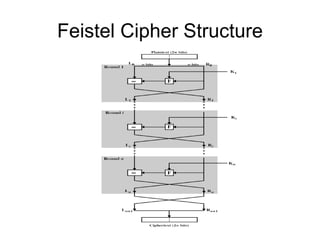
Feistel Cipher Structure Horst Feistel devised the  feistel cipher based on concept of invertible product cipher partitions input block into two halves process through multiple rounds which perform a substitution on left data half based on round function of right half & subkey then have permutation swapping halves implements Shannon’s substitution-permutation network concept
Feistel Cipher Structure
Feistel Cipher Design Principles block size   increasing size improves security, but slows cipher  key size   increasing size improves security, makes exhaustive key searching harder, but may slow cipher  number of rounds   increasing number improves security, but slows cipher  subkey generation   greater complexity can make analysis harder, but slows cipher  round function   greater complexity can make analysis harder, but slows cipher  fast software en/decryption & ease of analysis are more recent concerns for practical use and testing
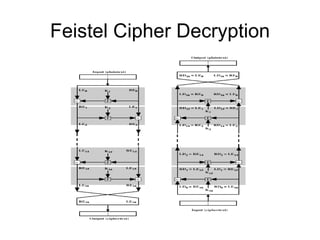
Feistel Cipher Decryption
Data Encryption Standard (DES) most widely used block cipher in world  adopted in 1977 by NBS (now NIST) as FIPS PUB 46 encrypts 64-bit data using 56-bit key has widespread use has been considerable controversy over its security
DES History IBM developed Lucifer cipher by team led by Feistel used 64-bit data blocks with 128-bit key then redeveloped as a commercial cipher with input from NSA and others in 1973 NBS issued request for proposals for a national cipher standard IBM submitted their revised Lucifer which was eventually accepted as the DES
DES Design Controversy although DES standard is public was considerable controversy over design  in choice of 56-bit key (vs Lucifer 128-bit) and because design criteria were classified  subsequent events and public analysis show in fact design was appropriate DES has become widely used, esp in financial applications
DES Encryption
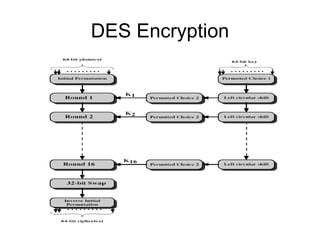
Initial Permutation IP first step of the data computation  IP reorders the input data bits  even bits to LH half, odd bits to RH half  quite regular in structure (easy in h/w) see text Table 3.2 example: IP(675a6967 5e5a6b5a) = (ffb2194d 004df6fb)
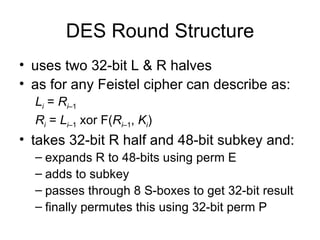
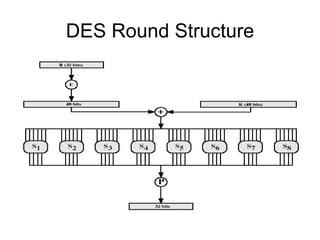
DES Round Structure uses two 32-bit L & R halves as for any Feistel cipher can describe as: L i   =  R i –1 R i   =  L i –1  xor F( R i –1 ,  K i ) takes 32-bit R half and 48-bit subkey and: expands R to 48-bits using perm E adds to subkey passes through 8 S-boxes to get 32-bit result finally permutes this using 32-bit perm P
DES Round Structure
Substitution Boxes S have eight S-boxes which map 6 to 4 bits  each S-box is actually 4 little 4 bit boxes  outer bits 1 & 6 ( row  bits) select one rows  inner bits 2-5 ( col  bits) are substituted  result is 8 lots of 4 bits, or 32 bits row selection depends on both data & key feature known as autoclaving (autokeying) example: S(18 09 12 3d 11 17 38 39) = 5fd25e03
DES Key Schedule forms subkeys used in each round consists of: initial permutation of the key (PC1) which selects 56-bits in two 28-bit halves  16 stages consisting of:  selecting 24-bits from each half  permuting them by PC2 for use in function f,  rotating  each half  separately either 1 or 2 places depending on the  key rotation schedule  K
DES Decryption decrypt must unwind steps of data computation  with Feistel design, do encryption steps again  using subkeys in reverse order (SK16 … SK1) note that IP undoes final FP step of encryption  1st round with SK16 undoes 16th encrypt round … . 16th round with SK1 undoes 1st encrypt round  then final FP undoes initial encryption IP  thus recovering original data value
Avalanche Effect  key desirable property of encryption alg where a change of  one  input or key bit results in changing approx  half  output bits making attempts to “home-in” by guessing keys impossible DES exhibits strong avalanche
Strength of DES – Key Size 56-bit keys have 2 56  = 7.2 x 10 16  values brute force search looks hard recent advances have shown is possible in 1997 on Internet in a few months  in 1998 on dedicated h/w (EFF) in a few days  in 1999 above combined in 22hrs! still must be able to recognize plaintext now considering alternatives to DES
Strength of DES – Timing Attacks attacks actual implementation of cipher use knowledge of consequences of implementation to derive knowledge of some/all subkey bits specifically use fact that calculations can take varying times depending on the value of the inputs to it particularly problematic on smartcards
Strength of DES – Analytic Attacks now have several analytic attacks on DES these  utilise some deep structure of the cipher  by gathering information about encryptions  can eventually recover some/all of the sub-key bits  if necessary then exhaustively search for the rest  generally these are statistical attacks include differential cryptanalysis  linear cryptanalysis  related key attacks
Differential Cryptanalysis one of the most significant recent (public) advances in cryptanalysis  known by NSA in 70's cf DES design Murphy, Biham & Shamir published 1990 powerful method to analyse block ciphers  used to analyse most current block ciphers with varying degrees of success DES reasonably resistant to it, cf Lucifer
Differential Cryptanalysis a statistical attack against Feistel ciphers  uses cipher structure not previously used  design of S-P networks has output of function  f  influenced by both input & key hence cannot trace values back through cipher without knowing values of the key  Differential Cryptanalysis compares two related pairs of encryptions
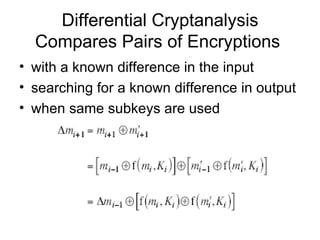
Differential Cryptanalysis Compares Pairs of Encryptions  with a known difference in the input  searching for a known difference in output when same subkeys are used
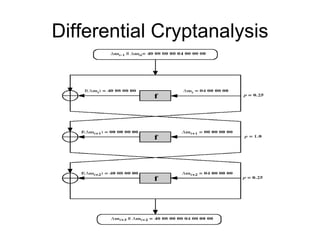
Differential Cryptanalysis have some input difference giving some output difference with probability p if find instances of some higher probability input / output difference pairs occurring can infer subkey that was used in round then must iterate process over many rounds (with decreasing probabilities)
Differential Cryptanalysis
Differential Cryptanalysis perform attack by repeatedly encrypting plaintext pairs with known input XOR until obtain desired output XOR  when found if intermediate rounds match required XOR have a  right pair if not then have a  wrong pair , relative ratio is S/N for attack  can then deduce keys values for the rounds right pairs suggest same key bits wrong pairs give random values  for large numbers of rounds, probability is so low that more pairs are required than exist with 64-bit inputs  Biham and Shamir have shown how a 13-round iterated characteristic can break the full 16-round DES
Linear Cryptanalysis another recent development  also a statistical method  must be iterated over rounds, with decreasing probabilities developed by Matsui et al in early 90's based on finding linear approximations can attack DES with  2 47  known plaintexts, still in practise infeasible
Linear Cryptanalysis find linear approximations with prob p != ½ P[i1,i2,...,ia](+)C[j1,j2,...,jb] = K[k1,k2,...,kc] where ia,jb,kc are bit locations in P,C,K   gives linear equation for key bits get one key bit using max likelihood alg using a large number of trial encryptions  effectiveness given by:  |p–½|
Block Cipher Design Principles basic principles still like Feistel in 1970’s number of rounds more is better, exhaustive search best attack function f: provides “confusion”, is nonlinear, avalanche key schedule complex subkey creation, key avalanche
Modes of Operation block ciphers encrypt fixed size blocks eg. DES encrypts 64-bit blocks, with 56-bit key  need way to use in practise, given usually have arbitrary amount of information to encrypt  four were defined for DES in ANSI standard  ANSI X3.106-1983 Modes of Use subsequently now have 5 for DES and AES have  block  and  stream  modes
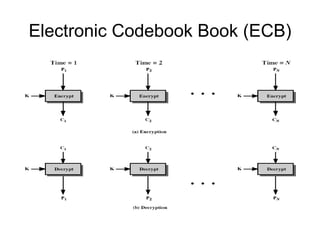
Electronic Codebook Book (ECB) message is broken into independent blocks which are encrypted  each block is a value which is substituted, like a codebook, hence name  each block is encoded independently of the other blocks  C i  = DES K1  (P i ) uses: secure transmission of single values
Electronic Codebook Book (ECB)
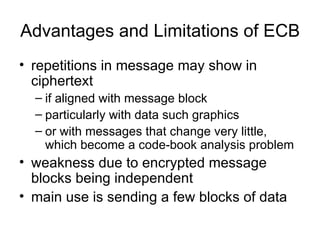
Advantages and Limitations of ECB repetitions in message may show in ciphertext  if aligned with message block  particularly with data such graphics  or with messages that change very little, which become a code-book analysis problem  weakness due to encrypted message blocks being independent  main use is sending a few blocks of data
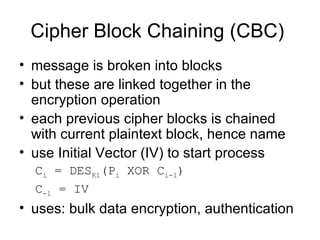
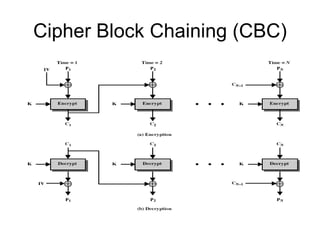
Cipher Block Chaining (CBC)  message is broken into blocks  but these are linked together in the encryption operation  each previous cipher blocks is chained with current plaintext block, hence name  use Initial Vector (IV) to start process  C i  = DES K1 (P i  XOR C i-1 ) C -1  = IV   uses: bulk data encryption, authentication
Cipher Block Chaining (CBC)
Advantages and Limitations of CBC each ciphertext block depends on  all  message blocks  thus a change in the message affects all ciphertext blocks after the change as well as the original block  need  Initial Value  (IV) known to sender & receiver  however if IV is sent in the clear, an attacker can change bits of the first block, and change IV to compensate  hence either IV must be a fixed value (as in EFTPOS) or it must be sent encrypted in ECB mode before rest of message  at end of message, handle possible last short block  by padding either with known non-data value (eg nulls) or  pad last block with count of pad size  eg. [ b1 b2 b3 0 0 0 0 5] <- 3 data bytes, then 5 bytes pad+count
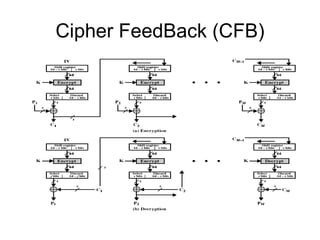
Cipher FeedBack (CFB) message is treated as a stream of bits  added to the output of the block cipher  result is feed back for next stage (hence name)  standard allows any number of bit (1,8 or 64 or whatever) to be feed back  denoted CFB-1, CFB-8, CFB-64 etc  is most efficient to use all 64 bits (CFB-64) C i  = P i  XOR DES K1 (C i-1 ) C -1  = IV   uses: stream data encryption, authentication
Cipher FeedBack (CFB)
Advantages and Limitations of CFB appropriate when data arrives in bits/bytes  most common stream mode  limitation is need to stall while do block encryption after every n-bits  note that the block cipher is used in  encryption  mode at  both  ends  errors propogate for several blocks after the error
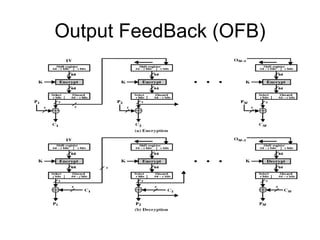
Output FeedBack (OFB) message is treated as a stream of bits  output of cipher is added to message  output is then feed back (hence name)  feedback is independent of message  can be computed in advance C i  = P i  XOR O i   O i  = DES K1 (O i-1 ) O -1  = IV uses: stream encryption over noisy channels
Output FeedBack (OFB)
Advantages and Limitations of OFB used when error feedback a problem or where need to  encryptions before message is available  superficially similar to CFB  but feedback is from the output of cipher and is independent of message  a variation of a Vernam cipher  hence must  never  reuse the same sequence (key+IV)  sender and receiver must remain in sync, and some recovery method is needed to ensure this occurs  originally specified with m-bit feedback in the standards  subsequent research has shown that only  OFB-64  should ever be used
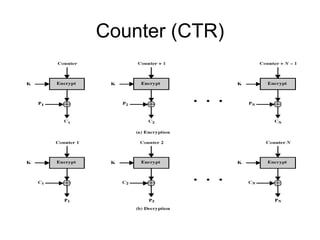
Counter (CTR) a “new” mode, though proposed early on similar to OFB but encrypts counter value rather than any feedback value must have a different key & counter value for every plaintext block (never reused) C i  = P i  XOR O i   O i  = DES K1 (i) uses: high-speed network encryptions
Counter (CTR)
Advantages and Limitations of CTR efficiency can do parallel encryptions in advance of need good for bursty high speed links random access to encrypted data blocks provable security (good as other modes) but must ensure never reuse key/counter values, otherwise could break (cf OFB)
Summary have considered: block cipher design principles DES details strength Differential & Linear Cryptanalysis Modes of Operation  ECB, CBC, CFB, OFB, CTR

Ch03

  • 1.
    Cryptography and NetworkSecurity Third Edition by William Stallings Lecture slides by Lawrie Brown
  • 2.
    Chapter 3 –Block Ciphers and the Data Encryption Standard All the afternoon Mungo had been working on Stern's code, principally with the aid of the latest messages which he had copied down at the Nevin Square drop. Stern was very confident. He must be well aware London Central knew about that drop. It was obvious that they didn't care how often Mungo read their messages, so confident were they in the impenetrability of the code. — Talking to Strange Men, Ruth Rendell
  • 3.
    Modern Block Cipherswill now look at modern block ciphers one of the most widely used types of cryptographic algorithms provide secrecy and/or authentication services in particular will introduce DES (Data Encryption Standard)
  • 4.
    Block vs StreamCiphers block ciphers process messages in into blocks, each of which is then en/decrypted like a substitution on very big characters 64-bits or more stream ciphers process messages a bit or byte at a time when en/decrypting many current ciphers are block ciphers hence are focus of course
  • 5.
    Block Cipher Principlesmost symmetric block ciphers are based on a Feistel Cipher Structure needed since must be able to decrypt ciphertext to recover messages efficiently block ciphers look like an extremely large substitution would need table of 2 64 entries for a 64-bit block instead create from smaller building blocks using idea of a product cipher
  • 6.
    Claude Shannon andSubstitution-Permutation Ciphers in 1949 Claude Shannon introduced idea of substitution-permutation (S-P) networks modern substitution-transposition product cipher these form the basis of modern block ciphers S-P networks are based on the two primitive cryptographic operations we have seen before: substitution (S-box) permutation (P-box) provide confusion and diffusion of message
  • 7.
    Confusion and Diffusioncipher needs to completely obscure statistical properties of original message a one-time pad does this more practically Shannon suggested combining elements to obtain: diffusion – dissipates statistical structure of plaintext over bulk of ciphertext confusion – makes relationship between ciphertext and key as complex as possible
  • 8.
    Feistel Cipher StructureHorst Feistel devised the feistel cipher based on concept of invertible product cipher partitions input block into two halves process through multiple rounds which perform a substitution on left data half based on round function of right half & subkey then have permutation swapping halves implements Shannon’s substitution-permutation network concept
  • 9.
  • 10.
    Feistel Cipher DesignPrinciples block size increasing size improves security, but slows cipher key size increasing size improves security, makes exhaustive key searching harder, but may slow cipher number of rounds increasing number improves security, but slows cipher subkey generation greater complexity can make analysis harder, but slows cipher round function greater complexity can make analysis harder, but slows cipher fast software en/decryption & ease of analysis are more recent concerns for practical use and testing
  • 11.
  • 12.
    Data Encryption Standard(DES) most widely used block cipher in world adopted in 1977 by NBS (now NIST) as FIPS PUB 46 encrypts 64-bit data using 56-bit key has widespread use has been considerable controversy over its security
  • 13.
    DES History IBMdeveloped Lucifer cipher by team led by Feistel used 64-bit data blocks with 128-bit key then redeveloped as a commercial cipher with input from NSA and others in 1973 NBS issued request for proposals for a national cipher standard IBM submitted their revised Lucifer which was eventually accepted as the DES
  • 14.
    DES Design Controversyalthough DES standard is public was considerable controversy over design in choice of 56-bit key (vs Lucifer 128-bit) and because design criteria were classified subsequent events and public analysis show in fact design was appropriate DES has become widely used, esp in financial applications
  • 15.
  • 16.
    Initial Permutation IPfirst step of the data computation IP reorders the input data bits even bits to LH half, odd bits to RH half quite regular in structure (easy in h/w) see text Table 3.2 example: IP(675a6967 5e5a6b5a) = (ffb2194d 004df6fb)
  • 17.
    DES Round Structureuses two 32-bit L & R halves as for any Feistel cipher can describe as: L i = R i –1 R i = L i –1 xor F( R i –1 , K i ) takes 32-bit R half and 48-bit subkey and: expands R to 48-bits using perm E adds to subkey passes through 8 S-boxes to get 32-bit result finally permutes this using 32-bit perm P
  • 18.
  • 19.
    Substitution Boxes Shave eight S-boxes which map 6 to 4 bits each S-box is actually 4 little 4 bit boxes outer bits 1 & 6 ( row bits) select one rows inner bits 2-5 ( col bits) are substituted result is 8 lots of 4 bits, or 32 bits row selection depends on both data & key feature known as autoclaving (autokeying) example: S(18 09 12 3d 11 17 38 39) = 5fd25e03
  • 20.
    DES Key Scheduleforms subkeys used in each round consists of: initial permutation of the key (PC1) which selects 56-bits in two 28-bit halves 16 stages consisting of: selecting 24-bits from each half permuting them by PC2 for use in function f, rotating each half separately either 1 or 2 places depending on the key rotation schedule K
  • 21.
    DES Decryption decryptmust unwind steps of data computation with Feistel design, do encryption steps again using subkeys in reverse order (SK16 … SK1) note that IP undoes final FP step of encryption 1st round with SK16 undoes 16th encrypt round … . 16th round with SK1 undoes 1st encrypt round then final FP undoes initial encryption IP thus recovering original data value
  • 22.
    Avalanche Effect key desirable property of encryption alg where a change of one input or key bit results in changing approx half output bits making attempts to “home-in” by guessing keys impossible DES exhibits strong avalanche
  • 23.
    Strength of DES– Key Size 56-bit keys have 2 56 = 7.2 x 10 16 values brute force search looks hard recent advances have shown is possible in 1997 on Internet in a few months in 1998 on dedicated h/w (EFF) in a few days in 1999 above combined in 22hrs! still must be able to recognize plaintext now considering alternatives to DES
  • 24.
    Strength of DES– Timing Attacks attacks actual implementation of cipher use knowledge of consequences of implementation to derive knowledge of some/all subkey bits specifically use fact that calculations can take varying times depending on the value of the inputs to it particularly problematic on smartcards
  • 25.
    Strength of DES– Analytic Attacks now have several analytic attacks on DES these utilise some deep structure of the cipher by gathering information about encryptions can eventually recover some/all of the sub-key bits if necessary then exhaustively search for the rest generally these are statistical attacks include differential cryptanalysis linear cryptanalysis related key attacks
  • 26.
    Differential Cryptanalysis oneof the most significant recent (public) advances in cryptanalysis known by NSA in 70's cf DES design Murphy, Biham & Shamir published 1990 powerful method to analyse block ciphers used to analyse most current block ciphers with varying degrees of success DES reasonably resistant to it, cf Lucifer
  • 27.
    Differential Cryptanalysis astatistical attack against Feistel ciphers uses cipher structure not previously used design of S-P networks has output of function f influenced by both input & key hence cannot trace values back through cipher without knowing values of the key Differential Cryptanalysis compares two related pairs of encryptions
  • 28.
    Differential Cryptanalysis ComparesPairs of Encryptions with a known difference in the input searching for a known difference in output when same subkeys are used
  • 29.
    Differential Cryptanalysis havesome input difference giving some output difference with probability p if find instances of some higher probability input / output difference pairs occurring can infer subkey that was used in round then must iterate process over many rounds (with decreasing probabilities)
  • 30.
  • 31.
    Differential Cryptanalysis performattack by repeatedly encrypting plaintext pairs with known input XOR until obtain desired output XOR when found if intermediate rounds match required XOR have a right pair if not then have a wrong pair , relative ratio is S/N for attack can then deduce keys values for the rounds right pairs suggest same key bits wrong pairs give random values for large numbers of rounds, probability is so low that more pairs are required than exist with 64-bit inputs Biham and Shamir have shown how a 13-round iterated characteristic can break the full 16-round DES
  • 32.
    Linear Cryptanalysis anotherrecent development also a statistical method must be iterated over rounds, with decreasing probabilities developed by Matsui et al in early 90's based on finding linear approximations can attack DES with 2 47 known plaintexts, still in practise infeasible
  • 33.
    Linear Cryptanalysis findlinear approximations with prob p != ½ P[i1,i2,...,ia](+)C[j1,j2,...,jb] = K[k1,k2,...,kc] where ia,jb,kc are bit locations in P,C,K gives linear equation for key bits get one key bit using max likelihood alg using a large number of trial encryptions effectiveness given by: |p–½|
  • 34.
    Block Cipher DesignPrinciples basic principles still like Feistel in 1970’s number of rounds more is better, exhaustive search best attack function f: provides “confusion”, is nonlinear, avalanche key schedule complex subkey creation, key avalanche
  • 35.
    Modes of Operationblock ciphers encrypt fixed size blocks eg. DES encrypts 64-bit blocks, with 56-bit key need way to use in practise, given usually have arbitrary amount of information to encrypt four were defined for DES in ANSI standard ANSI X3.106-1983 Modes of Use subsequently now have 5 for DES and AES have block and stream modes
  • 36.
    Electronic Codebook Book(ECB) message is broken into independent blocks which are encrypted each block is a value which is substituted, like a codebook, hence name each block is encoded independently of the other blocks C i = DES K1 (P i ) uses: secure transmission of single values
  • 37.
  • 38.
    Advantages and Limitationsof ECB repetitions in message may show in ciphertext if aligned with message block particularly with data such graphics or with messages that change very little, which become a code-book analysis problem weakness due to encrypted message blocks being independent main use is sending a few blocks of data
  • 39.
    Cipher Block Chaining(CBC) message is broken into blocks but these are linked together in the encryption operation each previous cipher blocks is chained with current plaintext block, hence name use Initial Vector (IV) to start process C i = DES K1 (P i XOR C i-1 ) C -1 = IV uses: bulk data encryption, authentication
  • 40.
  • 41.
    Advantages and Limitationsof CBC each ciphertext block depends on all message blocks thus a change in the message affects all ciphertext blocks after the change as well as the original block need Initial Value (IV) known to sender & receiver however if IV is sent in the clear, an attacker can change bits of the first block, and change IV to compensate hence either IV must be a fixed value (as in EFTPOS) or it must be sent encrypted in ECB mode before rest of message at end of message, handle possible last short block by padding either with known non-data value (eg nulls) or pad last block with count of pad size eg. [ b1 b2 b3 0 0 0 0 5] <- 3 data bytes, then 5 bytes pad+count
  • 42.
    Cipher FeedBack (CFB)message is treated as a stream of bits added to the output of the block cipher result is feed back for next stage (hence name) standard allows any number of bit (1,8 or 64 or whatever) to be feed back denoted CFB-1, CFB-8, CFB-64 etc is most efficient to use all 64 bits (CFB-64) C i = P i XOR DES K1 (C i-1 ) C -1 = IV uses: stream data encryption, authentication
  • 43.
  • 44.
    Advantages and Limitationsof CFB appropriate when data arrives in bits/bytes most common stream mode limitation is need to stall while do block encryption after every n-bits note that the block cipher is used in encryption mode at both ends errors propogate for several blocks after the error
  • 45.
    Output FeedBack (OFB)message is treated as a stream of bits output of cipher is added to message output is then feed back (hence name) feedback is independent of message can be computed in advance C i = P i XOR O i O i = DES K1 (O i-1 ) O -1 = IV uses: stream encryption over noisy channels
  • 46.
  • 47.
    Advantages and Limitationsof OFB used when error feedback a problem or where need to encryptions before message is available superficially similar to CFB but feedback is from the output of cipher and is independent of message a variation of a Vernam cipher hence must never reuse the same sequence (key+IV) sender and receiver must remain in sync, and some recovery method is needed to ensure this occurs originally specified with m-bit feedback in the standards subsequent research has shown that only OFB-64 should ever be used
  • 48.
    Counter (CTR) a“new” mode, though proposed early on similar to OFB but encrypts counter value rather than any feedback value must have a different key & counter value for every plaintext block (never reused) C i = P i XOR O i O i = DES K1 (i) uses: high-speed network encryptions
  • 49.
  • 50.
    Advantages and Limitationsof CTR efficiency can do parallel encryptions in advance of need good for bursty high speed links random access to encrypted data blocks provable security (good as other modes) but must ensure never reuse key/counter values, otherwise could break (cf OFB)
  • 51.
    Summary have considered:block cipher design principles DES details strength Differential & Linear Cryptanalysis Modes of Operation ECB, CBC, CFB, OFB, CTR