Classical Encryption
Techniques
Dr.I.Sumaiya Thaseen, AP(SG), SITE
Symmetric Encryption
 or conventional / private-key / single-key
 sender and recipient share a common key
 all classical encryption algorithms are
private-key
 was only type prior to invention of public-
key in 1970’s
 and by far most widely used
Some Basic Terminology
 plaintext - original message
 ciphertext - coded message
 cipher - algorithm for transforming plaintext to ciphertext
 key - info used in cipher known only to sender/receiver
 encipher (encrypt) - converting plaintext to ciphertext
 decipher (decrypt) - recovering ciphertext from plaintext
 cryptography - study of encryption principles/methods
 cryptanalysis (codebreaking) - study of principles/
methods of deciphering ciphertext without knowing key
 cryptology - field of both cryptography and cryptanalysis
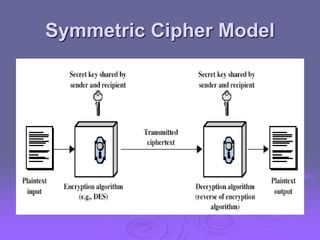
Symmetric Cipher Model
Requirements
 two requirements for secure use of symmetric
encryption:
 a strong encryption algorithm
 a secret key known only to sender / receiver
 mathematically have: Plain text X= [X1,X2,…XM]
 Encryption Key K = [ K1,K2,…KJ]
Y = EK(X)
X = DK(Y)
 assume encryption algorithm is known
 implies a secure channel to distribute key
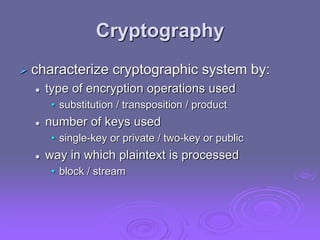
Cryptography
 characterize cryptographic system by:
 type of encryption operations used
• substitution / transposition / product
 number of keys used
• single-key or private / two-key or public
 way in which plaintext is processed
• block / stream
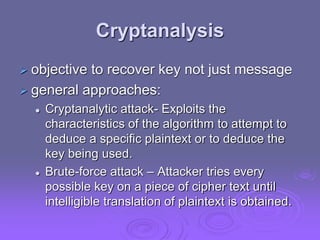
Cryptanalysis
 objective to recover key not just message
 general approaches:
 Cryptanalytic attack- Exploits the
characteristics of the algorithm to attempt to
deduce a specific plaintext or to deduce the
key being used.
 Brute-force attack – Attacker tries every
possible key on a piece of cipher text until
intelligible translation of plaintext is obtained.
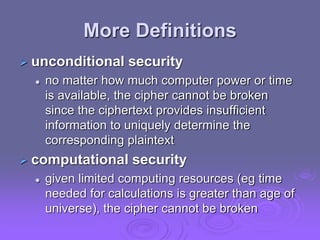
More Definitions
 unconditional security
 no matter how much computer power or time
is available, the cipher cannot be broken
since the ciphertext provides insufficient
information to uniquely determine the
corresponding plaintext
 computational security
 given limited computing resources (eg time
needed for calculations is greater than age of
universe), the cipher cannot be broken
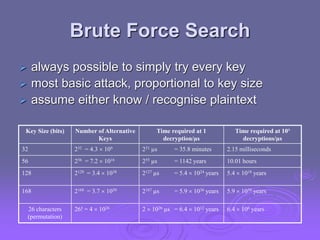
Brute Force Search
 always possible to simply try every key
 most basic attack, proportional to key size
 assume either know / recognise plaintext
Key Size (bits) Number of Alternative
Keys
Time required at 1
decryption/µs
Time required at 106
decryptions/µs
32 232 = 4.3  109 231 µs = 35.8 minutes 2.15 milliseconds
56 256 = 7.2  1016 255 µs = 1142 years 10.01 hours
128 2128 = 3.4  1038 2127 µs = 5.4  1024 years 5.4  1018 years
168 2168 = 3.7  1050 2167 µs = 5.9  1036 years 5.9  1030 years
26 characters
(permutation)
26! = 4  1026 2  1026 µs = 6.4  1012 years 6.4  106 years
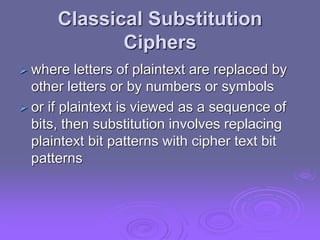
Classical Substitution
Ciphers
 where letters of plaintext are replaced by
other letters or by numbers or symbols
 or if plaintext is viewed as a sequence of
bits, then substitution involves replacing
plaintext bit patterns with cipher text bit
patterns
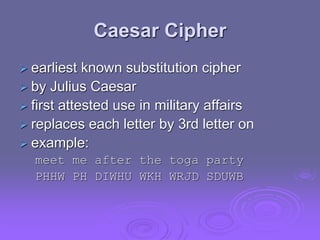
Caesar Cipher
 earliest known substitution cipher
 by Julius Caesar
 first attested use in military affairs
 replaces each letter by 3rd letter on
 example:
meet me after the toga party
PHHW PH DIWHU WKH WRJD SDUWB
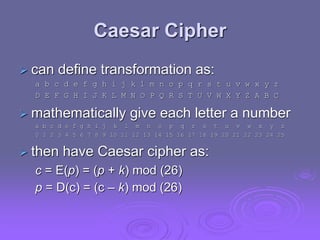
Caesar Cipher
 can define transformation as:
a b c d e f g h i j k l m n o p q r s t u v w x y z
D E F G H I J K L M N O P Q R S T U V W X Y Z A B C
 mathematically give each letter a number
a b c d e f g h i j k l m n o p q r s t u v w x y z
0 1 2 3 4 5 6 7 8 9 10 11 12 13 14 15 16 17 18 19 20 21 22 23 24 25
 then have Caesar cipher as:
c = E(p) = (p + k) mod (26)
p = D(c) = (c – k) mod (26)
Cryptanalysis of Caesar
Cipher
 only have 26 possible ciphers
 A maps to A,B,..Z
 could simply try each in turn
 a brute force search
 given ciphertext, just try all shifts of letters
 do need to recognize when have plaintext
Monoalphabetic Cipher
 rather than just shifting the alphabet
 could shuffle (jumble) the letters arbitrarily
 each plaintext letter maps to a different random
ciphertext letter
 hence key is 26 letters long
Plain: abcdefghijklmnopqrstuvwxyz
Cipher: DKVQFIBJWPESCXHTMYAUOLRGZN
Plaintext: ifwewishtoreplaceletters
Ciphertext: WIRFRWAJUHYFTSDVFSFUUFYA
Playfair Cipher
 one approach to improve security was to
encrypt multiple letters
 the Playfair Cipher is an example
 invented by Charles Wheatstone in 1854,
but named after his friend Baron Playfair
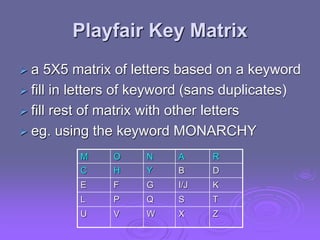
Playfair Key Matrix
 a 5X5 matrix of letters based on a keyword
 fill in letters of keyword (sans duplicates)
 fill rest of matrix with other letters
 eg. using the keyword MONARCHY
M O N A R
C H Y B D
E F G I/J K
L P Q S T
U V W X Z
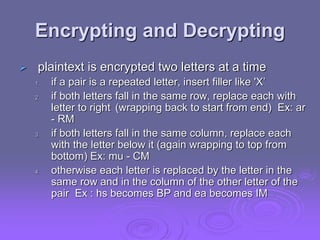
Encrypting and Decrypting
 plaintext is encrypted two letters at a time
1. if a pair is a repeated letter, insert filler like 'X’
2. if both letters fall in the same row, replace each with
letter to right (wrapping back to start from end) Ex: ar
- RM
3. if both letters fall in the same column, replace each
with the letter below it (again wrapping to top from
bottom) Ex: mu - CM
4. otherwise each letter is replaced by the letter in the
same row and in the column of the other letter of the
pair Ex : hs becomes BP and ea becomes IM
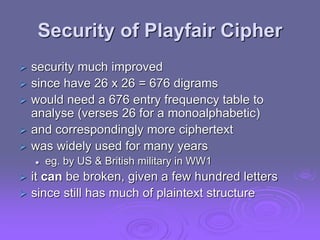
Security of Playfair Cipher
 security much improved
 since have 26 x 26 = 676 digrams
 would need a 676 entry frequency table to
analyse (verses 26 for a monoalphabetic)
 and correspondingly more ciphertext
 was widely used for many years
 eg. by US & British military in WW1
 it can be broken, given a few hundred letters
 since still has much of plaintext structure
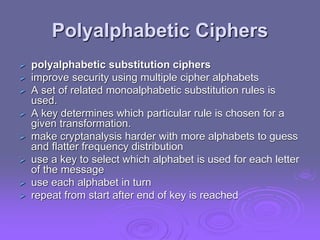
Polyalphabetic Ciphers
 polyalphabetic substitution ciphers
 improve security using multiple cipher alphabets
 A set of related monoalphabetic substitution rules is
used.
 A key determines which particular rule is chosen for a
given transformation.
 make cryptanalysis harder with more alphabets to guess
and flatter frequency distribution
 use a key to select which alphabet is used for each letter
of the message
 use each alphabet in turn
 repeat from start after end of key is reached
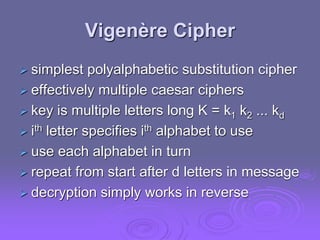
Vigenère Cipher
 simplest polyalphabetic substitution cipher
 effectively multiple caesar ciphers
 key is multiple letters long K = k1 k2 ... kd
 ith letter specifies ith alphabet to use
 use each alphabet in turn
 repeat from start after d letters in message
 decryption simply works in reverse
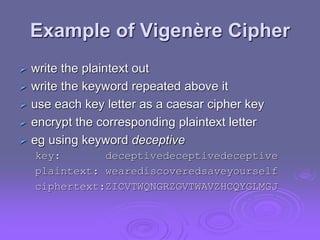
Example of Vigenère Cipher
 write the plaintext out
 write the keyword repeated above it
 use each key letter as a caesar cipher key
 encrypt the corresponding plaintext letter
 eg using keyword deceptive
key: deceptivedeceptivedeceptive
plaintext: wearediscoveredsaveyourself
ciphertext:ZICVTWQNGRZGVTWAVZHCQYGLMGJ
Security of Vigenère Ciphers
 have multiple ciphertext letters for each
plaintext letter
 hence letter frequencies are obscured
 but not totally lost
 start with letter frequencies
 see if look monoalphabetic or not
 if not, then need to determine number of
alphabets, since then can attach each
One-Time Pad
 if a truly random key as long as the message is
used, the cipher will be secure
 called a One-Time pad
 is unbreakable since ciphertext bears no
statistical relationship to the plaintext
 since for any plaintext & any ciphertext there
exists a key mapping one to other
 can only use the key once though
 problems in generation & safe distribution of key
Transposition Ciphers
 now consider classical transposition or
permutation ciphers
 these hide the message by rearranging
the letter order
 without altering the actual letters used
 can recognise these since have the same
frequency distribution as the original text
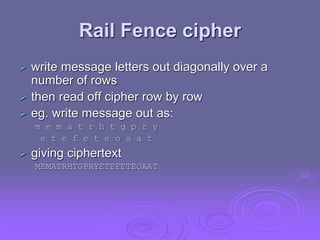
Rail Fence cipher
 write message letters out diagonally over a
number of rows
 then read off cipher row by row
 eg. write message out as:
m e m a t r h t g p r y
e t e f e t e o a a t
 giving ciphertext
MEMATRHTGPRYETEFETEOAAT
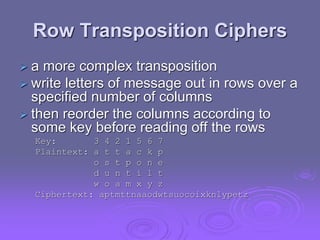
Row Transposition Ciphers
 a more complex transposition
 write letters of message out in rows over a
specified number of columns
 then reorder the columns according to
some key before reading off the rows
Key: 3 4 2 1 5 6 7
Plaintext: a t t a c k p
o s t p o n e
d u n t i l t
w o a m x y z
Ciphertext: aptmttnaaodwtsuocoixknlypetz
Product Ciphers
 ciphers using substitutions or transpositions are
not secure because of language characteristics
 hence consider using several ciphers in
succession to make harder, but:
 two substitutions make a more complex substitution
 two transpositions make more complex transposition
 but a substitution followed by a transposition makes a
new much harder cipher
 this is bridge from classical to modern ciphers
Rotor Machines
 before modern ciphers, rotor machines were
most common complex ciphers in use
 widely used in WW2
 German Enigma, Allied Hagelin, Japanese Purple
 implemented a very complex, varying
substitution cipher
 used a series of cylinders, each giving one
substitution, which rotated and changed after
each letter was encrypted
 with 3 cylinders have 263=17576 alphabets
Steganography
 an alternative to encryption
 hides existence of message
 using only a subset of letters/words in a
longer message marked in some way
 using invisible ink
 hiding in LSB in graphic image or sound file
 has drawbacks
 high overhead to hide relatively few info bits

classicalencryptiontechniques.ppt

  • 1.
  • 2.
    Symmetric Encryption  orconventional / private-key / single-key  sender and recipient share a common key  all classical encryption algorithms are private-key  was only type prior to invention of public- key in 1970’s  and by far most widely used
  • 3.
    Some Basic Terminology plaintext - original message  ciphertext - coded message  cipher - algorithm for transforming plaintext to ciphertext  key - info used in cipher known only to sender/receiver  encipher (encrypt) - converting plaintext to ciphertext  decipher (decrypt) - recovering ciphertext from plaintext  cryptography - study of encryption principles/methods  cryptanalysis (codebreaking) - study of principles/ methods of deciphering ciphertext without knowing key  cryptology - field of both cryptography and cryptanalysis
  • 4.
  • 5.
    Requirements  two requirementsfor secure use of symmetric encryption:  a strong encryption algorithm  a secret key known only to sender / receiver  mathematically have: Plain text X= [X1,X2,…XM]  Encryption Key K = [ K1,K2,…KJ] Y = EK(X) X = DK(Y)  assume encryption algorithm is known  implies a secure channel to distribute key
  • 6.
    Cryptography  characterize cryptographicsystem by:  type of encryption operations used • substitution / transposition / product  number of keys used • single-key or private / two-key or public  way in which plaintext is processed • block / stream
  • 7.
    Cryptanalysis  objective torecover key not just message  general approaches:  Cryptanalytic attack- Exploits the characteristics of the algorithm to attempt to deduce a specific plaintext or to deduce the key being used.  Brute-force attack – Attacker tries every possible key on a piece of cipher text until intelligible translation of plaintext is obtained.
  • 8.
    More Definitions  unconditionalsecurity  no matter how much computer power or time is available, the cipher cannot be broken since the ciphertext provides insufficient information to uniquely determine the corresponding plaintext  computational security  given limited computing resources (eg time needed for calculations is greater than age of universe), the cipher cannot be broken
  • 9.
    Brute Force Search always possible to simply try every key  most basic attack, proportional to key size  assume either know / recognise plaintext Key Size (bits) Number of Alternative Keys Time required at 1 decryption/µs Time required at 106 decryptions/µs 32 232 = 4.3  109 231 µs = 35.8 minutes 2.15 milliseconds 56 256 = 7.2  1016 255 µs = 1142 years 10.01 hours 128 2128 = 3.4  1038 2127 µs = 5.4  1024 years 5.4  1018 years 168 2168 = 3.7  1050 2167 µs = 5.9  1036 years 5.9  1030 years 26 characters (permutation) 26! = 4  1026 2  1026 µs = 6.4  1012 years 6.4  106 years
  • 10.
    Classical Substitution Ciphers  whereletters of plaintext are replaced by other letters or by numbers or symbols  or if plaintext is viewed as a sequence of bits, then substitution involves replacing plaintext bit patterns with cipher text bit patterns
  • 11.
    Caesar Cipher  earliestknown substitution cipher  by Julius Caesar  first attested use in military affairs  replaces each letter by 3rd letter on  example: meet me after the toga party PHHW PH DIWHU WKH WRJD SDUWB
  • 12.
    Caesar Cipher  candefine transformation as: a b c d e f g h i j k l m n o p q r s t u v w x y z D E F G H I J K L M N O P Q R S T U V W X Y Z A B C  mathematically give each letter a number a b c d e f g h i j k l m n o p q r s t u v w x y z 0 1 2 3 4 5 6 7 8 9 10 11 12 13 14 15 16 17 18 19 20 21 22 23 24 25  then have Caesar cipher as: c = E(p) = (p + k) mod (26) p = D(c) = (c – k) mod (26)
  • 13.
    Cryptanalysis of Caesar Cipher only have 26 possible ciphers  A maps to A,B,..Z  could simply try each in turn  a brute force search  given ciphertext, just try all shifts of letters  do need to recognize when have plaintext
  • 14.
    Monoalphabetic Cipher  ratherthan just shifting the alphabet  could shuffle (jumble) the letters arbitrarily  each plaintext letter maps to a different random ciphertext letter  hence key is 26 letters long Plain: abcdefghijklmnopqrstuvwxyz Cipher: DKVQFIBJWPESCXHTMYAUOLRGZN Plaintext: ifwewishtoreplaceletters Ciphertext: WIRFRWAJUHYFTSDVFSFUUFYA
  • 15.
    Playfair Cipher  oneapproach to improve security was to encrypt multiple letters  the Playfair Cipher is an example  invented by Charles Wheatstone in 1854, but named after his friend Baron Playfair
  • 16.
    Playfair Key Matrix a 5X5 matrix of letters based on a keyword  fill in letters of keyword (sans duplicates)  fill rest of matrix with other letters  eg. using the keyword MONARCHY M O N A R C H Y B D E F G I/J K L P Q S T U V W X Z
  • 17.
    Encrypting and Decrypting plaintext is encrypted two letters at a time 1. if a pair is a repeated letter, insert filler like 'X’ 2. if both letters fall in the same row, replace each with letter to right (wrapping back to start from end) Ex: ar - RM 3. if both letters fall in the same column, replace each with the letter below it (again wrapping to top from bottom) Ex: mu - CM 4. otherwise each letter is replaced by the letter in the same row and in the column of the other letter of the pair Ex : hs becomes BP and ea becomes IM
  • 18.
    Security of PlayfairCipher  security much improved  since have 26 x 26 = 676 digrams  would need a 676 entry frequency table to analyse (verses 26 for a monoalphabetic)  and correspondingly more ciphertext  was widely used for many years  eg. by US & British military in WW1  it can be broken, given a few hundred letters  since still has much of plaintext structure
  • 19.
    Polyalphabetic Ciphers  polyalphabeticsubstitution ciphers  improve security using multiple cipher alphabets  A set of related monoalphabetic substitution rules is used.  A key determines which particular rule is chosen for a given transformation.  make cryptanalysis harder with more alphabets to guess and flatter frequency distribution  use a key to select which alphabet is used for each letter of the message  use each alphabet in turn  repeat from start after end of key is reached
  • 20.
    Vigenère Cipher  simplestpolyalphabetic substitution cipher  effectively multiple caesar ciphers  key is multiple letters long K = k1 k2 ... kd  ith letter specifies ith alphabet to use  use each alphabet in turn  repeat from start after d letters in message  decryption simply works in reverse
  • 21.
    Example of VigenèreCipher  write the plaintext out  write the keyword repeated above it  use each key letter as a caesar cipher key  encrypt the corresponding plaintext letter  eg using keyword deceptive key: deceptivedeceptivedeceptive plaintext: wearediscoveredsaveyourself ciphertext:ZICVTWQNGRZGVTWAVZHCQYGLMGJ
  • 22.
    Security of VigenèreCiphers  have multiple ciphertext letters for each plaintext letter  hence letter frequencies are obscured  but not totally lost  start with letter frequencies  see if look monoalphabetic or not  if not, then need to determine number of alphabets, since then can attach each
  • 23.
    One-Time Pad  ifa truly random key as long as the message is used, the cipher will be secure  called a One-Time pad  is unbreakable since ciphertext bears no statistical relationship to the plaintext  since for any plaintext & any ciphertext there exists a key mapping one to other  can only use the key once though  problems in generation & safe distribution of key
  • 24.
    Transposition Ciphers  nowconsider classical transposition or permutation ciphers  these hide the message by rearranging the letter order  without altering the actual letters used  can recognise these since have the same frequency distribution as the original text
  • 25.
    Rail Fence cipher write message letters out diagonally over a number of rows  then read off cipher row by row  eg. write message out as: m e m a t r h t g p r y e t e f e t e o a a t  giving ciphertext MEMATRHTGPRYETEFETEOAAT
  • 26.
    Row Transposition Ciphers a more complex transposition  write letters of message out in rows over a specified number of columns  then reorder the columns according to some key before reading off the rows Key: 3 4 2 1 5 6 7 Plaintext: a t t a c k p o s t p o n e d u n t i l t w o a m x y z Ciphertext: aptmttnaaodwtsuocoixknlypetz
  • 27.
    Product Ciphers  ciphersusing substitutions or transpositions are not secure because of language characteristics  hence consider using several ciphers in succession to make harder, but:  two substitutions make a more complex substitution  two transpositions make more complex transposition  but a substitution followed by a transposition makes a new much harder cipher  this is bridge from classical to modern ciphers
  • 28.
    Rotor Machines  beforemodern ciphers, rotor machines were most common complex ciphers in use  widely used in WW2  German Enigma, Allied Hagelin, Japanese Purple  implemented a very complex, varying substitution cipher  used a series of cylinders, each giving one substitution, which rotated and changed after each letter was encrypted  with 3 cylinders have 263=17576 alphabets
  • 29.
    Steganography  an alternativeto encryption  hides existence of message  using only a subset of letters/words in a longer message marked in some way  using invisible ink  hiding in LSB in graphic image or sound file  has drawbacks  high overhead to hide relatively few info bits