ASSLAM U
ALAIKUM!
BEHAVIOURAL
APPROACHES
TO
LEARNING
Presented By:
Rabia Basri
Behaviourism
 It is a learning theory based on he
idea, that Behaviour can be
controlled & modified based on the
consequences of a behaviour.
 Learning occurs by copying others.
 Learning occurs by Repetition.
There are two types of
conditioning in
Behaviourism.
Classical Conditioning
Operant Conditioning
CLASSICAL
CONDITIONING
What is conditioning?
“A process of behavior
modification by which a
subject comes to associate
a desired behavior with a
previously unrelated
stimulus is called
conditioning.”
What is classical
conditioning?
Classical conditioning -
a type of learning in
which an organism learns
to connect or associate,
stimuli.
Pavlov’s Classical Conditioning
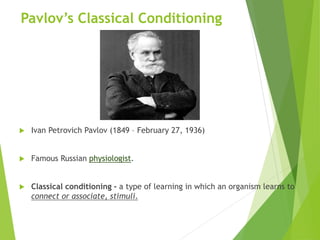
 Ivan Petrovich Pavlov (1849 – February 27, 1936)
 Famous Russian physiologist.
 Classical conditioning - a type of learning in which an organism learns to
connect or associate, stimuli.
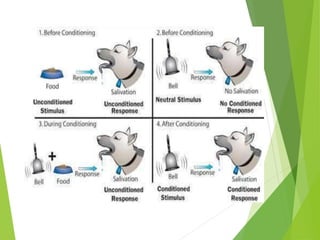
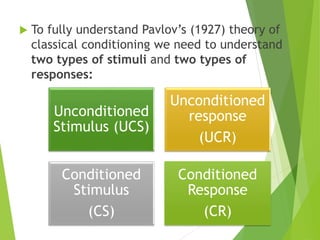
 To fully understand Pavlov’s (1927) theory of
classical conditioning we need to understand
two types of stimuli and two types of
responses:
Unconditioned
Stimulus (UCS)
Unconditioned
response
(UCR)
Conditioned
Stimulus
(CS)
Conditioned
Response
(CR)
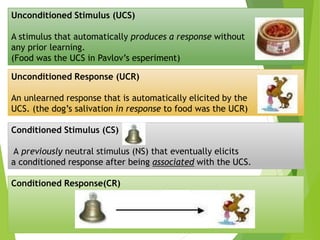
Conditioned Stimulus (CS)
A previously neutral stimulus (NS) that eventually elicits
a conditioned response after being associated with the UCS.
Unconditioned Stimulus (UCS)
A stimulus that automatically produces a response without
any prior learning.
(Food was the UCS in Pavlov’s esperiment)
Unconditioned Response (UCR)
An unlearned response that is automatically elicited by the
UCS. (the dog’s salivation in response to food was the UCR)
Conditioned Response(CR)
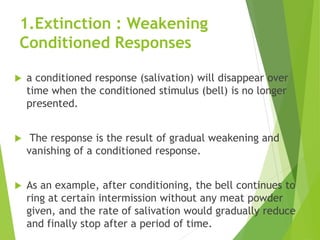
1.Extinction : Weakening
Conditioned Responses
 a conditioned response (salivation) will disappear over
time when the conditioned stimulus (bell) is no longer
presented.
 The response is the result of gradual weakening and
vanishing of a conditioned response.
 As an example, after conditioning, the bell continues to
ring at certain intermission without any meat powder
given, and the rate of salivation would gradually reduce
and finally stop after a period of time.
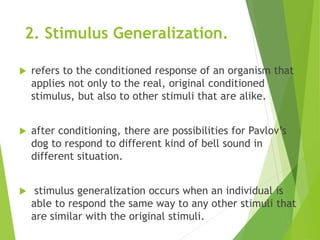
2. Stimulus Generalization.
 refers to the conditioned response of an organism that
applies not only to the real, original conditioned
stimulus, but also to other stimuli that are alike.
 after conditioning, there are possibilities for Pavlov’s
dog to respond to different kind of bell sound in
different situation.
 stimulus generalization occurs when an individual is
able to respond the same way to any other stimuli that
are similar with the original stimuli.
Implications of Pavlov’s Conditioning
Theory in Teaching Learning
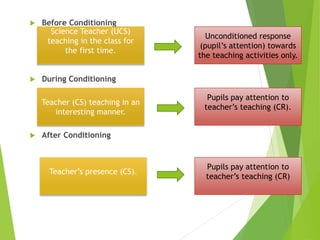
 Before Conditioning
 During Conditioning
 After Conditioning
Science Teacher (UCS)
teaching in the class for
the first time.
Unconditioned response
(pupil’s attention) towards
the teaching activities only.
Teacher (CS) teaching in an
interesting manner.
Pupils pay attention to
teacher’s teaching (CR).
Teacher’s presence (CS).
Pupils pay attention to
teacher’s teaching (CR)
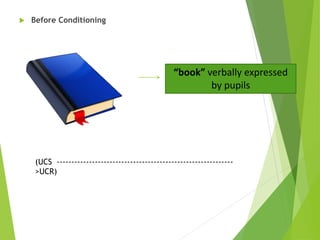
 Before Conditioning
“book” verbally expressed
by pupils
(UCS ------------------------------------------------------------
>UCR)
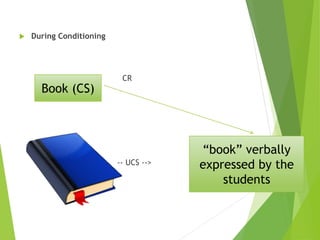
 During Conditioning
CR
-- UCS -->
Book (CS)
“book” verbally
expressed by the
students
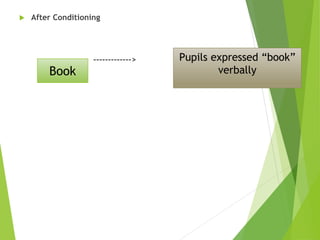
 After Conditioning
------------->
Book
Pupils expressed “book”
verbally
Watson’s
Conditioning
Theory
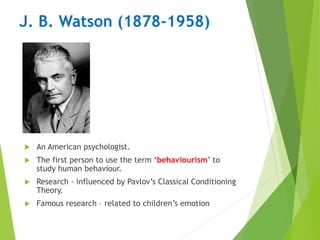
J. B. Watson (1878-1958)
 An American psychologist.
 The first person to use the term ‘behaviourism’ to
study human behaviour.
 Research - influenced by Pavlov’s Classical Conditioning
Theory.
 Famous research – related to children’s emotion
The experiment
 Together with colleague,
Rosalie Rayner (1920), they
used a nine-month old baby,
named Little Albert and a
white tame mouse to conduct
the experiment.
1. A white mouse was brought to Little Albert whom he
showed interest to play with.
2. As soon as the white mouse was shown to Albert the
second time, a loud, startling sound was emitted all of
a sudden from the back.
3. Immediately, Albert’s reaction was panic and
frightened.
4. After conditioned response was established, Little
Albert began to show fear of the white mouse itself.
Implications of Watson’s Learning
Theory in Teaching and Learning
1. All types of behaviour can be learned through
conditioning process. Positive behaviour can be
taught by using suitable stimulus.
2. Pupils ought to relate the relationship between
all responses systematically in order to master
the skill of solving problems.
3. More exercises should be carried out after
learning in order to strengthen what has been
learned in the memory
4. Teacher should use suitable stimulus during
the teaching process to motivate pupils in
learning, and at the same time, avoid using
stimulus which will produce negative effect.
OPERANT
CONDITIONING
What is operant
conditioning?
Operant conditioning is an
association made between
a behavior and a
consequence for that
behavior.
B.F. Skinner
 1904-1990
 American psychologist, author,
inventor, advocate for social
reform, and poet.
 Wanted to find principles that
controlled behavior.
 Wrote controversial books which
describe utopian society based on
rules of behaviorism.
REINFOCEMENT
Ii is a process which
strengthen a desired
behaviour with in any
organism.
REINFOCER
Any event or stimulus, that
when following a response,
increases the probability
that the response will occur
again.
Any event that strengthens
the behavior it follows.
Types of
reinforcement
A. Positive reinforcement
 The reinforcement of a response by
the addition or experiencing of a
pleasurable stimulus.
B. Negative reinforcement
 The reinforcement of a response by
the removal, escape from, or
avoidance of an unpleasant stimulus.
EXAMPLES
 children completing homework to
earn a reward from a parent or
teacher
 employees finishing projects to
receive praise or promotions
 a child who lost recess privileges
because he talk out of turn in class
Educational Implications
We can use operant conditioning
in classroom to enhance:
 Productivity
 Interest
 Behaviour modification
 Skills
 Conceptual Understanding
 Motivation
Any
Question???
Thanks

Behavioural approach to learning

  • 1.
  • 2.
  • 3.
    Behaviourism  It isa learning theory based on he idea, that Behaviour can be controlled & modified based on the consequences of a behaviour.  Learning occurs by copying others.  Learning occurs by Repetition.
  • 4.
    There are twotypes of conditioning in Behaviourism. Classical Conditioning Operant Conditioning
  • 5.
  • 6.
    What is conditioning? “Aprocess of behavior modification by which a subject comes to associate a desired behavior with a previously unrelated stimulus is called conditioning.”
  • 7.
    What is classical conditioning? Classicalconditioning - a type of learning in which an organism learns to connect or associate, stimuli.
  • 8.
    Pavlov’s Classical Conditioning Ivan Petrovich Pavlov (1849 – February 27, 1936)  Famous Russian physiologist.  Classical conditioning - a type of learning in which an organism learns to connect or associate, stimuli.
  • 10.
     To fullyunderstand Pavlov’s (1927) theory of classical conditioning we need to understand two types of stimuli and two types of responses: Unconditioned Stimulus (UCS) Unconditioned response (UCR) Conditioned Stimulus (CS) Conditioned Response (CR)
  • 11.
    Conditioned Stimulus (CS) Apreviously neutral stimulus (NS) that eventually elicits a conditioned response after being associated with the UCS. Unconditioned Stimulus (UCS) A stimulus that automatically produces a response without any prior learning. (Food was the UCS in Pavlov’s esperiment) Unconditioned Response (UCR) An unlearned response that is automatically elicited by the UCS. (the dog’s salivation in response to food was the UCR) Conditioned Response(CR)
  • 12.
    1.Extinction : Weakening ConditionedResponses  a conditioned response (salivation) will disappear over time when the conditioned stimulus (bell) is no longer presented.  The response is the result of gradual weakening and vanishing of a conditioned response.  As an example, after conditioning, the bell continues to ring at certain intermission without any meat powder given, and the rate of salivation would gradually reduce and finally stop after a period of time.
  • 13.
    2. Stimulus Generalization. refers to the conditioned response of an organism that applies not only to the real, original conditioned stimulus, but also to other stimuli that are alike.  after conditioning, there are possibilities for Pavlov’s dog to respond to different kind of bell sound in different situation.  stimulus generalization occurs when an individual is able to respond the same way to any other stimuli that are similar with the original stimuli.
  • 14.
    Implications of Pavlov’sConditioning Theory in Teaching Learning
  • 15.
     Before Conditioning During Conditioning  After Conditioning Science Teacher (UCS) teaching in the class for the first time. Unconditioned response (pupil’s attention) towards the teaching activities only. Teacher (CS) teaching in an interesting manner. Pupils pay attention to teacher’s teaching (CR). Teacher’s presence (CS). Pupils pay attention to teacher’s teaching (CR)
  • 16.
     Before Conditioning “book”verbally expressed by pupils (UCS ------------------------------------------------------------ >UCR)
  • 17.
     During Conditioning CR --UCS --> Book (CS) “book” verbally expressed by the students
  • 18.
  • 19.
  • 20.
    J. B. Watson(1878-1958)  An American psychologist.  The first person to use the term ‘behaviourism’ to study human behaviour.  Research - influenced by Pavlov’s Classical Conditioning Theory.  Famous research – related to children’s emotion
  • 21.
    The experiment  Togetherwith colleague, Rosalie Rayner (1920), they used a nine-month old baby, named Little Albert and a white tame mouse to conduct the experiment.
  • 22.
    1. A whitemouse was brought to Little Albert whom he showed interest to play with. 2. As soon as the white mouse was shown to Albert the second time, a loud, startling sound was emitted all of a sudden from the back. 3. Immediately, Albert’s reaction was panic and frightened. 4. After conditioned response was established, Little Albert began to show fear of the white mouse itself.
  • 23.
    Implications of Watson’sLearning Theory in Teaching and Learning 1. All types of behaviour can be learned through conditioning process. Positive behaviour can be taught by using suitable stimulus. 2. Pupils ought to relate the relationship between all responses systematically in order to master the skill of solving problems.
  • 24.
    3. More exercisesshould be carried out after learning in order to strengthen what has been learned in the memory 4. Teacher should use suitable stimulus during the teaching process to motivate pupils in learning, and at the same time, avoid using stimulus which will produce negative effect.
  • 25.
  • 26.
    What is operant conditioning? Operantconditioning is an association made between a behavior and a consequence for that behavior.
  • 27.
    B.F. Skinner  1904-1990 American psychologist, author, inventor, advocate for social reform, and poet.  Wanted to find principles that controlled behavior.  Wrote controversial books which describe utopian society based on rules of behaviorism.
  • 28.
    REINFOCEMENT Ii is aprocess which strengthen a desired behaviour with in any organism.
  • 29.
    REINFOCER Any event orstimulus, that when following a response, increases the probability that the response will occur again. Any event that strengthens the behavior it follows.
  • 30.
    Types of reinforcement A. Positivereinforcement  The reinforcement of a response by the addition or experiencing of a pleasurable stimulus. B. Negative reinforcement  The reinforcement of a response by the removal, escape from, or avoidance of an unpleasant stimulus.
  • 31.
    EXAMPLES  children completinghomework to earn a reward from a parent or teacher  employees finishing projects to receive praise or promotions  a child who lost recess privileges because he talk out of turn in class
  • 32.
    Educational Implications We canuse operant conditioning in classroom to enhance:  Productivity  Interest  Behaviour modification  Skills  Conceptual Understanding  Motivation
  • 33.
  • 34.