Learning
DR. SSEKAWU CHARLES
Definition
• acquiring of knowledge (James E. Mazur).
• Learning is relatively permanent change in
behaviour brought about by experience (Rod Plotnik,
1989).
• Learning is the changing of behavior in
response to experience and comes in a
number of forms, each of which operates
according to distinct principles.
Knowledge: Information in the mind, e.g. facts, ideas, truths, principles, objects, images
Forms of learning
• Conditioning
– Classical conditioning
– Operant/operational/instrumental/functional
conditioning
• Cognitive learning
– Latent learning
– Observational learning
Principles of Learning
• Learning: A relatively permanent change in
behavior based on experience.
• Classical conditioning: A method of learning that
creates new associations between neutral stimuli
and reflex-causing stimuli.
• Operant conditioning: A method of learning that
alters the frequency of a behavior by
manipulating its consequences through
reinforcement or punishment.
• Observational learning/social learning: A form of
learning that occurs by watching the behaviors of
others.
• Classical conditioning is a form of learning in
which people (or any organism) learns to
associate two stimuli that occur in sequence.
• Classical conditioning occurs when a person
forms a mental association between two
stimuli, so that encountering one stimulus
means the person thinks of the other.
Condition: to make people or animals act or react in a particular way by
gradually getting them used to a specific pattern of events.
Terminologies used
• Classical conditioning was discovered by Ivan Petrovich
Pavlov in 1900s.
• Neutral Stimulus: a stimulus that, before conditioning, has
no effect on the desired response.
• Unconditioned Stimulus (UCS): a stimulus that brings
about a response without having been learned.
• Unconditioned response (UCR): a response that is natural
and needs no training.
• Conditioned Stimulus (CS): Once-neutral stimulus that has
been paired with an unconditioned stimulus to bring about
a response formerly caused only by the unconditioned
stimulus.
• Conditioned response (CR): a response that, after
conditioning, follows a previously neutral stimulus.
Principles of Classical Conditioning
Process
• 1. The acquisition phase is the initial learning
of the conditioned response—for example, the
dog learning to salivate at the sound of the bell.
Acquisition: the act of acquiring something
2. Extinction is used to describe the elimination
of the conditioned response by repeatedly
presenting the conditioned stimulus without
the unconditioned stimulus.
• If a dog has learned to salivate at the sound of
a bell, an experimenter can gradually
extinguish the dog’s response by repeatedly
ringing the bell without presenting food
afterward.
3. Spontaneous Recovery.
• Extinction does not mean, however, that the dog
has simply unlearned or forgotten the association
between the bell and the food.
• After extinction, if the experimenter lets a few
hours pass and then rings the bell again, the dog
will usually salivate at the sound of the bell once
again.
• The reappearance of an extinguished response
after some time has passed is called spontaneous
recovery.
4. Generalization
• After an animal has learned a conditioned
response to one stimulus, it may also respond to
similar stimuli without further training.
• If a child is bitten by a large black dog, the child
may fear not only that dog, but other large dogs.
• This phenomenon is called generalization.
• Less similar stimuli will usually produce less
generalization.
• For example, the child may show little fear of
smaller dogs.
5. Discrimination
• The opposite of generalization is
discrimination, in which an individual learns to
produce a conditioned response to one
stimulus but not to another stimulus that is
similar.
• For example, a child may show a fear response
to freely roaming dogs, but may show no fear
when a dog is on a leash or confined to a pen.
Application of Classical Conditioning
• classical conditioning explains some cases of
phobias, which are irrational or excessive fears
of specific objects or situations.
• classical conditioning explains many
emotional responses—such as happiness,
excitement, anger, and anxiety—that people
have to specific stimuli.
• classical conditioning procedures are used to
treat phobias and other unwanted behaviors,
such as alcoholism and addictions.
• To treat phobias of specific objects, the therapist
gradually and repeatedly presents the feared
object to the patient while the patient relaxes.
• Through extinction, the patient loses his or her
fear of the object.
• In one treatment for alcoholism, patients drink an
alcoholic beverage and then ingest a drug that
produces nausea.
• Eventually they feel nauseous at the sight or
smell of alcohol and stop drinking it.
• Operant or Instrumental Conditioning is a
type of learning in which voluntary behavior is
strengthened if it is reinforced and weakened
if it is punished.
• Note: Skinner referred to this as Instrumental Conditioning/Learning
• The term operant conditioning refers to the
fact that the learner must operate, or perform
a certain behaviour, before receiving a reward
or punishment.
Edward L. Thorndike’s Law of Effect
• This law states that
behaviors that are
followed by pleasant
consequences will be
strengthened, and will be
more likely to occur in the
future.
• Conversely, behaviors
that are followed by
unpleasant consequences
will be weakened, and
will be less likely to be
repeated in the future.
Thorndike’s Puzzle box
B.F. Skinner Experiments
• American psychologist B. F. Skinner became
one of the most famous psychologists in
history for his pioneering research on operant
conditioning.
• In fact, he coined the term operant
conditioning.
• Beginning in the 1930s, Skinner spent several
decades studying the behavior of animals—
usually rats or pigeons—in chambers that
became known as Skinner boxes.
• Like Thorndike’s puzzle box, the Skinner box was
a barren chamber in which an animal could earn
food by making simple responses, such as
pressing a lever or a circular response key.
• A device attached to the box recorded the
animal’s responses.
Principles of Operant Conditioning
1. Reinforcement refers to any process that strengthens a
particular behavior—that is, increases the chances that
the behavior will occur again.
– Positive reinforcement: a method of strengthening
behavior by following it with a pleasant stimulus.
– Negative reinforcement: Negative reinforcement is a
method of strengthening a behavior by following it with
the removal or omission of an unpleasant stimulus.
1. Escape: In escape, performing a particular behavior leads to the
removal of an unpleasant stimulus.
2. Avoidance: In avoidance, people perform a behavior to avoid
unpleasant consequences.
2. Punishment weakens a behaviour, reducing
the chances that the behavior will occur again.
– Positive: involves reducing a behavior by
delivering an unpleasant stimulus if the behavior
occurs.
– Negative: involves reducing a behavior by
removing a pleasant stimulus if the behavior
occurs.
Types of Reinforcement and Punishment
Positive
Reinforcement
Negative
Reinforcement
Punishment
Stimulus is Added Removed Added or removed
Desired effect on
behaviour
Increases in response
strength
Increase in response
strength
Decrease in
response strength
Example Giving a raise for
good performance
leads to increase in
good performance
Taking an aspirin to
relieve a headache
leads to a higher future
likelihood of taking
aspirin
Penalizing for
misbehaving leads
to a decrease in
frequency of that
behaviour
stimulus Behaviour/action
3. Shaping is a reinforcement technique that is used to
teach animals or people behaviours that they have
never performed before.
•
• In this method, the teacher begins by reinforcing a
response the learner can perform easily, and then
gradually requires more and more difficult responses.
• For example, to teach a rat to press a lever that is over
its head, the trainer can first reward any upward head
movement, then an upward movement of at least one
inch, then two inches, and so on, until the rat reaches
the lever.
4. extinction is the elimination of a learned
behavior by discontinuing the reinforcer of
that behavior.
A behaviour learned is not always permanent.
If a rate has learned to press a lever because it receives food for doing so, its
lever-pressing will decrease and eventually disappear if food is no longer
delivered.
5. Generalization and discrimination occur in
operant conditioning in much the same way that
they do in classical conditioning.
• In generalization, people perform a behaviour
learned in one situation in other, similar
situations.
• For example, a man who is rewarded with
laughter when he tells certain jokes at a bar may
tell the same jokes at restaurants, parties, or
wedding receptions.
Generalizing Pakhtoons or Punjabis or Sardars etc.
• Discrimination is learning that a behavior will
be reinforced in one situation but not in
another.
• The man may learn that telling his jokes in
church or at a serious business meeting will
not make people laugh.
Application of Operant Conditioning
• Parents
• Teachers
• Behavior therapists use shaping techniques to teach
basic job skills to adults with mental retardation.
• Therapists use reinforcement techniques to teach self-
care skills to people with severe mental illnesses, such
as schizophrenia, and use punishment and extinction
to reduce aggressive and antisocial behaviors by these
individuals.
• to treat stuttering, marital problems, drug addictions,
impulsive spending, eating disorders, and many other
behavioral problems.
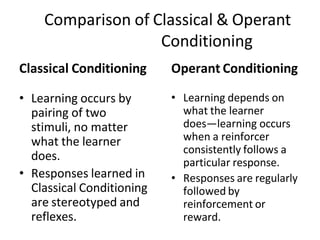
Comparison of Classical & Operant
Conditioning
• Learning occurs by
pairing of two
stimuli, no matter
what the learner
does.
• Responses learned in
Classical Conditioning
are stereotyped and
reflexes.
• Learning depends on
what the learner
does—learning occurs
when a reinforcer
consistently follows a
particular response.
• Responses are regularly
followed by
reinforcement or
reward.
Classical Conditioning Operant Conditioning
Cognitive Approaches to Learning
• Cognitive learning theory is an approach to the
study of learning that focuses on the thought
processes ( ) that underlie learning.
• Rather than concentrating solely on external
stimuli, responses, and reinforcements,
Cognitive-Social Learning theorists focus on the
unseen mental processes that occur during
learning.
1. Latent Learning
• Latent learning is learning in which a new
behaviour is acquired but is not demonstrated
until some incentive is provided for displaying
it.
Latent: hidden; present but unexpressed
Tolman’s Maze Experiment
Maze: puzzle made of connecting parts.
• Rats: one maze
trial/day
• One group found food
every time (red line)
• Second group never
found food (blue line)
• Third group found
food on Day 11 (green
line)
– Sudden change, day
12
• Learning isn’t the
same as performance
• Cognitive-map –a mental representation of
spatial locations and directions.
2. Observational Learning
• Learning through observing the behaviour of
another person called a model (Robert S.
Feldman., 2005. p.211).
•
Essential Factors for Observational Learning
a. Attention,
b. Retention,
c. Reproduction, and
d. Motivation
a. Attention
• First, the learner must pay attention to the
crucial details of the model’s behavior.
• A young girl watching her mother bake a cake
will not be able to imitate this behavior
successfully unless she pays attention to many
important details—ingredients, quantities,
oven temperature, baking time, and so on.
b. Retention
• Retention—the learner must be able to retain
all of this information in memory until it is time
to use it.
• If the person forgets important details, he or
she will not be able to successfully imitate the
behavior.
Retention: the ability to remember things
c. Reproduction
• Third, the learner must have the physical skills
and coordination needed for reproduction of
the behavior.
• The young girl must have enough strength and
dexterity to mix the ingredients, pour the
batter, and so on, in order to bake a cake on
her own.
d. Motivation
• Finally, the learner must have the motivation
to imitate the model.
• That is, learners are more likely to imitate a
behavior if they expect it to lead to some type
of reward or reinforcement.
• If learners expect that imitating the behavior
will not lead to reward or might lead to
punishment, they are less likely to imitate the
behavior.
learning PSYCHOLOGY.pptx

learning PSYCHOLOGY.pptx

  • 1.
  • 2.
    Definition • acquiring ofknowledge (James E. Mazur). • Learning is relatively permanent change in behaviour brought about by experience (Rod Plotnik, 1989). • Learning is the changing of behavior in response to experience and comes in a number of forms, each of which operates according to distinct principles. Knowledge: Information in the mind, e.g. facts, ideas, truths, principles, objects, images
  • 3.
    Forms of learning •Conditioning – Classical conditioning – Operant/operational/instrumental/functional conditioning • Cognitive learning – Latent learning – Observational learning
  • 4.
    Principles of Learning •Learning: A relatively permanent change in behavior based on experience. • Classical conditioning: A method of learning that creates new associations between neutral stimuli and reflex-causing stimuli. • Operant conditioning: A method of learning that alters the frequency of a behavior by manipulating its consequences through reinforcement or punishment. • Observational learning/social learning: A form of learning that occurs by watching the behaviors of others.
  • 5.
    • Classical conditioningis a form of learning in which people (or any organism) learns to associate two stimuli that occur in sequence. • Classical conditioning occurs when a person forms a mental association between two stimuli, so that encountering one stimulus means the person thinks of the other. Condition: to make people or animals act or react in a particular way by gradually getting them used to a specific pattern of events.
  • 6.
    Terminologies used • Classicalconditioning was discovered by Ivan Petrovich Pavlov in 1900s. • Neutral Stimulus: a stimulus that, before conditioning, has no effect on the desired response. • Unconditioned Stimulus (UCS): a stimulus that brings about a response without having been learned. • Unconditioned response (UCR): a response that is natural and needs no training. • Conditioned Stimulus (CS): Once-neutral stimulus that has been paired with an unconditioned stimulus to bring about a response formerly caused only by the unconditioned stimulus. • Conditioned response (CR): a response that, after conditioning, follows a previously neutral stimulus.
  • 8.
    Principles of ClassicalConditioning Process • 1. The acquisition phase is the initial learning of the conditioned response—for example, the dog learning to salivate at the sound of the bell. Acquisition: the act of acquiring something
  • 9.
    2. Extinction isused to describe the elimination of the conditioned response by repeatedly presenting the conditioned stimulus without the unconditioned stimulus. • If a dog has learned to salivate at the sound of a bell, an experimenter can gradually extinguish the dog’s response by repeatedly ringing the bell without presenting food afterward.
  • 10.
    3. Spontaneous Recovery. •Extinction does not mean, however, that the dog has simply unlearned or forgotten the association between the bell and the food. • After extinction, if the experimenter lets a few hours pass and then rings the bell again, the dog will usually salivate at the sound of the bell once again. • The reappearance of an extinguished response after some time has passed is called spontaneous recovery.
  • 11.
    4. Generalization • Afteran animal has learned a conditioned response to one stimulus, it may also respond to similar stimuli without further training. • If a child is bitten by a large black dog, the child may fear not only that dog, but other large dogs. • This phenomenon is called generalization. • Less similar stimuli will usually produce less generalization. • For example, the child may show little fear of smaller dogs.
  • 12.
    5. Discrimination • Theopposite of generalization is discrimination, in which an individual learns to produce a conditioned response to one stimulus but not to another stimulus that is similar. • For example, a child may show a fear response to freely roaming dogs, but may show no fear when a dog is on a leash or confined to a pen.
  • 13.
    Application of ClassicalConditioning • classical conditioning explains some cases of phobias, which are irrational or excessive fears of specific objects or situations. • classical conditioning explains many emotional responses—such as happiness, excitement, anger, and anxiety—that people have to specific stimuli.
  • 14.
    • classical conditioningprocedures are used to treat phobias and other unwanted behaviors, such as alcoholism and addictions. • To treat phobias of specific objects, the therapist gradually and repeatedly presents the feared object to the patient while the patient relaxes. • Through extinction, the patient loses his or her fear of the object. • In one treatment for alcoholism, patients drink an alcoholic beverage and then ingest a drug that produces nausea. • Eventually they feel nauseous at the sight or smell of alcohol and stop drinking it.
  • 16.
    • Operant orInstrumental Conditioning is a type of learning in which voluntary behavior is strengthened if it is reinforced and weakened if it is punished. • Note: Skinner referred to this as Instrumental Conditioning/Learning • The term operant conditioning refers to the fact that the learner must operate, or perform a certain behaviour, before receiving a reward or punishment.
  • 17.
    Edward L. Thorndike’sLaw of Effect • This law states that behaviors that are followed by pleasant consequences will be strengthened, and will be more likely to occur in the future. • Conversely, behaviors that are followed by unpleasant consequences will be weakened, and will be less likely to be repeated in the future. Thorndike’s Puzzle box
  • 18.
    B.F. Skinner Experiments •American psychologist B. F. Skinner became one of the most famous psychologists in history for his pioneering research on operant conditioning. • In fact, he coined the term operant conditioning.
  • 19.
    • Beginning inthe 1930s, Skinner spent several decades studying the behavior of animals— usually rats or pigeons—in chambers that became known as Skinner boxes. • Like Thorndike’s puzzle box, the Skinner box was a barren chamber in which an animal could earn food by making simple responses, such as pressing a lever or a circular response key. • A device attached to the box recorded the animal’s responses.
  • 21.
    Principles of OperantConditioning 1. Reinforcement refers to any process that strengthens a particular behavior—that is, increases the chances that the behavior will occur again. – Positive reinforcement: a method of strengthening behavior by following it with a pleasant stimulus. – Negative reinforcement: Negative reinforcement is a method of strengthening a behavior by following it with the removal or omission of an unpleasant stimulus. 1. Escape: In escape, performing a particular behavior leads to the removal of an unpleasant stimulus. 2. Avoidance: In avoidance, people perform a behavior to avoid unpleasant consequences.
  • 22.
    2. Punishment weakensa behaviour, reducing the chances that the behavior will occur again. – Positive: involves reducing a behavior by delivering an unpleasant stimulus if the behavior occurs. – Negative: involves reducing a behavior by removing a pleasant stimulus if the behavior occurs.
  • 23.
    Types of Reinforcementand Punishment Positive Reinforcement Negative Reinforcement Punishment Stimulus is Added Removed Added or removed Desired effect on behaviour Increases in response strength Increase in response strength Decrease in response strength Example Giving a raise for good performance leads to increase in good performance Taking an aspirin to relieve a headache leads to a higher future likelihood of taking aspirin Penalizing for misbehaving leads to a decrease in frequency of that behaviour stimulus Behaviour/action
  • 24.
    3. Shaping isa reinforcement technique that is used to teach animals or people behaviours that they have never performed before. • • In this method, the teacher begins by reinforcing a response the learner can perform easily, and then gradually requires more and more difficult responses. • For example, to teach a rat to press a lever that is over its head, the trainer can first reward any upward head movement, then an upward movement of at least one inch, then two inches, and so on, until the rat reaches the lever.
  • 25.
    4. extinction isthe elimination of a learned behavior by discontinuing the reinforcer of that behavior. A behaviour learned is not always permanent. If a rate has learned to press a lever because it receives food for doing so, its lever-pressing will decrease and eventually disappear if food is no longer delivered.
  • 26.
    5. Generalization anddiscrimination occur in operant conditioning in much the same way that they do in classical conditioning. • In generalization, people perform a behaviour learned in one situation in other, similar situations. • For example, a man who is rewarded with laughter when he tells certain jokes at a bar may tell the same jokes at restaurants, parties, or wedding receptions. Generalizing Pakhtoons or Punjabis or Sardars etc.
  • 27.
    • Discrimination islearning that a behavior will be reinforced in one situation but not in another. • The man may learn that telling his jokes in church or at a serious business meeting will not make people laugh.
  • 28.
    Application of OperantConditioning • Parents • Teachers • Behavior therapists use shaping techniques to teach basic job skills to adults with mental retardation. • Therapists use reinforcement techniques to teach self- care skills to people with severe mental illnesses, such as schizophrenia, and use punishment and extinction to reduce aggressive and antisocial behaviors by these individuals. • to treat stuttering, marital problems, drug addictions, impulsive spending, eating disorders, and many other behavioral problems.
  • 29.
    Comparison of Classical& Operant Conditioning • Learning occurs by pairing of two stimuli, no matter what the learner does. • Responses learned in Classical Conditioning are stereotyped and reflexes. • Learning depends on what the learner does—learning occurs when a reinforcer consistently follows a particular response. • Responses are regularly followed by reinforcement or reward. Classical Conditioning Operant Conditioning
  • 31.
    Cognitive Approaches toLearning • Cognitive learning theory is an approach to the study of learning that focuses on the thought processes ( ) that underlie learning. • Rather than concentrating solely on external stimuli, responses, and reinforcements, Cognitive-Social Learning theorists focus on the unseen mental processes that occur during learning.
  • 32.
    1. Latent Learning •Latent learning is learning in which a new behaviour is acquired but is not demonstrated until some incentive is provided for displaying it. Latent: hidden; present but unexpressed
  • 33.
    Tolman’s Maze Experiment Maze:puzzle made of connecting parts.
  • 34.
    • Rats: onemaze trial/day • One group found food every time (red line) • Second group never found food (blue line) • Third group found food on Day 11 (green line) – Sudden change, day 12 • Learning isn’t the same as performance
  • 35.
    • Cognitive-map –amental representation of spatial locations and directions.
  • 36.
    2. Observational Learning •Learning through observing the behaviour of another person called a model (Robert S. Feldman., 2005. p.211). •
  • 37.
    Essential Factors forObservational Learning a. Attention, b. Retention, c. Reproduction, and d. Motivation
  • 38.
    a. Attention • First,the learner must pay attention to the crucial details of the model’s behavior. • A young girl watching her mother bake a cake will not be able to imitate this behavior successfully unless she pays attention to many important details—ingredients, quantities, oven temperature, baking time, and so on.
  • 39.
    b. Retention • Retention—thelearner must be able to retain all of this information in memory until it is time to use it. • If the person forgets important details, he or she will not be able to successfully imitate the behavior. Retention: the ability to remember things
  • 40.
    c. Reproduction • Third,the learner must have the physical skills and coordination needed for reproduction of the behavior. • The young girl must have enough strength and dexterity to mix the ingredients, pour the batter, and so on, in order to bake a cake on her own.
  • 41.
    d. Motivation • Finally,the learner must have the motivation to imitate the model. • That is, learners are more likely to imitate a behavior if they expect it to lead to some type of reward or reinforcement. • If learners expect that imitating the behavior will not lead to reward or might lead to punishment, they are less likely to imitate the behavior.