Learning
Classical and
Operant Conditioning
Chapter 3
A Life without Learning
 Learning is more than school, books and
tests. Without learning our lives would
simply be a series of reflexes and instincts.
 We would not be able to communicate, we
would have no memory of our past or
goals for the future.
Learning
 Learning is a lasting change in behavior or
mental process as the result of an experience.
 There are two important parts:
 a lasting change…a simple reflexive reaction is not learning
 learning regarding mental process is much harder to
observe and study.
Learning & It’s Effect on Behavior
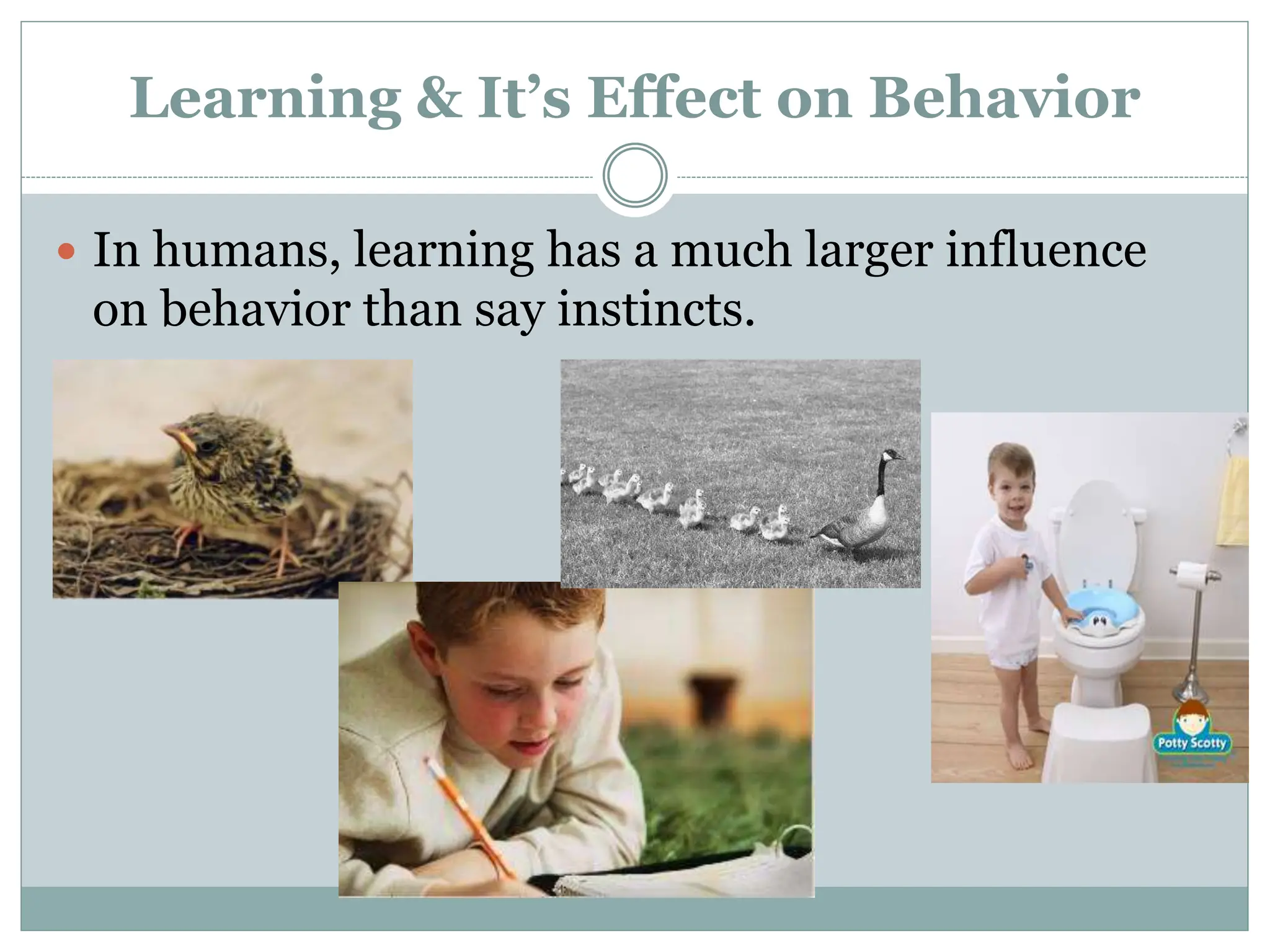
 In humans, learning has a much larger influence
on behavior than say instincts.
SIMPLE AND
COMPLEX LEARNING
Types of Learning
Simple Learning
 Habituation: Learning not to respond to the
repeated presentation of a stimulus.
 Example: Emergency sirens in the city
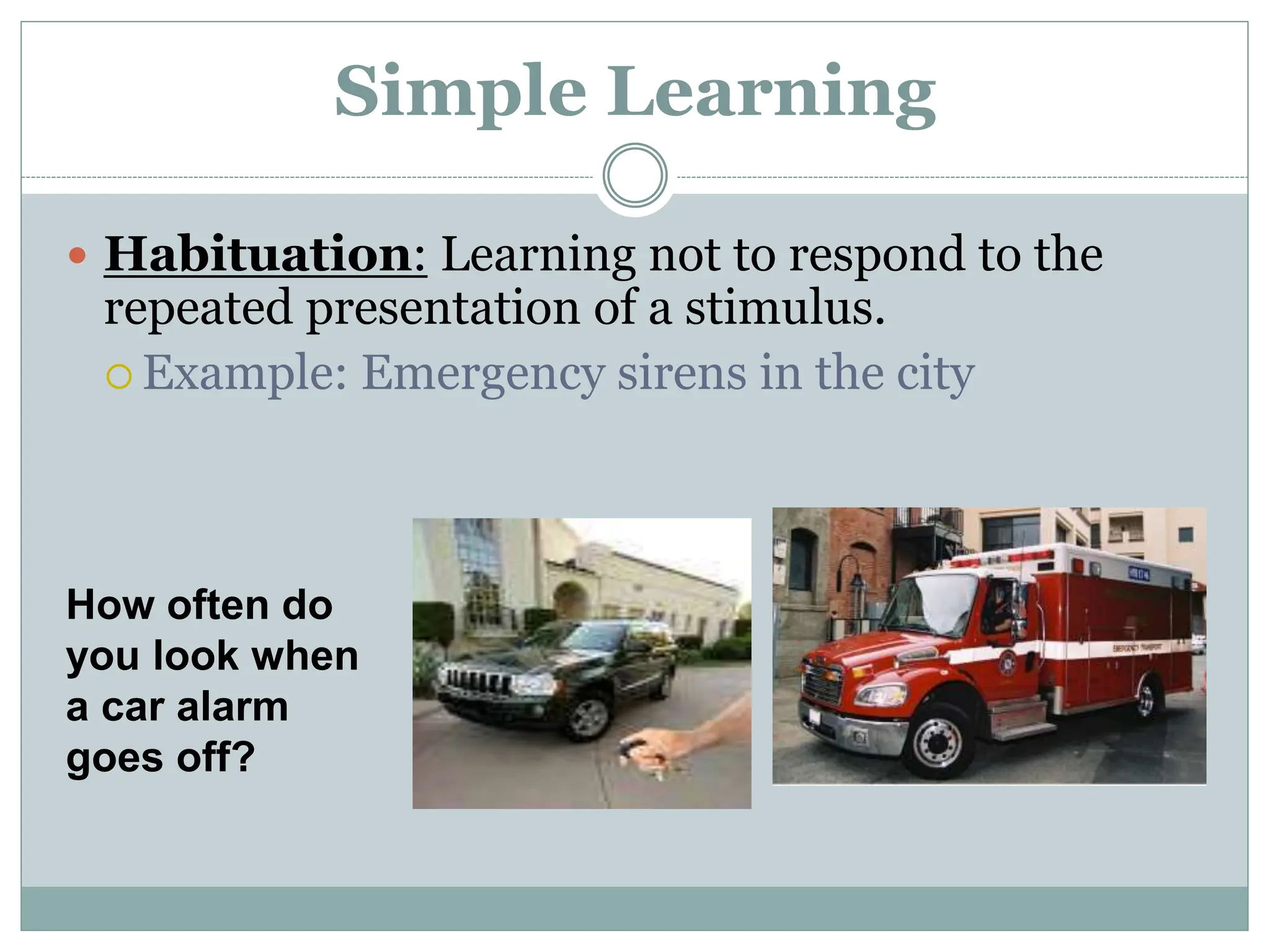
How often do
you look when
a car alarm
goes off?
Simple Learning
 Mere Exposure Effect: A learned preference for
stimuli to which we have been previously exposed.
 Ex-A coach/parent’s voice
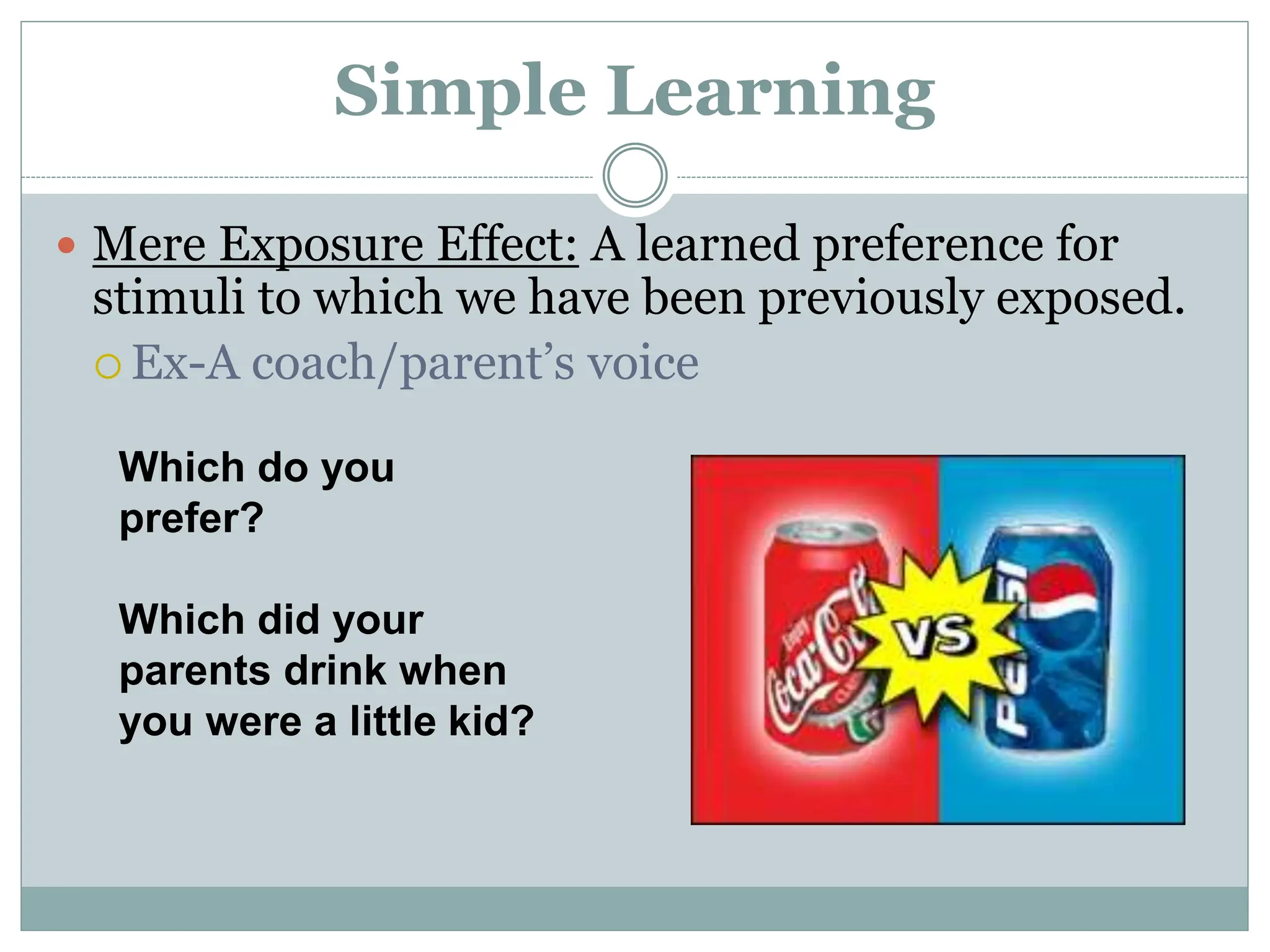
Which do you
prefer?
Which did your
parents drink when
you were a little kid?
Complex Learning
 Behavioral Learning: Forms of learning, such
as classical and operant conditioning which can be
described in terms of stimuli and responses.
 Classical conditioning is more simple learning, operant
conditioning is more complex learning.
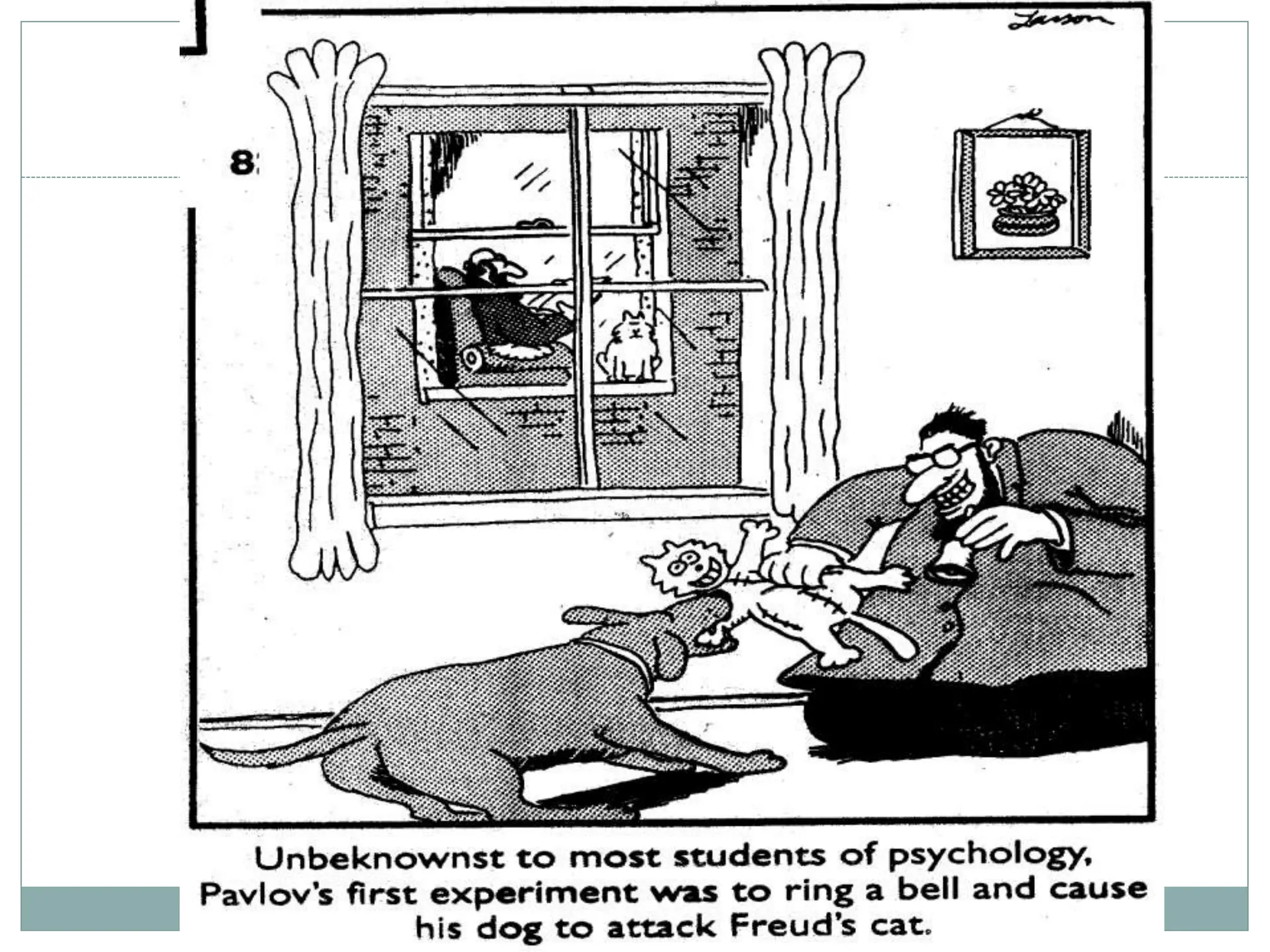
Ivan Pavlov and Classical Conditioning
 One of most famous people in the study of learning is
Ivan Pavlov.
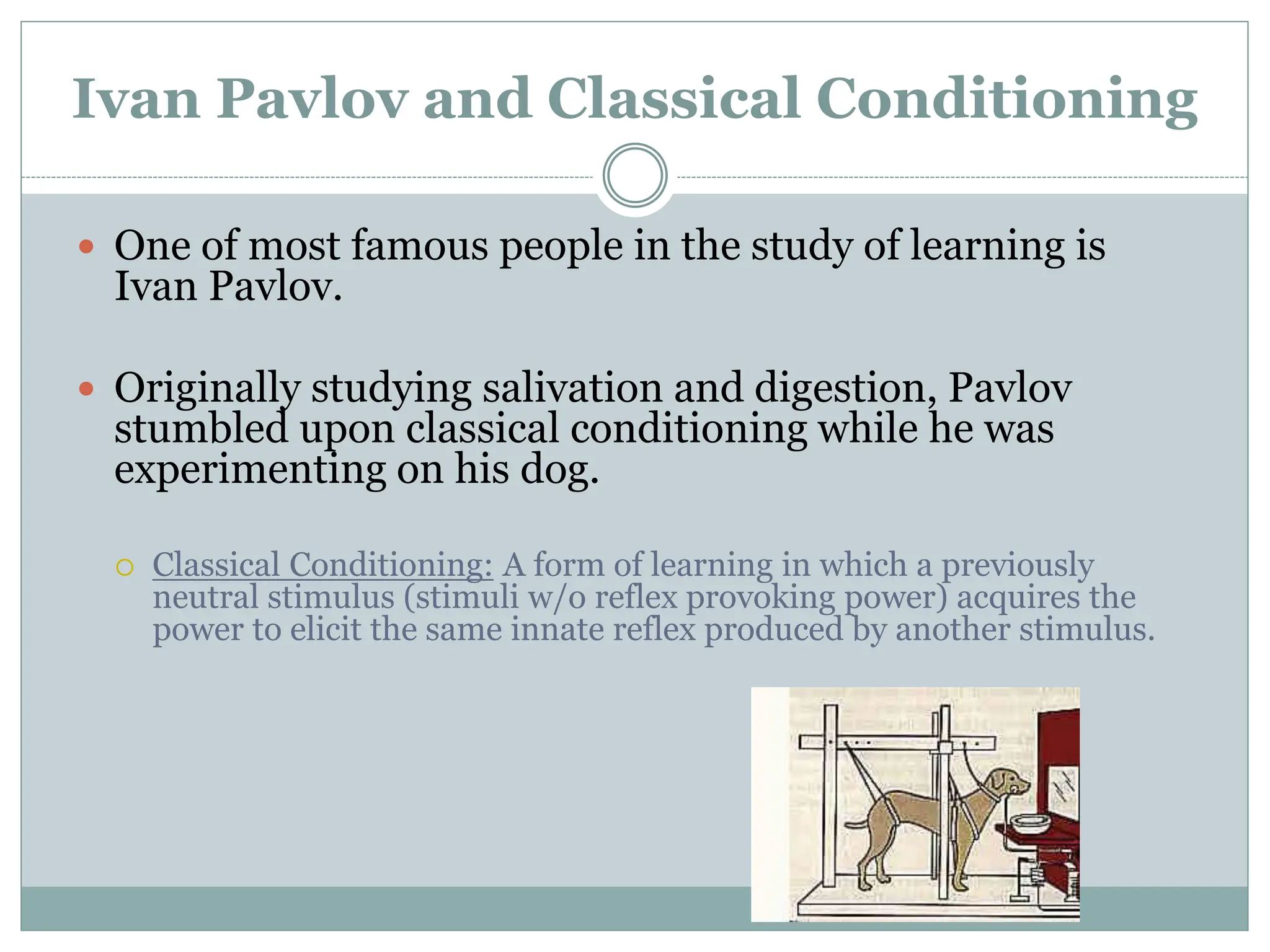
 Originally studying salivation and digestion, Pavlov
stumbled upon classical conditioning while he was
experimenting on his dog.
 Classical Conditioning: A form of learning in which a previously
neutral stimulus (stimuli w/o reflex provoking power) acquires the
power to elicit the same innate reflex produced by another stimulus.
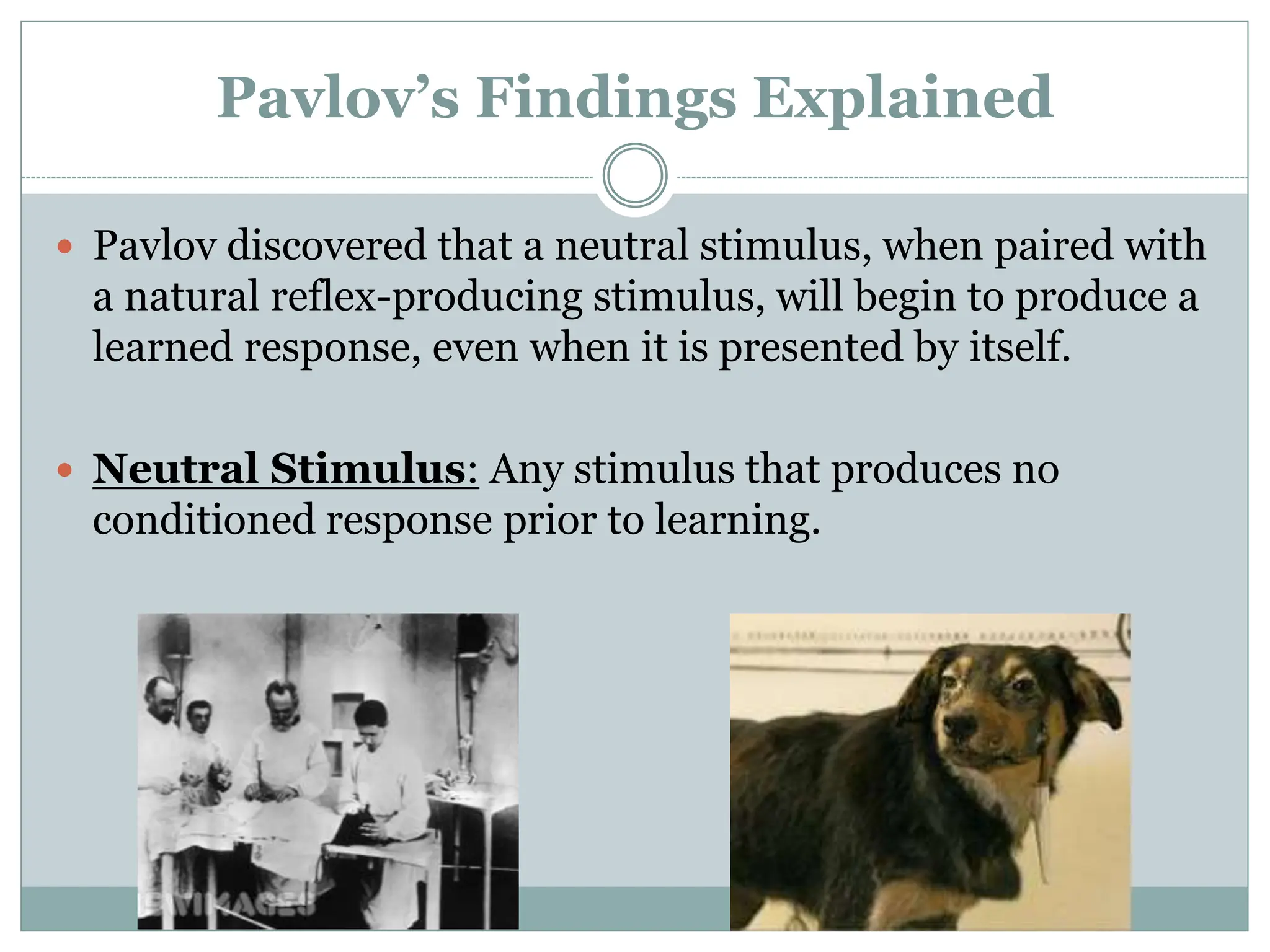
Pavlov’s Findings Explained
 Pavlov discovered that a neutral stimulus, when paired with
a natural reflex-producing stimulus, will begin to produce a
learned response, even when it is presented by itself.
 Neutral Stimulus: Any stimulus that produces no
conditioned response prior to learning.
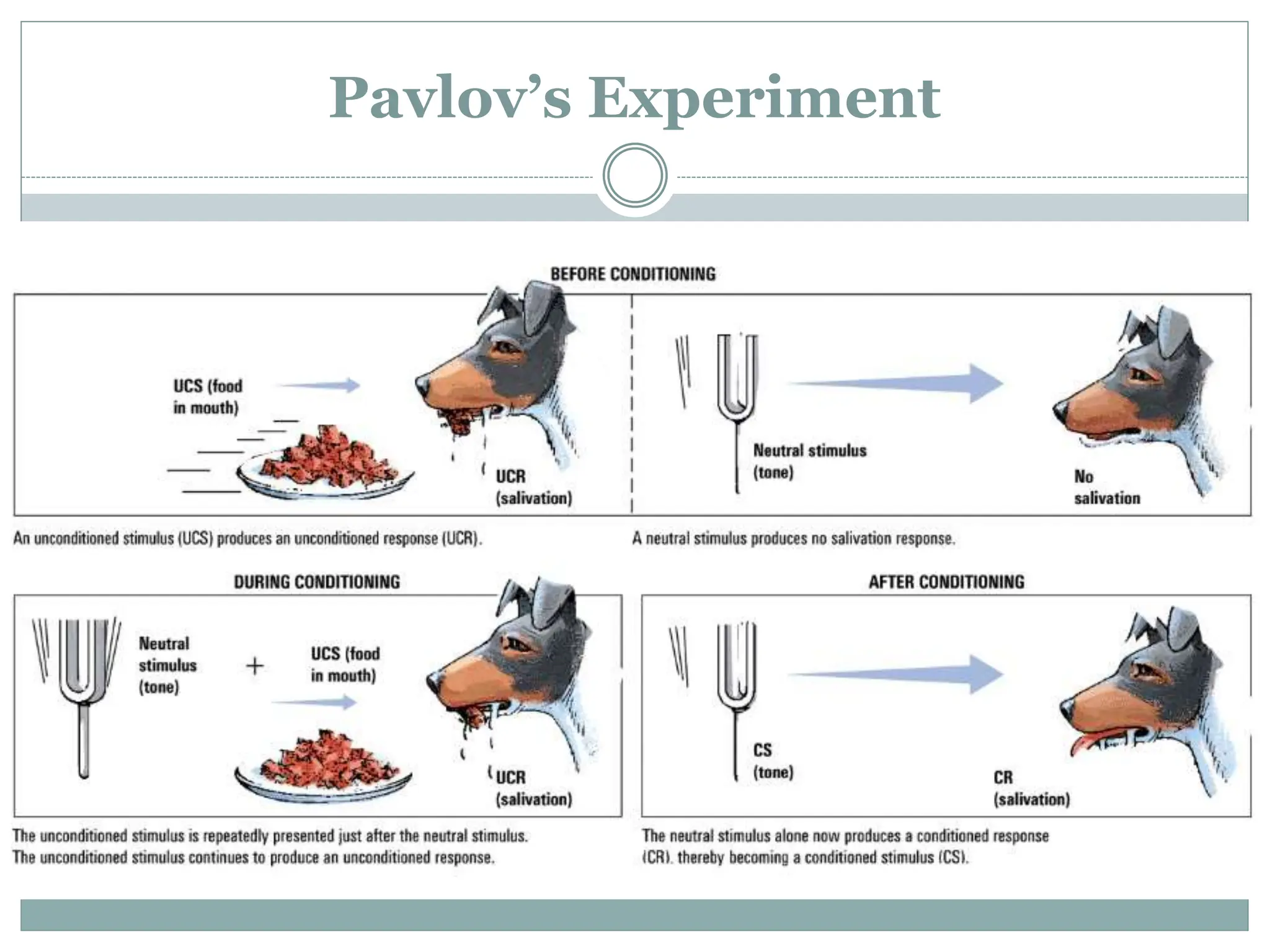
Pavlov’s Experiment
Components of Conditioning
 There are 5 main components of conditioning.
Classical Conditioning always involves these parts.
They are:
 Neutral Stimulus
 Unconditioned Stimulus (UCS)
 Unconditioned Response (UCR)
 Conditioned Stimulus (CS)
 Conditioned Response (CR)
Unconditioned Stimulus (UCS)
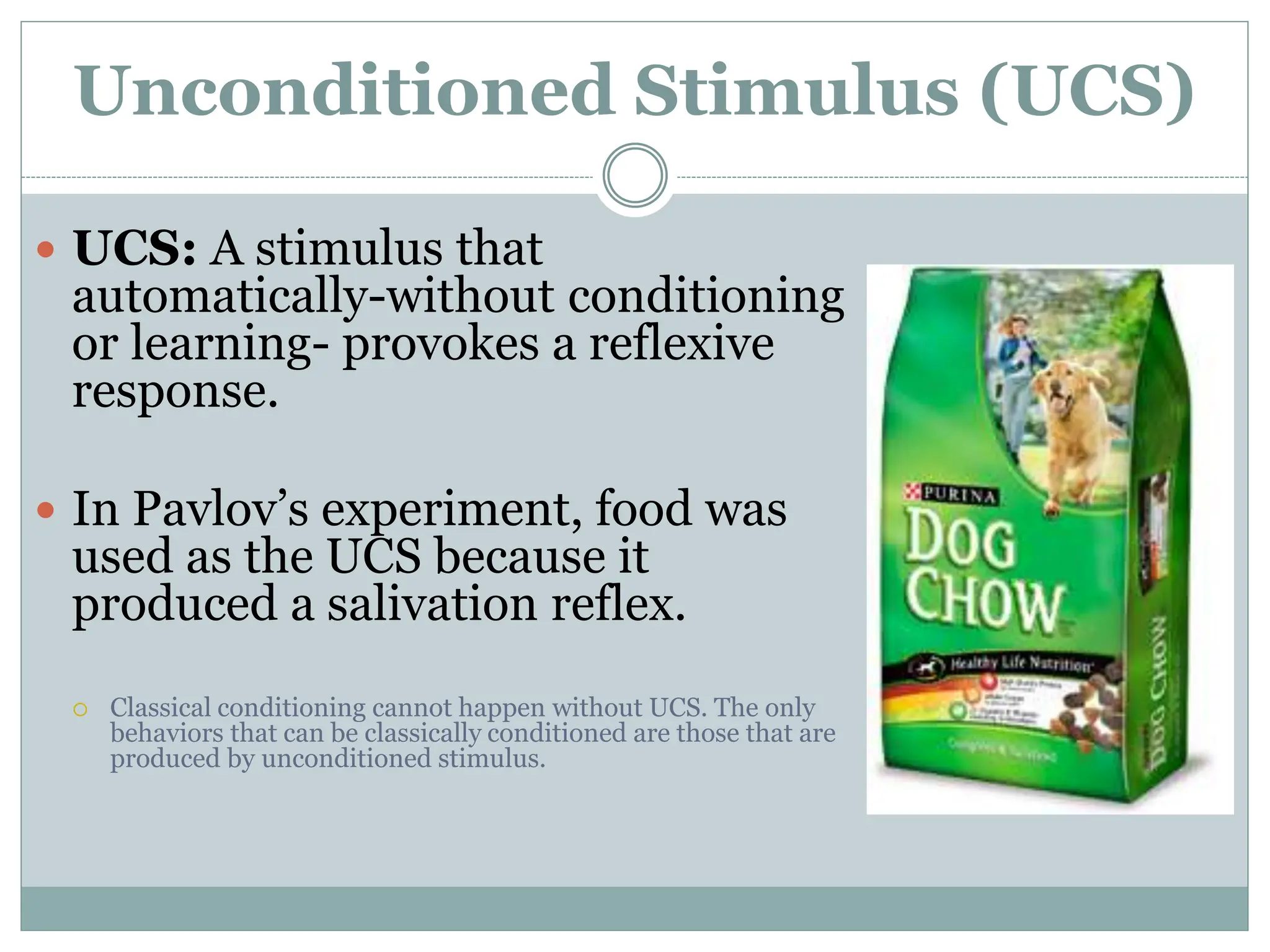
 UCS: A stimulus that
automatically-without conditioning
or learning- provokes a reflexive
response.
 In Pavlov’s experiment, food was
used as the UCS because it
produced a salivation reflex.
 Classical conditioning cannot happen without UCS. The only
behaviors that can be classically conditioned are those that are
produced by unconditioned stimulus.
Unconditioned Response (UCR)
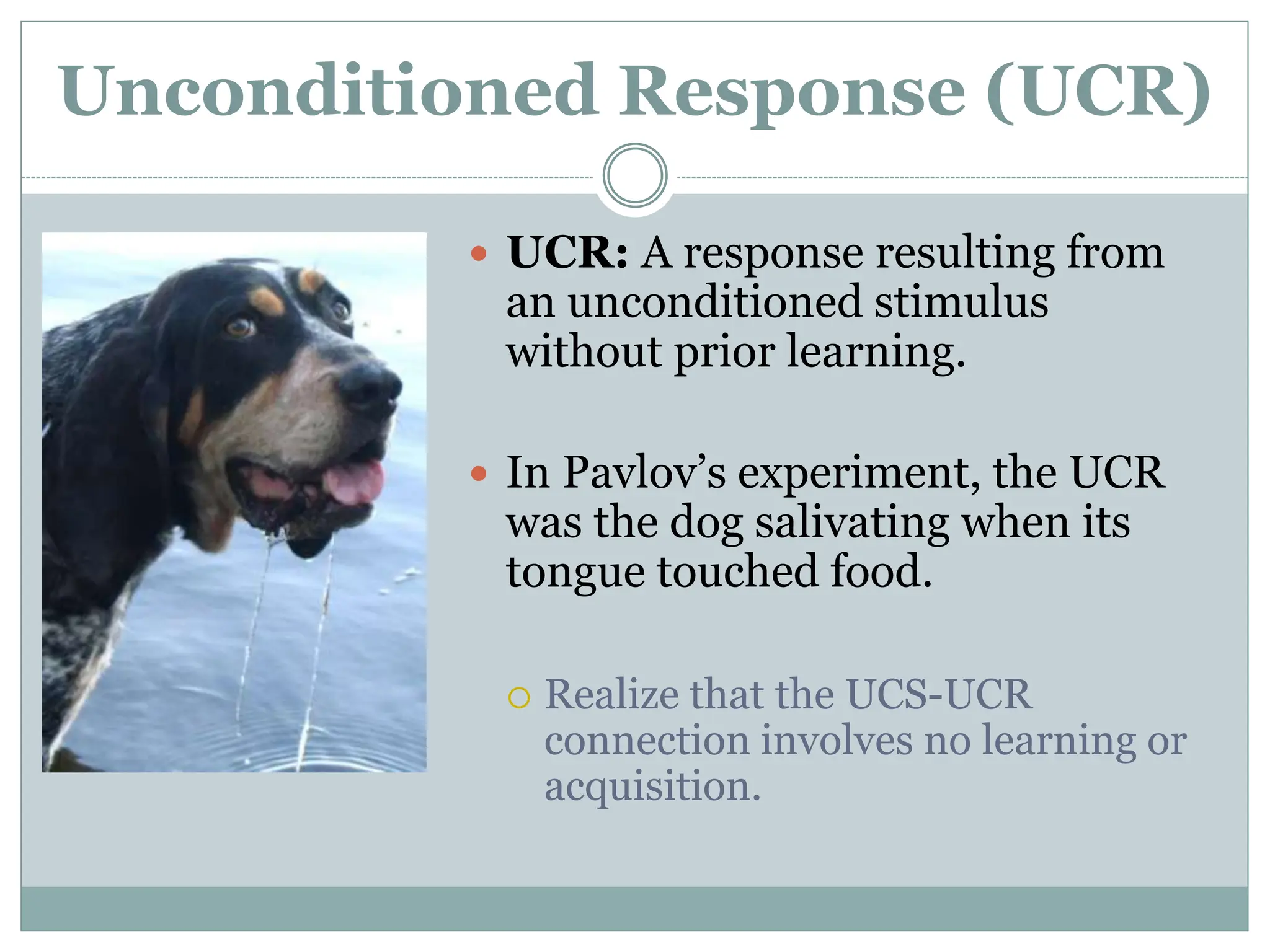
 UCR: A response resulting from
an unconditioned stimulus
without prior learning.
 In Pavlov’s experiment, the UCR
was the dog salivating when its
tongue touched food.
 Realize that the UCS-UCR
connection involves no learning or
acquisition.
From Unconditioned to Conditioned
 During acquisition, a neutral stimulus is paired with the
unconditioned stimulus.
 After several trials the neutral stimulus will gradually begin to
elicit the same response as the UCS.
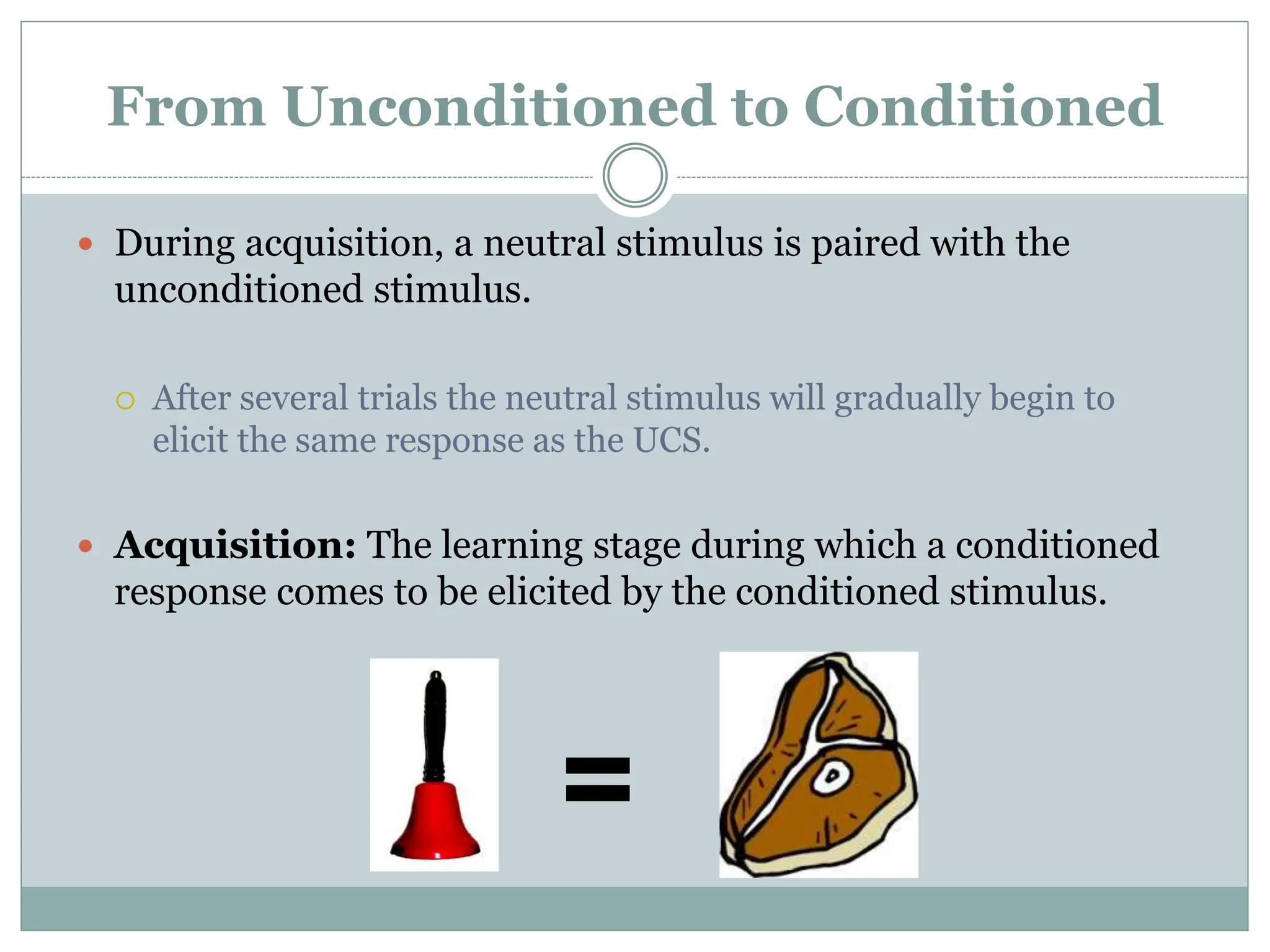
 Acquisition: The learning stage during which a conditioned
response comes to be elicited by the conditioned stimulus.
=
Conditioned Stimulus
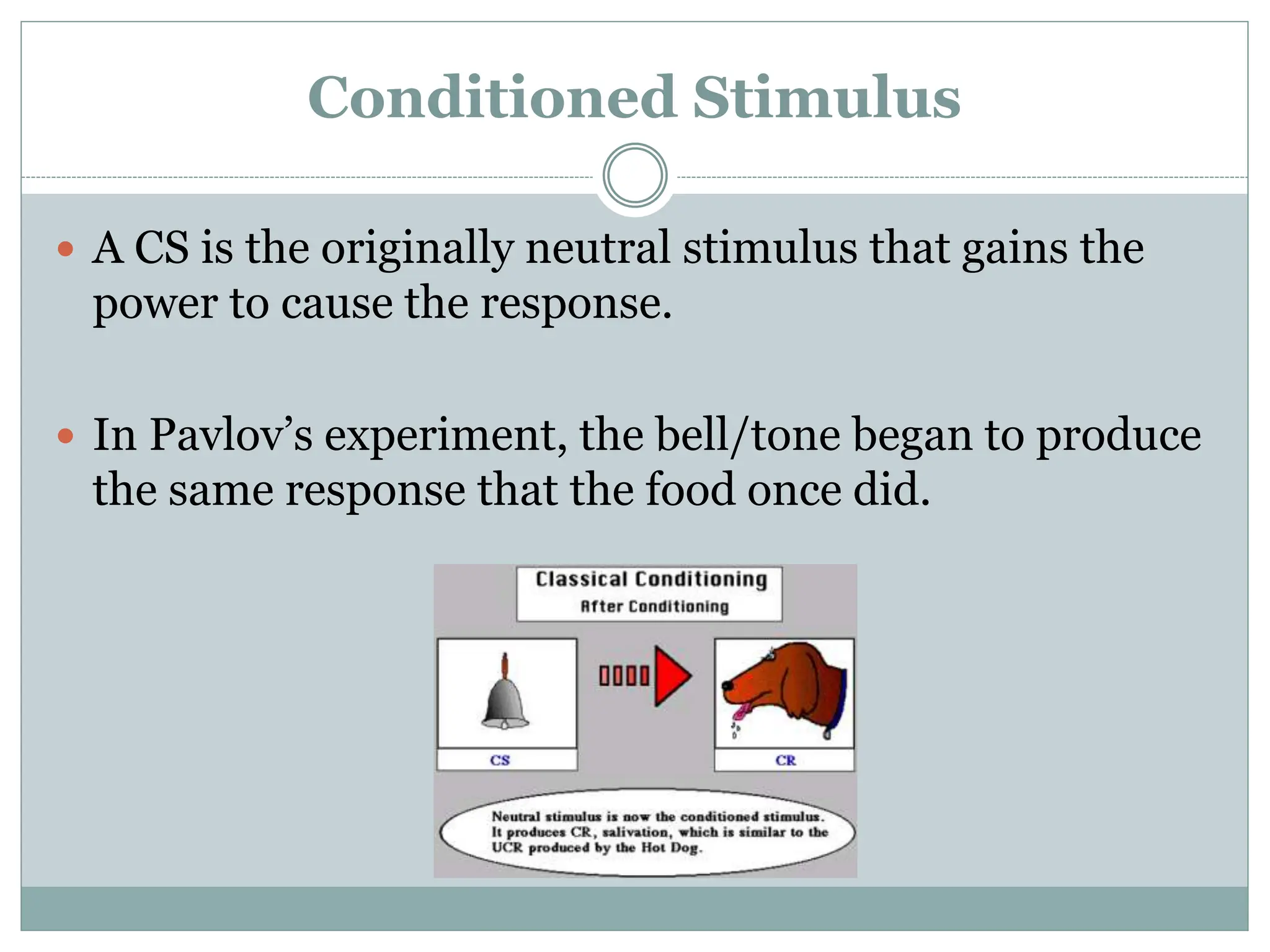
 A CS is the originally neutral stimulus that gains the
power to cause the response.
 In Pavlov’s experiment, the bell/tone began to produce
the same response that the food once did.
Conditioned Response
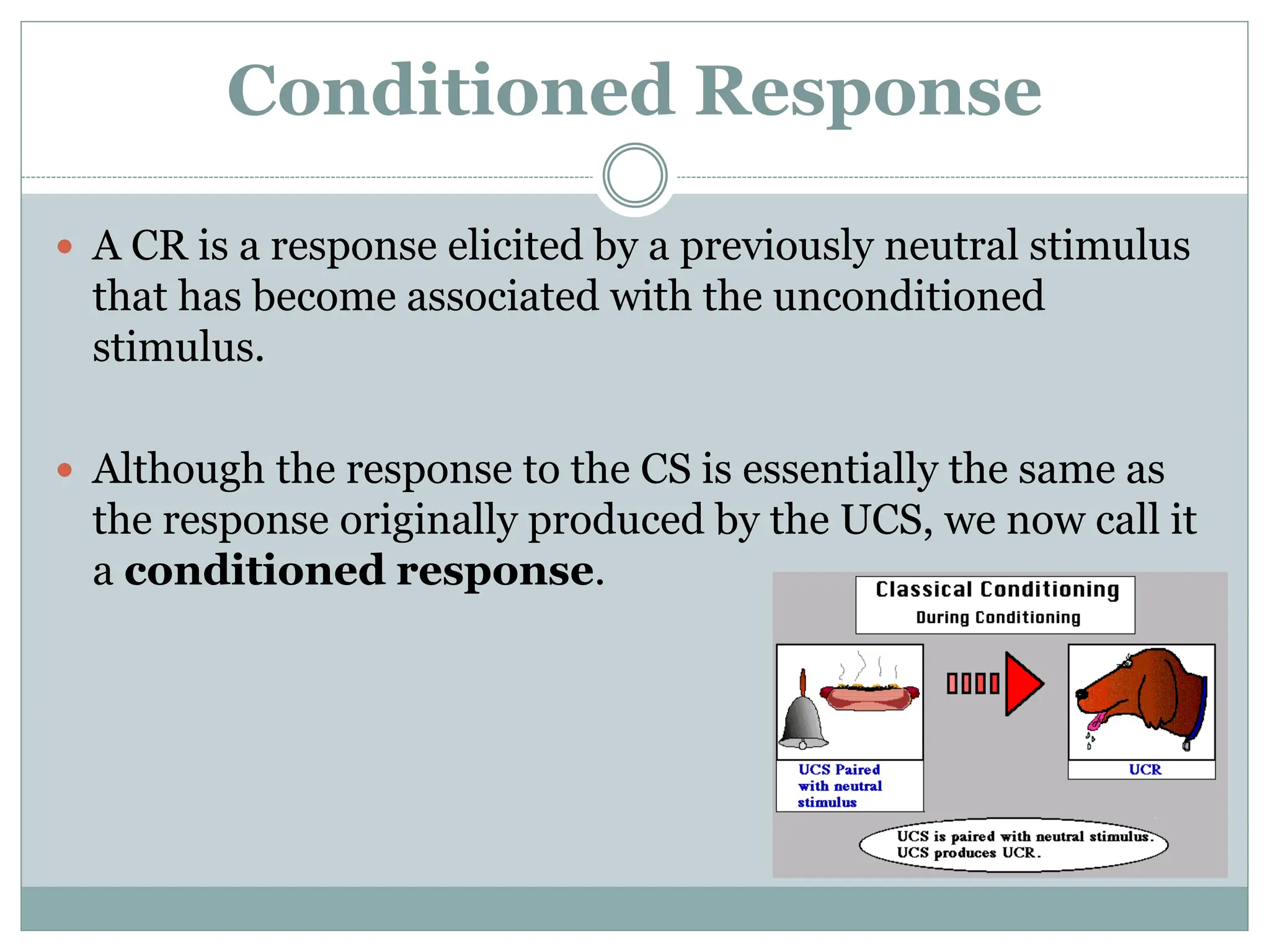
 A CR is a response elicited by a previously neutral stimulus
that has become associated with the unconditioned
stimulus.
 Although the response to the CS is essentially the same as
the response originally produced by the UCS, we now call it
a conditioned response.
Extinction
 Extinction: The diminishing (or lessening) of a
learned response, when an unconditioned stimulus
does not follow a conditioned stimulus.
 To acquire a CR, we repeatedly pair a neutral stimulus with the
UCS. But, if we want to reverse this learning, we must weaken the
strength of the connection between the two stimuli.
 It is important to realize that extinction does not mean complete
elimination of a response.
Spontaneous Recovery
 Extinction merely suppresses the conditioned response,
and the CR can reappear during spontaneous recovery.
 Spontaneous Recovery: The response after a rest period of
an extinguished conditioned response.
 Spontaneous recovery is weaker than the original CR.
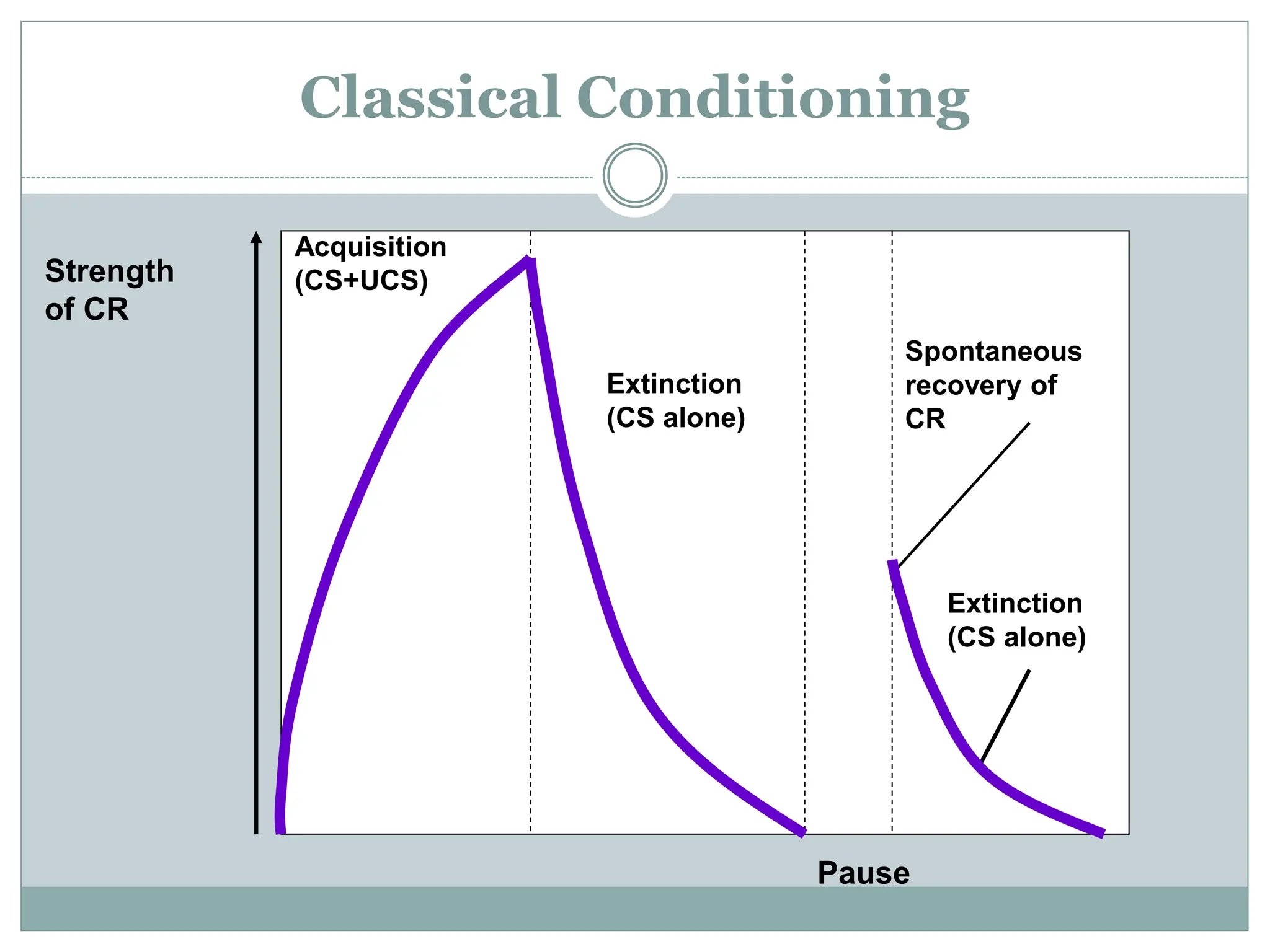
Classical Conditioning
Strength
of CR
Pause
Acquisition
(CS+UCS)
Extinction
(CS alone)
Extinction
(CS alone)
Spontaneous
recovery of
CR
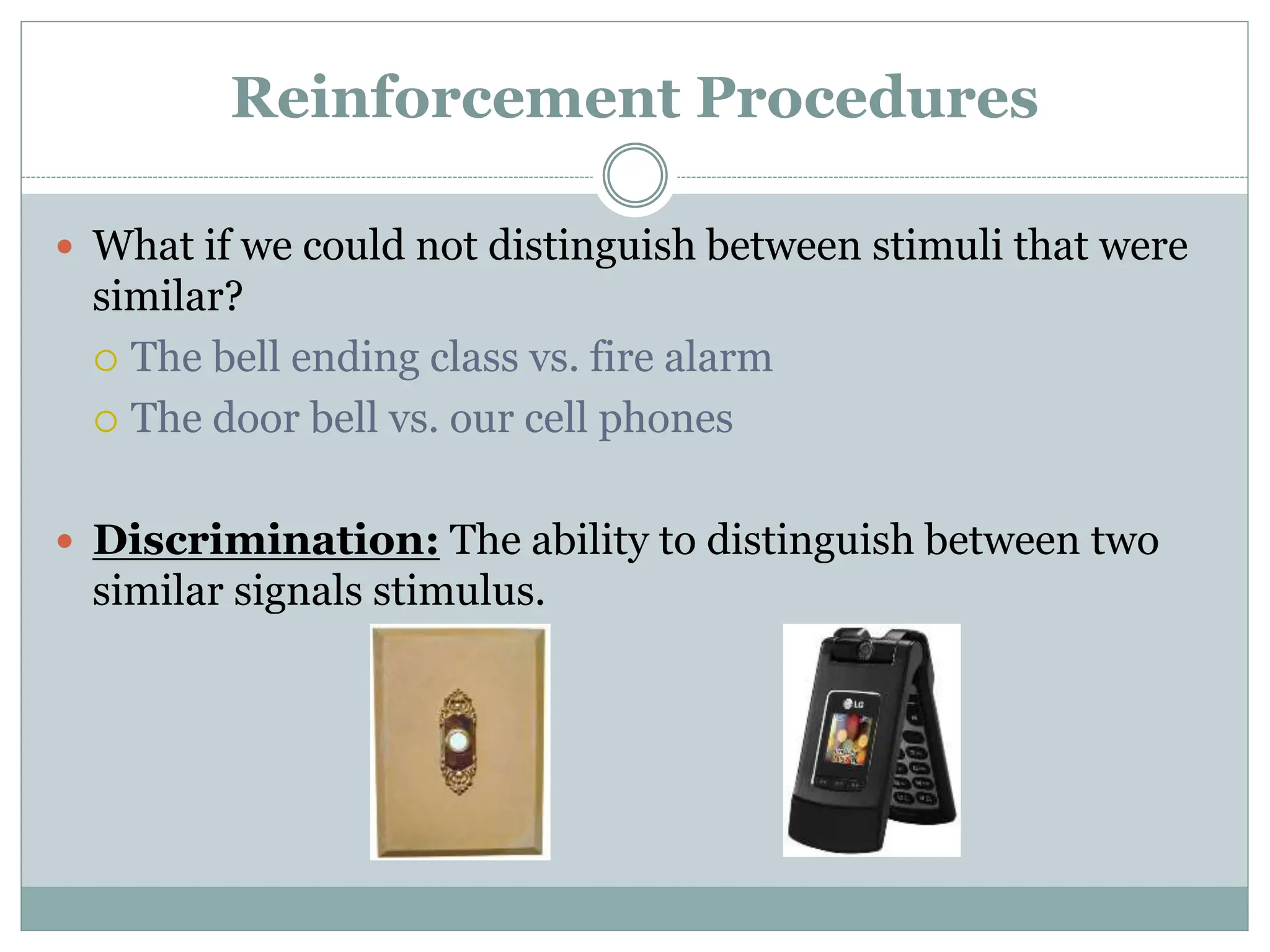
Reinforcement Procedures
 What if we could not distinguish between stimuli that were
similar?
 The bell ending class vs. fire alarm
 The door bell vs. our cell phones
 Discrimination: The ability to distinguish between two
similar signals stimulus.
Operant
Conditioning
Classical vs. Operant Conditioning
 With classical conditioning you can teach a dog to
salivate, but you cannot teach it to sit up or roll
over. Why?
 Salivation is an involuntary reflex, while sitting up
and rolling over are far more complex responses
that we think of as voluntary.
Operant Conditioning
 An operant is an observable behavior that an
organism uses to “operate” in the environment.
 Operant Conditioning: A form of learning in
which the probability of a response is changed by
its consequences…that is, by the stimuli that
follows the response.
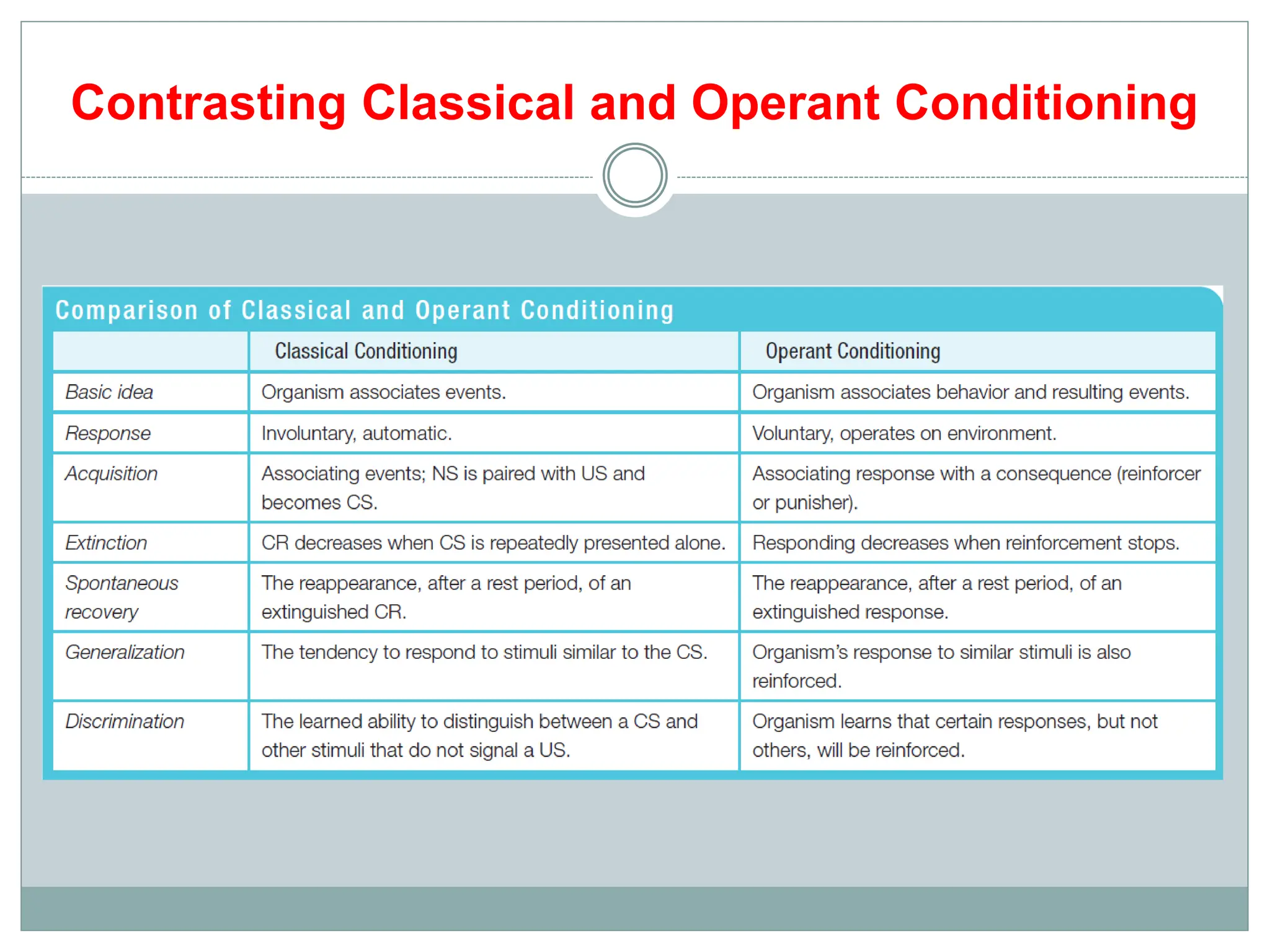
Contrasting Classical and Operant Conditioning
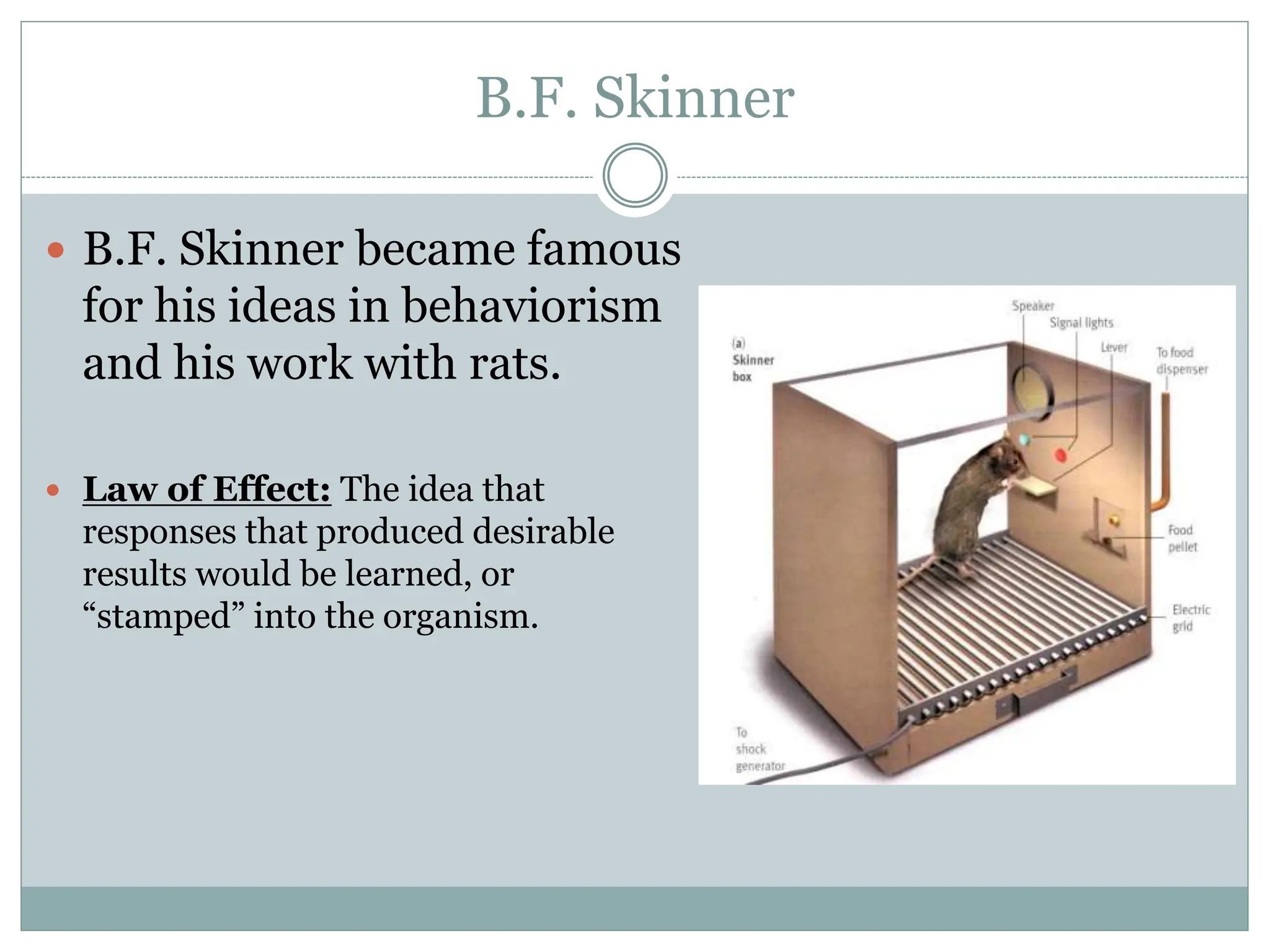
B.F. Skinner
 B.F. Skinner became famous
for his ideas in behaviorism
and his work with rats.
 Law of Effect: The idea that
responses that produced desirable
results would be learned, or
“stamped” into the organism.
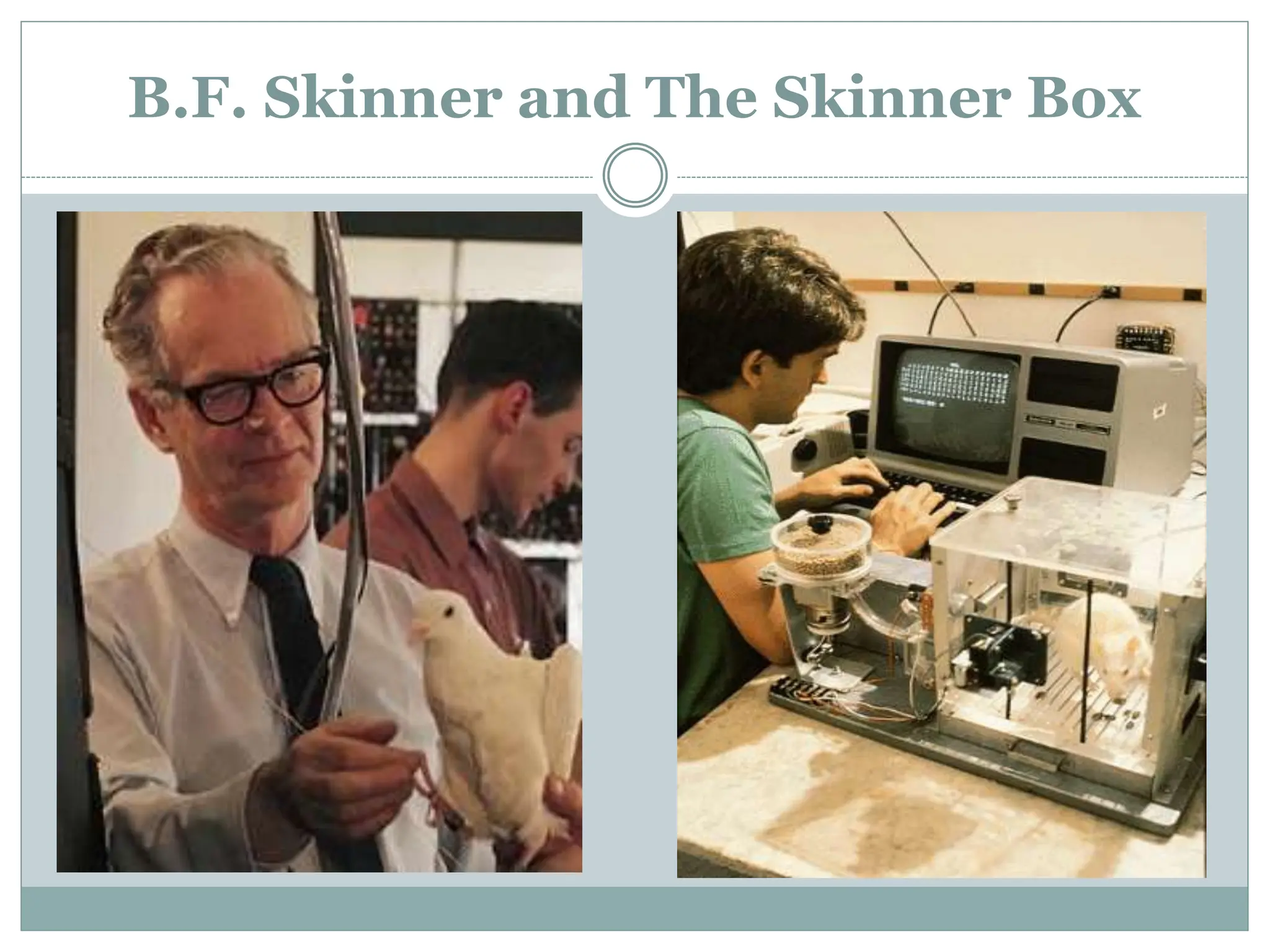
B.F. Skinner and The Skinner Box
Reinforcement
 A reinforcer is a condition in which the
presentation or removal of a stimulus, that occurs
after a response (behavior) and strengthens that
response, or makes it more likely to happen again
in the future.
 Positive Reinforcement: A stimulus presented
after a response that increases the probability of
that response happening again.
 Ex: Getting paid for good grades
Negative Reinforcement
 Negative Reinforcement: The removal of an
unpleasant or averse stimulus that increases the
probability of that response happening again.
 Ex: Taking Advil to get rid of a headache.
 Ex: Putting on a seatbelt to make the annoying seatbelt
buzzer stop.
 The word “positive” means add or apply;
“negative” is used to mean subtract or remove.
Reinforcement Schedules
 Continuous Reinforcement: A reinforcement
schedule under which all correct responses are
reinforced.
 This is a useful tactic early in the learning process.
It also helps when “shaping” new behavior.
 Shaping: A technique where new behavior is
produced by reinforcing responses that are similar
to the desired response.
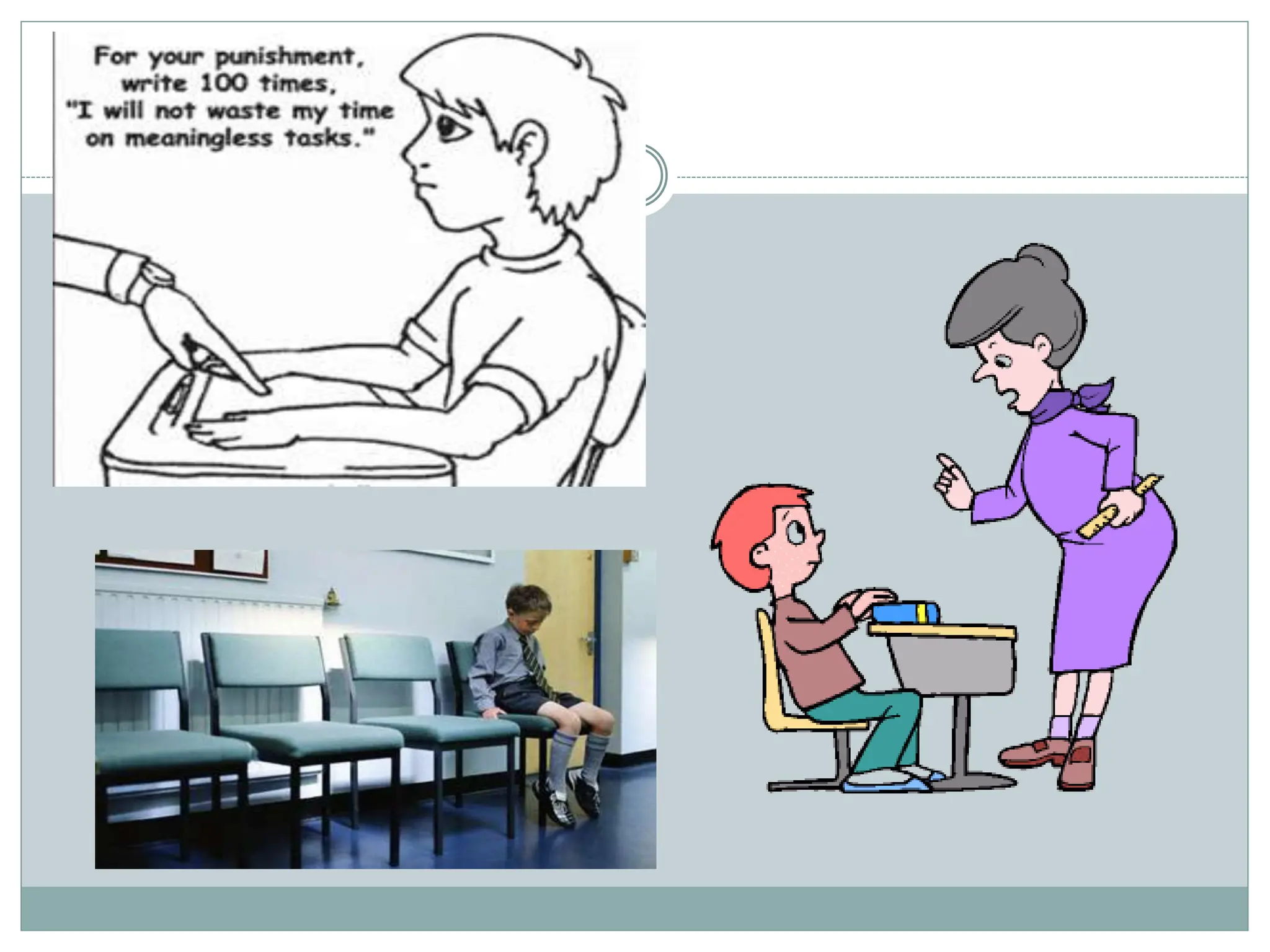
Punishment
 A punishment is an averse/disliked stimulus
which occurs after a behavior, and decreases the
probability it will occur again.
Punishment
 Negative Punishment: When a desirable event
ends or is taken away after a behavior.
 Example: getting grounded from your cell phone after
failing your progress report, it is the taking away from a
fun activity
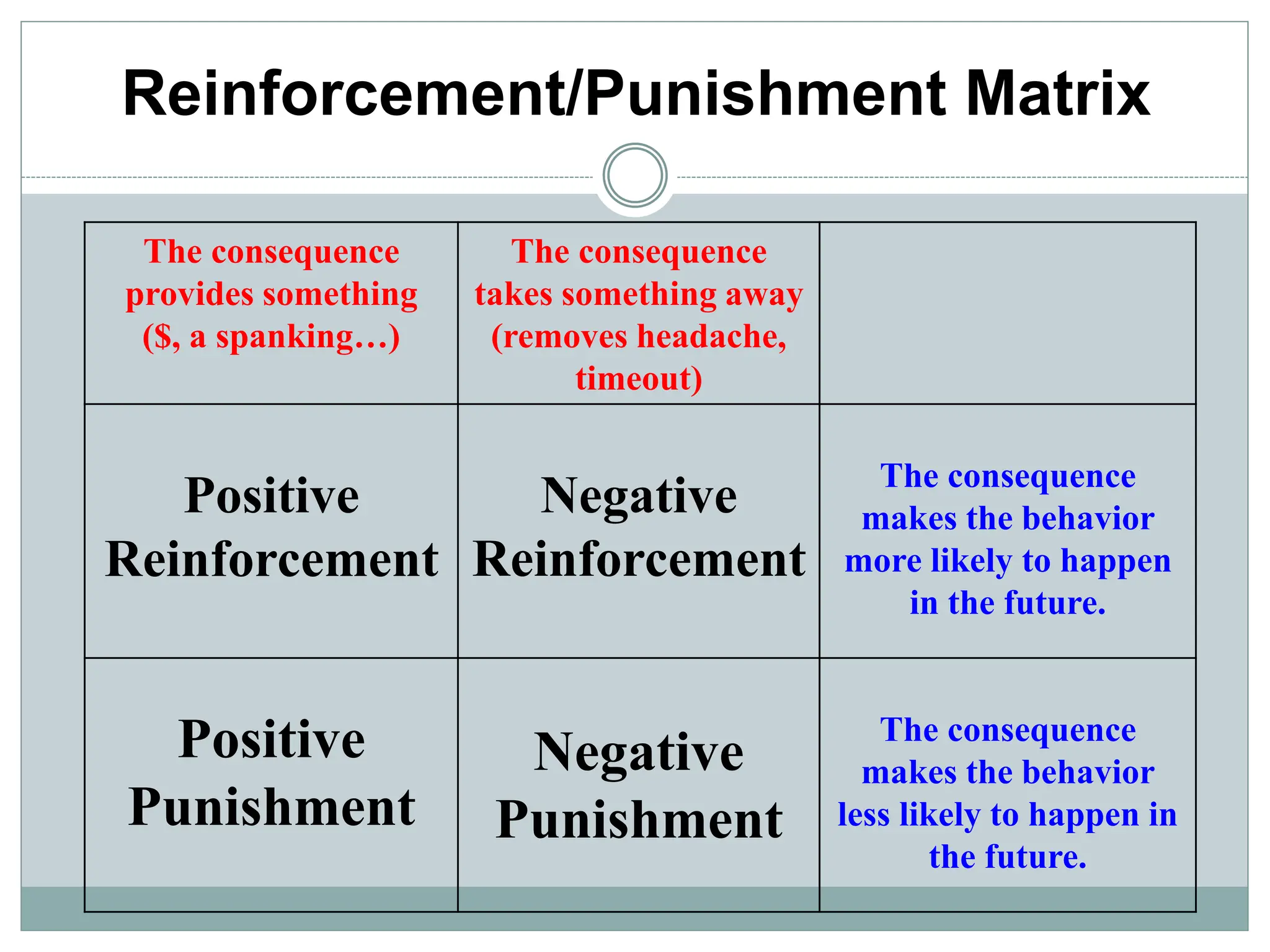
The consequence
provides something
($, a spanking…)
The consequence
takes something away
(removes headache,
timeout)
Positive
Reinforcement
Negative
Reinforcement
The consequence
makes the behavior
more likely to happen
in the future.
Positive
Punishment
Negative
Punishment
The consequence
makes the behavior
less likely to happen in
the future.
Reinforcement/Punishment Matrix
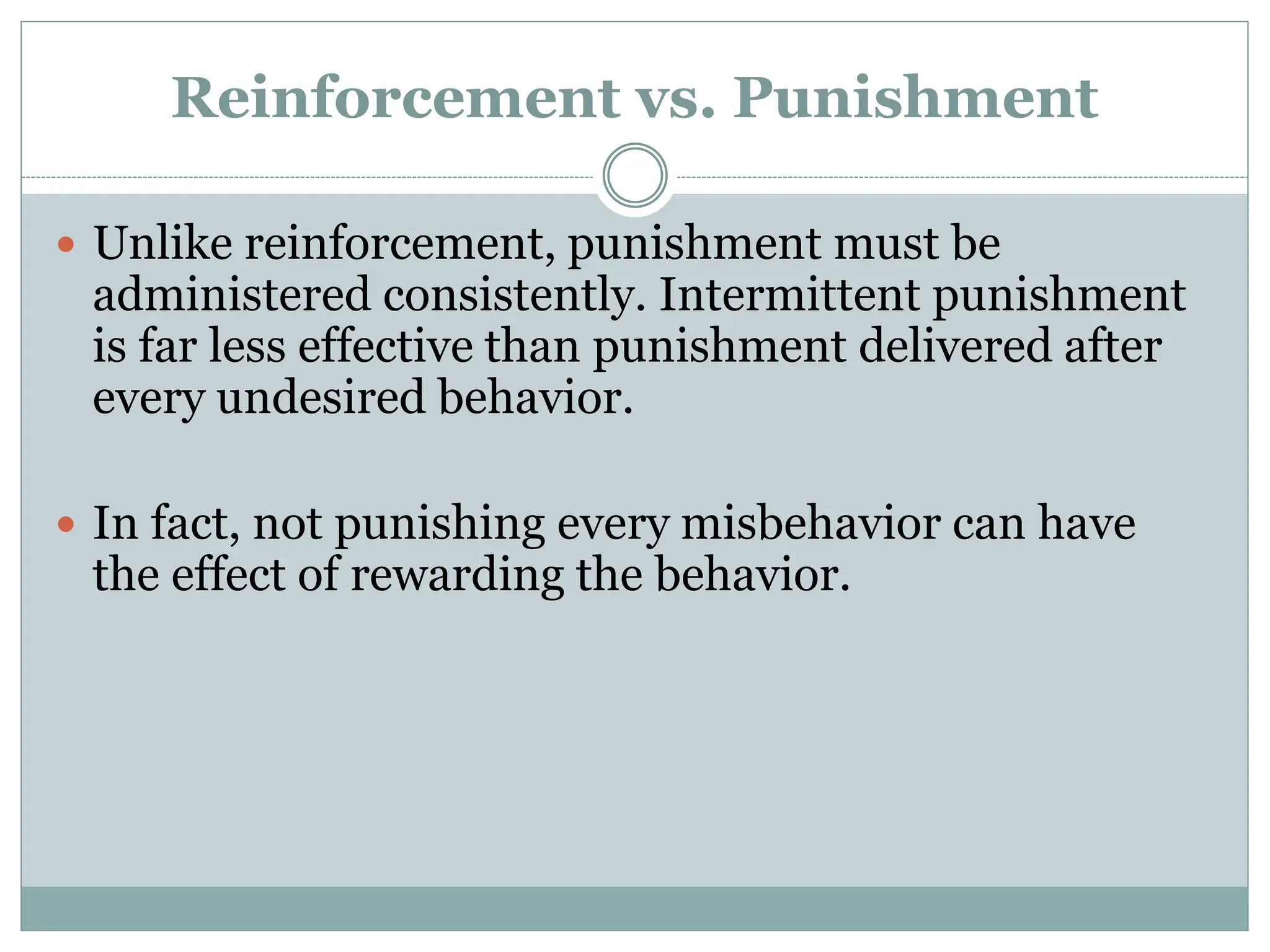
Reinforcement vs. Punishment
 Unlike reinforcement, punishment must be
administered consistently. Intermittent punishment
is far less effective than punishment delivered after
every undesired behavior.
 In fact, not punishing every misbehavior can have
the effect of rewarding the behavior.
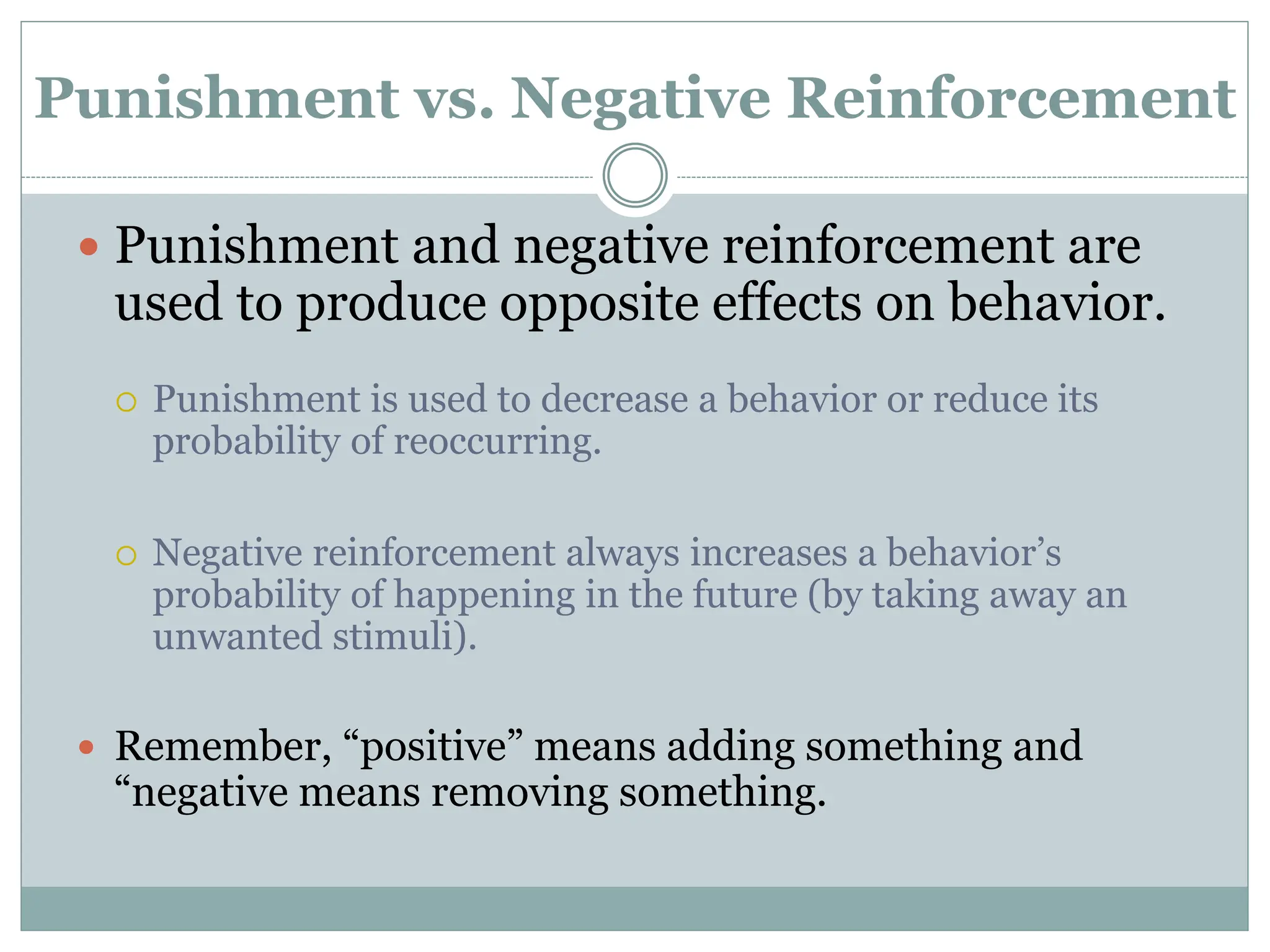
Punishment vs. Negative Reinforcement
 Punishment and negative reinforcement are
used to produce opposite effects on behavior.
 Punishment is used to decrease a behavior or reduce its
probability of reoccurring.
 Negative reinforcement always increases a behavior’s
probability of happening in the future (by taking away an
unwanted stimuli).
 Remember, “positive” means adding something and
“negative means removing something.
Uses and Abuses of Punishment
 Punishment often produces an immediate change in
behavior, which ironically reinforces the punisher.
 However, punishment rarely works in the long run for four reasons:
1. The power of punishment to suppress behavior usually disappears
when the threat of punishment is gone.
2. Punishment triggers escape or aggression
3. Punishment makes the learner apprehensive: inhibits learning.
4. Punishment is often applied unequally.
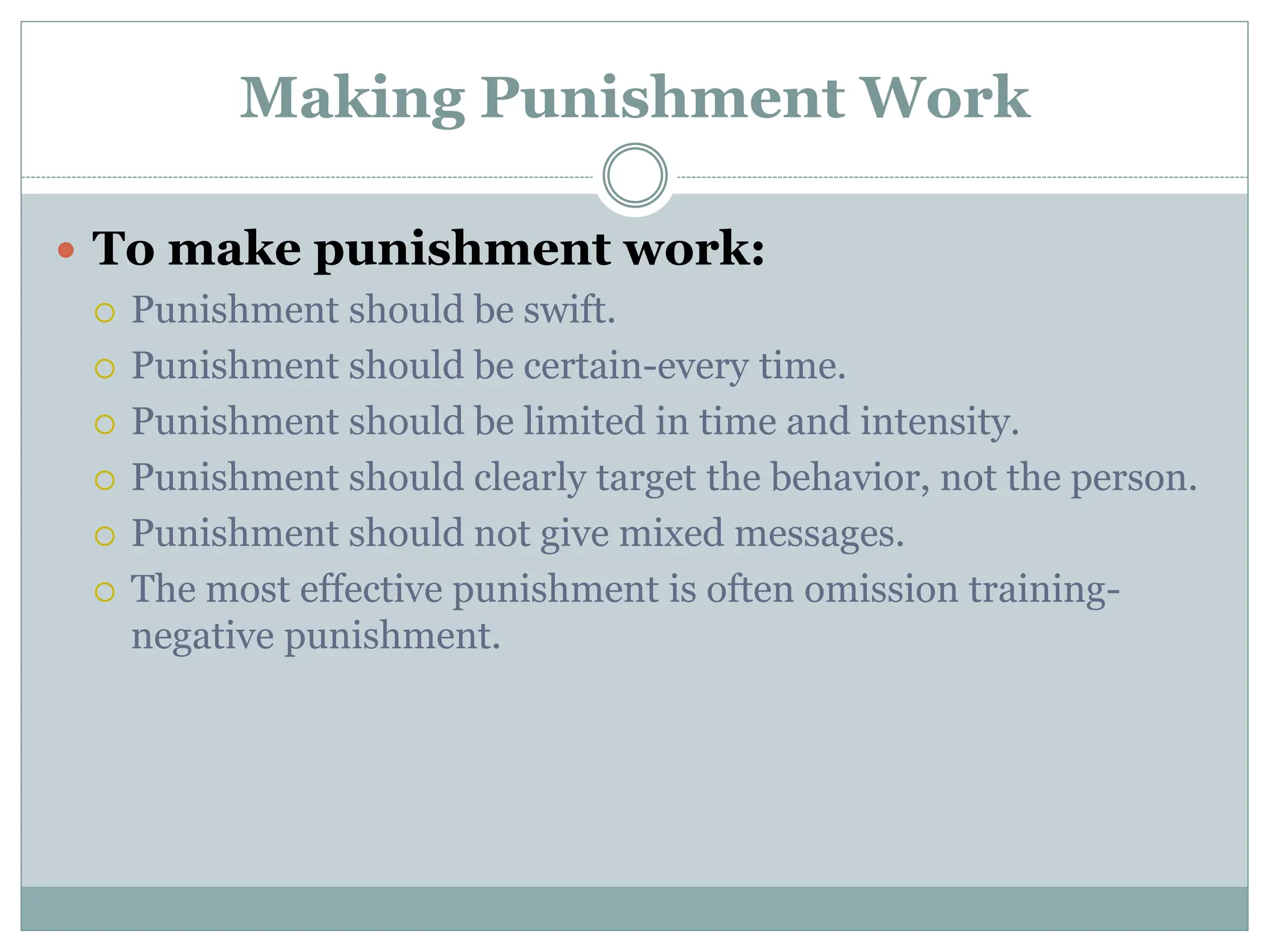
Making Punishment Work
 To make punishment work:
 Punishment should be swift.
 Punishment should be certain-every time.
 Punishment should be limited in time and intensity.
 Punishment should clearly target the behavior, not the person.
 Punishment should not give mixed messages.
 The most effective punishment is often omission training-
negative punishment.
Reinforcement Schedules
 Intermittent Reinforcement: A type of
reinforcement schedule by which some, but not all,
correct responses are reinforced.
 Intermittent reinforcement is the most effective way
to maintain a desired behavior that has already been
learned.
Continuous Reinforcement
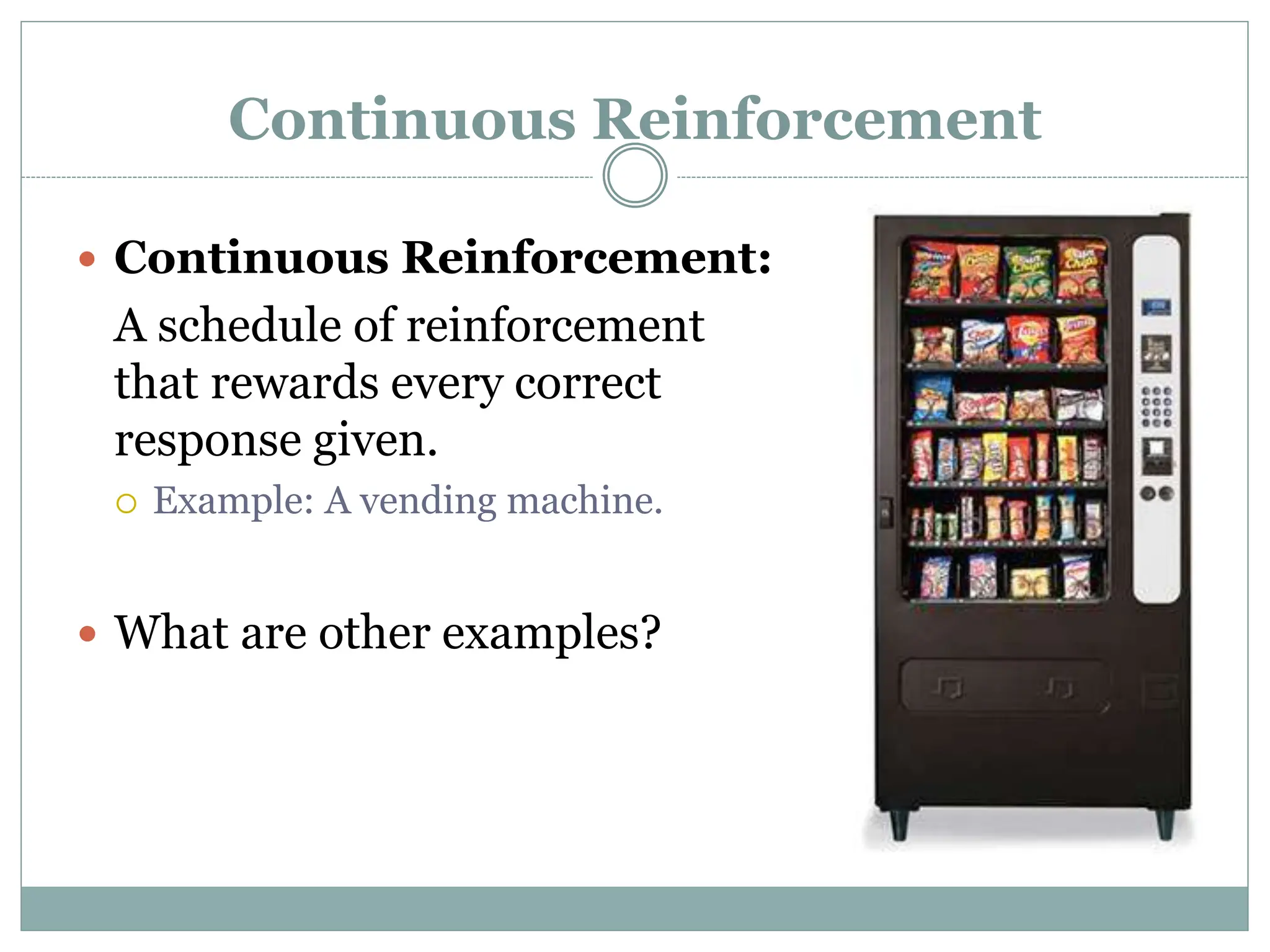
 Continuous Reinforcement:
A schedule of reinforcement
that rewards every correct
response given.
 Example: A vending machine.
 What are other examples?
Schedules of Intermittent Reinforcement
 Interval schedule: rewards subjects after a
certain time interval.
 Ratio schedule: rewards subjects after a certain
number of responses.
 There are 4 types of intermittent reinforcement:
 Fixed Interval Schedule (FI)
 Variable Interval Schedule (VI)
 Fixed Ratio Schedule (FR)
 Variable Ratio Schedule (VR)
Interval Schedules
 Fixed Interval Schedule (FI):
 A schedule that a rewards a learner only for the first correct
response after some defined period of time.
 Example: B.F. Skinner put rats in a box with a lever connected to a feeder. It
only provided a reinforcement after 60 seconds. The rats quickly learned that it
didn’t matter how early or often it pushed the lever, it had to wait a set amount of
time. As the set amount of time came to an end, the rats became more active in
hitting the lever.
Interval Schedules
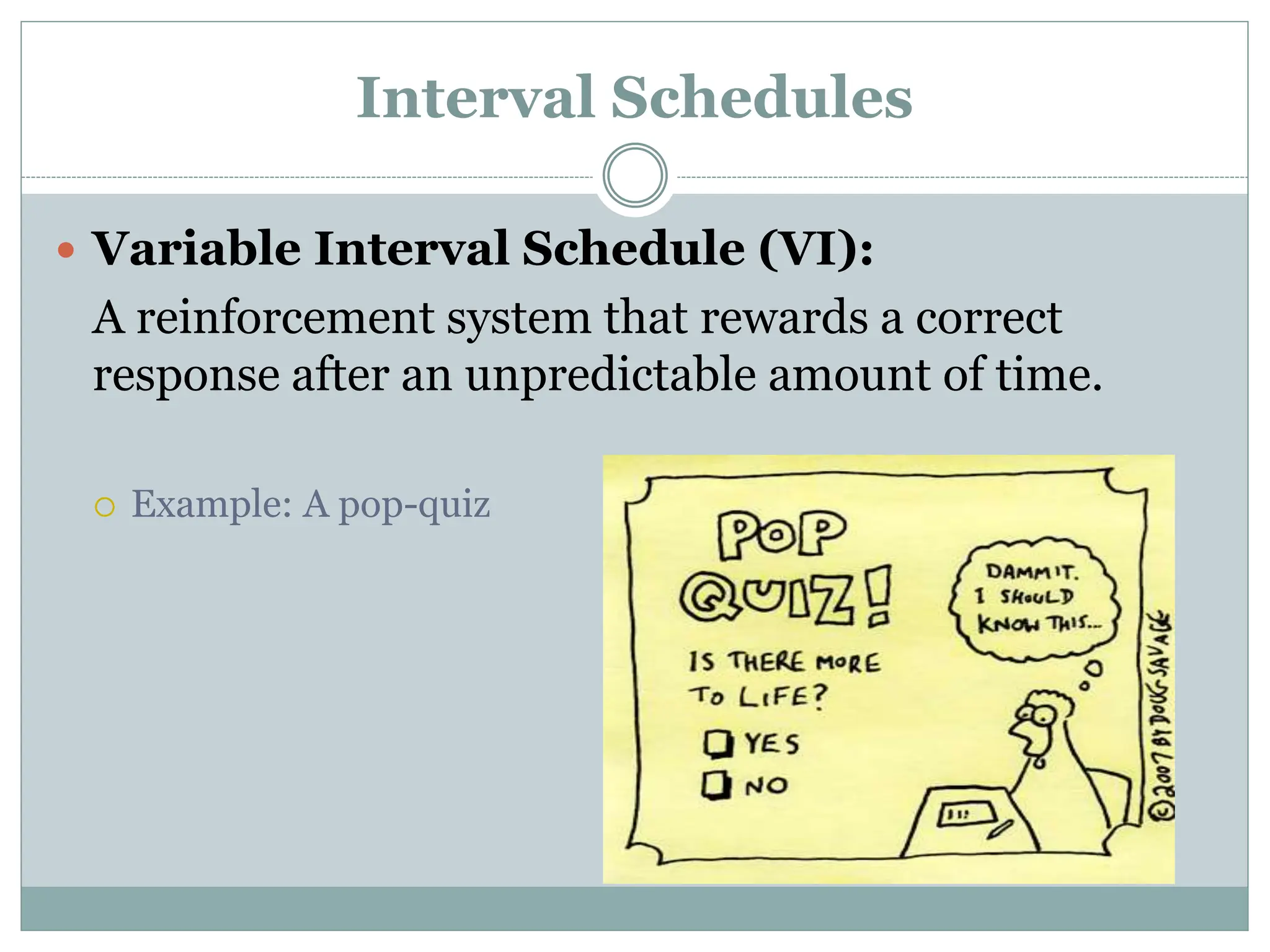
 Variable Interval Schedule (VI):
A reinforcement system that rewards a correct
response after an unpredictable amount of time.
 Example: A pop-quiz
Ratio Schedules
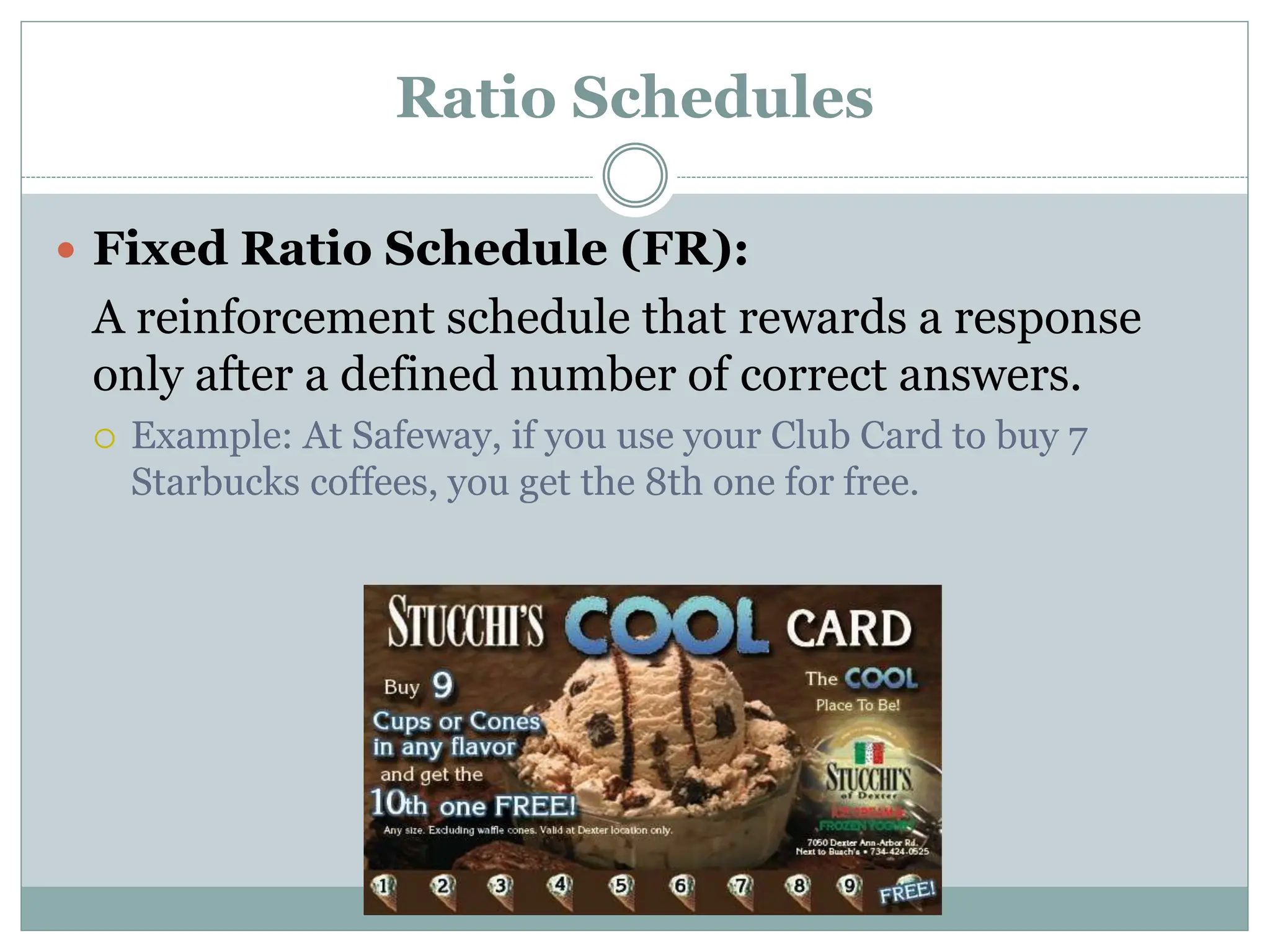
 Fixed Ratio Schedule (FR):
A reinforcement schedule that rewards a response
only after a defined number of correct answers.
 Example: At Safeway, if you use your Club Card to buy 7
Starbucks coffees, you get the 8th one for free.
Ratio Schedules
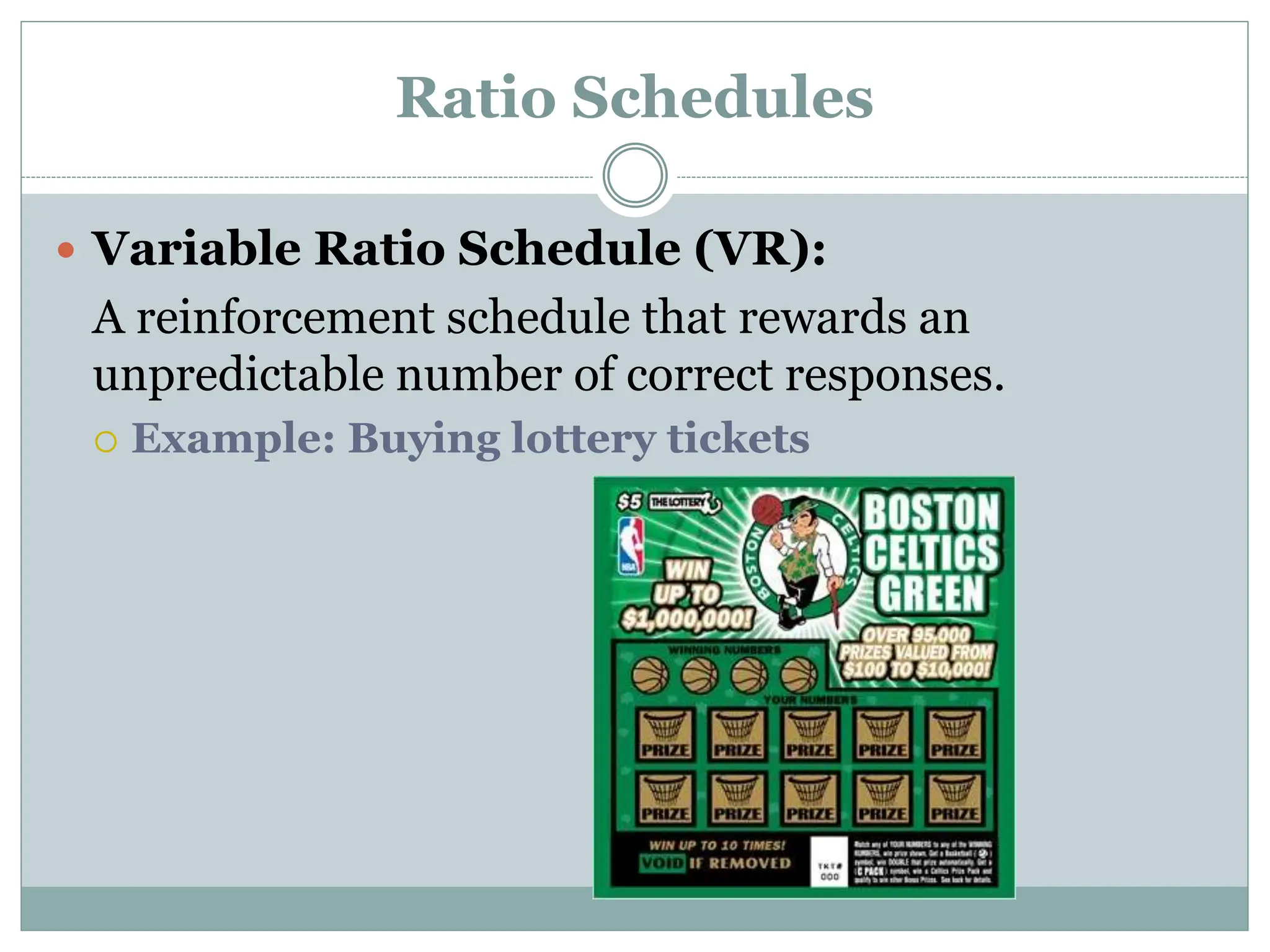
 Variable Ratio Schedule (VR):
A reinforcement schedule that rewards an
unpredictable number of correct responses.
 Example: Buying lottery tickets
Primary and Secondary reinforcement
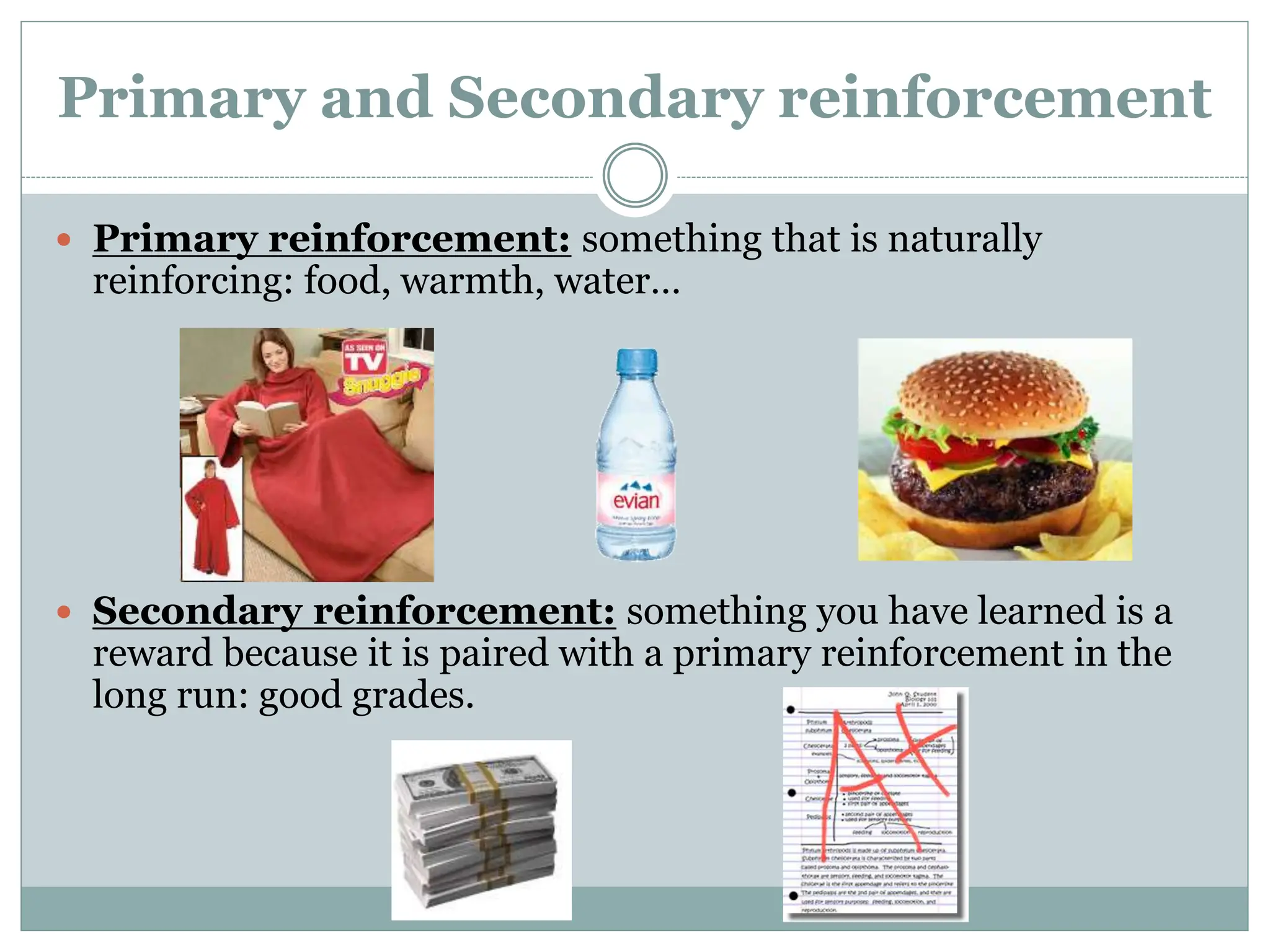
 Primary reinforcement: something that is naturally
reinforcing: food, warmth, water…
 Secondary reinforcement: something you have learned is a
reward because it is paired with a primary reinforcement in the
long run: good grades.
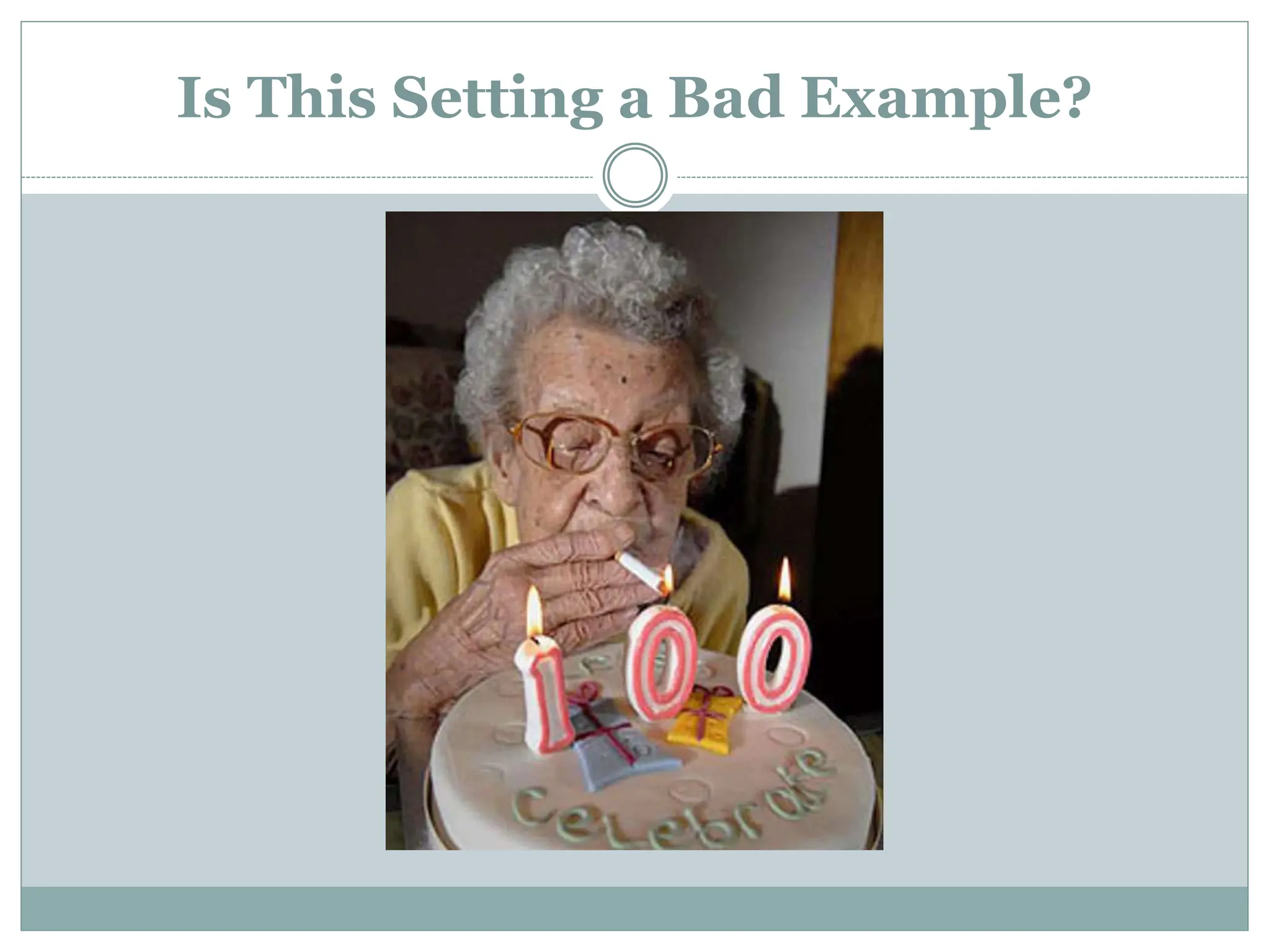
Is This Setting a Bad Example?
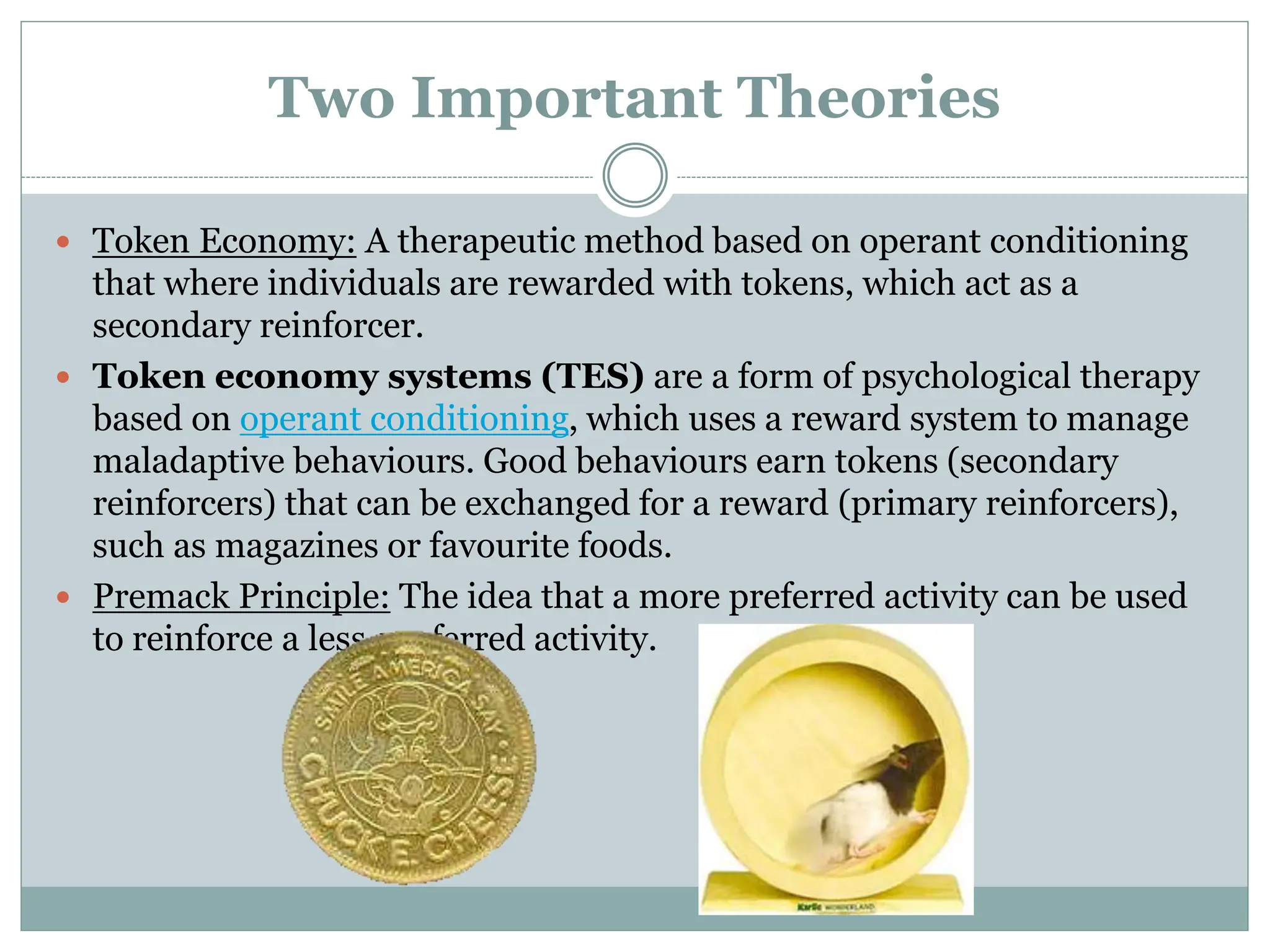
Two Important Theories
 Token Economy: A therapeutic method based on operant conditioning
that where individuals are rewarded with tokens, which act as a
secondary reinforcer.
 Token economy systems (TES) are a form of psychological therapy
based on operant conditioning, which uses a reward system to manage
maladaptive behaviours. Good behaviours earn tokens (secondary
reinforcers) that can be exchanged for a reward (primary reinforcers),
such as magazines or favourite foods.
 Premack Principle: The idea that a more preferred activity can be used
to reinforce a less-preferred activity.
Cognitive Learning:A Third Type of Learning
 Sometimes we have “flashes of insight” when dealing
with a problem where we have been experiencing
trial and error.
 This type of learning is called cognitive learning,
which is explained as changes in mental processes,
rather than as changes in behavior alone.
Cognitive Learning
 Cognitive learning is a powerful mechanism that provides
the means of knowledge, and goes well beyond simple
imitation of others.
 Conditioning can never fully explain what you are learning
 Cognitive learning is defined as the acquisition of
knowledge and skill by mental or cognitive processes — ;the
procedures we have for manipulating information 'in our
heads'.
 Cognitive processes include creating mental
representations of physical objects and events, and other
forms of information processing
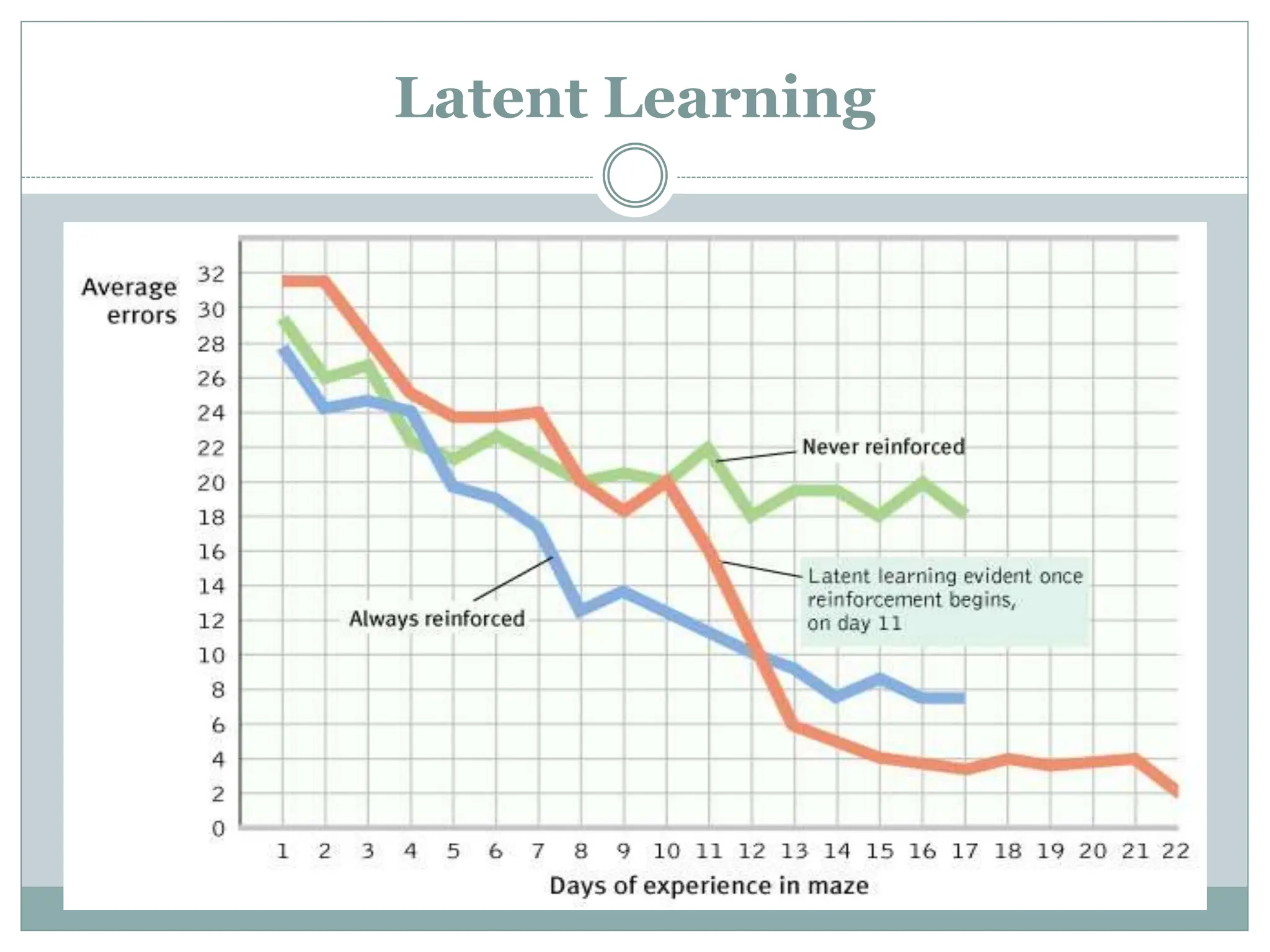
Latent Learning
 Learning that depends on mental activity that is
not directly observable
 It involves such processes as attention,
expectation, thinking, and memory
 Latent learning: Learning that occurs but is not
apparent until the learner has an incentive to
demonstrate it.
 Latent learning is learning that takes place before the
subject realizes it and is not immediately reflected in
behavior
Latent Learning
Cognitive Map
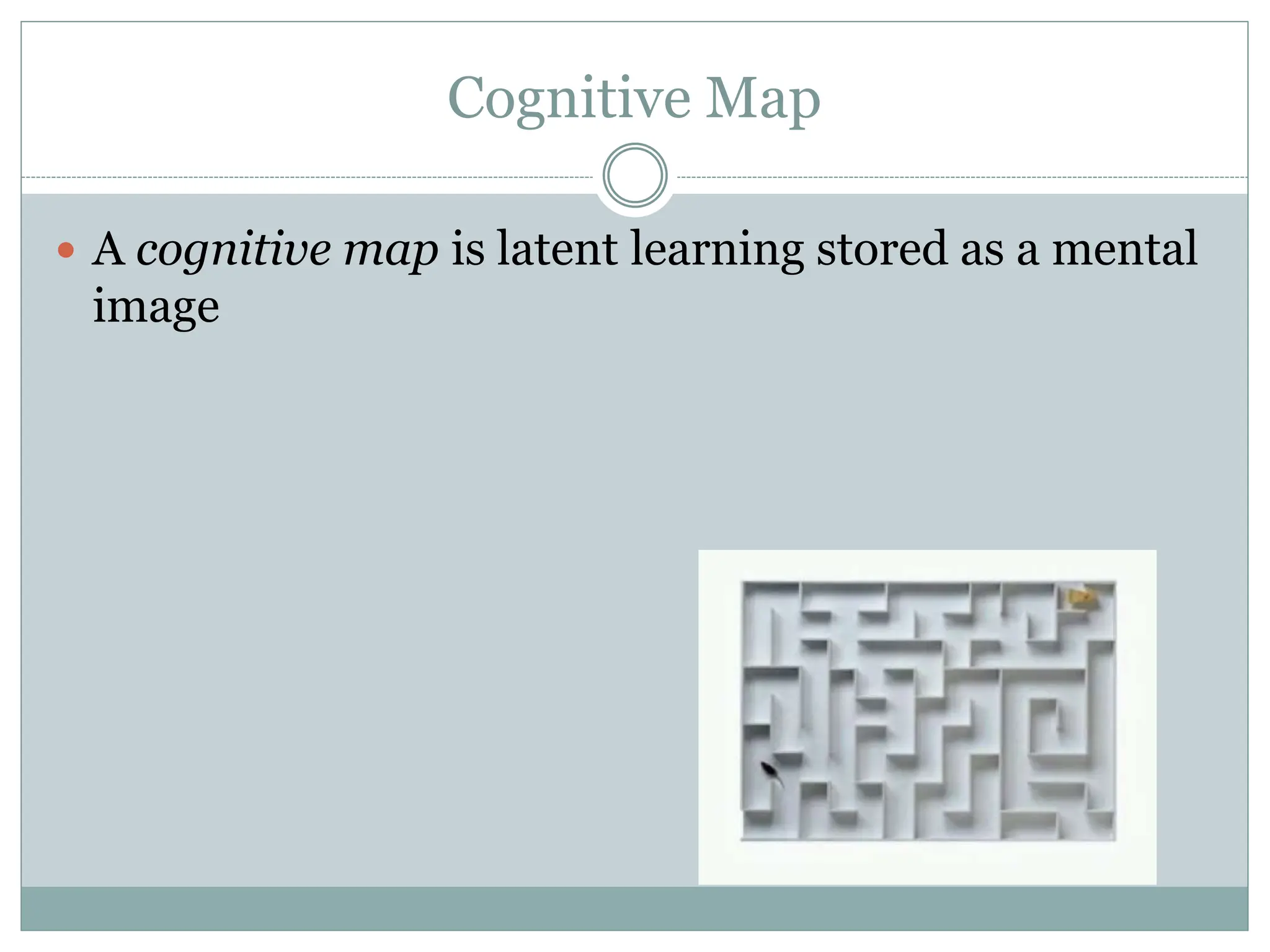
 A cognitive map is latent learning stored as a mental
image
Insight and Learning Sets
 Insight is when learning seems to occur in a sudden
“flash” as elements of a situation come together
 Insight Learning: type of learning or problem solving
that happens all-of-a-sudden through understanding
the relationships of various parts of a problem rather
than through trial and error.
 Learning sets refer to increasing effectiveness at
problem solving through experience, i.e., organisms
“learn how to learn”
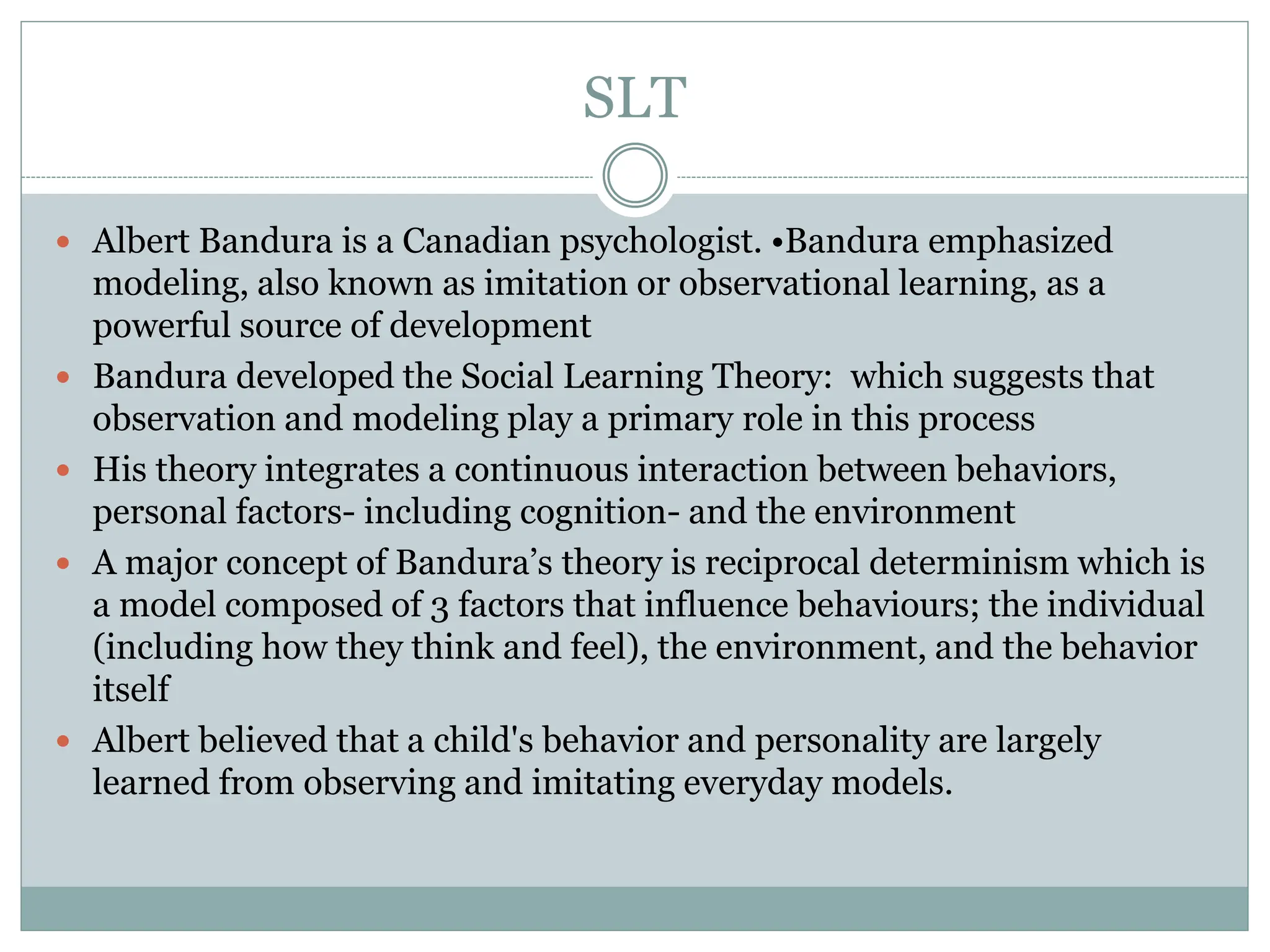
Mirror Neurons
 Mirror Neurons= frontal lobe neurons that some
scientists believe fire when performing certain
actions or when observing another doing so.
 The brain’s mirroring of another’s action may enable
imitation and empathy.
 Cognitive explanation for social phenomena
 Neuroscientists discovered mirror neurons in the
brains of animals and humans that are active
during observational learning.
Social Learning Theory/Observational Learning
 You can think of observational learning as an
extension of operant conditioning, in which we
observe someone else getting rewarded but act as
thought we had also received the reward.
 Observational Learning= learning by observing
others. Also called social learning.
 Observational learning: Learning in which new
responses are acquired after other’s behavior and the
consequences of their behavior are observed.
 Modelling = the process of observing and imitating a
specific behavior.
SLT
 Albert Bandura is a Canadian psychologist. •Bandura emphasized
modeling, also known as imitation or observational learning, as a
powerful source of development
 Bandura developed the Social Learning Theory: which suggests that
observation and modeling play a primary role in this process
 His theory integrates a continuous interaction between behaviors,
personal factors- including cognition- and the environment
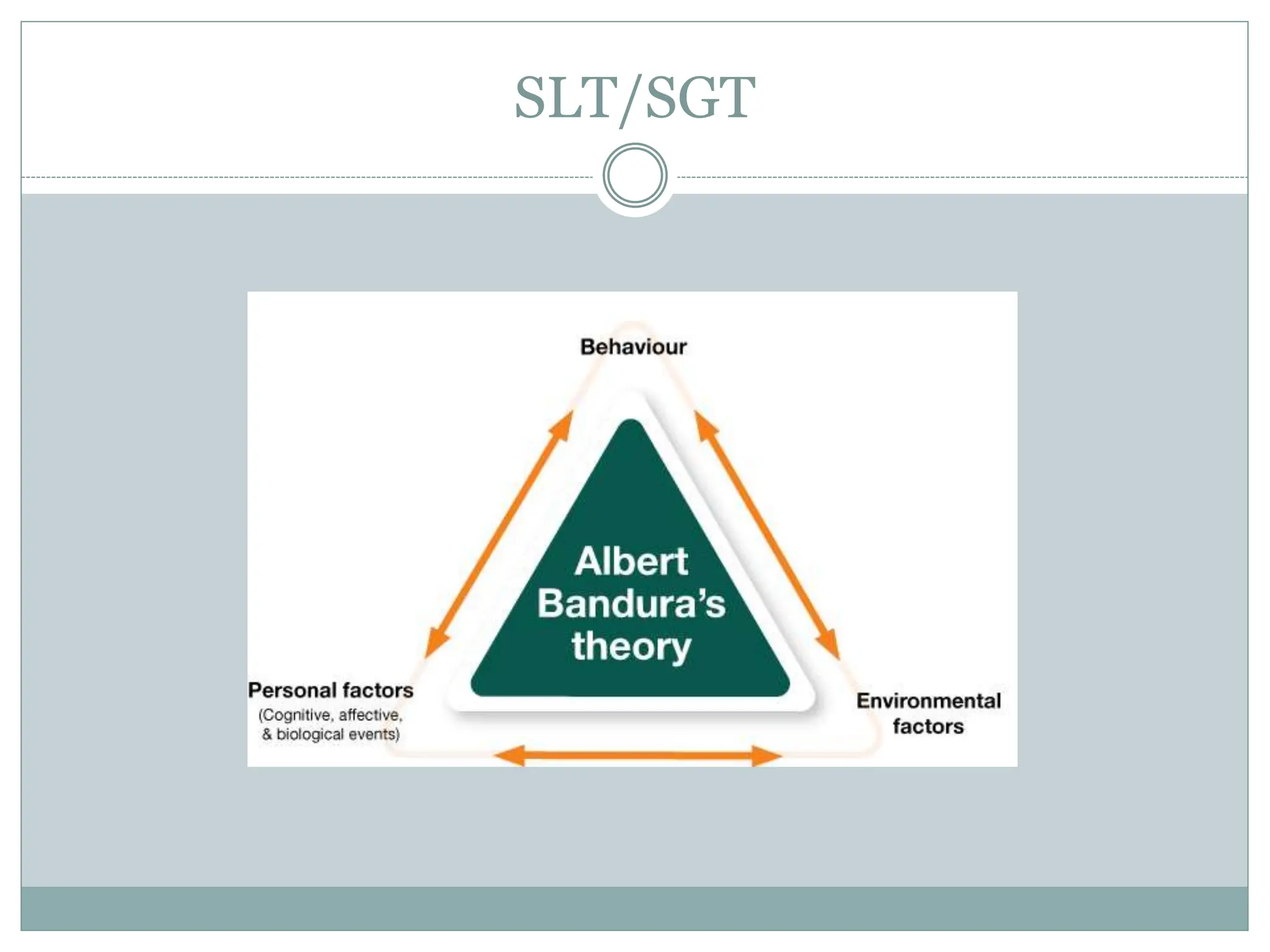
 A major concept of Bandura’s theory is reciprocal determinism which is
a model composed of 3 factors that influence behaviours; the individual
(including how they think and feel), the environment, and the behavior
itself
 Albert believed that a child's behavior and personality are largely
learned from observing and imitating everyday models.
SLT/SGT
SLT/SGT
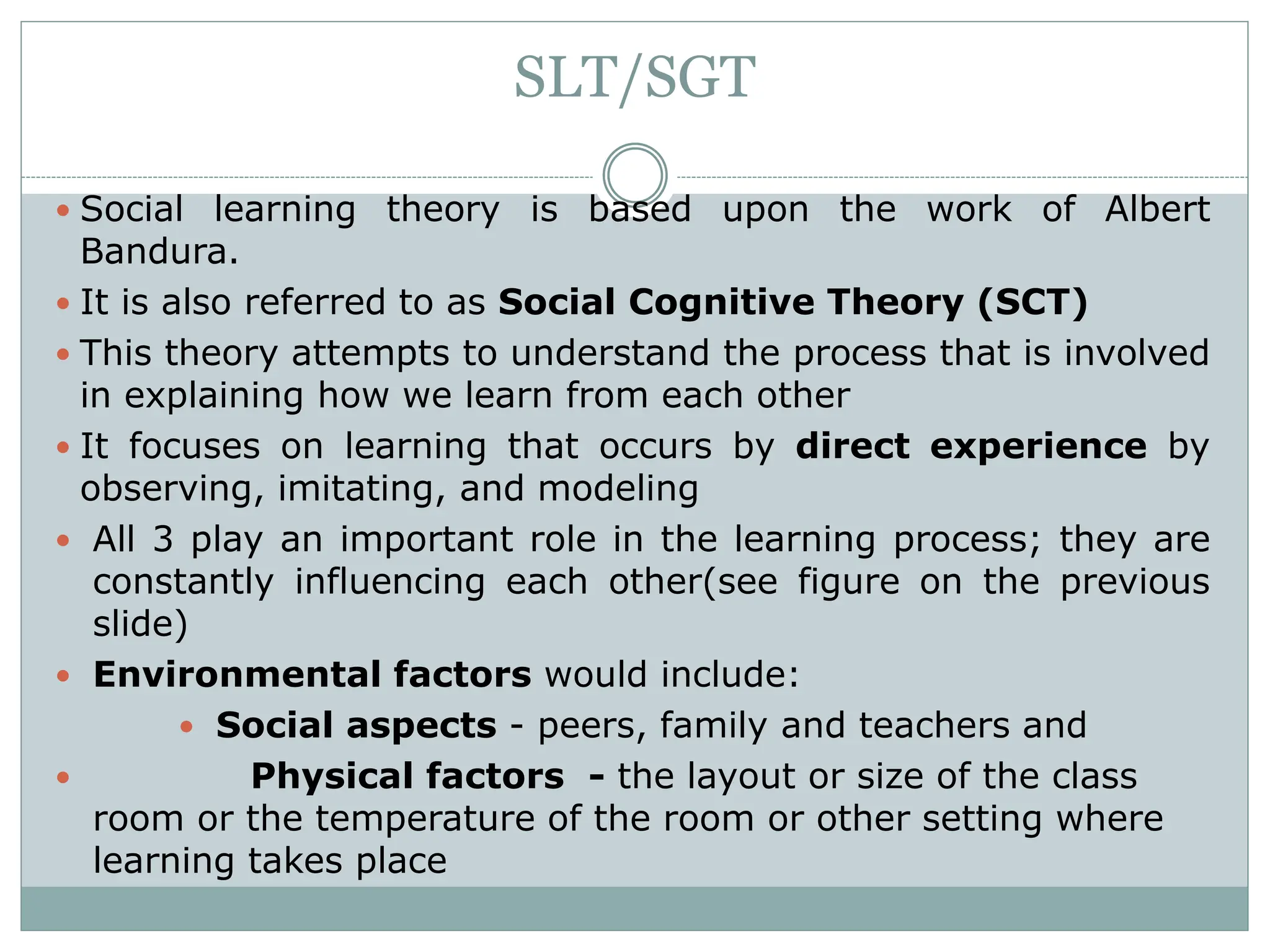
 Social learning theory is based upon the work of Albert
Bandura.
 It is also referred to as Social Cognitive Theory (SCT)
 This theory attempts to understand the process that is involved
in explaining how we learn from each other
 It focuses on learning that occurs by direct experience by
observing, imitating, and modeling
 All 3 play an important role in the learning process; they are
constantly influencing each other(see figure on the previous
slide)
 Environmental factors would include:
 Social aspects - peers, family and teachers and
 Physical factors - the layout or size of the class
room or the temperature of the room or other setting where
learning takes place
or the temperature of the room
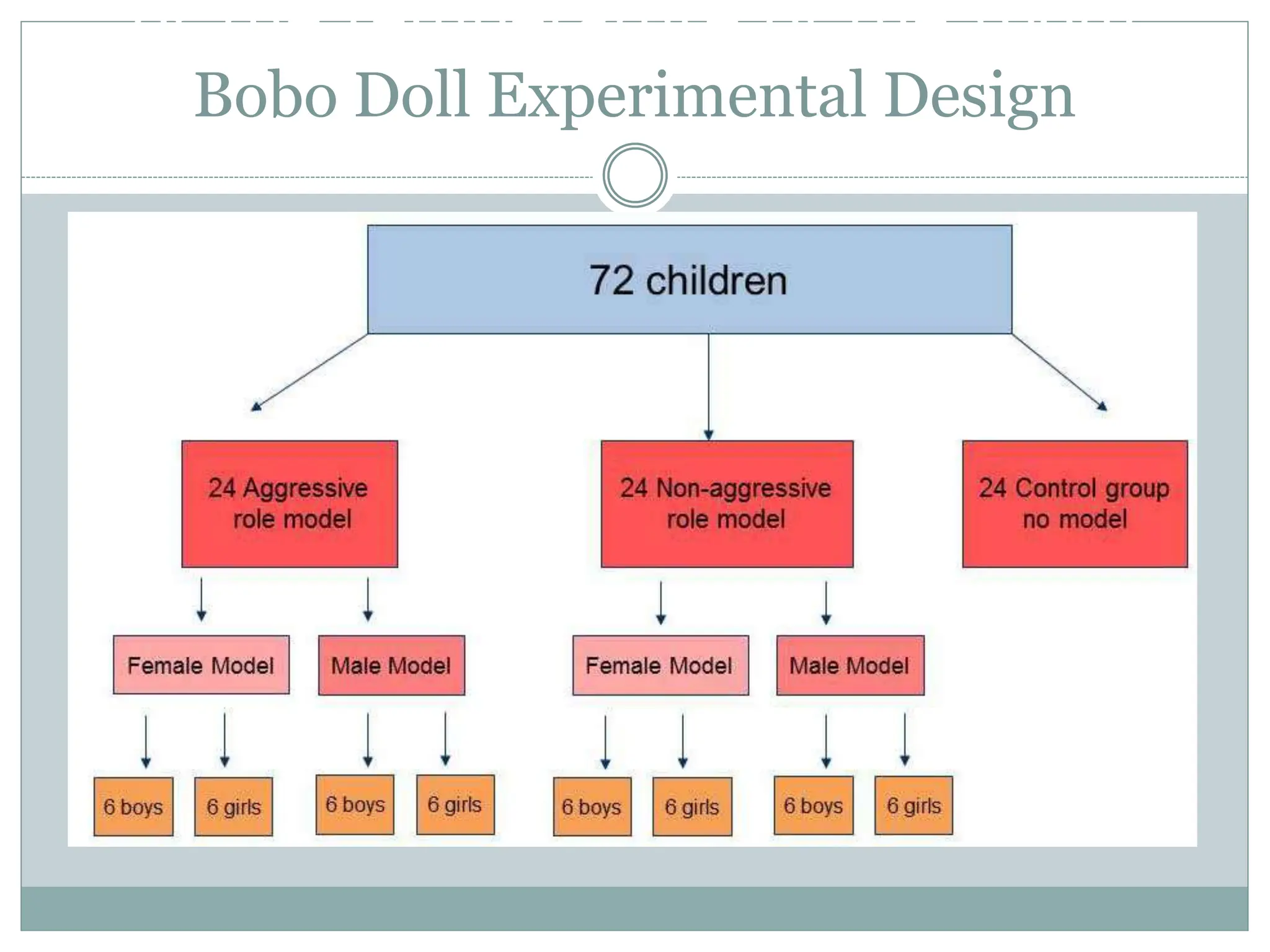
Bobo Doll Experimental Design
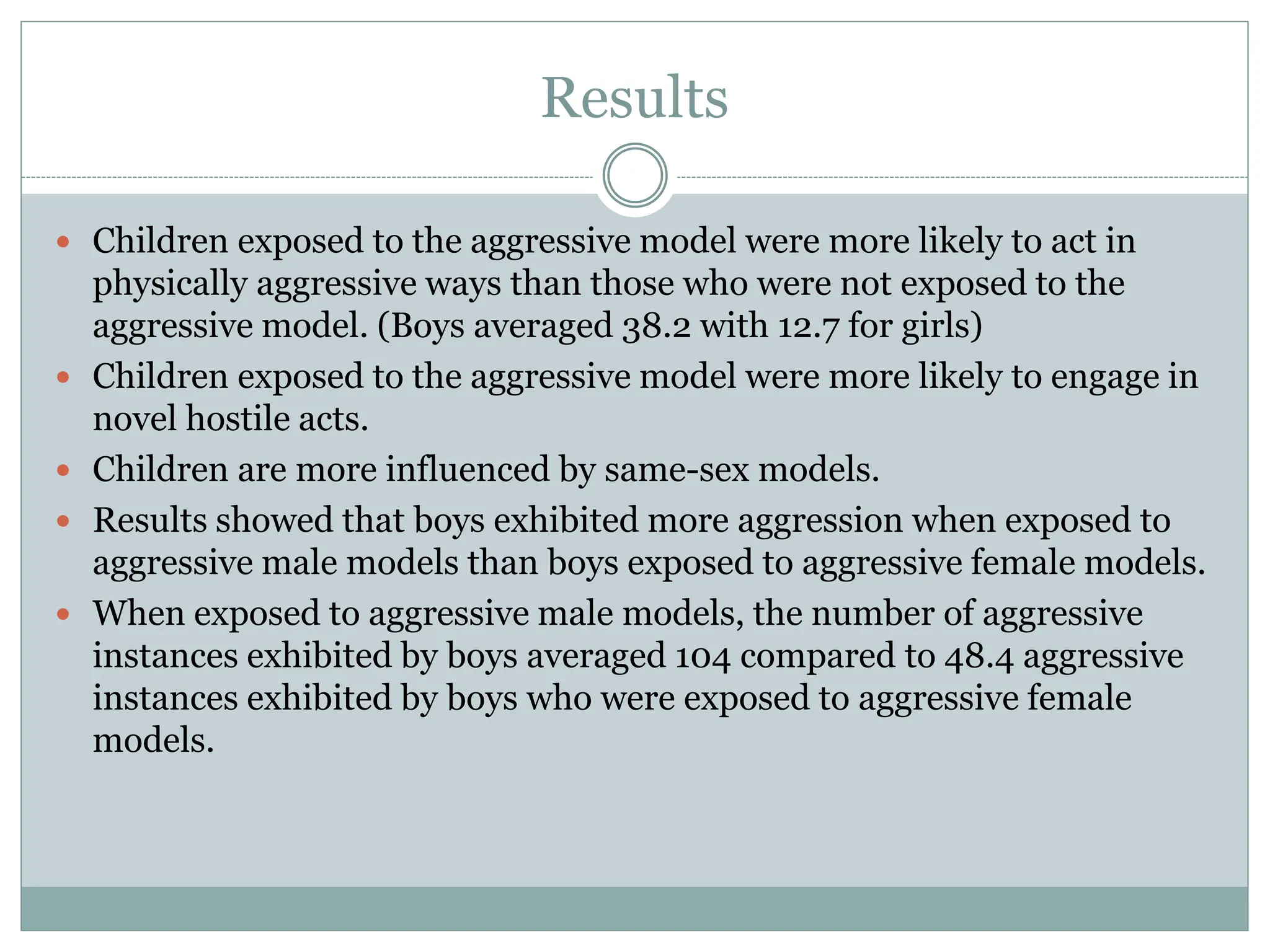
Results
 Children exposed to the aggressive model were more likely to act in
physically aggressive ways than those who were not exposed to the
aggressive model. (Boys averaged 38.2 with 12.7 for girls)
 Children exposed to the aggressive model were more likely to engage in
novel hostile acts.
 Children are more influenced by same-sex models.
 Results showed that boys exhibited more aggression when exposed to
aggressive male models than boys exposed to aggressive female models.
 When exposed to aggressive male models, the number of aggressive
instances exhibited by boys averaged 104 compared to 48.4 aggressive
instances exhibited by boys who were exposed to aggressive female
models.
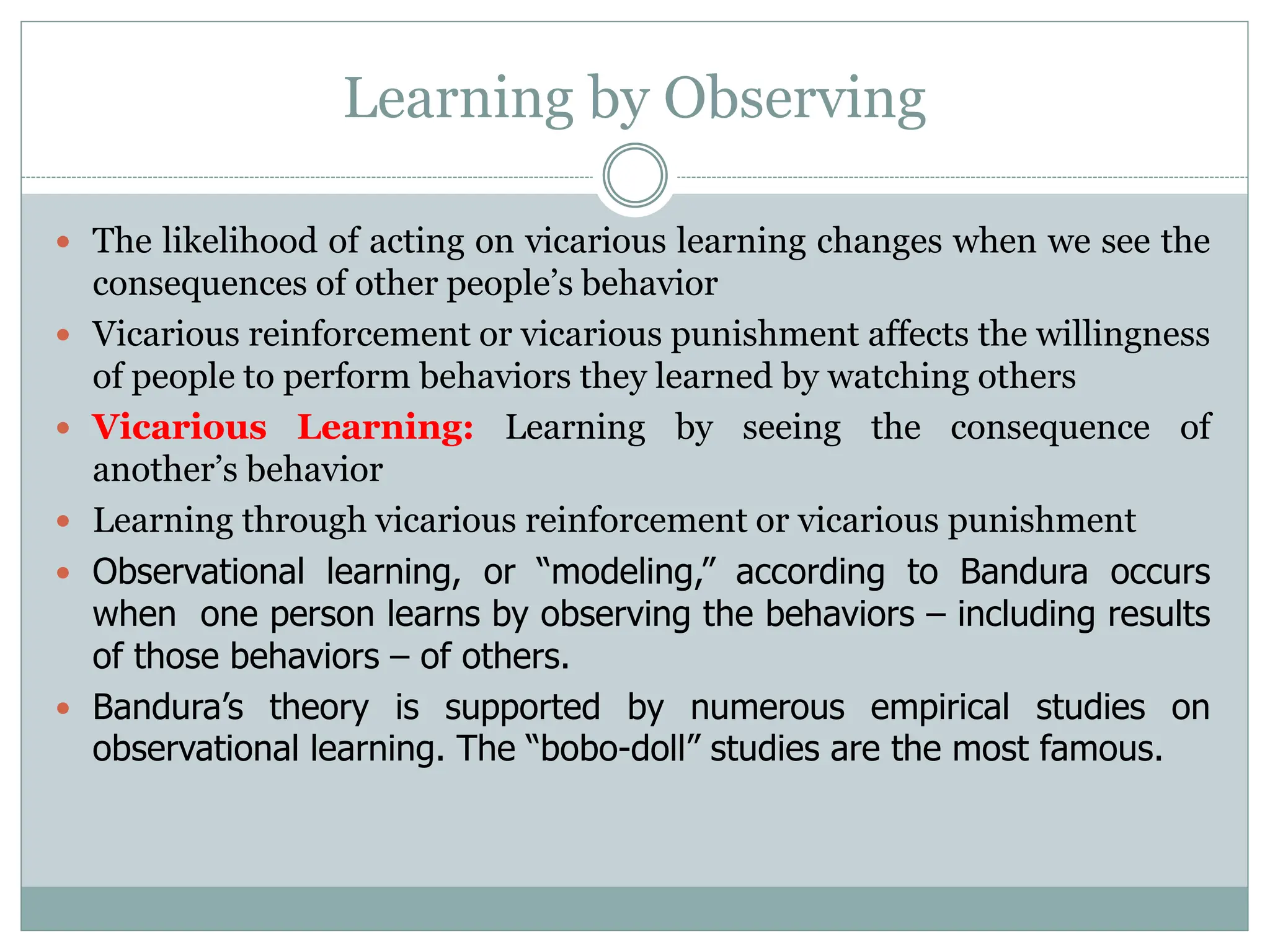
Learning by Observing
 The likelihood of acting on vicarious learning changes when we see the
consequences of other people’s behavior
 Vicarious reinforcement or vicarious punishment affects the willingness
of people to perform behaviors they learned by watching others
 Vicarious Learning: Learning by seeing the consequence of
another’s behavior
 Learning through vicarious reinforcement or vicarious punishment
 Observational learning, or “modeling,” according to Bandura occurs
when one person learns by observing the behaviors – including results
of those behaviors – of others.
 Bandura’s theory is supported by numerous empirical studies on
observational learning. The “bobo-doll” studies are the most famous.
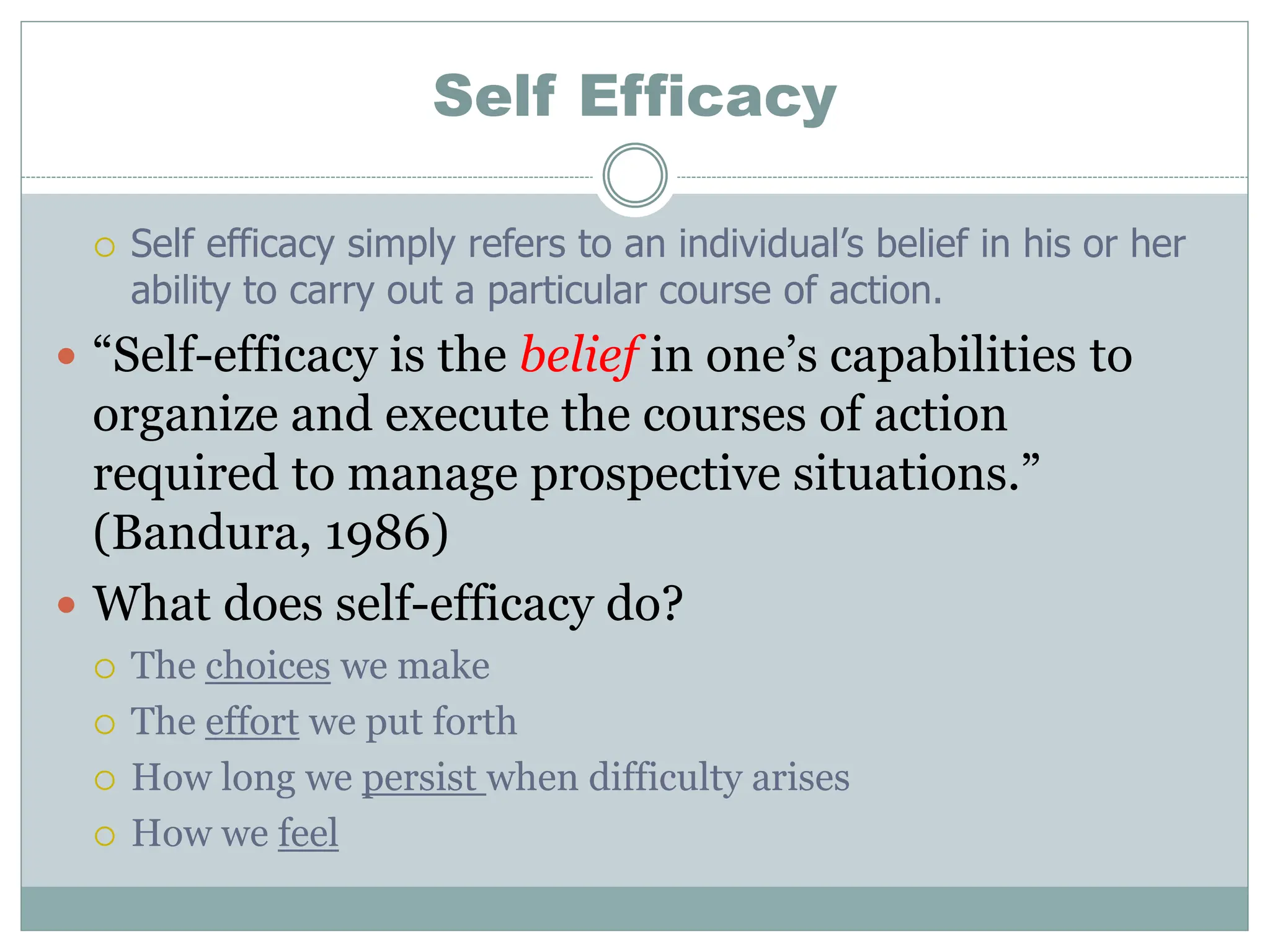
Self Efficacy
 Self efficacy simply refers to an individual’s belief in his or her
ability to carry out a particular course of action.
 “Self-efficacy is the belief in one’s capabilities to
organize and execute the courses of action
required to manage prospective situations.”
(Bandura, 1986)
 What does self-efficacy do?
 The choices we make
 The effort we put forth
 How long we persist when difficulty arises
 How we feel
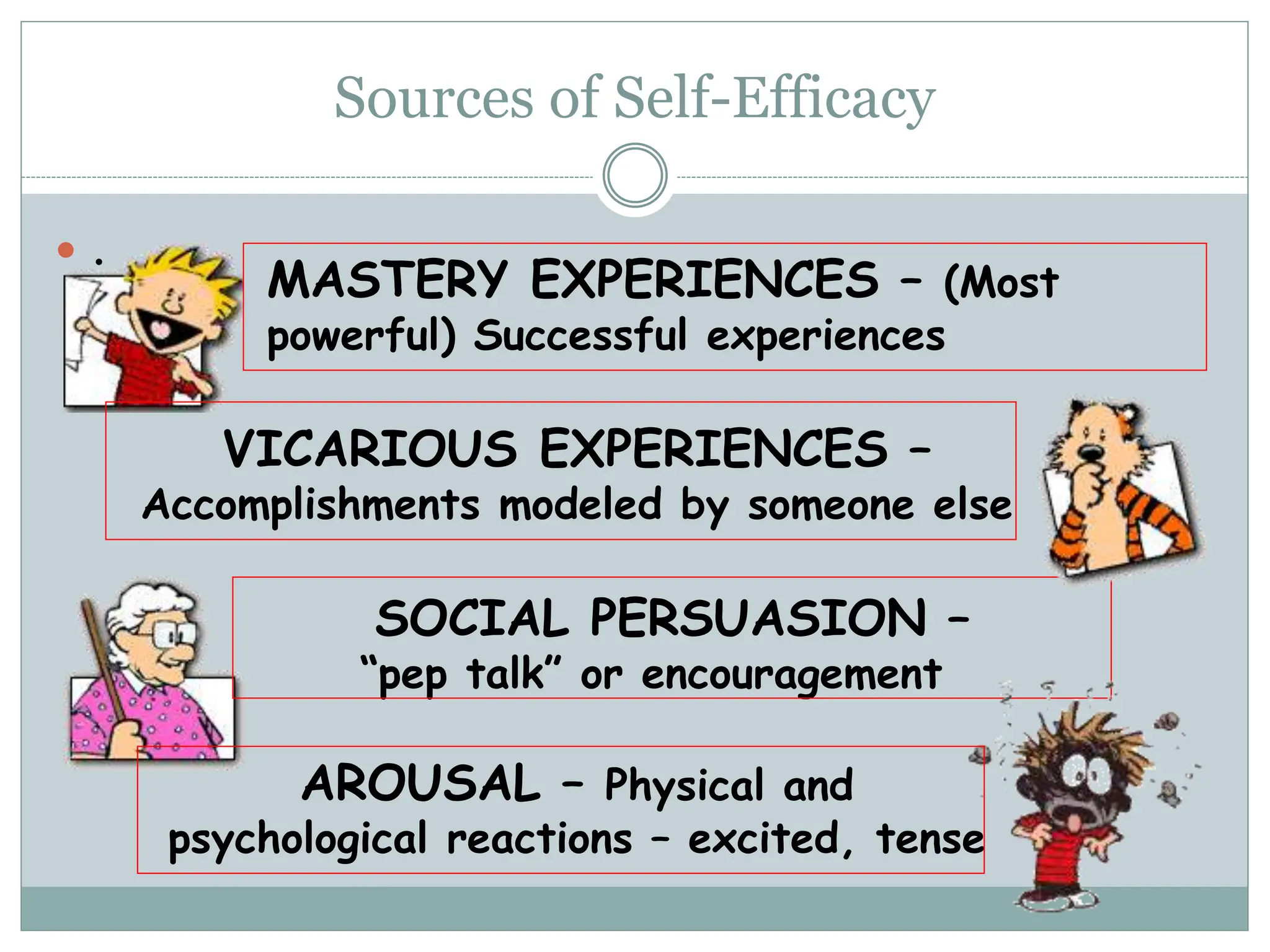
Sources of Self-Efficacy
 .
MASTERY EXPERIENCES – (Most
powerful) Successful experiences
SOCIAL PERSUASION –
“pep talk” or encouragement
AROUSAL – Physical and
psychological reactions – excited, tense
VICARIOUS EXPERIENCES –
Accomplishments modeled by someone else
Goal Setting
 Goal setting is another central process
within SCT (Bandura, 1986; Schunk, 1990).
 Goals reflect cognitive representations of
anticipated, desired, or preferred outcomes.
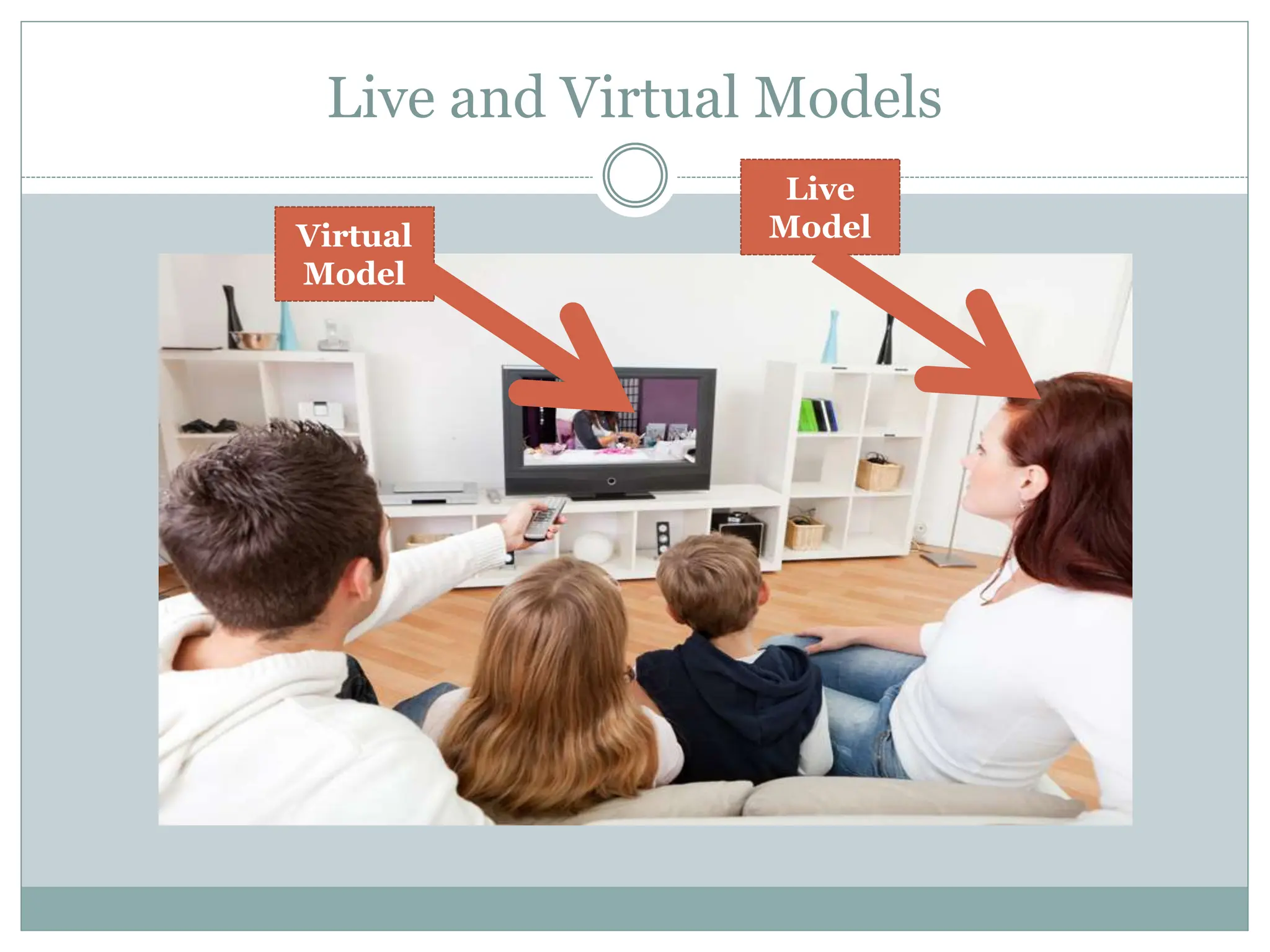
Live and Virtual Models
Virtual
Model
Live
Model
Four conditions are necessary for effective modeling
to occur(Process in OL/SLT)
 Attention: the person must first pay attention to the model.
 Retention: the observer must be able to remember the
behavior that has been observed. One way of increasing this is
using the technique of rehearsal.
 Motor reproduction: the third condition is the ability to
replicate the behavior that the model has just demonstrated.
 Motivation: the final condition for modeling to occur is
motivation, learners must want to demonstrate what they
have learned.
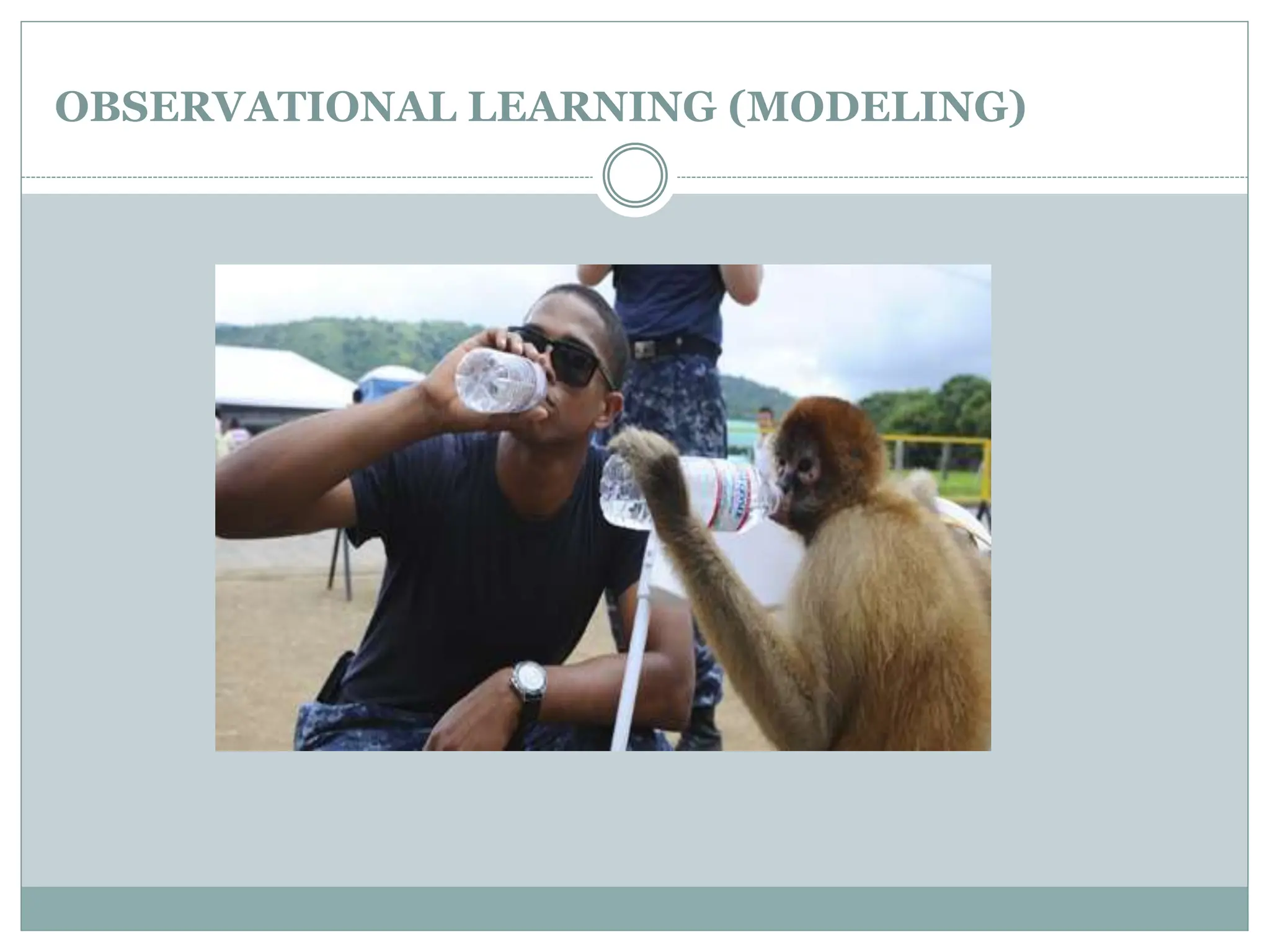
OBSERVATIONAL LEARNING (MODELING)
Media and Violence
 Does violence on TV/movies/video games have an
impact on the learning of children?
 Correlation evidence from over 50 studies shows that
observing violence is associated with violent
behavior.
 In addition, experiment evidence shows that viewers
of media violence show a reduction in emotional
arousal and distress when they subsequently observe
violent acts-a condition known as psychic
numbing.
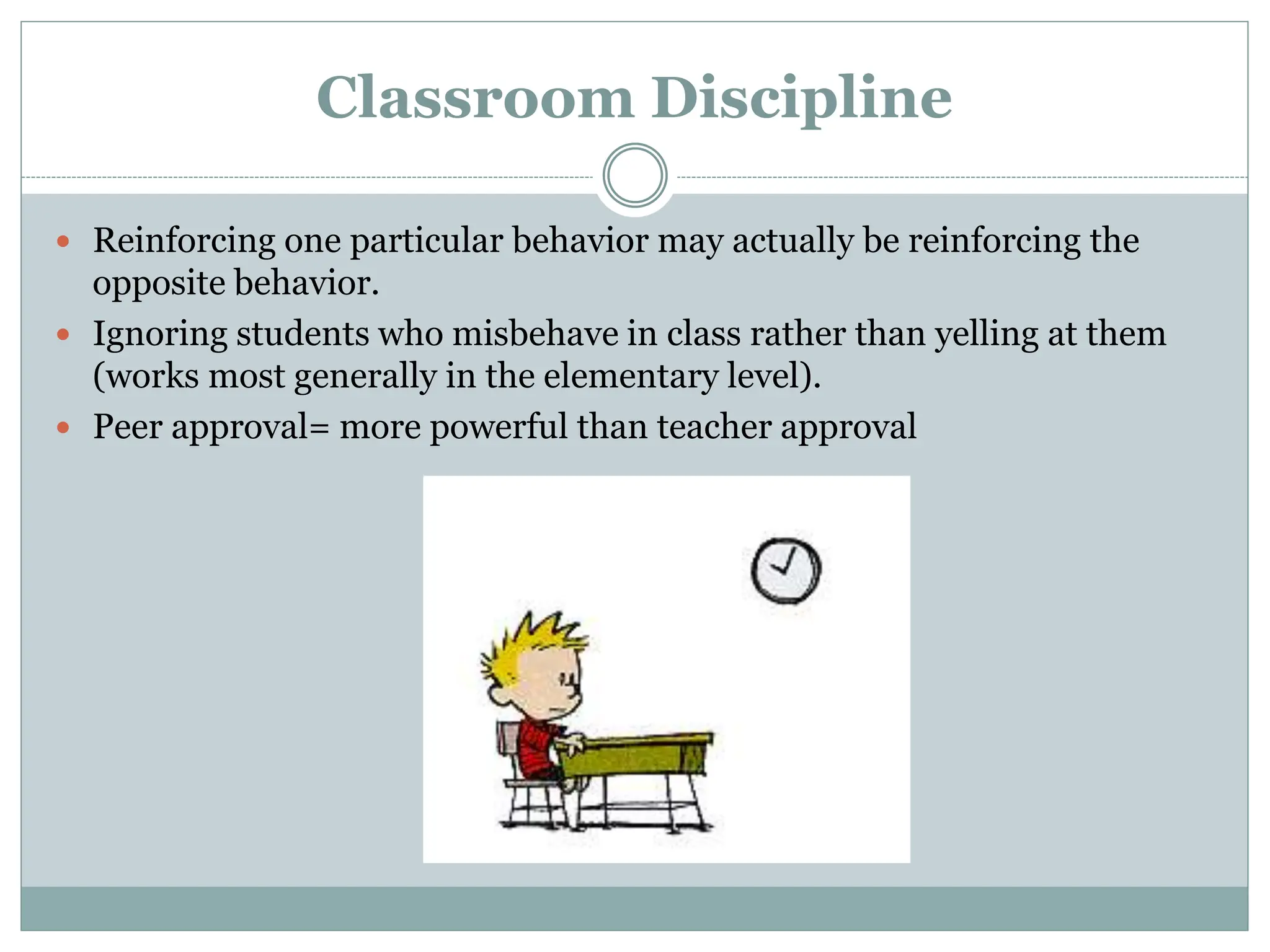
Classroom Discipline
 Reinforcing one particular behavior may actually be reinforcing the
opposite behavior.
 Ignoring students who misbehave in class rather than yelling at them
(works most generally in the elementary level).
 Peer approval= more powerful than teacher approval
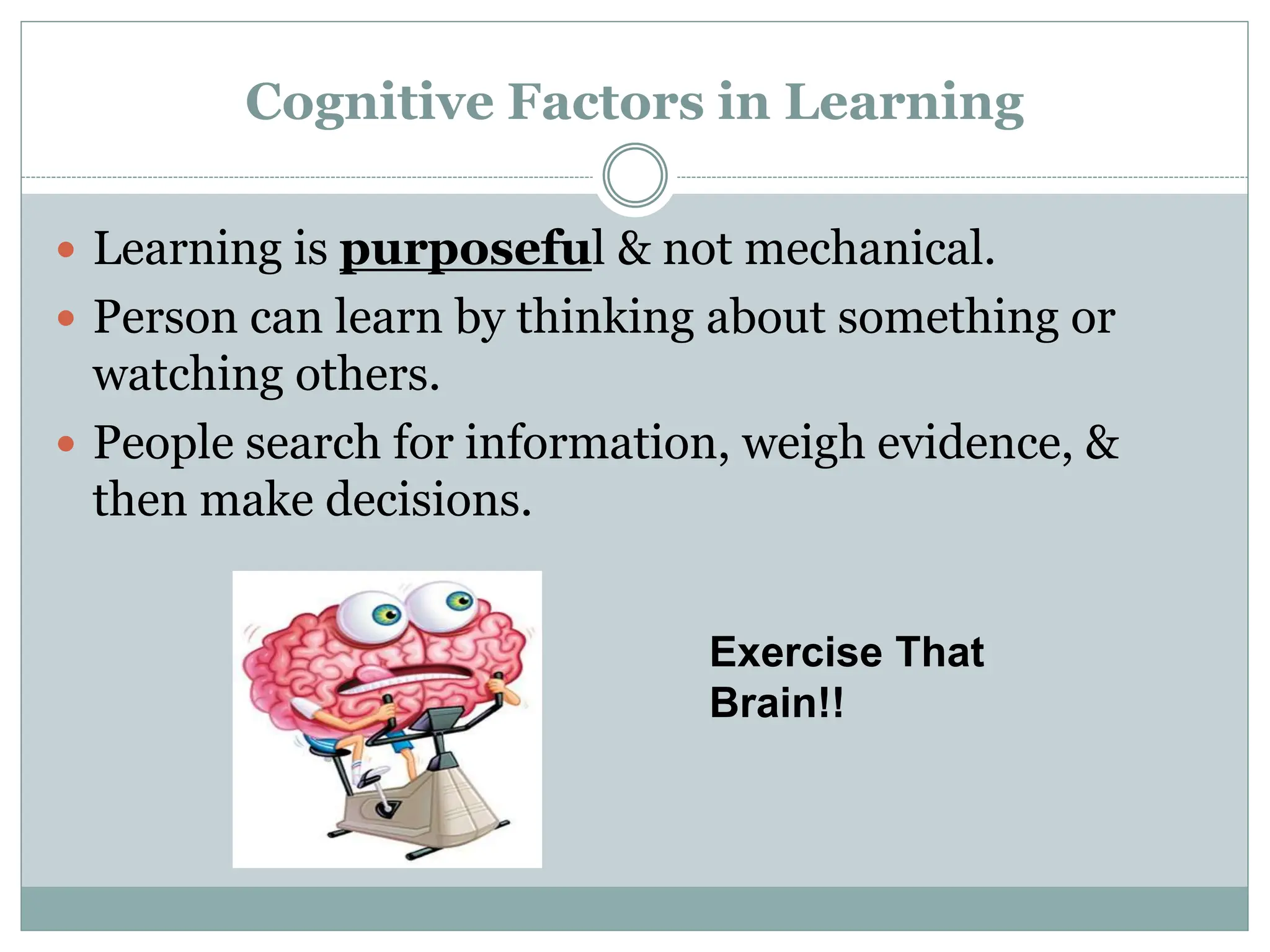
Cognitive Factors in Learning
 Learning is purposeful & not mechanical.
 Person can learn by thinking about something or
watching others.
 People search for information, weigh evidence, &
then make decisions.
Exercise That
Brain!!
Self-Control
 People set up personal systems of rewards and
punishment to shape their own thoughts and actions.
 First step to develop some self control is to define
the problem.
 Set up a behavioral contract.
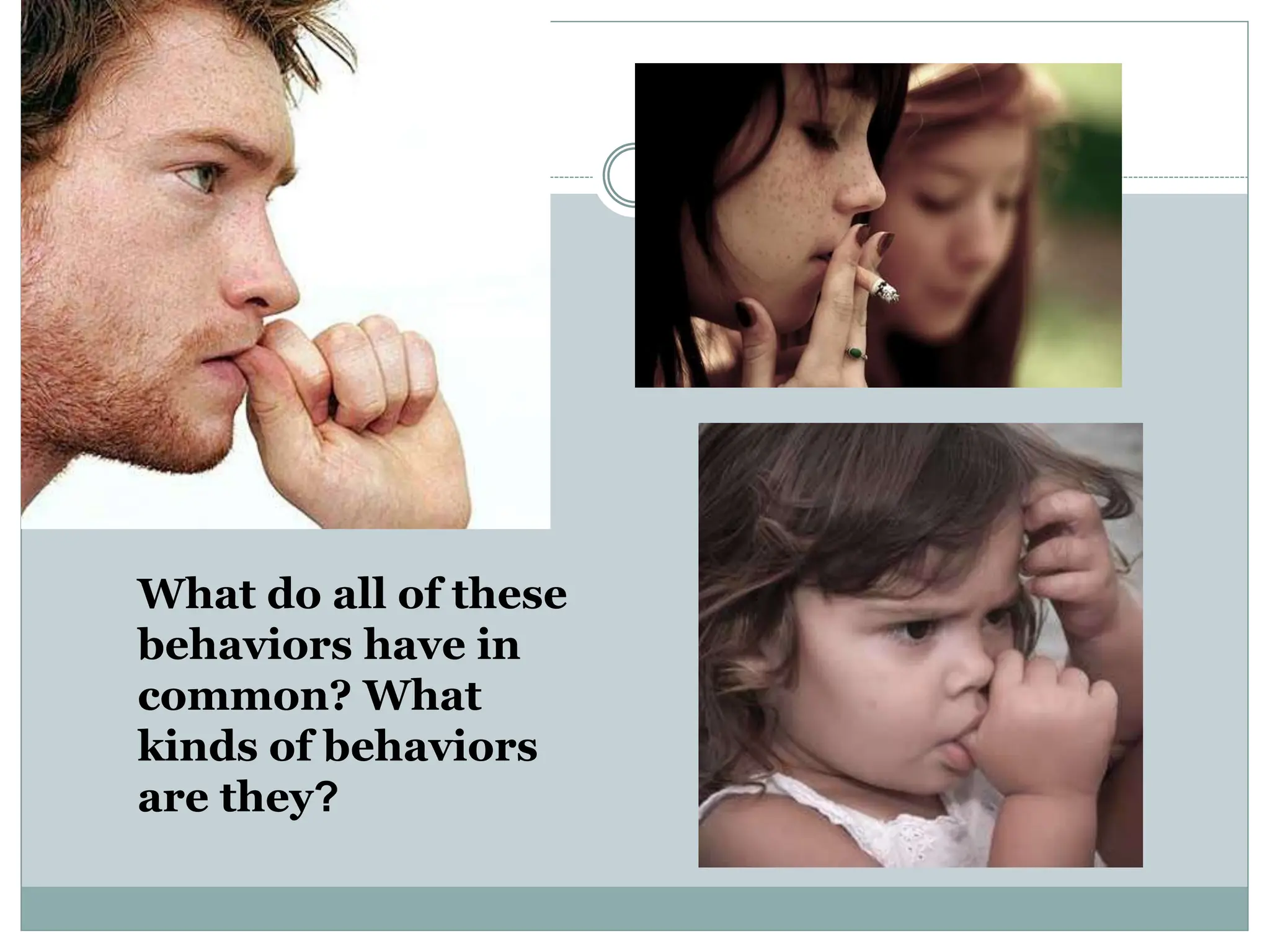
What do all of these
behaviors have in
common? What
kinds of behaviors
are they?
Improving Study Habits
 Pay attention, read/recite information you have
heard.
 Make flash cards—USE THEM
 Redo problems or questions on a lengthy assignment
or test.
 Make meaningful connections with the information
you are learning.
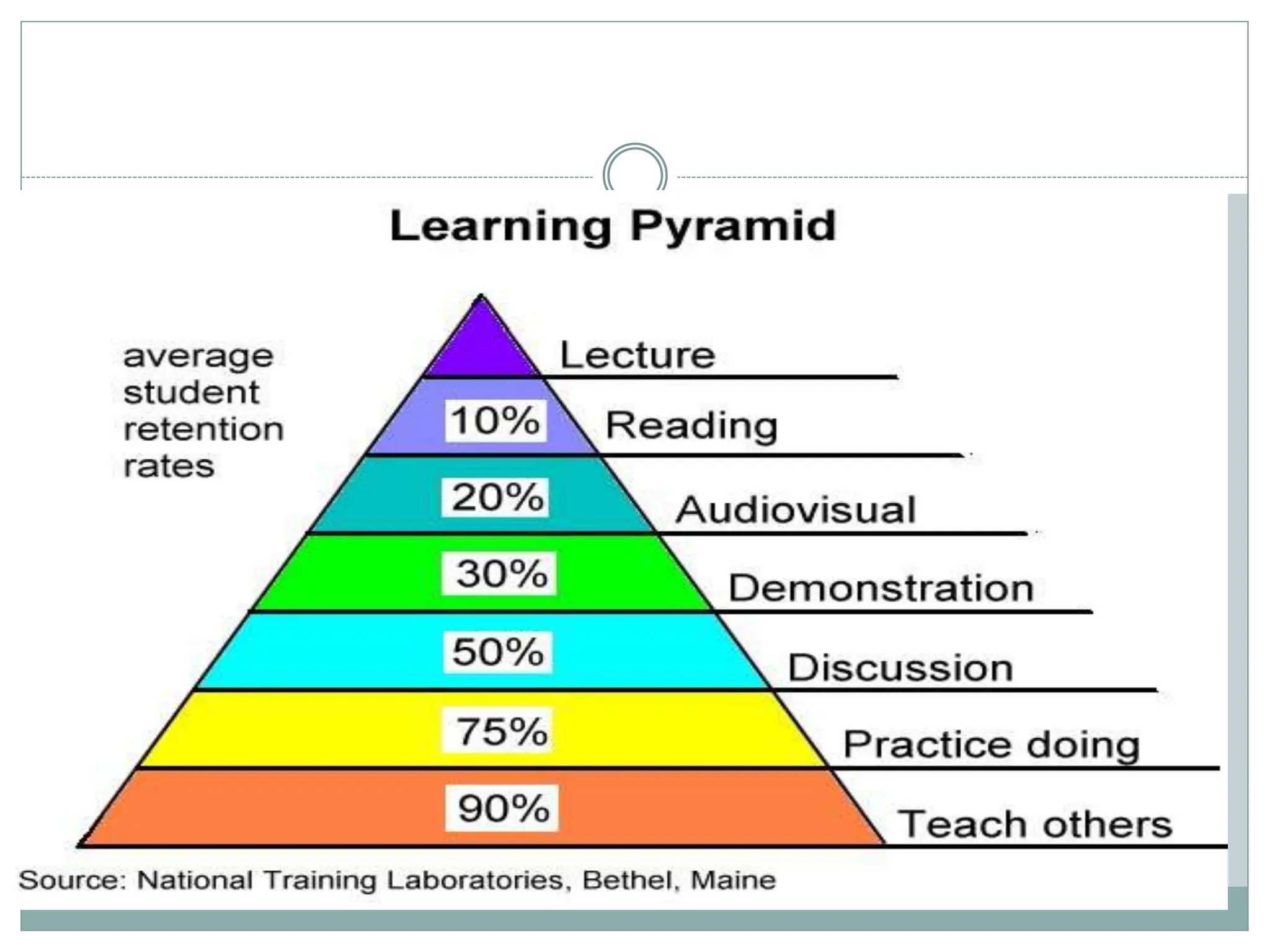
 Find a study partner—you haven’t mastered
something until you can teach it to someone else.
 Study material in small dose—not the night of the
exam.
Reinforcement
 Primary: stimuli that increases the probability of a response
because they satisfy a biological need, such as food or water.
 Secondary: stimuli that increases the probability of a
response because of their learned value, such as money and
material possessions.
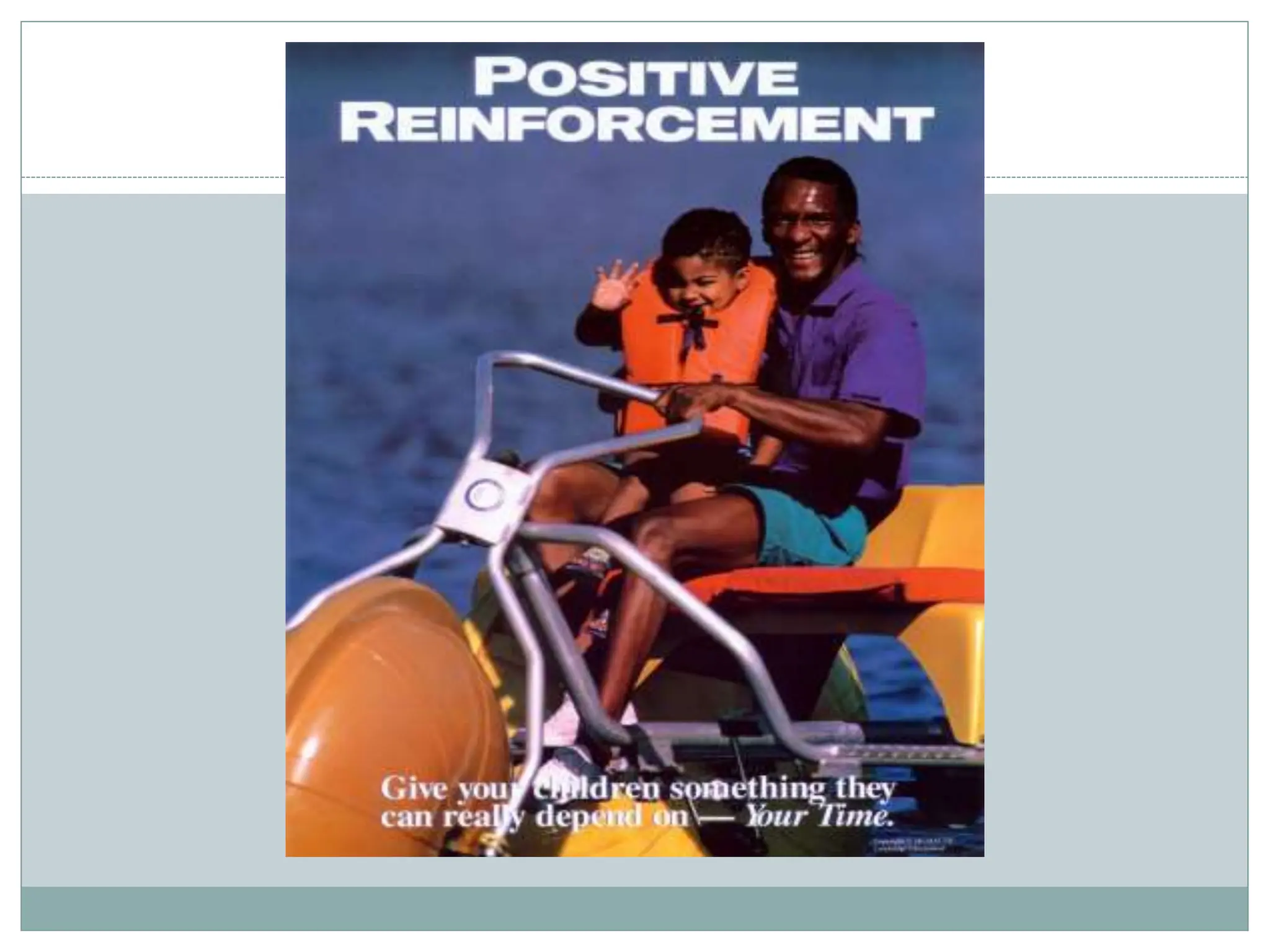
 Positive: adding or presenting a stimulus which strengthens
a response and makes it more likely to occur.
 Negative: taking away or removing a stimulus, which
strengthens a response and makes it more likely to occur.
Schedules of Reinforcement Examples
 Fixed Ratio: employee receives $10 for every 4
customers he/she helps at Best Buy.
 Variable Ratio: slot machine at Caesars’ Palace
pays out after an average number of responses,
maybe every 15 minutes.
 Fixed Interval: Intel employee receives a paycheck
every two weeks for their service as an engineer.
 Variable Interval: Chemistry class gives pop
quizzes, student studies at a slow but steady rate
because they can’t anticipate the next quiz.
Reinforcement Example
 You want to teach a dog to shake hands. One way
would be to give the animal a treat every time it lifts
its paws up to you. The treat is called a positive
reinforcer.
 Your dog will stop shaking hands when you forget to
reward it for the trick as extinction will occur
because the reinforcement is withheld; But will take
a period of time
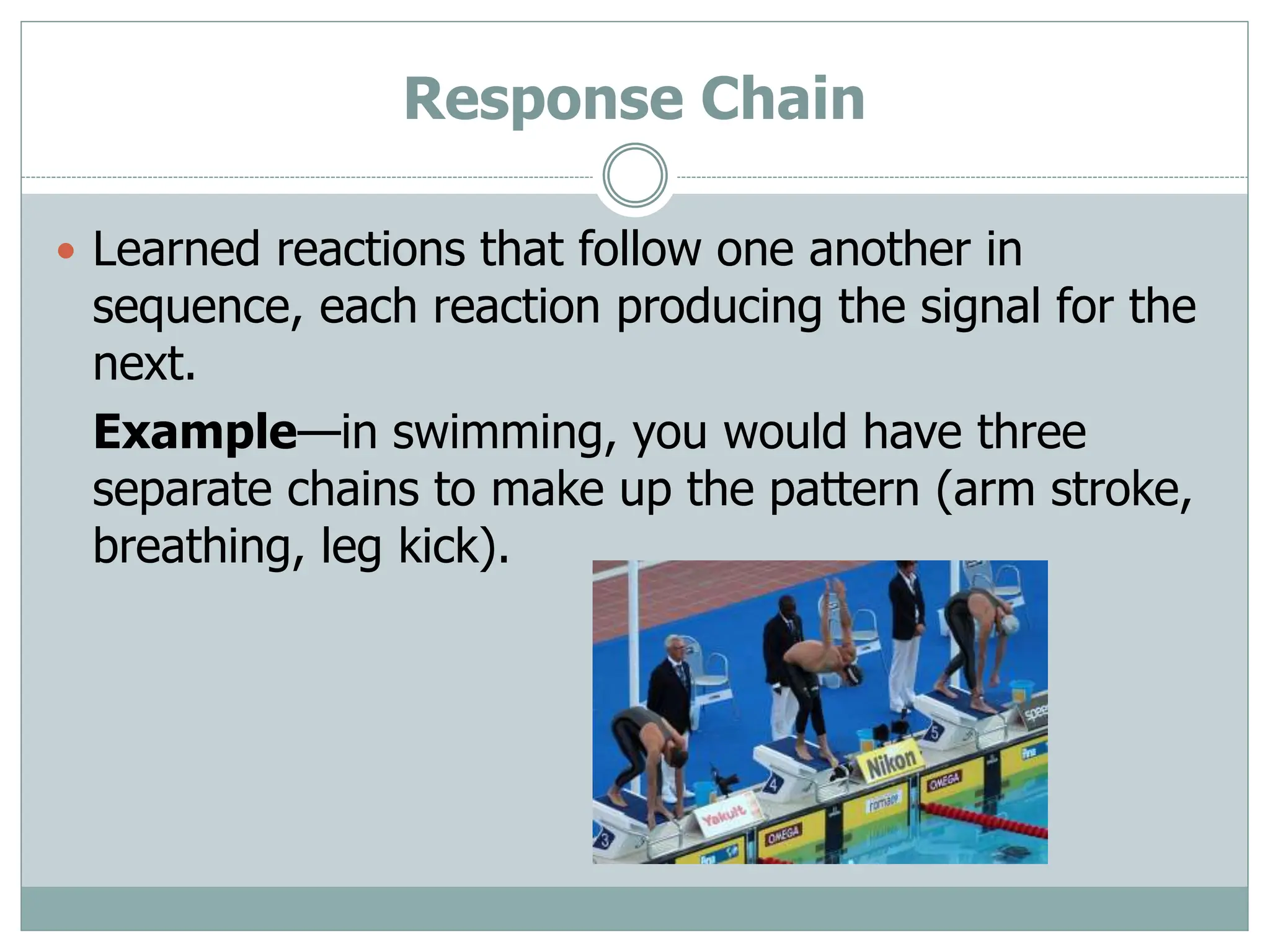
Response Chain
 Learned reactions that follow one another in
sequence, each reaction producing the signal for the
next.
Example—in swimming, you would have three
separate chains to make up the pattern (arm stroke,
breathing, leg kick).
Punishment
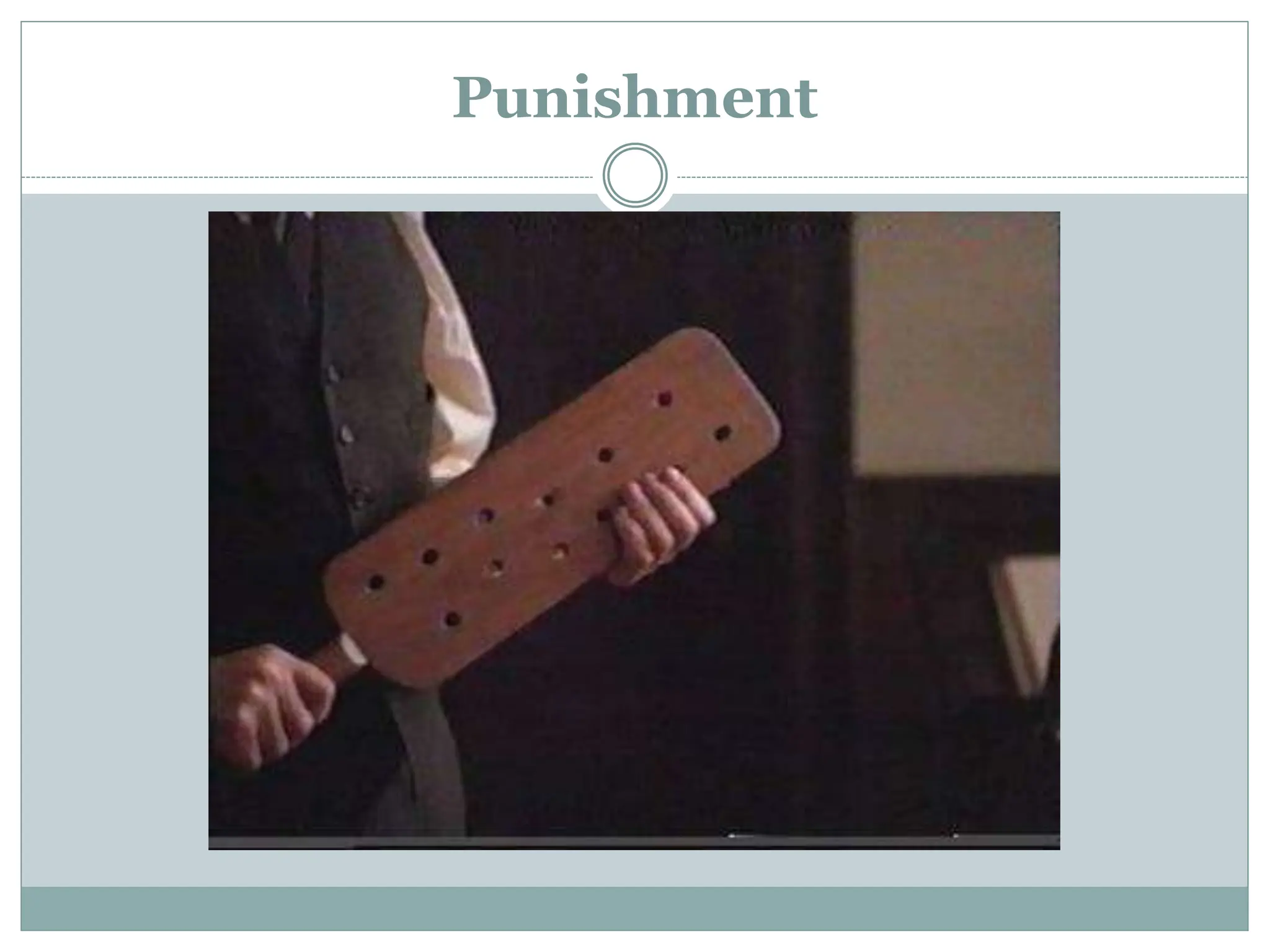
Punishment
 The most obvious form of aversive control.
 An unpleasant consequence occurs & decreases the
frequency of the behavior that produced it.
 Behavior that is punished decreases or is not
repeated—that is the goal of punishment.
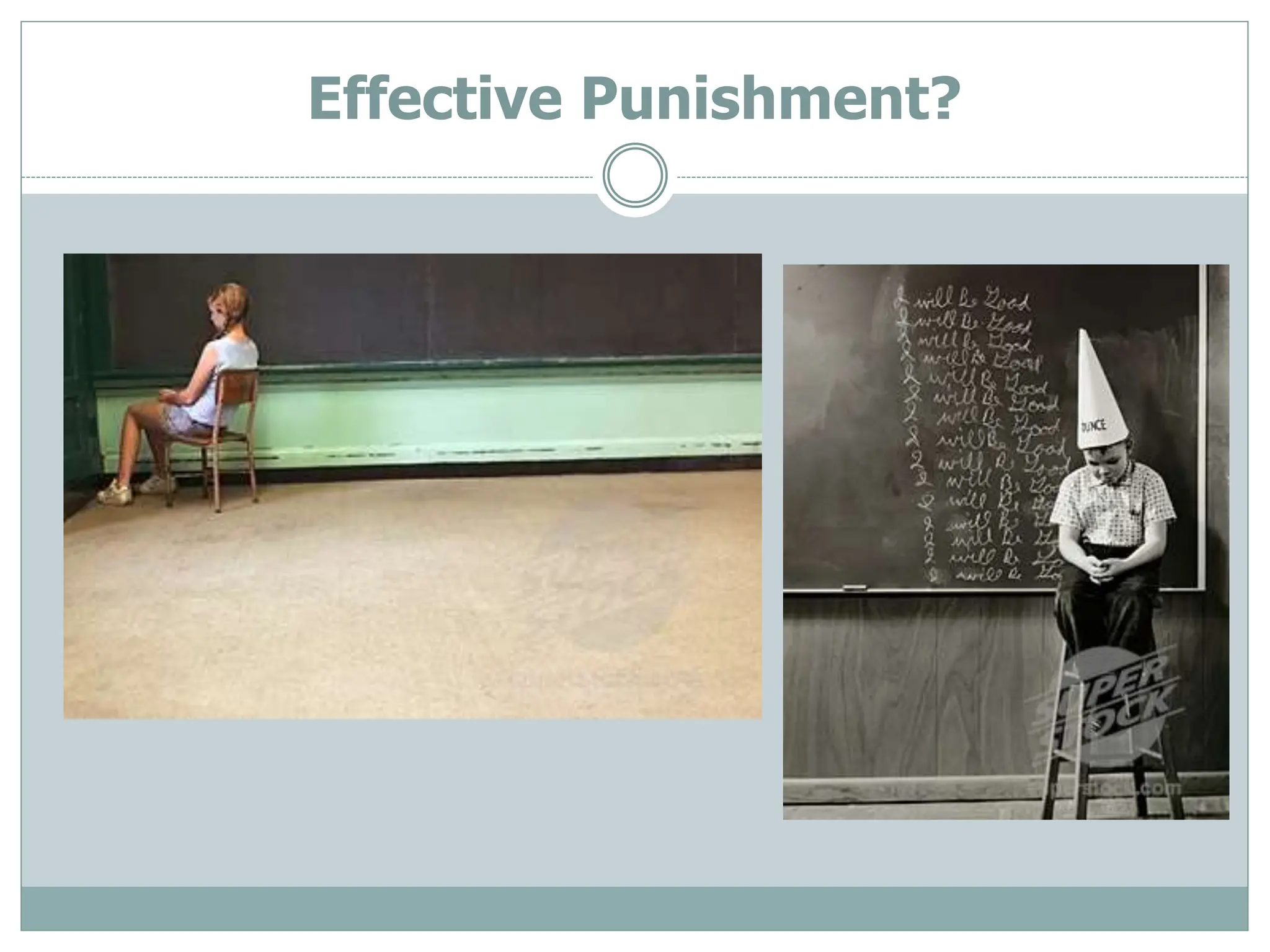
Effective Punishment?
Disadvantages of Punishment
1. Aversive stimuli can produce unwanted side effects—rage,
aggression, fear.
2. Instead of one behavior to change, multiple behaviors could
emerge.
3. People learn to avoid the person delivering the aversive
consequences—children learn to stay away from parents or
teachers who often punish them.
4. Can just merely “suppress” the undesired behavior, not
totally eliminate it.
5. A child may not learn “correct” behaviors by punishment
alone—coaching/training is needed.
Questions
1. How do you learn?
2. What environment is most suitable for you to
learn?
3. Are you a visual or auditory learner?
4. What can you do to improve your ability to learn
new material?
5. What causes you not to learn?
6. Is there some material or information that people
just simply cannot grasp?
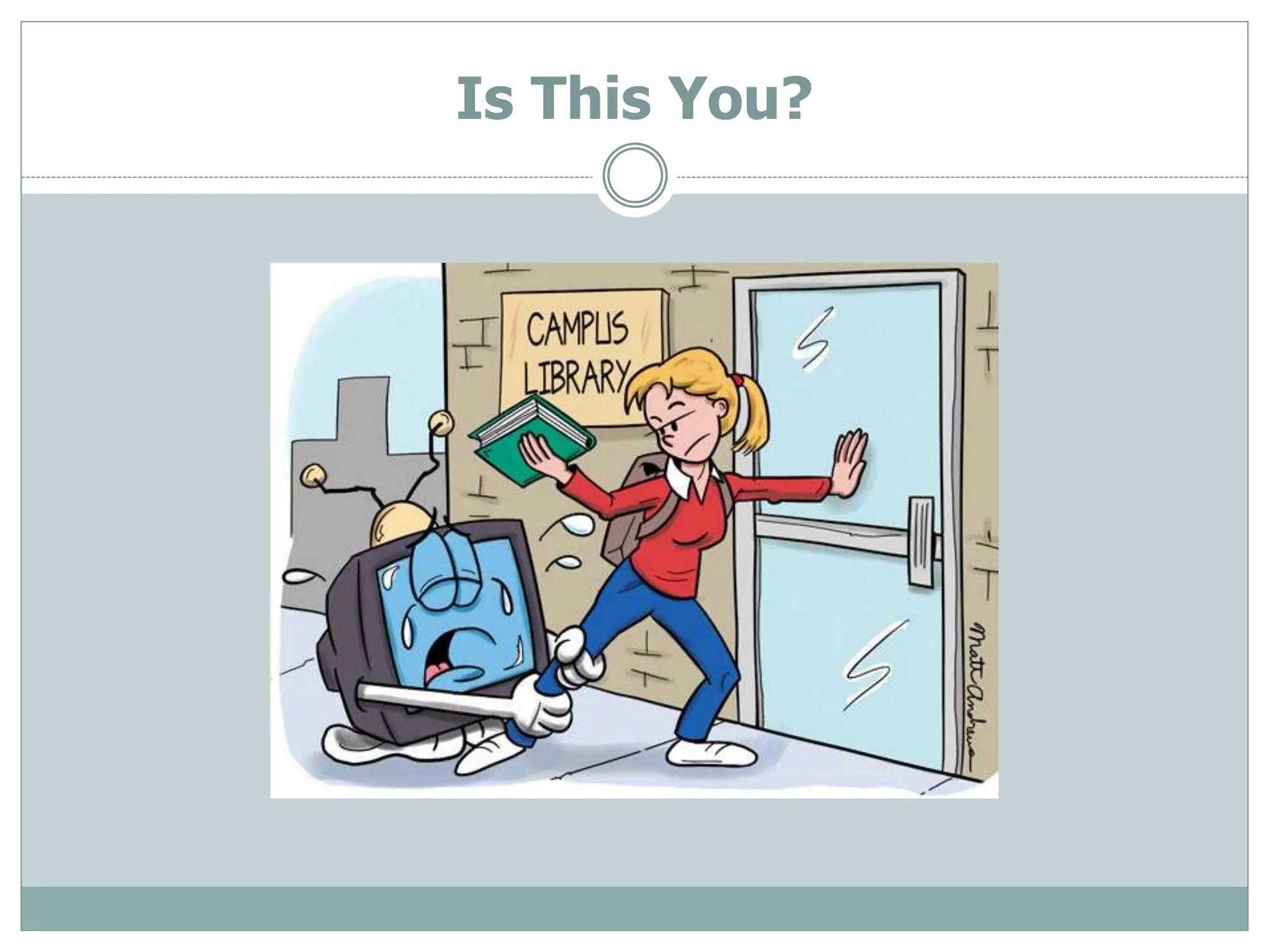
Is This You?
Self-Control
 Personal systems of rewards and punishments—
helps shape one’s own thoughts and actions.
 First step in self-control is to define the problem.
 People who have a very poor opinion of themselves
would have to define the problem more concretely.
 Keep track of self-deprecating thoughts and remarks
you make—may lead to a start in changing behavior.
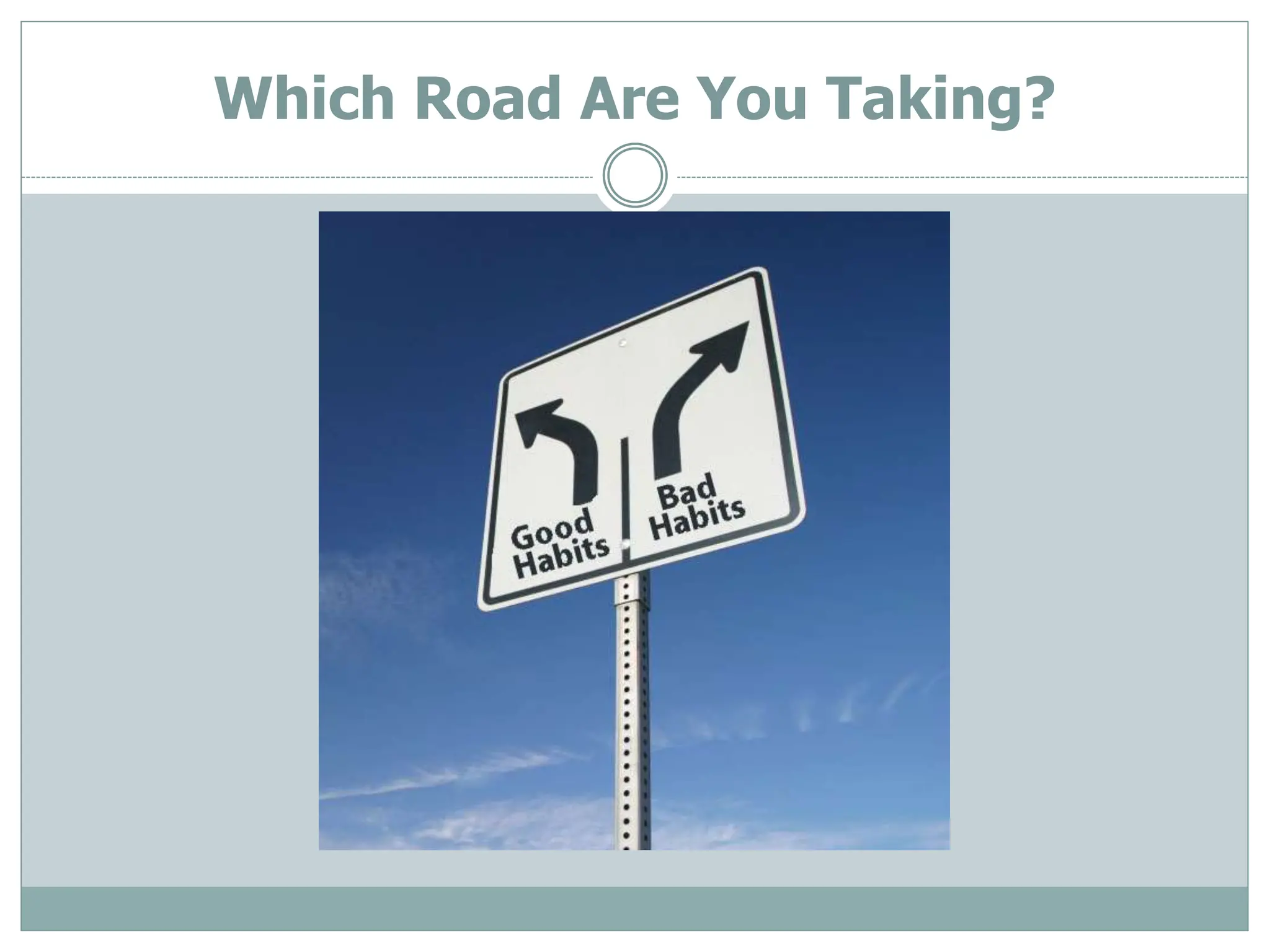
Which Road Are You Taking?
Improving Study Habits
 Studying in a new place—free from distractions.
 Don’t study too much at any one given time.
 Attempt to study at the same time each day.
 Set specific goals.
 Tell friends not to call during study times.
Summary
1. Human behavior influenced by one’s history of
rewards and punishments.
2. Behavior can be reinforced according to continuous
or partial reinforcement schedules.
3. Punishments are stimuli that actually decrease the
likelihood of certain behaviors from repeating
themselves.
Questions
1. What are appropriate punishments for teenagers
who commit crimes?
2. How would you go about “modifying” teenagers or
even younger children’s behavior?
3. What are two advantages and two disadvantages of
punishment

AP Chapter 6 Learning.ppt:Classical Conditioning, Operant Condition, Social Cognitive Learning theory, and cognitive learning theories.

  • 1.
  • 2.
    A Life withoutLearning  Learning is more than school, books and tests. Without learning our lives would simply be a series of reflexes and instincts.  We would not be able to communicate, we would have no memory of our past or goals for the future.
  • 3.
    Learning  Learning isa lasting change in behavior or mental process as the result of an experience.  There are two important parts:  a lasting change…a simple reflexive reaction is not learning  learning regarding mental process is much harder to observe and study.
  • 4.
    Learning & It’sEffect on Behavior  In humans, learning has a much larger influence on behavior than say instincts.
  • 5.
  • 6.
    Simple Learning  Habituation:Learning not to respond to the repeated presentation of a stimulus.  Example: Emergency sirens in the city How often do you look when a car alarm goes off?
  • 7.
    Simple Learning  MereExposure Effect: A learned preference for stimuli to which we have been previously exposed.  Ex-A coach/parent’s voice Which do you prefer? Which did your parents drink when you were a little kid?
  • 8.
    Complex Learning  BehavioralLearning: Forms of learning, such as classical and operant conditioning which can be described in terms of stimuli and responses.  Classical conditioning is more simple learning, operant conditioning is more complex learning.
  • 9.
    Ivan Pavlov andClassical Conditioning  One of most famous people in the study of learning is Ivan Pavlov.  Originally studying salivation and digestion, Pavlov stumbled upon classical conditioning while he was experimenting on his dog.  Classical Conditioning: A form of learning in which a previously neutral stimulus (stimuli w/o reflex provoking power) acquires the power to elicit the same innate reflex produced by another stimulus.
  • 10.
    Pavlov’s Findings Explained Pavlov discovered that a neutral stimulus, when paired with a natural reflex-producing stimulus, will begin to produce a learned response, even when it is presented by itself.  Neutral Stimulus: Any stimulus that produces no conditioned response prior to learning.
  • 11.
  • 12.
    Components of Conditioning There are 5 main components of conditioning. Classical Conditioning always involves these parts. They are:  Neutral Stimulus  Unconditioned Stimulus (UCS)  Unconditioned Response (UCR)  Conditioned Stimulus (CS)  Conditioned Response (CR)
  • 13.
    Unconditioned Stimulus (UCS) UCS: A stimulus that automatically-without conditioning or learning- provokes a reflexive response.  In Pavlov’s experiment, food was used as the UCS because it produced a salivation reflex.  Classical conditioning cannot happen without UCS. The only behaviors that can be classically conditioned are those that are produced by unconditioned stimulus.
  • 14.
    Unconditioned Response (UCR) UCR: A response resulting from an unconditioned stimulus without prior learning.  In Pavlov’s experiment, the UCR was the dog salivating when its tongue touched food.  Realize that the UCS-UCR connection involves no learning or acquisition.
  • 15.
    From Unconditioned toConditioned  During acquisition, a neutral stimulus is paired with the unconditioned stimulus.  After several trials the neutral stimulus will gradually begin to elicit the same response as the UCS.  Acquisition: The learning stage during which a conditioned response comes to be elicited by the conditioned stimulus. =
  • 16.
    Conditioned Stimulus  ACS is the originally neutral stimulus that gains the power to cause the response.  In Pavlov’s experiment, the bell/tone began to produce the same response that the food once did.
  • 17.
    Conditioned Response  ACR is a response elicited by a previously neutral stimulus that has become associated with the unconditioned stimulus.  Although the response to the CS is essentially the same as the response originally produced by the UCS, we now call it a conditioned response.
  • 18.
    Extinction  Extinction: Thediminishing (or lessening) of a learned response, when an unconditioned stimulus does not follow a conditioned stimulus.  To acquire a CR, we repeatedly pair a neutral stimulus with the UCS. But, if we want to reverse this learning, we must weaken the strength of the connection between the two stimuli.  It is important to realize that extinction does not mean complete elimination of a response.
  • 19.
    Spontaneous Recovery  Extinctionmerely suppresses the conditioned response, and the CR can reappear during spontaneous recovery.  Spontaneous Recovery: The response after a rest period of an extinguished conditioned response.  Spontaneous recovery is weaker than the original CR.
  • 20.
    Classical Conditioning Strength of CR Pause Acquisition (CS+UCS) Extinction (CSalone) Extinction (CS alone) Spontaneous recovery of CR
  • 21.
    Reinforcement Procedures  Whatif we could not distinguish between stimuli that were similar?  The bell ending class vs. fire alarm  The door bell vs. our cell phones  Discrimination: The ability to distinguish between two similar signals stimulus.
  • 24.
  • 25.
    Classical vs. OperantConditioning  With classical conditioning you can teach a dog to salivate, but you cannot teach it to sit up or roll over. Why?  Salivation is an involuntary reflex, while sitting up and rolling over are far more complex responses that we think of as voluntary.
  • 26.
    Operant Conditioning  Anoperant is an observable behavior that an organism uses to “operate” in the environment.  Operant Conditioning: A form of learning in which the probability of a response is changed by its consequences…that is, by the stimuli that follows the response.
  • 27.
    Contrasting Classical andOperant Conditioning
  • 28.
    B.F. Skinner  B.F.Skinner became famous for his ideas in behaviorism and his work with rats.  Law of Effect: The idea that responses that produced desirable results would be learned, or “stamped” into the organism.
  • 29.
    B.F. Skinner andThe Skinner Box
  • 30.
    Reinforcement  A reinforceris a condition in which the presentation or removal of a stimulus, that occurs after a response (behavior) and strengthens that response, or makes it more likely to happen again in the future.  Positive Reinforcement: A stimulus presented after a response that increases the probability of that response happening again.  Ex: Getting paid for good grades
  • 31.
    Negative Reinforcement  NegativeReinforcement: The removal of an unpleasant or averse stimulus that increases the probability of that response happening again.  Ex: Taking Advil to get rid of a headache.  Ex: Putting on a seatbelt to make the annoying seatbelt buzzer stop.  The word “positive” means add or apply; “negative” is used to mean subtract or remove.
  • 32.
    Reinforcement Schedules  ContinuousReinforcement: A reinforcement schedule under which all correct responses are reinforced.  This is a useful tactic early in the learning process. It also helps when “shaping” new behavior.  Shaping: A technique where new behavior is produced by reinforcing responses that are similar to the desired response.
  • 33.
    Punishment  A punishmentis an averse/disliked stimulus which occurs after a behavior, and decreases the probability it will occur again.
  • 34.
    Punishment  Negative Punishment:When a desirable event ends or is taken away after a behavior.  Example: getting grounded from your cell phone after failing your progress report, it is the taking away from a fun activity
  • 35.
    The consequence provides something ($,a spanking…) The consequence takes something away (removes headache, timeout) Positive Reinforcement Negative Reinforcement The consequence makes the behavior more likely to happen in the future. Positive Punishment Negative Punishment The consequence makes the behavior less likely to happen in the future. Reinforcement/Punishment Matrix
  • 36.
    Reinforcement vs. Punishment Unlike reinforcement, punishment must be administered consistently. Intermittent punishment is far less effective than punishment delivered after every undesired behavior.  In fact, not punishing every misbehavior can have the effect of rewarding the behavior.
  • 37.
    Punishment vs. NegativeReinforcement  Punishment and negative reinforcement are used to produce opposite effects on behavior.  Punishment is used to decrease a behavior or reduce its probability of reoccurring.  Negative reinforcement always increases a behavior’s probability of happening in the future (by taking away an unwanted stimuli).  Remember, “positive” means adding something and “negative means removing something.
  • 39.
    Uses and Abusesof Punishment  Punishment often produces an immediate change in behavior, which ironically reinforces the punisher.  However, punishment rarely works in the long run for four reasons: 1. The power of punishment to suppress behavior usually disappears when the threat of punishment is gone. 2. Punishment triggers escape or aggression 3. Punishment makes the learner apprehensive: inhibits learning. 4. Punishment is often applied unequally.
  • 40.
    Making Punishment Work To make punishment work:  Punishment should be swift.  Punishment should be certain-every time.  Punishment should be limited in time and intensity.  Punishment should clearly target the behavior, not the person.  Punishment should not give mixed messages.  The most effective punishment is often omission training- negative punishment.
  • 41.
    Reinforcement Schedules  IntermittentReinforcement: A type of reinforcement schedule by which some, but not all, correct responses are reinforced.  Intermittent reinforcement is the most effective way to maintain a desired behavior that has already been learned.
  • 42.
    Continuous Reinforcement  ContinuousReinforcement: A schedule of reinforcement that rewards every correct response given.  Example: A vending machine.  What are other examples?
  • 43.
    Schedules of IntermittentReinforcement  Interval schedule: rewards subjects after a certain time interval.  Ratio schedule: rewards subjects after a certain number of responses.  There are 4 types of intermittent reinforcement:  Fixed Interval Schedule (FI)  Variable Interval Schedule (VI)  Fixed Ratio Schedule (FR)  Variable Ratio Schedule (VR)
  • 44.
    Interval Schedules  FixedInterval Schedule (FI):  A schedule that a rewards a learner only for the first correct response after some defined period of time.  Example: B.F. Skinner put rats in a box with a lever connected to a feeder. It only provided a reinforcement after 60 seconds. The rats quickly learned that it didn’t matter how early or often it pushed the lever, it had to wait a set amount of time. As the set amount of time came to an end, the rats became more active in hitting the lever.
  • 45.
    Interval Schedules  VariableInterval Schedule (VI): A reinforcement system that rewards a correct response after an unpredictable amount of time.  Example: A pop-quiz
  • 46.
    Ratio Schedules  FixedRatio Schedule (FR): A reinforcement schedule that rewards a response only after a defined number of correct answers.  Example: At Safeway, if you use your Club Card to buy 7 Starbucks coffees, you get the 8th one for free.
  • 47.
    Ratio Schedules  VariableRatio Schedule (VR): A reinforcement schedule that rewards an unpredictable number of correct responses.  Example: Buying lottery tickets
  • 48.
    Primary and Secondaryreinforcement  Primary reinforcement: something that is naturally reinforcing: food, warmth, water…  Secondary reinforcement: something you have learned is a reward because it is paired with a primary reinforcement in the long run: good grades.
  • 49.
    Is This Settinga Bad Example?
  • 50.
    Two Important Theories Token Economy: A therapeutic method based on operant conditioning that where individuals are rewarded with tokens, which act as a secondary reinforcer.  Token economy systems (TES) are a form of psychological therapy based on operant conditioning, which uses a reward system to manage maladaptive behaviours. Good behaviours earn tokens (secondary reinforcers) that can be exchanged for a reward (primary reinforcers), such as magazines or favourite foods.  Premack Principle: The idea that a more preferred activity can be used to reinforce a less-preferred activity.
  • 51.
    Cognitive Learning:A ThirdType of Learning  Sometimes we have “flashes of insight” when dealing with a problem where we have been experiencing trial and error.  This type of learning is called cognitive learning, which is explained as changes in mental processes, rather than as changes in behavior alone.
  • 52.
    Cognitive Learning  Cognitivelearning is a powerful mechanism that provides the means of knowledge, and goes well beyond simple imitation of others.  Conditioning can never fully explain what you are learning  Cognitive learning is defined as the acquisition of knowledge and skill by mental or cognitive processes — ;the procedures we have for manipulating information 'in our heads'.  Cognitive processes include creating mental representations of physical objects and events, and other forms of information processing
  • 53.
    Latent Learning  Learningthat depends on mental activity that is not directly observable  It involves such processes as attention, expectation, thinking, and memory  Latent learning: Learning that occurs but is not apparent until the learner has an incentive to demonstrate it.  Latent learning is learning that takes place before the subject realizes it and is not immediately reflected in behavior
  • 54.
  • 55.
    Cognitive Map  Acognitive map is latent learning stored as a mental image
  • 56.
    Insight and LearningSets  Insight is when learning seems to occur in a sudden “flash” as elements of a situation come together  Insight Learning: type of learning or problem solving that happens all-of-a-sudden through understanding the relationships of various parts of a problem rather than through trial and error.  Learning sets refer to increasing effectiveness at problem solving through experience, i.e., organisms “learn how to learn”
  • 57.
    Mirror Neurons  MirrorNeurons= frontal lobe neurons that some scientists believe fire when performing certain actions or when observing another doing so.  The brain’s mirroring of another’s action may enable imitation and empathy.  Cognitive explanation for social phenomena  Neuroscientists discovered mirror neurons in the brains of animals and humans that are active during observational learning.
  • 58.
    Social Learning Theory/ObservationalLearning  You can think of observational learning as an extension of operant conditioning, in which we observe someone else getting rewarded but act as thought we had also received the reward.  Observational Learning= learning by observing others. Also called social learning.  Observational learning: Learning in which new responses are acquired after other’s behavior and the consequences of their behavior are observed.  Modelling = the process of observing and imitating a specific behavior.
  • 59.
    SLT  Albert Bandurais a Canadian psychologist. •Bandura emphasized modeling, also known as imitation or observational learning, as a powerful source of development  Bandura developed the Social Learning Theory: which suggests that observation and modeling play a primary role in this process  His theory integrates a continuous interaction between behaviors, personal factors- including cognition- and the environment  A major concept of Bandura’s theory is reciprocal determinism which is a model composed of 3 factors that influence behaviours; the individual (including how they think and feel), the environment, and the behavior itself  Albert believed that a child's behavior and personality are largely learned from observing and imitating everyday models.
  • 60.
  • 61.
    SLT/SGT  Social learningtheory is based upon the work of Albert Bandura.  It is also referred to as Social Cognitive Theory (SCT)  This theory attempts to understand the process that is involved in explaining how we learn from each other  It focuses on learning that occurs by direct experience by observing, imitating, and modeling  All 3 play an important role in the learning process; they are constantly influencing each other(see figure on the previous slide)  Environmental factors would include:  Social aspects - peers, family and teachers and  Physical factors - the layout or size of the class room or the temperature of the room or other setting where learning takes place
  • 62.
    or the temperatureof the room Bobo Doll Experimental Design
  • 63.
    Results  Children exposedto the aggressive model were more likely to act in physically aggressive ways than those who were not exposed to the aggressive model. (Boys averaged 38.2 with 12.7 for girls)  Children exposed to the aggressive model were more likely to engage in novel hostile acts.  Children are more influenced by same-sex models.  Results showed that boys exhibited more aggression when exposed to aggressive male models than boys exposed to aggressive female models.  When exposed to aggressive male models, the number of aggressive instances exhibited by boys averaged 104 compared to 48.4 aggressive instances exhibited by boys who were exposed to aggressive female models.
  • 64.
    Learning by Observing The likelihood of acting on vicarious learning changes when we see the consequences of other people’s behavior  Vicarious reinforcement or vicarious punishment affects the willingness of people to perform behaviors they learned by watching others  Vicarious Learning: Learning by seeing the consequence of another’s behavior  Learning through vicarious reinforcement or vicarious punishment  Observational learning, or “modeling,” according to Bandura occurs when one person learns by observing the behaviors – including results of those behaviors – of others.  Bandura’s theory is supported by numerous empirical studies on observational learning. The “bobo-doll” studies are the most famous.
  • 65.
    Self Efficacy  Selfefficacy simply refers to an individual’s belief in his or her ability to carry out a particular course of action.  “Self-efficacy is the belief in one’s capabilities to organize and execute the courses of action required to manage prospective situations.” (Bandura, 1986)  What does self-efficacy do?  The choices we make  The effort we put forth  How long we persist when difficulty arises  How we feel
  • 66.
    Sources of Self-Efficacy . MASTERY EXPERIENCES – (Most powerful) Successful experiences SOCIAL PERSUASION – “pep talk” or encouragement AROUSAL – Physical and psychological reactions – excited, tense VICARIOUS EXPERIENCES – Accomplishments modeled by someone else
  • 67.
    Goal Setting  Goalsetting is another central process within SCT (Bandura, 1986; Schunk, 1990).  Goals reflect cognitive representations of anticipated, desired, or preferred outcomes.
  • 68.
    Live and VirtualModels Virtual Model Live Model
  • 69.
    Four conditions arenecessary for effective modeling to occur(Process in OL/SLT)  Attention: the person must first pay attention to the model.  Retention: the observer must be able to remember the behavior that has been observed. One way of increasing this is using the technique of rehearsal.  Motor reproduction: the third condition is the ability to replicate the behavior that the model has just demonstrated.  Motivation: the final condition for modeling to occur is motivation, learners must want to demonstrate what they have learned.
  • 70.
  • 71.
    Media and Violence Does violence on TV/movies/video games have an impact on the learning of children?  Correlation evidence from over 50 studies shows that observing violence is associated with violent behavior.  In addition, experiment evidence shows that viewers of media violence show a reduction in emotional arousal and distress when they subsequently observe violent acts-a condition known as psychic numbing.
  • 72.
    Classroom Discipline  Reinforcingone particular behavior may actually be reinforcing the opposite behavior.  Ignoring students who misbehave in class rather than yelling at them (works most generally in the elementary level).  Peer approval= more powerful than teacher approval
  • 75.
    Cognitive Factors inLearning  Learning is purposeful & not mechanical.  Person can learn by thinking about something or watching others.  People search for information, weigh evidence, & then make decisions. Exercise That Brain!!
  • 77.
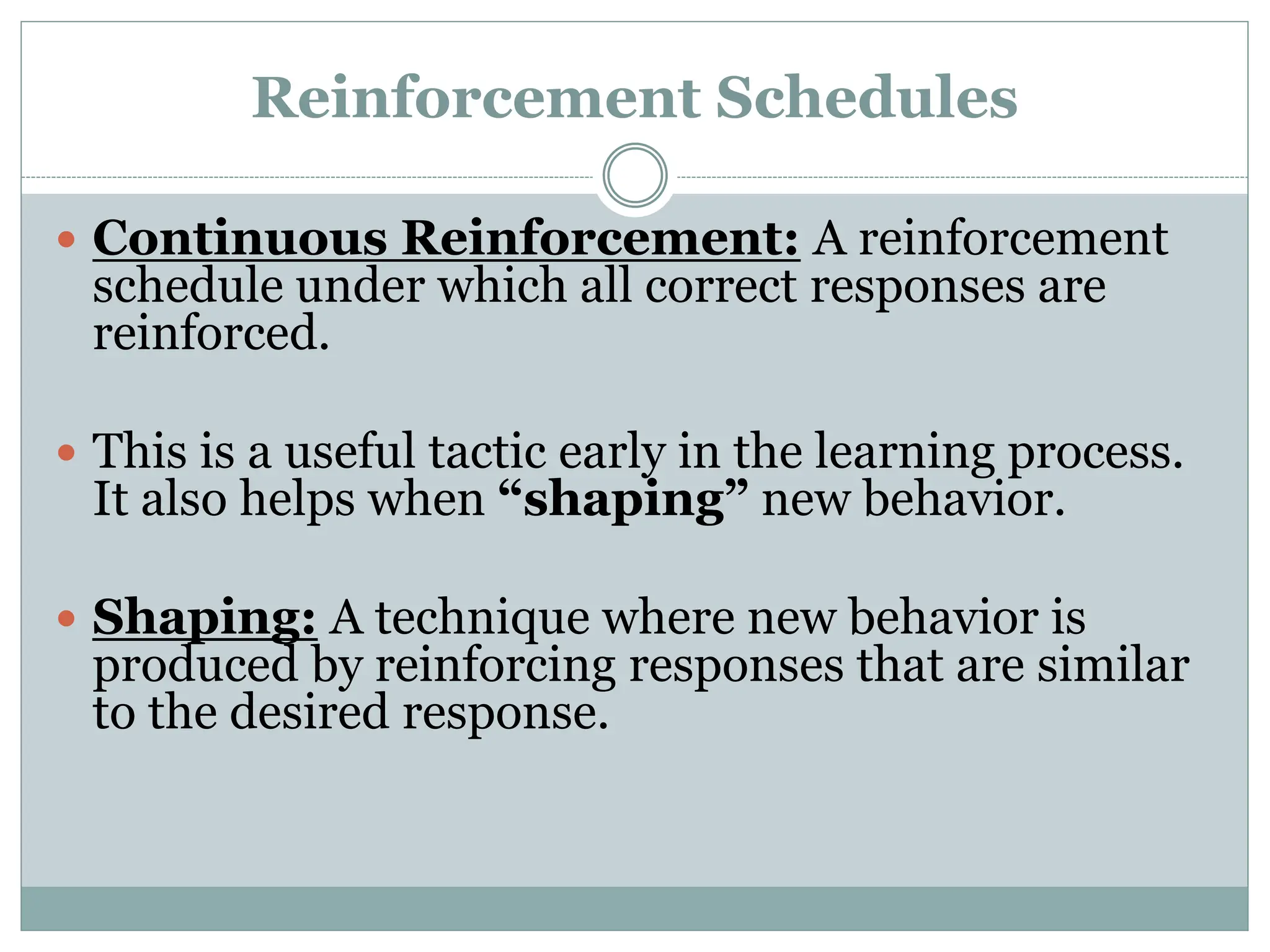
    Self-Control  People setup personal systems of rewards and punishment to shape their own thoughts and actions.  First step to develop some self control is to define the problem.  Set up a behavioral contract.
  • 78.
    What do allof these behaviors have in common? What kinds of behaviors are they?
  • 79.
    Improving Study Habits Pay attention, read/recite information you have heard.  Make flash cards—USE THEM  Redo problems or questions on a lengthy assignment or test.  Make meaningful connections with the information you are learning.  Find a study partner—you haven’t mastered something until you can teach it to someone else.  Study material in small dose—not the night of the exam.
  • 80.
    Reinforcement  Primary: stimulithat increases the probability of a response because they satisfy a biological need, such as food or water.  Secondary: stimuli that increases the probability of a response because of their learned value, such as money and material possessions.  Positive: adding or presenting a stimulus which strengthens a response and makes it more likely to occur.  Negative: taking away or removing a stimulus, which strengthens a response and makes it more likely to occur.
  • 81.
    Schedules of ReinforcementExamples  Fixed Ratio: employee receives $10 for every 4 customers he/she helps at Best Buy.  Variable Ratio: slot machine at Caesars’ Palace pays out after an average number of responses, maybe every 15 minutes.  Fixed Interval: Intel employee receives a paycheck every two weeks for their service as an engineer.  Variable Interval: Chemistry class gives pop quizzes, student studies at a slow but steady rate because they can’t anticipate the next quiz.
  • 82.
    Reinforcement Example  Youwant to teach a dog to shake hands. One way would be to give the animal a treat every time it lifts its paws up to you. The treat is called a positive reinforcer.  Your dog will stop shaking hands when you forget to reward it for the trick as extinction will occur because the reinforcement is withheld; But will take a period of time
  • 84.
    Response Chain  Learnedreactions that follow one another in sequence, each reaction producing the signal for the next. Example—in swimming, you would have three separate chains to make up the pattern (arm stroke, breathing, leg kick).
  • 85.
  • 86.
    Punishment  The mostobvious form of aversive control.  An unpleasant consequence occurs & decreases the frequency of the behavior that produced it.  Behavior that is punished decreases or is not repeated—that is the goal of punishment.
  • 87.
  • 88.
    Disadvantages of Punishment 1.Aversive stimuli can produce unwanted side effects—rage, aggression, fear. 2. Instead of one behavior to change, multiple behaviors could emerge. 3. People learn to avoid the person delivering the aversive consequences—children learn to stay away from parents or teachers who often punish them. 4. Can just merely “suppress” the undesired behavior, not totally eliminate it. 5. A child may not learn “correct” behaviors by punishment alone—coaching/training is needed.
  • 89.
    Questions 1. How doyou learn? 2. What environment is most suitable for you to learn? 3. Are you a visual or auditory learner? 4. What can you do to improve your ability to learn new material? 5. What causes you not to learn? 6. Is there some material or information that people just simply cannot grasp?
  • 90.
  • 91.
    Self-Control  Personal systemsof rewards and punishments— helps shape one’s own thoughts and actions.  First step in self-control is to define the problem.  People who have a very poor opinion of themselves would have to define the problem more concretely.  Keep track of self-deprecating thoughts and remarks you make—may lead to a start in changing behavior.
  • 92.
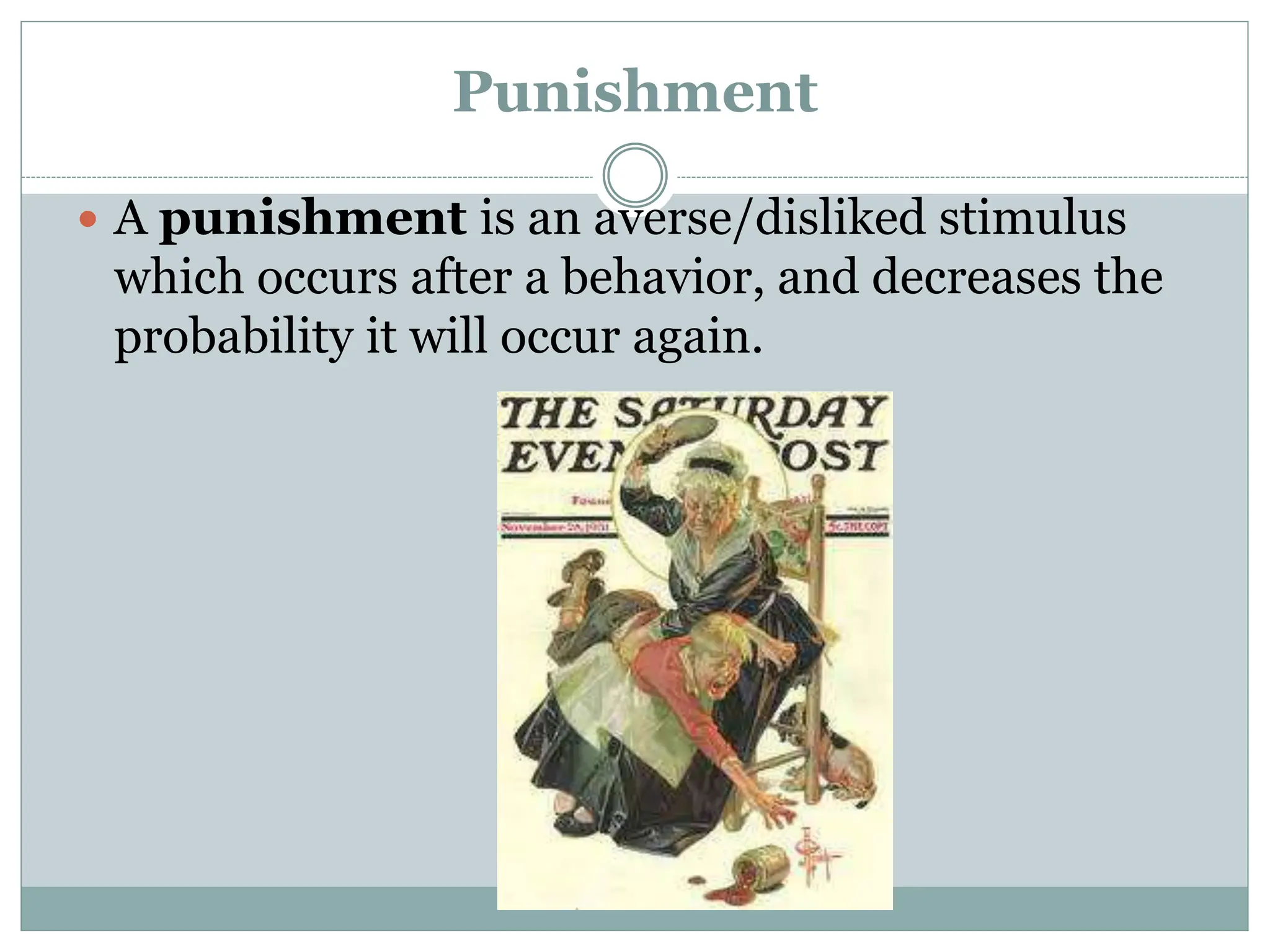
    Which Road AreYou Taking?
  • 93.
    Improving Study Habits Studying in a new place—free from distractions.  Don’t study too much at any one given time.  Attempt to study at the same time each day.  Set specific goals.  Tell friends not to call during study times.
  • 94.
    Summary 1. Human behaviorinfluenced by one’s history of rewards and punishments. 2. Behavior can be reinforced according to continuous or partial reinforcement schedules. 3. Punishments are stimuli that actually decrease the likelihood of certain behaviors from repeating themselves.
  • 95.
    Questions 1. What areappropriate punishments for teenagers who commit crimes? 2. How would you go about “modifying” teenagers or even younger children’s behavior? 3. What are two advantages and two disadvantages of punishment