What is supply?
 ‘Supply refers to the quantity
    of a commodity which
producers or sellers are willing
to produce and offer for sale at
 a particular price’, in a given
 market, at a purticular period
            of time
The three important aspects of
                 supply are….
• Supply is a desired quantity
• Supply is always explained with
  reference to price
• Supply is a flow variable
Stock and flow concepts
      Stock variable              Flow variable
• It is an economic        • It is an economic
  variable which can be      variable which can be
  measured at a point of     measured at a period
  time.                      of time.
• Eg: population, water    • Eg: National income,
  in a reservoir, goods in   water in a river, sales
  a warehouse.               etc.
Individual supply

• Individual supply refers to the quantity of a
  commodity which a firm is willing to produce
  and offer for sale at a particular price during a
  specified period.
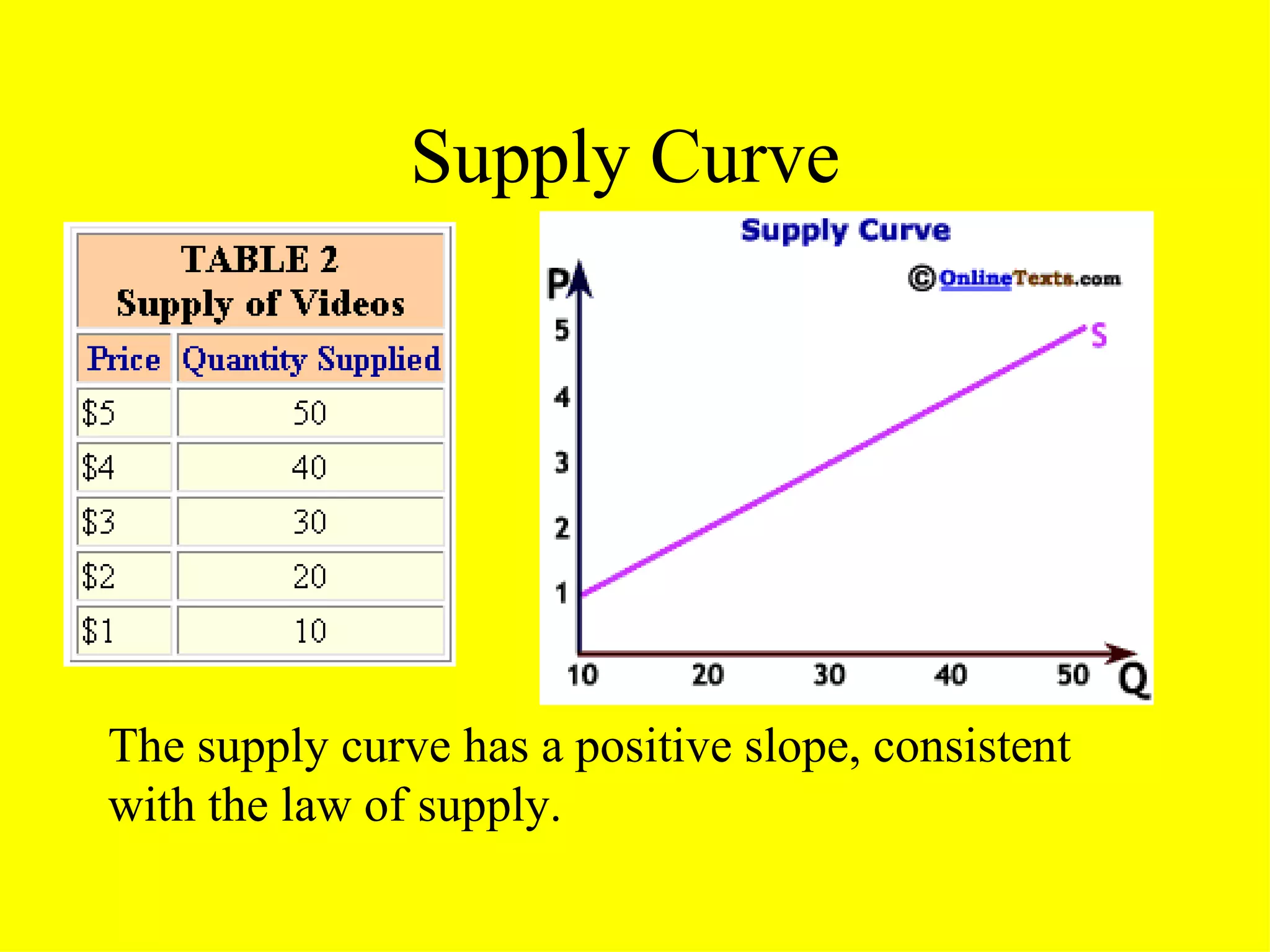
Supply Curve


The supply curve has a positive slope, consistent
with the law of supply.
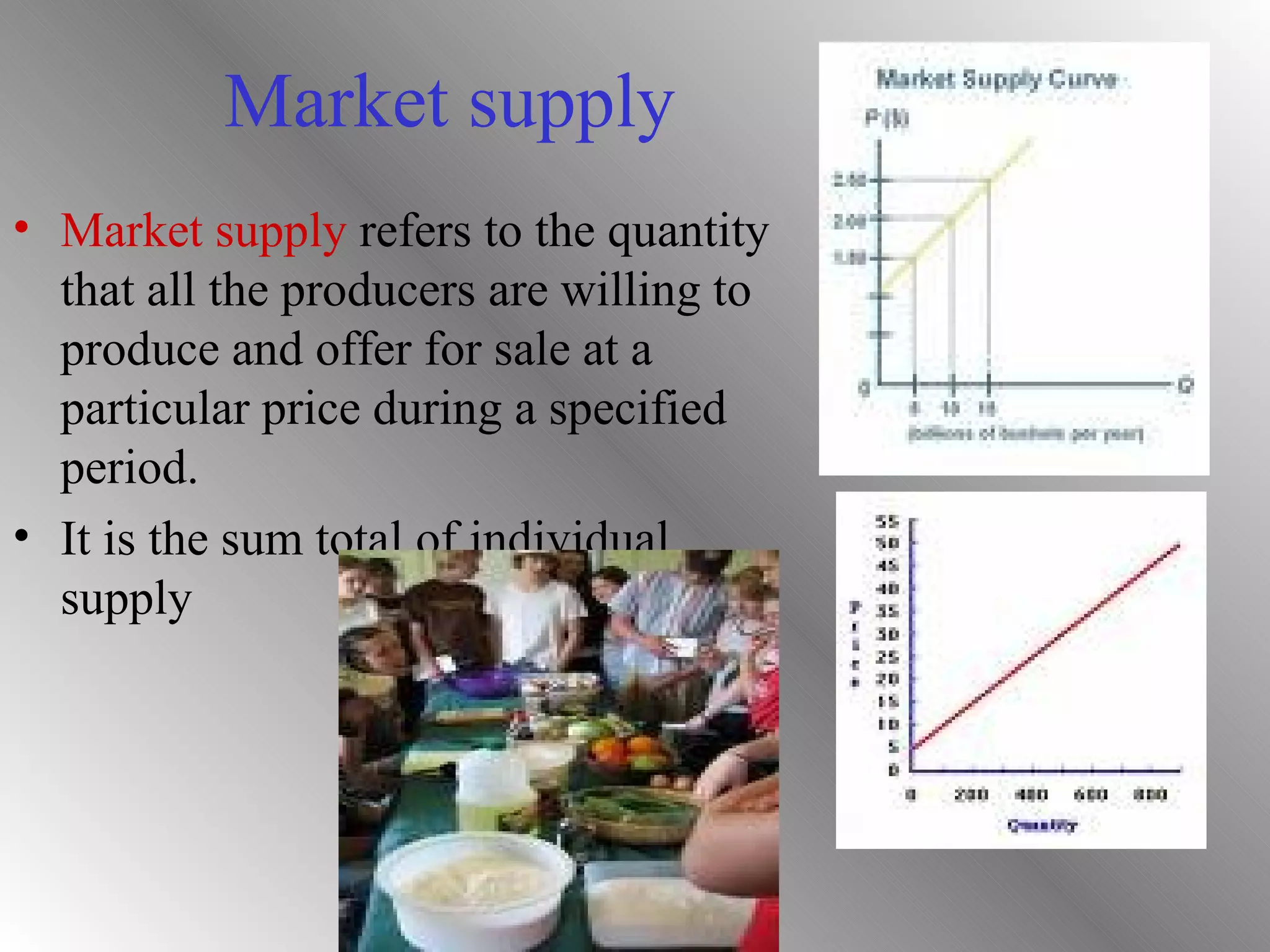
Market supply
• Market supply refers to the quantity
  that all the producers are willing to
  produce and offer for sale at a
  particular price during a specified
  period.
• It is the sum total of individual
  supply
Difference between stock and supply
Stock                      Supply
• Stock is the total       • Supply is that part of
  quantity of a              stock which the
  commodity available        producers are willing
  with the producers         to bring to the market
  which is ready for         and offer for sale at a
  sale.                      particular price.
• Stock is not a part of   • Supply depends on
  supply                     stock.
Determinants of supply

• Price of the commodity:
  When price increases,
  supply also increases
  because it motivate the firm
  to supply more in order to
  get more profit. When price
  decreases, smaller quantity
  will be supplied as profit
  decreases.
Determinants of supply

• Goals of the firm: The goals of
  the firm may be “profit
  maximization"," sales
  maximization" or “risk
  minimization". If the aim is
  sales maximization, they will
  produce and supply more and
  if the aim is risk minimization,
  they will supply less.
Determinants of supply
• Input prices:
  If the prices of inputs and factors
  used in production such as raw
  materials, labour, machine etc. are
  high, the cost of production will be
  high. Higher cost of production, at
  the given price, reduces the profit
  margin and will persuade the
  producer to produce and supply
  less.
Determinants of supply
• Prices of related commodities:
Producers always have the tendency of shifting from
  the production of one commodity to another
  commodity. If the prices of another commodity
  increases, especially substitute goods, producers will
  find it more profitable to produce that commodity by
  reducing the production of the existing commodity.
Determinants of supply
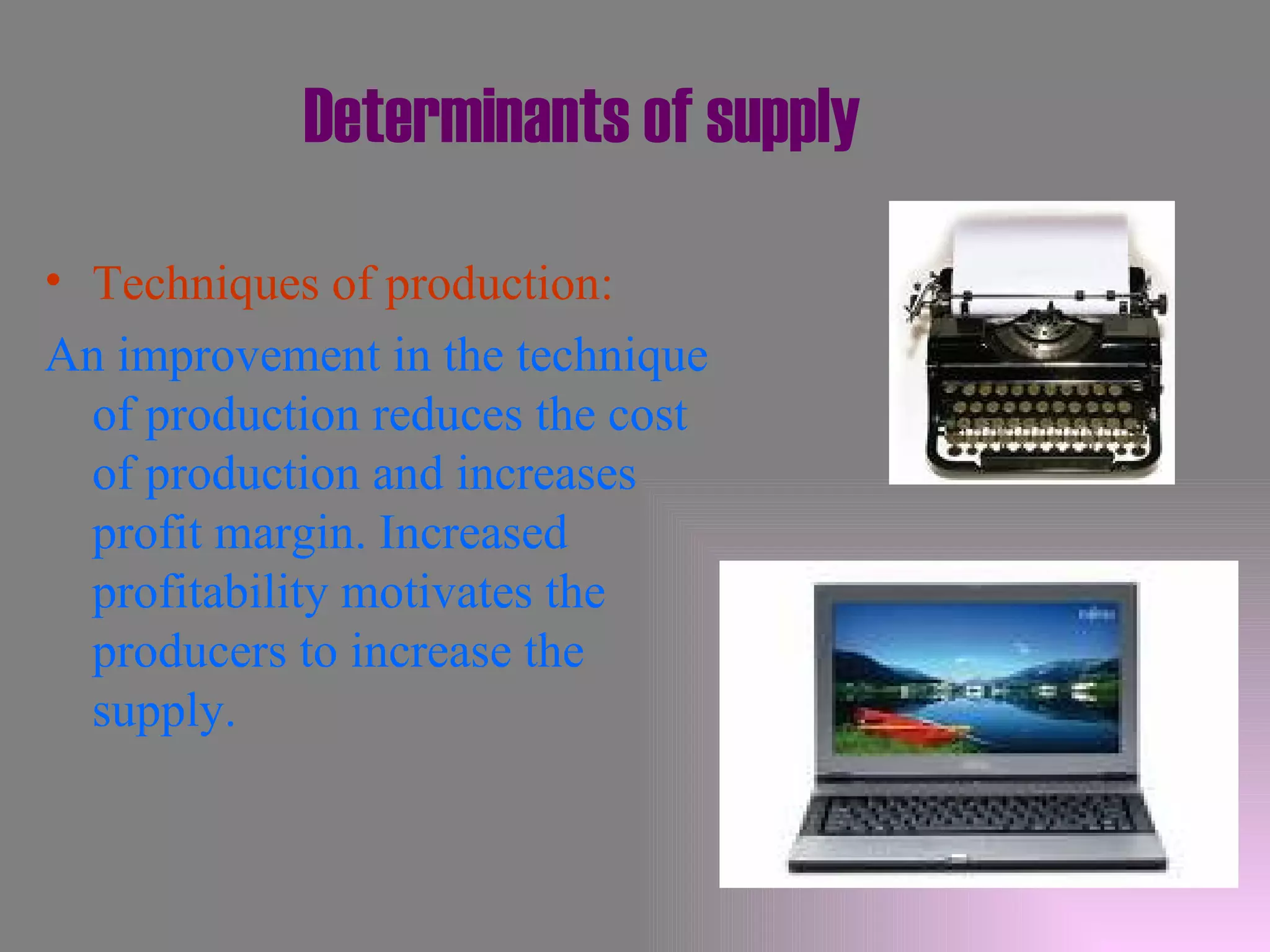
• Techniques of production:
An improvement in the technique
  of production reduces the cost
  of production and increases
  profit margin. Increased
  profitability motivates the
  producers to increase the
  supply.
Determinants of supply
• Nature of the market:
  A monopolist firm will like to restrict supply so as to
  raise the market price and as a result supply decreases.
  But in a competitive market there will be no tendency
  to restrict output because each firm wants to sell more
  to earn more profit.
Determinants of supply
• The policy of taxation and subsidies:
  The taxation policy of the government also
  influences the supply of a commodity. For eg> If
  government increases the sales tax and excise
  duty, it increases the cost of production, which
  induces the producer to reduce the supply as the
  profit margin decreases.
Determinants of supply
• Expectations about future prices:
 If a producer expects an increase in market price in
  future, then they will supply less today and hoard
  the stock to sell at a high price in future and vice
  versa.
Determinants of supply
• Natural factors:
In case of agricultural products, the
   natural factors like flood, draught
   etc. adversely affect the supply of
   commodities. On the other hand
   favourable climatic conditions
   may help in increasing the supply
   of agricultural commodities.
Determinants of supply
• Agreement among producers:
 Some times producers may form associations and enter
  into some agreement to restrict the supply of a
  commodity to earn large profits. They will create
  artificial scarcity of the commodities and as a
  consequence, the supply will decrease.
Determinants of demand
• Availability of transport
  and communication
  facilities:
  An improvement in
  transport and
  communication facilities
  will expand the size of
  market and this will
  motivate the producers to
  produce and supply more.

Supply Presentation

  • 1.
    What is supply? ‘Supply refers to the quantity of a commodity which producers or sellers are willing to produce and offer for sale at a particular price’, in a given market, at a purticular period of time
  • 2.
    The three importantaspects of supply are…. • Supply is a desired quantity • Supply is always explained with reference to price • Supply is a flow variable
  • 3.
    Stock and flowconcepts Stock variable Flow variable • It is an economic • It is an economic variable which can be variable which can be measured at a point of measured at a period time. of time. • Eg: population, water • Eg: National income, in a reservoir, goods in water in a river, sales a warehouse. etc.
  • 4.
    Individual supply • Individualsupply refers to the quantity of a commodity which a firm is willing to produce and offer for sale at a particular price during a specified period.
  • 5.
    Supply Curve The supplycurve has a positive slope, consistent with the law of supply.
  • 6.
    Market supply • Marketsupply refers to the quantity that all the producers are willing to produce and offer for sale at a particular price during a specified period. • It is the sum total of individual supply
  • 7.
    Difference between stockand supply Stock Supply • Stock is the total • Supply is that part of quantity of a stock which the commodity available producers are willing with the producers to bring to the market which is ready for and offer for sale at a sale. particular price. • Stock is not a part of • Supply depends on supply stock.
  • 8.
    Determinants of supply •Price of the commodity: When price increases, supply also increases because it motivate the firm to supply more in order to get more profit. When price decreases, smaller quantity will be supplied as profit decreases.
  • 9.
    Determinants of supply •Goals of the firm: The goals of the firm may be “profit maximization"," sales maximization" or “risk minimization". If the aim is sales maximization, they will produce and supply more and if the aim is risk minimization, they will supply less.
  • 10.
    Determinants of supply •Input prices: If the prices of inputs and factors used in production such as raw materials, labour, machine etc. are high, the cost of production will be high. Higher cost of production, at the given price, reduces the profit margin and will persuade the producer to produce and supply less.
  • 11.
    Determinants of supply •Prices of related commodities: Producers always have the tendency of shifting from the production of one commodity to another commodity. If the prices of another commodity increases, especially substitute goods, producers will find it more profitable to produce that commodity by reducing the production of the existing commodity.
  • 12.
    Determinants of supply •Techniques of production: An improvement in the technique of production reduces the cost of production and increases profit margin. Increased profitability motivates the producers to increase the supply.
  • 13.
    Determinants of supply •Nature of the market: A monopolist firm will like to restrict supply so as to raise the market price and as a result supply decreases. But in a competitive market there will be no tendency to restrict output because each firm wants to sell more to earn more profit.
  • 14.
    Determinants of supply •The policy of taxation and subsidies: The taxation policy of the government also influences the supply of a commodity. For eg> If government increases the sales tax and excise duty, it increases the cost of production, which induces the producer to reduce the supply as the profit margin decreases.
  • 15.
    Determinants of supply •Expectations about future prices: If a producer expects an increase in market price in future, then they will supply less today and hoard the stock to sell at a high price in future and vice versa.
  • 16.
    Determinants of supply •Natural factors: In case of agricultural products, the natural factors like flood, draught etc. adversely affect the supply of commodities. On the other hand favourable climatic conditions may help in increasing the supply of agricultural commodities.
  • 17.
    Determinants of supply •Agreement among producers: Some times producers may form associations and enter into some agreement to restrict the supply of a commodity to earn large profits. They will create artificial scarcity of the commodities and as a consequence, the supply will decrease.
  • 18.
    Determinants of demand •Availability of transport and communication facilities: An improvement in transport and communication facilities will expand the size of market and this will motivate the producers to produce and supply more.

Editor's Notes

  • #2 Supply ki skjhkjhkj