M S E D U C A T I O N A L R E S O U R C E S
( K I T I Z A M E R C H A N T )
THEORIES OF
INTERNATIONAL TRADE
IMPORTANT TERMINOLOGIES
 Specialization: In international trade,
specialization refers to a country’s decision to major
in the production of a certain good or list of goods
because of the advantages it possesses in their
 Opportunity cost: refers to what you sacrifice in
making an economic choice.
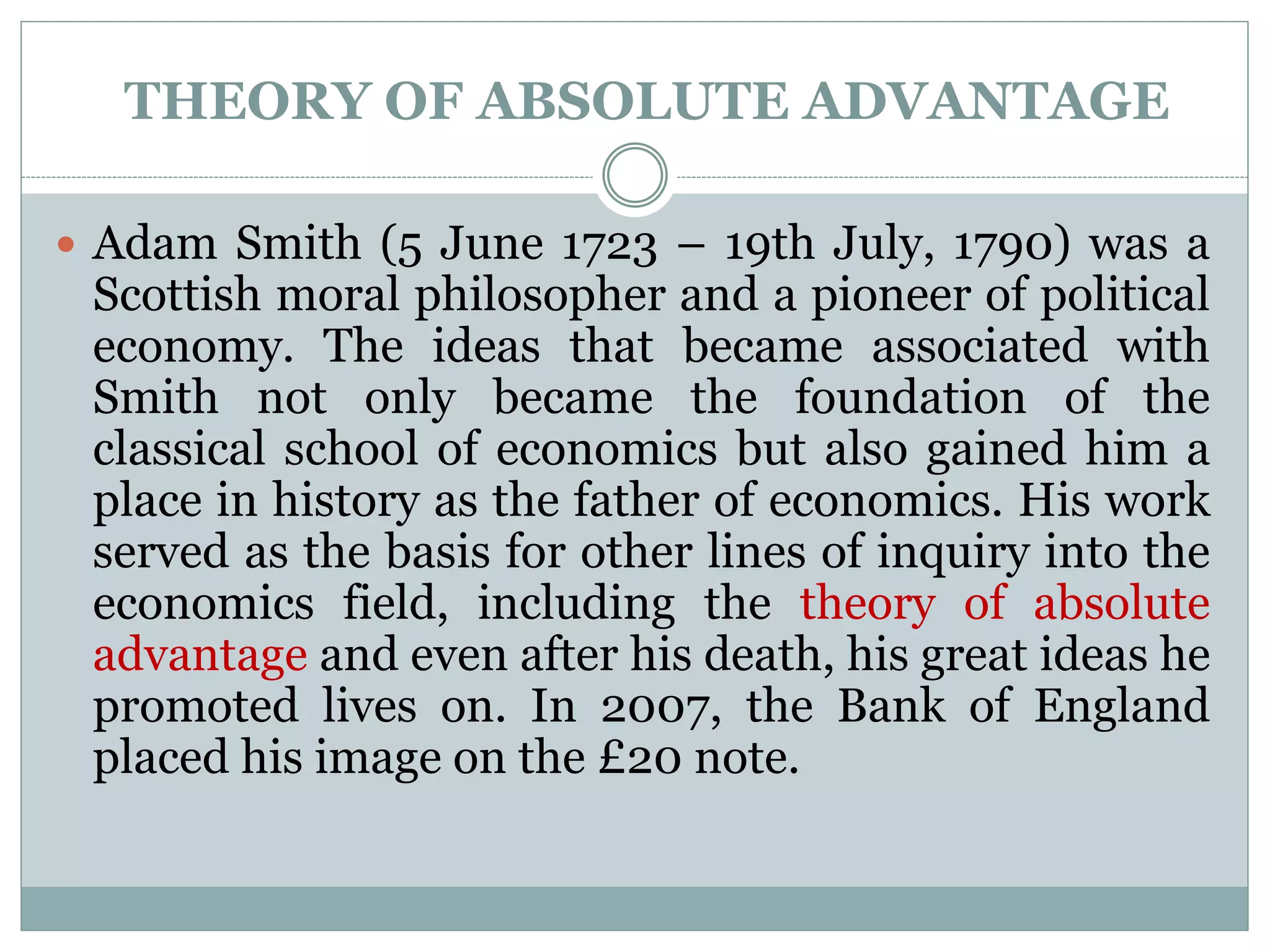
THEORY OF ABSOLUTE ADVANTAGE
 Adam Smith (5 June 1723 – 19th July, 1790) was a
Scottish moral philosopher and a pioneer of political
economy. The ideas that became associated with
Smith not only became the foundation of the
classical school of economics but also gained him a
place in history as the father of economics. His work
served as the basis for other lines of inquiry into the
economics field, including the theory of absolute
advantage and even after his death, his great ideas he
promoted lives on. In 2007, the Bank of England
placed his image on the £20 note.
ADAM SMITH (5 June 1723 –19th July,
1790
 /
THEORY OF ABSOLUTE ADVANTAGE
 This theory was developed by Adam Smith to
counter Mercantilism (Zero-sum game) while ‘AA’ is
a positive -sum game.
 Talks about who can do it better, cheaper and
quicker.
THEORY OF ABSOLUTE ADVANTAGE
CONT’D
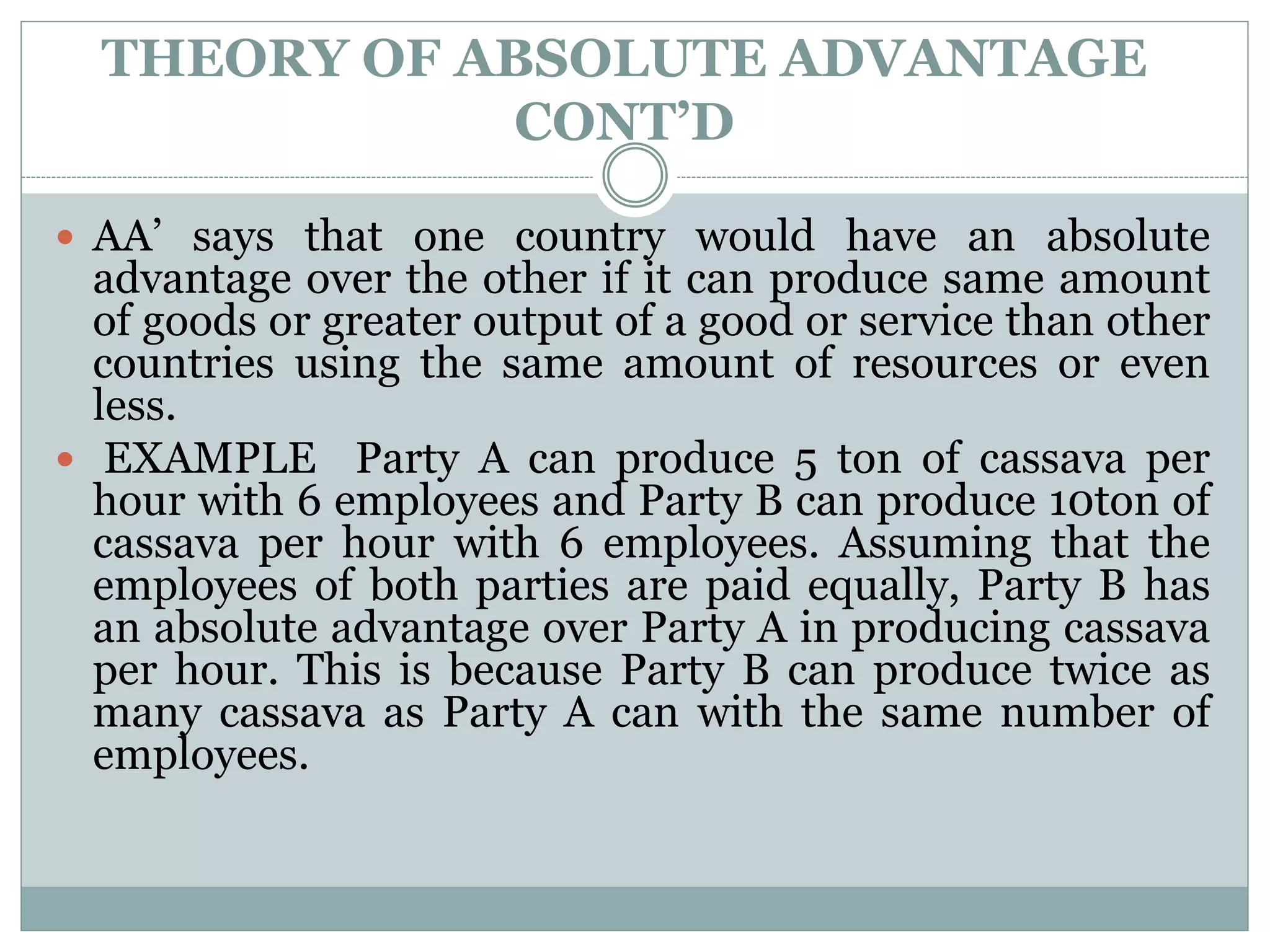
 AA’ says that one country would have an absolute
advantage over the other if it can produce same amount
of goods or greater output of a good or service than other
countries using the same amount of resources or even
less.
 EXAMPLE Party A can produce 5 ton of cassava per
hour with 6 employees and Party B can produce 10ton of
cassava per hour with 6 employees. Assuming that the
employees of both parties are paid equally, Party B has
an absolute advantage over Party A in producing cassava
per hour. This is because Party B can produce twice as
many cassava as Party A can with the same number of
employees.
THE THEORY OF COMPARATIVE
ADVANTAGES.
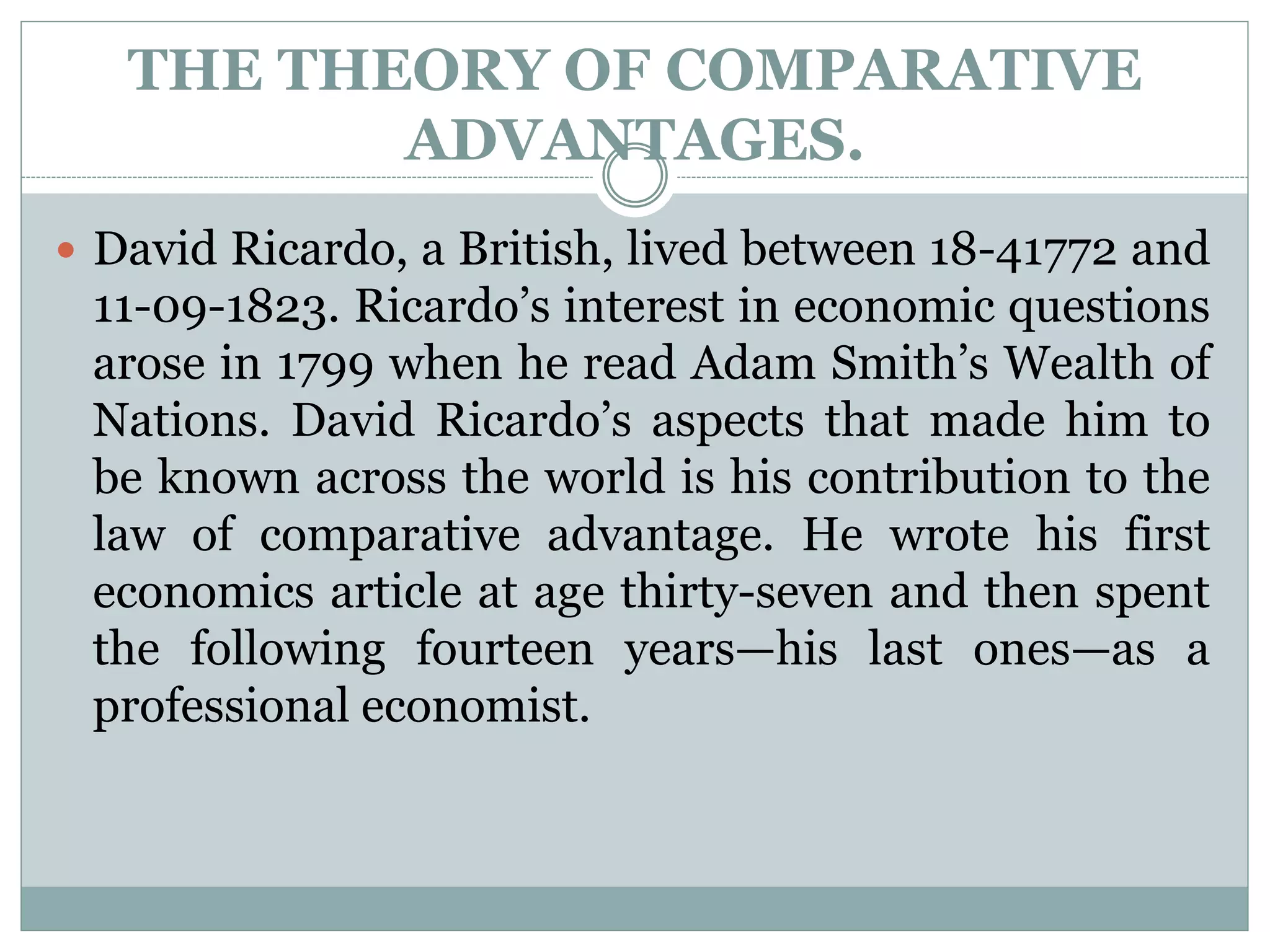
 David Ricardo, a British, lived between 18-41772 and
11-09-1823. Ricardo’s interest in economic questions
arose in 1799 when he read Adam Smith’s Wealth of
Nations. David Ricardo’s aspects that made him to
be known across the world is his contribution to the
law of comparative advantage. He wrote his first
economics article at age thirty-seven and then spent
the following fourteen years—his last ones—as a
professional economist.
David Ricardo, a British, lived between 18-
4-1772 and 11-09-1823.
 /
COMPARATIVE ADVANTAGE
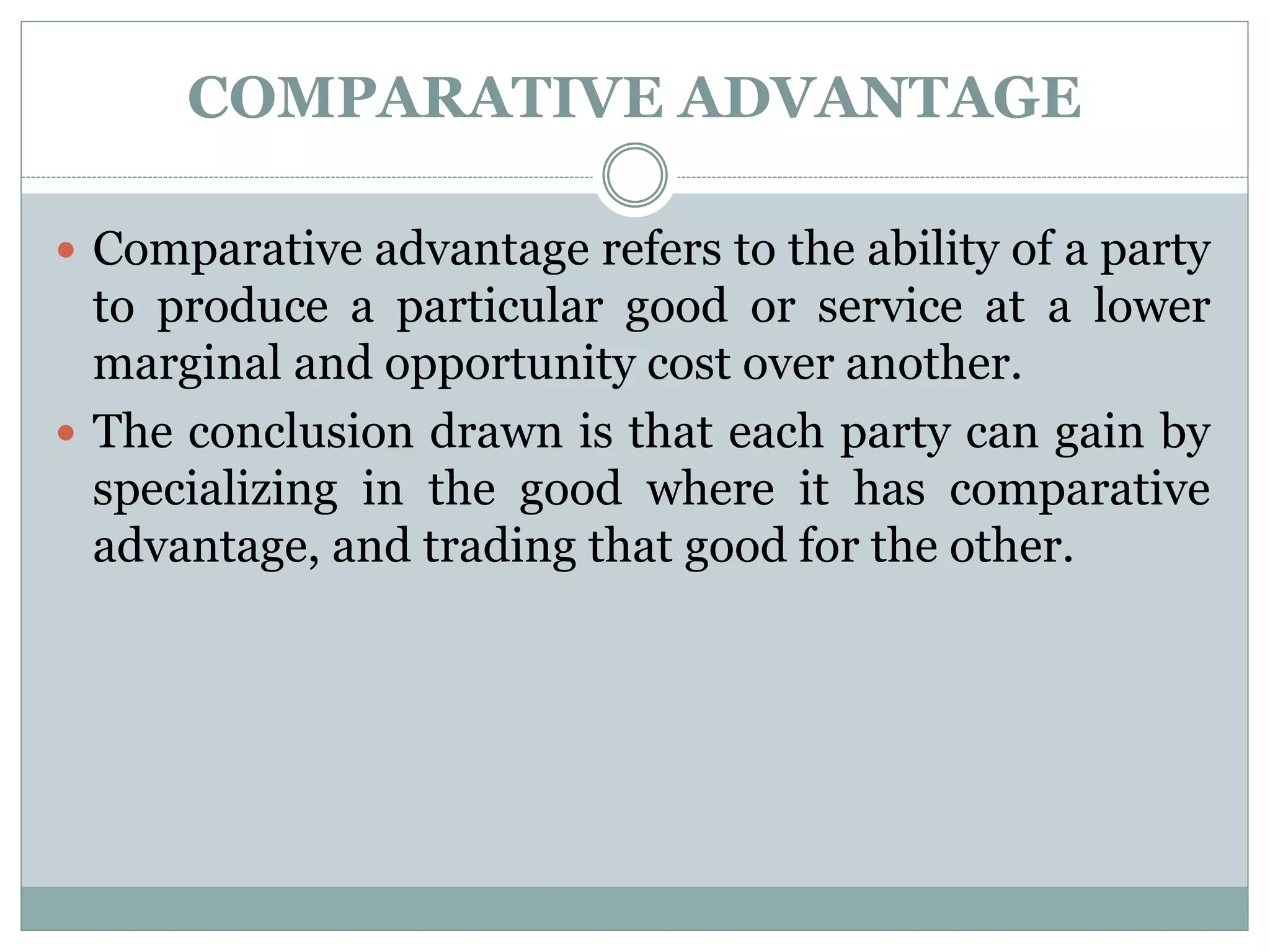
 Comparative advantage refers to the ability of a party
to produce a particular good or service at a lower
marginal and opportunity cost over another.
 The conclusion drawn is that each party can gain by
specializing in the good where it has comparative
advantage, and trading that good for the other.
EXAMPLE
COUNTRIES TEXTILES BOOKS
UK 1 4
India 2 3
Total 3 7
CONT’D
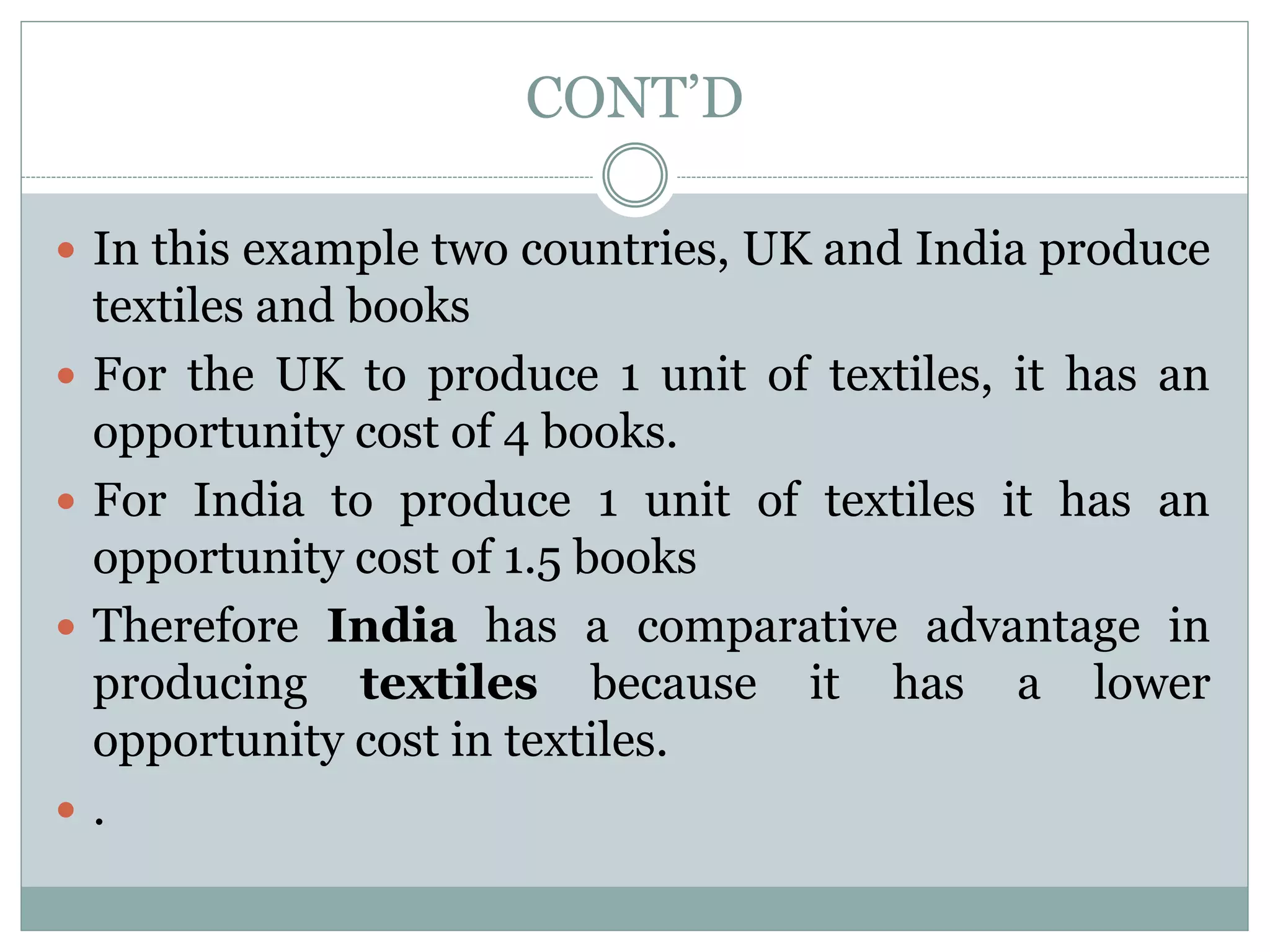
 In this example two countries, UK and India produce
textiles and books
 For the UK to produce 1 unit of textiles, it has an
opportunity cost of 4 books.
 For India to produce 1 unit of textiles it has an
opportunity cost of 1.5 books
 Therefore India has a comparative advantage in
producing textiles because it has a lower
opportunity cost in textiles.
 .
CONT’D
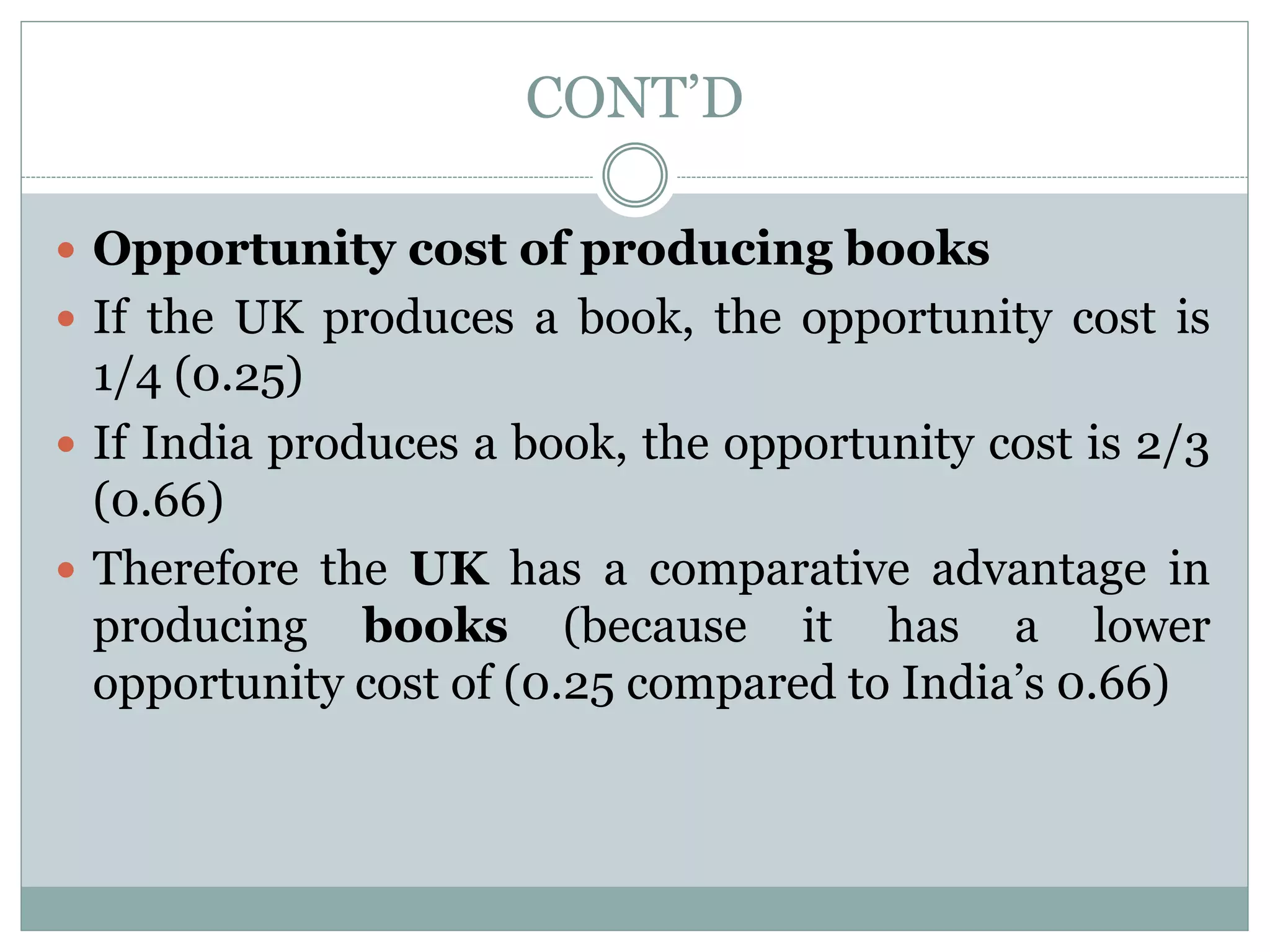
 Opportunity cost of producing books
 If the UK produces a book, the opportunity cost is
1/4 (0.25)
 If India produces a book, the opportunity cost is 2/3
(0.66)
 Therefore the UK has a comparative advantage in
producing books (because it has a lower
opportunity cost of (0.25 compared to India’s 0.66)
CONT’D
 The theory of comparative advantage
 If each country now specializes in one producing
good then assuming constant returns to scale, the
output will double.
 Output after specialisation >
CONT’D
Textiles Books
UK 0 8
India 4 0
TOTAL 4 8
CONT’D
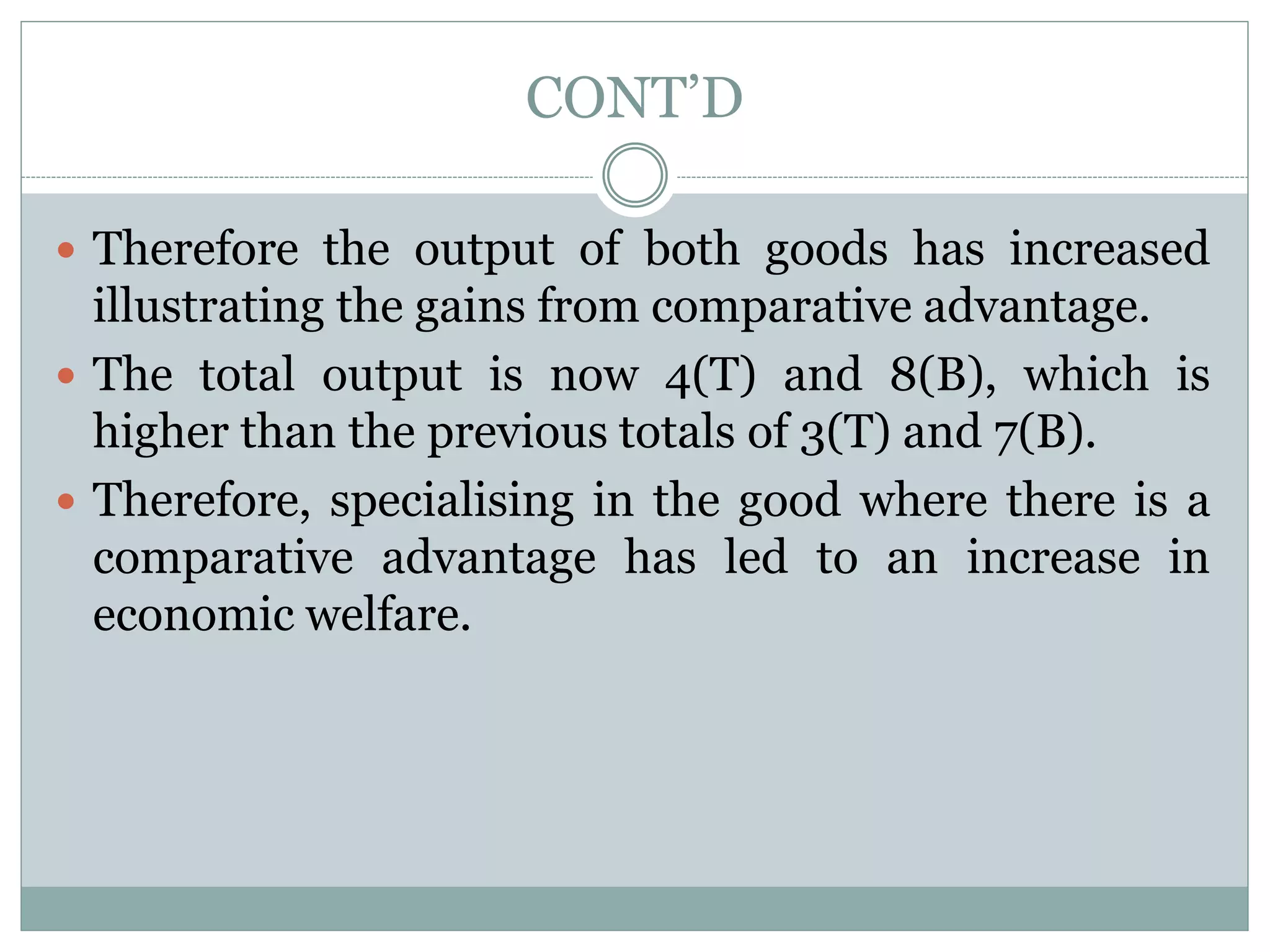
 Therefore the output of both goods has increased
illustrating the gains from comparative advantage.
 The total output is now 4(T) and 8(B), which is
higher than the previous totals of 3(T) and 7(B).
 Therefore, specialising in the good where there is a
comparative advantage has led to an increase in
economic welfare.

The law of absolute advantage and comparative advantage

  • 1.
    M S ED U C A T I O N A L R E S O U R C E S ( K I T I Z A M E R C H A N T ) THEORIES OF INTERNATIONAL TRADE
  • 2.
    IMPORTANT TERMINOLOGIES  Specialization:In international trade, specialization refers to a country’s decision to major in the production of a certain good or list of goods because of the advantages it possesses in their  Opportunity cost: refers to what you sacrifice in making an economic choice.
  • 3.
    THEORY OF ABSOLUTEADVANTAGE  Adam Smith (5 June 1723 – 19th July, 1790) was a Scottish moral philosopher and a pioneer of political economy. The ideas that became associated with Smith not only became the foundation of the classical school of economics but also gained him a place in history as the father of economics. His work served as the basis for other lines of inquiry into the economics field, including the theory of absolute advantage and even after his death, his great ideas he promoted lives on. In 2007, the Bank of England placed his image on the £20 note.
  • 4.
    ADAM SMITH (5June 1723 –19th July, 1790  /
  • 5.
    THEORY OF ABSOLUTEADVANTAGE  This theory was developed by Adam Smith to counter Mercantilism (Zero-sum game) while ‘AA’ is a positive -sum game.  Talks about who can do it better, cheaper and quicker.
  • 6.
    THEORY OF ABSOLUTEADVANTAGE CONT’D  AA’ says that one country would have an absolute advantage over the other if it can produce same amount of goods or greater output of a good or service than other countries using the same amount of resources or even less.  EXAMPLE Party A can produce 5 ton of cassava per hour with 6 employees and Party B can produce 10ton of cassava per hour with 6 employees. Assuming that the employees of both parties are paid equally, Party B has an absolute advantage over Party A in producing cassava per hour. This is because Party B can produce twice as many cassava as Party A can with the same number of employees.
  • 7.
    THE THEORY OFCOMPARATIVE ADVANTAGES.  David Ricardo, a British, lived between 18-41772 and 11-09-1823. Ricardo’s interest in economic questions arose in 1799 when he read Adam Smith’s Wealth of Nations. David Ricardo’s aspects that made him to be known across the world is his contribution to the law of comparative advantage. He wrote his first economics article at age thirty-seven and then spent the following fourteen years—his last ones—as a professional economist.
  • 8.
    David Ricardo, aBritish, lived between 18- 4-1772 and 11-09-1823.  /
  • 9.
    COMPARATIVE ADVANTAGE  Comparativeadvantage refers to the ability of a party to produce a particular good or service at a lower marginal and opportunity cost over another.  The conclusion drawn is that each party can gain by specializing in the good where it has comparative advantage, and trading that good for the other.
  • 10.
    EXAMPLE COUNTRIES TEXTILES BOOKS UK1 4 India 2 3 Total 3 7
  • 11.
    CONT’D  In thisexample two countries, UK and India produce textiles and books  For the UK to produce 1 unit of textiles, it has an opportunity cost of 4 books.  For India to produce 1 unit of textiles it has an opportunity cost of 1.5 books  Therefore India has a comparative advantage in producing textiles because it has a lower opportunity cost in textiles.  .
  • 12.
    CONT’D  Opportunity costof producing books  If the UK produces a book, the opportunity cost is 1/4 (0.25)  If India produces a book, the opportunity cost is 2/3 (0.66)  Therefore the UK has a comparative advantage in producing books (because it has a lower opportunity cost of (0.25 compared to India’s 0.66)
  • 13.
    CONT’D  The theoryof comparative advantage  If each country now specializes in one producing good then assuming constant returns to scale, the output will double.  Output after specialisation >
  • 14.
    CONT’D Textiles Books UK 08 India 4 0 TOTAL 4 8
  • 15.
    CONT’D  Therefore theoutput of both goods has increased illustrating the gains from comparative advantage.  The total output is now 4(T) and 8(B), which is higher than the previous totals of 3(T) and 7(B).  Therefore, specialising in the good where there is a comparative advantage has led to an increase in economic welfare.