FARAHA LUGMAN
MA-42
22642
5/12/2014 (13:20PM) 1
OVERVIEW
 Demand and supply
 Equilibrium in market
Equilibrium quantity
Equilibrium price
 Excess supply & demand
 How equilibrium point change?
 Summary of changes in equilibrium
 Conclusion
 References
5/12/2014 (13:20PM) 2
Demand
 Demand is quantity of a commodity that the
consumers are willing and able to buy at a given
price over a given period of time
5/12/2014 (13:20PM) 3
Law of demand
• An inverse relationship exists between price &
quantity demanded
» As price rises…..
…..quantity demanded falls
» As price falls…..
....quantity demanded rises
5/12/2014 (13:20PM) 4
Demand curve
5/12/2014 (13:20PM) 5
Qty price
Qty product
Supply
• Supply is the quantity of a commodity that
the suppliers are willing able to offer for
sale at a given price over a given period of
time.
5/12/2014 (13:20PM) 6
Law of supply
• A direct relationship exists between price &
quantity supplied
As price falls….
…..quantity supplied falls
 As price rises….
…..quantity supplied rises
5/12/2014 (13:20PM) 7
Supply curve
5/12/2014 (13:20PM) 8
Qty price
Qty product
Equilibrium in market
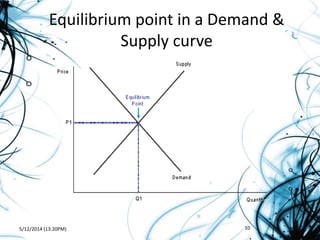
• It is where the market price has reached to a level
at which quantity demanded is equal to quantity
supplied
• Demand intersect the supply
• The price at which quantity demanded and quantity
supplied is Equilibrium price
• The quantity at which equilibrium arises is
Equilibrium quantity
5/12/2014 (13:20PM) 9
Equilibrium point in a Demand &
Supply curve
5/12/2014 (13:20PM) 10
Equilibrium table
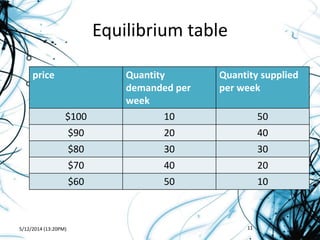
price Quantity
demanded per
week
Quantity supplied
per week
$100 10 50
$90 20 40
$80 30 30
$70 40 20
$60 50 10
5/12/2014 (13:20PM) 11
Excess demand
• In shortage the price will be lower than the
equilibrium price; on the other hand quantity
demanded will exceed the quantity supplied
• To comeback
Supplier rise the price of goods
5/12/2014 (13:20PM) 12
5/12/2014 (13:20PM) 13
Excess supply
• The surplus occurs when the price exceeds
equilibrium price, on the other hand the quantity
supplied would be greater than the quantity
demanded
• To comeback
Suppliers lower the price of good
5/12/2014 (13:20PM) 14
5/12/2014 (13:20PM) 15
Changes in equilibrium point
• Graphically, changes in the underlying factors that
affect demand and supply will cause shifts in the
position of the demand or supply curve at every
price.
• There are 4 basic causes of price change which
would change the equilibrium point
5/12/2014 (13:20PM) 16
Changes in demand
1. Demand shifts to the right: increase in demand shift
the demand curve to right, & raises price and output.
2. Demand shifts to the left: decrease in demand shifts
the demand curve to the left, & reduces price and
output
5/12/2014 (13:20PM) 17
Changes in supply
3. Supply shifts to the right: increase in supply shifts the
supply curve to the right, which reduces prices and
increase output
4. Supply shifts to the left: decrease in supply shifts the supply
curve to the left, which raises price but reduces output
5/12/2014 (13:20PM) 18
Summary of changes in equilibrium
Shift Equilibrium price Equilibrium
quantity
Demand increases Higher Higher
Demand decreases Lower Lower
Supply increases Lower Higher
Supply decreases higher lower
5/12/2014 (13:20PM) 19
Conclusion
• Demand is defined as the quantity of a good or service
consumers are willing and able to buy at a given price in a
given time period.
• Supply is defined as the quantity of a product that a producer
is willing and able to supply onto the market at a given price
in a given time period.
• Equilibrium is where the demand and supply intersect
5/12/2014 (13:20PM) 20
reference
• http://www.shmoop.com/supply-
demand/equilibrium-price.html
• http://www.economicsonline.co.uk/Competiti
ve_markets/Market_equilibrium.html
• http://thismatter.com/economics/market-
equilibrium.htm
5/12/2014 (13:20PM) 21
5/12/2014 (13:20PM) 22

Equilibrium

  • 1.
  • 2.
    OVERVIEW  Demand andsupply  Equilibrium in market Equilibrium quantity Equilibrium price  Excess supply & demand  How equilibrium point change?  Summary of changes in equilibrium  Conclusion  References 5/12/2014 (13:20PM) 2
  • 3.
    Demand  Demand isquantity of a commodity that the consumers are willing and able to buy at a given price over a given period of time 5/12/2014 (13:20PM) 3
  • 4.
    Law of demand •An inverse relationship exists between price & quantity demanded » As price rises….. …..quantity demanded falls » As price falls….. ....quantity demanded rises 5/12/2014 (13:20PM) 4
  • 5.
    Demand curve 5/12/2014 (13:20PM)5 Qty price Qty product
  • 6.
    Supply • Supply isthe quantity of a commodity that the suppliers are willing able to offer for sale at a given price over a given period of time. 5/12/2014 (13:20PM) 6
  • 7.
    Law of supply •A direct relationship exists between price & quantity supplied As price falls…. …..quantity supplied falls  As price rises…. …..quantity supplied rises 5/12/2014 (13:20PM) 7
  • 8.
    Supply curve 5/12/2014 (13:20PM)8 Qty price Qty product
  • 9.
    Equilibrium in market •It is where the market price has reached to a level at which quantity demanded is equal to quantity supplied • Demand intersect the supply • The price at which quantity demanded and quantity supplied is Equilibrium price • The quantity at which equilibrium arises is Equilibrium quantity 5/12/2014 (13:20PM) 9
  • 10.
    Equilibrium point ina Demand & Supply curve 5/12/2014 (13:20PM) 10
  • 11.
    Equilibrium table price Quantity demandedper week Quantity supplied per week $100 10 50 $90 20 40 $80 30 30 $70 40 20 $60 50 10 5/12/2014 (13:20PM) 11
  • 12.
    Excess demand • Inshortage the price will be lower than the equilibrium price; on the other hand quantity demanded will exceed the quantity supplied • To comeback Supplier rise the price of goods 5/12/2014 (13:20PM) 12
  • 13.
  • 14.
    Excess supply • Thesurplus occurs when the price exceeds equilibrium price, on the other hand the quantity supplied would be greater than the quantity demanded • To comeback Suppliers lower the price of good 5/12/2014 (13:20PM) 14
  • 15.
  • 16.
    Changes in equilibriumpoint • Graphically, changes in the underlying factors that affect demand and supply will cause shifts in the position of the demand or supply curve at every price. • There are 4 basic causes of price change which would change the equilibrium point 5/12/2014 (13:20PM) 16
  • 17.
    Changes in demand 1.Demand shifts to the right: increase in demand shift the demand curve to right, & raises price and output. 2. Demand shifts to the left: decrease in demand shifts the demand curve to the left, & reduces price and output 5/12/2014 (13:20PM) 17
  • 18.
    Changes in supply 3.Supply shifts to the right: increase in supply shifts the supply curve to the right, which reduces prices and increase output 4. Supply shifts to the left: decrease in supply shifts the supply curve to the left, which raises price but reduces output 5/12/2014 (13:20PM) 18
  • 19.
    Summary of changesin equilibrium Shift Equilibrium price Equilibrium quantity Demand increases Higher Higher Demand decreases Lower Lower Supply increases Lower Higher Supply decreases higher lower 5/12/2014 (13:20PM) 19
  • 20.
    Conclusion • Demand isdefined as the quantity of a good or service consumers are willing and able to buy at a given price in a given time period. • Supply is defined as the quantity of a product that a producer is willing and able to supply onto the market at a given price in a given time period. • Equilibrium is where the demand and supply intersect 5/12/2014 (13:20PM) 20
  • 21.
  • 22.