Production
and
Cost
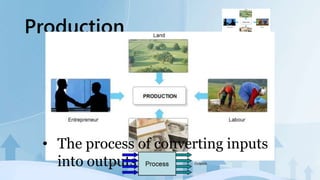
Production
•Refers to any economic activity,
which combines the four factors
of production to form an output
that will give direct satisfaction
to consumers
• The process of converting inputs
into outputs
Categories of Inputs
• Land (natural resources) includes
those above and under the earth
like forest products and mineral
ores.
• Labor is the mental and physical
ability used in the production of
goods and services.
• Capital resources are the goods that
are used in the production of other
other goods and services like
machines, equipments, buildings,
buildings, etc.
Short Run vs Long Run
•Short-run is the period of time so short that
there is at least one fixed input therefore
changes in the output level must be
accomplished exclusively by changes in the use
use of variable outputs.
•Long-run is a period of time so long that all
inputs are considered variable.
The Production Function
•The functional relationship between
quantities of inputs used in production
and outputs to be produced.
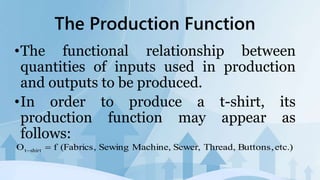
•In order to produce a t-shirt, its
production function may appear as
follows:
etc.)Buttons,Thread,Sewer,Machine,Sewing(Fabrics,fO shirtt 
Production Concepts
•Total Product refers to the total output
produced after utilizing the fixed and
variable inputs in the production process.
process.
-Fixed inputs are components of
production which do not change,
like machineries and equipment.
-Variable inputs are the changeable
resources in the production, such as
raw materials and number of
•Marginal Product of an input is the extra
output produced by 1 additional unit of
of that input while other inputs are held
held constant.
•Average Product equals total product
divided by total units of input used.
1ΔI
ΔTP
MP 
12
12
LL II
TPTP
MP



1I
TP
AP 
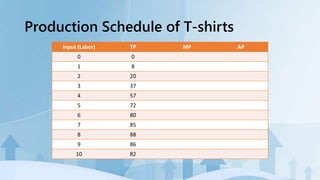
Production Schedule of T-shirts
Input (Labor) TP MP AP
0 0
1 8
2 20
3 37
4 57
5 72
6 80
7 85
8 88
9 86
10 82
Production Schedule of T-shirts
Input (Labor) TP MP AP
0 0 0 0
1 8 8 8
2 20 12 10
3 37 17 12
4 57 20 14
5 72 15 14
6 80 8 13
7 85 5 12
8 88 3 11
9 86 -2 10
10 82 -4 8
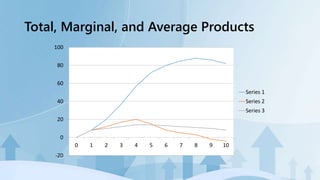
Total, Marginal, and Average Products
-20
0
20
40
60
80
100
0 1 2 3 4 5 6 7 8 9 10
Series 1
Series 2
Series 3
Law of Diminishing Returns
The Law of
Diminishing Returns
holds that we will get
less and less extra
output when we add
additional doses of an
input while holding
other inputs fixed.
Increasing marginal returns happen when
the marginal product of an additional
worker exceeds the marginal product of
of the previous worker.
Input (Labor) TP MP AP
1 8 8 8
2 20 12 10
3 37 17 12
4 57 20 14
5 72 15 14
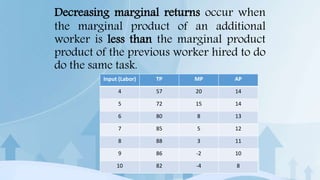
Decreasing marginal returns occur when
the marginal product of an additional
worker is less than the marginal product
product of the previous worker hired to do
do the same task.
Input (Labor) TP MP AP
4 57 20 14
5 72 15 14
6 80 8 13
7 85 5 12
8 88 3 11
9 86 -2 10
10 82 -4 8
Returns to Scale
Constant returns to
scale indicates a
case where a change
change in all inputs
inputs leads to a
proportional change
in output.
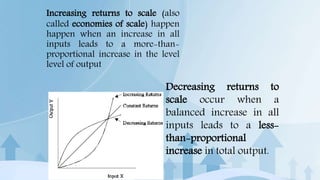
Increasing returns to scale (also
called economies of scale) happen
happen when an increase in all
inputs leads to a more-than-
proportional increase in the level
level of output
Decreasing returns to
scale occur when a
balanced increase in all
inputs leads to a less-
than-proportional
increase in total output.
The Firm’s Goal
Of course, the basic goal of a firm is to
maximize its profit. A firm that does
not seek to maximize profit is either
eliminated or absorbed by firms that do
seek that goal.
Sales – Costs = Profit
Or
Total Revenue- Total Costs = Profit
Total cost
refers to all expenses acquired during the
economic activity or the production of goods or
services.
Total revenue
is the amount received from the sale of the
product.
price of the output X Quantity sold
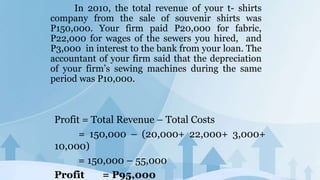
In 2010, the total revenue of your t- shirts
company from the sale of souvenir shirts was
P150,000. Your firm paid P20,000 for fabric,
P22,000 for wages of the sewers you hired, and
P3,000 in interest to the bank from your loan. The
accountant of your firm said that the depreciation
of your firm’s sewing machines during the same
period was P10,000.
Profit = Total Revenue – Total Costs
= 150,000 – (20,000+ 22,000+ 3,000+
10,000)
= 150,000 – 55,000
Profit = P95,000
Explicit costs are payments to non- owners
of a firm for their resources such as labor
labor or the use of a building.
Examples:
- wages paid to labor
- rental charges for a plant or office
building
- the cost of electricity and phone
bills
- the cost of raw materials
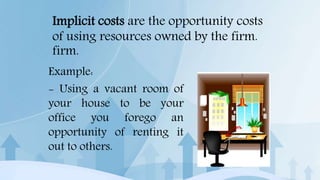
Implicit costs are the opportunity costs
of using resources owned by the firm.
firm.
Example:
- Using a vacant room of
your house to be your
office you forego an
opportunity of renting it
out to others.
Fixed Cost
Also called overhead or
supplementary cost, are those expenses
are spent for the use of fixed factors of
production.
Fixed costs stay the same no matter
how much changes.
Fixed costs are sometimes call sunk
costs because once we have obligated
ourselves to pay them, that money has
been sunk into our business firm.
Variable Cost
Variable costs or prime or
operating costs are those expenses
change as a consequence of a change
quantity of output produced.
In case of reduction in production,
there should be a corresponding
decrease in variable costs to maintain
production efficiency.
However, some costs can have
a component or part that is fixed
and part that is variable.
Two Basic Categories of Cost
1. Total Fixed Cost (TFC) - consists of
cost that do not vary as output varies
and that must be paid even if output is
zero. Even if a firm does not produce any
output, still it must pay rent, property
taxes, etc.
2. Total Variable Cost (TVC) -
consists of costs that are zero when
output is zero and vary as output
increases (decreases)
Given total fixed cost and total
variable cost, the firm can
calculate total cost (TC). Total
the sum of total fixed cost and total
variable cost at each level of output.
Thus,
TC = TFC + TVC
Average Fixed Cost
𝑨𝑭𝑪 =
𝑭𝑪
𝑸
Average Variable Cost
𝑨𝑽𝑪 =
𝑽𝑪
𝑸
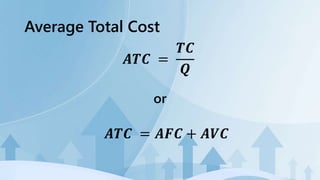
Average Total Cost
𝑨𝑻𝑪 =
𝑻𝑪
𝑸
or
𝑨𝑻𝑪 = 𝑨𝑭𝑪 + 𝑨𝑽𝑪
Marginal Cost
Marginal Cost (MC) is the cost of producing
one additional unit of output. It is the change
change in total cost when one additional unit
unit of output is produced.
Equation
𝑴𝑪 =
∆𝑻𝑪
∆𝑸
or
𝑴𝑪 =
∆𝑻𝑽𝑪
∆𝑸
Short Run Cost Schedule
Q FC VC TC MC AFC AVC ATC
0 100 0 100 - - - -
1 100 40
2 100 78
3 100 90
4 100 211
5 100 248
6 100 300
7 100 260
8 100 355
Q FC VC TC MC AFC AVC ATC
0 100 0 100 - - - -
1 100 40 140 40 100 40 140
2 100 78 178 38 50 39 89
3 100 90 190 12 33 30 63
4 100 111 211 21 25 28 53
5 100 148 248 37 20 30 50
6 100 200 300 52 17 33 50
7 100 260 360 60 14 37 51
8 100 355 454 94 13 13 26
Relationship of TVC and TFC
0
50
100
150
200
250
300
350
400
450
500
1 2 3 4 5 6 7 8 9
FC VC TC
Relationship of MC to AFC, AVC, & ATC
0
20
40
60
80
100
120
140
160
1 2 3 4 5 6 7 8
MC AFC AVC ATC
In summary, in the short run a firm has
two options: operate or shut down. It
operates when total revenue exceeds variable
costs. But when variable costs are greater
than total revenue, it shuts down.
Microeconomics: Production and Cost

Microeconomics: Production and Cost

  • 1.
  • 2.
    Production •Refers to anyeconomic activity, which combines the four factors of production to form an output that will give direct satisfaction to consumers • The process of converting inputs into outputs
  • 3.
    Categories of Inputs •Land (natural resources) includes those above and under the earth like forest products and mineral ores. • Labor is the mental and physical ability used in the production of goods and services. • Capital resources are the goods that are used in the production of other other goods and services like machines, equipments, buildings, buildings, etc.
  • 4.
    Short Run vsLong Run •Short-run is the period of time so short that there is at least one fixed input therefore changes in the output level must be accomplished exclusively by changes in the use use of variable outputs. •Long-run is a period of time so long that all inputs are considered variable.
  • 5.
    The Production Function •Thefunctional relationship between quantities of inputs used in production and outputs to be produced. •In order to produce a t-shirt, its production function may appear as follows: etc.)Buttons,Thread,Sewer,Machine,Sewing(Fabrics,fO shirtt 
  • 6.
    Production Concepts •Total Productrefers to the total output produced after utilizing the fixed and variable inputs in the production process. process. -Fixed inputs are components of production which do not change, like machineries and equipment. -Variable inputs are the changeable resources in the production, such as raw materials and number of
  • 7.
    •Marginal Product ofan input is the extra output produced by 1 additional unit of of that input while other inputs are held held constant. •Average Product equals total product divided by total units of input used. 1ΔI ΔTP MP  12 12 LL II TPTP MP    1I TP AP 
  • 8.
    Production Schedule ofT-shirts Input (Labor) TP MP AP 0 0 1 8 2 20 3 37 4 57 5 72 6 80 7 85 8 88 9 86 10 82
  • 9.
    Production Schedule ofT-shirts Input (Labor) TP MP AP 0 0 0 0 1 8 8 8 2 20 12 10 3 37 17 12 4 57 20 14 5 72 15 14 6 80 8 13 7 85 5 12 8 88 3 11 9 86 -2 10 10 82 -4 8
  • 10.
    Total, Marginal, andAverage Products -20 0 20 40 60 80 100 0 1 2 3 4 5 6 7 8 9 10 Series 1 Series 2 Series 3
  • 11.
    Law of DiminishingReturns The Law of Diminishing Returns holds that we will get less and less extra output when we add additional doses of an input while holding other inputs fixed.
  • 12.
    Increasing marginal returnshappen when the marginal product of an additional worker exceeds the marginal product of of the previous worker. Input (Labor) TP MP AP 1 8 8 8 2 20 12 10 3 37 17 12 4 57 20 14 5 72 15 14
  • 13.
    Decreasing marginal returnsoccur when the marginal product of an additional worker is less than the marginal product product of the previous worker hired to do do the same task. Input (Labor) TP MP AP 4 57 20 14 5 72 15 14 6 80 8 13 7 85 5 12 8 88 3 11 9 86 -2 10 10 82 -4 8
  • 14.
    Returns to Scale Constantreturns to scale indicates a case where a change change in all inputs inputs leads to a proportional change in output.
  • 15.
    Increasing returns toscale (also called economies of scale) happen happen when an increase in all inputs leads to a more-than- proportional increase in the level level of output Decreasing returns to scale occur when a balanced increase in all inputs leads to a less- than-proportional increase in total output.
  • 16.
    The Firm’s Goal Ofcourse, the basic goal of a firm is to maximize its profit. A firm that does not seek to maximize profit is either eliminated or absorbed by firms that do seek that goal.
  • 17.
    Sales – Costs= Profit Or Total Revenue- Total Costs = Profit Total cost refers to all expenses acquired during the economic activity or the production of goods or services. Total revenue is the amount received from the sale of the product. price of the output X Quantity sold
  • 18.
    In 2010, thetotal revenue of your t- shirts company from the sale of souvenir shirts was P150,000. Your firm paid P20,000 for fabric, P22,000 for wages of the sewers you hired, and P3,000 in interest to the bank from your loan. The accountant of your firm said that the depreciation of your firm’s sewing machines during the same period was P10,000. Profit = Total Revenue – Total Costs = 150,000 – (20,000+ 22,000+ 3,000+ 10,000) = 150,000 – 55,000 Profit = P95,000
  • 19.
    Explicit costs arepayments to non- owners of a firm for their resources such as labor labor or the use of a building. Examples: - wages paid to labor - rental charges for a plant or office building - the cost of electricity and phone bills - the cost of raw materials
  • 20.
    Implicit costs arethe opportunity costs of using resources owned by the firm. firm. Example: - Using a vacant room of your house to be your office you forego an opportunity of renting it out to others.
  • 21.
    Fixed Cost Also calledoverhead or supplementary cost, are those expenses are spent for the use of fixed factors of production. Fixed costs stay the same no matter how much changes. Fixed costs are sometimes call sunk costs because once we have obligated ourselves to pay them, that money has been sunk into our business firm.
  • 22.
    Variable Cost Variable costsor prime or operating costs are those expenses change as a consequence of a change quantity of output produced. In case of reduction in production, there should be a corresponding decrease in variable costs to maintain production efficiency.
  • 23.
    However, some costscan have a component or part that is fixed and part that is variable.
  • 24.
    Two Basic Categoriesof Cost 1. Total Fixed Cost (TFC) - consists of cost that do not vary as output varies and that must be paid even if output is zero. Even if a firm does not produce any output, still it must pay rent, property taxes, etc.
  • 25.
    2. Total VariableCost (TVC) - consists of costs that are zero when output is zero and vary as output increases (decreases)
  • 26.
    Given total fixedcost and total variable cost, the firm can calculate total cost (TC). Total the sum of total fixed cost and total variable cost at each level of output. Thus, TC = TFC + TVC
  • 27.
    Average Fixed Cost 𝑨𝑭𝑪= 𝑭𝑪 𝑸 Average Variable Cost 𝑨𝑽𝑪 = 𝑽𝑪 𝑸
  • 28.
    Average Total Cost 𝑨𝑻𝑪= 𝑻𝑪 𝑸 or 𝑨𝑻𝑪 = 𝑨𝑭𝑪 + 𝑨𝑽𝑪
  • 29.
    Marginal Cost Marginal Cost(MC) is the cost of producing one additional unit of output. It is the change change in total cost when one additional unit unit of output is produced.
  • 30.
  • 31.
    Short Run CostSchedule Q FC VC TC MC AFC AVC ATC 0 100 0 100 - - - - 1 100 40 2 100 78 3 100 90 4 100 211 5 100 248 6 100 300 7 100 260 8 100 355
  • 32.
    Q FC VCTC MC AFC AVC ATC 0 100 0 100 - - - - 1 100 40 140 40 100 40 140 2 100 78 178 38 50 39 89 3 100 90 190 12 33 30 63 4 100 111 211 21 25 28 53 5 100 148 248 37 20 30 50 6 100 200 300 52 17 33 50 7 100 260 360 60 14 37 51 8 100 355 454 94 13 13 26
  • 33.
    Relationship of TVCand TFC 0 50 100 150 200 250 300 350 400 450 500 1 2 3 4 5 6 7 8 9 FC VC TC
  • 34.
    Relationship of MCto AFC, AVC, & ATC 0 20 40 60 80 100 120 140 160 1 2 3 4 5 6 7 8 MC AFC AVC ATC
  • 35.
    In summary, inthe short run a firm has two options: operate or shut down. It operates when total revenue exceeds variable costs. But when variable costs are greater than total revenue, it shuts down.