Animal Cell Structure
Achuth B S, M.Sc. Biotechnology
University of Kerala
Animal Cell
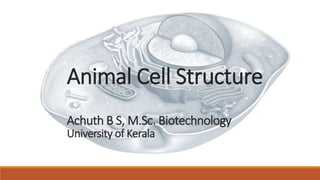
Animal cells are eukaryotic cells or cells with a membrane-bound nucleus.
DNA in animal cells is housed within the nucleus.
In addition to having nucleus animal cells also contain other membrane-bound organelles.
Organelles have a wide range of responsibilities that include everything from producing
hormones and enzymes to providing energy for animal cells.
All living things are made up of cells that make up their body structure. Some of these living
things are single-celled and other organisms are made up of more than one cell.
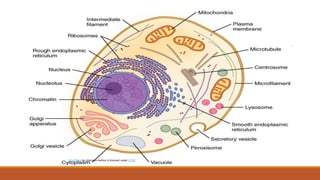
This Photo by Unknown Author is licensed under CC BY
Cell Membrane
Cell membrane is a biological membrane that separates the interior of all cells from the outside
environment.
The cell membrane is selectively permeable to ions and organic molecules and controls the cells.
It basically protects the cell from outside forces.
It contains of the lipid bilayer with embedded proteins.
Fungi, bacteria, and plants.
It contains a percentage of lipids making a semi-permeable barrier between the cell and its
physical environment.
Functions
To enclose and protect the cell content
The proteins are actively involved in the transporting materials across the membrane,
The proteins and lipids allow cell communication, and carbohydrates which decorate both the
proteins and lipids and cells recognize each other.
Nucleus
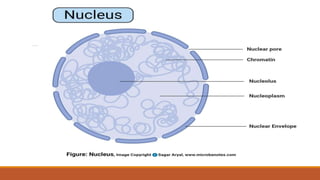
This is a spherical structured organelle found majorly at the center of a cell surrounded by a double-
layered nuclear membrane separating it from the cytoplasm.
It is held together to the cytoplasm with the help of filaments and microtubules.
It holds other cell organelles including the nucleolus, nucleosomes, and chromatins.
A cell has one nucleus which divides producing multinucleated cells e.g. the skeletal muscle cell
fibers.
Some cells lose their nuclei after maturations e.g. RBC
Functions
The primary role of the nucleus is to control and regulate cell activities of growth and maintain
cell metabolisms.
It also carries the genes that have hereditary information of the cell.
The chromosomal DNA and genetic materials, which are made up of genetic coded amino acids
sequences for use by the cell.
It is the site for transcription and the mRNA is transported to nuclear envelope.
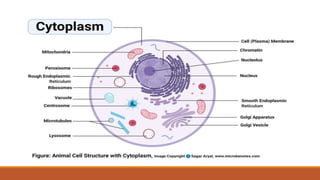
CYTOPLASM
This is a gel-like material that contains all the cell organelles, enclosed within the cell
membrane.
These organelles include; mitochondria, ribosomes, endoplasmic reticulum, golgi apparatus etc.
Mitochondria
These are membrane-bound organelles located in the cytoplasm of all eukaryotic cells.
The number of mitochondria found in each cell varies widely depending upon the function of
the cell it performs.
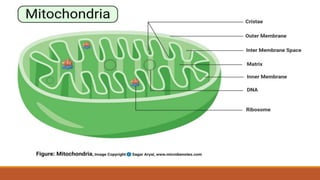
Mitochondria have two special membranes – outer and inner membrane.
They have a mitochondrial gel-matric in the central mass.
The membranes bend into folds known as cristae.
Functions
The primary function is to generate energy for the cell as Adenosine Tri-phosphate, by
converting nutrients and oxygen into energy enabling the cell to perform its function.
Mitochondria also store calcium which helps in cell signaling.
The outer membrane is permeable, allowing the transport of small molecules and a special
channel to transport large molecules.
The inner mitochondrial membrane is less permeable thus allowing very small molecules into
the mitochondrial gel-matrix in central mass. The gel matrix is composed of DNA and enzymes
for TCA cycle.
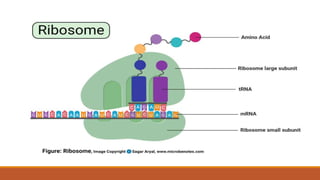
Ribosomes
They are small organelles majorly made up of 60% RNA cytoplasmic – granules and 40% proteins.
All living cells contains ribosomes, which may be freely circulating in the cytoplasm and are bound to
the endoplasmic reticulum.
It is the site for protein synthesis.
Ribosomes are made up of ribosomal proteins and ribosomal RNA (rRNA). In a eukaryotic cell,
ribosomes constitute half ribosomal RNA and half ribosomal proteins,
Each ribosome is made up of two subunits that is a large subunit and small subunit with their own
distinct shape. These subunits are designated as the 40s and 60s in the animal cell.
Functions
Ribosomes that occur as free particles are attached to the endoplasmic reticulum
membrane occurring in large numbers accounting for about a quarter of the cell
organelles. A single replicated cell has about 10 million ribosomes.
The ribosomal subunits are the site for genetic coding into proteins.
This leads to the formation of the rRNA which are involved in the catalyzation of peptidyl
transferase creating the peptide bond found between the amino acid sequences that
develop the proteins. The formed proteins then detach from the ribosomes, migrating to
other cell parts for utilization by the cell.
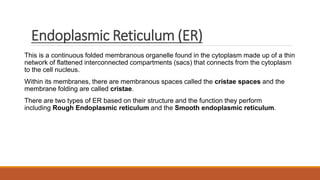
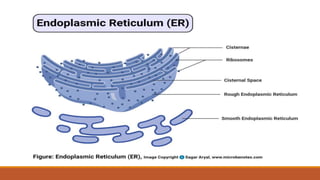
Endoplasmic Reticulum (ER)
This is a continuous folded membranous organelle found in the cytoplasm made up of a thin
network of flattened interconnected compartments (sacs) that connects from the cytoplasm
to the cell nucleus.
Within its membranes, there are membranous spaces called the cristae spaces and the
membrane folding are called cristae.
There are two types of ER based on their structure and the function they perform
including Rough Endoplasmic reticulum and the Smooth endoplasmic reticulum.
Functions
•Manufacturing, processing and transporting proteins for cell utilization both in and out of
the cell. This is because it is directly connected to the nuclear membrane providing a
passage between the nucleus and the cytoplasm.
•The ER has more than half the membranous cell content, hence it has a large surface
area where chemical reactions take place. They also contain the enzymes for almost all
the cell lipid synthesis hence they are the site for lipid synthesis.
Types of Endoplasmic Reticulum
1.Rough Endoplasmic Reticulum (Rough ER) – Rough ER is called “rough” because there
surface is covered with ribosomes, giving it a rough appearance. The function of the
ribosomes on rough ER is to synthesis proteins and they have a signaling sequence,
directing them to the endoplasmic reticulum for processing. Rough ER transports the
proteins and lipids through the cell into the cristae. They are then sent into the Golgi bodies
or inserted into the cell membrane.
2.Smooth Endoplasmic Reticulum (Smooth ER) – Smooth ER is not associated with
ribosomes and their function is different from that of the rough endoplasmic reticulum,
despite lying adjacent to the rough endoplasmic reticulum. Its function is to synthesis lipids
(cholesterol and phospholipids) that are utilized for producing new cellular membranes. They
are also involved in the synthesis of steroid hormones from cholesterol for certain cell
types. It also contributes to the detoxification of the liver after the intake of drugs and toxic
chemicals.
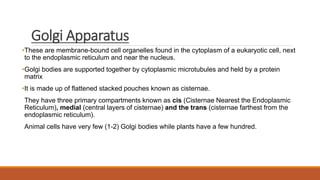
Golgi Apparatus
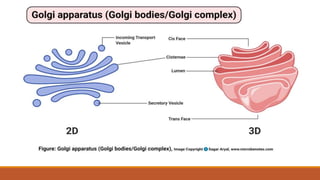
•These are membrane-bound cell organelles found in the cytoplasm of a eukaryotic cell, next
to the endoplasmic reticulum and near the nucleus.
•Golgi bodies are supported together by cytoplasmic microtubules and held by a protein
matrix
•It is made up of flattened stacked pouches known as cisternae.
They have three primary compartments known as cis (Cisternae Nearest the Endoplasmic
Reticulum), medial (central layers of cisternae) and the trans (cisternae farthest from the
endoplasmic reticulum).
Animal cells have very few (1-2) Golgi bodies while plants have a few hundred.
Functions
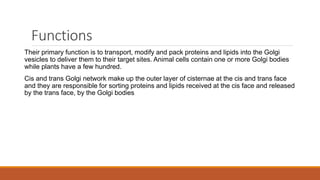
Their primary function is to transport, modify and pack proteins and lipids into the Golgi
vesicles to deliver them to their target sites. Animal cells contain one or more Golgi bodies
while plants have a few hundred.
Cis and trans Golgi network make up the outer layer of cisternae at the cis and trans face
and they are responsible for sorting proteins and lipids received at the cis face and released
by the trans face, by the Golgi bodies
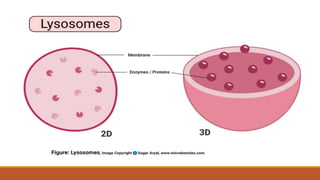
Lysosomes
•They are round subcellular organelle found in almost all eukaryotic cells
•Lysosomes are very acidic organelles containing the digestive enzymes and therefore each
of the lysosomes is surrounded by a membrane to protect it from the outer environment.
Functions
This is the site for digestion of cell nutrients, excretion, and cell renewal.
Lysosomes break down macromolecules components from the outside of the cell into
simpler elements that are transported into the cytoplasm via a proton pump to build new
cell materials.
The digestive enzymes found in the lysosomes are called hydrolytic enzymes breaking large
to small molecules.
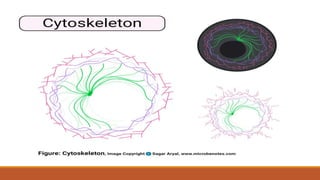
Cytoskeleton
This is a fibrous network that’s formed from and by different proteins of long chains of amino
acids.
These proteins are found in the cell cytoplasm of the eukaryotic cells.
They are also made up of 3 types of tiny filaments: Actin filaments (Microfilaments),
Microtubules, Intermediate filaments.
Functions
The cytoskeleton functions to create a network organizing the cell components and to also
maintain the cell shape.
It also organizes some of the cell components maintaining the cell shape
It plays a major role in the movement of the cell and some cell organelles in the cytoplasm.
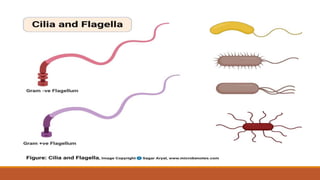
Cilia and Flagella
These are locomotive projections found on the surface of the cell.
They are made of strands of filaments. these filaments have partial and complete
microtubules that extend the projections. Partial microtubules don’t extend to the tip of the
cilium and the complete microtubules extend to the tip of the cilium.
The microtubules also have motor proteins known as dynein making a link between the
partial microtubules to the complete microtubules.
Functions
Sperm cells have flagella allowing them to swim to the ova for fertilization. For single
cells, such as sperm, this enables them to swim.
Cilia in the animal cell helps move fluids away from and past immobile cells
Cilia help move surface particles especially on the epithelial lining of the nostrils and
move mucus over the surface of the cell.
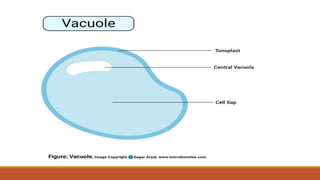
Vacuole
These are fluid-filled cell organelles enclosed by a membrane.
They are membrane-bound sacs found within the cell cytoplasm.
Functions
their primary function is to store food, water, carbohydrates in the form of sugars and waste
materials
They also remove toxic substances and waste materials from the cell as a protection
strategy.
They also remove poorly folded proteins from the cell.
Microvilli
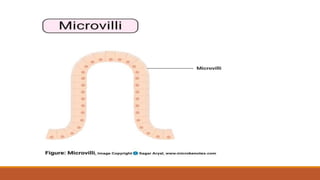
These are surface protrusions formed from accessory proteins of the actin filaments. The
accessory proteins bundle together to form microvilli on the surface of the cell membrane
In the small intestines, they increase the surface area for the absorption of digested food and
water.
some microvilli may be found in the ear for detection of sound and they transmit the sound
waves to the brain through an electric signal.
In white blood cells, they also act as anchors allowing the white blood cells to freely move in
the circulatory system to attach to possible pathogens.
Animal Cell Structure

Animal Cell Structure

  • 1.
    Animal Cell Structure AchuthB S, M.Sc. Biotechnology University of Kerala
  • 2.
    Animal Cell Animal cellsare eukaryotic cells or cells with a membrane-bound nucleus. DNA in animal cells is housed within the nucleus. In addition to having nucleus animal cells also contain other membrane-bound organelles. Organelles have a wide range of responsibilities that include everything from producing hormones and enzymes to providing energy for animal cells. All living things are made up of cells that make up their body structure. Some of these living things are single-celled and other organisms are made up of more than one cell.
  • 3.
    This Photo byUnknown Author is licensed under CC BY
  • 4.
    Cell Membrane Cell membraneis a biological membrane that separates the interior of all cells from the outside environment. The cell membrane is selectively permeable to ions and organic molecules and controls the cells. It basically protects the cell from outside forces. It contains of the lipid bilayer with embedded proteins. Fungi, bacteria, and plants. It contains a percentage of lipids making a semi-permeable barrier between the cell and its physical environment.
  • 5.
    Functions To enclose andprotect the cell content The proteins are actively involved in the transporting materials across the membrane, The proteins and lipids allow cell communication, and carbohydrates which decorate both the proteins and lipids and cells recognize each other.
  • 6.
    Nucleus This is aspherical structured organelle found majorly at the center of a cell surrounded by a double- layered nuclear membrane separating it from the cytoplasm. It is held together to the cytoplasm with the help of filaments and microtubules. It holds other cell organelles including the nucleolus, nucleosomes, and chromatins. A cell has one nucleus which divides producing multinucleated cells e.g. the skeletal muscle cell fibers. Some cells lose their nuclei after maturations e.g. RBC
  • 8.
    Functions The primary roleof the nucleus is to control and regulate cell activities of growth and maintain cell metabolisms. It also carries the genes that have hereditary information of the cell. The chromosomal DNA and genetic materials, which are made up of genetic coded amino acids sequences for use by the cell. It is the site for transcription and the mRNA is transported to nuclear envelope.
  • 9.
    CYTOPLASM This is agel-like material that contains all the cell organelles, enclosed within the cell membrane. These organelles include; mitochondria, ribosomes, endoplasmic reticulum, golgi apparatus etc.
  • 11.
    Mitochondria These are membrane-boundorganelles located in the cytoplasm of all eukaryotic cells. The number of mitochondria found in each cell varies widely depending upon the function of the cell it performs. Mitochondria have two special membranes – outer and inner membrane. They have a mitochondrial gel-matric in the central mass. The membranes bend into folds known as cristae.
  • 13.
    Functions The primary functionis to generate energy for the cell as Adenosine Tri-phosphate, by converting nutrients and oxygen into energy enabling the cell to perform its function. Mitochondria also store calcium which helps in cell signaling. The outer membrane is permeable, allowing the transport of small molecules and a special channel to transport large molecules. The inner mitochondrial membrane is less permeable thus allowing very small molecules into the mitochondrial gel-matrix in central mass. The gel matrix is composed of DNA and enzymes for TCA cycle.
  • 14.
    Ribosomes They are smallorganelles majorly made up of 60% RNA cytoplasmic – granules and 40% proteins. All living cells contains ribosomes, which may be freely circulating in the cytoplasm and are bound to the endoplasmic reticulum. It is the site for protein synthesis. Ribosomes are made up of ribosomal proteins and ribosomal RNA (rRNA). In a eukaryotic cell, ribosomes constitute half ribosomal RNA and half ribosomal proteins, Each ribosome is made up of two subunits that is a large subunit and small subunit with their own distinct shape. These subunits are designated as the 40s and 60s in the animal cell.
  • 16.
    Functions Ribosomes that occuras free particles are attached to the endoplasmic reticulum membrane occurring in large numbers accounting for about a quarter of the cell organelles. A single replicated cell has about 10 million ribosomes. The ribosomal subunits are the site for genetic coding into proteins. This leads to the formation of the rRNA which are involved in the catalyzation of peptidyl transferase creating the peptide bond found between the amino acid sequences that develop the proteins. The formed proteins then detach from the ribosomes, migrating to other cell parts for utilization by the cell.
  • 17.
    Endoplasmic Reticulum (ER) Thisis a continuous folded membranous organelle found in the cytoplasm made up of a thin network of flattened interconnected compartments (sacs) that connects from the cytoplasm to the cell nucleus. Within its membranes, there are membranous spaces called the cristae spaces and the membrane folding are called cristae. There are two types of ER based on their structure and the function they perform including Rough Endoplasmic reticulum and the Smooth endoplasmic reticulum.
  • 19.
    Functions •Manufacturing, processing andtransporting proteins for cell utilization both in and out of the cell. This is because it is directly connected to the nuclear membrane providing a passage between the nucleus and the cytoplasm. •The ER has more than half the membranous cell content, hence it has a large surface area where chemical reactions take place. They also contain the enzymes for almost all the cell lipid synthesis hence they are the site for lipid synthesis.
  • 20.
    Types of EndoplasmicReticulum 1.Rough Endoplasmic Reticulum (Rough ER) – Rough ER is called “rough” because there surface is covered with ribosomes, giving it a rough appearance. The function of the ribosomes on rough ER is to synthesis proteins and they have a signaling sequence, directing them to the endoplasmic reticulum for processing. Rough ER transports the proteins and lipids through the cell into the cristae. They are then sent into the Golgi bodies or inserted into the cell membrane. 2.Smooth Endoplasmic Reticulum (Smooth ER) – Smooth ER is not associated with ribosomes and their function is different from that of the rough endoplasmic reticulum, despite lying adjacent to the rough endoplasmic reticulum. Its function is to synthesis lipids (cholesterol and phospholipids) that are utilized for producing new cellular membranes. They are also involved in the synthesis of steroid hormones from cholesterol for certain cell types. It also contributes to the detoxification of the liver after the intake of drugs and toxic chemicals.
  • 21.
    Golgi Apparatus •These aremembrane-bound cell organelles found in the cytoplasm of a eukaryotic cell, next to the endoplasmic reticulum and near the nucleus. •Golgi bodies are supported together by cytoplasmic microtubules and held by a protein matrix •It is made up of flattened stacked pouches known as cisternae. They have three primary compartments known as cis (Cisternae Nearest the Endoplasmic Reticulum), medial (central layers of cisternae) and the trans (cisternae farthest from the endoplasmic reticulum). Animal cells have very few (1-2) Golgi bodies while plants have a few hundred.
  • 23.
    Functions Their primary functionis to transport, modify and pack proteins and lipids into the Golgi vesicles to deliver them to their target sites. Animal cells contain one or more Golgi bodies while plants have a few hundred. Cis and trans Golgi network make up the outer layer of cisternae at the cis and trans face and they are responsible for sorting proteins and lipids received at the cis face and released by the trans face, by the Golgi bodies
  • 24.
    Lysosomes •They are roundsubcellular organelle found in almost all eukaryotic cells •Lysosomes are very acidic organelles containing the digestive enzymes and therefore each of the lysosomes is surrounded by a membrane to protect it from the outer environment. Functions This is the site for digestion of cell nutrients, excretion, and cell renewal. Lysosomes break down macromolecules components from the outside of the cell into simpler elements that are transported into the cytoplasm via a proton pump to build new cell materials. The digestive enzymes found in the lysosomes are called hydrolytic enzymes breaking large to small molecules.
  • 26.
    Cytoskeleton This is afibrous network that’s formed from and by different proteins of long chains of amino acids. These proteins are found in the cell cytoplasm of the eukaryotic cells. They are also made up of 3 types of tiny filaments: Actin filaments (Microfilaments), Microtubules, Intermediate filaments. Functions The cytoskeleton functions to create a network organizing the cell components and to also maintain the cell shape. It also organizes some of the cell components maintaining the cell shape It plays a major role in the movement of the cell and some cell organelles in the cytoplasm.
  • 28.
    Cilia and Flagella Theseare locomotive projections found on the surface of the cell. They are made of strands of filaments. these filaments have partial and complete microtubules that extend the projections. Partial microtubules don’t extend to the tip of the cilium and the complete microtubules extend to the tip of the cilium. The microtubules also have motor proteins known as dynein making a link between the partial microtubules to the complete microtubules.
  • 29.
    Functions Sperm cells haveflagella allowing them to swim to the ova for fertilization. For single cells, such as sperm, this enables them to swim. Cilia in the animal cell helps move fluids away from and past immobile cells Cilia help move surface particles especially on the epithelial lining of the nostrils and move mucus over the surface of the cell.
  • 31.
    Vacuole These are fluid-filledcell organelles enclosed by a membrane. They are membrane-bound sacs found within the cell cytoplasm. Functions their primary function is to store food, water, carbohydrates in the form of sugars and waste materials They also remove toxic substances and waste materials from the cell as a protection strategy. They also remove poorly folded proteins from the cell.
  • 33.
    Microvilli These are surfaceprotrusions formed from accessory proteins of the actin filaments. The accessory proteins bundle together to form microvilli on the surface of the cell membrane In the small intestines, they increase the surface area for the absorption of digested food and water. some microvilli may be found in the ear for detection of sound and they transmit the sound waves to the brain through an electric signal. In white blood cells, they also act as anchors allowing the white blood cells to freely move in the circulatory system to attach to possible pathogens.