Scope of Anatomy and Physiology
Presented By: - Asst. Prof. Miss. J. Y. Burade
(Dr. Rajendra Gode College of Pharmacy, Amravati)
Content
• Anatomy
• Physiology
• Scope of anatomy & physiology
• Level of structural organization
• Basic life processes
• Definition of different terminologies
ANATOMY :- (Ana= up; To my= process of cutting)
It is the science of body Structure and the relationship
among them.
PHYSIOLOGY :- ( Physio= nature; logy :- Study of)
It is the science of body function i.e. how the body parts
work?
ANATOMY PHYSIOLOGY
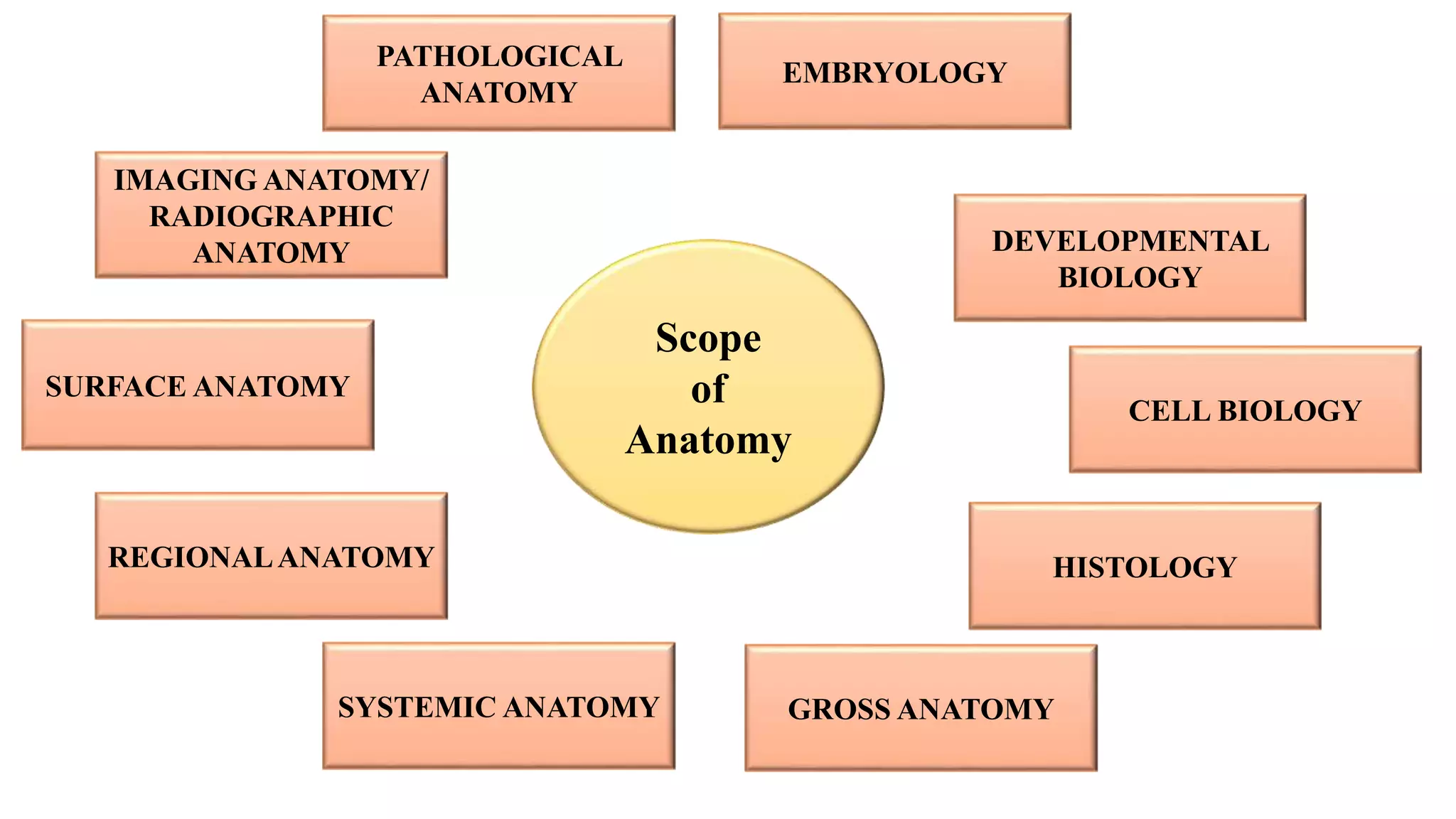
Scope
of
Anatomy
IMAGING ANATOMY/
RADIOGRAPHIC
ANATOMY DEVELOPMENTAL
BIOLOGY
SURFACE ANATOMY
REGIONALANATOMY
SYSTEMIC ANATOMY GROSS ANATOMY
PATHOLOGICAL
ANATOMY
CELL BIOLOGY
HISTOLOGY
EMBRYOLOGY
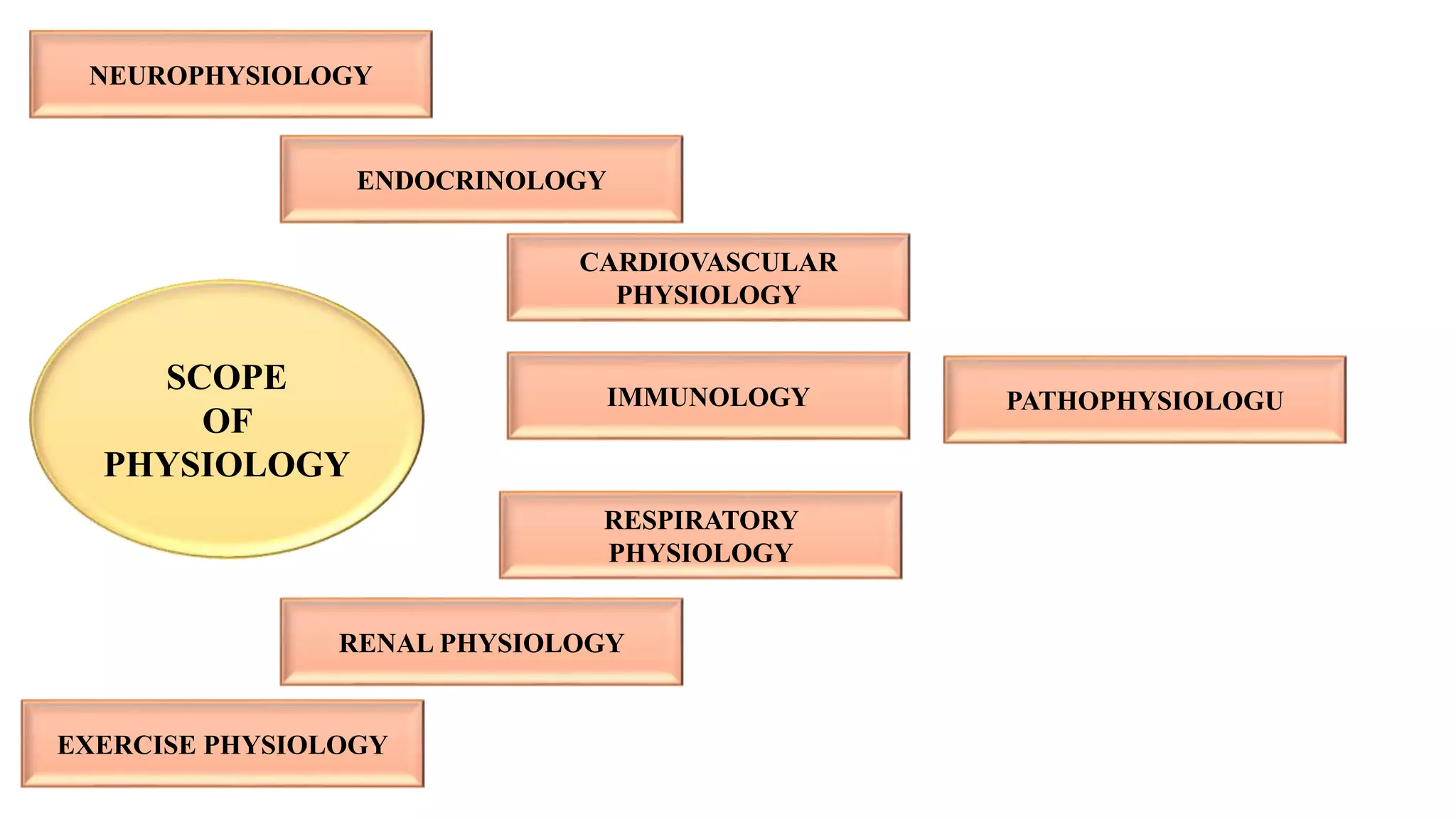
SCOPE
OF
PHYSIOLOGY
PATHOPHYSIOLOGU
RESPIRATORY
PHYSIOLOGY
RENAL PHYSIOLOGY
EXERCISE PHYSIOLOGY
IMMUNOLOGY
CARDIOVASCULAR
PHYSIOLOGY
ENDOCRINOLOGY
NEUROPHYSIOLOGY
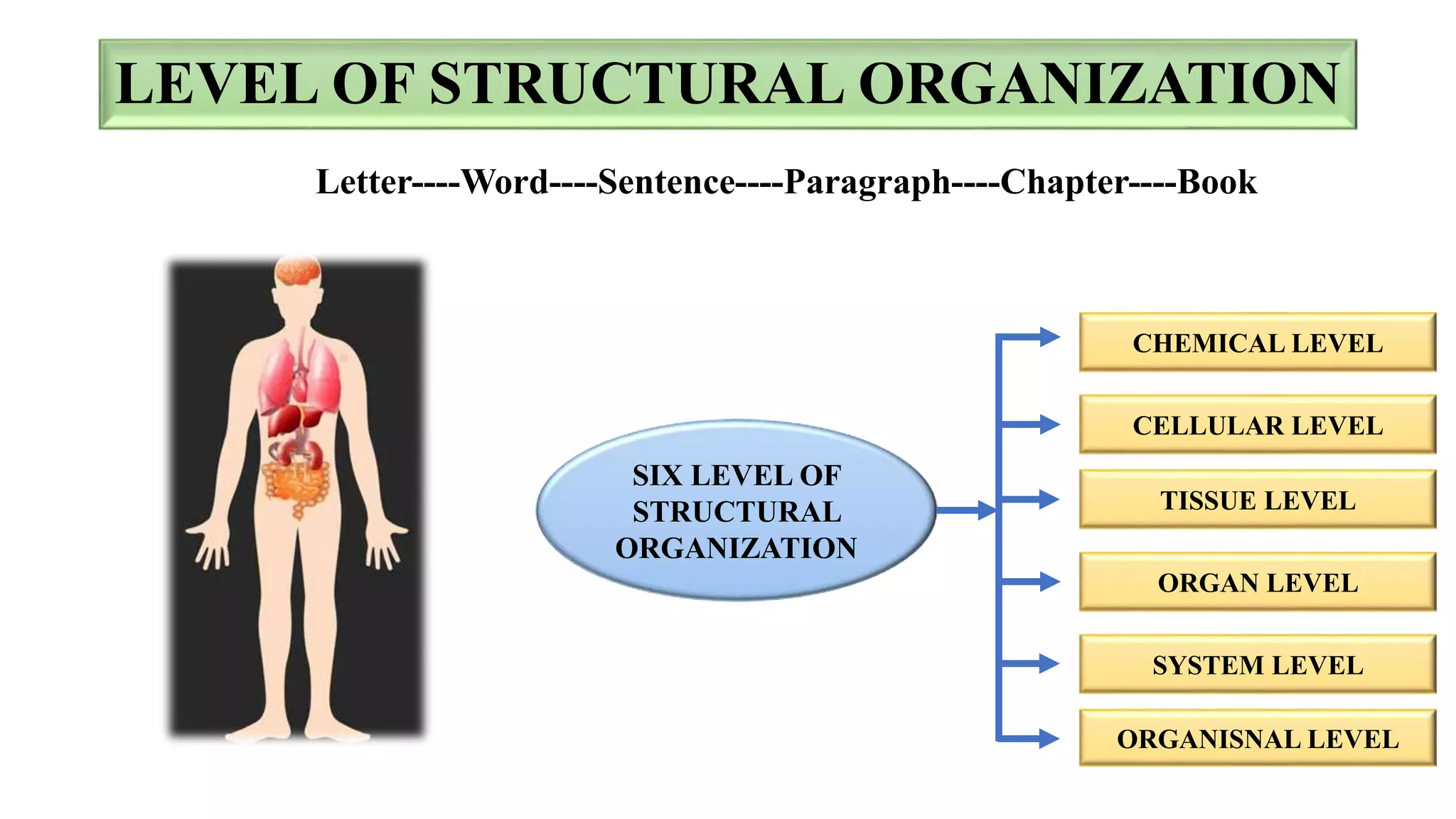
LEVEL OF STRUCTURAL ORGANIZATION
Letter----Word----Sentence----Paragraph----Chapter----Book
SIX LEVEL OF
STRUCTURAL
ORGANIZATION
CHEMICAL LEVEL
CELLULAR LEVEL
TISSUE LEVEL
ORGAN LEVEL
SYSTEM LEVEL
ORGANISNAL LEVEL
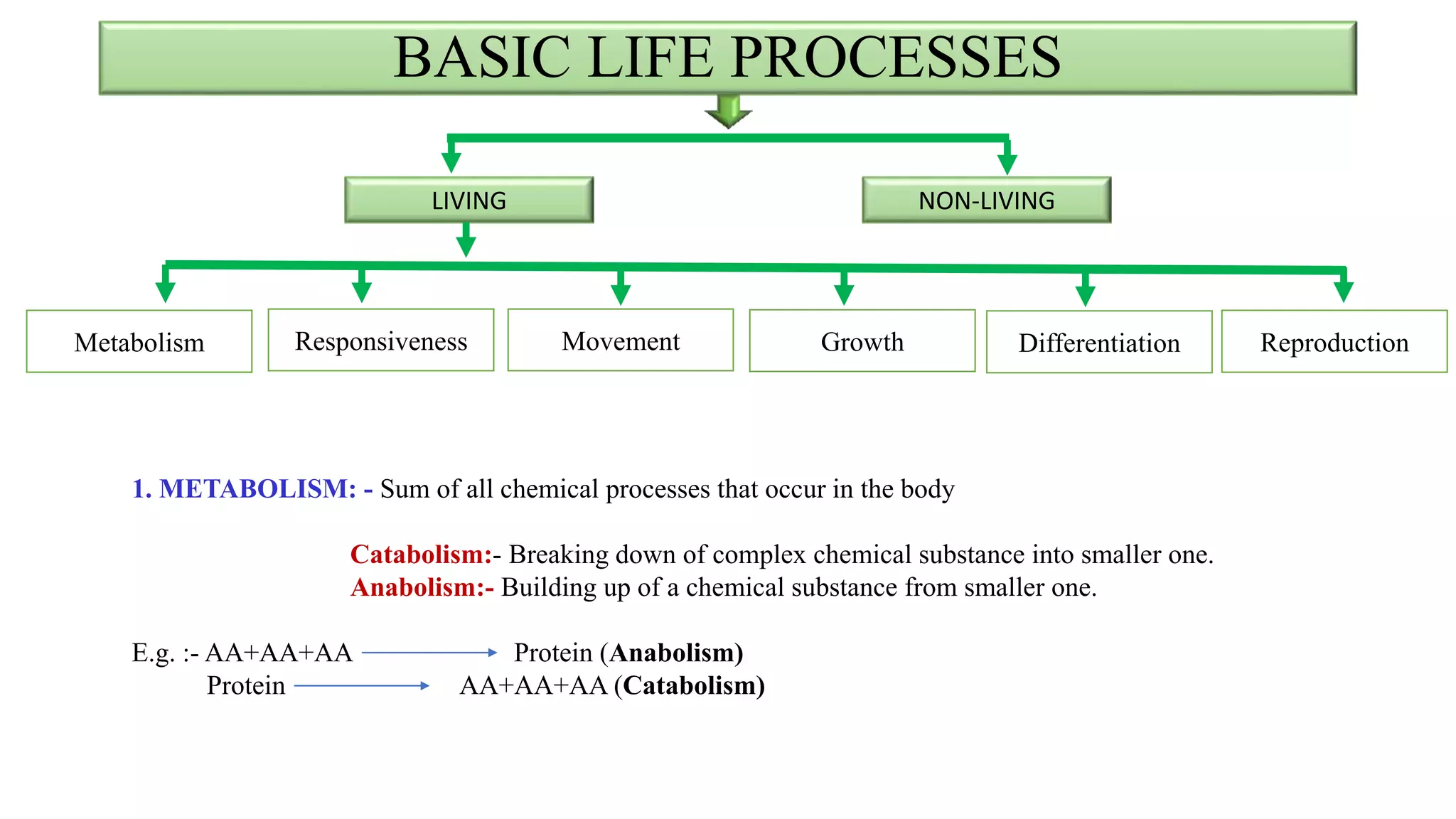
BASIC LIFE PROCESSES
LIVING NON-LIVING
Reproduction
Movement Growth Differentiation
Metabolism Responsiveness
1. METABOLISM: - Sum of all chemical processes that occur in the body
Catabolism:- Breaking down of complex chemical substance into smaller one.
Anabolism:- Building up of a chemical substance from smaller one.
E.g. :- AA+AA+AA Protein (Anabolism)
Protein AA+AA+AA (Catabolism)
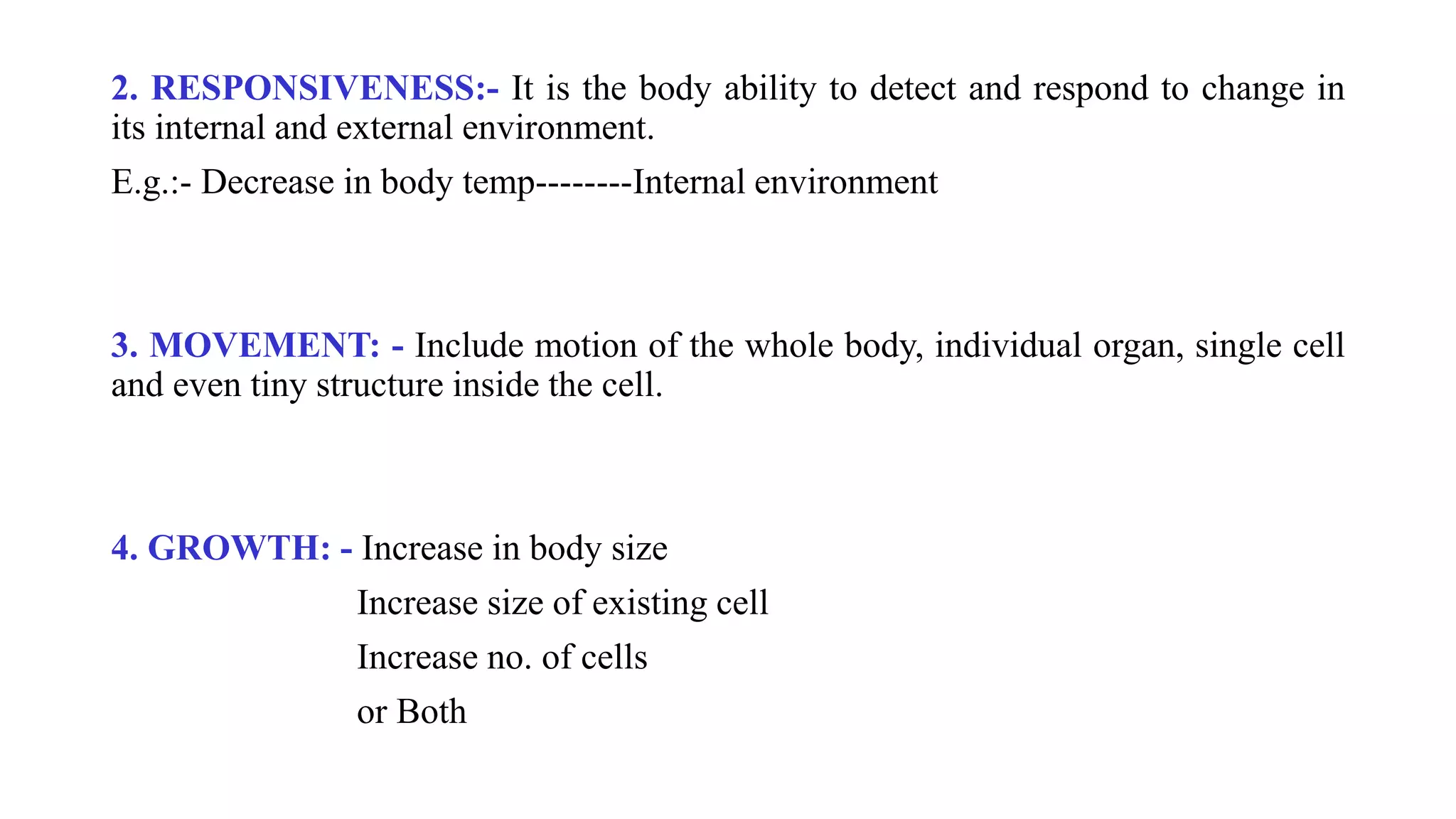
2. RESPONSIVENESS:- It is the body ability to detect and respond to change in
its internal and external environment.
E.g.:- Decrease in body temp--------Internal environment
3. MOVEMENT: - Include motion of the whole body, individual organ, single cell
and even tiny structure inside the cell.
4. GROWTH: - Increase in body size
Increase size of existing cell
Increase no. of cells
or Both
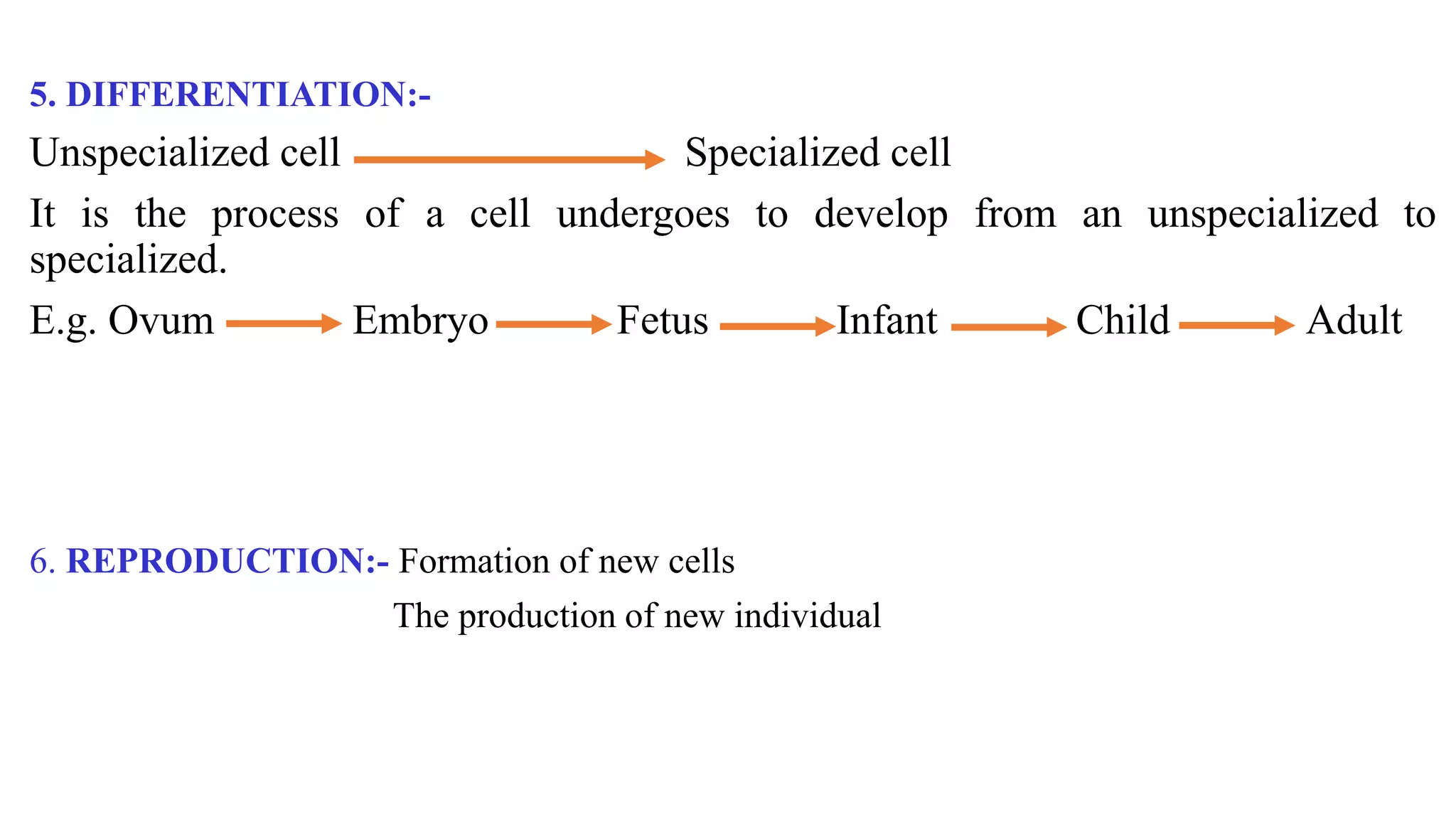
5. DIFFERENTIATION:-
Unspecialized cell Specialized cell
It is the process of a cell undergoes to develop from an unspecialized to
specialized.
E.g. Ovum Embryo Fetus Infant Child Adult
6. REPRODUCTION:- Formation of new cells
The production of new individual
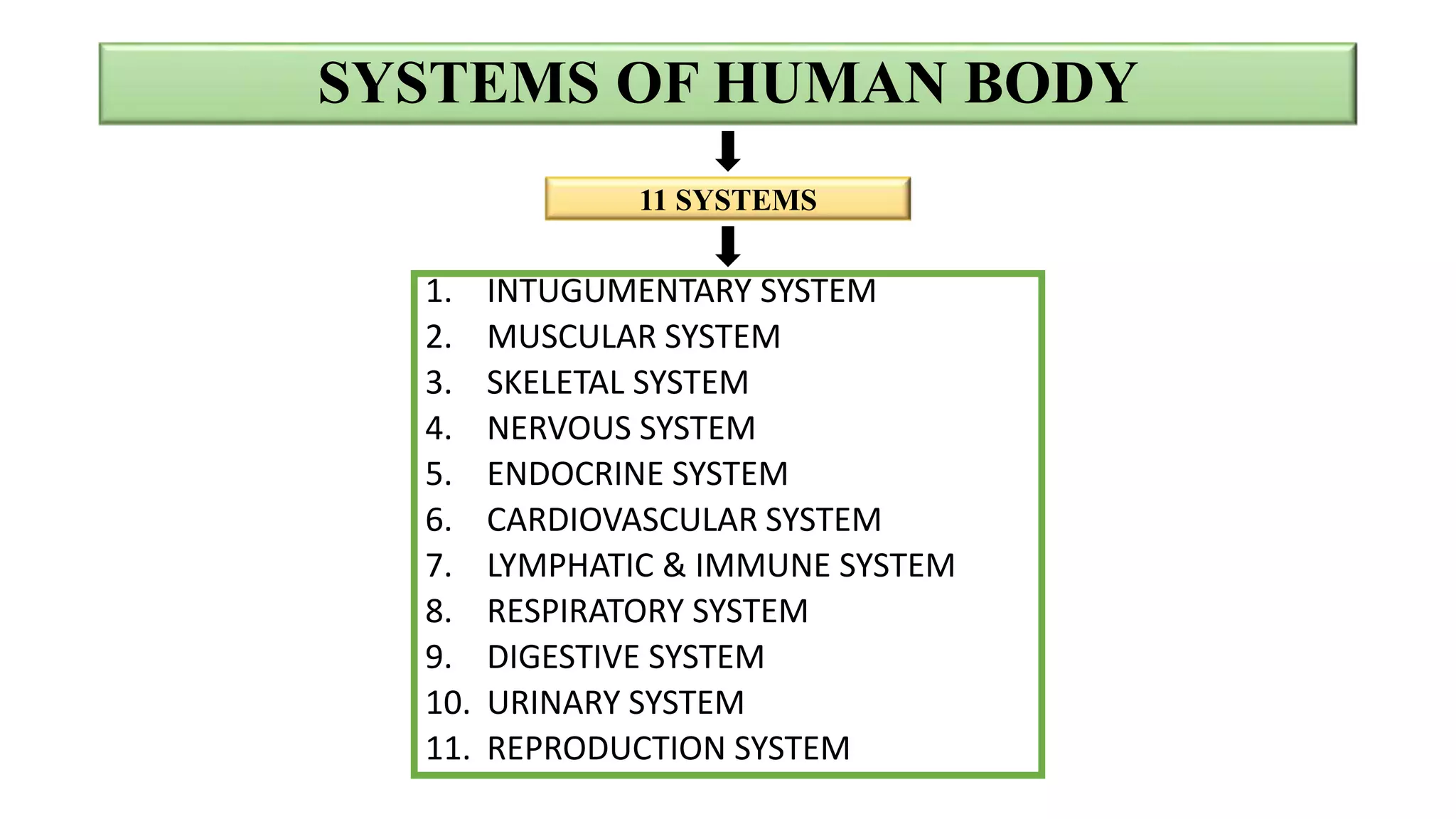
SYSTEMS OF HUMAN BODY
1. INTUGUMENTARY SYSTEM
2. MUSCULAR SYSTEM
3. SKELETAL SYSTEM
4. NERVOUS SYSTEM
5. ENDOCRINE SYSTEM
6. CARDIOVASCULAR SYSTEM
7. LYMPHATIC & IMMUNE SYSTEM
8. RESPIRATORY SYSTEM
9. DIGESTIVE SYSTEM
10. URINARY SYSTEM
11. REPRODUCTION SYSTEM
11 SYSTEMS
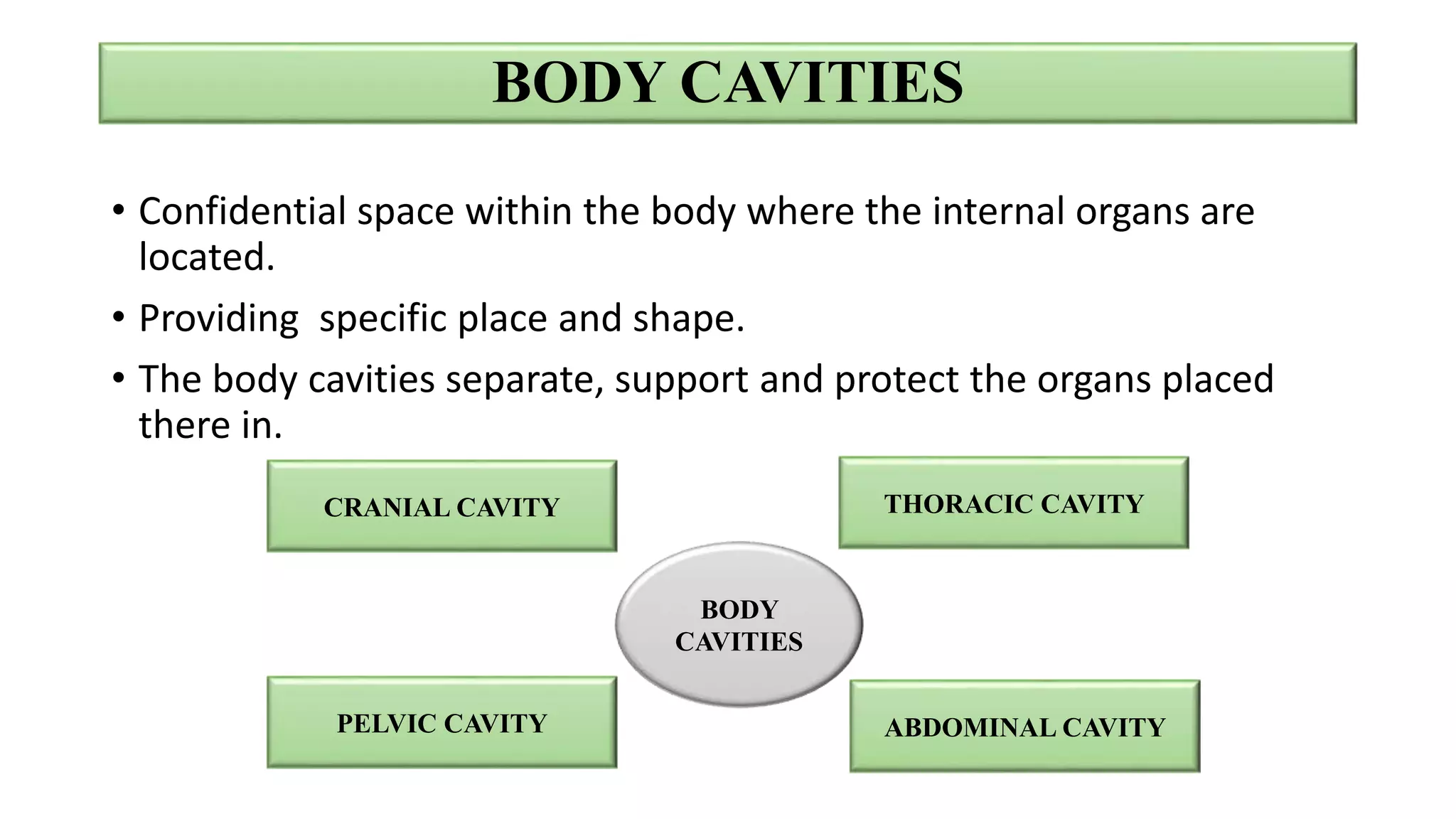
BODY CAVITIES
• Confidential space within the body where the internal organs are
located.
• Providing specific place and shape.
• The body cavities separate, support and protect the organs placed
there in.
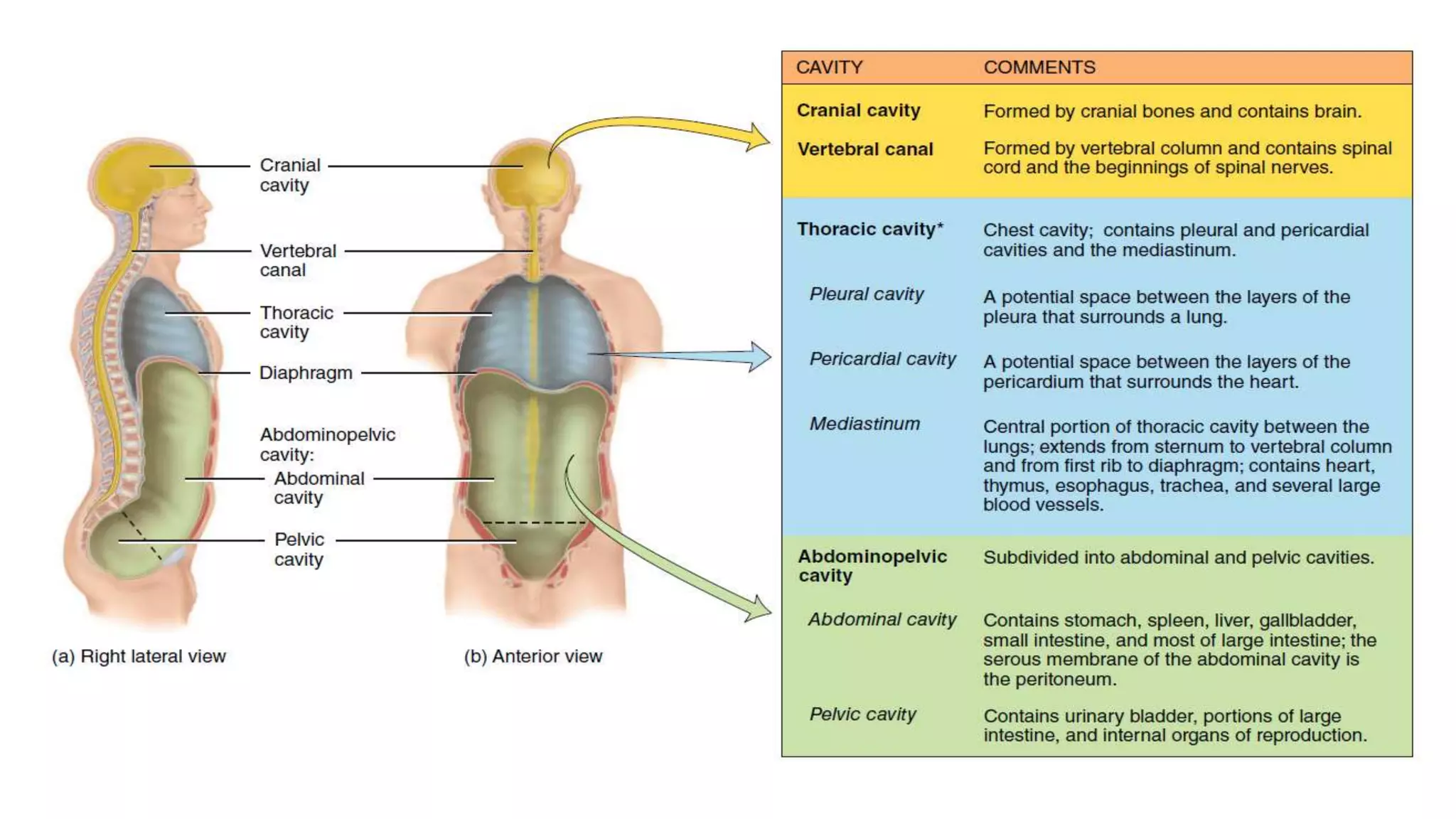
BODY
CAVITIES
THORACIC CAVITY
PELVIC CAVITY
CRANIAL CAVITY
ABDOMINAL CAVITY
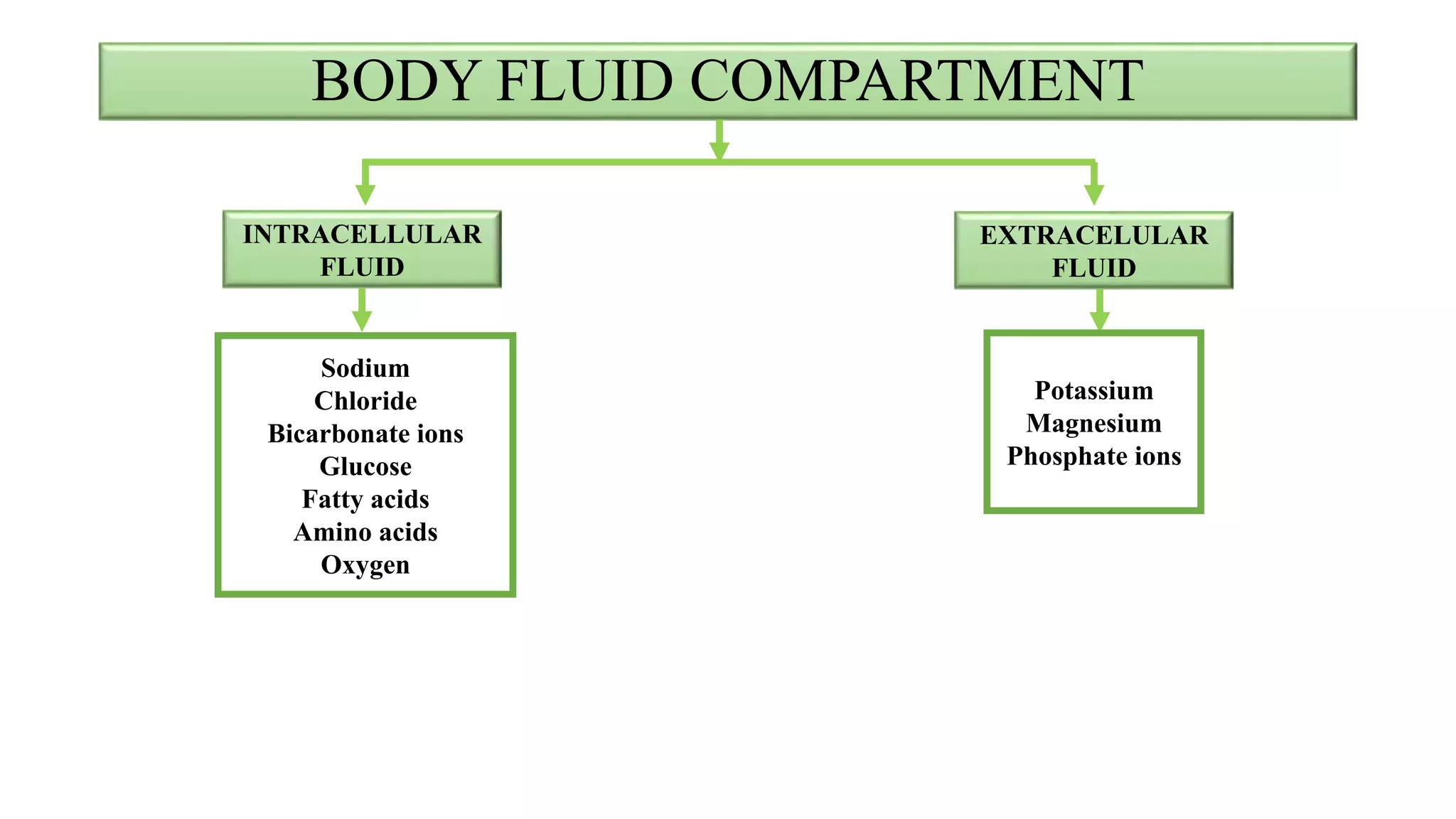
BODY FLUID COMPARTMENT
INTRACELLULAR
FLUID
EXTRACELULAR
FLUID
Sodium
Chloride
Bicarbonate ions
Glucose
Fatty acids
Amino acids
Oxygen
Potassium
Magnesium
Phosphate ions
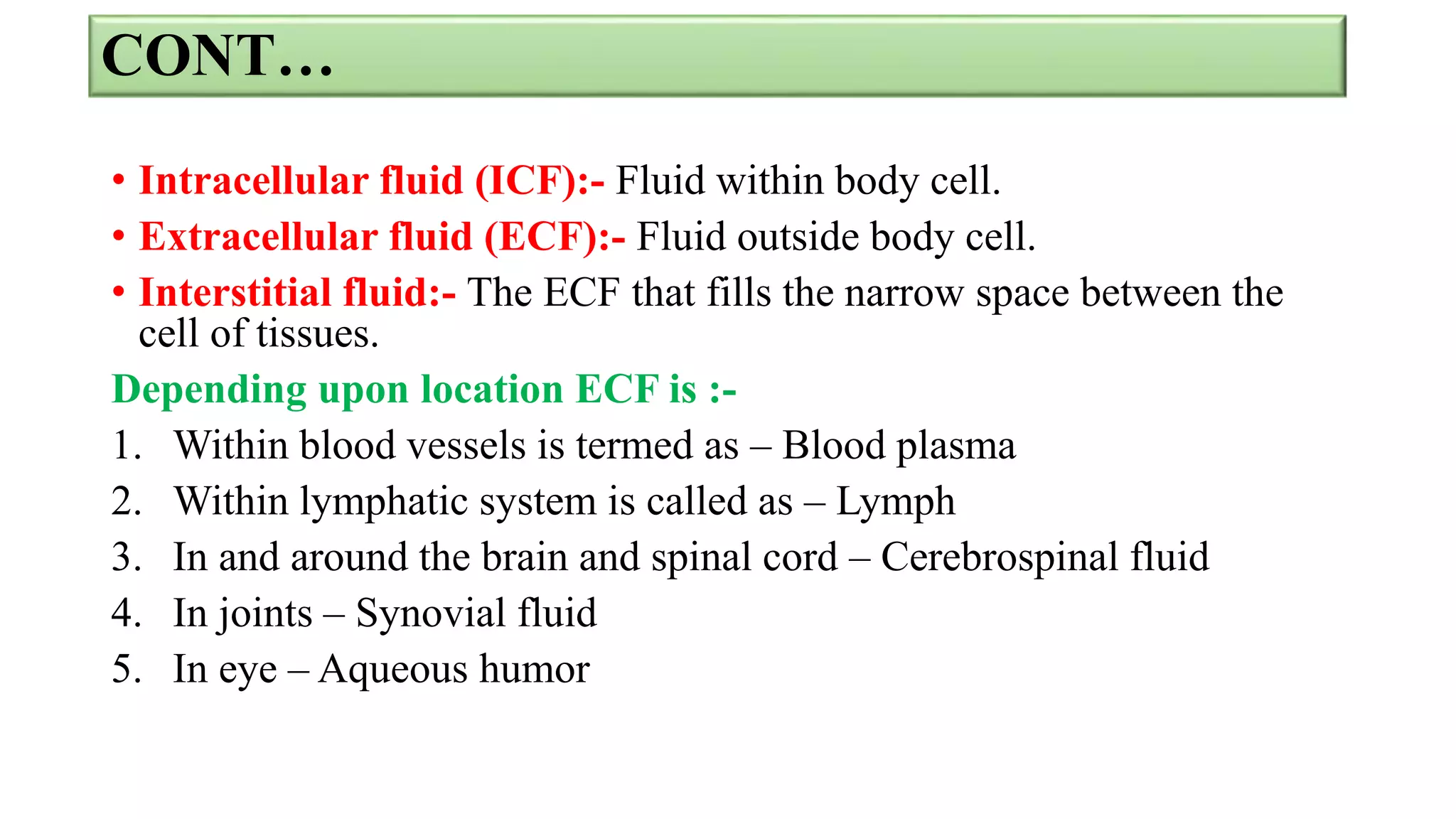
CONT…
• Intracellular fluid (ICF):- Fluid within body cell.
• Extracellular fluid (ECF):- Fluid outside body cell.
• Interstitial fluid:- The ECF that fills the narrow space between the
cell of tissues.
Depending upon location ECF is :-
1. Within blood vessels is termed as – Blood plasma
2. Within lymphatic system is called as – Lymph
3. In and around the brain and spinal cord – Cerebrospinal fluid
4. In joints – Synovial fluid
5. In eye – Aqueous humor
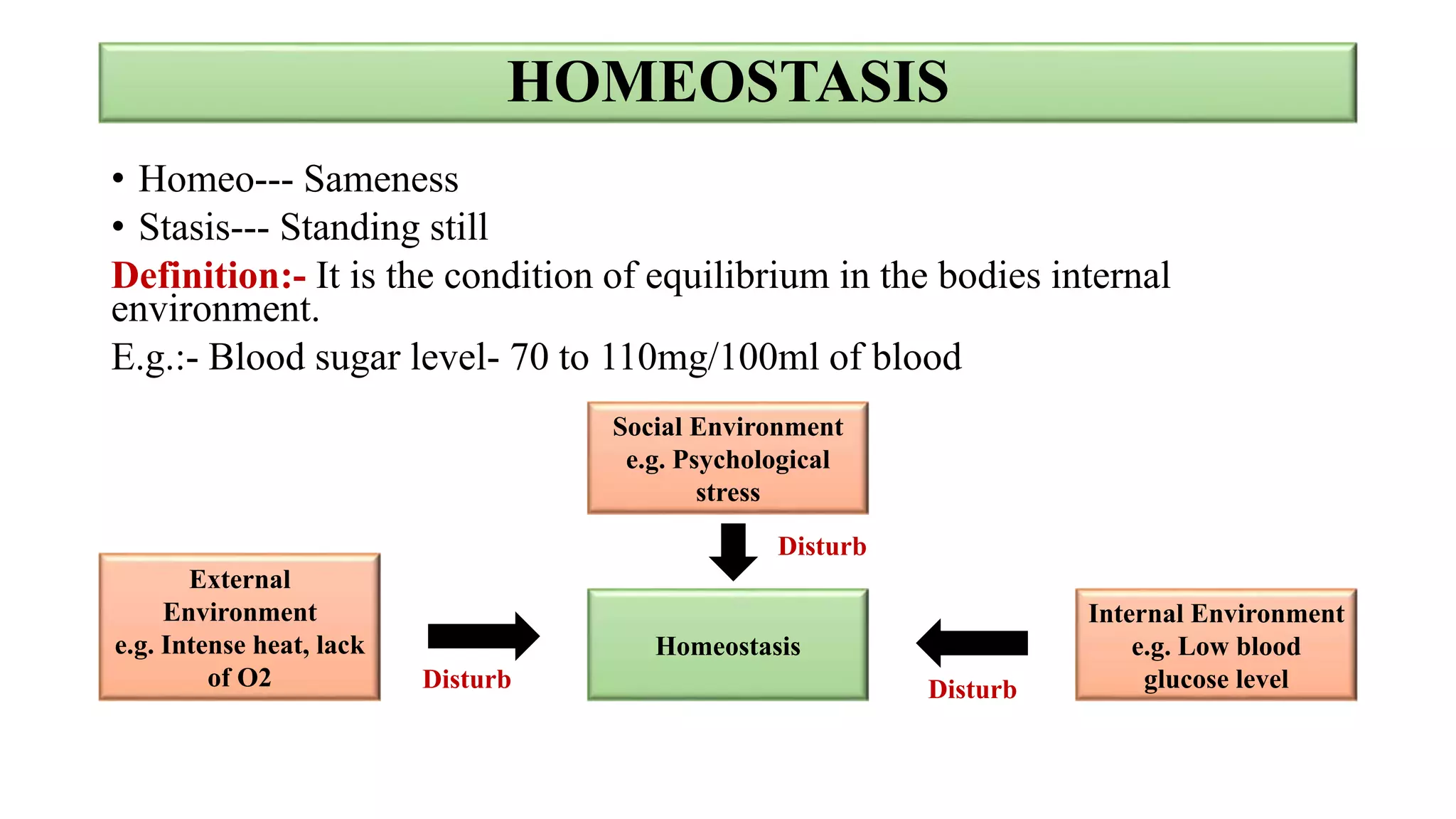
HOMEOSTASIS
• Homeo--- Sameness
• Stasis--- Standing still
Definition:- It is the condition of equilibrium in the bodies internal
environment.
E.g.:- Blood sugar level- 70 to 110mg/100ml of blood
Homeostasis
External
Environment
e.g. Intense heat, lack
of O2
Internal Environment
e.g. Low blood
glucose level
Social Environment
e.g. Psychological
stress
Disturb
Disturb
Disturb
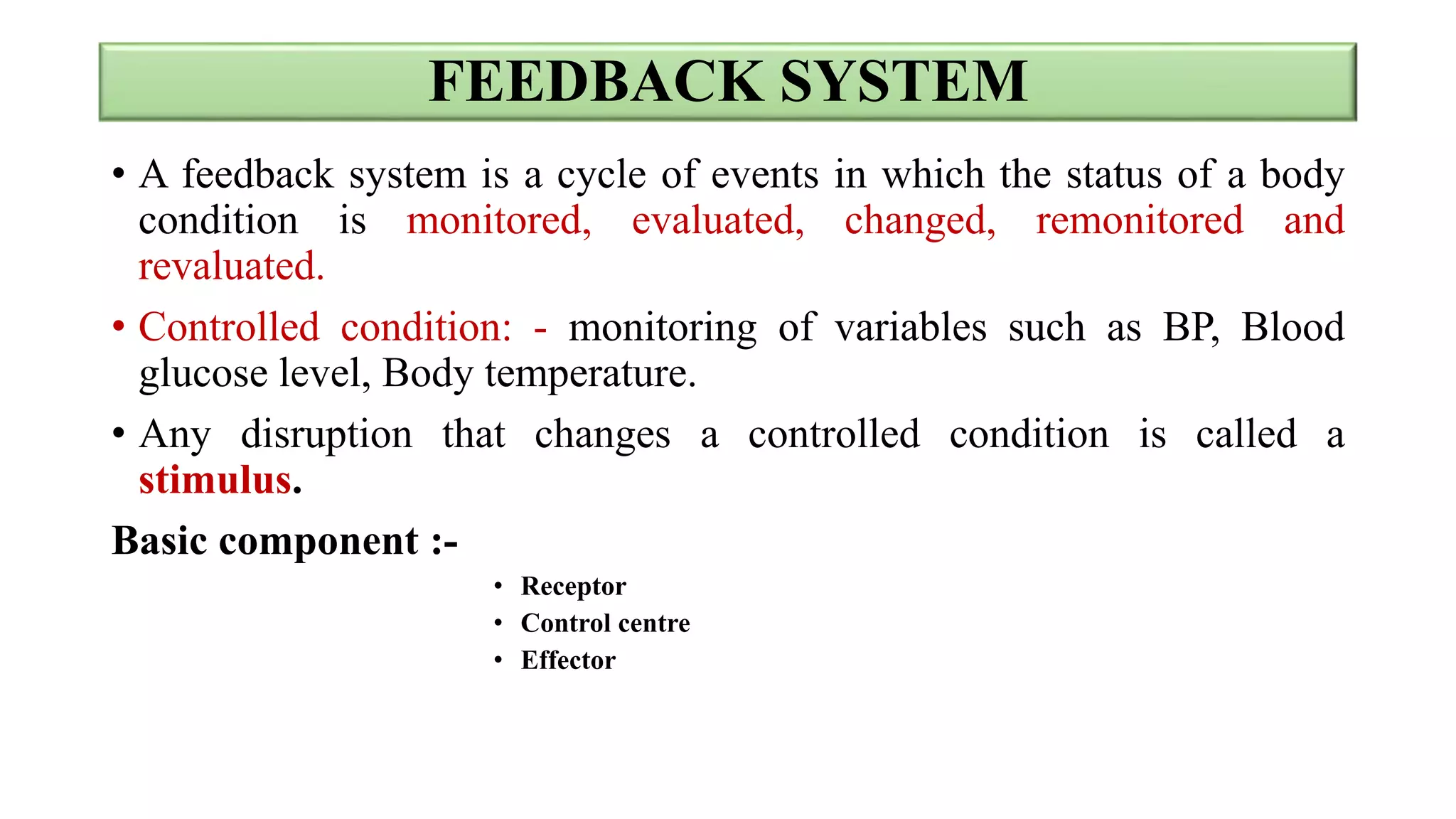
FEEDBACK SYSTEM
• A feedback system is a cycle of events in which the status of a body
condition is monitored, evaluated, changed, remonitored and
revaluated.
• Controlled condition: - monitoring of variables such as BP, Blood
glucose level, Body temperature.
• Any disruption that changes a controlled condition is called a
stimulus.
Basic component :-
• Receptor
• Control centre
• Effector
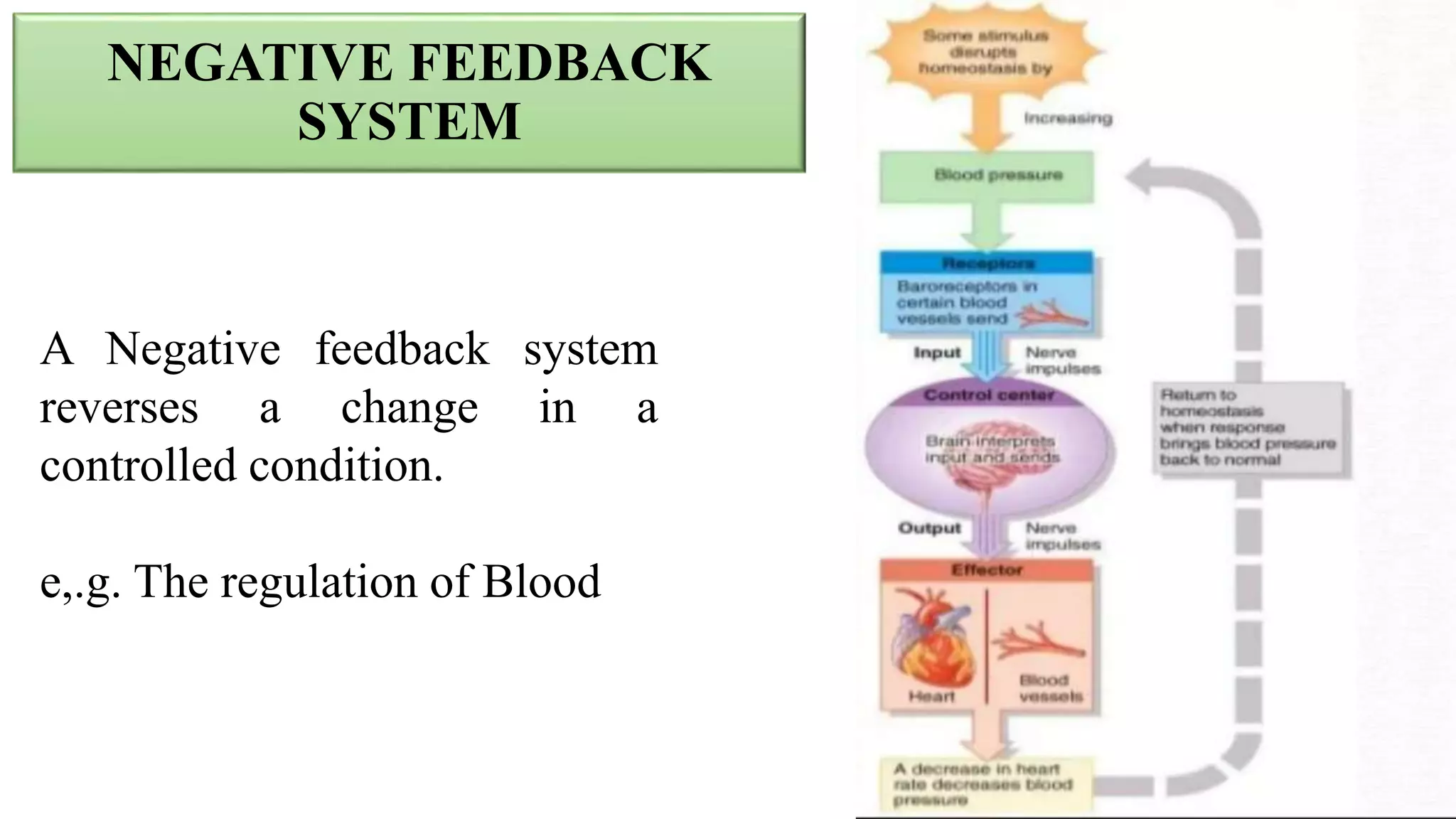
NEGATIVE FEEDBACK
SYSTEM
A Negative feedback system
reverses a change in a
controlled condition.
e,.g. The regulation of Blood
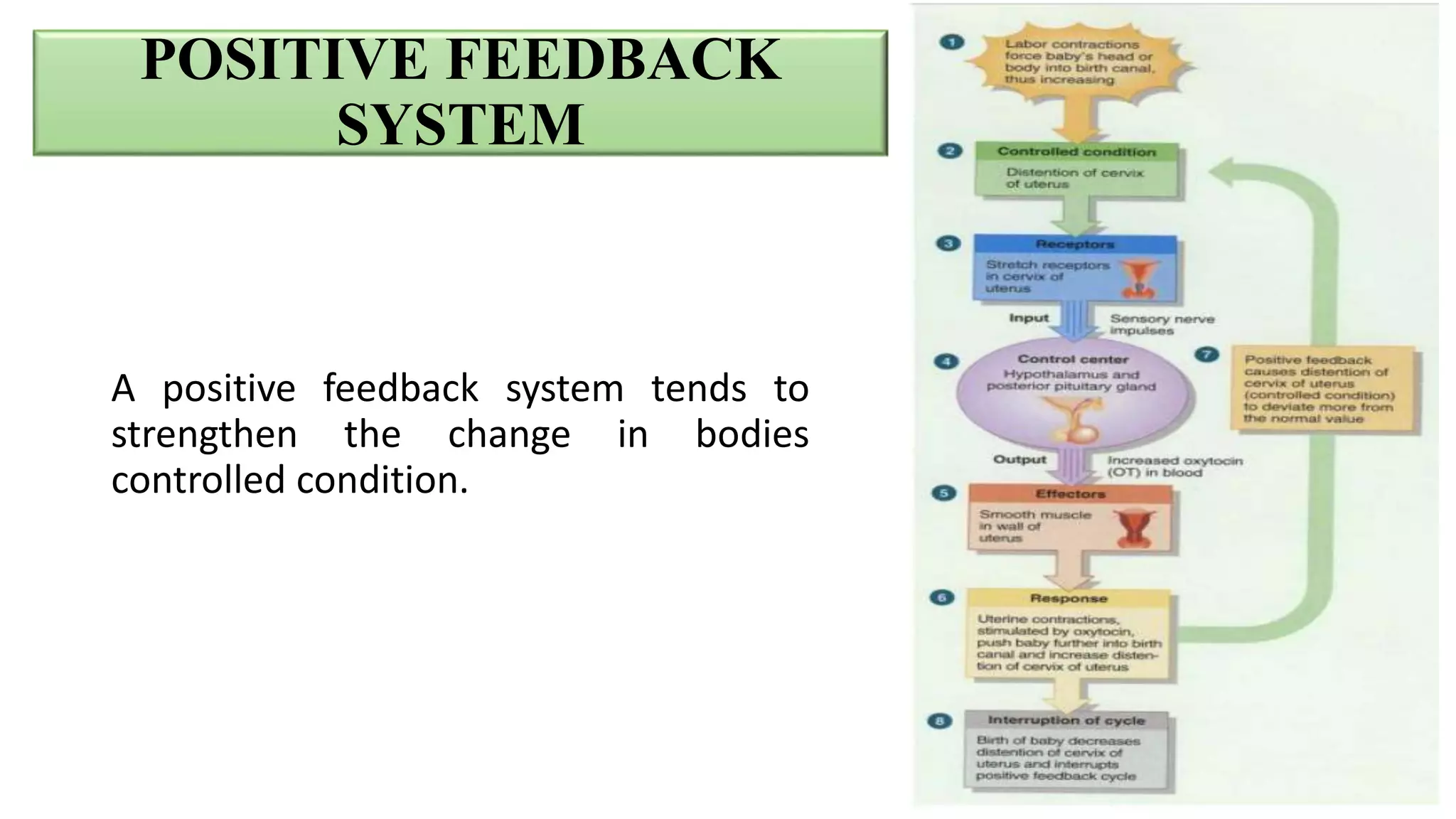
POSITIVE FEEDBACK
SYSTEM
A positive feedback system tends to
strengthen the change in bodies
controlled condition.
DEFINATIONS
• ANATOMICAL POSITION:- A position of the body in which the body is
erect, facing the observer, the upper extremities are at the sides, the
palms of hands are facing forward, and the feet are on the floor.
• ANTERIOR:- Nearer to or at the front of body. Also k/as ventral.
• APERTURE: - It is an opening or orifice.
• APEX: - Conical structure or pointed end.
• APPENDAGE: - Structure attached to the body.
• ARTICULATION: - Joint
• AXILLA:- Armpit
A
B
• BACK: - Posterior portion of body.
• BELLY: - Abdomen.
• BIFURCATE: - Possessing two branches.
• BILATERAL: - Two similar sides of body.
• BODY CAVITY: - It is a space within the body where the internal organs are
located.
C
• CANAL: - A narrow passageway, tube like structure.
• CEPHALIC: - Pertaining to the head; superior in position.
• CERVIX:- Neck, constricted portion of an organ.
• Corpus: - The principal part of any organ.
• Cortex : - Outer layer of any organ
• Cranium : - Skeleton of skull.
• Cutaneous: - Related to skin.
• Cytology: - Study of cell.
• Deep: - Away from body surface
• Deep fascia: - Connective tissue sheet wrapped around a muscle to
hold it in place.
• Developmental anatomy:-
• Distal: -Farther from the point of origin
• Dorsal body cavity:- Cavity near the dorsal surface of body
D
• Ectopic: - Other than the normal position.
• Effusion: - Leakage of fluid from lymphatic or blood vessels into cavity or
tissues.
• Elasticity: - Ability of a tissue to come back to its normal shape after
extension.
• Elevation: - Upward movement of body part.
• Exogenous: - When the origin is outside.
• Extension:- Increasing angle between two bones.
• Extrinsic: - Of external origin
• External : - Outside the body surface
E
• Fissure:- A fold, slit or groove.
• Flaccid:- Relaxed, soft, lacking muscle tone.
• Flatus:- Air in stomach or intestine.
• Flexion:- Folding movement where angle between two bones
decreases.
• Foramen:- An opening between two cavities or in a bone for passage
of blood vessels or nerves.
• Fossa:- A shallow depression.
• Fracture:- Breakage of a bone.
F
• Gamete:- Spermatozoon or ovum, i.e. male or female reproductive
cell.
• Genetics:- Study of heredity.
• Genitalia:- Reproductive organs.
• Gross anatomy:- Macroscopic study of structural features.
G
• Haematology:- Study of blood.
• Haemorrhage:- Bleeding.
• Haemostasis:- Stoppage of bleeding.
• Hernia:- Protrusion of an organ through a membrane or cavity wall.
• Hilus:- Also called hilum, it is area of depression through which blood vessels or
nerves enter or leave an organ.
• Histology:- Microscopic study of tissue structure.
• Homologous:- Correspondence of two organs in structure, position and origin.
• Horizontal plane:- Also called transverse plane, divides body or organs into superior
or inferior portion.
• Hypertrophy:- An excessive enlargement or out growth of tissue without cell
division.
H
• Inferior:- Towards the lower part of the structure.
• Insertion:- Attachment of a muscle tendon to a movable bone.
• Intermediate:- Between two structure.
• Intrinsic:- Of internal origin.
• In vitro:- Outside the living body.
• In vivo:- Inside the living body.
• Ischemia:- Lack of sufficient blood supply.
• Isotonic:- Having equal tension/ osmotic pressure.
I
• Lateral:- Farther from midline of body.
• Lesion:- Any local, abnormal change in tissue formation.
• Ligament:- Connective tissue attaching bone to bone.
• Lobe:- A curved or rounded portion.
L
• Meatus:- External opening of a canal.
• Medial:- Near midline of body.
• Median plane:- A vertical plane dividing body into right and left
halves.
• Medulla:- Inner part of organ.
• Midline:- An imaginary vertical line that divides body into right and
left halves.
• Myology:- Study of muscles.
M
• Oedema:- An abnormal accumulation of interstitial fluid at a particular
part.
• Orifice:- Opening.
• Origin:- Attachment of muscle tendon to a stationary bone.
• Osseous:- Bony.
• Ossicle:- Small bone.
• Ossification:- Bone formation.
• Otic:- About ear.
O
Reference
• Phate Rahul P., Anatomy Physiology and Health Education, Pharma
Career Publication, fourth edition, Feb 2019, Page no. 2-7.
• Ingawale D. K. , Mandlik S. K. , Human Anatomy and Physiology, Nirali
prakashan, 1st edition Sep 2017, Page no. 1.1-1.20
THANK YOU!

Scope of Anatomy and Physiology.pptx

  • 1.
    Scope of Anatomyand Physiology Presented By: - Asst. Prof. Miss. J. Y. Burade (Dr. Rajendra Gode College of Pharmacy, Amravati)
  • 2.
    Content • Anatomy • Physiology •Scope of anatomy & physiology • Level of structural organization • Basic life processes • Definition of different terminologies
  • 3.
    ANATOMY :- (Ana=up; To my= process of cutting) It is the science of body Structure and the relationship among them. PHYSIOLOGY :- ( Physio= nature; logy :- Study of) It is the science of body function i.e. how the body parts work? ANATOMY PHYSIOLOGY
  • 4.
    Scope of Anatomy IMAGING ANATOMY/ RADIOGRAPHIC ANATOMY DEVELOPMENTAL BIOLOGY SURFACEANATOMY REGIONALANATOMY SYSTEMIC ANATOMY GROSS ANATOMY PATHOLOGICAL ANATOMY CELL BIOLOGY HISTOLOGY EMBRYOLOGY
  • 5.
  • 6.
    LEVEL OF STRUCTURALORGANIZATION Letter----Word----Sentence----Paragraph----Chapter----Book SIX LEVEL OF STRUCTURAL ORGANIZATION CHEMICAL LEVEL CELLULAR LEVEL TISSUE LEVEL ORGAN LEVEL SYSTEM LEVEL ORGANISNAL LEVEL
  • 7.
    BASIC LIFE PROCESSES LIVINGNON-LIVING Reproduction Movement Growth Differentiation Metabolism Responsiveness 1. METABOLISM: - Sum of all chemical processes that occur in the body Catabolism:- Breaking down of complex chemical substance into smaller one. Anabolism:- Building up of a chemical substance from smaller one. E.g. :- AA+AA+AA Protein (Anabolism) Protein AA+AA+AA (Catabolism)
  • 8.
    2. RESPONSIVENESS:- Itis the body ability to detect and respond to change in its internal and external environment. E.g.:- Decrease in body temp--------Internal environment 3. MOVEMENT: - Include motion of the whole body, individual organ, single cell and even tiny structure inside the cell. 4. GROWTH: - Increase in body size Increase size of existing cell Increase no. of cells or Both
  • 9.
    5. DIFFERENTIATION:- Unspecialized cellSpecialized cell It is the process of a cell undergoes to develop from an unspecialized to specialized. E.g. Ovum Embryo Fetus Infant Child Adult 6. REPRODUCTION:- Formation of new cells The production of new individual
  • 10.
    SYSTEMS OF HUMANBODY 1. INTUGUMENTARY SYSTEM 2. MUSCULAR SYSTEM 3. SKELETAL SYSTEM 4. NERVOUS SYSTEM 5. ENDOCRINE SYSTEM 6. CARDIOVASCULAR SYSTEM 7. LYMPHATIC & IMMUNE SYSTEM 8. RESPIRATORY SYSTEM 9. DIGESTIVE SYSTEM 10. URINARY SYSTEM 11. REPRODUCTION SYSTEM 11 SYSTEMS
  • 11.
    BODY CAVITIES • Confidentialspace within the body where the internal organs are located. • Providing specific place and shape. • The body cavities separate, support and protect the organs placed there in. BODY CAVITIES THORACIC CAVITY PELVIC CAVITY CRANIAL CAVITY ABDOMINAL CAVITY
  • 13.
    BODY FLUID COMPARTMENT INTRACELLULAR FLUID EXTRACELULAR FLUID Sodium Chloride Bicarbonateions Glucose Fatty acids Amino acids Oxygen Potassium Magnesium Phosphate ions
  • 14.
    CONT… • Intracellular fluid(ICF):- Fluid within body cell. • Extracellular fluid (ECF):- Fluid outside body cell. • Interstitial fluid:- The ECF that fills the narrow space between the cell of tissues. Depending upon location ECF is :- 1. Within blood vessels is termed as – Blood plasma 2. Within lymphatic system is called as – Lymph 3. In and around the brain and spinal cord – Cerebrospinal fluid 4. In joints – Synovial fluid 5. In eye – Aqueous humor
  • 15.
    HOMEOSTASIS • Homeo--- Sameness •Stasis--- Standing still Definition:- It is the condition of equilibrium in the bodies internal environment. E.g.:- Blood sugar level- 70 to 110mg/100ml of blood Homeostasis External Environment e.g. Intense heat, lack of O2 Internal Environment e.g. Low blood glucose level Social Environment e.g. Psychological stress Disturb Disturb Disturb
  • 16.
    FEEDBACK SYSTEM • Afeedback system is a cycle of events in which the status of a body condition is monitored, evaluated, changed, remonitored and revaluated. • Controlled condition: - monitoring of variables such as BP, Blood glucose level, Body temperature. • Any disruption that changes a controlled condition is called a stimulus. Basic component :- • Receptor • Control centre • Effector
  • 18.
    NEGATIVE FEEDBACK SYSTEM A Negativefeedback system reverses a change in a controlled condition. e,.g. The regulation of Blood
  • 19.
    POSITIVE FEEDBACK SYSTEM A positivefeedback system tends to strengthen the change in bodies controlled condition.
  • 20.
    DEFINATIONS • ANATOMICAL POSITION:-A position of the body in which the body is erect, facing the observer, the upper extremities are at the sides, the palms of hands are facing forward, and the feet are on the floor. • ANTERIOR:- Nearer to or at the front of body. Also k/as ventral. • APERTURE: - It is an opening or orifice. • APEX: - Conical structure or pointed end. • APPENDAGE: - Structure attached to the body. • ARTICULATION: - Joint • AXILLA:- Armpit A
  • 21.
    B • BACK: -Posterior portion of body. • BELLY: - Abdomen. • BIFURCATE: - Possessing two branches. • BILATERAL: - Two similar sides of body. • BODY CAVITY: - It is a space within the body where the internal organs are located.
  • 22.
    C • CANAL: -A narrow passageway, tube like structure. • CEPHALIC: - Pertaining to the head; superior in position. • CERVIX:- Neck, constricted portion of an organ. • Corpus: - The principal part of any organ. • Cortex : - Outer layer of any organ • Cranium : - Skeleton of skull. • Cutaneous: - Related to skin. • Cytology: - Study of cell.
  • 23.
    • Deep: -Away from body surface • Deep fascia: - Connective tissue sheet wrapped around a muscle to hold it in place. • Developmental anatomy:- • Distal: -Farther from the point of origin • Dorsal body cavity:- Cavity near the dorsal surface of body D
  • 24.
    • Ectopic: -Other than the normal position. • Effusion: - Leakage of fluid from lymphatic or blood vessels into cavity or tissues. • Elasticity: - Ability of a tissue to come back to its normal shape after extension. • Elevation: - Upward movement of body part. • Exogenous: - When the origin is outside. • Extension:- Increasing angle between two bones. • Extrinsic: - Of external origin • External : - Outside the body surface E
  • 25.
    • Fissure:- Afold, slit or groove. • Flaccid:- Relaxed, soft, lacking muscle tone. • Flatus:- Air in stomach or intestine. • Flexion:- Folding movement where angle between two bones decreases. • Foramen:- An opening between two cavities or in a bone for passage of blood vessels or nerves. • Fossa:- A shallow depression. • Fracture:- Breakage of a bone. F
  • 26.
    • Gamete:- Spermatozoonor ovum, i.e. male or female reproductive cell. • Genetics:- Study of heredity. • Genitalia:- Reproductive organs. • Gross anatomy:- Macroscopic study of structural features. G
  • 27.
    • Haematology:- Studyof blood. • Haemorrhage:- Bleeding. • Haemostasis:- Stoppage of bleeding. • Hernia:- Protrusion of an organ through a membrane or cavity wall. • Hilus:- Also called hilum, it is area of depression through which blood vessels or nerves enter or leave an organ. • Histology:- Microscopic study of tissue structure. • Homologous:- Correspondence of two organs in structure, position and origin. • Horizontal plane:- Also called transverse plane, divides body or organs into superior or inferior portion. • Hypertrophy:- An excessive enlargement or out growth of tissue without cell division. H
  • 28.
    • Inferior:- Towardsthe lower part of the structure. • Insertion:- Attachment of a muscle tendon to a movable bone. • Intermediate:- Between two structure. • Intrinsic:- Of internal origin. • In vitro:- Outside the living body. • In vivo:- Inside the living body. • Ischemia:- Lack of sufficient blood supply. • Isotonic:- Having equal tension/ osmotic pressure. I
  • 29.
    • Lateral:- Fartherfrom midline of body. • Lesion:- Any local, abnormal change in tissue formation. • Ligament:- Connective tissue attaching bone to bone. • Lobe:- A curved or rounded portion. L
  • 30.
    • Meatus:- Externalopening of a canal. • Medial:- Near midline of body. • Median plane:- A vertical plane dividing body into right and left halves. • Medulla:- Inner part of organ. • Midline:- An imaginary vertical line that divides body into right and left halves. • Myology:- Study of muscles. M
  • 31.
    • Oedema:- Anabnormal accumulation of interstitial fluid at a particular part. • Orifice:- Opening. • Origin:- Attachment of muscle tendon to a stationary bone. • Osseous:- Bony. • Ossicle:- Small bone. • Ossification:- Bone formation. • Otic:- About ear. O
  • 32.
    Reference • Phate RahulP., Anatomy Physiology and Health Education, Pharma Career Publication, fourth edition, Feb 2019, Page no. 2-7. • Ingawale D. K. , Mandlik S. K. , Human Anatomy and Physiology, Nirali prakashan, 1st edition Sep 2017, Page no. 1.1-1.20
  • 33.