Session VI1
Dr Jyoti Prasad Pattnaik, MBBS
Session VI Topics
1. Basic life processes,
Metabolism, growth,
responsiveness,
differentiation,
movement,
reproduction.
2. Homeostasis.
Definition,
regulation, feedback
system. Disorders,
diseases and death.
Signs and Symptoms.
These are the topics we will discuss in this session.
2
Dr Jyoti Prasad Pattnaik, MBBS
Basic Life Processes
All living organisms have certain characteristics that
distinguish them from non-living forms. The basic processes of
life include organization, metabolism, responsiveness,
movements, and reproduction. In humans, who represent the
most complex form of life, there are additional requirements
such as growth, differentiation, respiration, digestion, and
excretion. All of these processes are interrelated. No part of the
body, from the smallest cell to a complete body system, works in
isolation. All function together, in fine-tuned balance, for the well
being of the individual and to maintain life. Disease such as
cancer and death represent a disruption of the balance in these
processes.
3
Dr Jyoti Prasad Pattnaik, MBBS
Metabolism
• Metabolism is the chemical process in which different
types of chemical reactions are involved in controlling
the living state of the cells in an organism. It is broadly
classified into catabolism and anabolism.
• Catabolism: The metabolic process in which energy is
released.
• Anabolism: The metabolic process in which energy is
stored for further requirements.
4
Dr Jyoti Prasad Pattnaik, MBBS
Growth and Development
• All living things, including humans, grow and
develop in the patterns determined by their
DNA. Growth occurs because cells grow larger
or because cells increase in numbers. In higher
life forms like humans, as the cells multiply,
they also change or differentiate. For example,
some cells become skin cells while others
become bone, muscle or other specialized
cells.
5
Dr Jyoti Prasad Pattnaik, MBBS
Responsiveness
• Responsiveness or irritability is concerned with
detecting changes in the internal or external
environments and reacting to that change. It is the
act of sensing a stimulus and responding to it.
6
Dr Jyoti Prasad Pattnaik, MBBS
Differentiation
• Differentiation is a developmental process by
which unspecialized cells change into
specialized cells with distinctive structural and
functional characteristics. Through
differentiation, cells develop into tissues and
organs.
7
Dr Jyoti Prasad Pattnaik, MBBS
Movement
• There are many types of movement within the body.
On the cellular level, molecules move from one
place to another. Blood moves from one part of the
body to another. The diaphragm moves with every
breath. The ability of muscle fibers to shorten and
thus to produce movement is called contractility.
8
Dr Jyoti Prasad Pattnaik, MBBS
Reproduction
• For most people, reproduction refers to the
formation of a new person, the birth of a baby. In
this way, life is transmitted from one generation to
the next through reproduction of the organism. In a
broader sense, reproduction also refers to the
formation of new cells for the replacement and
repair of old cells as well as for growth. This is
cellular reproduction. Both are essential to the
survival of the human race.
9
Dr Jyoti Prasad Pattnaik, MBBS
Homeostasis
• Homeostasis is the ability to maintain a relatively
stable internal state that persists despite changes in
the world outside. All living organisms, from plants
to puppies to people, must regulate their internal
environment to process energy and ultimately
survive.
10
Dr Jyoti Prasad Pattnaik, MBBS
Homeostasis
• Homeostasis is the state of steady internal, physical,
and chemical conditions maintained by living systems.
This is the condition of optimal functioning for the
organism and includes many variables, such as body
temperature and fluid balance, being kept within
certain pre-set limits (homeostatic range). Other
variables include the pH of extracellular fluid, the
concentrations of sodium, potassium and calcium ions,
as well as that of the blood sugar level, and these need
to be regulated despite changes in the environment,
diet, or level of activity. Each of these variables is
controlled by one or more regulators or homeostatic
mechanisms, which together maintain life.
11
Dr Jyoti Prasad Pattnaik, MBBS
Maintaining Homeostasis
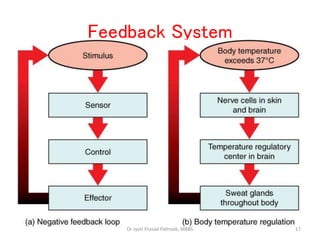
• Homeostasis is normally maintained in the human body by an extremely
complex balancing act. Regardless of the variable being kept within its
normal range, maintaining homeostasis requires at least four interacting
components: stimulus, sensor, control center, and effector.
• The stimulus is provided by the variable that is being regulated. Generally,
the stimulus indicates that the value of the variable has moved away from the
set point or has left the normal range.
• The sensor monitors the values of the variable and sends data on it to the
control center.
• The control center matches the data with normal values. If the value is not
at the set point or is outside the normal range, the control center sends a
signal to the effector.
• The effector is an organ, gland, muscle, or other structure that acts on the
signal from the control center to move the variable back toward the set point.
12
Dr Jyoti Prasad Pattnaik, MBBS
Defect in Homeostasis
Many diseases are the result of a homeostatic failure.
Almost any homeostatic component can malfunction either as a
result of an inherited defect, an inborn error of metabolism, or an
acquired disease. Some homeostatic mechanisms have inbuilt
redundancies, which ensures that life is not immediately
threatened if a component malfunctions; but sometimes a
homeostatic malfunction can result in serious disease, which
can be fatal if not treated. A well-known example of a
homeostatic failure is shown in type 1 diabetes mellitus. Here
blood sugar regulation is unable to function because the beta
cells of the pancreatic islets are destroyed and cannot produce
the necessary insulin. The blood sugar rises in a condition
known as hyperglycemia.
13
Dr Jyoti Prasad Pattnaik, MBBS
Disorder, Disease and Death
Disorder : When something is not working in orderly
manner
Disease : When the body is not in comfort or ease
due to change in its internal / external environment
Death : When the organism fails to show signs of life
14
Dr Jyoti Prasad Pattnaik, MBBS
Signs and Symptoms
Signs and symptoms are abnormalities that can
indicate a potential medical condition.
Whereas a symptom is subjective, that is,
apparent only to the patient (for example back pain or
fatigue),
a sign is any objective evidence of a disease
that can be observed by others (for example a skin
rash or lump).
15
Dr Jyoti Prasad Pattnaik, MBBS
Feedback system
• Feedback systems function with the help of the nervous
and endocrine systems. While nerve cells detect
changes in the body and quickly respond to the brain
for a rapid response, hormones of the endocrine
system regulate the system more slowly.
• The body uses feedback systems to control certain
functions. ... A feedback system uses one of the
products of a pathway, usually the end product, to
control the activity of the pathway and to regulate the
amount of that product. Feedback control may be
positive or negative.
16
Dr Jyoti Prasad Pattnaik, MBBS
Feedback System
17
Dr Jyoti Prasad Pattnaik, MBBS
Negative Feedback System
Feedback control or regulation can be either negative or
positive. With negative feedback, the activity of a system is
reduced, slowed down or minimized by the presence of high
amounts of a substance it produces. An example is the
increased breathing resulting from the presence of high levels of
carbon dioxide in extracellular fluids. The purpose of breathing
is to provide the oxygen required by the body for its functioning
(metabolism ) and to eliminate waste carbon dioxide. In the
presence of high levels of carbon dioxide, breathing increases,
which increases the supply of oxygen present in the air of the
lungs, thus counteracting the high amounts of carbon dioxide,
which are harmful to the body.
18
Dr Jyoti Prasad Pattnaik, MBBS
Positive Feedback System
With positive feedback, the activity of a system is
increased by the presence of high amounts of a
substance it produces. Positive feedback systems thus
speed up or maximize the rates of processes. For
example, they are used in the production of nerve
impulses and blood clotting. In the above example, labor
contractions are a positive feedback system. As oxytocin
reaches the uterus, causing contractions, more stretching
causes an increase in oxytocin levels, which causes more
forceful contractions.
19
Dr Jyoti Prasad Pattnaik, MBBS
• Types of tissue and their origin,
• Epithelial tissue,
– cells, types, functions,
• connective tissue,
– cells, characteristics, functions
Session VII Topics
These are the topics we will discuss in the next
session of HAP, so come prepared.
20
Dr Jyoti Prasad Pattnaik, MBBS

Human Anatomy and Physiology : Basic Life process, Homeostasis

  • 1.
    Session VI1 Dr JyotiPrasad Pattnaik, MBBS
  • 2.
    Session VI Topics 1.Basic life processes, Metabolism, growth, responsiveness, differentiation, movement, reproduction. 2. Homeostasis. Definition, regulation, feedback system. Disorders, diseases and death. Signs and Symptoms. These are the topics we will discuss in this session. 2 Dr Jyoti Prasad Pattnaik, MBBS
  • 3.
    Basic Life Processes Allliving organisms have certain characteristics that distinguish them from non-living forms. The basic processes of life include organization, metabolism, responsiveness, movements, and reproduction. In humans, who represent the most complex form of life, there are additional requirements such as growth, differentiation, respiration, digestion, and excretion. All of these processes are interrelated. No part of the body, from the smallest cell to a complete body system, works in isolation. All function together, in fine-tuned balance, for the well being of the individual and to maintain life. Disease such as cancer and death represent a disruption of the balance in these processes. 3 Dr Jyoti Prasad Pattnaik, MBBS
  • 4.
    Metabolism • Metabolism isthe chemical process in which different types of chemical reactions are involved in controlling the living state of the cells in an organism. It is broadly classified into catabolism and anabolism. • Catabolism: The metabolic process in which energy is released. • Anabolism: The metabolic process in which energy is stored for further requirements. 4 Dr Jyoti Prasad Pattnaik, MBBS
  • 5.
    Growth and Development •All living things, including humans, grow and develop in the patterns determined by their DNA. Growth occurs because cells grow larger or because cells increase in numbers. In higher life forms like humans, as the cells multiply, they also change or differentiate. For example, some cells become skin cells while others become bone, muscle or other specialized cells. 5 Dr Jyoti Prasad Pattnaik, MBBS
  • 6.
    Responsiveness • Responsiveness orirritability is concerned with detecting changes in the internal or external environments and reacting to that change. It is the act of sensing a stimulus and responding to it. 6 Dr Jyoti Prasad Pattnaik, MBBS
  • 7.
    Differentiation • Differentiation isa developmental process by which unspecialized cells change into specialized cells with distinctive structural and functional characteristics. Through differentiation, cells develop into tissues and organs. 7 Dr Jyoti Prasad Pattnaik, MBBS
  • 8.
    Movement • There aremany types of movement within the body. On the cellular level, molecules move from one place to another. Blood moves from one part of the body to another. The diaphragm moves with every breath. The ability of muscle fibers to shorten and thus to produce movement is called contractility. 8 Dr Jyoti Prasad Pattnaik, MBBS
  • 9.
    Reproduction • For mostpeople, reproduction refers to the formation of a new person, the birth of a baby. In this way, life is transmitted from one generation to the next through reproduction of the organism. In a broader sense, reproduction also refers to the formation of new cells for the replacement and repair of old cells as well as for growth. This is cellular reproduction. Both are essential to the survival of the human race. 9 Dr Jyoti Prasad Pattnaik, MBBS
  • 10.
    Homeostasis • Homeostasis isthe ability to maintain a relatively stable internal state that persists despite changes in the world outside. All living organisms, from plants to puppies to people, must regulate their internal environment to process energy and ultimately survive. 10 Dr Jyoti Prasad Pattnaik, MBBS
  • 11.
    Homeostasis • Homeostasis isthe state of steady internal, physical, and chemical conditions maintained by living systems. This is the condition of optimal functioning for the organism and includes many variables, such as body temperature and fluid balance, being kept within certain pre-set limits (homeostatic range). Other variables include the pH of extracellular fluid, the concentrations of sodium, potassium and calcium ions, as well as that of the blood sugar level, and these need to be regulated despite changes in the environment, diet, or level of activity. Each of these variables is controlled by one or more regulators or homeostatic mechanisms, which together maintain life. 11 Dr Jyoti Prasad Pattnaik, MBBS
  • 12.
    Maintaining Homeostasis • Homeostasisis normally maintained in the human body by an extremely complex balancing act. Regardless of the variable being kept within its normal range, maintaining homeostasis requires at least four interacting components: stimulus, sensor, control center, and effector. • The stimulus is provided by the variable that is being regulated. Generally, the stimulus indicates that the value of the variable has moved away from the set point or has left the normal range. • The sensor monitors the values of the variable and sends data on it to the control center. • The control center matches the data with normal values. If the value is not at the set point or is outside the normal range, the control center sends a signal to the effector. • The effector is an organ, gland, muscle, or other structure that acts on the signal from the control center to move the variable back toward the set point. 12 Dr Jyoti Prasad Pattnaik, MBBS
  • 13.
    Defect in Homeostasis Manydiseases are the result of a homeostatic failure. Almost any homeostatic component can malfunction either as a result of an inherited defect, an inborn error of metabolism, or an acquired disease. Some homeostatic mechanisms have inbuilt redundancies, which ensures that life is not immediately threatened if a component malfunctions; but sometimes a homeostatic malfunction can result in serious disease, which can be fatal if not treated. A well-known example of a homeostatic failure is shown in type 1 diabetes mellitus. Here blood sugar regulation is unable to function because the beta cells of the pancreatic islets are destroyed and cannot produce the necessary insulin. The blood sugar rises in a condition known as hyperglycemia. 13 Dr Jyoti Prasad Pattnaik, MBBS
  • 14.
    Disorder, Disease andDeath Disorder : When something is not working in orderly manner Disease : When the body is not in comfort or ease due to change in its internal / external environment Death : When the organism fails to show signs of life 14 Dr Jyoti Prasad Pattnaik, MBBS
  • 15.
    Signs and Symptoms Signsand symptoms are abnormalities that can indicate a potential medical condition. Whereas a symptom is subjective, that is, apparent only to the patient (for example back pain or fatigue), a sign is any objective evidence of a disease that can be observed by others (for example a skin rash or lump). 15 Dr Jyoti Prasad Pattnaik, MBBS
  • 16.
    Feedback system • Feedbacksystems function with the help of the nervous and endocrine systems. While nerve cells detect changes in the body and quickly respond to the brain for a rapid response, hormones of the endocrine system regulate the system more slowly. • The body uses feedback systems to control certain functions. ... A feedback system uses one of the products of a pathway, usually the end product, to control the activity of the pathway and to regulate the amount of that product. Feedback control may be positive or negative. 16 Dr Jyoti Prasad Pattnaik, MBBS
  • 17.
    Feedback System 17 Dr JyotiPrasad Pattnaik, MBBS
  • 18.
    Negative Feedback System Feedbackcontrol or regulation can be either negative or positive. With negative feedback, the activity of a system is reduced, slowed down or minimized by the presence of high amounts of a substance it produces. An example is the increased breathing resulting from the presence of high levels of carbon dioxide in extracellular fluids. The purpose of breathing is to provide the oxygen required by the body for its functioning (metabolism ) and to eliminate waste carbon dioxide. In the presence of high levels of carbon dioxide, breathing increases, which increases the supply of oxygen present in the air of the lungs, thus counteracting the high amounts of carbon dioxide, which are harmful to the body. 18 Dr Jyoti Prasad Pattnaik, MBBS
  • 19.
    Positive Feedback System Withpositive feedback, the activity of a system is increased by the presence of high amounts of a substance it produces. Positive feedback systems thus speed up or maximize the rates of processes. For example, they are used in the production of nerve impulses and blood clotting. In the above example, labor contractions are a positive feedback system. As oxytocin reaches the uterus, causing contractions, more stretching causes an increase in oxytocin levels, which causes more forceful contractions. 19 Dr Jyoti Prasad Pattnaik, MBBS
  • 20.
    • Types oftissue and their origin, • Epithelial tissue, – cells, types, functions, • connective tissue, – cells, characteristics, functions Session VII Topics These are the topics we will discuss in the next session of HAP, so come prepared. 20 Dr Jyoti Prasad Pattnaik, MBBS