


UNIT II
INTRODUCTION TO THE DETAILED
STRUCTURE OF THE HUMAN BODY
SUBMITTED TO
MRS. JISHA S.
PRINCIPAL,
ST. CATHERINE’S HOSPITAL
& SCHOOL OF NURSING
SUBMITTED BY
MR. EARNEST LAMUEL
NURSING TUTOR,
ST. CATHERINE’S HOSPITAL
& SCHOOL OF NURSING
THE CELL – STRUCTURE,
FUNCTION &
REPRODUCTION
CELL
The smallest functional unit of our body is the cell. It was
Robert Hook who first coined the term ‘cell’ in 1665. The
size of a cell can vary from a minimum of 6 micrometre
to a maximum of 80 micrometre.
The study of cells is called ‘Cytology’ and the study of
tissues is called ‘Histology’
STRUCTURE
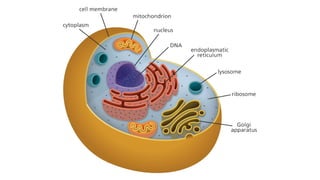
A eukaryotic cell consists of the following structures-
• A cell membrane or plasma membrane, which is
impermeable to large molecules like ions and
metabolites.
• A nucleus which contains the genetic machinery.
• Cytoplasm and the organelles
FUNCTIONS
•PROVIDE STRUCTURE
AND SUPPORT
•FACILITATE GROWTH
THROUGH MITOSIS
•ALLOW PASSIVE AND
ACTIVE TRANSPORT
•PRODUCE ENERGY
•CREATE METABOLIC
REACTIONS
•AIDS IN
REPRODUCTION
CELL MEMBRANE
The cell membrane is a protective sheath that envelops the cell
body. It separates the fluid outside the cell called ‘extracellular
fluid’ and the fluid inside the cell called ‘intracellular fluid’. It is a
semipermeable membrane and allows free exchange of certain
substances between ECF and ICF.
STRUCTURE
When examined by electronic microscope, the average cell
membrane is seen to be about 7.5 nm thick. It consists of two
densely stained layers separated by a lighter zone, thus creating
a trilaminar appearance.
FUNCTIONS
• Protective function – Cell membrane protects the cytoplasm
and the organelles present in the cytoplasm.
• Selective permeability – cell membrane acts as a substances
semipermeable membrane which allows only some
substances to pass through it and acts as a barrier for other
substances.
• Absorptive function – Nutrients are absorbed into the cell
through the cell membrane
FUNCTIONS
• Excretory function – Metabolites and other waste products
from the cell are excreted out through the cell membrane
• Exchange of gases – Oxygen enters the cell from the blood
and carbon dioxide leaves the cell and enters the blood
through the cell membrane.
• Maintenance of shape and size of the cell – Cell membrane is
responsible for the maintenance of shape and size of the cell
COMPOSITION
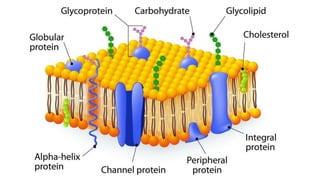
The cell membrane is composed of three types of substances
• Proteins (55%)
• Lipids (40%)
• Carbohydrates (5%)
PROTEINS
The protein layers of the cell membrane are the electron dense
layers situated on either side of the central lipid layer. The protein
substances present in these layers are mostly glycoproteins. These
protein molecules are classified into two categories
• Integral proteins
• Peripheral proteins
FUNCTIONS
• Integral proteins serve as receptors which bind with various
hormones.
• Integral proteins help in the transport of substances across
the cell membrane. They serve as pores and channels
through which water and water-soluble ions can diffuse
freely.
• Some integral proteins serve as carrier proteins which can
facilitate transport of certain molecules across the membrane
LIPIDS
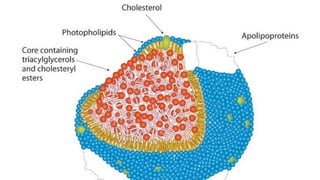
The trilaminar structure of membranes is produced by the
arrangement of lipid molecules that constitute the basic
framework of the membrane. The major lipids in cell membrane
are –
• Phospholipid
• Cholesterol
FUNCTIONS
The lipid layer is semipermeable in nature and allows only the
fat-soluble substances like oxygen, carbon dioxide and alcohol
to pass through it. It does not allow the water-soluble materials
like glucose, urea and electrolytes to pass through it.
CARBOHYDRATES
Carbohydrate molecules form a thin loose covering over the
entire surface of the cell membrane called ‘glycocalyx’. Some
carbohydrate molecules are attached with proteins and form
‘glycoproteins’ and some are attached with lipids and form
‘glycolipids’.
FUNCTIONS
• The carbohydrate molecules are negatively charged
substances and do not permit the negatively charged
substances to move in and out of the cell.
• The glycocalyx from the neighbouring cells helps in
the tight fixation of cells with one another.
• Some of the carbohydrate molecules form the
receptors for some hormones.
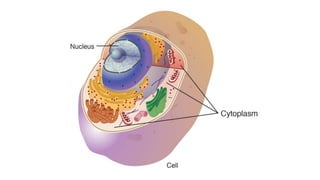
CYTOPLASM
The cytoplasm is the fluid present inside the cell. It contains a clear
liquid portion called ‘cytosol’ which contains various substances like
proteins, carbohydrates, lipids and electrolytes. Apart from these
substances, many organelles are also present in cytoplasm. The
cytoplasm is distributed as peripheral ectoplasm just beneath the
cell membrane and inner endoplasm between the ectoplasm and
the nucleus.
FUNCTIONS
• Most of the important activities of the cell occur in the cytoplasm.
Cytoplasm contains molecules such as enzymes which are responsible
for breaking down waste and also aid in metabolic activity.
• Cytoplasm is responsible for giving a cell its shape. It helps to fill out
the cell and keeps organelles in their place. Without cytoplasm, the cell
would be deflated and materials would not be able to pass easily from
one organelle to another.
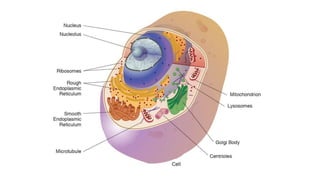
CELL ORGANELLES
We have seen that the cytoplasm of a typical cell contains various
structures that are referred to as organelles. They include the
endoplasmic reticulum, ribosomes, mitochondria, the Golgi
complex, the various types of vesicles. The cytosol also contains a
cytoskeleton made up of microtubules, microfilaments and
intermediate filaments.
ENDOPLASMIC RETICULUM
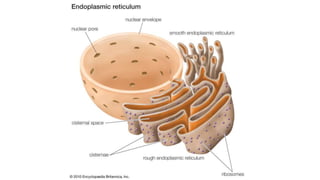
Endoplasmic reticulum is made up of tubules and microsomal
vesicles. These structures form an interconnected network which
acts as the link between the organelles and cell membrane. It is of
two types
• Rough Endoplasmic Reticulum
• Smooth Endoplasmic Reticulum
FUNCTIONS
• Rough endoplasmic reticulum is concerned with synthesis of
proteins.
• Smooth endoplasmic reticulum lacks ribosomes and is concerned
with the synthesis of lipids, steroids, cholesterol and carbohydrates.
It acts as a surface for the attachment of many enzymes systems
and helps in detoxifying drugs, alcohol, metabolic by-product, etc.
• Highly specialized endoplasmic reticulum is present in some cells. In
strained muscle cells, where it is called ‘sarcoplasmic reticulum’ it is
involved, it is involved in the storage and release of Ca2+ it initiate
muscle contraction.
GOLGI APPARATUS
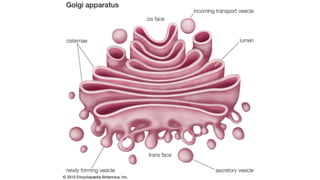
Golgi apparatus is present in all the cells except red blood cells. It consists
of 5 to 8 flattened membranous sacs called ‘cisternae’. The Golgi apparatus
is situated near the nucleus. It has two ends or faces namely, cis face and
trans face. This cis face is positioned near the endoplasmic reticulum. The
reticular vesicles from endoplasmic reticulum enter the Golgi apparatus
through cis face. The trans face is situated near the cell membrane. The
processed substances make their exit from Golgi apparatus though trans
face.
FUNCTIONS
• It is concerned with the processing and delivery of
substances like proteins and lipids to different parts of the
cell.
• It functions like a post office because, it packs the processed
materials into the secretory granules, secretory vesicles, and
lysosomes and dispatch them either out of the cell or to
another part of the cell.
• It also functions like a shipping department of the cell
because it sorts out and labels the materials for distribution
to their proper destinations.
MITOCHONDRIA
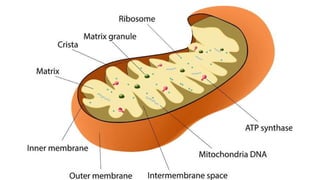
Mitochondria are membrane bound organelles and are called the power-
generating units of the cell. Each mitochondrion consists of two layers of
membrane.
• An outer smooth membrane, which contains many pores, allowing free
passage of small molecules.
• An inner membrane, which is thrown into folds that increase the surface
area.
FUNCTIONS
• It is the chief site of tricarboxylic acid cycle, electron transport chain
and fatty acid metabolism
• Release of energy from ATP and guanosine triphosphate (GTP)
• It contains Ca2+
CYTOSKELETON
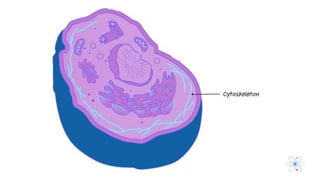
The cytoskeleton of the cell is a complex network that gives shape, support
and stability to the cell. It is also essential for the cellular movements and
the response of the cell to external stimuli. The cytoskeleton consists of
three major protein componets
• Microtubules
• Intermediate filaments
• microfilaments
FUNCTIONS
• As the name implies, a cytoskeleton is the frame that gives shape to a cell. Just
like in a human being, the skeleton also helps hold all of the organelles
(organs, in people) in place. Finally, it also assists in moving materials in and
out of the cell.
• Through a series of intercellular proteins, the cytoskeleton gives a cell its
shape, offers support, and facilitates movement through three main
components. The cytoskeleton helps the cell move in its environment and
controls the movement of all of the cell's interior workings.
• The microtubules have three different functions which contribute to the job of
the cytoskeleton. They make up the centrioles in a cell, they are the base of
both the flagella and cilia of a cell, and they function as the pathway that the
transport vesicles move along.
NUCLEUS
Nucleus is present in those cells which divide and produce enzymes. The
cells with nucleus are called eukaryotes and those without nucleus are
known as prokaryotes. Prokaryotes do not divide or synthesize the
enzymes. Most of the cells have only one nucleus. Few types of cells like
skeletal muscle cells have many nuclei. Generally the nucleus is located near
the center of the cell. It is mostly spherical in shape. However, the shape
and situation of nucleus vary in different cells.
FUNCTIONS
• Controls all the activities of the cell
• Synthesizes RNA
• Forms subunits of ribosomes
• Sends genetic instruction to the cytoplasm for protein synthesis
through messenger RNA
• Controls the cell division through genes
• Stores the hereditary information and transforms this information
from one generation of the species to the next.
NUCLEAR COMPONENTS
• Nuclear membrane
• Nucleoplasm
• Nucleolus
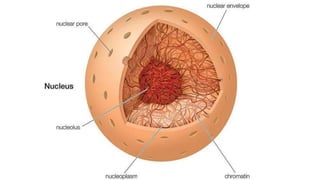
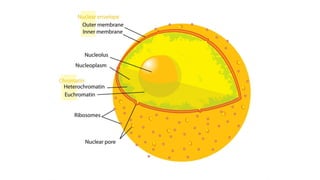
NUCLEAR MEMBRANE
The nucleus is covered by a double layered membrane called
nuclear membrane. It encloses the fluid called nucleoplasm.
Nuclear membrane is porous and permeable in nature and it
allows nucleoplasm to communicable with the cytoplasm.
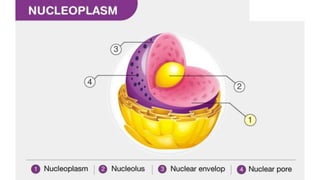
NUCLEOPLASM
It is a gel like ground substance and contains large quantities of
the genetic material in the form of DNA. The DNA is made up
of chromatin threads. These chromatin threads become the rod
shaped chromosomes just before the cell division.
NUCLEOLI
One or more nucleoli are present in each nucleus. The nucleolus
contains RNA and some proteins, which are similar to those
found in ribosomes. The RNA is synthesized by chromosomes
and stored in the nucleolus.
TISSUES INCLUDING
MEMBRANES AND GLANDS
– TYPES, STRUCTURE AND
FUNCTIONS
PRIMARY TISSUES
A tissue is defined as a collection of cells and associated
intercellular materials specialized for a particular function of
functions.
CLASSIFICATION
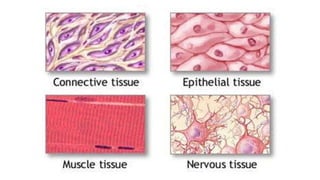
There are four primary tissues in the body
• Epithelial tissue
• Connective tissue
• Muscular tissue
• Nervous tissue
EPITHELIAL TISSUE
Epi – above, Thelos – nipple, Epithelium – covering of nipple.
This term originally referred to the cellular covering of the
nipple. It is a layer or layers of cells that covers the outer surface
of the body or line the luminal surface of tubular structure and
cavities.
CLASSIFICATION
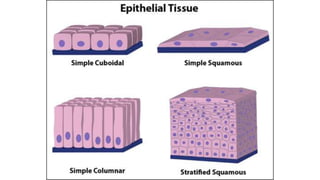
• Simple epithelium
• Squamous epithelium
• Cuboidal epithelium
• Columnar epithelium
• Pseudostratified
epithelium
• Stratified epithelium
• Transitional epithelium
FUNCTIONS
• Protection
• Absorption
• Filtration
• Secretion
• Sensory reception
CONNECTIVE TISSUE
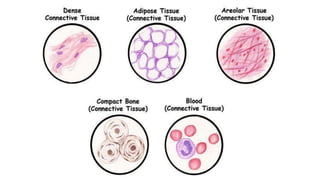
The term connective tissue is applied to a tissue that fills the
interstices between more specified element. Connective tissue
serves to hold together, and to support, different elements within
an organ. For this reason, such connective tissue is to be found in
almost every part of the body. It is conspicuous in some regions and
scanty in others. This kind of connective tissue is referred to as
general connective tissue.
FUNCTIONS
• Storage of energy
• Protection of organs
• Provision of structural
framework for the body
• Connection of body tissues
(muscle to bones)
• Connection of epithelial
tissues to muscle fibres
• Supply of hormone all over
the body
• Nutritional support to
epithelium
• Site of defence reaction
• Helps in repair of injuries
COMPONENTS
• Fibers –
o Collagen fibres
o Reticular fibres
o Elastic fibres
• Cells –
o Fibroblasts
o Macrophages
o Fat cells
o Undifferentiated
mesenchymal cells
o Pigment cells
o Blood leukocytes
o Mast cells
• Intracellular
Ground substance
TYPES
• Loose areolar
connective
tissue
• Dense
collagenous
connective
tissue
o Dense regular
connective tissue
o Dense Irregular
connective tissue
• Connective
tissue with
special
properties
o Elastic tissue
o Reticular tissue
o Mucoid tissue
o Adipose tissue
MUSCULAR TISSUE
Muscle tissue is a soft tissue that composes muscles and gives rise to
muscles' ability to contract. It is formed during embryonic
development through a process known as myogenesis.
The muscular tissue is organised to form the musculature of the body. It
helps in the movements of various parts of the body.
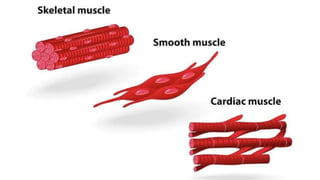
TYPES
• Smooth muscle tissue
• Cardiac muscle tissue
• Skeletal muscle tissue
STRUCTURE
Muscle tissue is an elongated tissue ranging from several millimetres to
about 10 centimetres in length and from 10 to 100 micrometres in width.
These cells are joined together in tissues that may be either striated or
smooth, depending on the presence or absence, respectively, of
organized, regularly repeated arrangements of myofibrillar contractile
proteins called myofilaments.
FUNCTIONS
• The main function of the muscular system is movement. Muscles are the only tissue in the body
that has the ability to contract and therefore move the other parts of the body.
• Related to the function of movement is the muscular system’s second function: the maintenance of
posture and body position. Muscles often contract to hold the body still or in a particular position
rather than to cause movement. The muscles responsible for the body’s posture have the greatest
endurance of all muscles in the body—they hold up the body throughout the day without
becoming tired.
• Another function related to movement is the movement of substances inside the body. The cardiac
and visceral muscles are primarily responsible for transporting substances like blood or food from
one part of the body to another.
• The final function of muscle tissue is the generation of body heat. As a result of the high metabolic
rate of contracting muscle, our muscular system produces a great deal of waste heat. Many small
muscle contractions within the body produce our natural body heat. When we exert ourselves
more than normal, the extra muscle contractions lead to a rise in body temperature and eventually
to sweating.
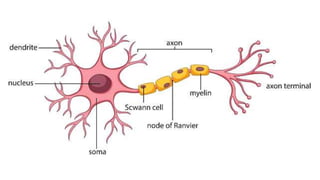
NERVOUS TISSUE
Nervous tissue is the term for groups of organized cells in
the nervous system, which is the organ system that controls the
body's movements, sends and carries signals to and from the
different parts of the body, and has a role in controlling bodily
functions such as digestion.
STRUCTURE
Nervous tissue is composed of neurons, also called nerve cells,
and neuroglial cells. Four types of neuroglia found in the CNS are
astrocytes, microglial cells, ependymal cells, and oligodendrocytes. Two
types of neuroglia found in the PNS are satellite cells and Schwann cells.
In the central nervous system (CNS), the tissue types found are grey
matter and white matter. The tissue is categorized by its neuronal and
neuroglial components.
FUNCTIONS
The function of nervous tissue is to form the communication network of
the nervous system by conducting electric signals across tissue. in the
CNS, grey matter, which contains the synapses, is important for
information processing. White matter, containing myelinated axons,
connects and facilitates nerve impulse between grey matter areas in the
CNS. in the PNS, the ganglion tissue, containing the cell bodies and
dendrites, contain relay points for nerve tissue impulses. The nerve tissue,
containing myelinated axons bundles, carry action potential nerve
impulses.
THANK YOU!

Unit II

  • 1.
    UNIT II INTRODUCTION TOTHE DETAILED STRUCTURE OF THE HUMAN BODY SUBMITTED TO MRS. JISHA S. PRINCIPAL, ST. CATHERINE’S HOSPITAL & SCHOOL OF NURSING SUBMITTED BY MR. EARNEST LAMUEL NURSING TUTOR, ST. CATHERINE’S HOSPITAL & SCHOOL OF NURSING
  • 2.
    THE CELL –STRUCTURE, FUNCTION & REPRODUCTION
  • 3.
    CELL The smallest functionalunit of our body is the cell. It was Robert Hook who first coined the term ‘cell’ in 1665. The size of a cell can vary from a minimum of 6 micrometre to a maximum of 80 micrometre. The study of cells is called ‘Cytology’ and the study of tissues is called ‘Histology’
  • 5.
    STRUCTURE A eukaryotic cellconsists of the following structures- • A cell membrane or plasma membrane, which is impermeable to large molecules like ions and metabolites. • A nucleus which contains the genetic machinery. • Cytoplasm and the organelles
  • 6.
    FUNCTIONS •PROVIDE STRUCTURE AND SUPPORT •FACILITATEGROWTH THROUGH MITOSIS •ALLOW PASSIVE AND ACTIVE TRANSPORT •PRODUCE ENERGY •CREATE METABOLIC REACTIONS •AIDS IN REPRODUCTION
  • 7.
    CELL MEMBRANE The cellmembrane is a protective sheath that envelops the cell body. It separates the fluid outside the cell called ‘extracellular fluid’ and the fluid inside the cell called ‘intracellular fluid’. It is a semipermeable membrane and allows free exchange of certain substances between ECF and ICF.
  • 9.
    STRUCTURE When examined byelectronic microscope, the average cell membrane is seen to be about 7.5 nm thick. It consists of two densely stained layers separated by a lighter zone, thus creating a trilaminar appearance.
  • 10.
    FUNCTIONS • Protective function– Cell membrane protects the cytoplasm and the organelles present in the cytoplasm. • Selective permeability – cell membrane acts as a substances semipermeable membrane which allows only some substances to pass through it and acts as a barrier for other substances. • Absorptive function – Nutrients are absorbed into the cell through the cell membrane
  • 11.
    FUNCTIONS • Excretory function– Metabolites and other waste products from the cell are excreted out through the cell membrane • Exchange of gases – Oxygen enters the cell from the blood and carbon dioxide leaves the cell and enters the blood through the cell membrane. • Maintenance of shape and size of the cell – Cell membrane is responsible for the maintenance of shape and size of the cell
  • 12.
    COMPOSITION The cell membraneis composed of three types of substances • Proteins (55%) • Lipids (40%) • Carbohydrates (5%)
  • 13.
    PROTEINS The protein layersof the cell membrane are the electron dense layers situated on either side of the central lipid layer. The protein substances present in these layers are mostly glycoproteins. These protein molecules are classified into two categories • Integral proteins • Peripheral proteins
  • 15.
    FUNCTIONS • Integral proteinsserve as receptors which bind with various hormones. • Integral proteins help in the transport of substances across the cell membrane. They serve as pores and channels through which water and water-soluble ions can diffuse freely. • Some integral proteins serve as carrier proteins which can facilitate transport of certain molecules across the membrane
  • 16.
    LIPIDS The trilaminar structureof membranes is produced by the arrangement of lipid molecules that constitute the basic framework of the membrane. The major lipids in cell membrane are – • Phospholipid • Cholesterol
  • 18.
    FUNCTIONS The lipid layeris semipermeable in nature and allows only the fat-soluble substances like oxygen, carbon dioxide and alcohol to pass through it. It does not allow the water-soluble materials like glucose, urea and electrolytes to pass through it.
  • 19.
    CARBOHYDRATES Carbohydrate molecules forma thin loose covering over the entire surface of the cell membrane called ‘glycocalyx’. Some carbohydrate molecules are attached with proteins and form ‘glycoproteins’ and some are attached with lipids and form ‘glycolipids’.
  • 21.
    FUNCTIONS • The carbohydratemolecules are negatively charged substances and do not permit the negatively charged substances to move in and out of the cell. • The glycocalyx from the neighbouring cells helps in the tight fixation of cells with one another. • Some of the carbohydrate molecules form the receptors for some hormones.
  • 22.
    CYTOPLASM The cytoplasm isthe fluid present inside the cell. It contains a clear liquid portion called ‘cytosol’ which contains various substances like proteins, carbohydrates, lipids and electrolytes. Apart from these substances, many organelles are also present in cytoplasm. The cytoplasm is distributed as peripheral ectoplasm just beneath the cell membrane and inner endoplasm between the ectoplasm and the nucleus.
  • 24.
    FUNCTIONS • Most ofthe important activities of the cell occur in the cytoplasm. Cytoplasm contains molecules such as enzymes which are responsible for breaking down waste and also aid in metabolic activity. • Cytoplasm is responsible for giving a cell its shape. It helps to fill out the cell and keeps organelles in their place. Without cytoplasm, the cell would be deflated and materials would not be able to pass easily from one organelle to another.
  • 25.
    CELL ORGANELLES We haveseen that the cytoplasm of a typical cell contains various structures that are referred to as organelles. They include the endoplasmic reticulum, ribosomes, mitochondria, the Golgi complex, the various types of vesicles. The cytosol also contains a cytoskeleton made up of microtubules, microfilaments and intermediate filaments.
  • 27.
    ENDOPLASMIC RETICULUM Endoplasmic reticulumis made up of tubules and microsomal vesicles. These structures form an interconnected network which acts as the link between the organelles and cell membrane. It is of two types • Rough Endoplasmic Reticulum • Smooth Endoplasmic Reticulum
  • 29.
    FUNCTIONS • Rough endoplasmicreticulum is concerned with synthesis of proteins. • Smooth endoplasmic reticulum lacks ribosomes and is concerned with the synthesis of lipids, steroids, cholesterol and carbohydrates. It acts as a surface for the attachment of many enzymes systems and helps in detoxifying drugs, alcohol, metabolic by-product, etc. • Highly specialized endoplasmic reticulum is present in some cells. In strained muscle cells, where it is called ‘sarcoplasmic reticulum’ it is involved, it is involved in the storage and release of Ca2+ it initiate muscle contraction.
  • 30.
    GOLGI APPARATUS Golgi apparatusis present in all the cells except red blood cells. It consists of 5 to 8 flattened membranous sacs called ‘cisternae’. The Golgi apparatus is situated near the nucleus. It has two ends or faces namely, cis face and trans face. This cis face is positioned near the endoplasmic reticulum. The reticular vesicles from endoplasmic reticulum enter the Golgi apparatus through cis face. The trans face is situated near the cell membrane. The processed substances make their exit from Golgi apparatus though trans face.
  • 32.
    FUNCTIONS • It isconcerned with the processing and delivery of substances like proteins and lipids to different parts of the cell. • It functions like a post office because, it packs the processed materials into the secretory granules, secretory vesicles, and lysosomes and dispatch them either out of the cell or to another part of the cell. • It also functions like a shipping department of the cell because it sorts out and labels the materials for distribution to their proper destinations.
  • 33.
    MITOCHONDRIA Mitochondria are membranebound organelles and are called the power- generating units of the cell. Each mitochondrion consists of two layers of membrane. • An outer smooth membrane, which contains many pores, allowing free passage of small molecules. • An inner membrane, which is thrown into folds that increase the surface area.
  • 35.
    FUNCTIONS • It isthe chief site of tricarboxylic acid cycle, electron transport chain and fatty acid metabolism • Release of energy from ATP and guanosine triphosphate (GTP) • It contains Ca2+
  • 36.
    CYTOSKELETON The cytoskeleton ofthe cell is a complex network that gives shape, support and stability to the cell. It is also essential for the cellular movements and the response of the cell to external stimuli. The cytoskeleton consists of three major protein componets • Microtubules • Intermediate filaments • microfilaments
  • 38.
    FUNCTIONS • As thename implies, a cytoskeleton is the frame that gives shape to a cell. Just like in a human being, the skeleton also helps hold all of the organelles (organs, in people) in place. Finally, it also assists in moving materials in and out of the cell. • Through a series of intercellular proteins, the cytoskeleton gives a cell its shape, offers support, and facilitates movement through three main components. The cytoskeleton helps the cell move in its environment and controls the movement of all of the cell's interior workings. • The microtubules have three different functions which contribute to the job of the cytoskeleton. They make up the centrioles in a cell, they are the base of both the flagella and cilia of a cell, and they function as the pathway that the transport vesicles move along.
  • 39.
    NUCLEUS Nucleus is presentin those cells which divide and produce enzymes. The cells with nucleus are called eukaryotes and those without nucleus are known as prokaryotes. Prokaryotes do not divide or synthesize the enzymes. Most of the cells have only one nucleus. Few types of cells like skeletal muscle cells have many nuclei. Generally the nucleus is located near the center of the cell. It is mostly spherical in shape. However, the shape and situation of nucleus vary in different cells.
  • 41.
    FUNCTIONS • Controls allthe activities of the cell • Synthesizes RNA • Forms subunits of ribosomes • Sends genetic instruction to the cytoplasm for protein synthesis through messenger RNA • Controls the cell division through genes • Stores the hereditary information and transforms this information from one generation of the species to the next.
  • 42.
    NUCLEAR COMPONENTS • Nuclearmembrane • Nucleoplasm • Nucleolus
  • 43.
    NUCLEAR MEMBRANE The nucleusis covered by a double layered membrane called nuclear membrane. It encloses the fluid called nucleoplasm. Nuclear membrane is porous and permeable in nature and it allows nucleoplasm to communicable with the cytoplasm.
  • 45.
    NUCLEOPLASM It is agel like ground substance and contains large quantities of the genetic material in the form of DNA. The DNA is made up of chromatin threads. These chromatin threads become the rod shaped chromosomes just before the cell division.
  • 47.
    NUCLEOLI One or morenucleoli are present in each nucleus. The nucleolus contains RNA and some proteins, which are similar to those found in ribosomes. The RNA is synthesized by chromosomes and stored in the nucleolus.
  • 48.
    TISSUES INCLUDING MEMBRANES ANDGLANDS – TYPES, STRUCTURE AND FUNCTIONS
  • 49.
    PRIMARY TISSUES A tissueis defined as a collection of cells and associated intercellular materials specialized for a particular function of functions.
  • 51.
    CLASSIFICATION There are fourprimary tissues in the body • Epithelial tissue • Connective tissue • Muscular tissue • Nervous tissue
  • 52.
    EPITHELIAL TISSUE Epi –above, Thelos – nipple, Epithelium – covering of nipple. This term originally referred to the cellular covering of the nipple. It is a layer or layers of cells that covers the outer surface of the body or line the luminal surface of tubular structure and cavities.
  • 54.
    CLASSIFICATION • Simple epithelium •Squamous epithelium • Cuboidal epithelium • Columnar epithelium • Pseudostratified epithelium • Stratified epithelium • Transitional epithelium
  • 55.
    FUNCTIONS • Protection • Absorption •Filtration • Secretion • Sensory reception
  • 56.
    CONNECTIVE TISSUE The termconnective tissue is applied to a tissue that fills the interstices between more specified element. Connective tissue serves to hold together, and to support, different elements within an organ. For this reason, such connective tissue is to be found in almost every part of the body. It is conspicuous in some regions and scanty in others. This kind of connective tissue is referred to as general connective tissue.
  • 58.
    FUNCTIONS • Storage ofenergy • Protection of organs • Provision of structural framework for the body • Connection of body tissues (muscle to bones) • Connection of epithelial tissues to muscle fibres • Supply of hormone all over the body • Nutritional support to epithelium • Site of defence reaction • Helps in repair of injuries
  • 59.
    COMPONENTS • Fibers – oCollagen fibres o Reticular fibres o Elastic fibres • Cells – o Fibroblasts o Macrophages o Fat cells o Undifferentiated mesenchymal cells o Pigment cells o Blood leukocytes o Mast cells • Intracellular Ground substance
  • 60.
    TYPES • Loose areolar connective tissue •Dense collagenous connective tissue o Dense regular connective tissue o Dense Irregular connective tissue • Connective tissue with special properties o Elastic tissue o Reticular tissue o Mucoid tissue o Adipose tissue
  • 61.
    MUSCULAR TISSUE Muscle tissueis a soft tissue that composes muscles and gives rise to muscles' ability to contract. It is formed during embryonic development through a process known as myogenesis. The muscular tissue is organised to form the musculature of the body. It helps in the movements of various parts of the body.
  • 63.
    TYPES • Smooth muscletissue • Cardiac muscle tissue • Skeletal muscle tissue
  • 64.
    STRUCTURE Muscle tissue isan elongated tissue ranging from several millimetres to about 10 centimetres in length and from 10 to 100 micrometres in width. These cells are joined together in tissues that may be either striated or smooth, depending on the presence or absence, respectively, of organized, regularly repeated arrangements of myofibrillar contractile proteins called myofilaments.
  • 65.
    FUNCTIONS • The mainfunction of the muscular system is movement. Muscles are the only tissue in the body that has the ability to contract and therefore move the other parts of the body. • Related to the function of movement is the muscular system’s second function: the maintenance of posture and body position. Muscles often contract to hold the body still or in a particular position rather than to cause movement. The muscles responsible for the body’s posture have the greatest endurance of all muscles in the body—they hold up the body throughout the day without becoming tired. • Another function related to movement is the movement of substances inside the body. The cardiac and visceral muscles are primarily responsible for transporting substances like blood or food from one part of the body to another. • The final function of muscle tissue is the generation of body heat. As a result of the high metabolic rate of contracting muscle, our muscular system produces a great deal of waste heat. Many small muscle contractions within the body produce our natural body heat. When we exert ourselves more than normal, the extra muscle contractions lead to a rise in body temperature and eventually to sweating.
  • 66.
    NERVOUS TISSUE Nervous tissueis the term for groups of organized cells in the nervous system, which is the organ system that controls the body's movements, sends and carries signals to and from the different parts of the body, and has a role in controlling bodily functions such as digestion.
  • 68.
    STRUCTURE Nervous tissue iscomposed of neurons, also called nerve cells, and neuroglial cells. Four types of neuroglia found in the CNS are astrocytes, microglial cells, ependymal cells, and oligodendrocytes. Two types of neuroglia found in the PNS are satellite cells and Schwann cells. In the central nervous system (CNS), the tissue types found are grey matter and white matter. The tissue is categorized by its neuronal and neuroglial components.
  • 69.
    FUNCTIONS The function ofnervous tissue is to form the communication network of the nervous system by conducting electric signals across tissue. in the CNS, grey matter, which contains the synapses, is important for information processing. White matter, containing myelinated axons, connects and facilitates nerve impulse between grey matter areas in the CNS. in the PNS, the ganglion tissue, containing the cell bodies and dendrites, contain relay points for nerve tissue impulses. The nerve tissue, containing myelinated axons bundles, carry action potential nerve impulses.
  • 70.