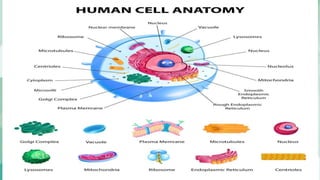
HUMAN CELL
ANATOMY
ANANYA GIRISH BABU
LECTURE
CONTENT
• What is cell
• Function
• Components
• Anatomy
• Organelles of cell
CELL
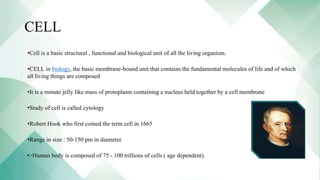
•Cell is a basic structural , functional and biological unit of all the living organism.
•CELL in biology, the basic membrane-bound unit that contains the fundamental molecules of life and of which
all living things are composed
•It is a minute jelly like mass of protoplasm containing a nucleus held together by a cell membrane
•Study of cell is called cytology
•Robert Hook who first coined the term cell in 1665
•Range in size : 50-150 pm in diameter.
•>Human body is composed of 75 - 100 trillions of cells ( age dependent).
FUNCTIONS OF CELL
• IRRITABILTY – the cell has the ability to detect and respond the change in its environment
• NUTRITION – they absorb fluids and dissolve substance directly through cell membrane
• RESPIRATION - they use oxygen combined with food to form carbon dioxide and water
• GROWTH AND REPRODUCTION
• MOVEMENT – muscle cell
• ION TRANSPORT – cells of kidney, duct of salivary glands
STRUCTURE OF CELL
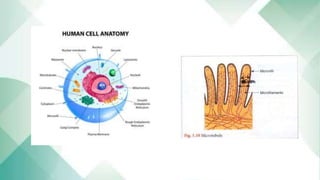
Cell is made up of following structure
1. Cell membrane or plasma membrane
2. Nucleus
3. Cytoplasm
4. Endoplasmic reticum
5. Mitochondria
6. Ribosome
7. Golgi apparatus
8. Lysosomes & Peroxisome
9. Centrosome
10. cytoskeleton
Cell organelles are small cellular
structure which shows specific
function
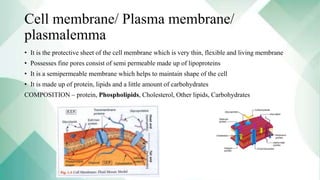
Cell membrane/ Plasma membrane/
plasmalemma
• It is the protective sheet of the cell membrane which is very thin, flexible and living membrane
• Possesses fine pores consist of semi permeable made up of lipoproteins
• It is a semipermeable membrane which helps to maintain shape of the cell
• It is made up of protein, lipids and a little amount of carbohydrates
COMPOSITION – protein, Phospholipids, Cholesterol, Other lipids, Carbohydrates
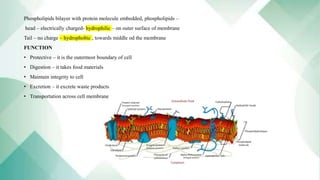
Phospholipids bilayer with protein molecule embedded, phospholipids –
head – electrically charged- hydrophilic – on outer surface of membrane
Tail – no charge – hydrophobic , towards middle od the membrane
FUNCTION
• Protective – it is the outermost boundary of cell
• Digestion – it takes food materials
• Maintain integrity to cell
• Excretion – it excrete waste products
• Transportation across cell membrane
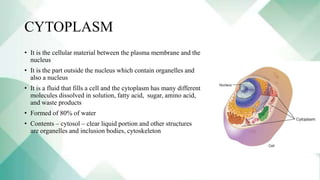
CYTOPLASM
• It is the cellular material between the plasma membrane and the
nucleus
• It is the part outside the nucleus which contain organelles and
also a nucleus
• It is a fluid that fills a cell and the cytoplasm has many different
molecules dissolved in solution, fatty acid, sugar, amino acid,
and waste products
• Formed of 80% of water
• Contents – cytosol – clear liquid portion and other structures
are organelles and inclusion bodies, cytoskeleton
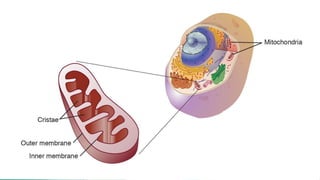
Mitochondria
• Power house of cell
• Double membrane bounded
• Sausage shaped structure in cytoplasm
• Converts oxygen and nutrients into adenosine triphosphate(ATP)-provide energy for various biochemical
processes in the body
• Mitochondria contains outer and inner membrane
1. The outer layer which is smooth
2. An inner layer folded into sheet of tubules called cristae
• Both these cavities are enclosed a central cavity called matrix
• Mitochondria are made up of protein, phospholipids and RNA [they also contain some important
enzymes ]
• They are metabolically active cells [ muscle cells , liver cells have more mitochondria]
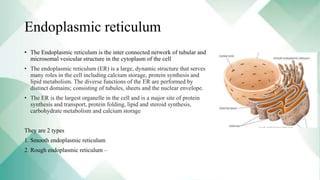
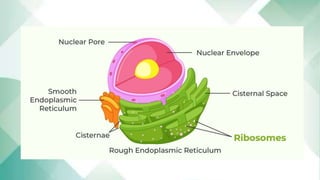
Endoplasmic reticulum
• The Endoplasmic reticulum is the inter connected network of tubular and
microsomal vesicular structure in the cytoplasm of the cell
• The endoplasmic reticulum (ER) is a large, dynamic structure that serves
many roles in the cell including calcium storage, protein synthesis and
lipid metabolism. The diverse functions of the ER are performed by
distinct domains; consisting of tubules, sheets and the nuclear envelope.
• The ER is the largest organelle in the cell and is a major site of protein
synthesis and transport, protein folding, lipid and steroid synthesis,
carbohydrate metabolism and calcium storage
They are 2 types
1. Smooth endoplasmic reticulum
2. Rough endoplasmic reticulum –
Smooth endoplasmic reticulum
• The smooth endoplasmic reticulum functions in
many metabolic processes.[ change food into
energy]
• It synthesizes lipids, phospholipids as in plasma
membranes, and steroids. Cells that secrete these
products, such as cells of the testes, ovaries, and
skin oil glands, have an excess of smooth
endoplasmic reticulum.
• The smooth endoplasmic reticulum also carries out
the metabolism of carbohydrates and steroids. In
muscle cells, the smooth endoplasmic reticulum
regulates calcium ion storage.
• Develops from Rough Endoplasmic Reticulum.
Rough endoplasmic reticulum
• it is the part of endoplasmic reticulum to which
granular ribosomes are attached . This part is called
granular ER. It is concerned with protein synthesis
• It possesses ribosomes attached to its membrane.
• It might develop from the nuclear envelope
• The RER is also located near the Golgi apparatus,
which transports, modifies, and packages proteins
for delivery to targeted destinations. Many proteins
that are synthesized in the RER are packaged into
vesicles and transported to the Golgi apparatus.
RIBOSOMES
• They are tiny granule composed of RNA and protein found throughout the cell and responsible for
making enzymes and other protein components
• They are found on the outer surface of RER
• And they contains 65% RNA and 35% protein
• Produce proteins from amino acids during a process called protein synthesis or translation. The
process of protein synthesis is a primary function, which is performed by all living cells
• They synthesis protein from amino acids
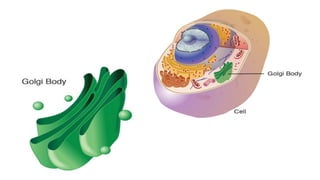
Golgi apparatus
• Consist of stacks of closely folded flattened membrane set
• It consists of flattened membrane disc called saccule, a typical Golgi apparatus consists of five
saccules
• They lies near the nucleus and shows micro vesicles [ secretory glands ] on the surface
• They help in process of receiving and storing of secretory products [ protein]
• It is present in all cells but is larger in those that synthesize and export proteins
• It is cup like shape structure and contain vesicles
• A Golgi body, also known as a Golgi apparatus, is a cell organelle that helps process and package
proteins and lipid molecules, especially proteins destined to be exported from the cell.
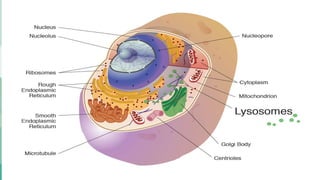
LYSOSOMES
• They are membrane bounded bodies, contain various hydrolytic enzymes like acid phosphate
• They are responsible for intracellular digestive process an in the breakdown of material ingested by
them
• They are large irregular structure surrounded by unit membrane and are found in the cytoplasm
• A lysosome is a membrane-bound cell organelle that contains digestive enzymes. Lysosomes are
involved with various cell processes. They break down excess or worn-out cell parts. They may be
used to destroy invading viruses and bacteria. If the cell is damaged beyond repair, lysosomes can
help it to self-destruct in a process called programmed cell death
• They are known as suicidal bag
Nucleus
• Large oval body near the center of the cell
• The control center for all activity
• Nucleus is found in all cells except mature erythrocytes [ RBC] and platelets
• The shape is normally rounded and placed centrally
• Nucleus contain genetic material and influences the metabolic activities of cell
• Normally cells have one nucleus but some cells like osteoclast, skeletal muscle have 2 or more
nuclei
• Nucleus id surrounded by a nuclear membrane which the membrane have many pores called
nuclear pores which the substances can transport to the cytoplasm
• Cytoplasm of nucleus is nucleoplasm contain chromatin material [ gene carrier ] and nucleolus
which is rich in RNA and concerned with protein synthesis
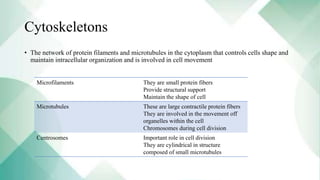
Cytoskeletons
• The network of protein filaments and microtubules in the cytoplasm that controls cells shape and
maintain intracellular organization and is involved in cell movement
Microfilaments They are small protein fibers
Provide structural support
Maintain the shape of cell
Microtubules These are large contractile protein fibers
They are involved in the movement off
organelles within the cell
Chromosomes during cell division
Centrosomes Important role in cell division
They are cylindrical in structure
composed of small microtubules
Thank you….

basic cell.pptx

  • 1.
  • 2.
    CONTENT • What iscell • Function • Components • Anatomy • Organelles of cell
  • 3.
    CELL •Cell is abasic structural , functional and biological unit of all the living organism. •CELL in biology, the basic membrane-bound unit that contains the fundamental molecules of life and of which all living things are composed •It is a minute jelly like mass of protoplasm containing a nucleus held together by a cell membrane •Study of cell is called cytology •Robert Hook who first coined the term cell in 1665 •Range in size : 50-150 pm in diameter. •>Human body is composed of 75 - 100 trillions of cells ( age dependent).
  • 4.
    FUNCTIONS OF CELL •IRRITABILTY – the cell has the ability to detect and respond the change in its environment • NUTRITION – they absorb fluids and dissolve substance directly through cell membrane • RESPIRATION - they use oxygen combined with food to form carbon dioxide and water • GROWTH AND REPRODUCTION • MOVEMENT – muscle cell • ION TRANSPORT – cells of kidney, duct of salivary glands
  • 6.
    STRUCTURE OF CELL Cellis made up of following structure 1. Cell membrane or plasma membrane 2. Nucleus 3. Cytoplasm 4. Endoplasmic reticum 5. Mitochondria 6. Ribosome 7. Golgi apparatus 8. Lysosomes & Peroxisome 9. Centrosome 10. cytoskeleton Cell organelles are small cellular structure which shows specific function
  • 7.
    Cell membrane/ Plasmamembrane/ plasmalemma • It is the protective sheet of the cell membrane which is very thin, flexible and living membrane • Possesses fine pores consist of semi permeable made up of lipoproteins • It is a semipermeable membrane which helps to maintain shape of the cell • It is made up of protein, lipids and a little amount of carbohydrates COMPOSITION – protein, Phospholipids, Cholesterol, Other lipids, Carbohydrates
  • 8.
    Phospholipids bilayer withprotein molecule embedded, phospholipids – head – electrically charged- hydrophilic – on outer surface of membrane Tail – no charge – hydrophobic , towards middle od the membrane FUNCTION • Protective – it is the outermost boundary of cell • Digestion – it takes food materials • Maintain integrity to cell • Excretion – it excrete waste products • Transportation across cell membrane
  • 9.
    CYTOPLASM • It isthe cellular material between the plasma membrane and the nucleus • It is the part outside the nucleus which contain organelles and also a nucleus • It is a fluid that fills a cell and the cytoplasm has many different molecules dissolved in solution, fatty acid, sugar, amino acid, and waste products • Formed of 80% of water • Contents – cytosol – clear liquid portion and other structures are organelles and inclusion bodies, cytoskeleton
  • 10.
    Mitochondria • Power houseof cell • Double membrane bounded • Sausage shaped structure in cytoplasm • Converts oxygen and nutrients into adenosine triphosphate(ATP)-provide energy for various biochemical processes in the body • Mitochondria contains outer and inner membrane 1. The outer layer which is smooth 2. An inner layer folded into sheet of tubules called cristae • Both these cavities are enclosed a central cavity called matrix • Mitochondria are made up of protein, phospholipids and RNA [they also contain some important enzymes ] • They are metabolically active cells [ muscle cells , liver cells have more mitochondria]
  • 12.
    Endoplasmic reticulum • TheEndoplasmic reticulum is the inter connected network of tubular and microsomal vesicular structure in the cytoplasm of the cell • The endoplasmic reticulum (ER) is a large, dynamic structure that serves many roles in the cell including calcium storage, protein synthesis and lipid metabolism. The diverse functions of the ER are performed by distinct domains; consisting of tubules, sheets and the nuclear envelope. • The ER is the largest organelle in the cell and is a major site of protein synthesis and transport, protein folding, lipid and steroid synthesis, carbohydrate metabolism and calcium storage They are 2 types 1. Smooth endoplasmic reticulum 2. Rough endoplasmic reticulum –
  • 13.
    Smooth endoplasmic reticulum •The smooth endoplasmic reticulum functions in many metabolic processes.[ change food into energy] • It synthesizes lipids, phospholipids as in plasma membranes, and steroids. Cells that secrete these products, such as cells of the testes, ovaries, and skin oil glands, have an excess of smooth endoplasmic reticulum. • The smooth endoplasmic reticulum also carries out the metabolism of carbohydrates and steroids. In muscle cells, the smooth endoplasmic reticulum regulates calcium ion storage. • Develops from Rough Endoplasmic Reticulum. Rough endoplasmic reticulum • it is the part of endoplasmic reticulum to which granular ribosomes are attached . This part is called granular ER. It is concerned with protein synthesis • It possesses ribosomes attached to its membrane. • It might develop from the nuclear envelope • The RER is also located near the Golgi apparatus, which transports, modifies, and packages proteins for delivery to targeted destinations. Many proteins that are synthesized in the RER are packaged into vesicles and transported to the Golgi apparatus.
  • 14.
    RIBOSOMES • They aretiny granule composed of RNA and protein found throughout the cell and responsible for making enzymes and other protein components • They are found on the outer surface of RER • And they contains 65% RNA and 35% protein • Produce proteins from amino acids during a process called protein synthesis or translation. The process of protein synthesis is a primary function, which is performed by all living cells • They synthesis protein from amino acids
  • 16.
    Golgi apparatus • Consistof stacks of closely folded flattened membrane set • It consists of flattened membrane disc called saccule, a typical Golgi apparatus consists of five saccules • They lies near the nucleus and shows micro vesicles [ secretory glands ] on the surface • They help in process of receiving and storing of secretory products [ protein] • It is present in all cells but is larger in those that synthesize and export proteins • It is cup like shape structure and contain vesicles • A Golgi body, also known as a Golgi apparatus, is a cell organelle that helps process and package proteins and lipid molecules, especially proteins destined to be exported from the cell.
  • 18.
    LYSOSOMES • They aremembrane bounded bodies, contain various hydrolytic enzymes like acid phosphate • They are responsible for intracellular digestive process an in the breakdown of material ingested by them • They are large irregular structure surrounded by unit membrane and are found in the cytoplasm • A lysosome is a membrane-bound cell organelle that contains digestive enzymes. Lysosomes are involved with various cell processes. They break down excess or worn-out cell parts. They may be used to destroy invading viruses and bacteria. If the cell is damaged beyond repair, lysosomes can help it to self-destruct in a process called programmed cell death • They are known as suicidal bag
  • 20.
    Nucleus • Large ovalbody near the center of the cell • The control center for all activity • Nucleus is found in all cells except mature erythrocytes [ RBC] and platelets • The shape is normally rounded and placed centrally • Nucleus contain genetic material and influences the metabolic activities of cell • Normally cells have one nucleus but some cells like osteoclast, skeletal muscle have 2 or more nuclei • Nucleus id surrounded by a nuclear membrane which the membrane have many pores called nuclear pores which the substances can transport to the cytoplasm • Cytoplasm of nucleus is nucleoplasm contain chromatin material [ gene carrier ] and nucleolus which is rich in RNA and concerned with protein synthesis
  • 22.
    Cytoskeletons • The networkof protein filaments and microtubules in the cytoplasm that controls cells shape and maintain intracellular organization and is involved in cell movement Microfilaments They are small protein fibers Provide structural support Maintain the shape of cell Microtubules These are large contractile protein fibers They are involved in the movement off organelles within the cell Chromosomes during cell division Centrosomes Important role in cell division They are cylindrical in structure composed of small microtubules
  • 24.