BASIC LIFE PROCESS
1
Name: Dr. Vir Vikram
Designation: Associate Professor
Department: P’Cology
E-mail: virvikram76@gmail.com
2
TITLE
BASIC LIFE PROCESS
CONTENTS
• Objectives
• Introduction
• definitions
3
Objectives
• To understand the meaning of basic life process
• Definition of various terms used in Basic life
process
4
Basic life Process and Their Function
1.Metabolism
2.Responsiveness
3.Movement
4. Growth
5. Differentiation
6. Reproduction
5
Metabolism
It is the sum of all the chemical process that occur
in the body
(a) Catabolism :- breakdown of complex chemical
substances into simpler components
(b) Anabolism :- the building up complex substance
from smaller, simpler components
E.g:- digestive processes catabolize protein in food
into amino acid. These amino acid then used to
anabolism (build) new proteins that make up body
structure such as muscle and bone.
6
Responsiveness
The body ability to detect and respond to changes.
Example
1. increase in the body temperature represent a
change in internal environment
2. turning head toward the sound is a response of
external environment.
Nerve cells response by generating electrical signals
known as nerve impulse
Muscle cells response by contracting which generate
force to move body parts. 7
Movement
It means motion of the whole body.
Example
1. Coordination action of legs.
2. When body tissue damage WBC move from
blood into affected tissue to help repair area.
.
8
Growth
• Increase in body size that result from an increase
in the size of existing cells, tissue some time
increase in size because the amount of material
between the cells increase.
9
Differentiation
The development of cell from an unspecialized
to specialized state.
Example
A fertilized egg (ovum) develops into an embryo,
then into foetus, an infants, child, finally adult
10
Reproduction
The formation of new cells for tissue growth,
repair or replacement or production of new
individual
11
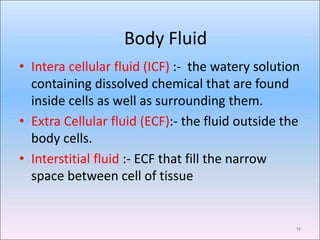
Body Fluid
12
• Intera cellular fluid (ICF) :- the watery solution
containing dissolved chemical that are found
inside cells as well as surrounding them.
• Extra Cellular fluid (ECF):- the fluid outside the
body cells.
• Interstitial fluid :- ECF that fill the narrow
space between cell of tissue
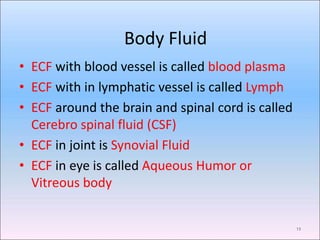
Body Fluid
13
• ECF with blood vessel is called blood plasma
• ECF with in lymphatic vessel is called Lymph
• ECF around the brain and spinal cord is called
Cerebro spinal fluid (CSF)
• ECF in joint is Synovial Fluid
• ECF in eye is called Aqueous Humor or
Vitreous body
REFERENCES
• Essentials of Medical Physiology by K. Sembulingam and P. Sembulingam. Jaypee
Brothers Medical Publishers, New Delhi.
• Anatomy and Physiology in Health and Illness by Kathleen J.W. Wilson, Churchill
Livingstone, New York.
. Physiological basis of Medical Practice-Best and Tailor. Williams and Wilkins
Co, Riverview, MI USA.
• Text book of Medical Physiology- Arthur C, Guyton and John.E. Hall.
Miamisburg, OH, U.S.A.
• Principles of Anatomy and Physiology by Tortora Grabowski. Palmetto, GA,
U.S.A.
Human Physiology (vol 1 and 2) by Dr. C.C. Chatterrje, Academic Publishers
Kolkata.
14
THANKS
ForFurther Detail/SUGGESTIONS PleaseContact
15

basic life process

  • 1.
  • 2.
    Name: Dr. VirVikram Designation: Associate Professor Department: P’Cology E-mail: virvikram76@gmail.com 2 TITLE BASIC LIFE PROCESS
  • 3.
  • 4.
    Objectives • To understandthe meaning of basic life process • Definition of various terms used in Basic life process 4
  • 5.
    Basic life Processand Their Function 1.Metabolism 2.Responsiveness 3.Movement 4. Growth 5. Differentiation 6. Reproduction 5
  • 6.
    Metabolism It is thesum of all the chemical process that occur in the body (a) Catabolism :- breakdown of complex chemical substances into simpler components (b) Anabolism :- the building up complex substance from smaller, simpler components E.g:- digestive processes catabolize protein in food into amino acid. These amino acid then used to anabolism (build) new proteins that make up body structure such as muscle and bone. 6
  • 7.
    Responsiveness The body abilityto detect and respond to changes. Example 1. increase in the body temperature represent a change in internal environment 2. turning head toward the sound is a response of external environment. Nerve cells response by generating electrical signals known as nerve impulse Muscle cells response by contracting which generate force to move body parts. 7
  • 8.
    Movement It means motionof the whole body. Example 1. Coordination action of legs. 2. When body tissue damage WBC move from blood into affected tissue to help repair area. . 8
  • 9.
    Growth • Increase inbody size that result from an increase in the size of existing cells, tissue some time increase in size because the amount of material between the cells increase. 9
  • 10.
    Differentiation The development ofcell from an unspecialized to specialized state. Example A fertilized egg (ovum) develops into an embryo, then into foetus, an infants, child, finally adult 10
  • 11.
    Reproduction The formation ofnew cells for tissue growth, repair or replacement or production of new individual 11
  • 12.
    Body Fluid 12 • Interacellular fluid (ICF) :- the watery solution containing dissolved chemical that are found inside cells as well as surrounding them. • Extra Cellular fluid (ECF):- the fluid outside the body cells. • Interstitial fluid :- ECF that fill the narrow space between cell of tissue
  • 13.
    Body Fluid 13 • ECFwith blood vessel is called blood plasma • ECF with in lymphatic vessel is called Lymph • ECF around the brain and spinal cord is called Cerebro spinal fluid (CSF) • ECF in joint is Synovial Fluid • ECF in eye is called Aqueous Humor or Vitreous body
  • 14.
    REFERENCES • Essentials ofMedical Physiology by K. Sembulingam and P. Sembulingam. Jaypee Brothers Medical Publishers, New Delhi. • Anatomy and Physiology in Health and Illness by Kathleen J.W. Wilson, Churchill Livingstone, New York. . Physiological basis of Medical Practice-Best and Tailor. Williams and Wilkins Co, Riverview, MI USA. • Text book of Medical Physiology- Arthur C, Guyton and John.E. Hall. Miamisburg, OH, U.S.A. • Principles of Anatomy and Physiology by Tortora Grabowski. Palmetto, GA, U.S.A. Human Physiology (vol 1 and 2) by Dr. C.C. Chatterrje, Academic Publishers Kolkata. 14
  • 15.