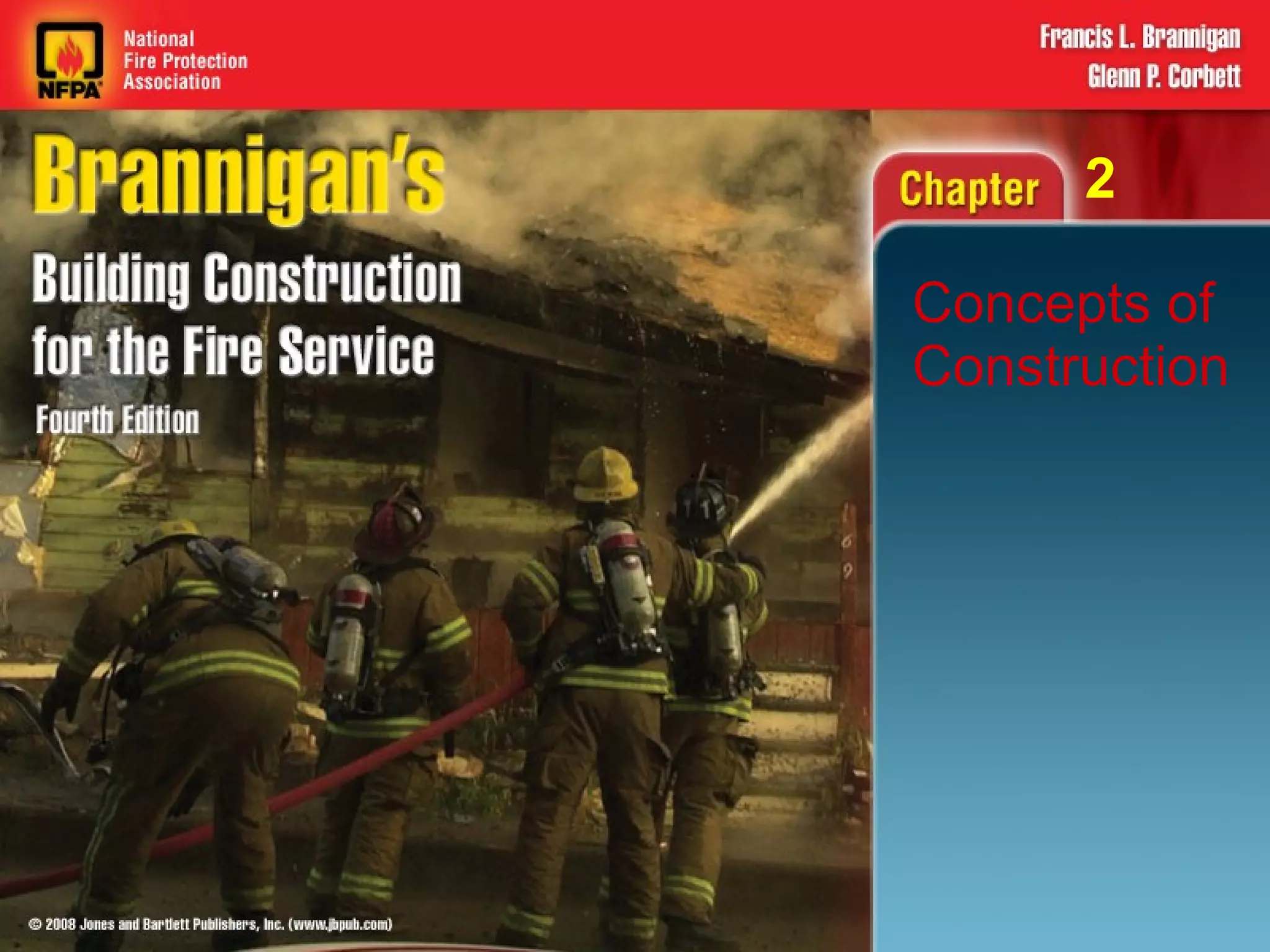
2   Concepts of Construction
Objectives  (1 of 2) Identify the variety of forces that buildings are subjected to Identify the different types of loads and how they are applied to buildings
Objectives  (2 of 2) Identify and define key different types of structural members such as columns, beams, and walls Identify the variety of different types of structural connections and how they behave in a fire
Introduction How will the buildings in your community react to fire? Prefire inspection The laws of physics Knowledge gained from the field
Gravity Exerts a continued force on a building The gravity resistance system  Unintended loads imposed by fire
Definition of Loads  Forces or other actions that result from the weight of all building materials, occupants and their possessions, environmental effects, differential movement, and restrained dimensional changes
Stress and Strain Stress  Measured in pounds per square inch (psi) KIP = 1000 pounds  Strain  Actual percent of elongation (deformation)
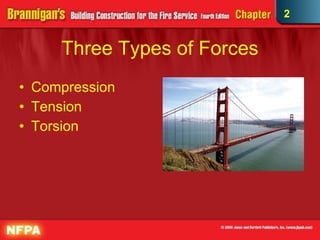
Three Types of Forces Compression Tension Torsion
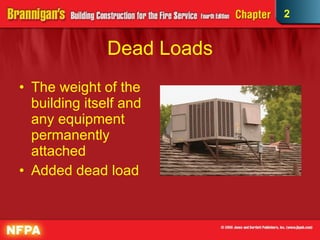
Dead Loads The weight of the building itself and any equipment permanently attached Added dead load
Live Loads  (1 of 2) Any load other than a dead load Assumes even distribution Concentrated load  Accounts for large heavy objects in a building  Larger than live load requirements
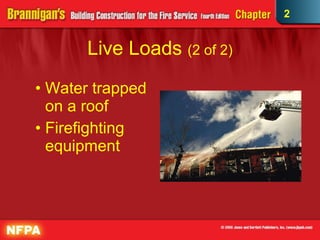
Live Loads  (2 of 2) Water trapped on a roof  Firefighting equipment
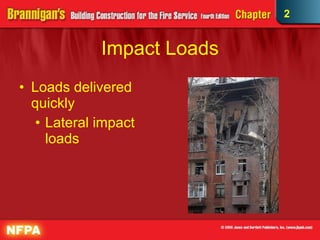
Impact Loads Loads delivered quickly  Lateral impact loads
Static and Repeated Loads Static loads  Applied slowly and remain constant A heavy safe   Repeated loads Applied intermittently  A rolling bridge crane
Wind Loads  (1 of 3) A force applied by the wind Small wood buildings are susceptible Masonry buildings are less susceptible
Wind Loads  (2 of 3) Diaphragm Floors and Bracing Designed to stiffen the building against wind Diagonal braces K-bracing
Wind Loads  (3 of 3) Types of Bracing Portal bracing  Masonry walls  Tube construction  Core construction
Concentrated Loads Heavy loads located at one point in a building A steel beam resting on a masonry wall Piers  Short columns used to level floors Create a gap between the floor and related arch
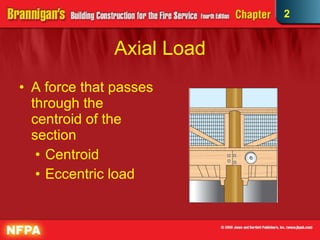
Axial Load A force that passes through the centroid of the section Centroid Eccentric load
Fire Loads Represents the potential fuel available to a fire and the total amount of potential energy (heat) in the fuel Heat release rate (HRR)  Q  Caloric value
Suspended Loads Suspended from a ceiling or other structure Tie rod  Suspended high-rise buildings use suspended beams
Safety Factor Represents the ratio of the strength of the material to the safe working stress Ultimate strength Design load is a fraction of the ultimate strength
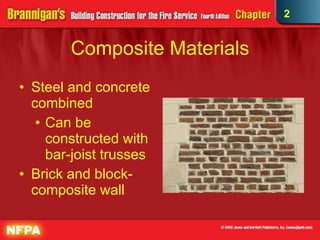
Composite Materials Steel and concrete combined Can be constructed with bar-joist trusses Brick and block-composite wall
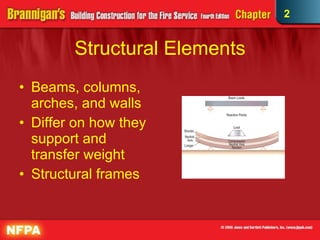
Structural Elements Beams, columns, arches, and walls Differ on how they support and transfer weight Structural frames
Beams  Transmits forces perpendicular to the reaction points  Deflection Neutral axis Stiffness
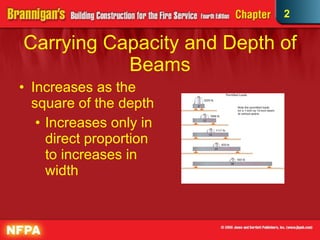
Carrying Capacity and Depth of Beams Increases as the square of the depth Increases only in direct proportion to increases in width
Types of Beams  (1 of 2) Simple  Continuous  Fixed Overhanging Bracket Joist, steel joist, and bar joist  Girder
Types of Beams  (2 of 2) Built-up girder  Spandrel girder  Lintel  Grillage  Cantilever beam  Suspended beam Transfer beam
Beam Loading Distribution of loads along a beam May be concentrated in one area  Create excessive beam loading
Reaction and Bending Reaction  Result of force exerted by a beam on a support Bending moment  Load that will bend or break the beam
Columns Transmit a compressive force along a straight path Struts or rakers Bent Bay Pillar
Decrease in Load-Carrying Capacity Decrease in load-carrying capacity proportionately 12-foot column vs. 6-foot column
Shapes of Columns Most efficient  Distributes the material equally around the axis  As far as possible from the center of the cylinder  Difficult to attach beams to round columns
Wooden Columns Smoothed off tree trunks Almost always hollow
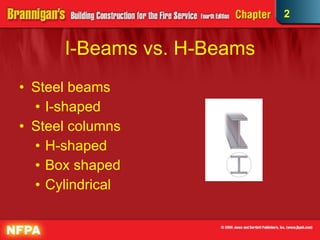
I-Beams vs. H-Beams Steel beams  I-shaped Steel columns H-shaped Box shaped Cylindrical
Types of Columns Piers  Short, squat columns  Fail by crushing Long, slender columns Buckle Intermediate columns  Fail in either manner
Euler’s Law Columns Very long thin columns Critical load Formula: P c  = ( π 2 EI)/L 2
Temporary Bracing Used in incomplete structures Also known as guy bracing
Walls  (1 of 3) Transmit the compressive forces applied along the top or received at any point Main divisions of walls:  Load-bearing Non-load-bearing Cross
Walls  (2 of 3) Veneer  Composite  Header  Stretcher  Panel  Curtain  Party
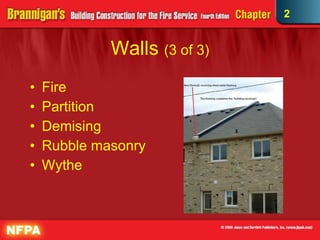
Walls  (3 of 3) Fire Partition  Demising  Rubble masonry  Wythe 
Cantilever Walls Severe winds  May topple a free-standing wall Eccentric loading Precast concrete tilt slab walls
Wall Bracing Serpentine  Buttresses  Pilasters Wall columns  Cavity or hollow
Wall Breaching  Homogenous walls Act as one unit Obstructed load Window or door  Does not follow a vertical path
Roofs Vital to the stability of the structure Roof damage  Can cause wall collapse
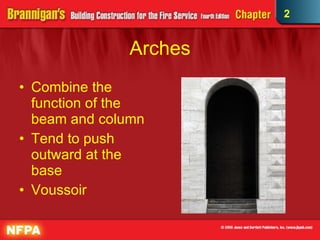
Arches Combine the function of the beam and column Tend to push outward at the base Voussoir
Rigid Frames Derived from the arch  Steel rigid frames  Industrial and commercial buildings Wooden rigid frames  Churches
Shells and Domes Shell Thin, curved plate Concrete Dome  A shell and three dimensional arch Geodesic domes
Transmission of Loads  Transmission Spread from the point of application to the ground Must be continuous  Any failure will lead to collapse Accurate knowledge of the ground
Foundations Delivers loads to the ground Foundation materials differ Almost all are concrete
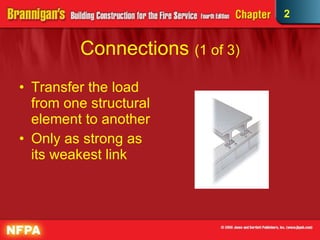
Connections  (1 of 3) Transfer the load from one structural element to another Only as strong as its weakest link
Connections  (2 of 3) Pinned  Elements are connected by simple connectors such as bolts, rivets, or welded joints Rigid-framed building Connections are strong enough to reroute forces if a member is removed
Connections  (3 of 3) Monolithic concrete  Wet joint  Plastic design 
Failure of Connections  (1 of 2) Masonry walls shift outward Temporary field bolting of steel  Ledger board  Steel connectors rust Concrete disintegrates Sand-lime mortar is water soluble.
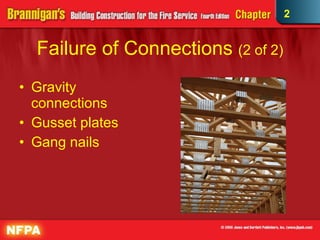
Failure of Connections  (2 of 2) Gravity connections  Gusset plates Gang nails
Overhanging and Drop-in Beams Economical No support from below
Spliced Beams If beam not long enough Spliced with connectors Connectors fail in heat
Summary Gravity Gravity resistance system  Specific terms  Structural elements Composite material Connections

Ch 02 Concepts of Construction

  • 1.
    2 Concepts of Construction
  • 2.
    Objectives (1of 2) Identify the variety of forces that buildings are subjected to Identify the different types of loads and how they are applied to buildings
  • 3.
    Objectives (2of 2) Identify and define key different types of structural members such as columns, beams, and walls Identify the variety of different types of structural connections and how they behave in a fire
  • 4.
    Introduction How willthe buildings in your community react to fire? Prefire inspection The laws of physics Knowledge gained from the field
  • 5.
    Gravity Exerts acontinued force on a building The gravity resistance system Unintended loads imposed by fire
  • 6.
    Definition of Loads Forces or other actions that result from the weight of all building materials, occupants and their possessions, environmental effects, differential movement, and restrained dimensional changes
  • 7.
    Stress and StrainStress Measured in pounds per square inch (psi) KIP = 1000 pounds Strain Actual percent of elongation (deformation)
  • 8.
    Three Types ofForces Compression Tension Torsion
  • 9.
    Dead Loads Theweight of the building itself and any equipment permanently attached Added dead load
  • 10.
    Live Loads (1 of 2) Any load other than a dead load Assumes even distribution Concentrated load Accounts for large heavy objects in a building Larger than live load requirements
  • 11.
    Live Loads (2 of 2) Water trapped on a roof Firefighting equipment
  • 12.
    Impact Loads Loadsdelivered quickly Lateral impact loads
  • 13.
    Static and RepeatedLoads Static loads Applied slowly and remain constant A heavy safe Repeated loads Applied intermittently A rolling bridge crane
  • 14.
    Wind Loads (1 of 3) A force applied by the wind Small wood buildings are susceptible Masonry buildings are less susceptible
  • 15.
    Wind Loads (2 of 3) Diaphragm Floors and Bracing Designed to stiffen the building against wind Diagonal braces K-bracing
  • 16.
    Wind Loads (3 of 3) Types of Bracing Portal bracing Masonry walls Tube construction  Core construction
  • 17.
    Concentrated Loads Heavyloads located at one point in a building A steel beam resting on a masonry wall Piers Short columns used to level floors Create a gap between the floor and related arch
  • 18.
    Axial Load Aforce that passes through the centroid of the section Centroid Eccentric load
  • 19.
    Fire Loads Representsthe potential fuel available to a fire and the total amount of potential energy (heat) in the fuel Heat release rate (HRR) Q  Caloric value
  • 20.
    Suspended Loads Suspendedfrom a ceiling or other structure Tie rod  Suspended high-rise buildings use suspended beams
  • 21.
    Safety Factor Representsthe ratio of the strength of the material to the safe working stress Ultimate strength Design load is a fraction of the ultimate strength
  • 22.
    Composite Materials Steeland concrete combined Can be constructed with bar-joist trusses Brick and block-composite wall
  • 23.
    Structural Elements Beams,columns, arches, and walls Differ on how they support and transfer weight Structural frames
  • 24.
    Beams Transmitsforces perpendicular to the reaction points Deflection Neutral axis Stiffness
  • 25.
    Carrying Capacity andDepth of Beams Increases as the square of the depth Increases only in direct proportion to increases in width
  • 26.
    Types of Beams (1 of 2) Simple Continuous Fixed Overhanging Bracket Joist, steel joist, and bar joist Girder
  • 27.
    Types of Beams (2 of 2) Built-up girder Spandrel girder Lintel Grillage Cantilever beam Suspended beam Transfer beam
  • 28.
    Beam Loading Distributionof loads along a beam May be concentrated in one area Create excessive beam loading
  • 29.
    Reaction and BendingReaction Result of force exerted by a beam on a support Bending moment Load that will bend or break the beam
  • 30.
    Columns Transmit acompressive force along a straight path Struts or rakers Bent Bay Pillar
  • 31.
    Decrease in Load-CarryingCapacity Decrease in load-carrying capacity proportionately 12-foot column vs. 6-foot column
  • 32.
    Shapes of ColumnsMost efficient Distributes the material equally around the axis As far as possible from the center of the cylinder Difficult to attach beams to round columns
  • 33.
    Wooden Columns Smoothedoff tree trunks Almost always hollow
  • 34.
    I-Beams vs. H-BeamsSteel beams I-shaped Steel columns H-shaped Box shaped Cylindrical
  • 35.
    Types of ColumnsPiers Short, squat columns Fail by crushing Long, slender columns Buckle Intermediate columns Fail in either manner
  • 36.
    Euler’s Law ColumnsVery long thin columns Critical load Formula: P c = ( π 2 EI)/L 2
  • 37.
    Temporary Bracing Usedin incomplete structures Also known as guy bracing
  • 38.
    Walls (1of 3) Transmit the compressive forces applied along the top or received at any point Main divisions of walls: Load-bearing Non-load-bearing Cross
  • 39.
    Walls (2of 3) Veneer Composite Header Stretcher Panel Curtain Party
  • 40.
    Walls (3of 3) Fire Partition Demising Rubble masonry Wythe 
  • 41.
    Cantilever Walls Severewinds May topple a free-standing wall Eccentric loading Precast concrete tilt slab walls
  • 42.
    Wall Bracing Serpentine Buttresses Pilasters Wall columns Cavity or hollow
  • 43.
    Wall Breaching Homogenous walls Act as one unit Obstructed load Window or door Does not follow a vertical path
  • 44.
    Roofs Vital tothe stability of the structure Roof damage Can cause wall collapse
  • 45.
    Arches Combine thefunction of the beam and column Tend to push outward at the base Voussoir
  • 46.
    Rigid Frames Derivedfrom the arch Steel rigid frames Industrial and commercial buildings Wooden rigid frames Churches
  • 47.
    Shells and DomesShell Thin, curved plate Concrete Dome A shell and three dimensional arch Geodesic domes
  • 48.
    Transmission of Loads Transmission Spread from the point of application to the ground Must be continuous Any failure will lead to collapse Accurate knowledge of the ground
  • 49.
    Foundations Delivers loadsto the ground Foundation materials differ Almost all are concrete
  • 50.
    Connections (1of 3) Transfer the load from one structural element to another Only as strong as its weakest link
  • 51.
    Connections (2of 3) Pinned Elements are connected by simple connectors such as bolts, rivets, or welded joints Rigid-framed building Connections are strong enough to reroute forces if a member is removed
  • 52.
    Connections (3of 3) Monolithic concrete  Wet joint  Plastic design 
  • 53.
    Failure of Connections (1 of 2) Masonry walls shift outward Temporary field bolting of steel Ledger board  Steel connectors rust Concrete disintegrates Sand-lime mortar is water soluble.
  • 54.
    Failure of Connections (2 of 2) Gravity connections Gusset plates Gang nails
  • 55.
    Overhanging and Drop-inBeams Economical No support from below
  • 56.
    Spliced Beams Ifbeam not long enough Spliced with connectors Connectors fail in heat
  • 57.
    Summary Gravity Gravityresistance system Specific terms Structural elements Composite material Connections

Editor's Notes

  • #9 © Brandon Holmes/ShutterStock, Inc.
  • #10 © Brand X Pictures/Alamy Images
  • #12 © Design Pics Inc./Alamy Images
  • #13 © Alexander Natruskin/Reuters/Landov
  • #15 Courtesy of IBHS – The Institute for Business & Home Safety.
  • #23 © Rémi Cauzid/ShutterStock, Inc.
  • #31 Courtesy of TNT Rescue Systems, Inc.
  • #41 Courtesy of Achim Hering
  • #46 © angelo gilardelli/ShutterStock, Inc.
  • #55 © David Huntley/ShutterStock, Inc.