10  Fire-Resistive Construction
Objectives  (1 of 2)‏ Recall the difference between noncombustible and fire-resistive construction Describe different types of concrete structural systems Describe the two types of prestressing 10
Objectives  (2 of 2)‏ Contrast precast and site-cast concrete Describe the hazards of formwork Describe the methods of fireproofing steel and of ensuring a level fire resistance in concrete Detail how compartmentation works to prevent the spread of fire  10
Introduction Fire-resistive construction Considered to be the best  Most resistant to collapse and does not contribute fuel to a fire  Is given the largest permissible area and heights  10
Concrete Cementatious material produced by a chemical reaction Cures indefinitely; low temperatures retard the curing of concrete Weak in tensile strength and has poor shear resistance  10
Concrete Structures  Pre-World War II Suitable only for structures in which aesthetics played little part Built of steel frames and fireproofed with concrete  Cinder blocks use cinders as the aggregate  Concrete blocks use other materials for aggregate 10
Underwriters Blocks Concrete blocks produced under Underwriters Laboratories’ classification  Manufacturer’s certificate gives the type and number of units delivered to a specific job Blocks must meet fire resistance standards 10
Today’s Variety of  Concrete Structures Use variety of building construction elements Steel-framed buildings now often have cast-in-place concrete floors Precast concrete and prefabricated metal wall panels and decorative brick veneer are common 10
Steel vs. Concrete Framing Designer preferences Some design in steel Others prefer concrete Some buildings concrete-framed and steel-framed mixed together 10
Fire Department Problems Problems with concrete construction Collapse during construction with no fire Fire during construction Fire in completed, occupied buildings 10
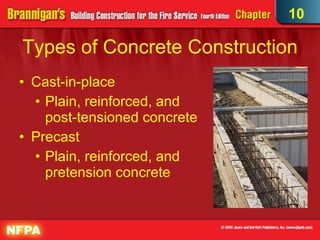
Types of Concrete Construction Cast-in-place Plain, reinforced, and  post-tensioned concrete Precast Plain, reinforced, and  pretension concrete 10
Concrete Definitions  (1 of 5)‏ Aggregate Cast-in-place concrete Casting Chairs Composite and combination columns 10
Concrete Definitions  (2 of 5)‏ Composite construction Continuous casting Continuous slipforming Drop panels Flat plate structural system (or continuous beam)‏ 10
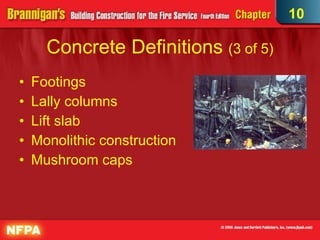
Concrete Definitions  (3 of 5)‏ Footings  Lally columns Lift slab Monolithic construction Mushroom caps 10
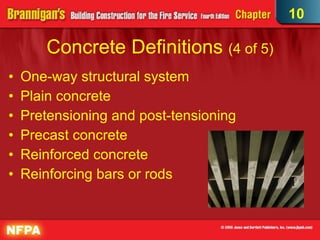
Concrete Definitions  (4 of 5)‏ One-way structural system Plain concrete Pretensioning and post-tensioning Precast concrete Reinforced concrete Reinforcing bars or rods 10
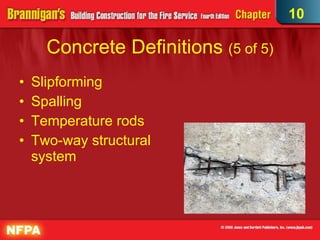
Concrete Definitions  (5 of 5)‏ Slipforming Spalling Temperature rods Two-way structural  system 10
Concrete Structural Elements Columns Beams (including t-beams) and girders Concrete floors 10
Virtue of Columns High compressive strength and low cost Columns are of reinforced concrete Steel reinforcing rods carry some of the compressive load The compressive strength of steel is many times that of concrete 10
Increasing Column Sizes Unsatisfactory in modern construction The useable area would vary from floor to floor Overcome by increasing the size of the reinforcing steel as the loads increase  10
Reinforcing Rods Long with a relatively thin diameter  Ends of rods are connected Ties or hoops join the rods in a column Ties cut the long slender column into a number of relatively short columns 10
Beams and Girding  (1 of 3) ‏ Plain concrete beam Strong in compression, weak in shear No tensile strength When a beam is loaded, it deflects Deflection brings compression in the top of the beam and tension in the bottom of the beam 10
Beams and Girding  (2 of 3)‏ Cantilever beam Tension is in the top of the beam Reinforcing rods are in the top of the beam 10
Beams and Girding  (3 of 3)‏ Continuous beam Supported at more than two points Tension in the top of the beam in the area over the tops of the columns Tension in the bottom of the beams between columns 10
T-Beams There is neither tension nor compression in the beam Has the neutral plane coincide with the bottom of the wide, thin floor slab  Double T’s are floor slab and beam combinations with two beams 10
Concrete Floors First used for leveling brick and tile arch floors Early floors built of individual beams supporting a floor slab Hollow tiles lightened concrete floors 10
Waffle Concrete Closely spaced beams are set at right angles to one another Unnecessary concrete is formed out 10
Lighter Construction Floor may be just a flat plate This gives a smooth surface Easily finished  10
Left-In-Place Form Occurs when concrete floors are cast onto corrugated steel  The steel provides necessary tensile strength If the bond fails, the floor section may fail 10
Precast T-Beam Units Additional concrete is often cast-in-place on top of the units Entire unit becomes an integral beam-and-floor element Cylindrical openings can be cast lengthwise through the units to remove unnecessary weight 10
Older Building Codes  Concrete floor can be in ordinary construction Case example: Concrete topping over wood beams concealed the destruction of the beams by fire. Four fire fighters died 10
One-Hour-Rated  Designs of Wood Floors Lightweight concrete topping as much as 1 to 1  1/2  inches thick  Thickness retards the passage of heat through the floor  National Fire Protection Association (NFPA) 251 (American Society of Testing and Materials (ASTM) E119) fire resistance standard 10
Cast-In-Place Concrete Floor Can be a hazard during construction A slot is left in the wall at the point where the floor is to be cast If a windstorm occurs during the time that the slot is open, a collapse may result 10
Concrete Floors in  Steel Buildings May be precast or cast-in-place  May be only load-bearing or provide structural stability  10
Concrete Floors in Cast-In-Place, Concrete-Framed Buildings Cast integrally with columns Provide a monolithic rigid-framed building  May be pinned May be connected as a monolithic unit 10
When Slabs Are Laid Down A space is left between them Protruding bars of one slab extend past the ends of the protruding bars of the other slab The sections are joined by a wet joint 10
Concrete Floors in Precast, Pinned Concrete Buildings May not contribute to the building’s structural stability  Precast columns are often built with haunches or shelves  Steel plates imbedded in the concrete may be welded together 10
Prestressed Concrete Recently developed Engineered stresses placed in architectural and structural concrete  Analogy: A row of books side by side, before and after being threaded together with wire  10
Special High-Strength,  Cold-Drawn Steel Cables Similar to those used for suspension bridges These or alloy steel bars are commonly used in prestressed concrete Known as tendons, but also called strands or cables 10
High-Tensile-Strength Wire Ordinarily used for prestressing More sensitive to high temperatures than structural steel Complete loss of prestress at 800°F 10
Two Methods of Prestressing  (1 of 2)‏ Pretensioning Done in a plant  High-tensile-strength steel strands are stretched between the ends of a form After processing, stretched strands draw back, thus compressing the concrete  10
Two Methods of Prestressing  (2 of 2)‏ Post-tensioning Done on the job site  High-tensile-steel strand wires are positioned in the forms After processing, steel tendons are stretched and anchored at the ends of the unit 10
Bridge Girders Some are tensioned enough to make shipment possible, then post-tensioned after being placed Cement paste might be forced into the space between the tendon and the concrete to provide a bond 10
Reinforced Masonry Widely used to resist earthquakes Unsuitable for multistory buildings in which large clear spans are required Apartment houses and motels are well adapted to this method 10
Ordinary Brick Bearing-Wall Buildings  (1 of 2)‏ Walls must increase in thickness as the building’s height increases.  Limit is generally about 6 stories Recent years, possible to 20 or more stories  10
Ordinary Brick Bearing-Wall Buildings  (2 of 2)‏ Construction methods allow higher buildings Two wythes of brick are built The width of one brick is left between them Reinforcing rods are placed vertically Concrete is poured into the void 10
Special Cases  (1 of 2)‏ Low-rise buildings Recent designs have eliminated reinforced concrete in the wall High compressive-strength bricks and special mortar are used instead Masonry wall-bearing building can be several stories high 10
Special Cases  (2 of 2) ‏ Concrete block Has become popular for some resorts With outside open-air stairways and balconies, life safety is achieved 10
Collapse Under Construction Concrete structures under construction sometimes collapse Fire department rescues construction workers Fire officers should be well informed on the legal position of the fire department 10
Ordering the Removal of a Dangerous Structure Power given to the building commissioner  Fire department has no right to demolish such a structure. 10
Lawsuits Common today Owner, architect, general contractor, subcontractors, and victims attempt to determine financial responsibility After collapses, some of those involved may try to cover up their actions 10
An Industry Warning Experts have warned of the collapse hazard of concrete structures  Design engineers should use construction loads as governing loads in structures 10
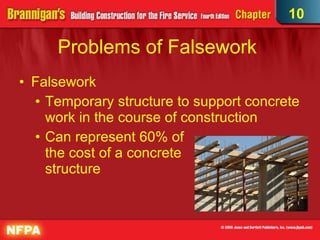
Problems of Falsework  Falsework Temporary structure to support concrete work in the course of construction  Can represent 60% of  the cost of a concrete  structure 10
Concrete Formwork Designed without the extra strength calculated into a building to compensate for deterioration Built at the lowest possible cost Formwork failures can occur, but it is surprising is that they are relatively rare 10
Falsework for Walls or Columns Must have adequate strength to resist the pressure of heavy fluid concrete As concrete sets, pressure is reduced due to internal friction Setting of concrete is temperature dependent 10
Reshoring Concrete Concrete requires time to cure Formwork is then removed Reshoring is putting shores back in place to help carry the load Reshoring means concrete is not yet set 10
Collapses of Floors (1 of 2)‏ Many involve formwork supporting newly cast or high bay floors Proper cross-bracing can help prevent this 10
Collapses of Floors (2 of 2)‏ Formwork can also be a problem Often rests on the ground Mudsills are the planks on which the shores rest If mud is involved, bearing may be inadequate 10
A Widely Believed Fallacy “Reinforced concrete which has set hard to the touch usually has developed enough strength to be self-supporting, though it may not be capable of handling superimposed loads.”  10
Skyline Towers Collapse Skyline Towers collapsed in Arlington, Virginia, 1973 Collapse proved the fallacy Shoring had been removed from the topmost floor The floor collapsed, and the collapse was progressive 10
Lessons from Skyline Towers Removal of shoring by laborers is no different than removal by fire Any concrete formwork failure presents the likelihood for catastrophic collapse Few concrete buildings can withstand the collapse of one floor onto another 10
Hazards of Post-Tensioning (1 of 2)‏ Hydraulic jacks are used to tension the tendons or jack the cables No bond between the tendons and the concrete 10
Hazards of Post-Tensioning  (2 of 2)‏ Weight of concrete transfers to columns only when tensioning is complete Case example: The Skyline Towers garage was made of post-tensioned concrete. Poor sheer resistance led to collapse 10
Collapse of Reinforced Masonry Used widely in construction Workers might overload a floor portion Case example: In Pittsburgh, Pennsylvania an excess load caused the partial collapse of several stories of precast floors 10
Collapse of Precast Concrete Precast concrete buildings under construction are unstable  Temporary bracing holds units in place Wooden temporary shoring might also be used Case example: Montgomery County Maryland. Three-story garage collapsed due to oversized washer 10
Lift-slab Collapses (1 of 3)‏ Lift-slab construction Ground floor slab is cast first Bond breakers are used between the slabs Slabs are raised to the columns Each floor is temporarily connected to the columns 10
Lift-Slab Collapses (2 of 3)‏ Case example: L’Ambience Plaza concrete building under construction in Connecticut was due to the failure of a single connection 10
Lift-Slab Collapses (3 of 3)‏ When do the accidents occur? While the slabs are being lifted or while no lifting is being done  Case example: In California, a roof slab was lifted to columns three inches out of plumb. As an attempt was made to pull the slab back into place, it collapsed 10
Fire Problems of Concrete Buildings Under Construction Concrete buildings under construction can present serious fire problems Fire in formwork can easily result in major collapse  Little reserve strength in formwork Little understanding of potential hazard 10
Potential Fires at a  Construction Site Fires at a construction site Causes include welding, cutting, and plumbers’ torches; temporary electrical lines; and arson Fuels are readily available Glass-fiber formwork is also combustible 10
Hazard of Heating Burning of scrap wood in steel barrels or the use kerosene heaters are hazards Liquefied petroleum gas (LPG) is also dangerous 10
Codes for LPG (1 of 2)‏ Store gas away from any open flames. Case example: 1963, LPG explosion at the Indianapolis Coliseum; caused when a leaking gas-fired cooker cylinder exploded and gas reached heater flame 10
Codes for LPG (2 of 2)‏ Install excess flow valves. Case example: In one city, gas stored and piped with plastic tubes at ground level; hazard should line break 10
Hazards of Post-Tensioned Concrete (1 of 2)‏ Catastrophic fire collapse potential Include bridges and parking garages Falsework fire could cause the sudden collapse of an entire concrete floor slab After tensioning, the ends of tendons are left exposed  10
Hazards of Post-Tensioned Concrete (2 of 2)‏ Hanging tendons can fail at about 800°F Excess tendons are rolled up and attached to a wooden rack.  Rolled-up tendons are heat collectors Failure of tendons will cause the collapse of that part of the structure 10
Protection of Tendons Insist on fireproofing tendon anchors immediately after tensioning is completed Insist on temporary protection for incrementally tensioned tendons 10
A Total Collapse:  Case Example A post-tensioned building under construction in Cleveland, Ohio, suffered a falsework fire After a second fire, the entire 18-story building collapsed 10
Precast Buildings (2 of 2)‏ Pose unique hazards while being constructed Construction involves erection of precast concrete units. 10
Precast Buildings (2 of 2)‏ Temporary bracing or support is used; it can collapse Columns can be braced with wood rather than by telescoping tubular steel braces;  wood is flammable Cold-drawn steel cables often provide diagonal bracing in precast buildings; these fail at 800° F 10
Cantilevered Platforms Used by cranes  delivering materials to buildings under construction  Are braced by wooden shores that would fail in a fire 10
Tower Cranes Supported on the building’s structural frame  Weight of the crane may be distributed over several floors by falsework A fire involving this falsework can bring down the crane 10
Falsework on a  Completed Floor  Should be investigated  May be supporting a patch over a hole  May be supporting a heavy load such as the crane  10
Falsework: Case Example Formwork for concrete placement burned on the 23 rd  to 25 th  floors of a high-rise Operator was trapped in his cab He was protected with a heavy-caliber stream from a nearby roof until rescued 10
Fire Problems in  Finished Buildings Concrete construction Thought to be truly fireproof Later, it was learned that concrete, like any other noncombustible material, can be destroyed by fire 10
Characteristics of Concrete  Inherently noncombustible  Some people confuse noncombustibility with fire resistance  Neither is synonymous with fire safety 10
Safety of Concrete Construction: Case Example Reinforced concrete Joelma building in Sao Paulo, Brazil, burned in 1974 Resulted in179 deaths. The structure had minor damage. 10
Fireproofing (Insulating) Steel Has a fire resistance rating if the protection system previously passed a standard fire test  No such thing as a truly fireproof building Fireproofed steel is protected steel 10
Types of Fireproofing (1 of 2)‏ Individual fireproofing provides protection for each piece of steel  Methods include encasement and intumescent coating  Membrane fireproofing does not protect individual members 10
Types of Fireproofing (2 of 2)‏ One method uses a rated floor-ceiling assembly Underwriters Laboratories can test a roof and ceiling assembly NFPA 251 (ASTM E119) standard fire test 10
Hazards of Floor–ceiling Assemblies Can present a serious menace to the safety of fire fighters Assemblies need to be assembled exactly as performed in the laboratory 10
Ceiling System At the mercy of those have reason to remove ceiling tiles  Access to utilities and additional storage space are two reasons to remove tiles 10
Legal Provisions None require membrane protection be maintained  Replacement acoustical tile may be combustible  All penetrations of the ceiling must be rated as part of the ceiling system 10
Term “Fire-rated” Used quite often in the fire protection and building construction fields  Nonspecific and meaningless  No part of a listed fire-resistance system stands by itself 10
Integrity of a Ceiling System Most are unaware of its significance Alterations compromise integrity Tiles are replaced haphazardly  Holes are cut through tiles  Displays are hung from the metal grid   Testing doesn’t include superimposed loads 10
Laboratory Fire Tests Conducted under a slight negative pressure to remove smoke and fumes  Fires generate positive pressure, and lay-in ceiling tiles may be easily displaced by fire pressures 10
Addition of Insulation Might not be part of the specifications of the listed ceiling assembly Wrong insulation causes heat to be held in the channels supporting the tiles A membrane protection system must be perfect  10
Cockloft Occurs between the ceiling and floor Allows for rapid fire spread Case example: Fire starting in one room traveled across a hallway above the ceiling; it came down through the tile ceiling of another room to ignite books 10
Firestopping Some code provisions provide for this Use of plenum space for various services makes it probable that the firestopping will conform only to the definition of legal firestopping 10
Deep, Long-span Trusses In some buildings, used to provide clear floor areas This creates plenum spaces several feet in height Sometimes voids are called “interstitial spaces” Using such space as storage places fire load next to unprotected steel 10
Fire Resistance of  Floor-Ceiling Assemblies Not all are intended to be fire resistive A steel bar-joist floor with concrete topping and flame-spread-rated tiles below may appear to be fire resistive, but it is not 10
Missing Tiles Does not necessarily mean that a fire resistance system has been violated  The building may be of noncombustible construction In such a case, ceiling tiles are at the option of the owner 10
Concrete Construction Building Some concrete assemblies have suspended tiles incorporated Most of the time, the suspended ceiling is installed to provide a hidden void for utilities 10
Fireproofing and Building Codes Fireproofing Applied to meet the standards required by the local building code  Further, building department will indicate which systems tested at which laboratories are acceptable. 10
Efficiency of Fireproofing Depends on the competence of the subcontractor Also depends on the building department staff and on the fire department inspectors  10
Encasement Methods Terra cotta tile Early method for encasement Case example: The cast-iron columns of the Parker Building in New York City were protected with three-inch terra cotta tiles, but still burned and failed 10
Errors in Encasement Leaving the bottom web of beams unprotected  Skewbacks, which are tiles shaped to fit around steel, corrects this error Skewbacks, however, often are removed for other reasons 10
Limitations of  Encasement Method Fireproofing that is easily removed is a hazard Case example: A contractor removed the fireproofing protection from a major column. About a hundred cylinders of propane gas were stored adjacent to the column 10
Concrete Encasement Concrete became quite popular as a protective covering for steel Wood falsework provides a high fuel load Has been involved in a number of serious construction fires  10
Fireproofing of Steel and Concrete Beams Fireproofing is integral; accomplished by a specified mix of concrete in a specified thickness Some concrete is necessary for fireproofing 10
Disadvantage of Concrete Its weight Fireproofing is often a tempting target for cutting back Case example: Builders replace concrete with wire laths covered with cement plaster or gypsum, both of which are lighter 10
Sprayed-on Fireproofing Sprayed concrete spalls badly when exposed to fire  Other sprayed-on fireproofing can pass laboratory tests, but questions exist about their reliability in the field 10
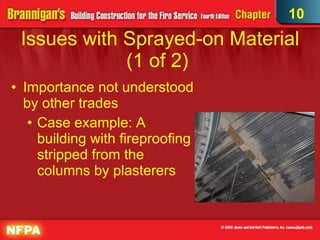
Issues with Sprayed-on Material (1 of 2)  Importance not understood by other trades Case example: A building with fireproofing stripped from the columns by plasterers 10
Issues with Sprayed-on Material (2 of 2)  Case example: A state office building in California had poorly applied fireproofing material If properly applied, can be very effective Case example: First Interstate Bank of Los Angeles 10
Asbestos Fiber Fireproofing Serious health hazard in its use  Difficult to sell a building with asbestos fireproofing  Asbestos is being removed from existing buildings 10
Signs of Trouble Deteriorated concrete Spalling that exposes reinforcing rods Cracks in concrete  10
Parking Garages When salt is used to melt snow and ice, corrosion is prevalent Damage is often difficult to determine 10
Calcium Chloride Added to concrete Has caused problems  Preventive measures include sealing the concrete, providing adequate drainage, and flushing surfaces with fresh water in the spring 10
Concrete Rehabilitation Includes removal and replacement Installation of cathodic protection Using additional steel beams  10
Unprotected Steel (1 of 4)‏ Concrete structures Often repaired with steel Steel cables fail even below 800°F 10
Unprotected Steel (2 of 4)‏ Fire fighters’ role Should watch what is being done to buildings  Almost none of what is done to a building after it is completed benefits the fire suppression effort 10
Unprotected Steel (3 of 4)‏ Case example: Fire fighter student saw structural problem with mall roof: owner did not want building department to know of problem 10
Unprotected Steel (4 of 4)‏ Steel designed into the structure Proper degree of fireproofing is usually specified If it is not designed into a structure, it is usually unprotected 10
Ceiling Finish and Voids Concrete construction has no inherent voids  Finish stages of the building can create voids  10
Waffle Slab Concrete Imitation plastic waffle concrete is often suspended below the structural slab Problem: Combustible tile with a high fire-hazard rating is often used for ceilings Interconnected voids make it possible for the tile to burn on both sides 10
Suspended Ceilings When installed as part of initial construction, more likely to have satisfactory fire hazard characteristics  Tile usually as safe as the law requires 10
Combustible Tile Need not be suspended to create a serious hazard  Flammable adhesive create problems Installing new ceilings below old combustible tile ceilings presents a serious hazard  Case example: John Sevier Retirement Center fire 10
Combustible Voids Can be created in a variety of ways Case example: A wooden suspended ceiling installed in an otherwise concrete construction. Sprinklers are below the ceiling. Fire could burn unchecked in the void  10
Modern Office Building Has huge communications and other utility requirements As much as one third of the height from floor to ceiling may be in-ceiling or under-floor voids 10
Noncombustible Voids Combustible thermal or electrical insulation and combustible plastic service piping may be in ceiling void  Hung ceilings are generally not required for the structural integrity of the building 10
The Integrity of Floors In fire-resistive buildings Floor will be a barrier to the extension of fire  More codes are requiring sprinkler protection Compartmentation is rarely achieved 10
Building Use Requires floor be penetrated Often, such penetrations compromise the integrity of the floor 10
Enclosures Around Ducts May be inadequate Can permit transmission of fire and/or smoke to other floors Poke-throughs are holes provided to draw utility services up to a floor from the void below 10
Penetrations of Floors  for Services Are increasing Floor may be unable to resist the passage of fire adequately. Suspended ceiling hopefully will develop the necessary fire resistance Owner is not free to modify the ceiling  10
Concrete Floors Require expansion joints  Case examples: Steel expansion joints transmitted fire from floor to floor in a huge postal building; molten aluminum expansion joints extended fire at McCormick place Concrete shrinks and creates cracks, which allows fire to pass 10
Imitation Materials Imitation concrete panels  Commonly used, particularly on the exterior of buildings  Fasteners that hold the panels on the building are made of plastic  If the plastic burns or melts, the panels will drop off the building 10
Energy Conservation Has brought about the use of exterior insulation and finish systems (EIFS)  Buildings can be finished in this manner when constructed or modified later Case example: Fort Worth, Texas Courthouse 10
Concrete’s Behavior in Fires Concrete in fire-resistive construction Resists compressive stresses  Protects the tensile strength of steel from fire  The concrete provides time to extinguish a fire 10
Impact Loads  Will damage concrete When spoiling has reached reinforcing steel, shoring should be done Concrete floors may give no clue to the distress on the other side 10
Cutting Tensioned Concrete  (1 of 2)‏ Fire tactics Can include cutting through a concrete floor for accessibility Hole cutter can cut a hole in conventional reinforced concrete and reinforcing rods 10
Cutting Tensioned Concrete  (2 of 2)‏ Tensioned concrete structures Steel cables are under tremendous tension  Cutting tension cables creates a potential whip  10
Precast Concrete (1 of 2)  Cast-in-place, monolithic concrete buildings Resistant to collapse  The loss of a column does not necessarily cause collapse.  Load will be redistributed 10
Precast Concrete (2 of 2)‏ Precast concrete buildings Individual columns, floors, girders, and wall panels are pinned by connectors No protective covering is provided for the connectors Fire load must be severe to cause failure 10
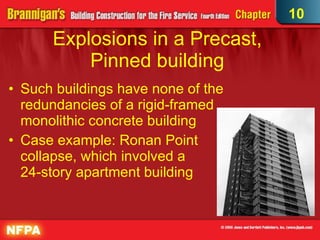
Explosions in a Precast,  Pinned building  Such buildings have none of the redundancies of a rigid-framed  monolithic concrete building Case example: Ronan Point  collapse, which involved a  24-story apartment building 10
Concrete Trusses Not common Exist in the Tampa, Florida, and Dallas/Fort Worth, Texas, airports  Exist in the American Airlines hanger at Dallas/Fort Worth  10
Fires in Concrete Buildings: Case Example 1 Los Angeles Central Library Fire in 1986 Loss was immense 200,000 books and numerous periodical collections were destroyed The book stacks provided an estimated 93 pounds per square foot (psf) of fuel  10
Fires in Concrete Buildings: Case Example 2 High-rise apartment building in Dallas, Texas $340,000 in damage  Utility and vent pipes had been punched through the ceilings 10
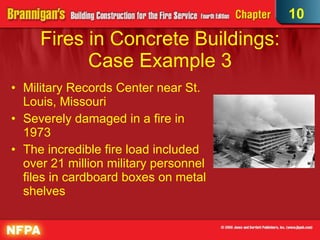
Fires in Concrete Buildings: Case Example 3 Military Records Center near St. Louis, Missouri Severely damaged in a fire in 1973  The incredible fire load included over 21 million military personnel files in cardboard boxes on metal shelves  10
Know Your Buildings When building rate is high, difficult for fire departments to keep pace Slowdowns present an opportunity to get current on the hazards of specific buildings “Experience keeps a dear school, but fools will learn in no other.”  10
Summary ( 1 of 2)‏ Concrete is a cementatious material produced by a chemical reaction There are two basic types of in-concrete construction: cast-in-place concrete and precast concrete Prestressing places engineered stresses in architectural and structural concrete 10
Summary ( 2 of 2)‏ Concrete buildings under construction can present serious fire problems The concrete in fire-resistive construction serves two purposes—it resists compressive stresses and protects the tensile strength of steel from fire 10

Ch 10 Fire-Resistive Construction

  • 1.
    10 Fire-ResistiveConstruction
  • 2.
    Objectives (1of 2)‏ Recall the difference between noncombustible and fire-resistive construction Describe different types of concrete structural systems Describe the two types of prestressing 10
  • 3.
    Objectives (2of 2)‏ Contrast precast and site-cast concrete Describe the hazards of formwork Describe the methods of fireproofing steel and of ensuring a level fire resistance in concrete Detail how compartmentation works to prevent the spread of fire 10
  • 4.
    Introduction Fire-resistive constructionConsidered to be the best Most resistant to collapse and does not contribute fuel to a fire Is given the largest permissible area and heights 10
  • 5.
    Concrete Cementatious materialproduced by a chemical reaction Cures indefinitely; low temperatures retard the curing of concrete Weak in tensile strength and has poor shear resistance 10
  • 6.
    Concrete Structures Pre-World War II Suitable only for structures in which aesthetics played little part Built of steel frames and fireproofed with concrete Cinder blocks use cinders as the aggregate Concrete blocks use other materials for aggregate 10
  • 7.
    Underwriters Blocks Concreteblocks produced under Underwriters Laboratories’ classification Manufacturer’s certificate gives the type and number of units delivered to a specific job Blocks must meet fire resistance standards 10
  • 8.
    Today’s Variety of Concrete Structures Use variety of building construction elements Steel-framed buildings now often have cast-in-place concrete floors Precast concrete and prefabricated metal wall panels and decorative brick veneer are common 10
  • 9.
    Steel vs. ConcreteFraming Designer preferences Some design in steel Others prefer concrete Some buildings concrete-framed and steel-framed mixed together 10
  • 10.
    Fire Department ProblemsProblems with concrete construction Collapse during construction with no fire Fire during construction Fire in completed, occupied buildings 10
  • 11.
    Types of ConcreteConstruction Cast-in-place Plain, reinforced, and post-tensioned concrete Precast Plain, reinforced, and pretension concrete 10
  • 12.
    Concrete Definitions (1 of 5)‏ Aggregate Cast-in-place concrete Casting Chairs Composite and combination columns 10
  • 13.
    Concrete Definitions (2 of 5)‏ Composite construction Continuous casting Continuous slipforming Drop panels Flat plate structural system (or continuous beam)‏ 10
  • 14.
    Concrete Definitions (3 of 5)‏ Footings Lally columns Lift slab Monolithic construction Mushroom caps 10
  • 15.
    Concrete Definitions (4 of 5)‏ One-way structural system Plain concrete Pretensioning and post-tensioning Precast concrete Reinforced concrete Reinforcing bars or rods 10
  • 16.
    Concrete Definitions (5 of 5)‏ Slipforming Spalling Temperature rods Two-way structural system 10
  • 17.
    Concrete Structural ElementsColumns Beams (including t-beams) and girders Concrete floors 10
  • 18.
    Virtue of ColumnsHigh compressive strength and low cost Columns are of reinforced concrete Steel reinforcing rods carry some of the compressive load The compressive strength of steel is many times that of concrete 10
  • 19.
    Increasing Column SizesUnsatisfactory in modern construction The useable area would vary from floor to floor Overcome by increasing the size of the reinforcing steel as the loads increase 10
  • 20.
    Reinforcing Rods Longwith a relatively thin diameter Ends of rods are connected Ties or hoops join the rods in a column Ties cut the long slender column into a number of relatively short columns 10
  • 21.
    Beams and Girding (1 of 3) ‏ Plain concrete beam Strong in compression, weak in shear No tensile strength When a beam is loaded, it deflects Deflection brings compression in the top of the beam and tension in the bottom of the beam 10
  • 22.
    Beams and Girding (2 of 3)‏ Cantilever beam Tension is in the top of the beam Reinforcing rods are in the top of the beam 10
  • 23.
    Beams and Girding (3 of 3)‏ Continuous beam Supported at more than two points Tension in the top of the beam in the area over the tops of the columns Tension in the bottom of the beams between columns 10
  • 24.
    T-Beams There isneither tension nor compression in the beam Has the neutral plane coincide with the bottom of the wide, thin floor slab Double T’s are floor slab and beam combinations with two beams 10
  • 25.
    Concrete Floors Firstused for leveling brick and tile arch floors Early floors built of individual beams supporting a floor slab Hollow tiles lightened concrete floors 10
  • 26.
    Waffle Concrete Closelyspaced beams are set at right angles to one another Unnecessary concrete is formed out 10
  • 27.
    Lighter Construction Floormay be just a flat plate This gives a smooth surface Easily finished 10
  • 28.
    Left-In-Place Form Occurswhen concrete floors are cast onto corrugated steel The steel provides necessary tensile strength If the bond fails, the floor section may fail 10
  • 29.
    Precast T-Beam UnitsAdditional concrete is often cast-in-place on top of the units Entire unit becomes an integral beam-and-floor element Cylindrical openings can be cast lengthwise through the units to remove unnecessary weight 10
  • 30.
    Older Building Codes Concrete floor can be in ordinary construction Case example: Concrete topping over wood beams concealed the destruction of the beams by fire. Four fire fighters died 10
  • 31.
    One-Hour-Rated Designsof Wood Floors Lightweight concrete topping as much as 1 to 1 1/2 inches thick Thickness retards the passage of heat through the floor National Fire Protection Association (NFPA) 251 (American Society of Testing and Materials (ASTM) E119) fire resistance standard 10
  • 32.
    Cast-In-Place Concrete FloorCan be a hazard during construction A slot is left in the wall at the point where the floor is to be cast If a windstorm occurs during the time that the slot is open, a collapse may result 10
  • 33.
    Concrete Floors in Steel Buildings May be precast or cast-in-place May be only load-bearing or provide structural stability 10
  • 34.
    Concrete Floors inCast-In-Place, Concrete-Framed Buildings Cast integrally with columns Provide a monolithic rigid-framed building May be pinned May be connected as a monolithic unit 10
  • 35.
    When Slabs AreLaid Down A space is left between them Protruding bars of one slab extend past the ends of the protruding bars of the other slab The sections are joined by a wet joint 10
  • 36.
    Concrete Floors inPrecast, Pinned Concrete Buildings May not contribute to the building’s structural stability Precast columns are often built with haunches or shelves Steel plates imbedded in the concrete may be welded together 10
  • 37.
    Prestressed Concrete Recentlydeveloped Engineered stresses placed in architectural and structural concrete Analogy: A row of books side by side, before and after being threaded together with wire 10
  • 38.
    Special High-Strength, Cold-Drawn Steel Cables Similar to those used for suspension bridges These or alloy steel bars are commonly used in prestressed concrete Known as tendons, but also called strands or cables 10
  • 39.
    High-Tensile-Strength Wire Ordinarilyused for prestressing More sensitive to high temperatures than structural steel Complete loss of prestress at 800°F 10
  • 40.
    Two Methods ofPrestressing (1 of 2)‏ Pretensioning Done in a plant High-tensile-strength steel strands are stretched between the ends of a form After processing, stretched strands draw back, thus compressing the concrete 10
  • 41.
    Two Methods ofPrestressing (2 of 2)‏ Post-tensioning Done on the job site High-tensile-steel strand wires are positioned in the forms After processing, steel tendons are stretched and anchored at the ends of the unit 10
  • 42.
    Bridge Girders Someare tensioned enough to make shipment possible, then post-tensioned after being placed Cement paste might be forced into the space between the tendon and the concrete to provide a bond 10
  • 43.
    Reinforced Masonry Widelyused to resist earthquakes Unsuitable for multistory buildings in which large clear spans are required Apartment houses and motels are well adapted to this method 10
  • 44.
    Ordinary Brick Bearing-WallBuildings (1 of 2)‏ Walls must increase in thickness as the building’s height increases. Limit is generally about 6 stories Recent years, possible to 20 or more stories 10
  • 45.
    Ordinary Brick Bearing-WallBuildings (2 of 2)‏ Construction methods allow higher buildings Two wythes of brick are built The width of one brick is left between them Reinforcing rods are placed vertically Concrete is poured into the void 10
  • 46.
    Special Cases (1 of 2)‏ Low-rise buildings Recent designs have eliminated reinforced concrete in the wall High compressive-strength bricks and special mortar are used instead Masonry wall-bearing building can be several stories high 10
  • 47.
    Special Cases (2 of 2) ‏ Concrete block Has become popular for some resorts With outside open-air stairways and balconies, life safety is achieved 10
  • 48.
    Collapse Under ConstructionConcrete structures under construction sometimes collapse Fire department rescues construction workers Fire officers should be well informed on the legal position of the fire department 10
  • 49.
    Ordering the Removalof a Dangerous Structure Power given to the building commissioner Fire department has no right to demolish such a structure. 10
  • 50.
    Lawsuits Common todayOwner, architect, general contractor, subcontractors, and victims attempt to determine financial responsibility After collapses, some of those involved may try to cover up their actions 10
  • 51.
    An Industry WarningExperts have warned of the collapse hazard of concrete structures Design engineers should use construction loads as governing loads in structures 10
  • 52.
    Problems of Falsework Falsework Temporary structure to support concrete work in the course of construction Can represent 60% of the cost of a concrete structure 10
  • 53.
    Concrete Formwork Designedwithout the extra strength calculated into a building to compensate for deterioration Built at the lowest possible cost Formwork failures can occur, but it is surprising is that they are relatively rare 10
  • 54.
    Falsework for Wallsor Columns Must have adequate strength to resist the pressure of heavy fluid concrete As concrete sets, pressure is reduced due to internal friction Setting of concrete is temperature dependent 10
  • 55.
    Reshoring Concrete Concreterequires time to cure Formwork is then removed Reshoring is putting shores back in place to help carry the load Reshoring means concrete is not yet set 10
  • 56.
    Collapses of Floors(1 of 2)‏ Many involve formwork supporting newly cast or high bay floors Proper cross-bracing can help prevent this 10
  • 57.
    Collapses of Floors(2 of 2)‏ Formwork can also be a problem Often rests on the ground Mudsills are the planks on which the shores rest If mud is involved, bearing may be inadequate 10
  • 58.
    A Widely BelievedFallacy “Reinforced concrete which has set hard to the touch usually has developed enough strength to be self-supporting, though it may not be capable of handling superimposed loads.” 10
  • 59.
    Skyline Towers CollapseSkyline Towers collapsed in Arlington, Virginia, 1973 Collapse proved the fallacy Shoring had been removed from the topmost floor The floor collapsed, and the collapse was progressive 10
  • 60.
    Lessons from SkylineTowers Removal of shoring by laborers is no different than removal by fire Any concrete formwork failure presents the likelihood for catastrophic collapse Few concrete buildings can withstand the collapse of one floor onto another 10
  • 61.
    Hazards of Post-Tensioning(1 of 2)‏ Hydraulic jacks are used to tension the tendons or jack the cables No bond between the tendons and the concrete 10
  • 62.
    Hazards of Post-Tensioning (2 of 2)‏ Weight of concrete transfers to columns only when tensioning is complete Case example: The Skyline Towers garage was made of post-tensioned concrete. Poor sheer resistance led to collapse 10
  • 63.
    Collapse of ReinforcedMasonry Used widely in construction Workers might overload a floor portion Case example: In Pittsburgh, Pennsylvania an excess load caused the partial collapse of several stories of precast floors 10
  • 64.
    Collapse of PrecastConcrete Precast concrete buildings under construction are unstable Temporary bracing holds units in place Wooden temporary shoring might also be used Case example: Montgomery County Maryland. Three-story garage collapsed due to oversized washer 10
  • 65.
    Lift-slab Collapses (1of 3)‏ Lift-slab construction Ground floor slab is cast first Bond breakers are used between the slabs Slabs are raised to the columns Each floor is temporarily connected to the columns 10
  • 66.
    Lift-Slab Collapses (2of 3)‏ Case example: L’Ambience Plaza concrete building under construction in Connecticut was due to the failure of a single connection 10
  • 67.
    Lift-Slab Collapses (3of 3)‏ When do the accidents occur? While the slabs are being lifted or while no lifting is being done Case example: In California, a roof slab was lifted to columns three inches out of plumb. As an attempt was made to pull the slab back into place, it collapsed 10
  • 68.
    Fire Problems ofConcrete Buildings Under Construction Concrete buildings under construction can present serious fire problems Fire in formwork can easily result in major collapse Little reserve strength in formwork Little understanding of potential hazard 10
  • 69.
    Potential Fires ata Construction Site Fires at a construction site Causes include welding, cutting, and plumbers’ torches; temporary electrical lines; and arson Fuels are readily available Glass-fiber formwork is also combustible 10
  • 70.
    Hazard of HeatingBurning of scrap wood in steel barrels or the use kerosene heaters are hazards Liquefied petroleum gas (LPG) is also dangerous 10
  • 71.
    Codes for LPG(1 of 2)‏ Store gas away from any open flames. Case example: 1963, LPG explosion at the Indianapolis Coliseum; caused when a leaking gas-fired cooker cylinder exploded and gas reached heater flame 10
  • 72.
    Codes for LPG(2 of 2)‏ Install excess flow valves. Case example: In one city, gas stored and piped with plastic tubes at ground level; hazard should line break 10
  • 73.
    Hazards of Post-TensionedConcrete (1 of 2)‏ Catastrophic fire collapse potential Include bridges and parking garages Falsework fire could cause the sudden collapse of an entire concrete floor slab After tensioning, the ends of tendons are left exposed 10
  • 74.
    Hazards of Post-TensionedConcrete (2 of 2)‏ Hanging tendons can fail at about 800°F Excess tendons are rolled up and attached to a wooden rack. Rolled-up tendons are heat collectors Failure of tendons will cause the collapse of that part of the structure 10
  • 75.
    Protection of TendonsInsist on fireproofing tendon anchors immediately after tensioning is completed Insist on temporary protection for incrementally tensioned tendons 10
  • 76.
    A Total Collapse: Case Example A post-tensioned building under construction in Cleveland, Ohio, suffered a falsework fire After a second fire, the entire 18-story building collapsed 10
  • 77.
    Precast Buildings (2of 2)‏ Pose unique hazards while being constructed Construction involves erection of precast concrete units. 10
  • 78.
    Precast Buildings (2of 2)‏ Temporary bracing or support is used; it can collapse Columns can be braced with wood rather than by telescoping tubular steel braces; wood is flammable Cold-drawn steel cables often provide diagonal bracing in precast buildings; these fail at 800° F 10
  • 79.
    Cantilevered Platforms Usedby cranes delivering materials to buildings under construction Are braced by wooden shores that would fail in a fire 10
  • 80.
    Tower Cranes Supportedon the building’s structural frame Weight of the crane may be distributed over several floors by falsework A fire involving this falsework can bring down the crane 10
  • 81.
    Falsework on a Completed Floor Should be investigated May be supporting a patch over a hole May be supporting a heavy load such as the crane 10
  • 82.
    Falsework: Case ExampleFormwork for concrete placement burned on the 23 rd to 25 th floors of a high-rise Operator was trapped in his cab He was protected with a heavy-caliber stream from a nearby roof until rescued 10
  • 83.
    Fire Problems in Finished Buildings Concrete construction Thought to be truly fireproof Later, it was learned that concrete, like any other noncombustible material, can be destroyed by fire 10
  • 84.
    Characteristics of Concrete Inherently noncombustible Some people confuse noncombustibility with fire resistance Neither is synonymous with fire safety 10
  • 85.
    Safety of ConcreteConstruction: Case Example Reinforced concrete Joelma building in Sao Paulo, Brazil, burned in 1974 Resulted in179 deaths. The structure had minor damage. 10
  • 86.
    Fireproofing (Insulating) SteelHas a fire resistance rating if the protection system previously passed a standard fire test No such thing as a truly fireproof building Fireproofed steel is protected steel 10
  • 87.
    Types of Fireproofing(1 of 2)‏ Individual fireproofing provides protection for each piece of steel Methods include encasement and intumescent coating Membrane fireproofing does not protect individual members 10
  • 88.
    Types of Fireproofing(2 of 2)‏ One method uses a rated floor-ceiling assembly Underwriters Laboratories can test a roof and ceiling assembly NFPA 251 (ASTM E119) standard fire test 10
  • 89.
    Hazards of Floor–ceilingAssemblies Can present a serious menace to the safety of fire fighters Assemblies need to be assembled exactly as performed in the laboratory 10
  • 90.
    Ceiling System Atthe mercy of those have reason to remove ceiling tiles Access to utilities and additional storage space are two reasons to remove tiles 10
  • 91.
    Legal Provisions Nonerequire membrane protection be maintained Replacement acoustical tile may be combustible All penetrations of the ceiling must be rated as part of the ceiling system 10
  • 92.
    Term “Fire-rated” Usedquite often in the fire protection and building construction fields Nonspecific and meaningless No part of a listed fire-resistance system stands by itself 10
  • 93.
    Integrity of aCeiling System Most are unaware of its significance Alterations compromise integrity Tiles are replaced haphazardly Holes are cut through tiles Displays are hung from the metal grid Testing doesn’t include superimposed loads 10
  • 94.
    Laboratory Fire TestsConducted under a slight negative pressure to remove smoke and fumes Fires generate positive pressure, and lay-in ceiling tiles may be easily displaced by fire pressures 10
  • 95.
    Addition of InsulationMight not be part of the specifications of the listed ceiling assembly Wrong insulation causes heat to be held in the channels supporting the tiles A membrane protection system must be perfect 10
  • 96.
    Cockloft Occurs betweenthe ceiling and floor Allows for rapid fire spread Case example: Fire starting in one room traveled across a hallway above the ceiling; it came down through the tile ceiling of another room to ignite books 10
  • 97.
    Firestopping Some codeprovisions provide for this Use of plenum space for various services makes it probable that the firestopping will conform only to the definition of legal firestopping 10
  • 98.
    Deep, Long-span TrussesIn some buildings, used to provide clear floor areas This creates plenum spaces several feet in height Sometimes voids are called “interstitial spaces” Using such space as storage places fire load next to unprotected steel 10
  • 99.
    Fire Resistance of Floor-Ceiling Assemblies Not all are intended to be fire resistive A steel bar-joist floor with concrete topping and flame-spread-rated tiles below may appear to be fire resistive, but it is not 10
  • 100.
    Missing Tiles Doesnot necessarily mean that a fire resistance system has been violated The building may be of noncombustible construction In such a case, ceiling tiles are at the option of the owner 10
  • 101.
    Concrete Construction BuildingSome concrete assemblies have suspended tiles incorporated Most of the time, the suspended ceiling is installed to provide a hidden void for utilities 10
  • 102.
    Fireproofing and BuildingCodes Fireproofing Applied to meet the standards required by the local building code Further, building department will indicate which systems tested at which laboratories are acceptable. 10
  • 103.
    Efficiency of FireproofingDepends on the competence of the subcontractor Also depends on the building department staff and on the fire department inspectors 10
  • 104.
    Encasement Methods Terracotta tile Early method for encasement Case example: The cast-iron columns of the Parker Building in New York City were protected with three-inch terra cotta tiles, but still burned and failed 10
  • 105.
    Errors in EncasementLeaving the bottom web of beams unprotected Skewbacks, which are tiles shaped to fit around steel, corrects this error Skewbacks, however, often are removed for other reasons 10
  • 106.
    Limitations of Encasement Method Fireproofing that is easily removed is a hazard Case example: A contractor removed the fireproofing protection from a major column. About a hundred cylinders of propane gas were stored adjacent to the column 10
  • 107.
    Concrete Encasement Concretebecame quite popular as a protective covering for steel Wood falsework provides a high fuel load Has been involved in a number of serious construction fires 10
  • 108.
    Fireproofing of Steeland Concrete Beams Fireproofing is integral; accomplished by a specified mix of concrete in a specified thickness Some concrete is necessary for fireproofing 10
  • 109.
    Disadvantage of ConcreteIts weight Fireproofing is often a tempting target for cutting back Case example: Builders replace concrete with wire laths covered with cement plaster or gypsum, both of which are lighter 10
  • 110.
    Sprayed-on Fireproofing Sprayedconcrete spalls badly when exposed to fire Other sprayed-on fireproofing can pass laboratory tests, but questions exist about their reliability in the field 10
  • 111.
    Issues with Sprayed-onMaterial (1 of 2) Importance not understood by other trades Case example: A building with fireproofing stripped from the columns by plasterers 10
  • 112.
    Issues with Sprayed-onMaterial (2 of 2) Case example: A state office building in California had poorly applied fireproofing material If properly applied, can be very effective Case example: First Interstate Bank of Los Angeles 10
  • 113.
    Asbestos Fiber FireproofingSerious health hazard in its use Difficult to sell a building with asbestos fireproofing Asbestos is being removed from existing buildings 10
  • 114.
    Signs of TroubleDeteriorated concrete Spalling that exposes reinforcing rods Cracks in concrete 10
  • 115.
    Parking Garages Whensalt is used to melt snow and ice, corrosion is prevalent Damage is often difficult to determine 10
  • 116.
    Calcium Chloride Addedto concrete Has caused problems Preventive measures include sealing the concrete, providing adequate drainage, and flushing surfaces with fresh water in the spring 10
  • 117.
    Concrete Rehabilitation Includesremoval and replacement Installation of cathodic protection Using additional steel beams 10
  • 118.
    Unprotected Steel (1of 4)‏ Concrete structures Often repaired with steel Steel cables fail even below 800°F 10
  • 119.
    Unprotected Steel (2of 4)‏ Fire fighters’ role Should watch what is being done to buildings Almost none of what is done to a building after it is completed benefits the fire suppression effort 10
  • 120.
    Unprotected Steel (3of 4)‏ Case example: Fire fighter student saw structural problem with mall roof: owner did not want building department to know of problem 10
  • 121.
    Unprotected Steel (4of 4)‏ Steel designed into the structure Proper degree of fireproofing is usually specified If it is not designed into a structure, it is usually unprotected 10
  • 122.
    Ceiling Finish andVoids Concrete construction has no inherent voids Finish stages of the building can create voids 10
  • 123.
    Waffle Slab ConcreteImitation plastic waffle concrete is often suspended below the structural slab Problem: Combustible tile with a high fire-hazard rating is often used for ceilings Interconnected voids make it possible for the tile to burn on both sides 10
  • 124.
    Suspended Ceilings Wheninstalled as part of initial construction, more likely to have satisfactory fire hazard characteristics Tile usually as safe as the law requires 10
  • 125.
    Combustible Tile Neednot be suspended to create a serious hazard Flammable adhesive create problems Installing new ceilings below old combustible tile ceilings presents a serious hazard Case example: John Sevier Retirement Center fire 10
  • 126.
    Combustible Voids Canbe created in a variety of ways Case example: A wooden suspended ceiling installed in an otherwise concrete construction. Sprinklers are below the ceiling. Fire could burn unchecked in the void 10
  • 127.
    Modern Office BuildingHas huge communications and other utility requirements As much as one third of the height from floor to ceiling may be in-ceiling or under-floor voids 10
  • 128.
    Noncombustible Voids Combustiblethermal or electrical insulation and combustible plastic service piping may be in ceiling void Hung ceilings are generally not required for the structural integrity of the building 10
  • 129.
    The Integrity ofFloors In fire-resistive buildings Floor will be a barrier to the extension of fire More codes are requiring sprinkler protection Compartmentation is rarely achieved 10
  • 130.
    Building Use Requiresfloor be penetrated Often, such penetrations compromise the integrity of the floor 10
  • 131.
    Enclosures Around DuctsMay be inadequate Can permit transmission of fire and/or smoke to other floors Poke-throughs are holes provided to draw utility services up to a floor from the void below 10
  • 132.
    Penetrations of Floors for Services Are increasing Floor may be unable to resist the passage of fire adequately. Suspended ceiling hopefully will develop the necessary fire resistance Owner is not free to modify the ceiling 10
  • 133.
    Concrete Floors Requireexpansion joints Case examples: Steel expansion joints transmitted fire from floor to floor in a huge postal building; molten aluminum expansion joints extended fire at McCormick place Concrete shrinks and creates cracks, which allows fire to pass 10
  • 134.
    Imitation Materials Imitationconcrete panels Commonly used, particularly on the exterior of buildings Fasteners that hold the panels on the building are made of plastic If the plastic burns or melts, the panels will drop off the building 10
  • 135.
    Energy Conservation Hasbrought about the use of exterior insulation and finish systems (EIFS) Buildings can be finished in this manner when constructed or modified later Case example: Fort Worth, Texas Courthouse 10
  • 136.
    Concrete’s Behavior inFires Concrete in fire-resistive construction Resists compressive stresses Protects the tensile strength of steel from fire The concrete provides time to extinguish a fire 10
  • 137.
    Impact Loads Will damage concrete When spoiling has reached reinforcing steel, shoring should be done Concrete floors may give no clue to the distress on the other side 10
  • 138.
    Cutting Tensioned Concrete (1 of 2)‏ Fire tactics Can include cutting through a concrete floor for accessibility Hole cutter can cut a hole in conventional reinforced concrete and reinforcing rods 10
  • 139.
    Cutting Tensioned Concrete (2 of 2)‏ Tensioned concrete structures Steel cables are under tremendous tension Cutting tension cables creates a potential whip 10
  • 140.
    Precast Concrete (1of 2) Cast-in-place, monolithic concrete buildings Resistant to collapse The loss of a column does not necessarily cause collapse. Load will be redistributed 10
  • 141.
    Precast Concrete (2of 2)‏ Precast concrete buildings Individual columns, floors, girders, and wall panels are pinned by connectors No protective covering is provided for the connectors Fire load must be severe to cause failure 10
  • 142.
    Explosions in aPrecast, Pinned building Such buildings have none of the redundancies of a rigid-framed monolithic concrete building Case example: Ronan Point collapse, which involved a 24-story apartment building 10
  • 143.
    Concrete Trusses Notcommon Exist in the Tampa, Florida, and Dallas/Fort Worth, Texas, airports Exist in the American Airlines hanger at Dallas/Fort Worth 10
  • 144.
    Fires in ConcreteBuildings: Case Example 1 Los Angeles Central Library Fire in 1986 Loss was immense 200,000 books and numerous periodical collections were destroyed The book stacks provided an estimated 93 pounds per square foot (psf) of fuel 10
  • 145.
    Fires in ConcreteBuildings: Case Example 2 High-rise apartment building in Dallas, Texas $340,000 in damage Utility and vent pipes had been punched through the ceilings 10
  • 146.
    Fires in ConcreteBuildings: Case Example 3 Military Records Center near St. Louis, Missouri Severely damaged in a fire in 1973 The incredible fire load included over 21 million military personnel files in cardboard boxes on metal shelves 10
  • 147.
    Know Your BuildingsWhen building rate is high, difficult for fire departments to keep pace Slowdowns present an opportunity to get current on the hazards of specific buildings “Experience keeps a dear school, but fools will learn in no other.” 10
  • 148.
    Summary ( 1of 2)‏ Concrete is a cementatious material produced by a chemical reaction There are two basic types of in-concrete construction: cast-in-place concrete and precast concrete Prestressing places engineered stresses in architectural and structural concrete 10
  • 149.
    Summary ( 2of 2)‏ Concrete buildings under construction can present serious fire problems The concrete in fire-resistive construction serves two purposes—it resists compressive stresses and protects the tensile strength of steel from fire 10

Editor's Notes

  • #12 © Dick Stada/ShutterStock, Inc.
  • #15 Courtesy National Institute of Standards and Technology
  • #16 © Brad Wynnyk/Alamy Images
  • #17 © Marek Pawluczuk/ShutterStock, Inc.
  • #53 © photoslb/ShutterStock, Inc.
  • #112 Photo courtesy of Blaze-tech Fire Protection
  • #143 © EMPICS/Landov
  • #147 © Renyold Ferguson/The St. Louis Post-Dispatch