Type IV
  Building
Construction


               By:
                     Manuel S.
                     Steven E.
                     Bryan W.
                     Jon M.
Type IV Building Construction
• Some times is called “mill construction” because
  it was the type of construction used at the turn of
  the century.
   – Was used on New England mills to house heavy
     equipment.
• These structures are manly used in
  manufacturing centers, churches, and/or schools.
• Buildings have masonry walls like type III
  buildings but the interior wood consists of large
  timbers.
• The floor and roof are plank board
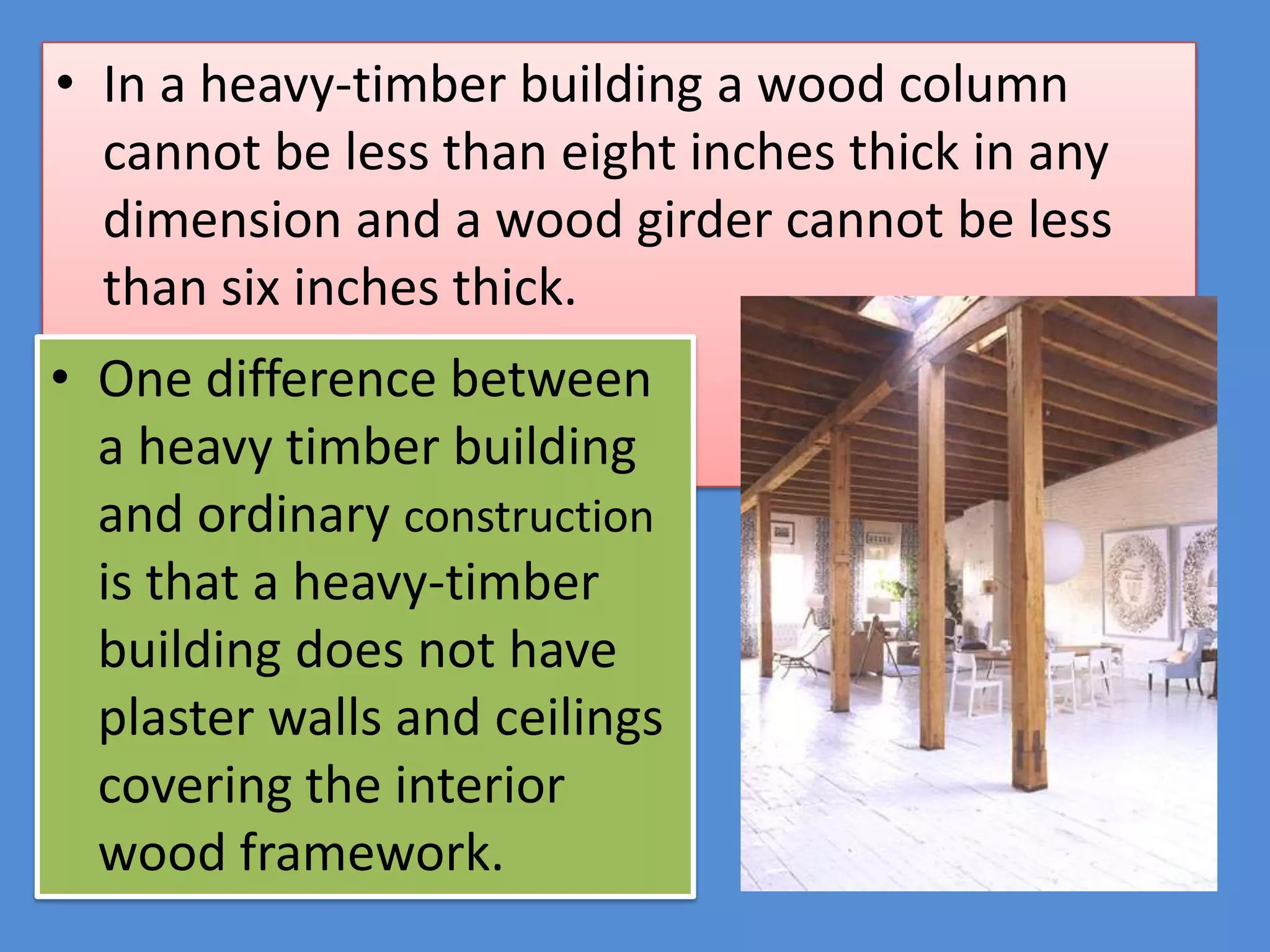
• In a heavy-timber building a wood column
  cannot be less than eight inches thick in any
  dimension and a wood girder cannot be less
  than six inches thick.
• One difference between
  a heavy timber building
  and ordinary construction
  is that a heavy-timber
  building does not have
  plaster walls and ceilings
  covering the interior
  wood framework.
• In heavy timber type of construction fire
  resistance is attained by putting limitations of
  minimum sizes on the wood structural
  members and on minimum thickness and
  composition of wood floors and roofs; by
  avoiding of concealed spaces under floors and
  roofs; by use of approved fastenings,
  construction details, and adhesives; and
  providing the required degree of fire
  resistance in exterior and interior walls.
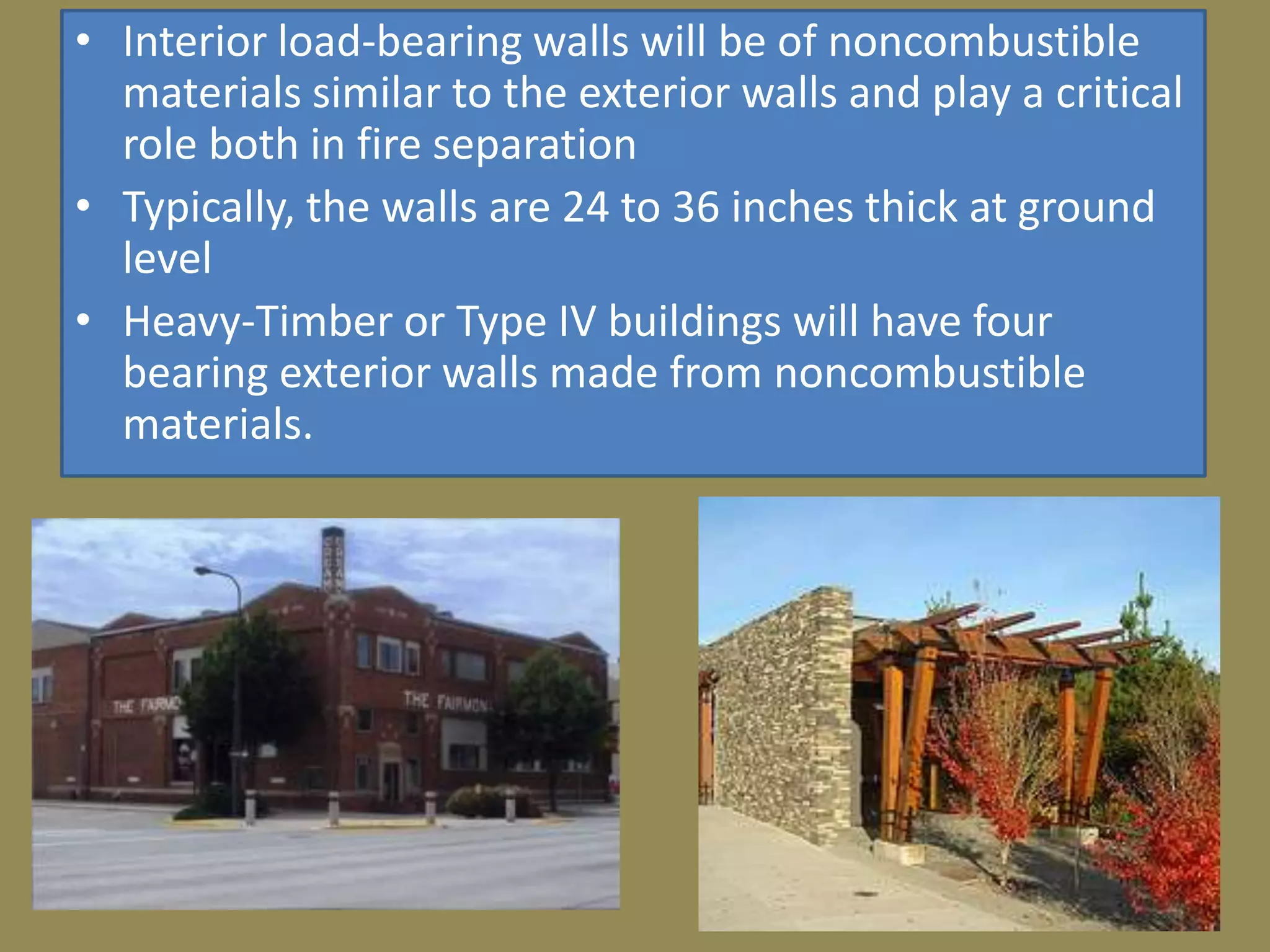
• Interior load-bearing walls will be of noncombustible
  materials similar to the exterior walls and play a critical
  role both in fire separation
• Typically, the walls are 24 to 36 inches thick at ground
  level
• Heavy-Timber or Type IV buildings will have four
  bearing exterior walls made from noncombustible
  materials.
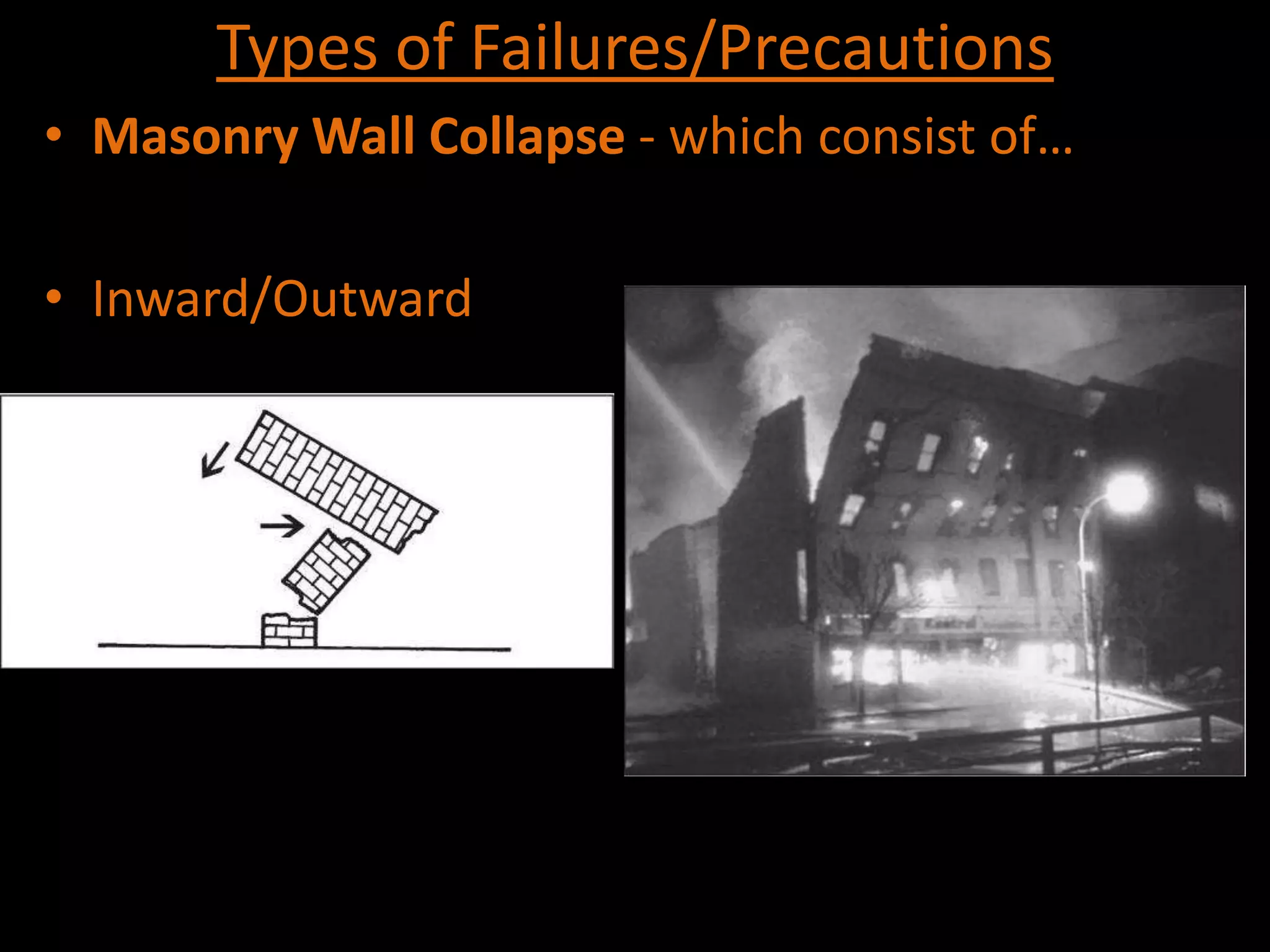
Types of Failures/Precautions
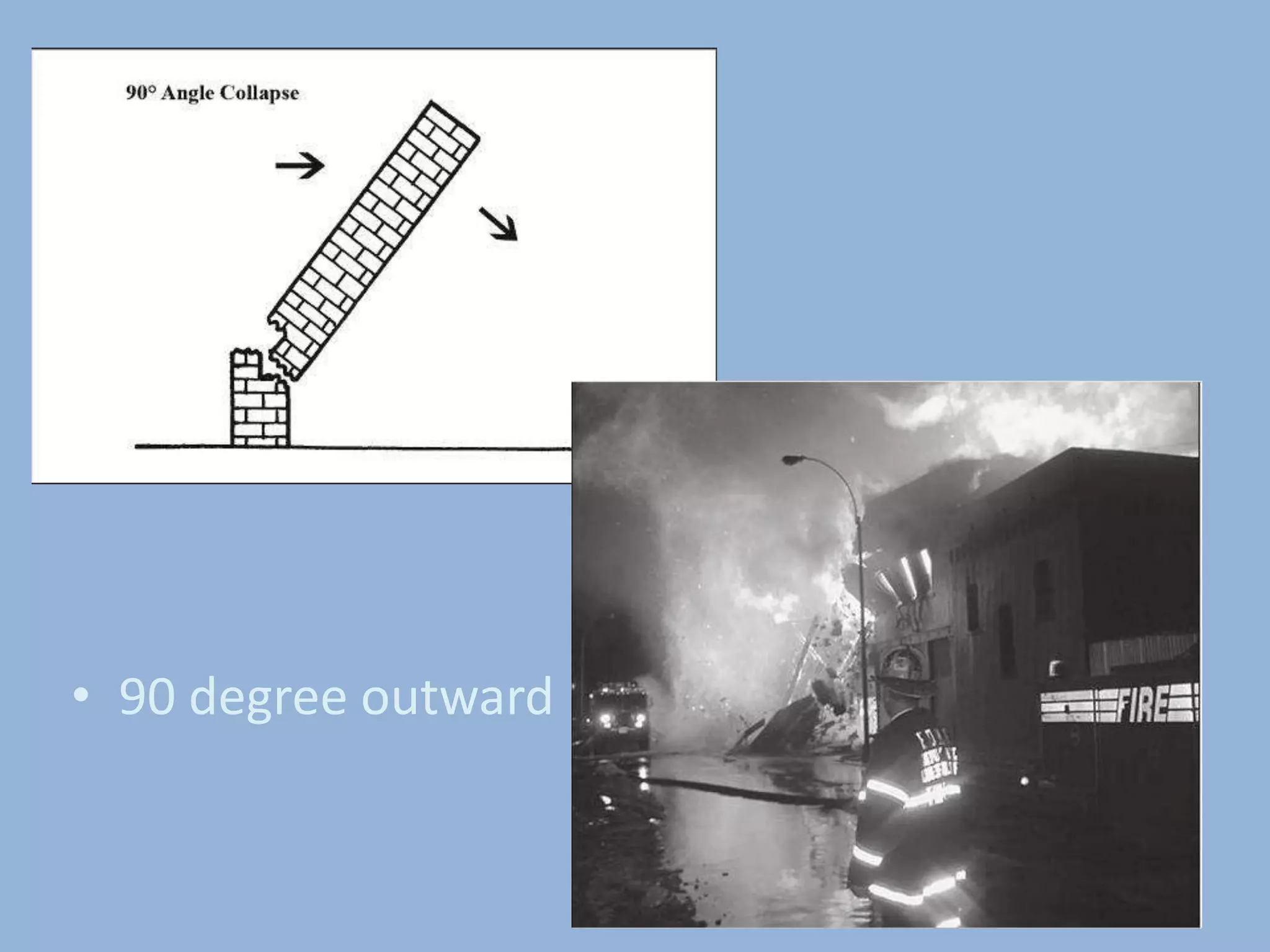
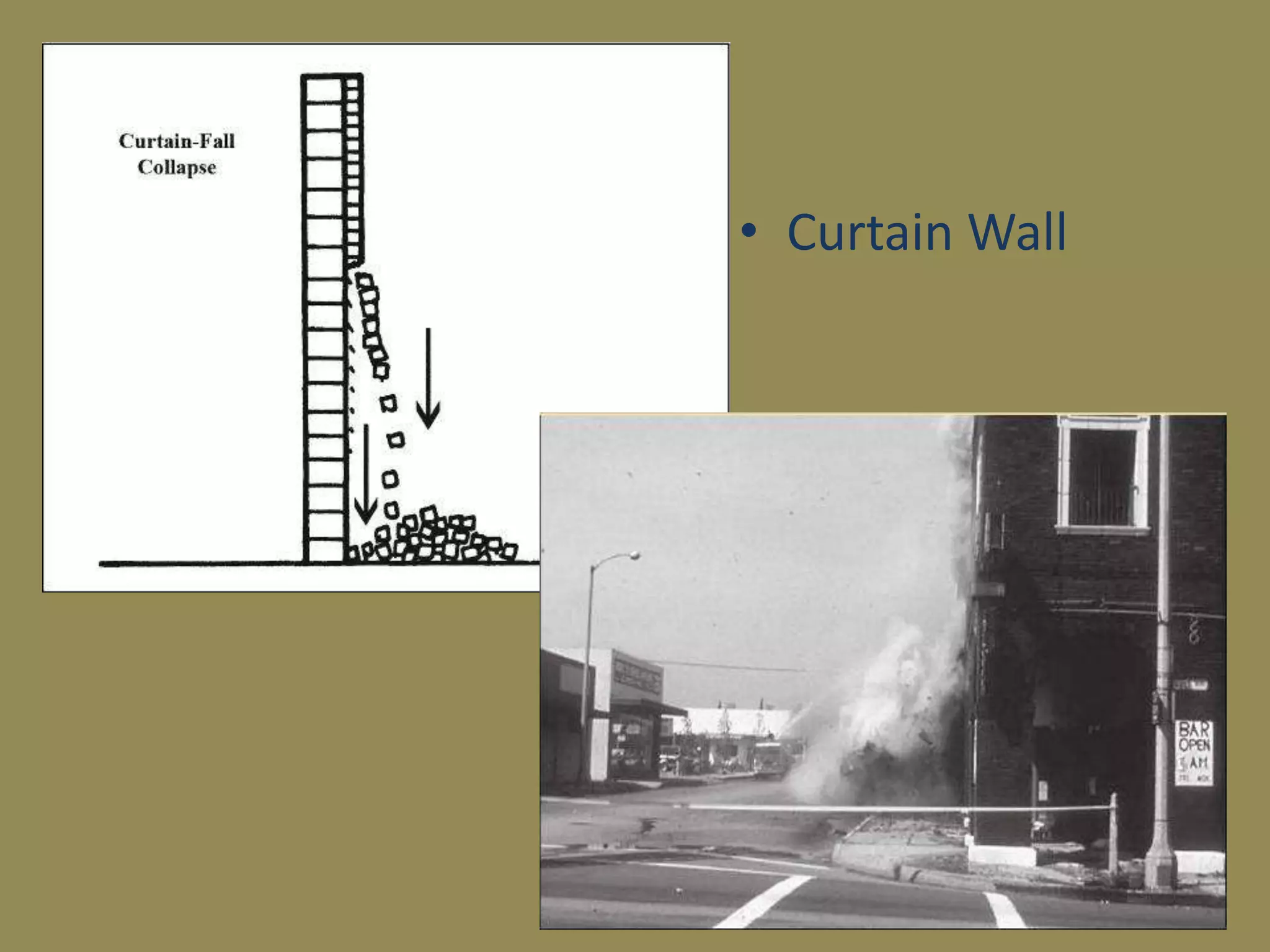
• Masonry Wall Collapse - which consist of…

• Inward/Outward
• 90 degree outward
• Curtain Wall
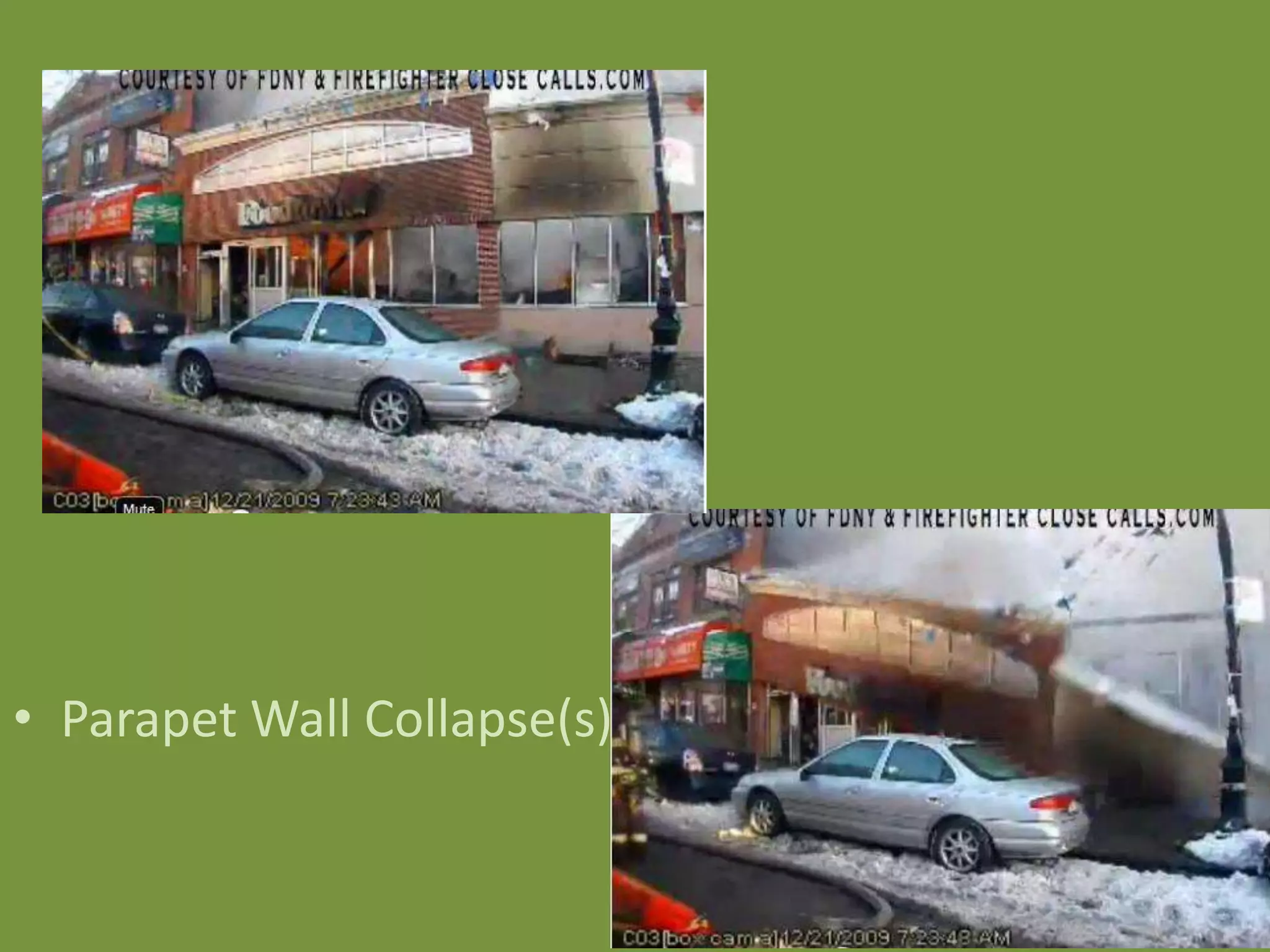
• Parapet Wall Collapse(s)
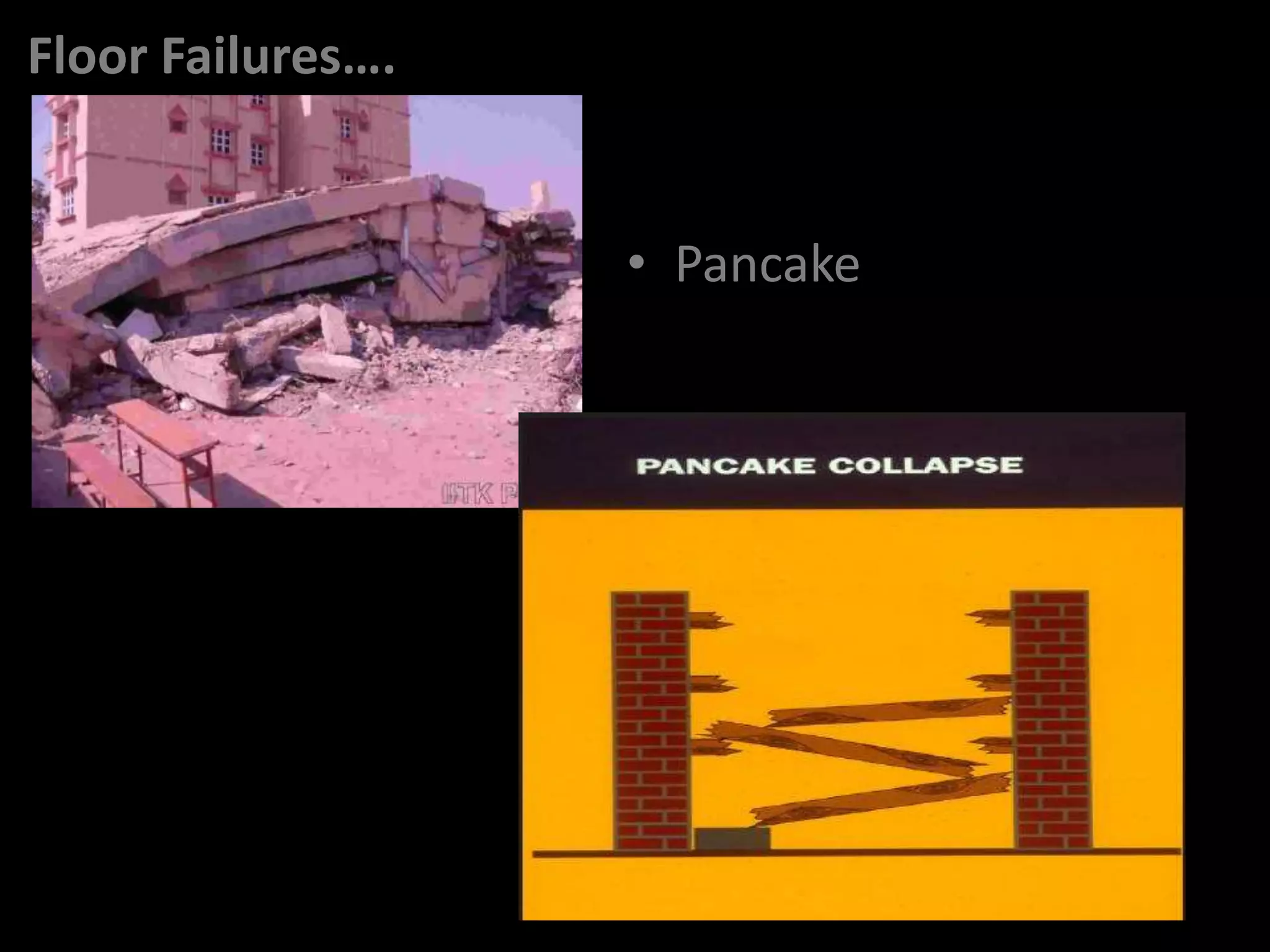
Floor Failures….


                   • Pancake
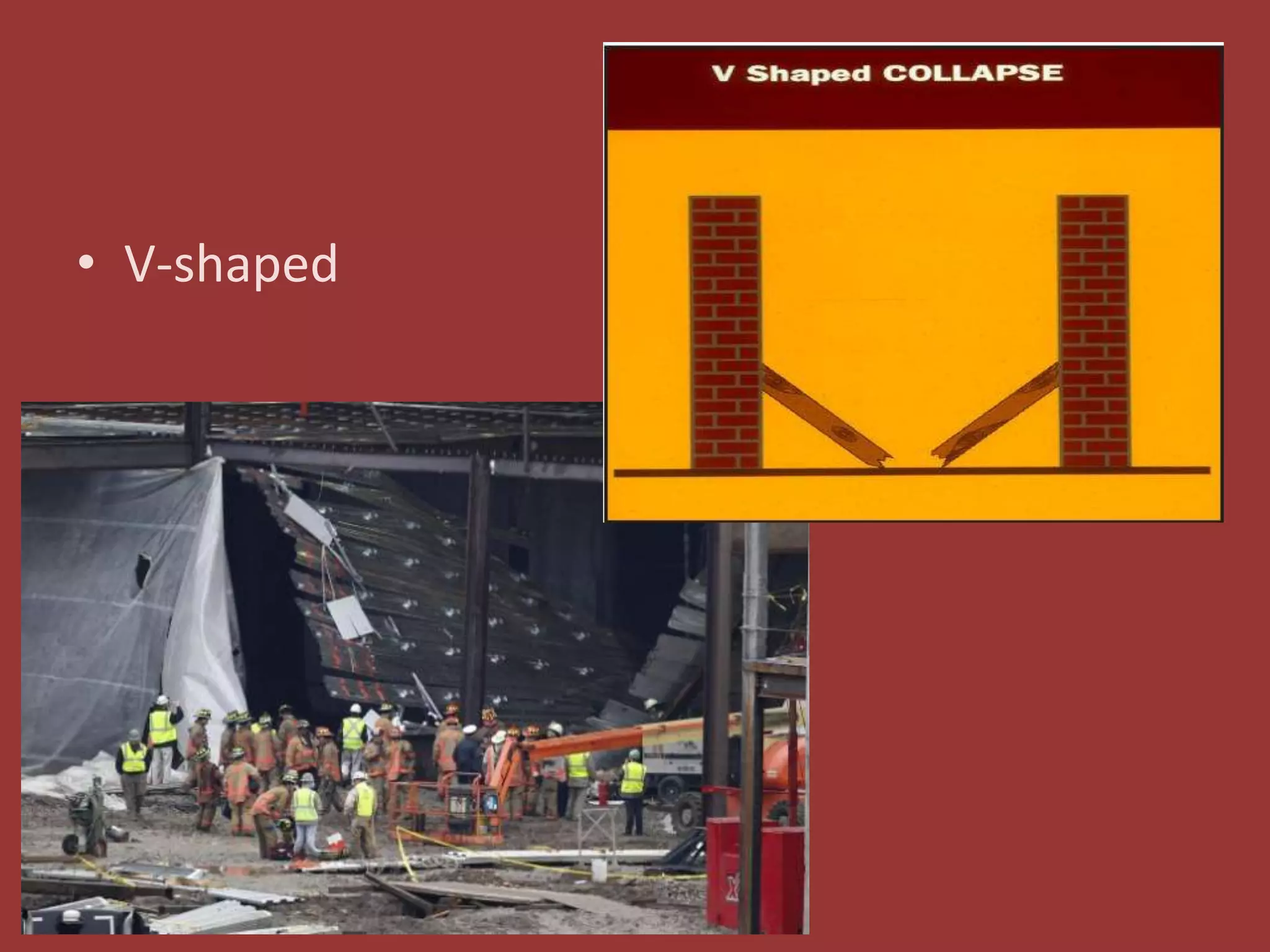
• V-shaped
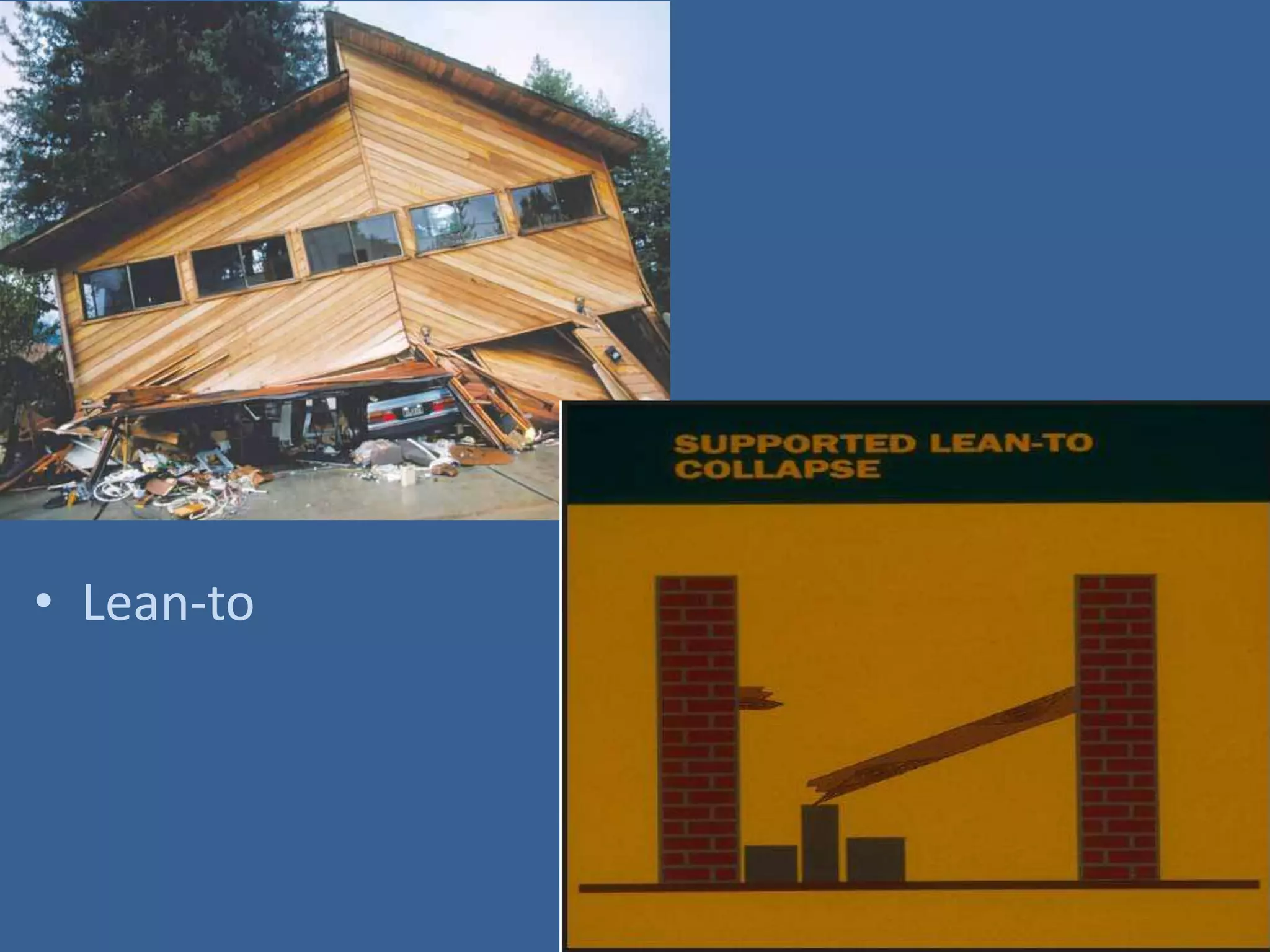
• Lean-to
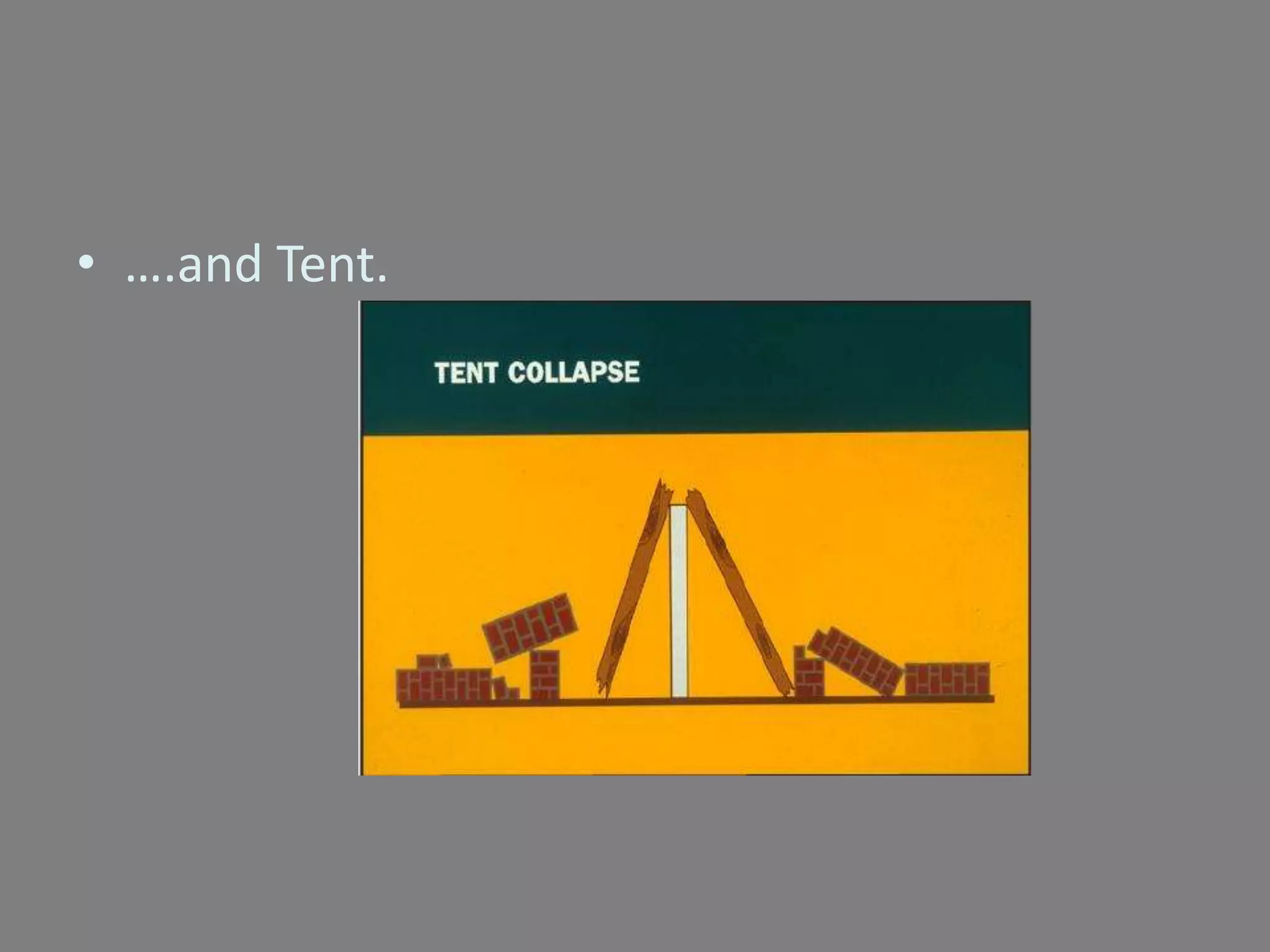
• ….and Tent.
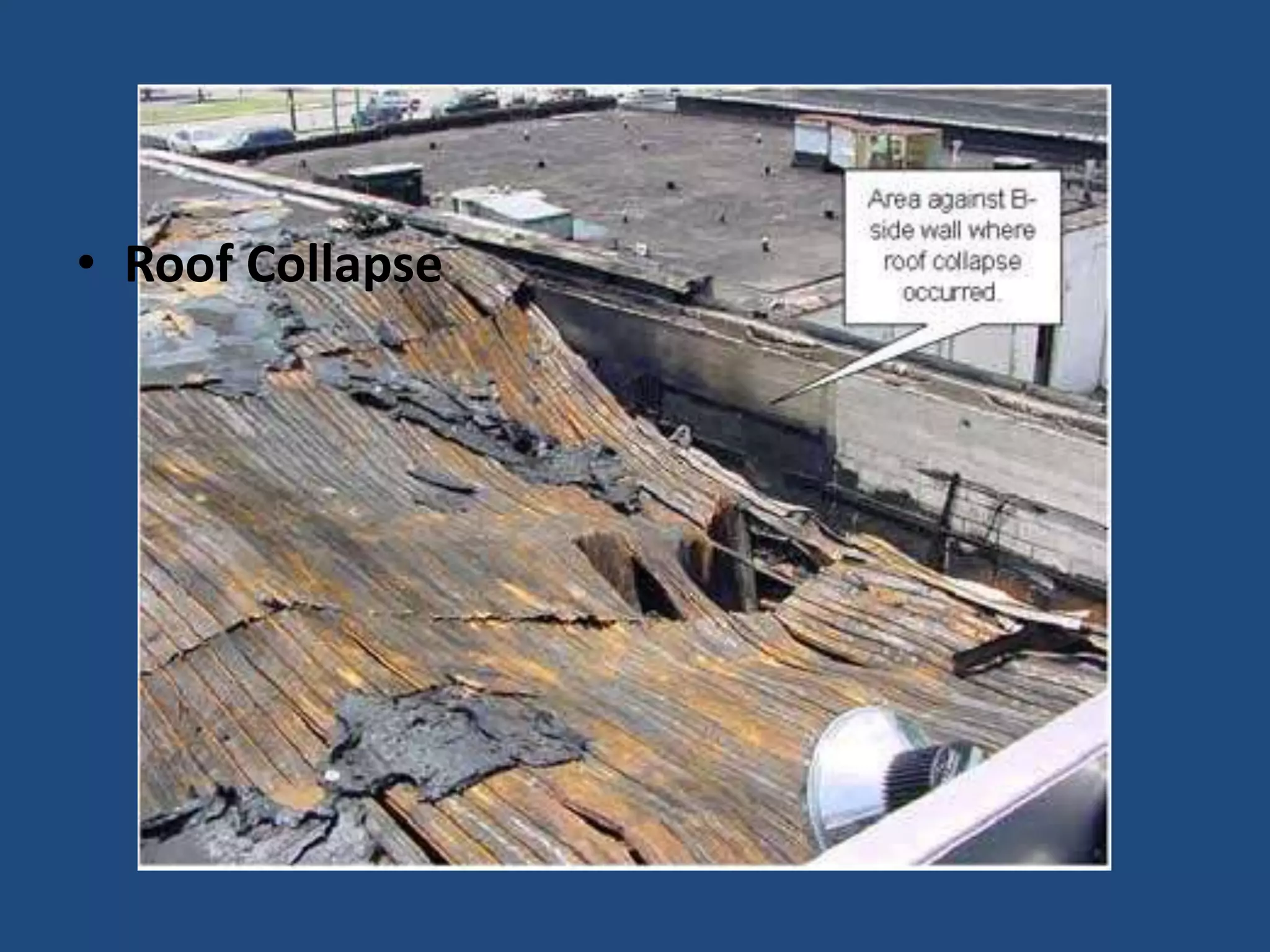
• Roof Collapse
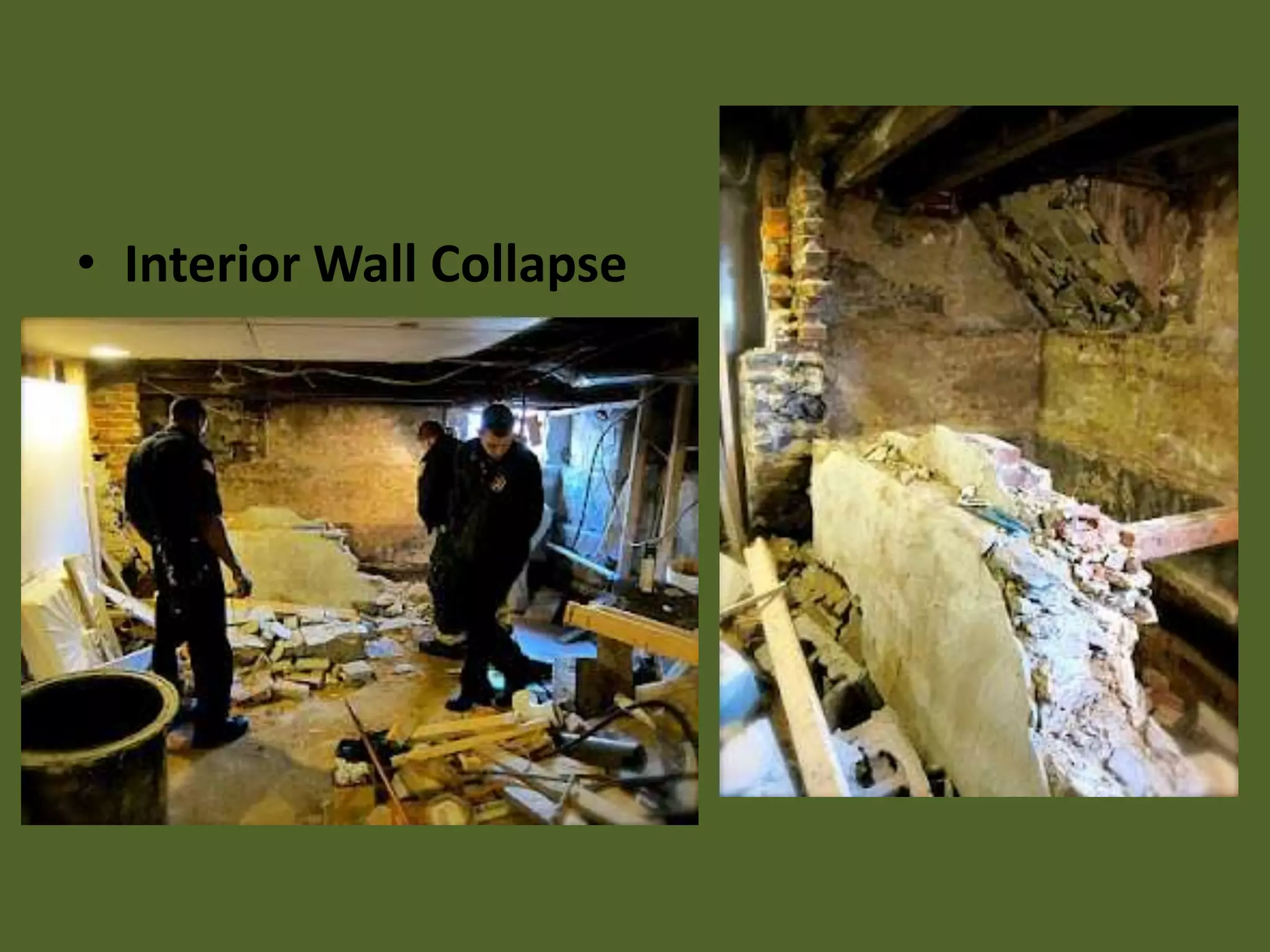
• Interior Wall Collapse
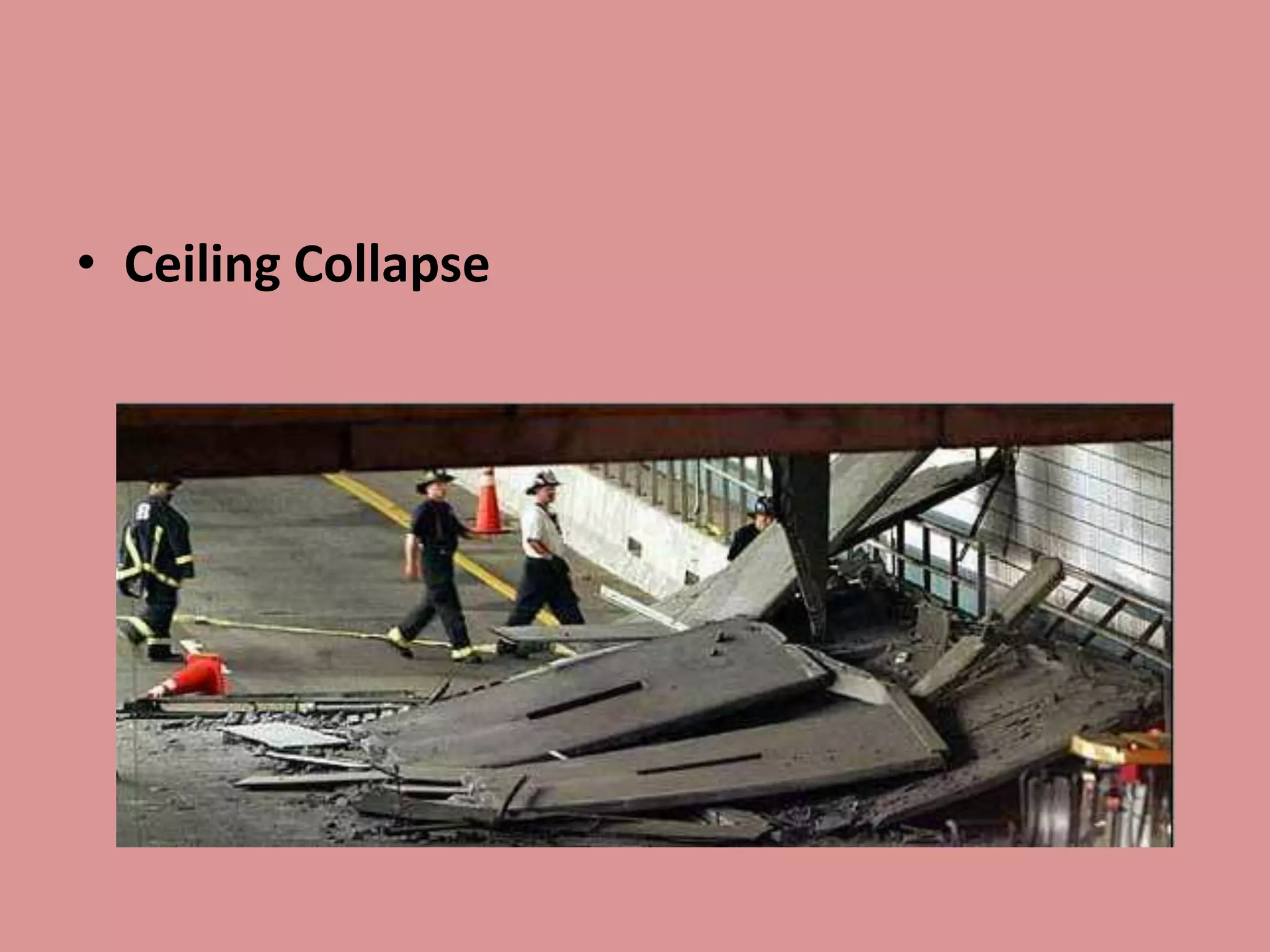
• Ceiling Collapse
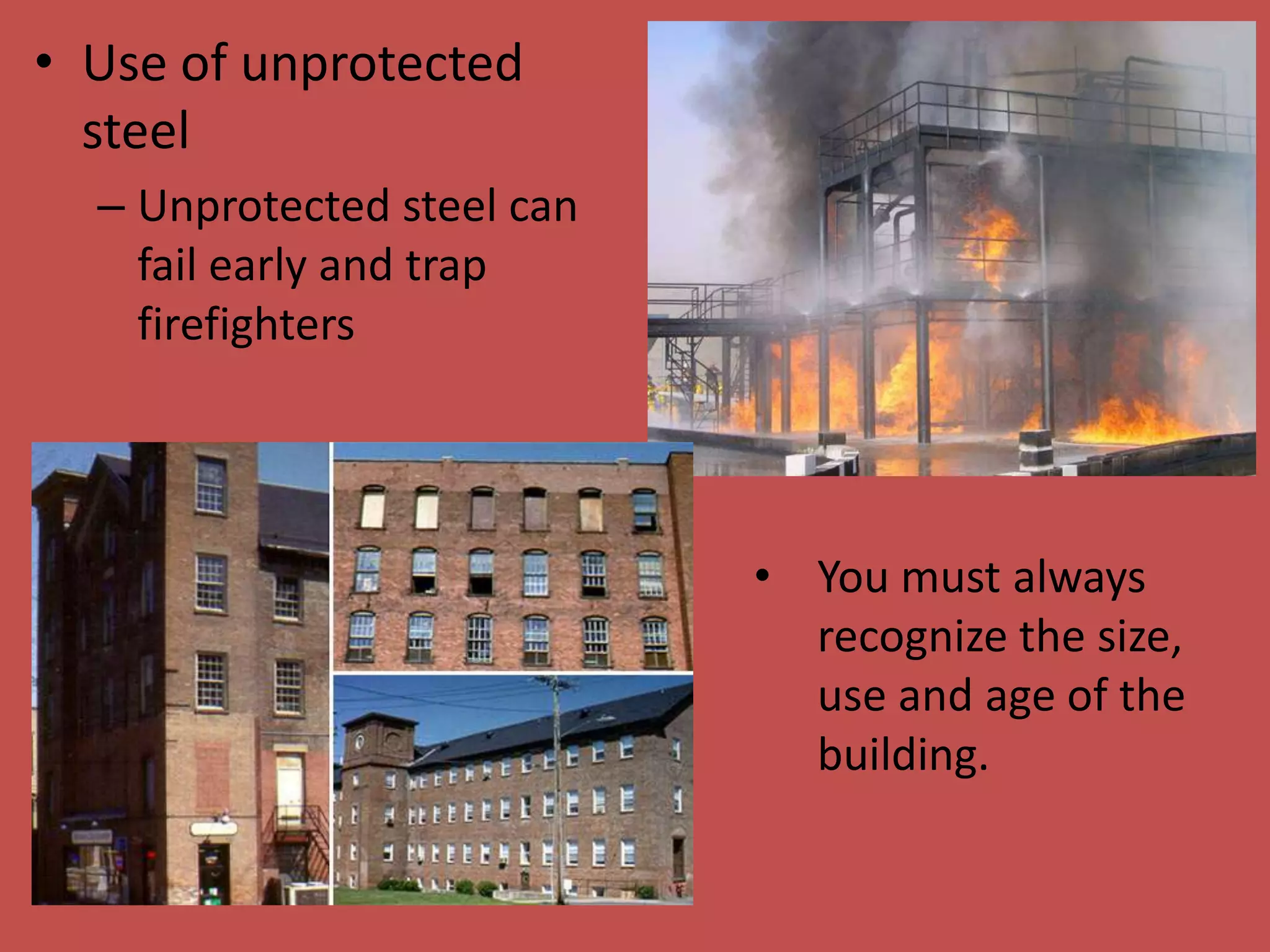
• Use of unprotected
  steel
  – Unprotected steel can
    fail early and trap
    firefighters


                            • You must always
                              recognize the size,
                              use and age of the
                              building.
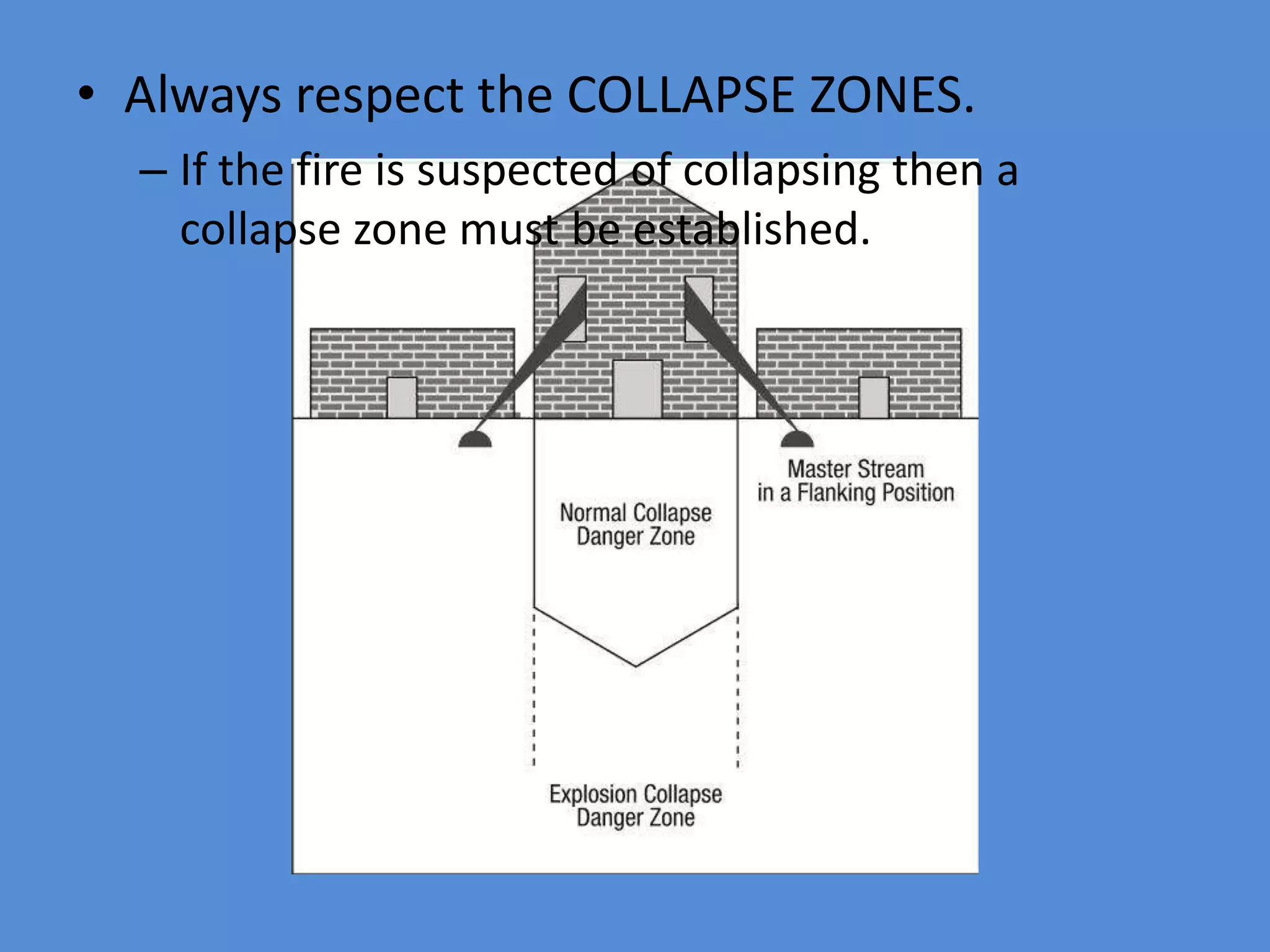
• Always respect the COLLAPSE ZONES.
  – If the fire is suspected of collapsing then a
    collapse zone must be established.
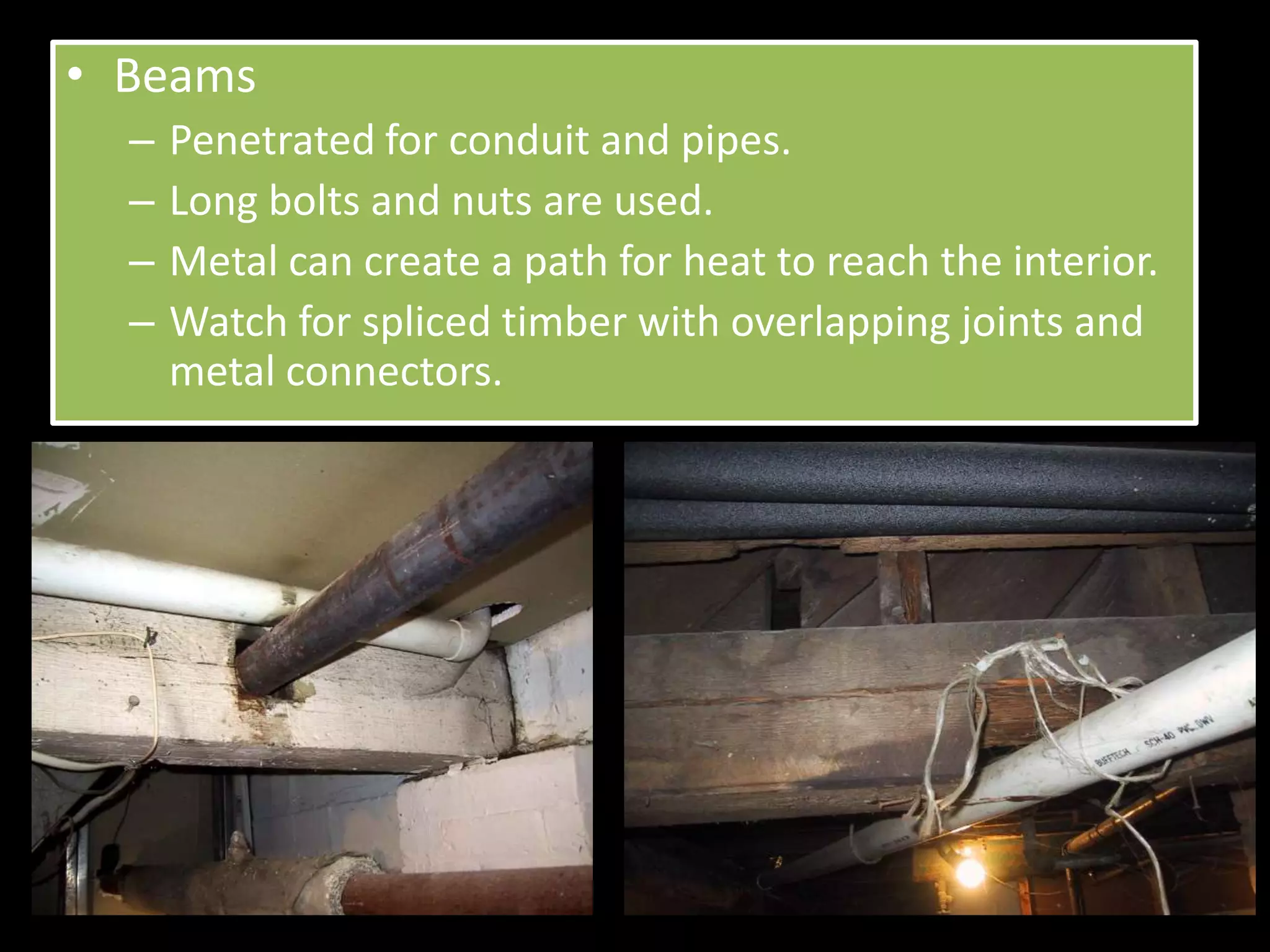
• Beams
  –   Penetrated for conduit and pipes.
  –   Long bolts and nuts are used.
  –   Metal can create a path for heat to reach the interior.
  –   Watch for spliced timber with overlapping joints and
      metal connectors.
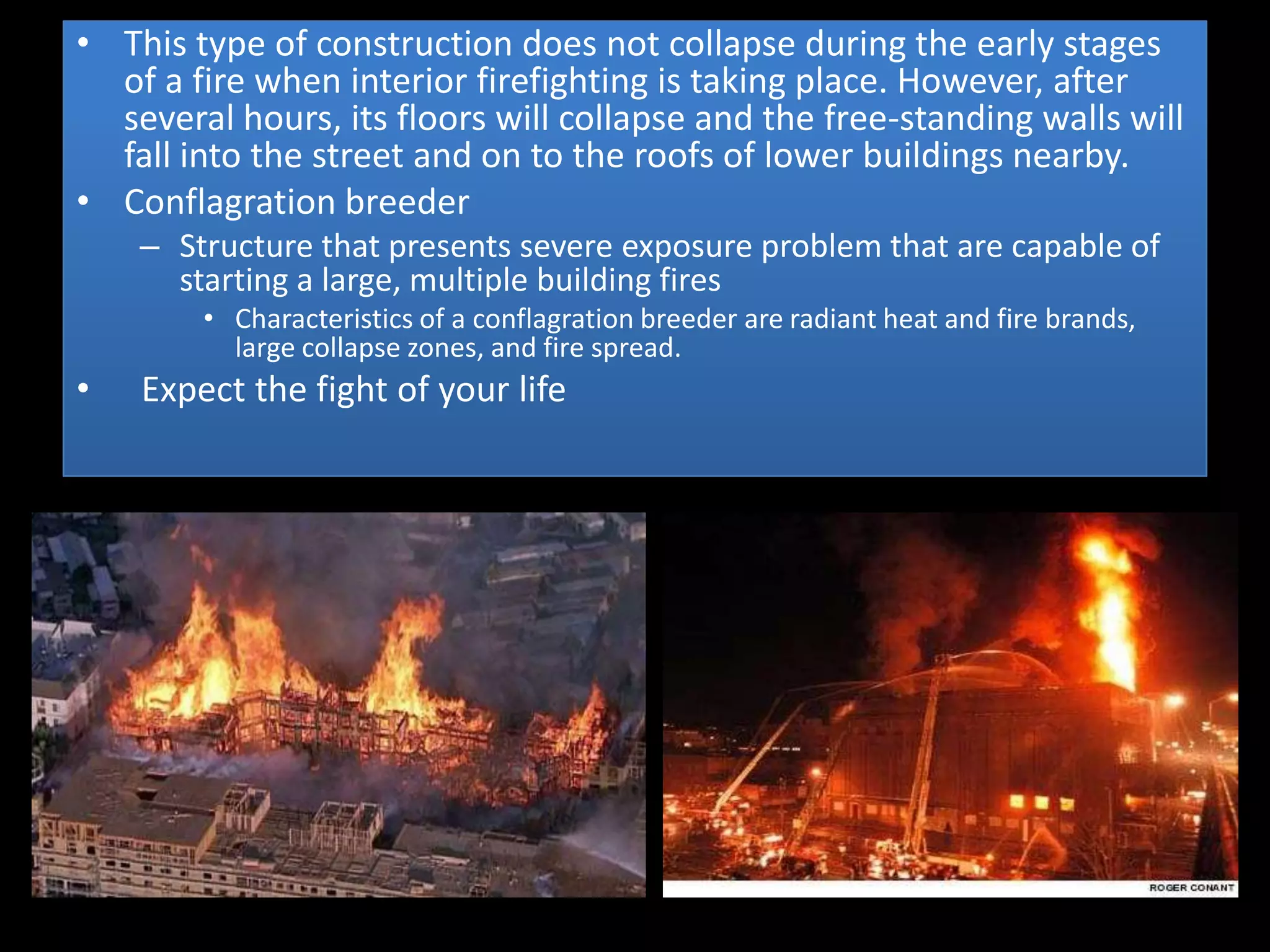
• This type of construction does not collapse during the early stages
  of a fire when interior firefighting is taking place. However, after
  several hours, its floors will collapse and the free-standing walls will
  fall into the street and on to the roofs of lower buildings nearby.
• Conflagration breeder
    – Structure that presents severe exposure problem that are capable of
      starting a large, multiple building fires
        • Characteristics of a conflagration breeder are radiant heat and fire brands,
          large collapse zones, and fire spread.
•   Expect the fight of your life
• Heavy timber is benefited by extended time of burning
  and the lack of voids spaces.
• Heavy timbers perform well and do not fail early in a
  fire, and is considered “slow burning”
   – “slow burning” means “collapse resistant”
   – Statement is only true when a fire department can
     maintain an interior offensive operation.
When it was used

Developed since that time, the building method was
brought to North America in the 17th century by
European settlers.
Started in the 18th century, in the US, on the east
coast, and still stand to this day
The first completely self-supporting timber frame
structure is believed to have been constructed during
the 10th century.
The advancement of technology and design
improvements helped to revive North American heavy
timber framing in the 1970s.
In Europe, there is timber framed buildings
constructed over 500 years ago that are still standing
today.
Why is Type IV used?

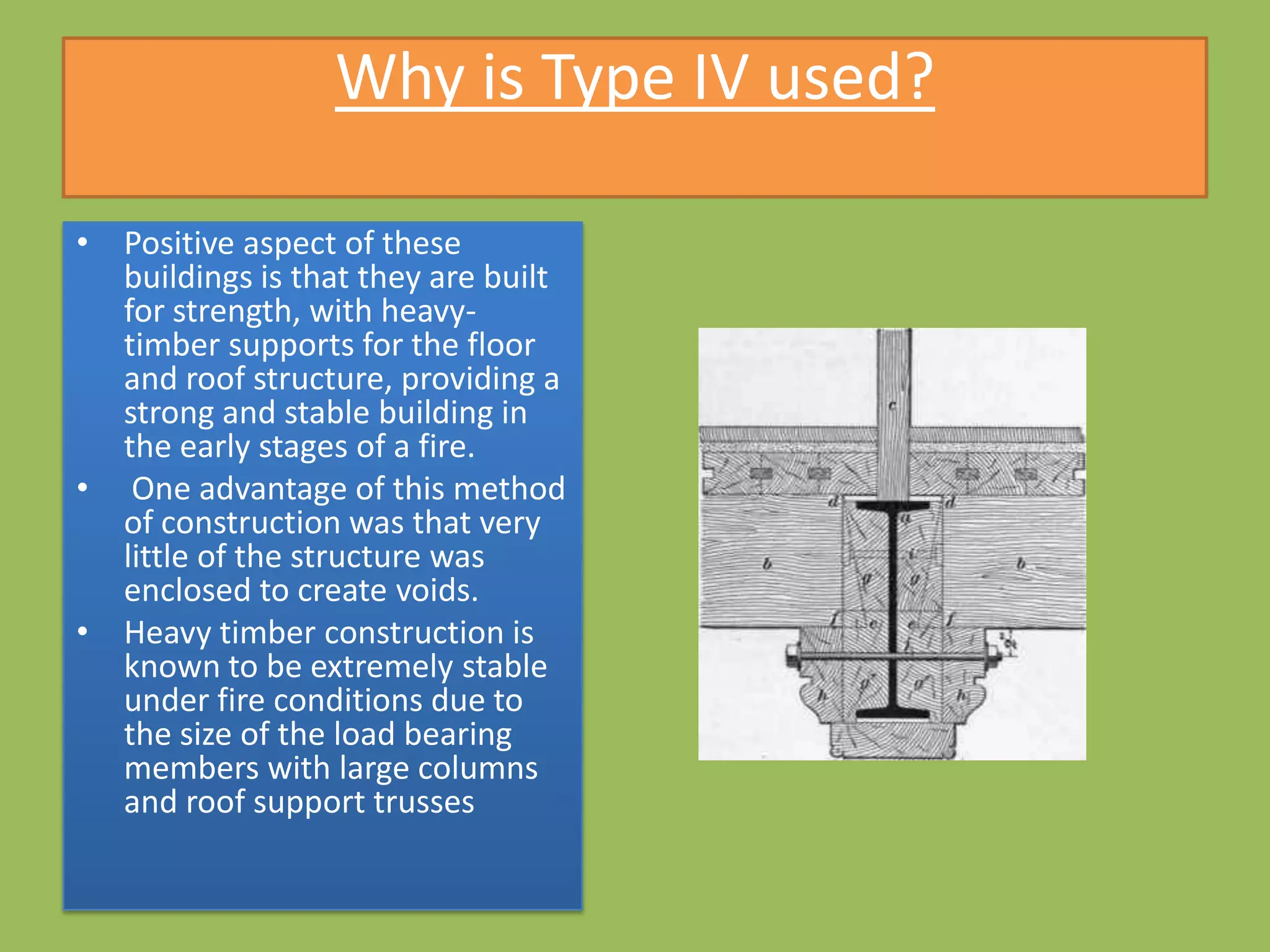
• Positive aspect of these
  buildings is that they are built
  for strength, with heavy-
  timber supports for the floor
  and roof structure, providing a
  strong and stable building in
  the early stages of a fire.
• One advantage of this method
  of construction was that very
  little of the structure was
  enclosed to create voids.
• Heavy timber construction is
  known to be extremely stable
  under fire conditions due to
  the size of the load bearing
  members with large columns
  and roof support trusses
• The heavy timber building was a multistory building,
  designed and originally used for storage and industrial
  purposes.
• The thickness of heavy timber is built for strength,
  which makes it able to burn for longer periods of time
• Large diameter wood components hold longer than
  steel .
• Used in building moderate-priced factories,
  warehouses, business blocks, and dwelling houses
  because of its simplicity, strength, and the rapidity with
  which it may be erected, and also because of its
  adaptability to very fine architecture if the designer
  uses judgment and skill.
How is it
 used?
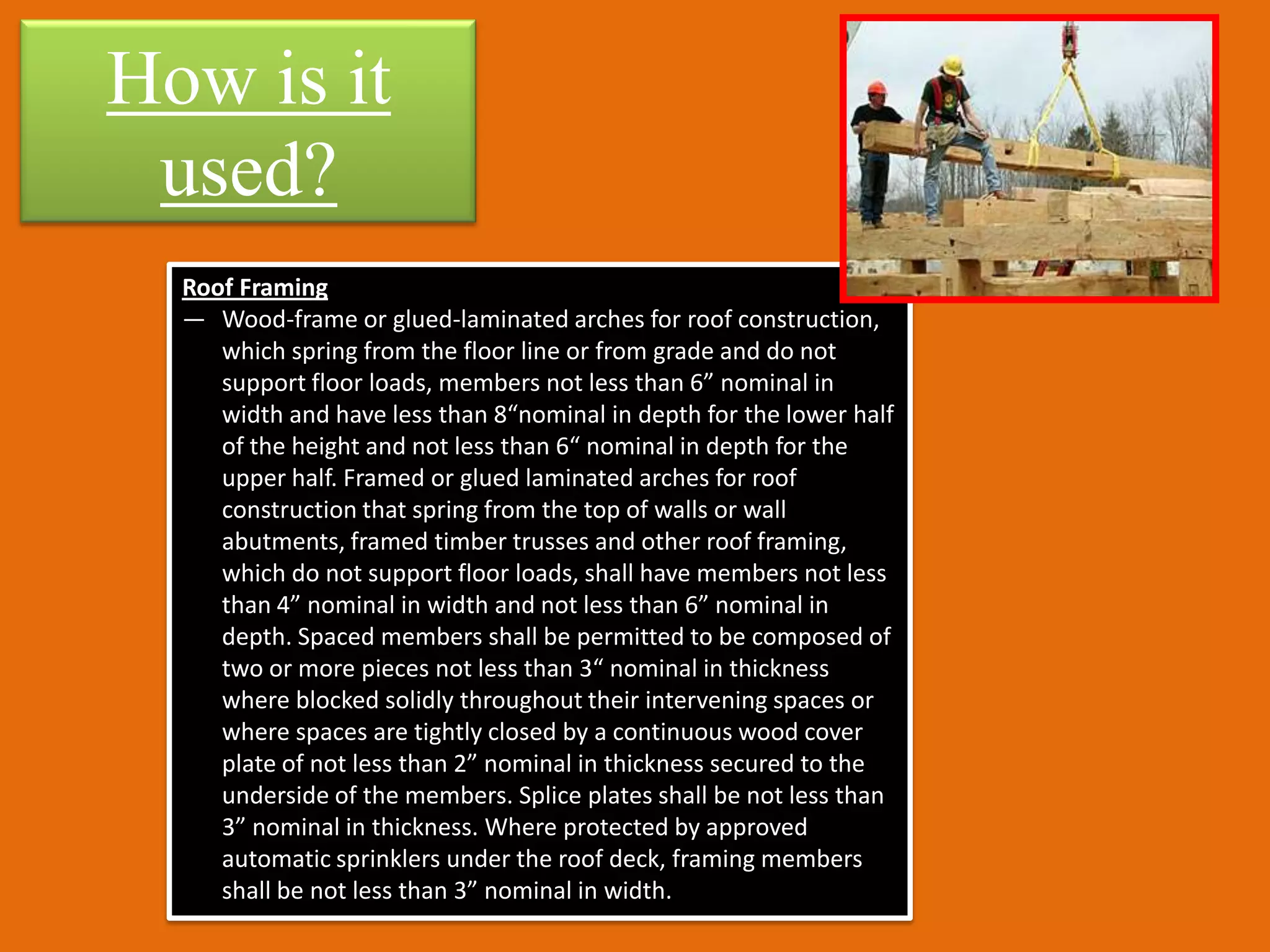
  Roof Framing
  — Wood-frame or glued-laminated arches for roof construction,
     which spring from the floor line or from grade and do not
     support floor loads, members not less than 6” nominal in
     width and have less than 8“nominal in depth for the lower half
     of the height and not less than 6“ nominal in depth for the
     upper half. Framed or glued laminated arches for roof
     construction that spring from the top of walls or wall
     abutments, framed timber trusses and other roof framing,
     which do not support floor loads, shall have members not less
     than 4” nominal in width and not less than 6” nominal in
     depth. Spaced members shall be permitted to be composed of
     two or more pieces not less than 3“ nominal in thickness
     where blocked solidly throughout their intervening spaces or
     where spaces are tightly closed by a continuous wood cover
     plate of not less than 2” nominal in thickness secured to the
     underside of the members. Splice plates shall be not less than
     3” nominal in thickness. Where protected by approved
     automatic sprinklers under the roof deck, framing members
     shall be not less than 3” nominal in width.
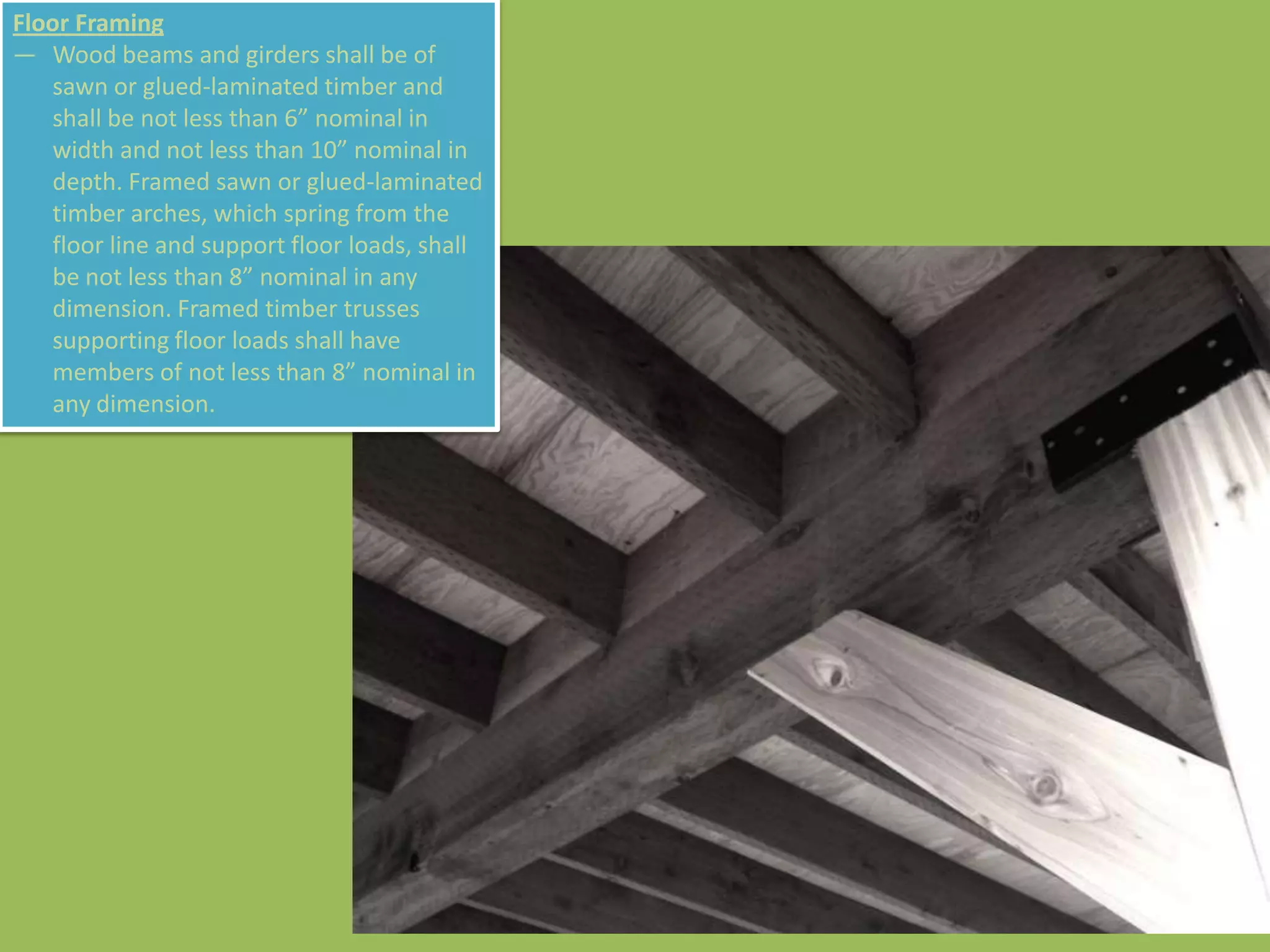
Floor Framing
— Wood beams and girders shall be of
   sawn or glued-laminated timber and
   shall be not less than 6” nominal in
   width and not less than 10” nominal in
   depth. Framed sawn or glued-laminated
   timber arches, which spring from the
   floor line and support floor loads, shall
   be not less than 8” nominal in any
   dimension. Framed timber trusses
   supporting floor loads shall have
   members of not less than 8” nominal in
   any dimension.
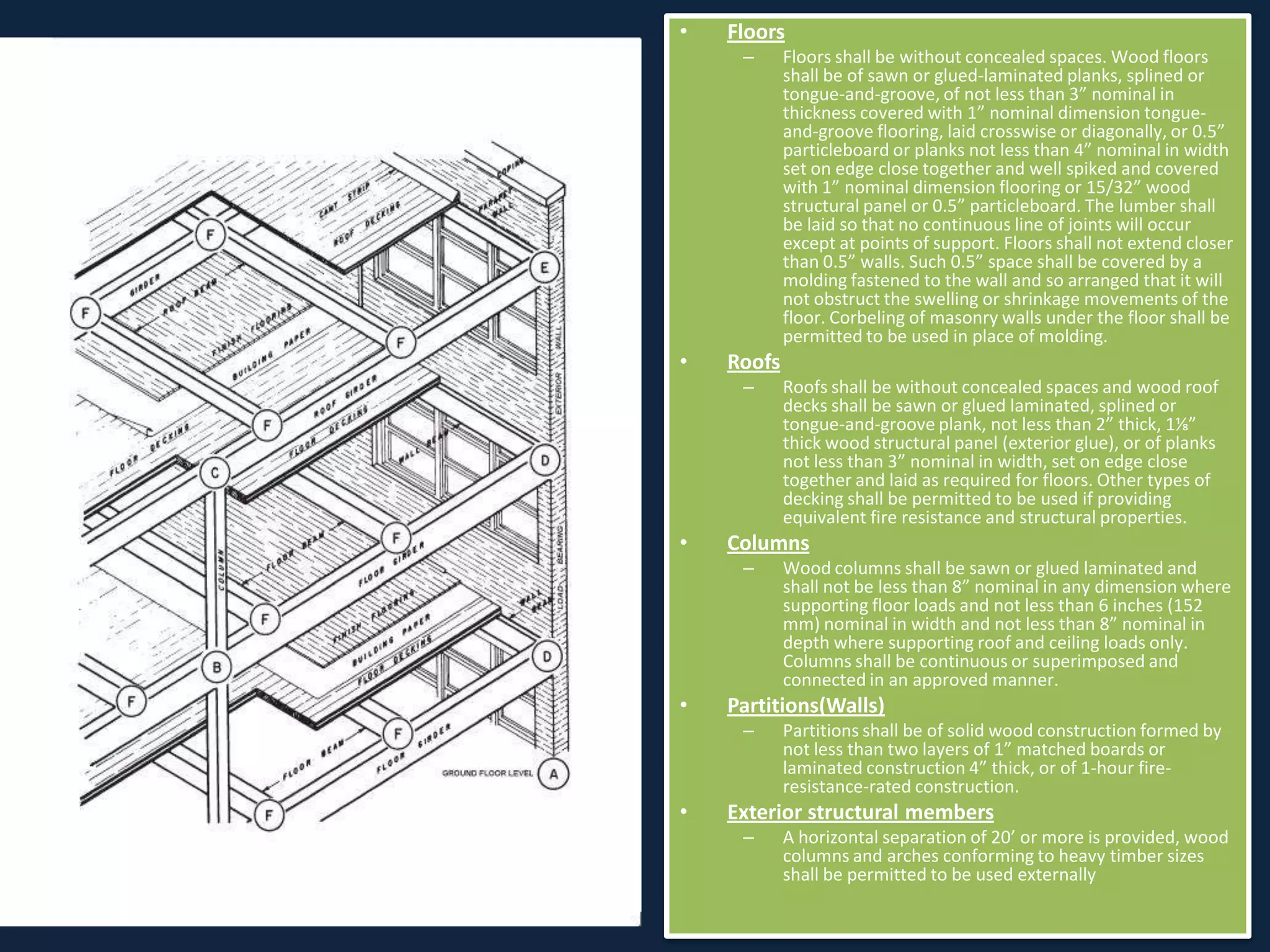
•   Floors
     –      Floors shall be without concealed spaces. Wood floors
            shall be of sawn or glued-laminated planks, splined or
            tongue-and-groove, of not less than 3” nominal in
            thickness covered with 1” nominal dimension tongue-
            and-groove flooring, laid crosswise or diagonally, or 0.5”
            particleboard or planks not less than 4” nominal in width
            set on edge close together and well spiked and covered
            with 1” nominal dimension flooring or 15/32” wood
            structural panel or 0.5” particleboard. The lumber shall
            be laid so that no continuous line of joints will occur
            except at points of support. Floors shall not extend closer
            than 0.5” walls. Such 0.5” space shall be covered by a
            molding fastened to the wall and so arranged that it will
            not obstruct the swelling or shrinkage movements of the
            floor. Corbeling of masonry walls under the floor shall be
            permitted to be used in place of molding.
•   Roofs
     –      Roofs shall be without concealed spaces and wood roof
            decks shall be sawn or glued laminated, splined or
            tongue-and-groove plank, not less than 2” thick, 1⅛”
            thick wood structural panel (exterior glue), or of planks
            not less than 3” nominal in width, set on edge close
            together and laid as required for floors. Other types of
            decking shall be permitted to be used if providing
            equivalent fire resistance and structural properties.
•   Columns
     –      Wood columns shall be sawn or glued laminated and
            shall not be less than 8” nominal in any dimension where
            supporting floor loads and not less than 6 inches (152
            mm) nominal in width and not less than 8” nominal in
            depth where supporting roof and ceiling loads only.
            Columns shall be continuous or superimposed and
            connected in an approved manner.
•   Partitions(Walls)
     –      Partitions shall be of solid wood construction formed by
            not less than two layers of 1” matched boards or
            laminated construction 4” thick, or of 1-hour fire-
            resistance-rated construction.
•   Exterior structural members
     –      A horizontal separation of 20’ or more is provided, wood
            columns and arches conforming to heavy timber sizes
            shall be permitted to be used externally
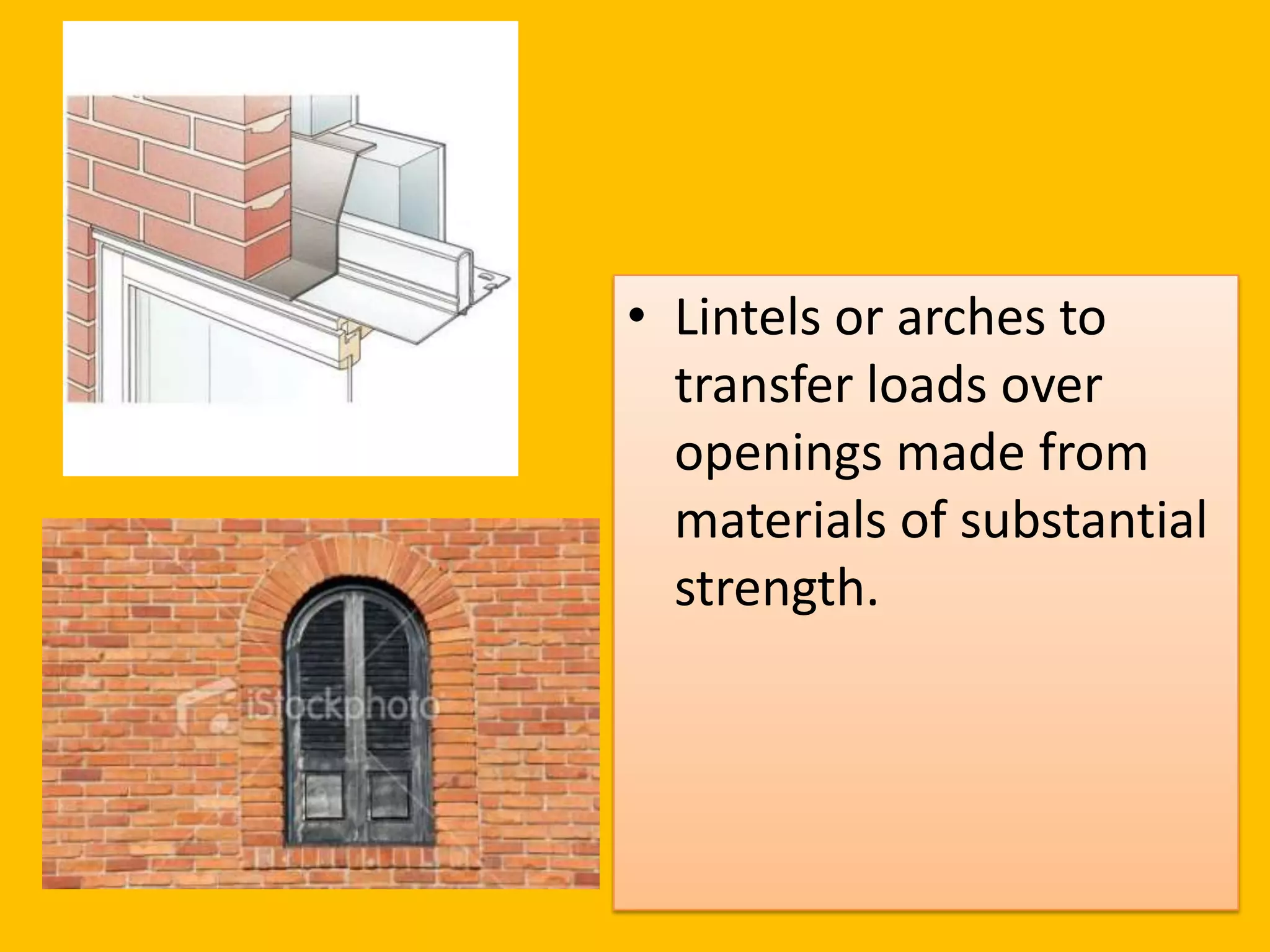
• Lintels or arches to
  transfer loads over
  openings made from
  materials of substantial
  strength.
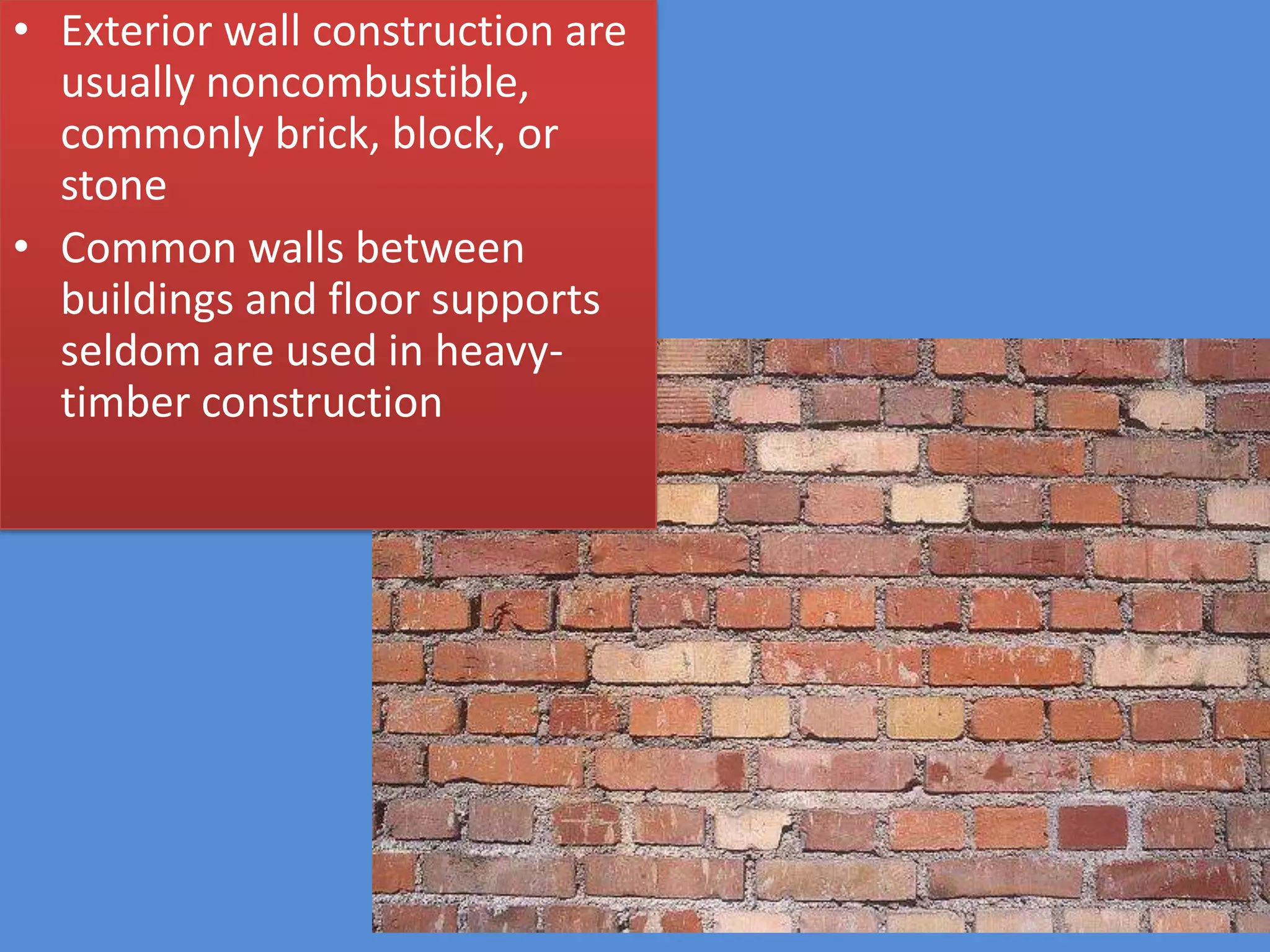
• Exterior wall construction are
  usually noncombustible,
  commonly brick, block, or
  stone
• Common walls between
  buildings and floor supports
  seldom are used in heavy-
  timber construction
End

Type iv building construction FINAL

  • 1.
    Type IV Building Construction By: Manuel S. Steven E. Bryan W. Jon M.
  • 2.
    Type IV BuildingConstruction • Some times is called “mill construction” because it was the type of construction used at the turn of the century. – Was used on New England mills to house heavy equipment. • These structures are manly used in manufacturing centers, churches, and/or schools. • Buildings have masonry walls like type III buildings but the interior wood consists of large timbers. • The floor and roof are plank board
  • 3.
    • In aheavy-timber building a wood column cannot be less than eight inches thick in any dimension and a wood girder cannot be less than six inches thick. • One difference between a heavy timber building and ordinary construction is that a heavy-timber building does not have plaster walls and ceilings covering the interior wood framework.
  • 4.
    • In heavytimber type of construction fire resistance is attained by putting limitations of minimum sizes on the wood structural members and on minimum thickness and composition of wood floors and roofs; by avoiding of concealed spaces under floors and roofs; by use of approved fastenings, construction details, and adhesives; and providing the required degree of fire resistance in exterior and interior walls.
  • 5.
    • Interior load-bearingwalls will be of noncombustible materials similar to the exterior walls and play a critical role both in fire separation • Typically, the walls are 24 to 36 inches thick at ground level • Heavy-Timber or Type IV buildings will have four bearing exterior walls made from noncombustible materials.
  • 6.
    Types of Failures/Precautions •Masonry Wall Collapse - which consist of… • Inward/Outward
  • 7.
  • 8.
  • 9.
    • Parapet WallCollapse(s)
  • 10.
  • 11.
  • 12.
  • 13.
  • 14.
  • 15.
  • 16.
  • 17.
    • Use ofunprotected steel – Unprotected steel can fail early and trap firefighters • You must always recognize the size, use and age of the building.
  • 18.
    • Always respectthe COLLAPSE ZONES. – If the fire is suspected of collapsing then a collapse zone must be established.
  • 19.
    • Beams – Penetrated for conduit and pipes. – Long bolts and nuts are used. – Metal can create a path for heat to reach the interior. – Watch for spliced timber with overlapping joints and metal connectors.
  • 20.
    • This typeof construction does not collapse during the early stages of a fire when interior firefighting is taking place. However, after several hours, its floors will collapse and the free-standing walls will fall into the street and on to the roofs of lower buildings nearby. • Conflagration breeder – Structure that presents severe exposure problem that are capable of starting a large, multiple building fires • Characteristics of a conflagration breeder are radiant heat and fire brands, large collapse zones, and fire spread. • Expect the fight of your life
  • 21.
    • Heavy timberis benefited by extended time of burning and the lack of voids spaces. • Heavy timbers perform well and do not fail early in a fire, and is considered “slow burning” – “slow burning” means “collapse resistant” – Statement is only true when a fire department can maintain an interior offensive operation.
  • 22.
    When it wasused Developed since that time, the building method was brought to North America in the 17th century by European settlers. Started in the 18th century, in the US, on the east coast, and still stand to this day The first completely self-supporting timber frame structure is believed to have been constructed during the 10th century. The advancement of technology and design improvements helped to revive North American heavy timber framing in the 1970s. In Europe, there is timber framed buildings constructed over 500 years ago that are still standing today.
  • 23.
    Why is TypeIV used? • Positive aspect of these buildings is that they are built for strength, with heavy- timber supports for the floor and roof structure, providing a strong and stable building in the early stages of a fire. • One advantage of this method of construction was that very little of the structure was enclosed to create voids. • Heavy timber construction is known to be extremely stable under fire conditions due to the size of the load bearing members with large columns and roof support trusses
  • 24.
    • The heavytimber building was a multistory building, designed and originally used for storage and industrial purposes. • The thickness of heavy timber is built for strength, which makes it able to burn for longer periods of time • Large diameter wood components hold longer than steel . • Used in building moderate-priced factories, warehouses, business blocks, and dwelling houses because of its simplicity, strength, and the rapidity with which it may be erected, and also because of its adaptability to very fine architecture if the designer uses judgment and skill.
  • 25.
    How is it used? Roof Framing — Wood-frame or glued-laminated arches for roof construction, which spring from the floor line or from grade and do not support floor loads, members not less than 6” nominal in width and have less than 8“nominal in depth for the lower half of the height and not less than 6“ nominal in depth for the upper half. Framed or glued laminated arches for roof construction that spring from the top of walls or wall abutments, framed timber trusses and other roof framing, which do not support floor loads, shall have members not less than 4” nominal in width and not less than 6” nominal in depth. Spaced members shall be permitted to be composed of two or more pieces not less than 3“ nominal in thickness where blocked solidly throughout their intervening spaces or where spaces are tightly closed by a continuous wood cover plate of not less than 2” nominal in thickness secured to the underside of the members. Splice plates shall be not less than 3” nominal in thickness. Where protected by approved automatic sprinklers under the roof deck, framing members shall be not less than 3” nominal in width.
  • 26.
    Floor Framing — Woodbeams and girders shall be of sawn or glued-laminated timber and shall be not less than 6” nominal in width and not less than 10” nominal in depth. Framed sawn or glued-laminated timber arches, which spring from the floor line and support floor loads, shall be not less than 8” nominal in any dimension. Framed timber trusses supporting floor loads shall have members of not less than 8” nominal in any dimension.
  • 27.
    Floors – Floors shall be without concealed spaces. Wood floors shall be of sawn or glued-laminated planks, splined or tongue-and-groove, of not less than 3” nominal in thickness covered with 1” nominal dimension tongue- and-groove flooring, laid crosswise or diagonally, or 0.5” particleboard or planks not less than 4” nominal in width set on edge close together and well spiked and covered with 1” nominal dimension flooring or 15/32” wood structural panel or 0.5” particleboard. The lumber shall be laid so that no continuous line of joints will occur except at points of support. Floors shall not extend closer than 0.5” walls. Such 0.5” space shall be covered by a molding fastened to the wall and so arranged that it will not obstruct the swelling or shrinkage movements of the floor. Corbeling of masonry walls under the floor shall be permitted to be used in place of molding. • Roofs – Roofs shall be without concealed spaces and wood roof decks shall be sawn or glued laminated, splined or tongue-and-groove plank, not less than 2” thick, 1⅛” thick wood structural panel (exterior glue), or of planks not less than 3” nominal in width, set on edge close together and laid as required for floors. Other types of decking shall be permitted to be used if providing equivalent fire resistance and structural properties. • Columns – Wood columns shall be sawn or glued laminated and shall not be less than 8” nominal in any dimension where supporting floor loads and not less than 6 inches (152 mm) nominal in width and not less than 8” nominal in depth where supporting roof and ceiling loads only. Columns shall be continuous or superimposed and connected in an approved manner. • Partitions(Walls) – Partitions shall be of solid wood construction formed by not less than two layers of 1” matched boards or laminated construction 4” thick, or of 1-hour fire- resistance-rated construction. • Exterior structural members – A horizontal separation of 20’ or more is provided, wood columns and arches conforming to heavy timber sizes shall be permitted to be used externally
  • 28.
    • Lintels orarches to transfer loads over openings made from materials of substantial strength.
  • 29.
    • Exterior wallconstruction are usually noncombustible, commonly brick, block, or stone • Common walls between buildings and floor supports seldom are used in heavy- timber construction
  • 30.