Portable Fire Extinguishers  Chapter 11
Learning Objectives Discuss the fire extinguisher classification system Discuss the fire extinguisher rating system and to which classification of extinguishers it applies Explain why a certain extinguisher classification requires a conductivity test Explain the acronym PASS in relation to fire extinguisher operation
Learning Objectives (continued) Describe the different types of fire extinguishers and their operation List the different extinguishing agents and their applications Discuss the inspection, testing, and maintenance procedures for portable fire extinguishers
Introduction Portable fire extinguishers are intended for use in incipient stage where water is ineffective Useful if there is quick access, the correct type is available, and person is trained Has fixed amount of suppression agent Are clearly labeled and require little training Rapid access to the extinguisher is critical
Requirements for Fire Extinguishers Code requirements exist in all of the model codes for fire extinguishers Requirements center on use and occupancy conditions and processes IFC requires extinguishers installed in almost every new and existing occupancy classification NFPA 10 lists the requirements for fire extinguishers
Fire Extinguisher Classification Through the classification system, extinguishing agents matched to fire hazards Classification designated with letters Class A fires: ordinary combustibles Class B fires. flammable and combustible liquids and gases Class C fires: energized electrical equipment Class D fires: combustible metals Class K fires: cooking media
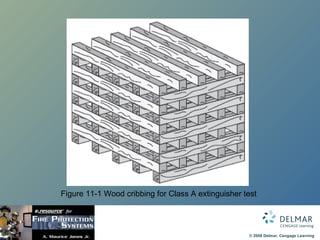
Fire Extinguisher Ratings Class A and B have a number rating to indicate performance capability of the extinguisher Expresses how much fire the extinguisher can handle Class A extinguishers are tested using a wood crib on fire, allowing it to burn for a time Class B extinguishers are tested with a flammable liquid fire in a pan Flammable liquid is usually heptane Class C extinguishers do not receive a rating
Figure 11-1 Wood cribbing for Class A extinguisher test
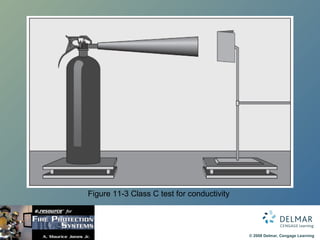
Figure 11-3 Class C test for conductivity
Types of Fire Extinguishers Pumped, stored pressure, and cartridge pressure categories Many suppression agents: Water, foam, carbon dioxide, dry chemical, wet chemical, dry powder, halon, clean agents Some agents will not work well with a particular category of extinguisher
Pump Extinguishers Require manual operation of a pump mechanism Creates pressure in the tank to expel extinguishing agent Extinguishing agent is either water or antifreeze solution Easy to operate and fill Backpack type extinguisher has external pump Mechanism similar to hand-held
Stored Pressure Extinguishers Mix pressurized gas and extinguishing agent in the same tank Gas is above the agent and keeps constant pressure on the agent When operated, the pressure of the gas forces the extinguishing agent out of the tank Air or nitrogen frequently used as expelling gas Pressure gauge indicates if pressure is sufficient
Cartridge Pressure Extinguishers Similar to stored pressure type, but pressurized gas is in a separate cartridge Attached to the side of the extinguishing tank Activating the extinguisher punctures the cartridge that expels the gas into the tank Allows for easy maintenance of certain types of agents Top removes without dumping the agent or losing the gas pressure Good for agents that settle and need stirring
Common Fire Extinguisher Agents Same agents used in sprinkler and suppression systems are common in fire extinguishers Present in smaller amounts
Water One of the best agents because it absorbs more heat per pound than any other material Most effective on Class A fires Not effective on some fuels; dangerous to use on others When used in an extinguisher, extinguisher must not be exposed to cold
Foam Good agent for Class A but better for Class B fires Foam forms a vapor barrier between the fuel and the atmosphere Agent must discharge through special aspirating nozzle so that air can mix with the agent Two types of foam:  Aqueous film-forming foam Film-forming fluoroprotein
Carbon Dioxide Carbon dioxide gas effective in Class B and C fires; limited use on Class A fires In extinguisher tank, carbon dioxide is a high-pressure liquid state Expands to a gas when released Depletes the oxygen supply Must be discharged at close range to the fire because air movement carries the gas away Operator must have oxygen supply available to avoid asphyxiation
Dry Chemicals Small solid particles propelled by pressurized gas When discharged, chemical smothers the burning material Not considered dangerous or toxic; do not react with flammable liquids or gases; not conductive Once discharged, create a cloud that limits visibility; may cause respiratory problems May leave a corrosive residue
Wet Chemicals Wet chemical agents most effective with Class K fires Water-based solutions that mix with potassium carbonate, potassium acetate, potassium citrate React with fat in the cooking medium or food to develop a soapy foam blanket on the surface Smothers, cools, and extinguishes the fire Liquid in the agent cools the cooking media adequately to maintain the foam blanket
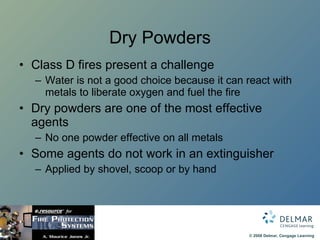
Dry Powders Class D fires present a challenge Water is not a good choice because it can react with metals to liberate oxygen and fuel the fire Dry powders are one of the most effective agents No one powder effective on all metals Some agents do not work in an extinguisher Applied by shovel, scoop or by hand
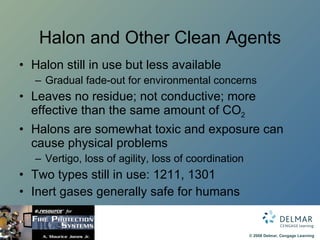
Halon and Other Clean Agents Halon still in use but less available Gradual fade-out for environmental concerns Leaves no residue; not conductive; more effective than the same amount of CO 2   Halons are somewhat toxic and exposure can cause physical problems Vertigo, loss of agility, loss of coordination Two types still in use: 1211, 1301 Inert gases generally safe for humans
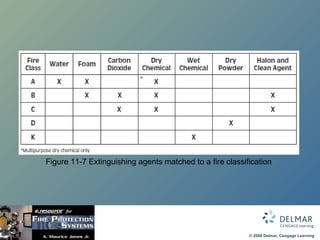
Figure 11-7 Extinguishing agents matched to a fire classification
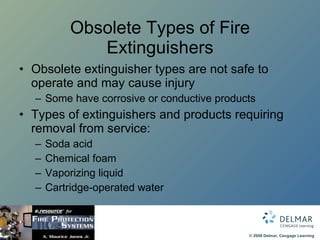
Obsolete Types of Fire Extinguishers Obsolete extinguisher types are not safe to operate and may cause injury Some have corrosive or conductive products Types of extinguishers and products requiring removal from service: Soda acid Chemical foam Vaporizing liquid Cartridge-operated water
Obsolete Types of Fire Extinguishers (continued) Cartridge-operated loaded stream Copper or brass shell joined by soft solder on rivets Carbon dioxide extinguishers with metal horns Sold charge-type AFFF extinguishers Pressurized water manufactured prior to 1971 Any extinguisher that must be inverted Any stored pressure manufactured before 1955 Any extinguishers with 4B, 6B, 8B, 12B, 16B ratings Stored-pressure with fiberglass shells
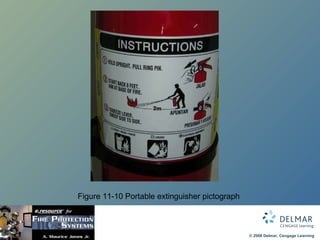
Fire Extinguisher Operation Most portable fire extinguishers operate in a similar manner Some small enough to carry by hand; others have a cart on wheels PASS for hand-held extinguishers Requires little or no training Pictographs depict instructions Any person who might use an extinguisher should know their operation and location Notify other occupants to evacuate
Figure 11-10 Portable extinguisher pictograph
Portable Fire Extinguisher Inspection, Maintenance, and Testing Inspection, testing, maintenance are the keys to ensuring that extinguishers work Involve a number of different activities that can be conducted by anyone Annual maintenance requires specialized training Hydrostatic testing requires further training
Visual Inspections Valuable fire prevention activity General condition of the extinguisher can be determined in a short amount of time Inspections should take place every 30 days Check the location, verify it is of the proper type, check for physical damage, etc. Determine if pressure gauge within normal range Note deficiencies found in prior inspections
Maintenance Follow manufacturer’s requirements Involves more thorough inspection Usually yearly, but could be sooner All extinguishers require disassembling and internal examination at regular intervals Look for conditions that could impair the extinguisher Some maintenance activities can be dangerous Personnel require proper training and tools
Testing Hydrostatic test critical on all refillable extinguishers Ensure extinguisher will not fail due to unnoticed conditions Test intervals range from five to ten years or on discovery of physical damage or corrosion Typical procedure: Disassemble and fill with water Immerse component in water  Pressurize component for desired amount of time
Summary Portable fire extinguishers Are intended to suppress small incipient fires Hold a fixed amount of suppression agent, so access should be quick Must have knowledgeable operator  Extinguishing agent must be suitable for the type of fire Three categories of extinguishers: pumped, stored-pressure, cartridge pressure

Chapter 11

  • 1.
  • 2.
    Learning Objectives Discussthe fire extinguisher classification system Discuss the fire extinguisher rating system and to which classification of extinguishers it applies Explain why a certain extinguisher classification requires a conductivity test Explain the acronym PASS in relation to fire extinguisher operation
  • 3.
    Learning Objectives (continued)Describe the different types of fire extinguishers and their operation List the different extinguishing agents and their applications Discuss the inspection, testing, and maintenance procedures for portable fire extinguishers
  • 4.
    Introduction Portable fireextinguishers are intended for use in incipient stage where water is ineffective Useful if there is quick access, the correct type is available, and person is trained Has fixed amount of suppression agent Are clearly labeled and require little training Rapid access to the extinguisher is critical
  • 5.
    Requirements for FireExtinguishers Code requirements exist in all of the model codes for fire extinguishers Requirements center on use and occupancy conditions and processes IFC requires extinguishers installed in almost every new and existing occupancy classification NFPA 10 lists the requirements for fire extinguishers
  • 6.
    Fire Extinguisher ClassificationThrough the classification system, extinguishing agents matched to fire hazards Classification designated with letters Class A fires: ordinary combustibles Class B fires. flammable and combustible liquids and gases Class C fires: energized electrical equipment Class D fires: combustible metals Class K fires: cooking media
  • 7.
    Fire Extinguisher RatingsClass A and B have a number rating to indicate performance capability of the extinguisher Expresses how much fire the extinguisher can handle Class A extinguishers are tested using a wood crib on fire, allowing it to burn for a time Class B extinguishers are tested with a flammable liquid fire in a pan Flammable liquid is usually heptane Class C extinguishers do not receive a rating
  • 8.
    Figure 11-1 Woodcribbing for Class A extinguisher test
  • 9.
    Figure 11-3 ClassC test for conductivity
  • 10.
    Types of FireExtinguishers Pumped, stored pressure, and cartridge pressure categories Many suppression agents: Water, foam, carbon dioxide, dry chemical, wet chemical, dry powder, halon, clean agents Some agents will not work well with a particular category of extinguisher
  • 11.
    Pump Extinguishers Requiremanual operation of a pump mechanism Creates pressure in the tank to expel extinguishing agent Extinguishing agent is either water or antifreeze solution Easy to operate and fill Backpack type extinguisher has external pump Mechanism similar to hand-held
  • 12.
    Stored Pressure ExtinguishersMix pressurized gas and extinguishing agent in the same tank Gas is above the agent and keeps constant pressure on the agent When operated, the pressure of the gas forces the extinguishing agent out of the tank Air or nitrogen frequently used as expelling gas Pressure gauge indicates if pressure is sufficient
  • 13.
    Cartridge Pressure ExtinguishersSimilar to stored pressure type, but pressurized gas is in a separate cartridge Attached to the side of the extinguishing tank Activating the extinguisher punctures the cartridge that expels the gas into the tank Allows for easy maintenance of certain types of agents Top removes without dumping the agent or losing the gas pressure Good for agents that settle and need stirring
  • 14.
    Common Fire ExtinguisherAgents Same agents used in sprinkler and suppression systems are common in fire extinguishers Present in smaller amounts
  • 15.
    Water One ofthe best agents because it absorbs more heat per pound than any other material Most effective on Class A fires Not effective on some fuels; dangerous to use on others When used in an extinguisher, extinguisher must not be exposed to cold
  • 16.
    Foam Good agentfor Class A but better for Class B fires Foam forms a vapor barrier between the fuel and the atmosphere Agent must discharge through special aspirating nozzle so that air can mix with the agent Two types of foam: Aqueous film-forming foam Film-forming fluoroprotein
  • 17.
    Carbon Dioxide Carbondioxide gas effective in Class B and C fires; limited use on Class A fires In extinguisher tank, carbon dioxide is a high-pressure liquid state Expands to a gas when released Depletes the oxygen supply Must be discharged at close range to the fire because air movement carries the gas away Operator must have oxygen supply available to avoid asphyxiation
  • 18.
    Dry Chemicals Smallsolid particles propelled by pressurized gas When discharged, chemical smothers the burning material Not considered dangerous or toxic; do not react with flammable liquids or gases; not conductive Once discharged, create a cloud that limits visibility; may cause respiratory problems May leave a corrosive residue
  • 19.
    Wet Chemicals Wetchemical agents most effective with Class K fires Water-based solutions that mix with potassium carbonate, potassium acetate, potassium citrate React with fat in the cooking medium or food to develop a soapy foam blanket on the surface Smothers, cools, and extinguishes the fire Liquid in the agent cools the cooking media adequately to maintain the foam blanket
  • 20.
    Dry Powders ClassD fires present a challenge Water is not a good choice because it can react with metals to liberate oxygen and fuel the fire Dry powders are one of the most effective agents No one powder effective on all metals Some agents do not work in an extinguisher Applied by shovel, scoop or by hand
  • 21.
    Halon and OtherClean Agents Halon still in use but less available Gradual fade-out for environmental concerns Leaves no residue; not conductive; more effective than the same amount of CO 2 Halons are somewhat toxic and exposure can cause physical problems Vertigo, loss of agility, loss of coordination Two types still in use: 1211, 1301 Inert gases generally safe for humans
  • 22.
    Figure 11-7 Extinguishingagents matched to a fire classification
  • 23.
    Obsolete Types ofFire Extinguishers Obsolete extinguisher types are not safe to operate and may cause injury Some have corrosive or conductive products Types of extinguishers and products requiring removal from service: Soda acid Chemical foam Vaporizing liquid Cartridge-operated water
  • 24.
    Obsolete Types ofFire Extinguishers (continued) Cartridge-operated loaded stream Copper or brass shell joined by soft solder on rivets Carbon dioxide extinguishers with metal horns Sold charge-type AFFF extinguishers Pressurized water manufactured prior to 1971 Any extinguisher that must be inverted Any stored pressure manufactured before 1955 Any extinguishers with 4B, 6B, 8B, 12B, 16B ratings Stored-pressure with fiberglass shells
  • 25.
    Fire Extinguisher OperationMost portable fire extinguishers operate in a similar manner Some small enough to carry by hand; others have a cart on wheels PASS for hand-held extinguishers Requires little or no training Pictographs depict instructions Any person who might use an extinguisher should know their operation and location Notify other occupants to evacuate
  • 26.
    Figure 11-10 Portableextinguisher pictograph
  • 27.
    Portable Fire ExtinguisherInspection, Maintenance, and Testing Inspection, testing, maintenance are the keys to ensuring that extinguishers work Involve a number of different activities that can be conducted by anyone Annual maintenance requires specialized training Hydrostatic testing requires further training
  • 28.
    Visual Inspections Valuablefire prevention activity General condition of the extinguisher can be determined in a short amount of time Inspections should take place every 30 days Check the location, verify it is of the proper type, check for physical damage, etc. Determine if pressure gauge within normal range Note deficiencies found in prior inspections
  • 29.
    Maintenance Follow manufacturer’srequirements Involves more thorough inspection Usually yearly, but could be sooner All extinguishers require disassembling and internal examination at regular intervals Look for conditions that could impair the extinguisher Some maintenance activities can be dangerous Personnel require proper training and tools
  • 30.
    Testing Hydrostatic testcritical on all refillable extinguishers Ensure extinguisher will not fail due to unnoticed conditions Test intervals range from five to ten years or on discovery of physical damage or corrosion Typical procedure: Disassemble and fill with water Immerse component in water Pressurize component for desired amount of time
  • 31.
    Summary Portable fireextinguishers Are intended to suppress small incipient fires Hold a fixed amount of suppression agent, so access should be quick Must have knowledgeable operator Extinguishing agent must be suitable for the type of fire Three categories of extinguishers: pumped, stored-pressure, cartridge pressure