DEPARTMENT OF
CIVIL ENGINEERING
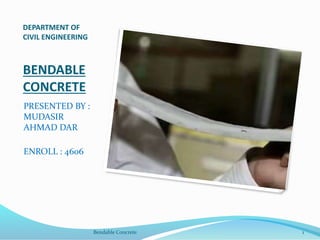
BENDABLE
CONCRETE
PRESENTED BY :
MUDASIR
AHMAD DAR
ENROLL : 4606
Bendable Concrete 1
• Conventional concretes are almost unbendable.
• This lack of bendability is a major cause of failure under
strain.
• It has been a pushing factor in the development of an
elegant material namely, bendable concrete also known as
Engineered Cementitious Composites (ECC.)
• Capable of exhibiting considerably enhanced flexibility.
• It is reinforced with micromechanically designed PVA fibres.
• ECC is made from the same basic ingredients as
conventional concrete but with the addition of High-Range
Water Reducing (HRWR) agent.
• However, coarse aggregates are not used in ECCs (hence it is
a mortar rather than concrete).
Bendable Concrete 2
• Traditional concrete is considered to be a ceramic,
brittle and rigid.
• It can suffer catastrophic failure when strained in
an earthquake or by routine overuse.
• ECC acts more like metal than glass.
• It is studded with specially-coated reinforcing
fibers that hold it together.
• ECC remains intact and safe to use at tensile strains
up to 5%.
• Traditional concrete fractures and can’t carry a load
at 0.01 % tensile strain.
Bendable Concrete 3
• CEMENT
• SAND [FINE AGGREGATE
• SUPER PLASTICIZER
• FLY ASH
• PVA FIBRES
• WATER
Bendable Concrete 4
• Cement used is Ordinary Portland cement 53 grade.
• Blast furnace slag may also be used in some cements
and the cement is called Portland slag cement (PSC).
• The color of the cement is due mainly to iron oxide. In
the absence of impurities, the color would be white.
Bendable Concrete 5
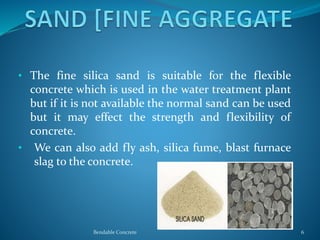
• The fine silica sand is suitable for the flexible
concrete which is used in the water treatment plant
but if it is not available the normal sand can be used
but it may effect the strength and flexibility of
concrete.
• We can also add fly ash, silica fume, blast furnace
slag to the concrete.
Bendable Concrete 6
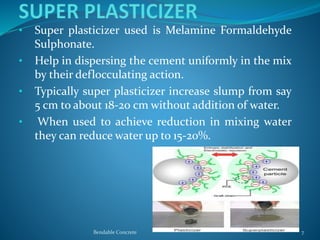
• Super plasticizer used is Melamine Formaldehyde
Sulphonate.
• Help in dispersing the cement uniformly in the mix
by their deflocculating action.
• Typically super plasticizer increase slump from say
5 cm to about 18-20 cm without addition of water.
• When used to achieve reduction in mixing water
they can reduce water up to 15-20%.
Bendable Concrete 7
• Fly ash used is pozzocrete dirk 60.
• Successful in reducing heat generation without loss
of strength, increasing ultimate strength beyond
180 days, and providing additional fines for
compaction.
• In proportioning mixes, for minimum paste
volumes, one of principal function of a fly ash is to
occupy void space which would otherwise be
occupied by cement or water.
• Occupation of void space with water would
obviously result in reduction in concrete strength.
Bendable Concrete 8
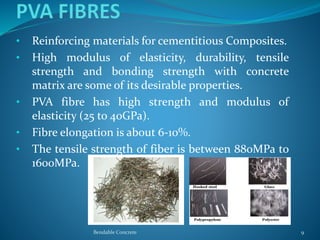
• Reinforcing materials for cementitious Composites.
• High modulus of elasticity, durability, tensile
strength and bonding strength with concrete
matrix are some of its desirable properties.
• PVA fibre has high strength and modulus of
elasticity (25 to 40GPa).
• Fibre elongation is about 6-10%.
• The tensile strength of fiber is between 880MPa to
1600MPa.
Bendable Concrete 9
• Water fit for drinking is generally considered fit for
making concrete.
• Water should be free from acids, oils, alkalis,
vegetables or other organic Impurities. Soft waters
also produce weaker concrete.
• Water has two functions in a concrete mix. Firstly, it
reacts chemically with the cement to form a cement
paste in which the inert aggregates are held in
suspension until the cement paste has hardened.
• Secondly, it serves as a vehicle or lubricant in the
mixture of fine aggregates and cement.
Bendable Concrete 10
• The flexible concrete has the ability to bend like a
metal.
• It is more Stronger, more durable, and lasts longer than
conventional concrete.
• It has a self-healing property that is it can heal itself by
using carbon dioxide and rainwater.
• It is not brittle like a glass.
• It is more resistant to cracking.
• It does not emit that amount of harmful gases as
compared to conventional concrete.
• The flexible concrete is approx. 20-40 percent lighter.
• The use of steel reinforcement is reduced and can be
eliminated.
• It reduces the cost of the project.
• It can be used as precast concrete.
Bendable Concrete 11
• It has a high initial cost as compared to
conventional concrete.
• It requires skilled labor for its construction.
• It needs some special type of materials which can
be difficult to find in some areas.
• Its quality depend upon the material used and the
condition under which it is made.
• Its compressive strength can be lesser than the
conventional concrete.
Bendable Concrete 12
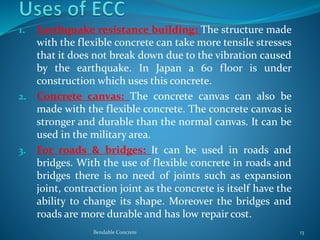
1. Earthquake resistance building: The structure made
with the flexible concrete can take more tensile stresses
that it does not break down due to the vibration caused
by the earthquake. In Japan a 60 floor is under
construction which uses this concrete.
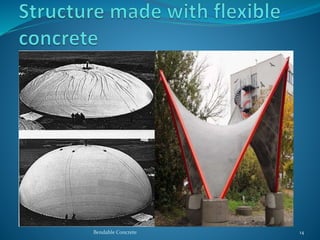
2. Concrete canvas: The concrete canvas can also be
made with the flexible concrete. The concrete canvas is
stronger and durable than the normal canvas. It can be
used in the military area.
3. For roads & bridges: It can be used in roads and
bridges. With the use of flexible concrete in roads and
bridges there is no need of joints such as expansion
joint, contraction joint as the concrete is itself have the
ability to change its shape. Moreover the bridges and
roads are more durable and has low repair cost.
Bendable Concrete 13
Bendable Concrete 14
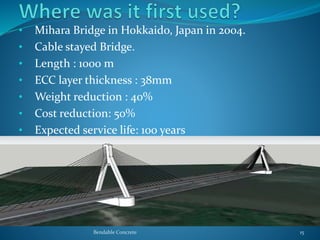
• Mihara Bridge in Hokkaido, Japan in 2004.
• Cable stayed Bridge.
• Length : 1000 m
• ECC layer thickness : 38mm
• Weight reduction : 40%
• Cost reduction: 50%
• Expected service life: 100 years
Bendable Concrete 15
• ECC is the upcoming advancement in technology
which will almost replace the Conventional
Concrete in countries which are more prone to
natural disaster.
• But in India it is still a new material and requires a
proper research for its use in India.
Bendable Concrete 16
THANK YOU
Bendable Concrete 17

Bendable concrete

  • 1.
    DEPARTMENT OF CIVIL ENGINEERING BENDABLE CONCRETE PRESENTEDBY : MUDASIR AHMAD DAR ENROLL : 4606 Bendable Concrete 1
  • 2.
    • Conventional concretesare almost unbendable. • This lack of bendability is a major cause of failure under strain. • It has been a pushing factor in the development of an elegant material namely, bendable concrete also known as Engineered Cementitious Composites (ECC.) • Capable of exhibiting considerably enhanced flexibility. • It is reinforced with micromechanically designed PVA fibres. • ECC is made from the same basic ingredients as conventional concrete but with the addition of High-Range Water Reducing (HRWR) agent. • However, coarse aggregates are not used in ECCs (hence it is a mortar rather than concrete). Bendable Concrete 2
  • 3.
    • Traditional concreteis considered to be a ceramic, brittle and rigid. • It can suffer catastrophic failure when strained in an earthquake or by routine overuse. • ECC acts more like metal than glass. • It is studded with specially-coated reinforcing fibers that hold it together. • ECC remains intact and safe to use at tensile strains up to 5%. • Traditional concrete fractures and can’t carry a load at 0.01 % tensile strain. Bendable Concrete 3
  • 4.
    • CEMENT • SAND[FINE AGGREGATE • SUPER PLASTICIZER • FLY ASH • PVA FIBRES • WATER Bendable Concrete 4
  • 5.
    • Cement usedis Ordinary Portland cement 53 grade. • Blast furnace slag may also be used in some cements and the cement is called Portland slag cement (PSC). • The color of the cement is due mainly to iron oxide. In the absence of impurities, the color would be white. Bendable Concrete 5
  • 6.
    • The finesilica sand is suitable for the flexible concrete which is used in the water treatment plant but if it is not available the normal sand can be used but it may effect the strength and flexibility of concrete. • We can also add fly ash, silica fume, blast furnace slag to the concrete. Bendable Concrete 6
  • 7.
    • Super plasticizerused is Melamine Formaldehyde Sulphonate. • Help in dispersing the cement uniformly in the mix by their deflocculating action. • Typically super plasticizer increase slump from say 5 cm to about 18-20 cm without addition of water. • When used to achieve reduction in mixing water they can reduce water up to 15-20%. Bendable Concrete 7
  • 8.
    • Fly ashused is pozzocrete dirk 60. • Successful in reducing heat generation without loss of strength, increasing ultimate strength beyond 180 days, and providing additional fines for compaction. • In proportioning mixes, for minimum paste volumes, one of principal function of a fly ash is to occupy void space which would otherwise be occupied by cement or water. • Occupation of void space with water would obviously result in reduction in concrete strength. Bendable Concrete 8
  • 9.
    • Reinforcing materialsfor cementitious Composites. • High modulus of elasticity, durability, tensile strength and bonding strength with concrete matrix are some of its desirable properties. • PVA fibre has high strength and modulus of elasticity (25 to 40GPa). • Fibre elongation is about 6-10%. • The tensile strength of fiber is between 880MPa to 1600MPa. Bendable Concrete 9
  • 10.
    • Water fitfor drinking is generally considered fit for making concrete. • Water should be free from acids, oils, alkalis, vegetables or other organic Impurities. Soft waters also produce weaker concrete. • Water has two functions in a concrete mix. Firstly, it reacts chemically with the cement to form a cement paste in which the inert aggregates are held in suspension until the cement paste has hardened. • Secondly, it serves as a vehicle or lubricant in the mixture of fine aggregates and cement. Bendable Concrete 10
  • 11.
    • The flexibleconcrete has the ability to bend like a metal. • It is more Stronger, more durable, and lasts longer than conventional concrete. • It has a self-healing property that is it can heal itself by using carbon dioxide and rainwater. • It is not brittle like a glass. • It is more resistant to cracking. • It does not emit that amount of harmful gases as compared to conventional concrete. • The flexible concrete is approx. 20-40 percent lighter. • The use of steel reinforcement is reduced and can be eliminated. • It reduces the cost of the project. • It can be used as precast concrete. Bendable Concrete 11
  • 12.
    • It hasa high initial cost as compared to conventional concrete. • It requires skilled labor for its construction. • It needs some special type of materials which can be difficult to find in some areas. • Its quality depend upon the material used and the condition under which it is made. • Its compressive strength can be lesser than the conventional concrete. Bendable Concrete 12
  • 13.
    1. Earthquake resistancebuilding: The structure made with the flexible concrete can take more tensile stresses that it does not break down due to the vibration caused by the earthquake. In Japan a 60 floor is under construction which uses this concrete. 2. Concrete canvas: The concrete canvas can also be made with the flexible concrete. The concrete canvas is stronger and durable than the normal canvas. It can be used in the military area. 3. For roads & bridges: It can be used in roads and bridges. With the use of flexible concrete in roads and bridges there is no need of joints such as expansion joint, contraction joint as the concrete is itself have the ability to change its shape. Moreover the bridges and roads are more durable and has low repair cost. Bendable Concrete 13
  • 14.
  • 15.
    • Mihara Bridgein Hokkaido, Japan in 2004. • Cable stayed Bridge. • Length : 1000 m • ECC layer thickness : 38mm • Weight reduction : 40% • Cost reduction: 50% • Expected service life: 100 years Bendable Concrete 15
  • 16.
    • ECC isthe upcoming advancement in technology which will almost replace the Conventional Concrete in countries which are more prone to natural disaster. • But in India it is still a new material and requires a proper research for its use in India. Bendable Concrete 16
  • 17.