Chapter 6 Reading Buildings
Objectives Describe the relationship of loads and load imposition in a building List the three types of force created when loads are imposed on materials Define columns, beams, connections Explain the effects of fire on building construction elements
Objectives (con’t.) List and define the five common types of building construction Define and list several types of hybrid buildings List, in-order, the five-step analytical approach to predicting building collapse List several factors that accelerate the time that a structural element will fail under fire conditions
Introduction ISOs must give the IC explicit detail and their judgment about collapse potential of a building fire Relying on experience is not enough Be aware of building construction principles Understand effects of fire on a building Invest training time in conducting building surveys, site visitations, and preparing prefire plan reviews
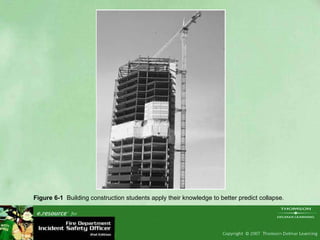
Figure 6-1   Building construction students apply their knowledge to better predict collapse.
Key Topics Imposition and resistance of loads Weather elements, gravity, and use of buildings create building loading Loads are imposed on building materials Imposition  Causes stress on materials called force Direction of a load to a component A material must resist the load imposed on it
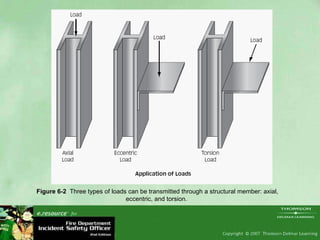
Figure 6-2   Three types of loads can be transmitted through a structural member: axial, eccentric, and torsion.
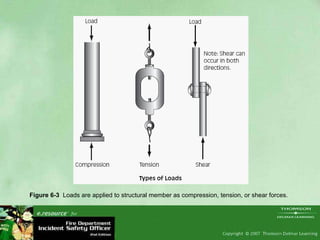
Figure 6-3   Loads are applied to structural member as compression, tension, or shear forces.
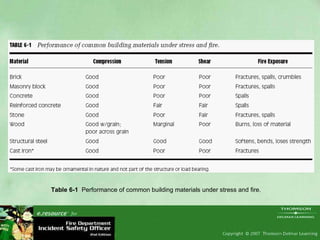
Key Topics (con’t.) Characteristics of building materials The mass (density) of a material directly impacts its fire resistance  Mass is heat resistance Heat resistance is time The more mass a material has in a given surface area, the more time (heat) is required before degradation
Table 6-1   Performance of common building materials under stress and fire.
Key Topics (con’t.) Characteristics of building materials (con’t.) Wood For most residential and small commercial buildings Engineered wood contains many pieces of wood glued together Steel Excellent for girders, lintels, cantilevered beams, and columns Cooling structural steel essential to preventing collapse
Key Topics (con’t.) Characteristics of building materials (con’t.) Concrete Often has added steel for reinforcement Is susceptible to spalling Masonry Used for load-bearing and veneer walls Lateral force exceeding compressive force can cause quick collapse
Key Topics (con’t.) Characteristics of building materials (con’t.) Composites Laminated veneer lumber (LVL): glued and pressed sheet veneers of wood in the same grain direction Oriented strand board (OSB): wood sheeting with wood chips (strands oriented in multiple directions) and emulsified glue Fiber-reinforced plastics (FiRP): mixed with wood to give tensile strength
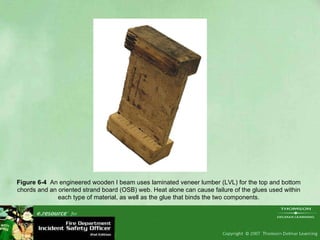
Figure 6-4   An engineered wooden I beam uses laminated veneer lumber (LVL) for the top and bottom chords and an oriented strand board (OSB) web. Heat alone can cause failure of the glues used within each type of material, as well as the glue that binds the two components.
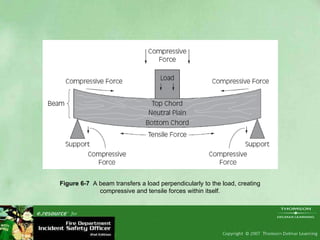
Key Topics (con’t.) Structural elements Columns Transmits compressive force parallel through its center Formed as wall or post Beams Delivers loads perpendicularly to its imposed load Top and bottom chords form “I beam” Material between chords is called the web
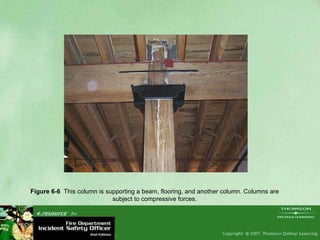
Figure 6-6   This column is supporting a beam, flooring, and another column. Columns are subject to compressive forces.
Figure 6-7   A beam transfers a load perpendicularly to the load, creating compressive and tensile forces within itself.
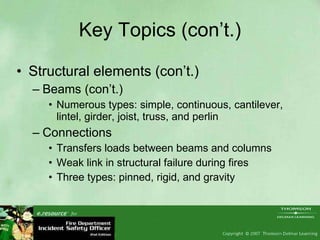
Key Topics (con’t.) Structural elements (con’t.) Beams (con’t.) Numerous types: simple, continuous, cantilever, lintel, girder, joist, truss, and perlin Connections Transfers loads between beams and columns Weak link in structural failure during fires Three types: pinned, rigid, and gravity
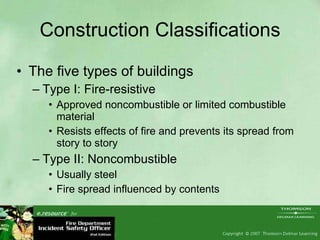
Construction Classifications The five types of buildings Type I: Fire-resistive Approved noncombustible or limited combustible material Resists effects of fire and prevents its spread from story to story Type II: Noncombustible Usually steel Fire spread influenced by contents
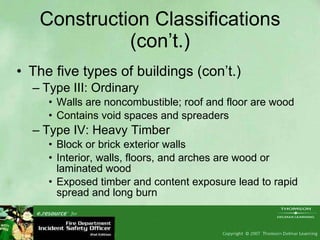
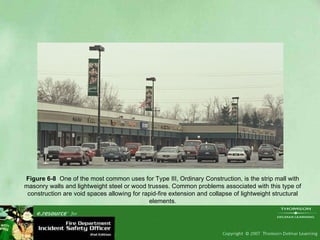
Construction Classifications (con’t.) The five types of buildings (con’t.) Type III: Ordinary Walls are noncombustible; roof and floor are wood Contains void spaces and spreaders Type IV: Heavy Timber Block or brick exterior walls Interior, walls, floors, and arches are wood or laminated wood Exposed timber and content exposure lead to rapid spread and long burn
Figure 6-8   One of the most common uses for Type III, Ordinary Construction, is the strip mall with masonry walls and lightweight steel or wood trusses. Common problems associated with this type of construction are void spaces allowing for rapid-fire extension and collapse of lightweight structural elements.
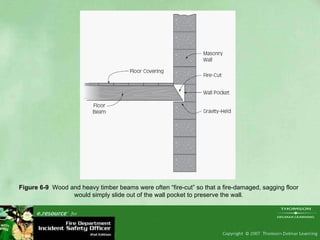
Figure 6-9   Wood and heavy timber beams were often “fire-cut” so that a fire-damaged, sagging floor would simply slide out of the wall pocket to preserve the wall.
Construction Classifications (con’t.) The five types of buildings (con’t.) Type V: Wood Frame Most common type Uses gypsum board to protect structural members Techniques: balloon frames, platform frames, lightweight trusses Possibility of early collapse
Construction Classifications (con’t.) Other construction types (hybrids) Lightweight steel Lightweight steel studs, added OSB, and drywall Insulated concrete forming (ICF) Made of EPS and concrete Two types: ICF block and ICF panel Structural Insulated Panels (SIP) Made from glued OSB and EPS sheets
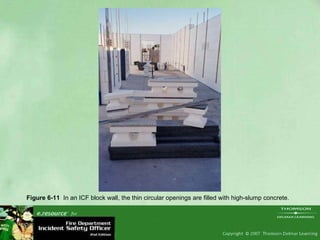
Figure 6-11   In an ICF block wall, the thin circular openings are filled with high-slump concrete.
Predicting Collapse Building analysis during any incident should be cyclic Five-step process for predicting collapse Classify the construction type Determining structural involvement Load-bearing components attacked by fire or heat If involved, attention to potential collapse should be immediate
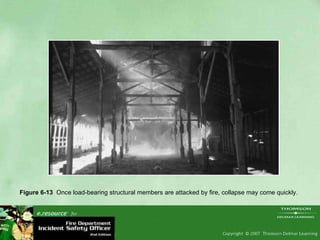
Figure 6-13   Once load-bearing structural members are attacked by fire, collapse may come quickly.
Predicting Collapse (con’t.) Five-step process (con’t.) Visualizing and tracing loads Scan building and trace loads to ground Determine key elements under attack Define weak links: connections, overloading, occupancy switch, trusses, void spaces, stairs, and parapet walls
Predicting Collapse (con’t.) Five-step process (con’t.) Evaluate time Numerous factors can accelerate potential collapse time: low material mass, imposed overload, higher BTU involvement, alternations, etc. Concerns regarding time: light structural elements, heavy load, hot steel, buildings under construction, brown or dark smoke from lightweight engineered wood
Predicting Collapse (con’t.) Five-step process (con’t.) Predicting and communicating the collapse potential Includes establishment of collapse zones Determine whether walls will fall inward or outward Partial collapse may trigger a general collapse
Other Collapse Concerns Deterioration of mortar joints and masonry Signs of building repair Bulges and bowing of walls Sagging floors Abandoned buildings with missing segments
Other Collapse Concerns (con’t.) Large volumes of fires impinging on structural components Multiple fires in the same building or previous fires Building construction Defensive operations should be the default for all construction site fires
Summary ISO functions regarding collapse potential Read the building by using knowledge of Building construction: loads, forces, and materials Effects of fire on materials and construction types Use five-step process to predict collapse Factors in construction types, fire impingement, weak links, and arrival time

Chapter 06

  • 1.
  • 2.
    Objectives Describe therelationship of loads and load imposition in a building List the three types of force created when loads are imposed on materials Define columns, beams, connections Explain the effects of fire on building construction elements
  • 3.
    Objectives (con’t.) Listand define the five common types of building construction Define and list several types of hybrid buildings List, in-order, the five-step analytical approach to predicting building collapse List several factors that accelerate the time that a structural element will fail under fire conditions
  • 4.
    Introduction ISOs mustgive the IC explicit detail and their judgment about collapse potential of a building fire Relying on experience is not enough Be aware of building construction principles Understand effects of fire on a building Invest training time in conducting building surveys, site visitations, and preparing prefire plan reviews
  • 5.
    Figure 6-1 Building construction students apply their knowledge to better predict collapse.
  • 6.
    Key Topics Impositionand resistance of loads Weather elements, gravity, and use of buildings create building loading Loads are imposed on building materials Imposition Causes stress on materials called force Direction of a load to a component A material must resist the load imposed on it
  • 7.
    Figure 6-2 Three types of loads can be transmitted through a structural member: axial, eccentric, and torsion.
  • 8.
    Figure 6-3 Loads are applied to structural member as compression, tension, or shear forces.
  • 9.
    Key Topics (con’t.)Characteristics of building materials The mass (density) of a material directly impacts its fire resistance Mass is heat resistance Heat resistance is time The more mass a material has in a given surface area, the more time (heat) is required before degradation
  • 10.
    Table 6-1 Performance of common building materials under stress and fire.
  • 11.
    Key Topics (con’t.)Characteristics of building materials (con’t.) Wood For most residential and small commercial buildings Engineered wood contains many pieces of wood glued together Steel Excellent for girders, lintels, cantilevered beams, and columns Cooling structural steel essential to preventing collapse
  • 12.
    Key Topics (con’t.)Characteristics of building materials (con’t.) Concrete Often has added steel for reinforcement Is susceptible to spalling Masonry Used for load-bearing and veneer walls Lateral force exceeding compressive force can cause quick collapse
  • 13.
    Key Topics (con’t.)Characteristics of building materials (con’t.) Composites Laminated veneer lumber (LVL): glued and pressed sheet veneers of wood in the same grain direction Oriented strand board (OSB): wood sheeting with wood chips (strands oriented in multiple directions) and emulsified glue Fiber-reinforced plastics (FiRP): mixed with wood to give tensile strength
  • 14.
    Figure 6-4 An engineered wooden I beam uses laminated veneer lumber (LVL) for the top and bottom chords and an oriented strand board (OSB) web. Heat alone can cause failure of the glues used within each type of material, as well as the glue that binds the two components.
  • 15.
    Key Topics (con’t.)Structural elements Columns Transmits compressive force parallel through its center Formed as wall or post Beams Delivers loads perpendicularly to its imposed load Top and bottom chords form “I beam” Material between chords is called the web
  • 16.
    Figure 6-6 This column is supporting a beam, flooring, and another column. Columns are subject to compressive forces.
  • 17.
    Figure 6-7 A beam transfers a load perpendicularly to the load, creating compressive and tensile forces within itself.
  • 18.
    Key Topics (con’t.)Structural elements (con’t.) Beams (con’t.) Numerous types: simple, continuous, cantilever, lintel, girder, joist, truss, and perlin Connections Transfers loads between beams and columns Weak link in structural failure during fires Three types: pinned, rigid, and gravity
  • 19.
    Construction Classifications Thefive types of buildings Type I: Fire-resistive Approved noncombustible or limited combustible material Resists effects of fire and prevents its spread from story to story Type II: Noncombustible Usually steel Fire spread influenced by contents
  • 20.
    Construction Classifications (con’t.)The five types of buildings (con’t.) Type III: Ordinary Walls are noncombustible; roof and floor are wood Contains void spaces and spreaders Type IV: Heavy Timber Block or brick exterior walls Interior, walls, floors, and arches are wood or laminated wood Exposed timber and content exposure lead to rapid spread and long burn
  • 21.
    Figure 6-8 One of the most common uses for Type III, Ordinary Construction, is the strip mall with masonry walls and lightweight steel or wood trusses. Common problems associated with this type of construction are void spaces allowing for rapid-fire extension and collapse of lightweight structural elements.
  • 22.
    Figure 6-9 Wood and heavy timber beams were often “fire-cut” so that a fire-damaged, sagging floor would simply slide out of the wall pocket to preserve the wall.
  • 23.
    Construction Classifications (con’t.)The five types of buildings (con’t.) Type V: Wood Frame Most common type Uses gypsum board to protect structural members Techniques: balloon frames, platform frames, lightweight trusses Possibility of early collapse
  • 24.
    Construction Classifications (con’t.)Other construction types (hybrids) Lightweight steel Lightweight steel studs, added OSB, and drywall Insulated concrete forming (ICF) Made of EPS and concrete Two types: ICF block and ICF panel Structural Insulated Panels (SIP) Made from glued OSB and EPS sheets
  • 25.
    Figure 6-11 In an ICF block wall, the thin circular openings are filled with high-slump concrete.
  • 26.
    Predicting Collapse Buildinganalysis during any incident should be cyclic Five-step process for predicting collapse Classify the construction type Determining structural involvement Load-bearing components attacked by fire or heat If involved, attention to potential collapse should be immediate
  • 27.
    Figure 6-13 Once load-bearing structural members are attacked by fire, collapse may come quickly.
  • 28.
    Predicting Collapse (con’t.)Five-step process (con’t.) Visualizing and tracing loads Scan building and trace loads to ground Determine key elements under attack Define weak links: connections, overloading, occupancy switch, trusses, void spaces, stairs, and parapet walls
  • 29.
    Predicting Collapse (con’t.)Five-step process (con’t.) Evaluate time Numerous factors can accelerate potential collapse time: low material mass, imposed overload, higher BTU involvement, alternations, etc. Concerns regarding time: light structural elements, heavy load, hot steel, buildings under construction, brown or dark smoke from lightweight engineered wood
  • 30.
    Predicting Collapse (con’t.)Five-step process (con’t.) Predicting and communicating the collapse potential Includes establishment of collapse zones Determine whether walls will fall inward or outward Partial collapse may trigger a general collapse
  • 31.
    Other Collapse ConcernsDeterioration of mortar joints and masonry Signs of building repair Bulges and bowing of walls Sagging floors Abandoned buildings with missing segments
  • 32.
    Other Collapse Concerns(con’t.) Large volumes of fires impinging on structural components Multiple fires in the same building or previous fires Building construction Defensive operations should be the default for all construction site fires
  • 33.
    Summary ISO functionsregarding collapse potential Read the building by using knowledge of Building construction: loads, forces, and materials Effects of fire on materials and construction types Use five-step process to predict collapse Factors in construction types, fire impingement, weak links, and arrival time