Standpipe and Hose Systems  Chapter 4
Learning Objectives State when and where standpipes and hose systems are required in buildings Reference the design and installation standards that apply to standpipes List and describe the different types of standpipes and the different standpipe classifications
Learning Objectives (continued) State the minimum standpipe system pressure and flow requirements List and describe the different standpipe system components Reference the inspection, testing, and maintenance requirements Recognize the possible impairments to standpipe systems
Introduction The standpipe system may be the only available fire protection equipment in a structure Standpipe system: network of piping and components that transport water  Required where occupied levels are more than 30 feet above or below vehicle access Standpipe system has fixed pipes that rise vertically or horizontally through the building To feed hose valve outlets or hose stations
Required Installations Standpipes systems installed based on use, occupancy, occupancy load, etc. Building height and area determine when a standpipe is required Referenced standards state how to install a fire protection system When researching standpipe systems, confirm the model codes and referenced standard in use
Building Height and Levels Below Grade Height above grade and distance below grade affect ability to fight fire Determine requirements Number of feet or levels above or below fire department access or grade level Occupancy requirements Occupancy conditions
Occupancy Requirements Height of a particular occupancy will play a major role Other factors: Occupancy load Lack of other fire protection features Stages are another example of assembly-based occupancy requirement for standpipe systems Part of many assembly occupancies
Hazard Requirements Building conditions considered more hazardous than normal should be thoroughly researched Fires can grow exponentially within moments Standpipe system requirements are straightforward Model codes occasionally have exceptions  Read entire code section Determine if other retroactive code requirements were in effect Know when the building was constructed
Buildings under Construction, Rehabilitations, or Demolition Construction and demolition sites create access and fuel load problems Construction materials surrounding the building complicate fire fighting Temporary standpipe may be required At least one hose connection per floor level Clearly marked and accessible connection at street level
Design and Installation Standards NFPA 14 most widely known and used  Establishes minimum requirements for components, hardware, etc. Discusses standpipe requirements while buildings are under construction Used as a referenced standard FM Global’s data Sheet 4-4N also well-known “ N” signifies FM Global has adopted NFPA standard Some changes or additions have been made
Types of Standpipe Systems Five different types of standpipe systems Differ by operation and configuration features Operational feature: Whether water supply will be immediately available or available after water manually supplied Configuration feature: Whether or not the standpipe system would ordinarily have water in the pipe Five types: wet, automatic dry, semiautomatic, manual, manual dry
Wet Standpipe Water in the pipe at all times Automatic and dedicated water supply provides water once a hose valve opens Immediately supplies water Required to supply sufficient quantities of water to support manual firefighting operations Fire pump connects to the system Environmental temperature must remain over 40 degrees Fahrenheit
Automatic Dry Standpipe Pressurized air in the pipes Water enters after hose valve opens and air pressure drops Loss of air pressure allows a system component to open Permits water to flow into system piping System piping and hose valve may be exposed to temperatures below 40 degrees Fahrenheit Common in residential apartment buildings
Semiautomatic Standpipe Either pressurized air or atmospheric air in the pipe Activation of a remote control device allows water to enter the pipe Remote control typically a manual release located at each hose valve Typically installed where system components housed in a room greater than 40 degrees F Common in industrial complexes or public areas
Manual Standpipe Water in the pipes at all times Water typically supplied from building’s domestic water system Tap size typically not more than ¾ inch or one inch in diameter Usually requires additional pumping to provide adequate water pressure Common in older mid- and high-rise buildings
Manual Dry Standpipe Does not have attached water supply Only atmospheric air in the standpipe Firefighters must connect a water source Common in remote or freestanding structures such as parking garages
Classifications of Standpipe Systems Classification dates back to 1917 edition of NFPA 14 Establishes classes of service in use today Three general categories: Class I Class II Class III Classification system establishes design, installation, use, water supply, outlet size
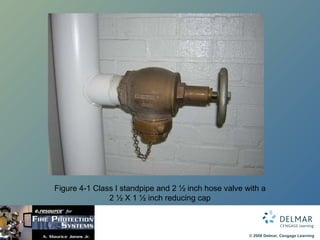
Class I Standpipe System Designed for use by personnel trained to handle “heavy fire streams” High pressure and volume Two to three people may be required to handle the hose line Hose valves commonly fitted with 2 ½ X 1 ½ inch reducing caps Common to high-rise buildings, open parking garages, covered malls, underground buildings
Figure 4-1 Class I standpipe and 2 ½ inch hose valve with a 2 ½ X 1 ½ inch reducing cap
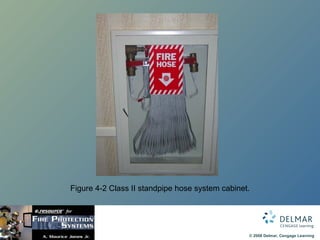
Class II Standpipe System Access to water supply through: Hose rack, pre-connected 1-inch or 1 ½ inch hose, and hose nozzle Water pressure and volume requirements much less demanding Any individual can start suppression activities Fire departments discourage building occupants from fighting fires beyond using fire extinguisher Reliability of hoses and nozzles is unknown Installed hoses are smaller
Figure 4-2 Class II standpipe hose system cabinet.
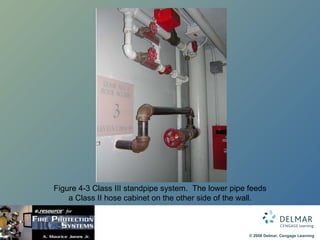
Class III Standpipe System Incorporates Class I and Class II requirements 2 ½ inch and 1 ½ inch hose outlets Water and pressure requirements same as for Class I Class III should be carefully considered Safety and reliability concerns Many authorities suggest Class I standpipe instead of Class II or III
Figure 4-3 Class III standpipe system.  The lower pipe feeds a Class II hose cabinet on the other side of the wall.
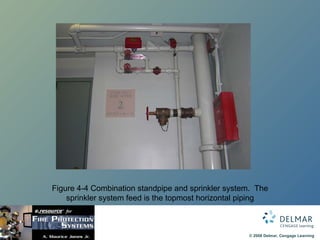
Combined Standpipe and Sprinkler Systems Standpipe system should be used as the sprinkler system riser Common in old buildings where there is an existing standpipe Common in new buildings where the standpipe design provides outlets for the sprinkler system 1971 NFPA adopted combined standpipe and sprinkler systems
Figure 4-4 Combination standpipe and sprinkler system.  The sprinkler system feed is the topmost horizontal piping
Water Pressure and Flow Requirements Factors such as standpipe class and type establish water supply requirements Calculating system demand ensures water supply provides minimum pressure and flow
Minimum and Maximum Pressure Requirements Per NFPA 14, minimum design pressure is 100 psi at hydraulically most remote 2 ½ inch outlet 65 psi at hydraulically most remote 1 ½ inch outlet Minimum valve ties directly to pressures required to properly operate modern nozzles Lower pressures adversely affect nozzle operation Maximum pressure factors: Ability of individuals to handle hose Pressure rating of standpipe and sprinkler system
Pressure Requirements in High-Rise Buildings In high-rises, overcoming pressure loss due to elevation places great demand on standpipes Pressures at hose valves on lower levels are much greater System may be zoned, and pressure-control devices installed Extremely tall buildings: upper and lower zones Water comes from many different sources
Minimum Flow Requirements Class I and III standpipe systems require minimum 500 gpm flow rate Additional 250 gpm per standpipe riser Total should not exceed 1,250 gpm When building equipped with sprinkler system, requirement reduces to 1,000 gpm Class II standpipe systems require 100 gpm flow rate No additional flow required when more than one hose provided
Standpipe System Components Standpipe system requires many components Each component has a pressure rating Factors such as type and classification of standpipe system determine components Fire department personnel should be familiar with their functions
Fire Department Connections First responders connect hose lines to the  fire department connection (FDC)  Types of fire department connections Single inlet and double inlet Wall mounted or free-standing
Fire Department Connections (continued) Location of fire department connections Must be accessible from street side of the building Fire department connection identification Type of system Inlet pressure requirements Part of building it serves
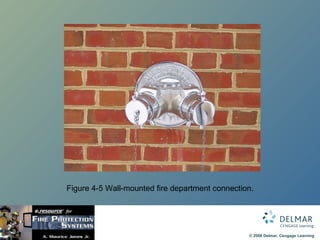
Figure 4-5 Wall-mounted fire department connection.
Pipe and Fittings Components to install standpipes and the way they join must meet adopted standards Commonly used materials Ductile iron, cast iron Malleable iron Steel  Copper Fittings join piping together by a number of different methods
Gauges Gauges determine available water pressure Alert personnel to potential problems Required at the top of each standpipe Recommended on each side of pressure-regulating devices Should not be subject to freezing temperatures Should have a control valve capable of draining
Valves Standpipe systems use many types of valves Check valves installed between the FDC and the standpipe system piping Prevent water flowing back to FDC Control valves permit water to flow into and through the system when open Isolate parts of the system for servicing when closed Drain valves permit water to purge from the system for testing or servicing
Valves (continued) Hose valves allow fire hoses to be connected Pressure-restricting, pressure-reducing, pressure control devices and valves Allow boost pressure to be high but manageable Require extra care and attention Flow test at time of acceptance is crucial Fire companies and inspectors conduct required tests
Hose Cabinets, Hose, Hose Racks, and Nozzles Hose cabinet is a metal enclosure mounted in the wall of a building Holds fire protection equipment Require labeling, cabinet door typically glass Cabinet door may be locked  Device to strike the glass must be available Sized to house the pre-connected hose and related equipment
Inspection, Testing, and Maintenance Requirements System must undergo acceptance testing Fire, building, insurance, third-party inspectors conduct acceptance tests Some tests occur during construction; others at the conclusion Through life of the standpipe, periodic inspection, testing, and maintenance is essential
Hydrostatic and Air Test One of the first and most important tests Subjects the system to a minimum 200 psi pressurized water for two hours Hydrostatic pressure measured at low elevation point At end of two hours, release of pressurized water allows system pressure to drop to zero 24-hour air test required for dry standpipes 40 psi air pressure for 24-hour period
Visual Inspection Visual inspection of all components ensures system maintains integrity Check for leaks Verify components are installed correctly Ensuring that piping and components specified by the designer and approved by the authority are installed Takes place at floor level As important as the hydrostatic test
Flushing Flushing supply piping necessary to remove dirt, stones, mud, debris, and particulates Inspector observes underground fire service mains and lead-in connections flowing water Recommended flow rate is 10 ft/sec Minimum flow rate should not be less than system demand rate System is flushed long enough to ensure pipe cleaning until water flows clear
Flow Tests Flowing water from hydraulically most remote outlet Determine if required flow and pressure available Takes place on the roof of a building Requires hose lines and nozzles  Pitot tube and riser gauge determine flow and pressure readings When roof not accessible, water flows out of a window or down stairs
Main Drain Test Main drain serves two purposes: Remove system water so it will not be a hazard Allows the inspector to determine if there is enough water supply in the system As main drain valve is fully open, system gauges display static and residual pressure Compare new readings with previous readings to determine if water supply has changed Drain should be piped to an exterior location
Operation of Components Any component capable of movement requires testing under operating conditions Almost every component requires unscrewing a cap or turning a valve to move water Doing so provides a means to determine whether system will operate when needed
Periodic Inspection, Testing, and Maintenance Many fire protection systems have never actually operated When a device is not tested and maintained, the operating condition is unknown and may fail Better to fail in a test than an emergency Visual inspection can reveal leaks, corrosion, and damage Hydrostatic testing determines if system can handle water pressure
Impairments Some impairments are system-related; some are not Important for fire companies to frequently tour their first due area Fencing, barricades, bushes, and physical barriers create access problems Unmaintained standpipe systems may be inoperable
Summary Standpipe and hose systems may be the only required fire protection system Height, area, occupancy, and hazard determine when a standpipe is required NFPA 14 establishes three standpipe classifications Five different types of standpipes Fire department connections are very important Inspections and tests crucial for system to work

Chapter 04

  • 1.
    Standpipe and HoseSystems Chapter 4
  • 2.
    Learning Objectives Statewhen and where standpipes and hose systems are required in buildings Reference the design and installation standards that apply to standpipes List and describe the different types of standpipes and the different standpipe classifications
  • 3.
    Learning Objectives (continued)State the minimum standpipe system pressure and flow requirements List and describe the different standpipe system components Reference the inspection, testing, and maintenance requirements Recognize the possible impairments to standpipe systems
  • 4.
    Introduction The standpipesystem may be the only available fire protection equipment in a structure Standpipe system: network of piping and components that transport water Required where occupied levels are more than 30 feet above or below vehicle access Standpipe system has fixed pipes that rise vertically or horizontally through the building To feed hose valve outlets or hose stations
  • 5.
    Required Installations Standpipessystems installed based on use, occupancy, occupancy load, etc. Building height and area determine when a standpipe is required Referenced standards state how to install a fire protection system When researching standpipe systems, confirm the model codes and referenced standard in use
  • 6.
    Building Height andLevels Below Grade Height above grade and distance below grade affect ability to fight fire Determine requirements Number of feet or levels above or below fire department access or grade level Occupancy requirements Occupancy conditions
  • 7.
    Occupancy Requirements Heightof a particular occupancy will play a major role Other factors: Occupancy load Lack of other fire protection features Stages are another example of assembly-based occupancy requirement for standpipe systems Part of many assembly occupancies
  • 8.
    Hazard Requirements Buildingconditions considered more hazardous than normal should be thoroughly researched Fires can grow exponentially within moments Standpipe system requirements are straightforward Model codes occasionally have exceptions Read entire code section Determine if other retroactive code requirements were in effect Know when the building was constructed
  • 9.
    Buildings under Construction,Rehabilitations, or Demolition Construction and demolition sites create access and fuel load problems Construction materials surrounding the building complicate fire fighting Temporary standpipe may be required At least one hose connection per floor level Clearly marked and accessible connection at street level
  • 10.
    Design and InstallationStandards NFPA 14 most widely known and used Establishes minimum requirements for components, hardware, etc. Discusses standpipe requirements while buildings are under construction Used as a referenced standard FM Global’s data Sheet 4-4N also well-known “ N” signifies FM Global has adopted NFPA standard Some changes or additions have been made
  • 11.
    Types of StandpipeSystems Five different types of standpipe systems Differ by operation and configuration features Operational feature: Whether water supply will be immediately available or available after water manually supplied Configuration feature: Whether or not the standpipe system would ordinarily have water in the pipe Five types: wet, automatic dry, semiautomatic, manual, manual dry
  • 12.
    Wet Standpipe Waterin the pipe at all times Automatic and dedicated water supply provides water once a hose valve opens Immediately supplies water Required to supply sufficient quantities of water to support manual firefighting operations Fire pump connects to the system Environmental temperature must remain over 40 degrees Fahrenheit
  • 13.
    Automatic Dry StandpipePressurized air in the pipes Water enters after hose valve opens and air pressure drops Loss of air pressure allows a system component to open Permits water to flow into system piping System piping and hose valve may be exposed to temperatures below 40 degrees Fahrenheit Common in residential apartment buildings
  • 14.
    Semiautomatic Standpipe Eitherpressurized air or atmospheric air in the pipe Activation of a remote control device allows water to enter the pipe Remote control typically a manual release located at each hose valve Typically installed where system components housed in a room greater than 40 degrees F Common in industrial complexes or public areas
  • 15.
    Manual Standpipe Waterin the pipes at all times Water typically supplied from building’s domestic water system Tap size typically not more than ¾ inch or one inch in diameter Usually requires additional pumping to provide adequate water pressure Common in older mid- and high-rise buildings
  • 16.
    Manual Dry StandpipeDoes not have attached water supply Only atmospheric air in the standpipe Firefighters must connect a water source Common in remote or freestanding structures such as parking garages
  • 17.
    Classifications of StandpipeSystems Classification dates back to 1917 edition of NFPA 14 Establishes classes of service in use today Three general categories: Class I Class II Class III Classification system establishes design, installation, use, water supply, outlet size
  • 18.
    Class I StandpipeSystem Designed for use by personnel trained to handle “heavy fire streams” High pressure and volume Two to three people may be required to handle the hose line Hose valves commonly fitted with 2 ½ X 1 ½ inch reducing caps Common to high-rise buildings, open parking garages, covered malls, underground buildings
  • 19.
    Figure 4-1 ClassI standpipe and 2 ½ inch hose valve with a 2 ½ X 1 ½ inch reducing cap
  • 20.
    Class II StandpipeSystem Access to water supply through: Hose rack, pre-connected 1-inch or 1 ½ inch hose, and hose nozzle Water pressure and volume requirements much less demanding Any individual can start suppression activities Fire departments discourage building occupants from fighting fires beyond using fire extinguisher Reliability of hoses and nozzles is unknown Installed hoses are smaller
  • 21.
    Figure 4-2 ClassII standpipe hose system cabinet.
  • 22.
    Class III StandpipeSystem Incorporates Class I and Class II requirements 2 ½ inch and 1 ½ inch hose outlets Water and pressure requirements same as for Class I Class III should be carefully considered Safety and reliability concerns Many authorities suggest Class I standpipe instead of Class II or III
  • 23.
    Figure 4-3 ClassIII standpipe system. The lower pipe feeds a Class II hose cabinet on the other side of the wall.
  • 24.
    Combined Standpipe andSprinkler Systems Standpipe system should be used as the sprinkler system riser Common in old buildings where there is an existing standpipe Common in new buildings where the standpipe design provides outlets for the sprinkler system 1971 NFPA adopted combined standpipe and sprinkler systems
  • 25.
    Figure 4-4 Combinationstandpipe and sprinkler system. The sprinkler system feed is the topmost horizontal piping
  • 26.
    Water Pressure andFlow Requirements Factors such as standpipe class and type establish water supply requirements Calculating system demand ensures water supply provides minimum pressure and flow
  • 27.
    Minimum and MaximumPressure Requirements Per NFPA 14, minimum design pressure is 100 psi at hydraulically most remote 2 ½ inch outlet 65 psi at hydraulically most remote 1 ½ inch outlet Minimum valve ties directly to pressures required to properly operate modern nozzles Lower pressures adversely affect nozzle operation Maximum pressure factors: Ability of individuals to handle hose Pressure rating of standpipe and sprinkler system
  • 28.
    Pressure Requirements inHigh-Rise Buildings In high-rises, overcoming pressure loss due to elevation places great demand on standpipes Pressures at hose valves on lower levels are much greater System may be zoned, and pressure-control devices installed Extremely tall buildings: upper and lower zones Water comes from many different sources
  • 29.
    Minimum Flow RequirementsClass I and III standpipe systems require minimum 500 gpm flow rate Additional 250 gpm per standpipe riser Total should not exceed 1,250 gpm When building equipped with sprinkler system, requirement reduces to 1,000 gpm Class II standpipe systems require 100 gpm flow rate No additional flow required when more than one hose provided
  • 30.
    Standpipe System ComponentsStandpipe system requires many components Each component has a pressure rating Factors such as type and classification of standpipe system determine components Fire department personnel should be familiar with their functions
  • 31.
    Fire Department ConnectionsFirst responders connect hose lines to the fire department connection (FDC) Types of fire department connections Single inlet and double inlet Wall mounted or free-standing
  • 32.
    Fire Department Connections(continued) Location of fire department connections Must be accessible from street side of the building Fire department connection identification Type of system Inlet pressure requirements Part of building it serves
  • 33.
    Figure 4-5 Wall-mountedfire department connection.
  • 34.
    Pipe and FittingsComponents to install standpipes and the way they join must meet adopted standards Commonly used materials Ductile iron, cast iron Malleable iron Steel Copper Fittings join piping together by a number of different methods
  • 35.
    Gauges Gauges determineavailable water pressure Alert personnel to potential problems Required at the top of each standpipe Recommended on each side of pressure-regulating devices Should not be subject to freezing temperatures Should have a control valve capable of draining
  • 36.
    Valves Standpipe systemsuse many types of valves Check valves installed between the FDC and the standpipe system piping Prevent water flowing back to FDC Control valves permit water to flow into and through the system when open Isolate parts of the system for servicing when closed Drain valves permit water to purge from the system for testing or servicing
  • 37.
    Valves (continued) Hosevalves allow fire hoses to be connected Pressure-restricting, pressure-reducing, pressure control devices and valves Allow boost pressure to be high but manageable Require extra care and attention Flow test at time of acceptance is crucial Fire companies and inspectors conduct required tests
  • 38.
    Hose Cabinets, Hose,Hose Racks, and Nozzles Hose cabinet is a metal enclosure mounted in the wall of a building Holds fire protection equipment Require labeling, cabinet door typically glass Cabinet door may be locked Device to strike the glass must be available Sized to house the pre-connected hose and related equipment
  • 39.
    Inspection, Testing, andMaintenance Requirements System must undergo acceptance testing Fire, building, insurance, third-party inspectors conduct acceptance tests Some tests occur during construction; others at the conclusion Through life of the standpipe, periodic inspection, testing, and maintenance is essential
  • 40.
    Hydrostatic and AirTest One of the first and most important tests Subjects the system to a minimum 200 psi pressurized water for two hours Hydrostatic pressure measured at low elevation point At end of two hours, release of pressurized water allows system pressure to drop to zero 24-hour air test required for dry standpipes 40 psi air pressure for 24-hour period
  • 41.
    Visual Inspection Visualinspection of all components ensures system maintains integrity Check for leaks Verify components are installed correctly Ensuring that piping and components specified by the designer and approved by the authority are installed Takes place at floor level As important as the hydrostatic test
  • 42.
    Flushing Flushing supplypiping necessary to remove dirt, stones, mud, debris, and particulates Inspector observes underground fire service mains and lead-in connections flowing water Recommended flow rate is 10 ft/sec Minimum flow rate should not be less than system demand rate System is flushed long enough to ensure pipe cleaning until water flows clear
  • 43.
    Flow Tests Flowingwater from hydraulically most remote outlet Determine if required flow and pressure available Takes place on the roof of a building Requires hose lines and nozzles Pitot tube and riser gauge determine flow and pressure readings When roof not accessible, water flows out of a window or down stairs
  • 44.
    Main Drain TestMain drain serves two purposes: Remove system water so it will not be a hazard Allows the inspector to determine if there is enough water supply in the system As main drain valve is fully open, system gauges display static and residual pressure Compare new readings with previous readings to determine if water supply has changed Drain should be piped to an exterior location
  • 45.
    Operation of ComponentsAny component capable of movement requires testing under operating conditions Almost every component requires unscrewing a cap or turning a valve to move water Doing so provides a means to determine whether system will operate when needed
  • 46.
    Periodic Inspection, Testing,and Maintenance Many fire protection systems have never actually operated When a device is not tested and maintained, the operating condition is unknown and may fail Better to fail in a test than an emergency Visual inspection can reveal leaks, corrosion, and damage Hydrostatic testing determines if system can handle water pressure
  • 47.
    Impairments Some impairmentsare system-related; some are not Important for fire companies to frequently tour their first due area Fencing, barricades, bushes, and physical barriers create access problems Unmaintained standpipe systems may be inoperable
  • 48.
    Summary Standpipe andhose systems may be the only required fire protection system Height, area, occupancy, and hazard determine when a standpipe is required NFPA 14 establishes three standpipe classifications Five different types of standpipes Fire department connections are very important Inspections and tests crucial for system to work