'I% 1 I r 1 t I tnc r - t ( I r 11
2 4 6 8 10 1 2 14 16
Fllter Number
(b) Response of 16-pulse processor.
A significant disadvantage of the MTD processor is the relatively large number
of pulscs that must bc transmitted to achicvc the desired pcrforniancc 1cvc:l.s This
rcstricts its use to 2-D surveillance radars or 3-D radars that use the stacked bean1
approach. Furthcr, the need for a relatively long coherent burst transr~lissionat a
stablc PKF (i.e., cight to ten pulses) makes thc MTD susceptible to clcctronic
couritcrnleasl~rcs(ECM) 1361. A rcsponsivc ji~ti~tncrcould rnc:tsurc t11c frcqrwncy of
thc first transmitted pulse and then center the jammer to spot jam thc f'ollowing
pulses. Also the requirement for a stable PRF precludes the use of pulse-to-pulse
jitter, which is one of the most effective techniques against deception and cnn~ouflage
jamtncrs that rcly on anticipating, the radar transmitter pulse.
1.41 Clutter Maps
Onc innovation eniploycd in the M'I'D-type of processor is the use of a clutter rmp
for false-alarm control against a spatially nonstationary variable cluttcr background
(sce Section 1.3.4). This is contrasted with a conventional cell-averaging CFAR that
provides good performance in a spatially stationary background but poor pcrfom~ance
when the sample cells surrounding the target cell have nonuniform statistics (441.
The conventional cell-averaging CFAR can be modified by using a split-gate or by
employing nonpara~netric detection techniques to improve its performance in
nonstatior~i~ryinterference. 1-Iowever, when the conditions are appropriate for using
il clut[cr ii~rrpCFAR, this type ofCITAI1control will gencsally outpcrfor~u(Ilavc less
CFAR loss) the conventional and derivative fonm of cell-averaging CFAR processors.
The basic difference between the conventional cell-averaging and the clutter-
map types of CFAR concerns the manner in which the samples are obtained to estinx~te
the background interference level and the method used to censor the target return
from thc: Ix~ckgr~unCIestimte. In the conventionid CFAR, h e background estirnate
is n~adewithin a single radar scan by examining statistically independent range ( a ~ l
possibly t1c)pj)lcr)cclls contiguous to h e test ccll, wl~ichis cxclilclccl rroin the cstirn~lte.
In the clutter-map approach, the background in the test cell is examined on a scan-
to-scan basis where target returns are excluded through doppler discrin~ination(the
M?'D uses tile zero-velocity doppler filter to estimate the mean clutter level) or. through
a target detection test 1451. Implicit in the clutter map CFAR method is that indcpcndc~lt
clutter samples are available on a scan-to-scan basis. This occurs naturally in most
conventiorlal surveillance radars, where the scan frame time is on thc orclcr of 5- 10
s, but thc clutter clecorrelation time due to scan modulation may be on tile order of
100-500 111s .
'l'he clutter-map type of CFAR processors generally use a first-order recursive
filter, as slrown in Figure 1.35, to cstinlatc thc mean clutter Ievctl. This typr: of filter
rcquircs otily one nlemory storage cell for each clutter map resolution cell. As there
can bc: 111any~lutterlnap resolution cells (e.g., 365,000 range-azimuth cells in 1111:
ASK-9 hl'l.l)), tile total rnemory could be excessive if a moving-window type of
avcragcr (c.g.,with I6 samples) were uscd iiS in the convc.ntion:d CFAR processor.
111 tlie rccur.ive f'iltcr type of cstimutor, tl fraction t u of' the present sarnplc (e.g., tr
Figure 1.35 C'luwr 111;ip recursive filter.
DELAY
w
= l / X in the hl'l'l)) is atlclcd to 1 - cu of tlic prcvious cstirii;~tcto f'orti~tlic new
cstir~iatc.'I'liis protluccs :in exponential typc of srnoothing action, where tllc cffcct
of cach sati~plcf;~dcsat an exponential rate.
Thc state equation for the first-ordcr rccursivc filter used in the clrlttcr rn:~p
CI:AK is pivcn by ri; = ( 1 - cu)j,-, + ax-),whcrc ?', is the jth output of thc power
cstitnatc, .; is thc jth sample of the interference (clutter and noise) powcr. arid cu is
thc filtcr's gain cocfficicnt. Thc cxpcctcd valuc ol' the power estimatc is gi.en by
E(y,) = P, I I - ( 1 - tu)'l, which ;~ppro;~cIicsE(  I ) - l', for I;~rpcvnlr1c501' j Notc
that tlic value ot' cluttcr power (PC)in cach cell is proportional to thc backwattcr
ccxf'ficicnt (cr"), which is assumed to be a rand0111variable in the spatially nonst;~tionnry
cluttcr model dcscribcd in Scction 1.3.4. Thus, thc clutter niap CFAK estiniates the
hackscattcring coefficient (UP) on a cell-to-CCIIb i ~ ~ i ~and hcncc accornniodatcs both
spti;~lly~ ~ I I I O ~ C I I C O U S;lrid ~ i ~ ~ ~ i h o r i w g c n e ~ ~ ~clutter distribitt ions.
Thc variancc of the rccursivc filtcr's estimate of the cluttcr powcr is given by
v , ) = c 1 - ( I - a)"]/[l - ( 1 - a)'],whcrc CT: is the variance o f thu clutter
power rantlorn v;~ri:ildc. For large valucs of j, this :~pproacIicsvat-(!) = rrrr;'/l - n,
which illustrates thc smoothing cffcct of thc filter. Because the variance is rctluccd
by tlic factor ,I' = (2 - cu)/cu, this is cquivalcnt to tlic use of rt' cclls in a cont~cntionnl
cell-averaging CFAR 1441.
One use of thc clutter-map type of CFAR is to provide si~pcrclutter~.i<ihility
in tliusc cluttcr cclls wlicrc the target return signil'icantly cxcccds the cluttcr rcturn.
In [he MTLI proccssor, this allows strong tangential targets (those with sr~lallradial
vcltwitics) to bc dctcctcd ovcr wcak ground clutter or tangentially moving precipitation
rcturns. 'Iliis is particularly advantageous in the hnnation and maintenance ot grounel
tracks that occur in subscqucnt data processing.
A siniplif'ied analysis of the CFAK loss associated with the clutter-map CFAU
proccssor shown in Figurc 1.35 can be made for the situation where a Sw.erling 1
typc fluctuating target is to bc dctcctcd in an unknown powcr Kaylcigll cluttcr
backgrouncl. wlicrc the cluttcr is corriplctcly corrclatcd within a single r;~tl:irscan
1441. 'The prch~hilityo f clctcction for ;I square-law clctcctor ; ~ t l c l ;I lixccl t l i r c.l~olcl
(lqh)is given by Pd, = CXP[--yb/(l + y)], where 7 = PJP, is the nlcan signd-to-
cluttcr poMocrratio. The threshold is cstiniated by the clutter map such that !-,= C$/
PC. wlicrc C is a fixed threshold offset, j, is the clutter power estimate froril the
rccursivc filtcr, and P,. is the cluttcr powcr. Thc V;II~IC for PI,C ; I I ~tllcli be Ivrittcn as
Pll = cxp[-CjJ/IJ,(l + y)],which is a function of the estimated clutter poLvcr (3).
If we average ovcr the cluttcr powcr estimate, this rcsults in l',,, = c.;p[-Cf,/
P,( 1 -1- y3]1'(f) (if, which can bc rccognizcd as thc characteristic fwiction AllS =
C/P,( I + y)] of j cvaluntcd at thc argumcnt of the cxponcntial. The fr~lscalarm
probability can be evaluated froni this relationship evaluated at y = O (i.c.. l'/, =
hl(S = ClI',).
The rccursivc iiltcr of Figure 1.35 provides an estimate of the clutter power
I
foniicci froni the currcnt and previous samples as ?', = aC7-,, ( I = cu).r, _ 'lhc proh:lhility
dcnsity of each .r clutter sample is given by y(s) = exp(-x/P,)/P, so that the
characteristic function of 3 equals M ( s ) = nt,[ I + a(l - a)'pJ]-', which upon
substituhn iu(o the probability of detection relationship becon~esc,,= 11;-,, [ 1 +
I x
1 - t i / I i - 7)) . This reliltio~~sllipC V ~ I ~ U ~ I ~ C ~iit y = 0 res~11tsin I;* = 11,-(,
I
1I -t C U ( I - ( t ) ' ] .
The CFAK loss call be evaluated by first solving the P/, relationship for C and
then substituting (his and an appropriate value of y = ~ J P ,into the PC,,relationship
lo provide ii p;irtic~liuprobihility of tlctection. The known powor ( I ~ - C F A R )valuc
of y, can illen be calculntud from y, = lnPb/lnPd, - 1. The CFAR loss in dB is
then found from id = 10 log(y - y,). This is plotted in Figure 1.36 as a function
of the recursive filter gain (Y for P,, = 0.9 and Ph, =
Figure 1.36 shows that snlall CFAR loss results from using a snlall filtcr gain
ctxl'licient ( t u ) . 'l'his occurs because decreasing a corresponds to using a longcr data
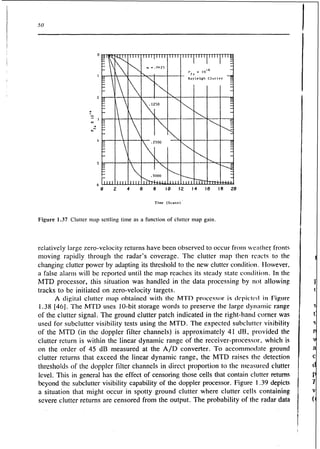
window to csli~natethe clutter power. Conversely, map settling time is reduced as
tr is i n c r c a d as is shown in Figure 1.37 1441. Thus, a compron~isebctwet!n low
Cb'AK loss rlr~tladequate settling time is required. A filtcr gain of cu = .I25 is used
in the hl'I'I), ujhich represents a compromise between these two factors.
ScttII~yt i w I)ecoiilcs important for clutter transients caused by either ch:mging
or moving c.1uttc.r. One example of this situation occurs in the hlTD processor, where
CFAR MAP LOSS
0.00 1.00 2.00 3.00 4.00 5.00 6.00 7.00 8.00
WEIGHT VALUE (8th'sl
Figurc 1.37 Cluttcr map scttling tirnc as a A~nctionof cluttcr map gain.
rclativcly largc zero-velocity returns have bccn obscrvcd to occur from ivcnther fronts
moving rapidly through the radar's coverage. The cluttcr nap then rcacts to the
changing cluttcr power by adapting its thscshold to the ncw clutter condition. Ilowever.
a klsc alarm will bc rcportcd until the map rcachcs its stcady stntc cordition. In thc
hlTD proccssor, this situation was handlcd in the data processing by not allowing
tracks to be initiated on zcro-velocity targcts.
A digital cluttcr n~npobtnincd with thc MTI3 proccssor is tlcpictrtl in Figr~rc
1.38 1461. The M'I'L) uses 10-bit storage words to preserve the large dynamic range
of thc cluttcr signal. The ground clutter patch indicated in the right-hand corner was
used for subcluttcr visibility tests using the MTD. The expected subcluttcr visibility
of thc hlTD (in thc dopplcr filter channels) is approximately 41 dB, provided the
cluttcr rcturn is within thc lincar dynamic range of thc receiver-processor, which is
on the order of 45 dB measured at the A/D converter. To accommodate ground
cluttcr rcturns that exceed the linear dynamic range, the MTD raises the detection
tllrcsholds of thc dopplcr filtcr channels in direct proportion to tllc rnc:~surctldi~ttcr
Icvel. This in general has the effect of censoring those cells that contain clutter returns
beyond thc subclutter visibility capability of the doppler processor. Figurc 1.39 depicts
a situation that might occur in spotty ground clutter where clutter cells containing
severe clutter rcturns are censored from the output. The probability of the radar data
FIVE MILE
r .
J" AREA USED FOR
GROUND CLUTTER
FLIGHT TESTS
processor iracker losing track is generally low in this situation. This is ;in example
of intercluttcr visibility that generally improves as the radar's resolution is increased.
'l'hc I I ~ ~ I I ~ ~ ~ ~ L I I I diilwnsio~lof a clutter cell used in a clutter n q is the radar's
surface resolution cell (the radar range corresponding to the effective pulsewidth and
the azirnutl~bea~nwid(h).If a stationary target exists within this cell, then it will be
suppressed by thc CFAR action as its return will become part of the estimated cluttcr
rctum. A slowly moving target also will be patially supprcssetl if its rcturn is corltaincd
within thc cluttcr cell for several data samples. The rninirnunl tilap-frce vclocity is
ii nxrrsure of this effect, and is defined as the minimum target velocity that will
cilusc: tllc t;i~gctnot to I)c suppressctl by thc clutler map's CFAK actio~l.111 the range
dirnensim, this velocity is given by 7),,,,, = (crc/2)/Ts, where 7, is the rnclar's cl't'cctive
plscwitJth, ; r r d T, is the interscan period. For the ASR-9 (7, = 1.05 ps, 0, - 1.3",
?; = 4.8 S) the rninirnurn rnap-free vclocity in the range dimension is thcn a radial
vclocity of about 65 knots. In the azimuth dimension, the relationship equals I),,,,, =
(OK)/'I;, ~ l w r cO is the azimuth beamwitlth, K is the range to the cluttcr ccll, arid
n95% OF GROUND
CLUTTER REJECTED
BE OUTPUT
POINT LOST
BY CLUTTER
RESIDUE CENSOR
X
"
%AIRCRAFT
TRACK
 RADAR
I IBCATION
-1-
1;igure 1.39 Aircri~fttracking using MTD processing.
T, is thc ititcrscan pcriod. For the ASR-9 at 10 nnii, the minimum map-frrc t;ingcntinl j
velocity bccomcs 170 knots. I
L
REFERENCES
I
D.C. Schlehcr, crl., MTI R(~(iar.~ k c h?louse,,Norwo()d, MA. 1978.
D. I'ovcjsil, R. Rnvcn, and P. Watennan, Airhorrrc R d ~ r ,U. Van Nostrand, I'riticclon. NJ.
1961.
D.K. Barton, cd., CIV c~ndDoppler Rack~r,in Rndars, Vol. 7, Artcch Eiouse. Noruood. hlA.
1078.
G. Stinison, 'Introduction to Airbornc K:idiir," Ill~glicsAircraft ('o~~ip;iny.El Scplntlo. CA.
1083.
kt. Skolnik, cd., R d r r Harrcfbook, 1st Ed., Chapters 17 and 18. "MTl Radar" and 'Airborne
klT1." McGraw-Hill, New York, 1970.
A. Kihaczck, Prirrciples of High Resolrction Radar, McGraw-Hill, New York . I000.

58 64

  • 1.
    'I% 1 Ir 1 t I tnc r - t ( I r 11 2 4 6 8 10 1 2 14 16 Fllter Number (b) Response of 16-pulse processor. A significant disadvantage of the MTD processor is the relatively large number of pulscs that must bc transmitted to achicvc the desired pcrforniancc 1cvc:l.s This rcstricts its use to 2-D surveillance radars or 3-D radars that use the stacked bean1 approach. Furthcr, the need for a relatively long coherent burst transr~lissionat a stablc PKF (i.e., cight to ten pulses) makes thc MTD susceptible to clcctronic couritcrnleasl~rcs(ECM) 1361. A rcsponsivc ji~ti~tncrcould rnc:tsurc t11c frcqrwncy of thc first transmitted pulse and then center the jammer to spot jam thc f'ollowing pulses. Also the requirement for a stable PRF precludes the use of pulse-to-pulse jitter, which is one of the most effective techniques against deception and cnn~ouflage jamtncrs that rcly on anticipating, the radar transmitter pulse. 1.41 Clutter Maps Onc innovation eniploycd in the M'I'D-type of processor is the use of a clutter rmp for false-alarm control against a spatially nonstationary variable cluttcr background (sce Section 1.3.4). This is contrasted with a conventional cell-averaging CFAR that provides good performance in a spatially stationary background but poor pcrfom~ance when the sample cells surrounding the target cell have nonuniform statistics (441.
  • 2.
    The conventional cell-averagingCFAR can be modified by using a split-gate or by employing nonpara~netric detection techniques to improve its performance in nonstatior~i~ryinterference. 1-Iowever, when the conditions are appropriate for using il clut[cr ii~rrpCFAR, this type ofCITAI1control will gencsally outpcrfor~u(Ilavc less CFAR loss) the conventional and derivative fonm of cell-averaging CFAR processors. The basic difference between the conventional cell-averaging and the clutter- map types of CFAR concerns the manner in which the samples are obtained to estinx~te the background interference level and the method used to censor the target return from thc: Ix~ckgr~unCIestimte. In the conventionid CFAR, h e background estirnate is n~adewithin a single radar scan by examining statistically independent range ( a ~ l possibly t1c)pj)lcr)cclls contiguous to h e test ccll, wl~ichis cxclilclccl rroin the cstirn~lte. In the clutter-map approach, the background in the test cell is examined on a scan- to-scan basis where target returns are excluded through doppler discrin~ination(the M?'D uses tile zero-velocity doppler filter to estimate the mean clutter level) or. through a target detection test 1451. Implicit in the clutter map CFAR method is that indcpcndc~lt clutter samples are available on a scan-to-scan basis. This occurs naturally in most conventiorlal surveillance radars, where the scan frame time is on thc orclcr of 5- 10 s, but thc clutter clecorrelation time due to scan modulation may be on tile order of 100-500 111s . 'l'he clutter-map type of CFAR processors generally use a first-order recursive filter, as slrown in Figure 1.35, to cstinlatc thc mean clutter Ievctl. This typr: of filter rcquircs otily one nlemory storage cell for each clutter map resolution cell. As there can bc: 111any~lutterlnap resolution cells (e.g., 365,000 range-azimuth cells in 1111: ASK-9 hl'l.l)), tile total rnemory could be excessive if a moving-window type of avcragcr (c.g.,with I6 samples) were uscd iiS in the convc.ntion:d CFAR processor. 111 tlie rccur.ive f'iltcr type of cstimutor, tl fraction t u of' the present sarnplc (e.g., tr Figure 1.35 C'luwr 111;ip recursive filter. DELAY w
  • 3.
    = l /X in the hl'l'l)) is atlclcd to 1 - cu of tlic prcvious cstirii;~tcto f'orti~tlic new cstir~iatc.'I'liis protluccs :in exponential typc of srnoothing action, where tllc cffcct of cach sati~plcf;~dcsat an exponential rate. Thc state equation for the first-ordcr rccursivc filter used in the clrlttcr rn:~p CI:AK is pivcn by ri; = ( 1 - cu)j,-, + ax-),whcrc ?', is the jth output of thc power cstitnatc, .; is thc jth sample of the interference (clutter and noise) powcr. arid cu is thc filtcr's gain cocfficicnt. Thc cxpcctcd valuc ol' the power estimatc is gi.en by E(y,) = P, I I - ( 1 - tu)'l, which ;~ppro;~cIicsE( I ) - l', for I;~rpcvnlr1c501' j Notc that tlic value ot' cluttcr power (PC)in cach cell is proportional to thc backwattcr ccxf'ficicnt (cr"), which is assumed to be a rand0111variable in the spatially nonst;~tionnry cluttcr model dcscribcd in Scction 1.3.4. Thus, thc clutter niap CFAK estiniates the hackscattcring coefficient (UP) on a cell-to-CCIIb i ~ ~ i ~and hcncc accornniodatcs both spti;~lly~ ~ I I I O ~ C I I C O U S;lrid ~ i ~ ~ ~ i h o r i w g c n e ~ ~ ~clutter distribitt ions. Thc variancc of the rccursivc filtcr's estimate of the cluttcr powcr is given by v , ) = c 1 - ( I - a)"]/[l - ( 1 - a)'],whcrc CT: is the variance o f thu clutter power rantlorn v;~ri:ildc. For large valucs of j, this :~pproacIicsvat-(!) = rrrr;'/l - n, which illustrates thc smoothing cffcct of thc filter. Because the variance is rctluccd by tlic factor ,I' = (2 - cu)/cu, this is cquivalcnt to tlic use of rt' cclls in a cont~cntionnl cell-averaging CFAR 1441. One use of thc clutter-map type of CFAR is to provide si~pcrclutter~.i<ihility in tliusc cluttcr cclls wlicrc the target return signil'icantly cxcccds the cluttcr rcturn. In [he MTLI proccssor, this allows strong tangential targets (those with sr~lallradial vcltwitics) to bc dctcctcd ovcr wcak ground clutter or tangentially moving precipitation rcturns. 'Iliis is particularly advantageous in the hnnation and maintenance ot grounel tracks that occur in subscqucnt data processing. A siniplif'ied analysis of the CFAK loss associated with the clutter-map CFAU proccssor shown in Figurc 1.35 can be made for the situation where a Sw.erling 1 typc fluctuating target is to bc dctcctcd in an unknown powcr Kaylcigll cluttcr backgrouncl. wlicrc the cluttcr is corriplctcly corrclatcd within a single r;~tl:irscan 1441. 'The prch~hilityo f clctcction for ;I square-law clctcctor ; ~ t l c l ;I lixccl t l i r c.l~olcl (lqh)is given by Pd, = CXP[--yb/(l + y)], where 7 = PJP, is the nlcan signd-to- cluttcr poMocrratio. The threshold is cstiniated by the clutter map such that !-,= C$/ PC. wlicrc C is a fixed threshold offset, j, is the clutter power estimate froril the rccursivc filtcr, and P,. is the cluttcr powcr. Thc V;II~IC for PI,C ; I I ~tllcli be Ivrittcn as Pll = cxp[-CjJ/IJ,(l + y)],which is a function of the estimated clutter poLvcr (3). If we average ovcr the cluttcr powcr estimate, this rcsults in l',,, = c.;p[-Cf,/ P,( 1 -1- y3]1'(f) (if, which can bc rccognizcd as thc characteristic fwiction AllS = C/P,( I + y)] of j cvaluntcd at thc argumcnt of the cxponcntial. The fr~lscalarm probability can be evaluated froni this relationship evaluated at y = O (i.c.. l'/, = hl(S = ClI',). The rccursivc iiltcr of Figure 1.35 provides an estimate of the clutter power I foniicci froni the currcnt and previous samples as ?', = aC7-,, ( I = cu).r, _ 'lhc proh:lhility
  • 4.
    dcnsity of each.r clutter sample is given by y(s) = exp(-x/P,)/P, so that the characteristic function of 3 equals M ( s ) = nt,[ I + a(l - a)'pJ]-', which upon substituhn iu(o the probability of detection relationship becon~esc,,= 11;-,, [ 1 + I x 1 - t i / I i - 7)) . This reliltio~~sllipC V ~ I ~ U ~ I ~ C ~iit y = 0 res~11tsin I;* = 11,-(, I 1I -t C U ( I - ( t ) ' ] . The CFAK loss call be evaluated by first solving the P/, relationship for C and then substituting (his and an appropriate value of y = ~ J P ,into the PC,,relationship lo provide ii p;irtic~liuprobihility of tlctection. The known powor ( I ~ - C F A R )valuc of y, can illen be calculntud from y, = lnPb/lnPd, - 1. The CFAR loss in dB is then found from id = 10 log(y - y,). This is plotted in Figure 1.36 as a function of the recursive filter gain (Y for P,, = 0.9 and Ph, = Figure 1.36 shows that snlall CFAR loss results from using a snlall filtcr gain ctxl'licient ( t u ) . 'l'his occurs because decreasing a corresponds to using a longcr data window to csli~natethe clutter power. Conversely, map settling time is reduced as tr is i n c r c a d as is shown in Figure 1.37 1441. Thus, a compron~isebctwet!n low Cb'AK loss rlr~tladequate settling time is required. A filtcr gain of cu = .I25 is used in the hl'I'I), ujhich represents a compromise between these two factors. ScttII~yt i w I)ecoiilcs important for clutter transients caused by either ch:mging or moving c.1uttc.r. One example of this situation occurs in the hlTD processor, where CFAR MAP LOSS 0.00 1.00 2.00 3.00 4.00 5.00 6.00 7.00 8.00 WEIGHT VALUE (8th'sl
  • 5.
    Figurc 1.37 Cluttcrmap scttling tirnc as a A~nctionof cluttcr map gain. rclativcly largc zero-velocity returns have bccn obscrvcd to occur from ivcnther fronts moving rapidly through the radar's coverage. The cluttcr nap then rcacts to the changing cluttcr power by adapting its thscshold to the ncw clutter condition. Ilowever. a klsc alarm will bc rcportcd until the map rcachcs its stcady stntc cordition. In thc hlTD proccssor, this situation was handlcd in the data processing by not allowing tracks to be initiated on zcro-velocity targcts. A digital cluttcr n~npobtnincd with thc MTI3 proccssor is tlcpictrtl in Figr~rc 1.38 1461. The M'I'L) uses 10-bit storage words to preserve the large dynamic range of thc cluttcr signal. The ground clutter patch indicated in the right-hand corner was used for subcluttcr visibility tests using the MTD. The expected subcluttcr visibility of thc hlTD (in thc dopplcr filter channels) is approximately 41 dB, provided the cluttcr rcturn is within thc lincar dynamic range of thc receiver-processor, which is on the order of 45 dB measured at the A/D converter. To accommodate ground cluttcr rcturns that exceed the linear dynamic range, the MTD raises the detection tllrcsholds of thc dopplcr filtcr channels in direct proportion to tllc rnc:~surctldi~ttcr Icvel. This in general has the effect of censoring those cells that contain clutter returns beyond thc subclutter visibility capability of the doppler processor. Figurc 1.39 depicts a situation that might occur in spotty ground clutter where clutter cells containing severe clutter rcturns are censored from the output. The probability of the radar data
  • 6.
    FIVE MILE r . J"AREA USED FOR GROUND CLUTTER FLIGHT TESTS processor iracker losing track is generally low in this situation. This is ;in example of intercluttcr visibility that generally improves as the radar's resolution is increased. 'l'hc I I ~ ~ I I ~ ~ ~ ~ L I I I diilwnsio~lof a clutter cell used in a clutter n q is the radar's surface resolution cell (the radar range corresponding to the effective pulsewidth and the azirnutl~bea~nwid(h).If a stationary target exists within this cell, then it will be suppressed by thc CFAR action as its return will become part of the estimated cluttcr rctum. A slowly moving target also will be patially supprcssetl if its rcturn is corltaincd within thc cluttcr cell for several data samples. The rninirnunl tilap-frce vclocity is ii nxrrsure of this effect, and is defined as the minimum target velocity that will cilusc: tllc t;i~gctnot to I)c suppressctl by thc clutler map's CFAK actio~l.111 the range dirnensim, this velocity is given by 7),,,,, = (crc/2)/Ts, where 7, is the rnclar's cl't'cctive plscwitJth, ; r r d T, is the interscan period. For the ASR-9 (7, = 1.05 ps, 0, - 1.3", ?; = 4.8 S) the rninirnurn rnap-free vclocity in the range dimension is thcn a radial vclocity of about 65 knots. In the azimuth dimension, the relationship equals I),,,,, = (OK)/'I;, ~ l w r cO is the azimuth beamwitlth, K is the range to the cluttcr ccll, arid
  • 7.
    n95% OF GROUND CLUTTERREJECTED BE OUTPUT POINT LOST BY CLUTTER RESIDUE CENSOR X " %AIRCRAFT TRACK RADAR I IBCATION -1- 1;igure 1.39 Aircri~fttracking using MTD processing. T, is thc ititcrscan pcriod. For the ASR-9 at 10 nnii, the minimum map-frrc t;ingcntinl j velocity bccomcs 170 knots. I L REFERENCES I D.C. Schlehcr, crl., MTI R(~(iar.~ k c h?louse,,Norwo()d, MA. 1978. D. I'ovcjsil, R. Rnvcn, and P. Watennan, Airhorrrc R d ~ r ,U. Van Nostrand, I'riticclon. NJ. 1961. D.K. Barton, cd., CIV c~ndDoppler Rack~r,in Rndars, Vol. 7, Artcch Eiouse. Noruood. hlA. 1078. G. Stinison, 'Introduction to Airbornc K:idiir," Ill~glicsAircraft ('o~~ip;iny.El Scplntlo. CA. 1083. kt. Skolnik, cd., R d r r Harrcfbook, 1st Ed., Chapters 17 and 18. "MTl Radar" and 'Airborne klT1." McGraw-Hill, New York, 1970. A. Kihaczck, Prirrciples of High Resolrction Radar, McGraw-Hill, New York . I000.