1
Carrier Frequency Offset in OFDM System
Syed Khalid Hussain
Department of Electrical and Computer Engineering
2
Outline
 Introduction
 Timing Offset (TO)
 Carrier Frequency Offset (CFO)
 Frequency Offset Estimation With Fast
Acquisition
 References
3
Outline
 Introduction
 Timing Offset (TO)
 Carrier Frequency Offset (CFO)
 Frequency Offset Estimation With Fast
Acquisition
 References
4
Introduction
Multicarrier Amplitude modulation scheme.
 Each carrier’s amplitude is modulated.
Carriers are spaced evenly and
orthogonally(can be computed
efficiently with IDFT and DFT.
Idea is to split the signal into
multiple smaller sub-signals
that are transmitted simultaneously. OFDM signal in Time and Frequency domain
5
Thus , OFDM can provide large data rates with sufficient robustness
to radio channel impairment ,therefor a popular choice for wireless
broadband communication(Adopted in WiFi , WiMax ,DAB , DVB,
LTE & LTA-A )
 ADVANTAGES
• Immunity to Frequency selective
fading
• Resilience to interference
• Robust to narrow-band
interference
• Spectrum efficiency
 DISADVANTAGES
• Sensitivity to synchronization
errors
• High Peak-to-average power ratio
Introduction
Block Diagram of OFDM Symbol
6
Introduction
• Impairment in OFDM
• Symbol Timing Offset (TO)
• Due to the unknown transmission time or propagation delay of
OFDM symbol at receiver
• Carrier Frequency Offset (CFO)
• Frequency differences between the transmitter and receiver
oscillator
• Oscillator instabilities
• Doppler shift of mobile channels
• Phase noise
• Sampling Clock Offset
These errors cause Inter symbol Interference(ISI) and Inter carrier
Interference(ICI)
7
 Introduction
 Timing Offset
 Carrier Frequency Offset
 Frequency Offset Estimation With Fast
Acquisition
 References
8
Timing Offset
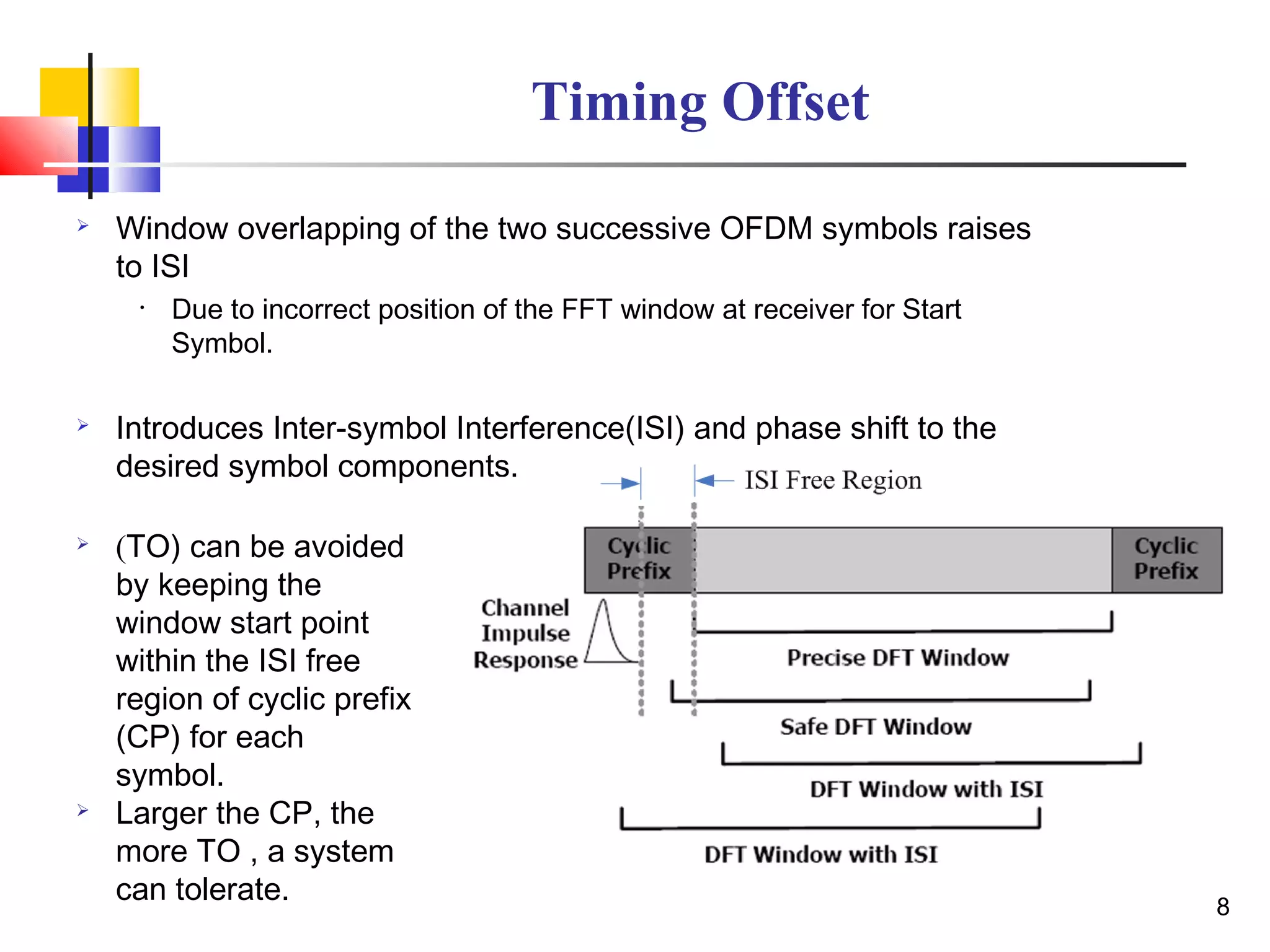
 Window overlapping of the two successive OFDM symbols raises
to ISI
• Due to incorrect position of the FFT window at receiver for Start
Symbol.
 Introduces Inter-symbol Interference(ISI) and phase shift to the
desired symbol components.
 (TO) can be avoided
by keeping the
window start point
within the ISI free
region of cyclic prefix
(CP) for each
symbol.
 Larger the CP, the
more TO , a system
can tolerate.
9
Timing Offset Estimator
 GOAL : To determine the start symbol position at receiver to avoid the ISI
and ICI.
 Pilot Based Method : (useful for systems with low SNR)
• Pilots (pseudo-random sequences or null symbols) can be used to
determine the start of an OFDM symbol.
• Pilot-symbols can be OFDM based or Non-OFDM based.
In case of continuous data , a null signal is appropriate , for bursty data this
is not true.
 Non-Pilot based Method :
• Most method exploits the redundancy of cyclic-prefix(CF) to find the
start symbol position.
• Some algorithms use the periodicity of the correlation function of the
time domain OFDM symbol.
10
 Introduction
 Timing Offset
 Carrier Frequency Offset
 Frequency Offset Estimation With Fast
Acquisition
 References
11
Carrier Frequency Offset
12
Carrier Frequency Offset
 Integer CFO :
• Do not introduces ICI between sub-carrier spacing but introduces a cyclic shift of
data sub-carriers and a phase change proportional to OFDM symbol number.
• No effect on orthogonality.
• In Acquisition phase, we estimate the Integer CFO (also called Coarse Frequency
Offset Estimation)
• Acquisition scheme generally have a wide range , but low accuracy.(Usually fast
acquisition is required)
 Fractional CFO :
• Causes rotation and introduces ICI between sub-carriers, (destroy the orthogonality
of sub-carrier ,results in BER degradation).
• In Tracking phase, we usually estimate Fractional CFO (also called Fine Frequency
Offset Estimation).
• Tracking algorithm have a narrower range but fine accuracy.
13
Carrier Frequency Offset
 The OFDM system model with CFO :
x ( t )
Channel h ( t)
S ( k )
S/P
X ( k ) x(n)
Adding Pilots
C(n)&
IFFT
Adding
Cyclic
Prefix
& P/S
DAC
Signal
Mapper
z (t )
r (t )
ˆ ( )S k
P/S
( )R k
FFT
Remove
Cyclic
Prefix
& S/P
ADC
Signal
Demapper
( )r n
AWGN w ( t)
02 /fj n N
e
πδ
/f fδ ε= ∆
 CFO Estimation Methods :
 Data Aided (Use of Pilots or training symbols , cause reduction in throughput as
known data pattern also needs to send)
 Non-Data Aided (Use of the Intrinsic structure of OFDM symbols e.g. exploits the
redundancy in Cyclic-Prefix)
 Blind Approaches (No data overhead but very high computational complexity and
relies on the signal statistics)
 Frequency synchronization Steps in OFDM :
I. Finding the correct Integer Offset
II. Finding a coarse estimate of the fractional frequency offset.
III. Refining the obtained fractional frequency offset.
14
Carrier Frequency Offset Estimator
15
Carrier Frequency Offset Estimator
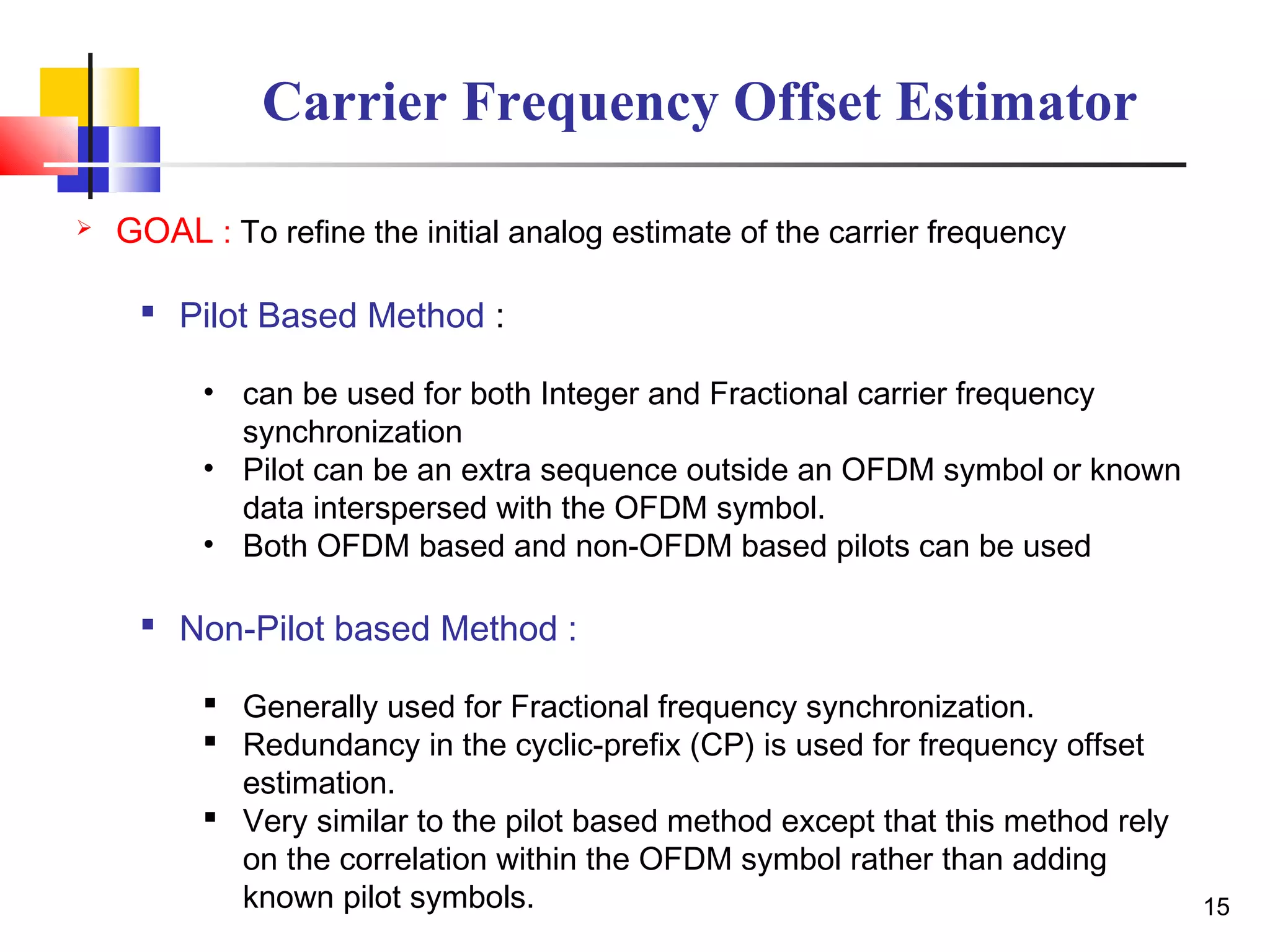
 GOAL : To refine the initial analog estimate of the carrier frequency
 Pilot Based Method :
• can be used for both Integer and Fractional carrier frequency
synchronization
• Pilot can be an extra sequence outside an OFDM symbol or known
data interspersed with the OFDM symbol.
• Both OFDM based and non-OFDM based pilots can be used
 Non-Pilot based Method :
 Generally used for Fractional frequency synchronization.
 Redundancy in the cyclic-prefix (CP) is used for frequency offset
estimation.
 Very similar to the pilot based method except that this method rely
on the correlation within the OFDM symbol rather than adding
known pilot symbols.
16
 Frequency Synchronization can be categorized into :
 Pre-FFT Synchronization
• i.e. estimation is performed before computation of DFT at receiver so
require less computing power and provides fast synchronization
 Post-FFT Synchronization
• i.e. estimation is performed
after computing the DFT.
• Carrier Frequency Offset Estimator
Without CFO With CFO
17
 Introduction
 Timing Offset
 Carrier Frequency Offset
 Frequency Offset Estimation With Fast
Acquisition
 References
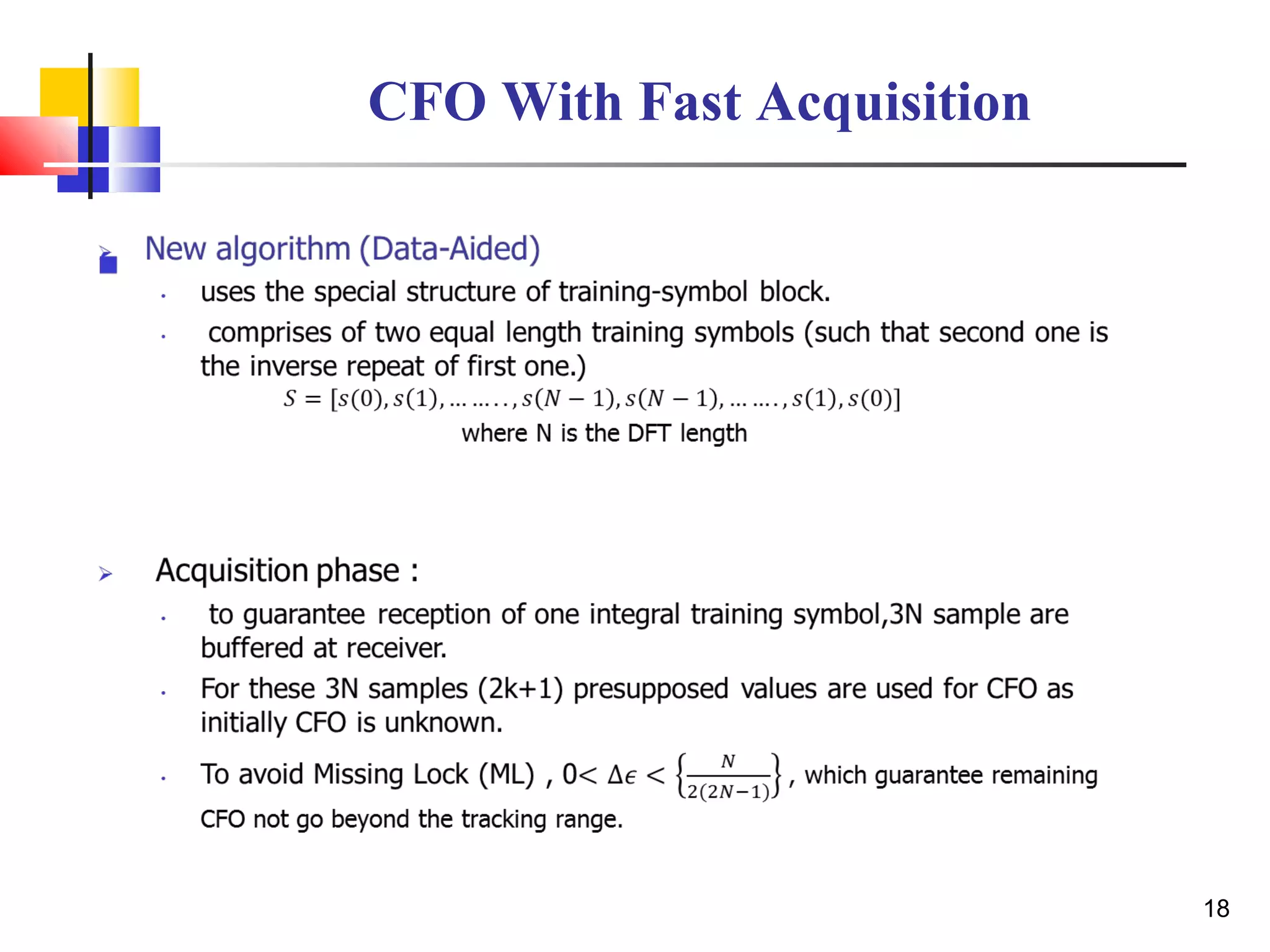
CFO With Fast Acquisition
18
CFO With Fast Acquisition
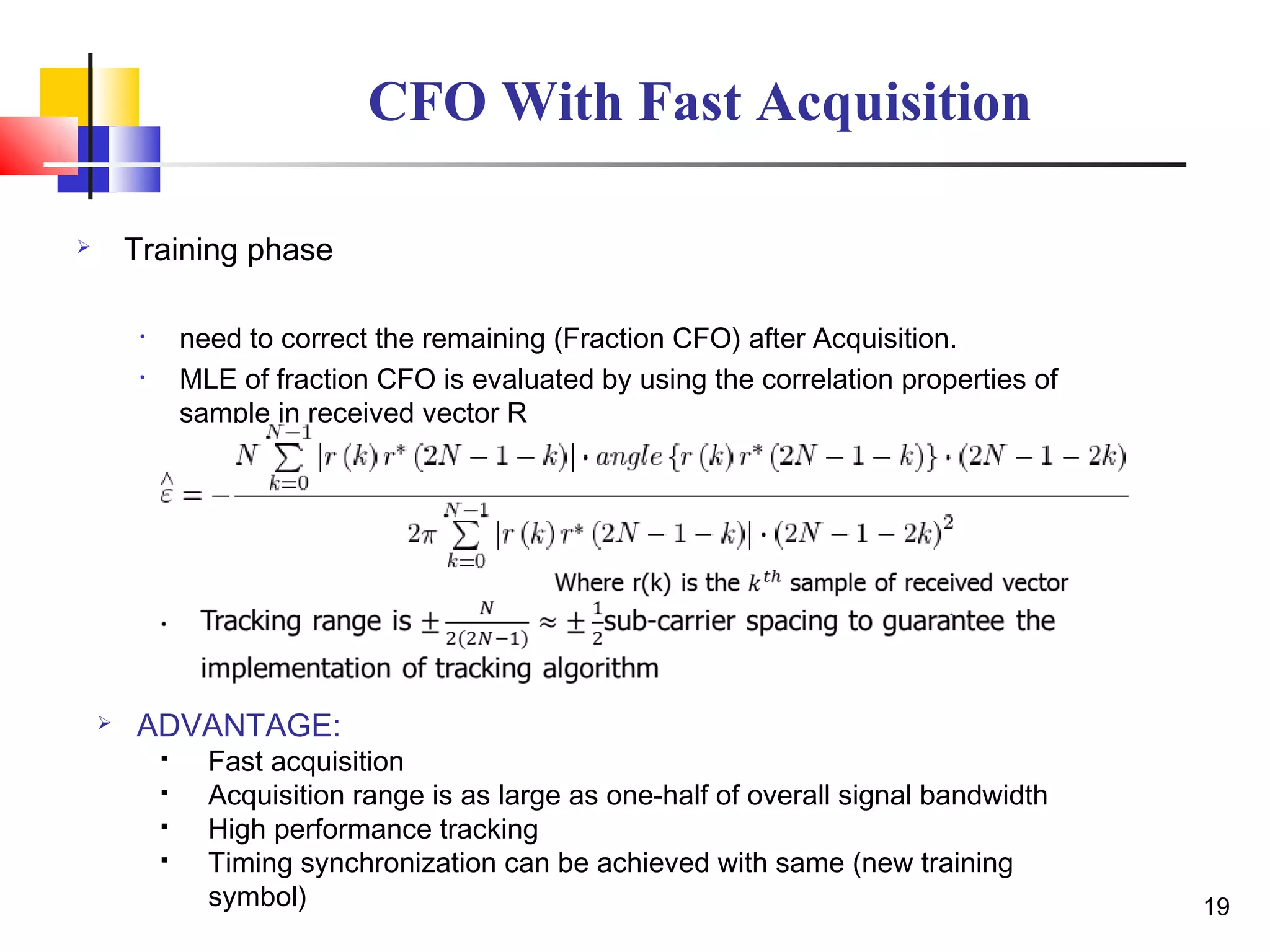
 Training phase
• need to correct the remaining (Fraction CFO) after Acquisition.
• MLE of fraction CFO is evaluated by using the correlation properties of
sample in received vector R
19
 ADVANTAGE:
 Fast acquisition
 Acquisition range is as large as one-half of overall signal bandwidth
 High performance tracking
 Timing synchronization can be achieved with same (new training
symbol)
20
References
[1] Zhang, Zhongshan, et al. "Frequency offset estimation with fast acquisition
in OFDM system." Communications Letters, IEEE 8.3 (2004): 171-173.
[2] Mohseni, Saeed, and Mohammad A. Matin. "Study of the estimation
techniques for the Carrier Frequency Offset (CFO) in OFDM
systems." IJCSNS International Journal of Computer Science and Network
Security 12.6 (2012): 73-80.
[3] J. R. Foerster, Ed., “Channel Modeling Sub-committee Report Final,” IEEE
P802.15 SG3a contribution.
[4] Li, Ye Geoffrey, and Gordon L. Stuber. Orthogonal frequency division
multiplexing for wireless communications. Springer Science & Business
Media, 2006.
[5] Chang, Dah-Chung. "Effect and compensation of symbol timing offset in
OFDM systems with channel interpolation." Broadcasting, IEEE
Transactions on 54.4 (2008): 761-770.

Cfo in ofdm

  • 1.
    1 Carrier Frequency Offsetin OFDM System Syed Khalid Hussain Department of Electrical and Computer Engineering
  • 2.
    2 Outline  Introduction  TimingOffset (TO)  Carrier Frequency Offset (CFO)  Frequency Offset Estimation With Fast Acquisition  References
  • 3.
    3 Outline  Introduction  TimingOffset (TO)  Carrier Frequency Offset (CFO)  Frequency Offset Estimation With Fast Acquisition  References
  • 4.
    4 Introduction Multicarrier Amplitude modulationscheme.  Each carrier’s amplitude is modulated. Carriers are spaced evenly and orthogonally(can be computed efficiently with IDFT and DFT. Idea is to split the signal into multiple smaller sub-signals that are transmitted simultaneously. OFDM signal in Time and Frequency domain
  • 5.
    5 Thus , OFDMcan provide large data rates with sufficient robustness to radio channel impairment ,therefor a popular choice for wireless broadband communication(Adopted in WiFi , WiMax ,DAB , DVB, LTE & LTA-A )  ADVANTAGES • Immunity to Frequency selective fading • Resilience to interference • Robust to narrow-band interference • Spectrum efficiency  DISADVANTAGES • Sensitivity to synchronization errors • High Peak-to-average power ratio Introduction Block Diagram of OFDM Symbol
  • 6.
    6 Introduction • Impairment inOFDM • Symbol Timing Offset (TO) • Due to the unknown transmission time or propagation delay of OFDM symbol at receiver • Carrier Frequency Offset (CFO) • Frequency differences between the transmitter and receiver oscillator • Oscillator instabilities • Doppler shift of mobile channels • Phase noise • Sampling Clock Offset These errors cause Inter symbol Interference(ISI) and Inter carrier Interference(ICI)
  • 7.
    7  Introduction  TimingOffset  Carrier Frequency Offset  Frequency Offset Estimation With Fast Acquisition  References
  • 8.
    8 Timing Offset  Windowoverlapping of the two successive OFDM symbols raises to ISI • Due to incorrect position of the FFT window at receiver for Start Symbol.  Introduces Inter-symbol Interference(ISI) and phase shift to the desired symbol components.  (TO) can be avoided by keeping the window start point within the ISI free region of cyclic prefix (CP) for each symbol.  Larger the CP, the more TO , a system can tolerate.
  • 9.
    9 Timing Offset Estimator GOAL : To determine the start symbol position at receiver to avoid the ISI and ICI.  Pilot Based Method : (useful for systems with low SNR) • Pilots (pseudo-random sequences or null symbols) can be used to determine the start of an OFDM symbol. • Pilot-symbols can be OFDM based or Non-OFDM based. In case of continuous data , a null signal is appropriate , for bursty data this is not true.  Non-Pilot based Method : • Most method exploits the redundancy of cyclic-prefix(CF) to find the start symbol position. • Some algorithms use the periodicity of the correlation function of the time domain OFDM symbol.
  • 10.
    10  Introduction  TimingOffset  Carrier Frequency Offset  Frequency Offset Estimation With Fast Acquisition  References
  • 11.
  • 12.
    12 Carrier Frequency Offset Integer CFO : • Do not introduces ICI between sub-carrier spacing but introduces a cyclic shift of data sub-carriers and a phase change proportional to OFDM symbol number. • No effect on orthogonality. • In Acquisition phase, we estimate the Integer CFO (also called Coarse Frequency Offset Estimation) • Acquisition scheme generally have a wide range , but low accuracy.(Usually fast acquisition is required)  Fractional CFO : • Causes rotation and introduces ICI between sub-carriers, (destroy the orthogonality of sub-carrier ,results in BER degradation). • In Tracking phase, we usually estimate Fractional CFO (also called Fine Frequency Offset Estimation). • Tracking algorithm have a narrower range but fine accuracy.
  • 13.
    13 Carrier Frequency Offset The OFDM system model with CFO : x ( t ) Channel h ( t) S ( k ) S/P X ( k ) x(n) Adding Pilots C(n)& IFFT Adding Cyclic Prefix & P/S DAC Signal Mapper z (t ) r (t ) ˆ ( )S k P/S ( )R k FFT Remove Cyclic Prefix & S/P ADC Signal Demapper ( )r n AWGN w ( t) 02 /fj n N e πδ /f fδ ε= ∆
  • 14.
     CFO EstimationMethods :  Data Aided (Use of Pilots or training symbols , cause reduction in throughput as known data pattern also needs to send)  Non-Data Aided (Use of the Intrinsic structure of OFDM symbols e.g. exploits the redundancy in Cyclic-Prefix)  Blind Approaches (No data overhead but very high computational complexity and relies on the signal statistics)  Frequency synchronization Steps in OFDM : I. Finding the correct Integer Offset II. Finding a coarse estimate of the fractional frequency offset. III. Refining the obtained fractional frequency offset. 14 Carrier Frequency Offset Estimator
  • 15.
    15 Carrier Frequency OffsetEstimator  GOAL : To refine the initial analog estimate of the carrier frequency  Pilot Based Method : • can be used for both Integer and Fractional carrier frequency synchronization • Pilot can be an extra sequence outside an OFDM symbol or known data interspersed with the OFDM symbol. • Both OFDM based and non-OFDM based pilots can be used  Non-Pilot based Method :  Generally used for Fractional frequency synchronization.  Redundancy in the cyclic-prefix (CP) is used for frequency offset estimation.  Very similar to the pilot based method except that this method rely on the correlation within the OFDM symbol rather than adding known pilot symbols.
  • 16.
    16  Frequency Synchronizationcan be categorized into :  Pre-FFT Synchronization • i.e. estimation is performed before computation of DFT at receiver so require less computing power and provides fast synchronization  Post-FFT Synchronization • i.e. estimation is performed after computing the DFT. • Carrier Frequency Offset Estimator Without CFO With CFO
  • 17.
    17  Introduction  TimingOffset  Carrier Frequency Offset  Frequency Offset Estimation With Fast Acquisition  References
  • 18.
    CFO With FastAcquisition 18
  • 19.
    CFO With FastAcquisition  Training phase • need to correct the remaining (Fraction CFO) after Acquisition. • MLE of fraction CFO is evaluated by using the correlation properties of sample in received vector R 19  ADVANTAGE:  Fast acquisition  Acquisition range is as large as one-half of overall signal bandwidth  High performance tracking  Timing synchronization can be achieved with same (new training symbol)
  • 20.
    20 References [1] Zhang, Zhongshan,et al. "Frequency offset estimation with fast acquisition in OFDM system." Communications Letters, IEEE 8.3 (2004): 171-173. [2] Mohseni, Saeed, and Mohammad A. Matin. "Study of the estimation techniques for the Carrier Frequency Offset (CFO) in OFDM systems." IJCSNS International Journal of Computer Science and Network Security 12.6 (2012): 73-80. [3] J. R. Foerster, Ed., “Channel Modeling Sub-committee Report Final,” IEEE P802.15 SG3a contribution. [4] Li, Ye Geoffrey, and Gordon L. Stuber. Orthogonal frequency division multiplexing for wireless communications. Springer Science & Business Media, 2006. [5] Chang, Dah-Chung. "Effect and compensation of symbol timing offset in OFDM systems with channel interpolation." Broadcasting, IEEE Transactions on 54.4 (2008): 761-770.