© 2012 Prentice Hall Inc. 1
PowerPoint presentation to accompany
Chopra and Meindl Supply Chain Management, 5e
1-1
Copyright ©2013 Pearson Education, Inc. publishing as Prentice Hall.Copyright ©2013 Pearson Education, Inc. publishing as Prentice Hall.Copyright ©2013 Pearson Education, Inc. publishing as Prentice Hall.
1-1
Copyright ©2013 Pearson Education, Inc. publishing as Prentice Hall.
1-1
Copyright ©2013 Pearson Education, Inc. publishing as Prentice Hall.
2-1
Copyright ©2013 Pearson Education, Inc. publishing as Prentice Hall.
Supply Chain
Performance:
Achieving Strategic
Fit and Scope
2
2-2Copyright ©2013 Pearson Education, Inc. publishing as Prentice Hall.
Learning Objectives
1. Explain why achieving strategic fit is critical to a
company’s overall success.
2. Describe how a company achieves strategic fit
between its supply chain strategy and its
competitive strategy.
3. Discuss the importance of expanding the scope
of strategic fit across the supply chain.
4. Describe the major challenges that must be
overcome to manage a supply chain
successfully.
2-3Copyright ©2013 Pearson Education, Inc. publishing as Prentice Hall.
Competitive and Supply
Chain Strategies
• Competitive strategy defines the set of customer needs a
firm seeks to satisfy through its products and services
• Product development strategy specifies the portfolio of
new products that the company will try to develop
• Marketing and sales strategy specifies how the market
will be segmented and product positioned, priced, and
promoted
• Supply chain strategy determines the nature of material
procurement, transportation of materials, manufacture of
product or creation of service, distribution of product
• All functional strategies must support one another and
the competitive strategy
2-4Copyright ©2013 Pearson Education, Inc. publishing as Prentice Hall.
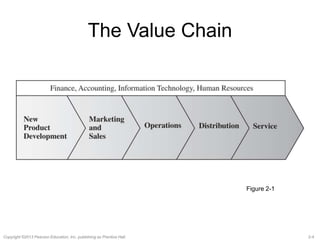
The Value Chain
Figure 2-1
2-5Copyright ©2013 Pearson Education, Inc. publishing as Prentice Hall.
Achieving Strategic Fit
• Strategic fit – competitive and supply
chain strategies have aligned goals
• A company may fail because of a lack of
strategic fit or because its processes and
resources do not provide the capabilities
to execute the desired strategy
2-6Copyright ©2013 Pearson Education, Inc. publishing as Prentice Hall.
Achieving Strategic Fit
1. The competitive strategy and all functional
strategies must fit together to form a
coordinated overall strategy.
2. The different functions in a company must
appropriately structure their processes and
resources to be able to execute these
strategies successfully.
3. The design of the overall supply chain and the
role of each stage must be aligned to support
the supply chain strategy.
2-7Copyright ©2013 Pearson Education, Inc. publishing as Prentice Hall.
How is Strategic Fit Achieved?
1. Understanding the customer and
supply chain uncertainty
2. Understanding the supply chain
3. Achieving strategic fit
2-8Copyright ©2013 Pearson Education, Inc. publishing as Prentice Hall.
Step 1: Understanding the Customer
and Supply Chain Uncertainty
• Quantity of product needed in each lot
• Response time customers will tolerate
• Variety of products needed
• Service level required
• Price of the product
• Desired rate of innovation in the
product
2-9Copyright ©2013 Pearson Education, Inc. publishing as Prentice Hall.
Step 1: Understanding the Customer
and Supply Chain Uncertainty
• Demand uncertainty – uncertainty of
customer demand for a product
• Implied demand uncertainty – resulting
uncertainty for the supply chain given
the portion of the demand the supply
chain must handle and attributes the
customer desires
2-10Copyright ©2013 Pearson Education, Inc. publishing as Prentice Hall.
Customer Needs and Implied
Demand Uncertainty
Customer Need Causes Implied Demand Uncertainty to …
Range of quantity required increases Increase because a wider range of the quantity required
implies greater variance in demand
Lead time decreases Increase because there is less time in which to react to
orders
Variety of products required increases Increase because demand per product becomes more
disaggregate
Number of channels through which
product may be acquired increases
Increase because the total customer demand is now
disaggregated over more channels
Rate of innovation increases Increase because new products tend to have more
uncertain demand
Required service level increases Increase because the firm now has to handle unusual
surges in demand
Table 2-1
2-11Copyright ©2013 Pearson Education, Inc. publishing as Prentice Hall.
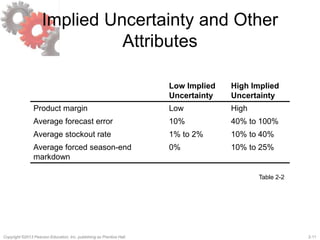
Implied Uncertainty and Other
Attributes
Low Implied
Uncertainty
High Implied
Uncertainty
Product margin Low High
Average forecast error 10% 40% to 100%
Average stockout rate 1% to 2% 10% to 40%
Average forced season-end
markdown
0% 10% to 25%
Table 2-2
2-12Copyright ©2013 Pearson Education, Inc. publishing as Prentice Hall.
Implied Uncertainty and Other
Attributes
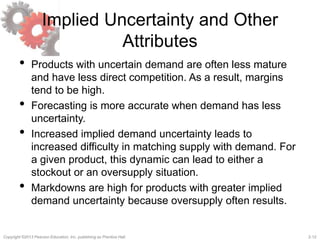
• Products with uncertain demand are often less mature
and have less direct competition. As a result, margins
tend to be high.
• Forecasting is more accurate when demand has less
uncertainty.
• Increased implied demand uncertainty leads to
increased difficulty in matching supply with demand. For
a given product, this dynamic can lead to either a
stockout or an oversupply situation.
• Markdowns are high for products with greater implied
demand uncertainty because oversupply often results.
2-13Copyright ©2013 Pearson Education, Inc. publishing as Prentice Hall.
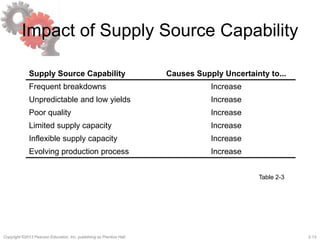
Impact of Supply Source Capability
Supply Source Capability Causes Supply Uncertainty to...
Frequent breakdowns Increase
Unpredictable and low yields Increase
Poor quality Increase
Limited supply capacity Increase
Inflexible supply capacity Increase
Evolving production process Increase
Table 2-3
2-14Copyright ©2013 Pearson Education, Inc. publishing as Prentice Hall.
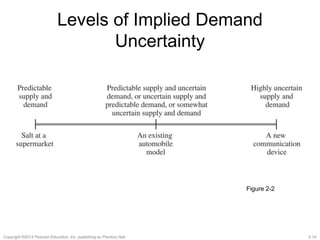
Levels of Implied Demand
Uncertainty
Figure 2-2
2-15Copyright ©2013 Pearson Education, Inc. publishing as Prentice Hall.
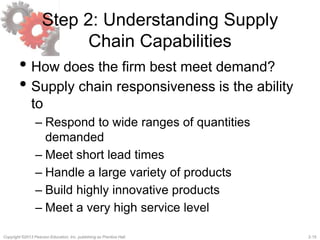
Step 2: Understanding Supply
Chain Capabilities
• How does the firm best meet demand?
• Supply chain responsiveness is the ability
to
– Respond to wide ranges of quantities
demanded
– Meet short lead times
– Handle a large variety of products
– Build highly innovative products
– Meet a very high service level
2-16Copyright ©2013 Pearson Education, Inc. publishing as Prentice Hall.
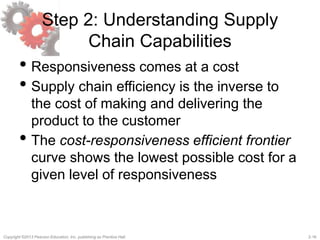
Step 2: Understanding Supply
Chain Capabilities
• Responsiveness comes at a cost
• Supply chain efficiency is the inverse to
the cost of making and delivering the
product to the customer
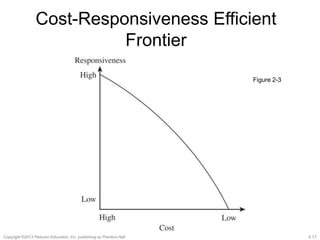
• The cost-responsiveness efficient frontier
curve shows the lowest possible cost for a
given level of responsiveness
2-17Copyright ©2013 Pearson Education, Inc. publishing as Prentice Hall.
Cost-Responsiveness Efficient
Frontier
Figure 2-3
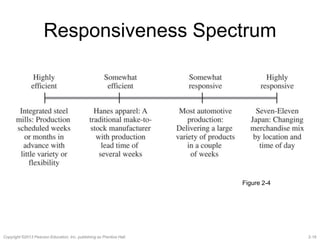
2-18Copyright ©2013 Pearson Education, Inc. publishing as Prentice Hall.
Responsiveness Spectrum
Figure 2-4
2-19Copyright ©2013 Pearson Education, Inc. publishing as Prentice Hall.
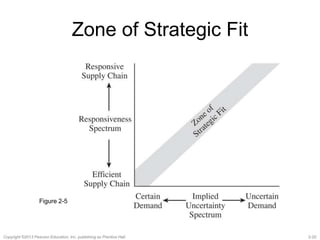
Step 3: Achieving Strategic Fit
• Ensure that the degree of supply chain
responsiveness is consistent with the
implied uncertainty
• Assign roles to different stages of the
supply chain that ensure the appropriate
level of responsiveness
• Ensure that all functions maintain
consistent strategies that support the
competitive strategy
2-20Copyright ©2013 Pearson Education, Inc. publishing as Prentice Hall.
Zone of Strategic Fit
Figure 2-5
2-21Copyright ©2013 Pearson Education, Inc. publishing as Prentice Hall.
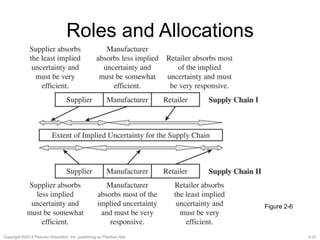
Roles and Allocations
Figure 2-6
2-22Copyright ©2013 Pearson Education, Inc. publishing as Prentice Hall.
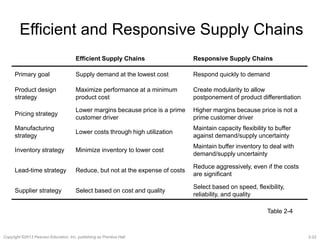
Efficient and Responsive Supply Chains
Efficient Supply Chains Responsive Supply Chains
Primary goal Supply demand at the lowest cost Respond quickly to demand
Product design
strategy
Maximize performance at a minimum
product cost
Create modularity to allow
postponement of product differentiation
Pricing strategy
Lower margins because price is a prime
customer driver
Higher margins because price is not a
prime customer driver
Manufacturing
strategy
Lower costs through high utilization
Maintain capacity flexibility to buffer
against demand/supply uncertainty
Inventory strategy Minimize inventory to lower cost
Maintain buffer inventory to deal with
demand/supply uncertainty
Lead-time strategy Reduce, but not at the expense of costs
Reduce aggressively, even if the costs
are significant
Supplier strategy Select based on cost and quality
Select based on speed, flexibility,
reliability, and quality
Table 2-4
2-23Copyright ©2013 Pearson Education, Inc. publishing as Prentice Hall.
Tailoring the Supply Chain
• Achieve strategic fit while serving many
customer segments with a variety of
products across multiple channels
• Requires sharing some links in the supply
chain with some products, while having
separate operations for other links
2-24Copyright ©2013 Pearson Education, Inc. publishing as Prentice Hall.
Changes Over Product Life Cycle
• Beginning stages
1. Demand is very uncertain, and supply may
be unpredictable
2. Margins are often high, and time is crucial to
gaining sales
3. Product availability is crucial to capturing the
market
4. Cost is often a secondary consideration
2-25Copyright ©2013 Pearson Education, Inc. publishing as Prentice Hall.
Changes Over Product Life Cycle
• Later stages
1. Demand has become more certain, and
supply is predictable
2. Margins are lower as a result of an increase
in competitive pressure
3. Price becomes a significant factor in
customer choice
2-26Copyright ©2013 Pearson Education, Inc. publishing as Prentice Hall.
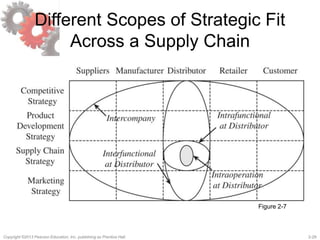
Expanding Strategic Scope
• Scope of strategic fit – the functions within
the firm and stages across the supply
chain that devise an integrated strategy
with an aligned objective
• Intraoperation scope – minimize local cost
view
– Each stage of the supply chain devises
strategy independently
2-27Copyright ©2013 Pearson Education, Inc. publishing as Prentice Hall.
Expanding Strategic Scope
• Intrafunctional view – minimize total
functional cost
– Firms align all operations within a function
• Interfunctional scope – maximize company
profit
– Functional strategies are developed to align
with one another and the competitive strategy
2-28Copyright ©2013 Pearson Education, Inc. publishing as Prentice Hall.
Expanding Strategic Scope
• Intercompany scope – maximize supply
chain surplus
– Supplier and customer work together and
share information to reduce total cost and
grow supply chain surplus
• Agile intercompany scope – a firm’s ability
to achieve strategic fit when partnering
with supply chain stages that change over
time
2-29Copyright ©2013 Pearson Education, Inc. publishing as Prentice Hall.
Different Scopes of Strategic Fit
Across a Supply Chain
Figure 2-7
2-30Copyright ©2013 Pearson Education, Inc. publishing as Prentice Hall.
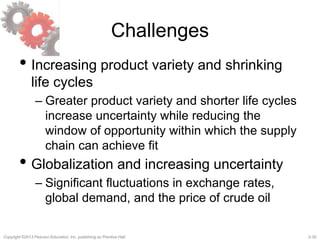
Challenges
• Increasing product variety and shrinking
life cycles
– Greater product variety and shorter life cycles
increase uncertainty while reducing the
window of opportunity within which the supply
chain can achieve fit
• Globalization and increasing uncertainty
– Significant fluctuations in exchange rates,
global demand, and the price of crude oil
2-31Copyright ©2013 Pearson Education, Inc. publishing as Prentice Hall.
Challenges
• Fragmentation of supply chain ownership
– Firms are less vertically integrated
– Take advantage of supplier and customer
competencies they did not have
– New ownership structure makes aligning and
managing the supply chain more difficult
– Aligning all members of a supply chain has
become critical to achieving supply chain fit
2-32Copyright ©2013 Pearson Education, Inc. publishing as Prentice Hall.
Challenges
• Changing technology and business
environment
– Customer needs and technology change may
force a firm to rethink their supply chain
strategy
• The environment and sustainability
– Growing in relevance and must be accounted
for when designing supply chain strategy
– Opportunities may require coordination across
different members of the supply chain
2-33Copyright ©2013 Pearson Education, Inc. publishing as Prentice Hall.
Summary of Learning Objectives
1. Explain why achieving strategic fit is critical to a
company’s overall success
2. Describe how a company achieves strategic fit
between its supply chain strategy and its
competitive strategy
3. Discuss the importance of expanding the scope
of strategic fit across the supply chain
4. Describe the major challenges that must be
overcome to manage a supply chain
successfully
2-34Copyright ©2013 Pearson Education, Inc. publishing as Prentice Hall.
All rights reserved. No part of this publication may be reproduced, stored in a retrieval
system, or transmitted, in any form or by any means, electronic, mechanical, photocopying,
recording, or otherwise, without the prior written permission of the publisher.
Printed in the United States of America.

Supply Chain Management chap 2

  • 1.
    © 2012 PrenticeHall Inc. 1 PowerPoint presentation to accompany Chopra and Meindl Supply Chain Management, 5e 1-1 Copyright ©2013 Pearson Education, Inc. publishing as Prentice Hall.Copyright ©2013 Pearson Education, Inc. publishing as Prentice Hall.Copyright ©2013 Pearson Education, Inc. publishing as Prentice Hall. 1-1 Copyright ©2013 Pearson Education, Inc. publishing as Prentice Hall. 1-1 Copyright ©2013 Pearson Education, Inc. publishing as Prentice Hall. 2-1 Copyright ©2013 Pearson Education, Inc. publishing as Prentice Hall. Supply Chain Performance: Achieving Strategic Fit and Scope 2
  • 2.
    2-2Copyright ©2013 PearsonEducation, Inc. publishing as Prentice Hall. Learning Objectives 1. Explain why achieving strategic fit is critical to a company’s overall success. 2. Describe how a company achieves strategic fit between its supply chain strategy and its competitive strategy. 3. Discuss the importance of expanding the scope of strategic fit across the supply chain. 4. Describe the major challenges that must be overcome to manage a supply chain successfully.
  • 3.
    2-3Copyright ©2013 PearsonEducation, Inc. publishing as Prentice Hall. Competitive and Supply Chain Strategies • Competitive strategy defines the set of customer needs a firm seeks to satisfy through its products and services • Product development strategy specifies the portfolio of new products that the company will try to develop • Marketing and sales strategy specifies how the market will be segmented and product positioned, priced, and promoted • Supply chain strategy determines the nature of material procurement, transportation of materials, manufacture of product or creation of service, distribution of product • All functional strategies must support one another and the competitive strategy
  • 4.
    2-4Copyright ©2013 PearsonEducation, Inc. publishing as Prentice Hall. The Value Chain Figure 2-1
  • 5.
    2-5Copyright ©2013 PearsonEducation, Inc. publishing as Prentice Hall. Achieving Strategic Fit • Strategic fit – competitive and supply chain strategies have aligned goals • A company may fail because of a lack of strategic fit or because its processes and resources do not provide the capabilities to execute the desired strategy
  • 6.
    2-6Copyright ©2013 PearsonEducation, Inc. publishing as Prentice Hall. Achieving Strategic Fit 1. The competitive strategy and all functional strategies must fit together to form a coordinated overall strategy. 2. The different functions in a company must appropriately structure their processes and resources to be able to execute these strategies successfully. 3. The design of the overall supply chain and the role of each stage must be aligned to support the supply chain strategy.
  • 7.
    2-7Copyright ©2013 PearsonEducation, Inc. publishing as Prentice Hall. How is Strategic Fit Achieved? 1. Understanding the customer and supply chain uncertainty 2. Understanding the supply chain 3. Achieving strategic fit
  • 8.
    2-8Copyright ©2013 PearsonEducation, Inc. publishing as Prentice Hall. Step 1: Understanding the Customer and Supply Chain Uncertainty • Quantity of product needed in each lot • Response time customers will tolerate • Variety of products needed • Service level required • Price of the product • Desired rate of innovation in the product
  • 9.
    2-9Copyright ©2013 PearsonEducation, Inc. publishing as Prentice Hall. Step 1: Understanding the Customer and Supply Chain Uncertainty • Demand uncertainty – uncertainty of customer demand for a product • Implied demand uncertainty – resulting uncertainty for the supply chain given the portion of the demand the supply chain must handle and attributes the customer desires
  • 10.
    2-10Copyright ©2013 PearsonEducation, Inc. publishing as Prentice Hall. Customer Needs and Implied Demand Uncertainty Customer Need Causes Implied Demand Uncertainty to … Range of quantity required increases Increase because a wider range of the quantity required implies greater variance in demand Lead time decreases Increase because there is less time in which to react to orders Variety of products required increases Increase because demand per product becomes more disaggregate Number of channels through which product may be acquired increases Increase because the total customer demand is now disaggregated over more channels Rate of innovation increases Increase because new products tend to have more uncertain demand Required service level increases Increase because the firm now has to handle unusual surges in demand Table 2-1
  • 11.
    2-11Copyright ©2013 PearsonEducation, Inc. publishing as Prentice Hall. Implied Uncertainty and Other Attributes Low Implied Uncertainty High Implied Uncertainty Product margin Low High Average forecast error 10% 40% to 100% Average stockout rate 1% to 2% 10% to 40% Average forced season-end markdown 0% 10% to 25% Table 2-2
  • 12.
    2-12Copyright ©2013 PearsonEducation, Inc. publishing as Prentice Hall. Implied Uncertainty and Other Attributes • Products with uncertain demand are often less mature and have less direct competition. As a result, margins tend to be high. • Forecasting is more accurate when demand has less uncertainty. • Increased implied demand uncertainty leads to increased difficulty in matching supply with demand. For a given product, this dynamic can lead to either a stockout or an oversupply situation. • Markdowns are high for products with greater implied demand uncertainty because oversupply often results.
  • 13.
    2-13Copyright ©2013 PearsonEducation, Inc. publishing as Prentice Hall. Impact of Supply Source Capability Supply Source Capability Causes Supply Uncertainty to... Frequent breakdowns Increase Unpredictable and low yields Increase Poor quality Increase Limited supply capacity Increase Inflexible supply capacity Increase Evolving production process Increase Table 2-3
  • 14.
    2-14Copyright ©2013 PearsonEducation, Inc. publishing as Prentice Hall. Levels of Implied Demand Uncertainty Figure 2-2
  • 15.
    2-15Copyright ©2013 PearsonEducation, Inc. publishing as Prentice Hall. Step 2: Understanding Supply Chain Capabilities • How does the firm best meet demand? • Supply chain responsiveness is the ability to – Respond to wide ranges of quantities demanded – Meet short lead times – Handle a large variety of products – Build highly innovative products – Meet a very high service level

  • 16.
    2-16Copyright ©2013 PearsonEducation, Inc. publishing as Prentice Hall. Step 2: Understanding Supply Chain Capabilities • Responsiveness comes at a cost • Supply chain efficiency is the inverse to the cost of making and delivering the product to the customer • The cost-responsiveness efficient frontier curve shows the lowest possible cost for a given level of responsiveness
  • 17.
    2-17Copyright ©2013 PearsonEducation, Inc. publishing as Prentice Hall. Cost-Responsiveness Efficient Frontier Figure 2-3
  • 18.
    2-18Copyright ©2013 PearsonEducation, Inc. publishing as Prentice Hall. Responsiveness Spectrum Figure 2-4
  • 19.
    2-19Copyright ©2013 PearsonEducation, Inc. publishing as Prentice Hall. Step 3: Achieving Strategic Fit • Ensure that the degree of supply chain responsiveness is consistent with the implied uncertainty • Assign roles to different stages of the supply chain that ensure the appropriate level of responsiveness • Ensure that all functions maintain consistent strategies that support the competitive strategy
  • 20.
    2-20Copyright ©2013 PearsonEducation, Inc. publishing as Prentice Hall. Zone of Strategic Fit Figure 2-5
  • 21.
    2-21Copyright ©2013 PearsonEducation, Inc. publishing as Prentice Hall. Roles and Allocations Figure 2-6
  • 22.
    2-22Copyright ©2013 PearsonEducation, Inc. publishing as Prentice Hall. Efficient and Responsive Supply Chains Efficient Supply Chains Responsive Supply Chains Primary goal Supply demand at the lowest cost Respond quickly to demand Product design strategy Maximize performance at a minimum product cost Create modularity to allow postponement of product differentiation Pricing strategy Lower margins because price is a prime customer driver Higher margins because price is not a prime customer driver Manufacturing strategy Lower costs through high utilization Maintain capacity flexibility to buffer against demand/supply uncertainty Inventory strategy Minimize inventory to lower cost Maintain buffer inventory to deal with demand/supply uncertainty Lead-time strategy Reduce, but not at the expense of costs Reduce aggressively, even if the costs are significant Supplier strategy Select based on cost and quality Select based on speed, flexibility, reliability, and quality Table 2-4
  • 23.
    2-23Copyright ©2013 PearsonEducation, Inc. publishing as Prentice Hall. Tailoring the Supply Chain • Achieve strategic fit while serving many customer segments with a variety of products across multiple channels • Requires sharing some links in the supply chain with some products, while having separate operations for other links
  • 24.
    2-24Copyright ©2013 PearsonEducation, Inc. publishing as Prentice Hall. Changes Over Product Life Cycle • Beginning stages 1. Demand is very uncertain, and supply may be unpredictable 2. Margins are often high, and time is crucial to gaining sales 3. Product availability is crucial to capturing the market 4. Cost is often a secondary consideration
  • 25.
    2-25Copyright ©2013 PearsonEducation, Inc. publishing as Prentice Hall. Changes Over Product Life Cycle • Later stages 1. Demand has become more certain, and supply is predictable 2. Margins are lower as a result of an increase in competitive pressure 3. Price becomes a significant factor in customer choice
  • 26.
    2-26Copyright ©2013 PearsonEducation, Inc. publishing as Prentice Hall. Expanding Strategic Scope • Scope of strategic fit – the functions within the firm and stages across the supply chain that devise an integrated strategy with an aligned objective • Intraoperation scope – minimize local cost view – Each stage of the supply chain devises strategy independently
  • 27.
    2-27Copyright ©2013 PearsonEducation, Inc. publishing as Prentice Hall. Expanding Strategic Scope • Intrafunctional view – minimize total functional cost – Firms align all operations within a function • Interfunctional scope – maximize company profit – Functional strategies are developed to align with one another and the competitive strategy
  • 28.
    2-28Copyright ©2013 PearsonEducation, Inc. publishing as Prentice Hall. Expanding Strategic Scope • Intercompany scope – maximize supply chain surplus – Supplier and customer work together and share information to reduce total cost and grow supply chain surplus • Agile intercompany scope – a firm’s ability to achieve strategic fit when partnering with supply chain stages that change over time
  • 29.
    2-29Copyright ©2013 PearsonEducation, Inc. publishing as Prentice Hall. Different Scopes of Strategic Fit Across a Supply Chain Figure 2-7
  • 30.
    2-30Copyright ©2013 PearsonEducation, Inc. publishing as Prentice Hall. Challenges • Increasing product variety and shrinking life cycles – Greater product variety and shorter life cycles increase uncertainty while reducing the window of opportunity within which the supply chain can achieve fit • Globalization and increasing uncertainty – Significant fluctuations in exchange rates, global demand, and the price of crude oil
  • 31.
    2-31Copyright ©2013 PearsonEducation, Inc. publishing as Prentice Hall. Challenges • Fragmentation of supply chain ownership – Firms are less vertically integrated – Take advantage of supplier and customer competencies they did not have – New ownership structure makes aligning and managing the supply chain more difficult – Aligning all members of a supply chain has become critical to achieving supply chain fit
  • 32.
    2-32Copyright ©2013 PearsonEducation, Inc. publishing as Prentice Hall. Challenges • Changing technology and business environment – Customer needs and technology change may force a firm to rethink their supply chain strategy • The environment and sustainability – Growing in relevance and must be accounted for when designing supply chain strategy – Opportunities may require coordination across different members of the supply chain
  • 33.
    2-33Copyright ©2013 PearsonEducation, Inc. publishing as Prentice Hall. Summary of Learning Objectives 1. Explain why achieving strategic fit is critical to a company’s overall success 2. Describe how a company achieves strategic fit between its supply chain strategy and its competitive strategy 3. Discuss the importance of expanding the scope of strategic fit across the supply chain 4. Describe the major challenges that must be overcome to manage a supply chain successfully
  • 34.
    2-34Copyright ©2013 PearsonEducation, Inc. publishing as Prentice Hall. All rights reserved. No part of this publication may be reproduced, stored in a retrieval system, or transmitted, in any form or by any means, electronic, mechanical, photocopying, recording, or otherwise, without the prior written permission of the publisher. Printed in the United States of America.