
Slides From ATI Professional Development Short Course
             CSEP Acquisition Extension Exam Preparation Course


                                            Instructor:
                                William “Bill” Fournier


ATI Course Schedule:      http://www.ATIcourses.com/schedule.htm
ATI's CSEP Acquisition:   http://www.aticourses.com/CSEP_Acquisition_Preparation.htm
www.ATIcourses.com

Boost Your Skills                                             349 Berkshire Drive
                                                              Riva, Maryland 21140
with On-Site Courses                                          Telephone 1-888-501-2100 / (410) 965-8805

Tailored to Your Needs
                                                              Fax (410) 956-5785
                                                              Email: ATI@ATIcourses.com

The Applied Technology Institute specializes in training programs for technical professionals. Our courses keep you
current in the state-of-the-art technology that is essential to keep your company on the cutting edge in today’s highly
competitive marketplace. Since 1984, ATI has earned the trust of training departments nationwide, and has presented
on-site training at the major Navy, Air Force and NASA centers, and for a large number of contractors. Our training
increases effectiveness and productivity. Learn from the proven best.

For a Free On-Site Quote Visit Us At: http://www.ATIcourses.com/free_onsite_quote.asp

For Our Current Public Course Schedule Go To: http://www.ATIcourses.com/schedule.htm
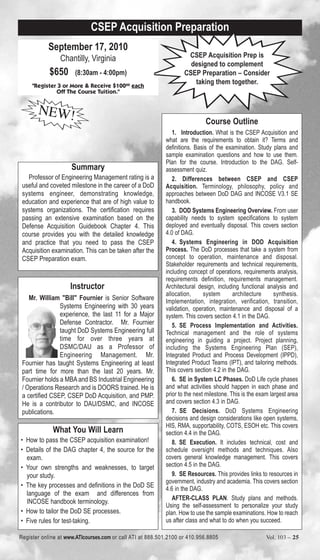
CSEP Acquisition Preparation
           September 17, 2010
                Chantilly, Virginia                                 CSEP Acquisition Prep is
                                                                     designed to complement
            $650      (8:30am - 4:00pm)                            CSEP Preparation – Consider
     "Register 3 or More & Receive $10000 each
                                                                      taking them together.
              Off The Course Tuition."


       NEW!
                                                                            Course Outline
                                                              1. Introduction. What is the CSEP Acquisition and
                                                           what are the requirements to obtain it? Terms and
                                                           definitions. Basis of the examination. Study plans and
                                                           sample examination questions and how to use them.
                                                           Plan for the course. Introduction to the DAG. Self-
                     Summary                               assessment quiz.
   Professor of Engineering Management rating is a            2. Differences between CSEP and CSEP
 useful and coveted milestone in the career of a DoD       Acquisition. Terminology, philosophy, policy and
 systems engineer, demonstrating knowledge,                approaches between DoD DAG and INCOSE V3.1 SE
 education and experience that are of high value to        handbook.
 systems organizations. The certification requires            3. DOD Systems Engineering Overview. From user
 passing an extensive examination based on the             capability needs to system specifications to system
 Defense Acquisition Guidebook Chapter 4. This             deployed and eventually disposal. This covers section
 course provides you with the detailed knowledge           4.0 of DAG.
 and practice that you need to pass the CSEP                  4. Systems Engineering in DOD Acquisition
 Acquisition examination. This can be taken after the      Process. The DoD processes that take a system from
 CSEP Preparation exam.                                    concept to operation, maintenance and disposal.
                                                           Stakeholder requirements and technical requirements,
                                                           including concept of operations, requirements analysis,
                                                           requirements definition, requirements management.
                    Instructor                             Architectural design, including functional analysis and
                                                           allocation,      system       architecture      synthesis.
    Mr. William "Bill" Fournier is Senior Software         Implementation, integration, verification, transition,
                Systems Engineering with 30 years          validation, operation, maintenance and disposal of a
                experience, the last 11 for a Major        system. This covers section 4.1 in the DAG.
                Defense Contractor. Mr. Fournier              5. SE Process Implementation and Activities.
                taught DoD Systems Engineering full        Technical management and the role of systems
                time for over three years at               engineering in guiding a project. Project planning,
                DSMC/DAU as a Professor of                 including the Systems Engineering Plan (SEP),
                Engineering Management. Mr.                Integrated Product and Process Development (IPPD),
 Fournier has taught Systems Engineering at least          Integrated Product Teams (IPT), and tailoring methods.
 part time for more than the last 20 years. Mr.            This covers section 4.2 in the DAG.
 Fournier holds a MBA and BS Industrial Engineering           6. SE in System LC Phases. DoD Life cycle phases
 / Operations Research and is DOORS trained. He is         and what activities should happen in each phase and
 a certified CSEP, CSEP DoD Acquisition, and PMP.          prior to the next milestone. This is the exam largest area
 He is a contributor to DAU/DSMC, and INCOSE               and covers section 4.3 in DAG.
 publications.                                                7. SE Decisions. DoD Systems Engineering
                                                           decisions and design considerations like open systems,
                                                           HIS, RMA, supportability, COTS, ESOH etc. This covers
             What You Will Learn                           section 4.4 in the DAG.
• How to pass the CSEP acquisition examination!               8. SE Execution. It includes technical, cost and
• Details of the DAG chapter 4, the source for the         schedule oversight methods and techniques. Also
  exam.                                                    covers general knowledge management. This covers
• Your own strengths and weaknesses, to target             section 4.5 in the DAG.
  your study.                                                 9. SE Resources. This provides links to resources in
                                                           government, industry and academia. This covers section
• The key processes and definitions in the DoD SE          4.6 in the DAG.
  language of the exam and differences from
                                                              AFTER-CLASS PLAN. Study plans and methods.
  INCOSE handbook terminology.
                                                           Using the self-assessment to personalize your study
• How to tailor the DoD SE processes.                      plan. How to use the sample examinations. How to reach
• Five rules for test-taking.                              us after class and what to do when you succeed.

Register online at www.ATIcourses.com or call ATI at 888.501.2100 or 410.956.8805                      Vol. 103 – 25
Module 1‐ Introduction
•   Administration/Agenda

•   Course Objectives

•   CSEP Acquisition Extension Examination

•   Defense Acquisition Guidebook  (DAG)  Nov. 2004

•   Changes in the latest DAG

•   Sample Questions

•   Self Assessment


                                                      Introduction
                                                                     2
Course Objectives
After completing the course, the attendees should be able to:
     – Know how to pass the CSEP‐Acquisition Extension Examination 
     – Explain Details of the DAG Chapter 4
     – Be aware of Your own strengths and weaknesses to target your study 
     – Understand the key processes and differences in DAG from INCOSE handbook 
        terminology
     – Comprehend how to tailor the DoD SE processes 
     – Understand the Six rules for test‐taking


                                                               Introduction        3
CSEP Acquisition Extension Exam


•   1 hour / 60 questions multiple choice knowledge/recall/recognition
•   Perceived less multiple answer questions
•   Based on DAG Chapter 4 
•   You can take same session as CSEP exam but do not recommend this due to 
    differences of source material
     –   Shift in terminology Generic vs. DoD
     –   DoD more directive and PM acquisition oversight oriented
     –   Exam constructed by different people
     –   Less information available of standard and content


                                                                    Introduction   4
Sample Tests 

•   In back of your book 2 sample tests with some from each section in proportion to 
    expected test areas
•   Sample Question 1‐1
•   Systems Engineering way of  responding to a capabilities or requirements 
    document is the following:
     a. Balance cost, schedule, performance and risk and a rigorous process.
     b. Apply a detailed SE approach that balances performance and life cycle cost for 
         systems.
     c.  Apply a robust SE approach that balances total system performance and total 
         ownership costs within the family‐of‐systems, systems‐of‐systems context. 
     d. Tailor SE process for the risk and rewards maximization over the entire life 
         cycle.


                                                              Introduction          5
Module 2‐ Differences From the CSEP
•   Length & Priority
•   Terminology 
     – DoD vs. Generic
     – Exam structure
•   Philosophy Policy Differences from INCOSE Handbook v 3.2
     – More directive 
     – More theoretical 
     – More specific Acquisition Policy dealing with Major system PMs oversight Job than SE 
         communicating in a common language
     – Less trusting
     – Weaker editing
•   Approaches
     – Top down
     – IPPD
     – Planning
     – Measurement
     – M&S
     – Tailoring

                                                                     Differences
                                                                                               6
Module 3‐ DoD SE Overview 

•   User capability needs translated into system specifications to system deployed & eventual 
    disposal. 
•   Section 4.0 of DAG. 
•   DoD policy and guidance recognize the importance of and introduce the application of 
    systems engineering approach in achieving an integrated, balanced system solution. 
•   Systems Engineering. Acquisition programs shall be managed through the application of a 
    systems engineering approach that optimizes total system performance and minimizes 
    total ownership costs. A modular open‐systems approach shall be employed, where 
    feasible. 
•   The use of SE Effective sustainment of weapon systems begins with the design and 
    development of reliable and maintainable systems through the continuous application of a 
    robust systems engineering methodology. …: 


                                                                       DoD SE Overview
                                                                                           7
4.0 SE / Purpose/ Content                                     4.0.1/4.0.2

•   Facilitate compliance with the above mandatory SE direction. 
•   Describes SE processes & fundamentals application to DoD Acquisition System
•   Design issues a PM must face to achieve desired balanced system solution. 
•   Guidance and describes expectations for completing the SEP. 
•   4.1  SE in DoD Acquisition. Defines SE and its relationship to acquisition. 
•   Provides perspective on the use of SE processes to translate user‐defined capabilities into 
    actionable engineering specifications and on the role of the PM in integrated system design 
    activities…
•    All programs responding to a capabilities or requirements document, shall apply a robust 
    SE approach that balances total system performance and total ownership costs within the 
    family‐of‐systems, systems‐of‐systems context.
•   Programs shall develop a Systems Engineering Plan (SEP) for MDA approval in conjunction 
    with each Milestone review, and integrated with the Acquisition Strategy.
•   SEP shall describe the program's overall technical approach, including processes, resources, 
    metrics, and applicable performance incentives. It shall also detail the timing, conduct, and 
    success criteria of technical reviews. 


                                                                         DoD SE Overview
                                                                                              8
4.0 SE / Purpose/ Content (Continued)                                4.0.2

•   4..2, SE Processes: How SE is Implemented, discusses SE processes and activities.
•   Groups SE processes into technical management processes and technical process 
    categories. 
•   Discussion of the use and tailoring of process, models and standards, as well as what to 
    expect of the contractor's SE process
•   4.3, SE in the System Life Cycle, provides an integrated technical framework for SE processes 
    throughout the acquisition phases of a system's life cycle,
•   Distinguishing the particular SE inputs and outputs of each acquisition phase. 
•   4.4, SE Decisions: Important Design Considerations, discusses the many design 
    considerations that should be taken into account throughout the  SE processes.
•   Introduction to open systems design; interoperability; software; COTS items; manufacturing 
    capability; quality; RAM; supportability;  HSI…. 
•   4.5, SE Execution: and techniques used in the technical management and technical Key SE 
    Tools and Techniques, includes the important technical, cost, and schedule oversight 
    methods processes...

•   4.6, SE Resources... 


                                                                        DoD SE Overview
                                                                                                9
Summary


•   Balanced & Integrated
•   Open Systems
•   Complete Life‐cycle oriented
•   PM robust SE process for TOC especially SOS, FOS
•   Tailored technical management processes 
•   What to expect of the contractor's SE process
•   Important Design Considerations 
•   Key SE Tools & Techniques, includes important technical, cost, and schedule 
    oversight methods processes.


                                                                DoD SE Overview
                                                                                   10
Quiz 3‐1


The Systems Engineering processes to translate user‐defined
capabilities into the following initially?
  a. Engineering Specifications 
  b. CONOPS
  c. Drawings
  d. TDP


                                                              DoD SE Overview
                                                                                11
Quiz 3‐2


Systems Engineering satisfy what?
 a. The need of the system user
 b. The needs of the customer
 c. The needs of the stakeholders
 d. The need of the program sponsor


                                      DoD SE Overview 12
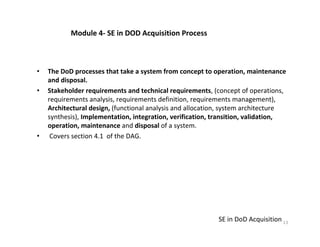
Module 4‐ SE in DOD Acquisition Process 


•   The DoD processes that take a system from concept to operation, maintenance 
    and disposal. 
•   Stakeholder requirements and technical requirements, (concept of operations, 
    requirements analysis, requirements definition, requirements management), 
    Architectural design, (functional analysis and allocation, system architecture 
    synthesis), Implementation, integration, verification, transition, validation, 
    operation, maintenance and disposal of a system. 
•    Covers section 4.1  of the DAG.


                                                            SE in DoD Acquisition 13
Technical Processes                            4.2.2.2


Technical Management Processes             Technical Processes
Decision Analysis                          Requirements Development

Technical Planning                         Logical Analysis 

Technical Assessment                       Design Solution 

Requirements Management                    Implementation 

Risk Management                            Integration 

Configuration Management                   Verification 

Technical Data Management                  Validation    

Interface Management                       Transition 


                                                               SE in DoD Acquisition14
SE in DoD Acquisition 

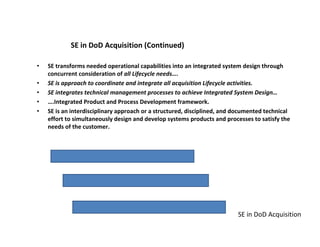
•   SE is the overarching process that a program team applies to transition from a stated 
    capability need to an operationally effective and suitable system. 
•   SE encompasses the application of SE processes across the acquisition life cycle (adapted 
    by phase) and is intended to be the integrating mechanism for balanced solutions 
    addressing capability needs, design considerations and constraints, …limitations imposed 
    by technology, budget, and schedule. 
•   SE processes are applied early in concept definition, and then continuously throughout the 
    total life cycle. 
•   SE is an interdisciplinary approach or a structured, disciplined, and documented technical 
    effort to simultaneously design and develop systems products and processes to satisfy the 
    needs of the customer. 


           CR         TD       SDD             PD                  OS


                                                                        SE in DoD Acquisition
                                                                                                15
SE in DoD Acquisition (Continued)

•   SE transforms needed operational capabilities into an integrated system design through 
    concurrent consideration of all Lifecycle needs…. 
•   SE is approach to coordinate and integrate all acquisition Lifecycle activities. 
•   SE integrates technical management processes to achieve Integrated System Design…
•   ….Integrated Product and Process Development framework. 
•   SE is an interdisciplinary approach or a structured, disciplined, and documented technical 
    effort to simultaneously design and develop systems products and processes to satisfy the 
    needs of the customer. 


                                                                           SE in DoD Acquisition
SE Processes

•   Although numerous definitions exist, this chapter adopts the following formal definition, adapted 
    from EIA/IS 632, Processes for Engineering a System: 
•   SE is an interdisciplinary approach encompassing the entire technical effort to evolve and 
    verify an integrated and total Lifecycle balanced set of system, people, and process solutions 
    that satisfy customer needs. 
•   SE offers a technical framework to enable sound decision making relative to trade studies 
    among system performance, risk, cost, and schedule.
•   Successful implementation of proven, disciplined SE processes results in a total system 
    solution that is–
      – Robust to changing technical, production, and operating environments; 
      – Adaptive to the needs of the user; and 
      – Balanced among the multiple requirements, design considerations, design constraints, 
          and program budgets. 


                                                                       SE in DoD Acquisition
                                                                                              17
Technology Development


                                                          18
                         SE in System Life Cycle Phases
Integrated Master Plan

•   The program manager should use event‐driven schedules and the participation of all 
    stakeholders to ensure that all tasks are accomplished in a rational and logical order and to 
    allow continuous communication with customers.
•   Necessary input conditions to complete each major task are identified, and no major task is 
    declared complete until all required input conditions and component tasks have been 
    satisfied. ..
•   One way of defining tasks and activities is the use of an integrated master plan, which 
    provides an overarching framework against which all work is accomplished. 
•   It documents all the tasks required to deliver a high quality product and facilitate success 
    throughout the product's life cycle. 
•   Cost, schedule (specific dates), and non‐essential tasks are not included in this plan.
•   As the program is defined, the integrated master plan is iterated several times, each time 
    increasing the level of detail and confidence that all essential work has been identified. 
•   The specific format for this plan is not critical; however, it usually reflects an 
    Event/Accomplishment/Criteria hierarchical structure‐‐a format that greatly facilitates the 
    tracking and execution of the program. …


                                                    19
                                                             SE Execution
Resources Standards and Models 


• International Organization for Standardization (ISO)/International Electrotechnical Commission (IEC) 
     15288, System Life Cycle Processes 
• ISO/IEC 12207, Software Life Cycle Processes 
• Electronic Industry Alliance (EIA)/Institute of Electrical and Electronic Engineers (IEEE) J‐STD‐016, 
     Software Development 
• American National Standards Institute (ANSI)/EIA 632, Processes for Engineering a System 
• ANSI/EIA 649, National Consensus Standard for Data Management 
• ANSI/EIA 748A, Earned Value Management Systems 
• EIA 859, Consensus Standard for Data Management 
• IEEE 1220, Application Management of the Systems Engineering Process 
• EIA 731, Systems Engineering Capability Model 
• CMMI SWE/SE/IPPD/SS, Capability Maturity Model‐Integration, Software Engineering, Systems 
     Engineering, Integrated Product and Process Development and Supplier Sourcing 


                                                                    SE Resources                      20
To learn more please attend ATI course
                     CSEP Acquisition


    Please post your comments and questions to our blog:
        http://www.aticourses.com/blog/

     Sign-up for ATI's monthly Course Schedule Updates :
http://www.aticourses.com/email_signup_page.html

CSEP Acquisition Preparation Technical Training Course Sampler

  • 1.
    Slides From ATIProfessional Development Short Course CSEP Acquisition Extension Exam Preparation Course Instructor: William “Bill” Fournier ATI Course Schedule: http://www.ATIcourses.com/schedule.htm ATI's CSEP Acquisition: http://www.aticourses.com/CSEP_Acquisition_Preparation.htm
  • 2.
    www.ATIcourses.com Boost Your Skills 349 Berkshire Drive Riva, Maryland 21140 with On-Site Courses Telephone 1-888-501-2100 / (410) 965-8805 Tailored to Your Needs Fax (410) 956-5785 Email: ATI@ATIcourses.com The Applied Technology Institute specializes in training programs for technical professionals. Our courses keep you current in the state-of-the-art technology that is essential to keep your company on the cutting edge in today’s highly competitive marketplace. Since 1984, ATI has earned the trust of training departments nationwide, and has presented on-site training at the major Navy, Air Force and NASA centers, and for a large number of contractors. Our training increases effectiveness and productivity. Learn from the proven best. For a Free On-Site Quote Visit Us At: http://www.ATIcourses.com/free_onsite_quote.asp For Our Current Public Course Schedule Go To: http://www.ATIcourses.com/schedule.htm
  • 3.
    CSEP Acquisition Preparation September 17, 2010 Chantilly, Virginia CSEP Acquisition Prep is designed to complement $650 (8:30am - 4:00pm) CSEP Preparation – Consider "Register 3 or More & Receive $10000 each taking them together. Off The Course Tuition." NEW! Course Outline 1. Introduction. What is the CSEP Acquisition and what are the requirements to obtain it? Terms and definitions. Basis of the examination. Study plans and sample examination questions and how to use them. Plan for the course. Introduction to the DAG. Self- Summary assessment quiz. Professor of Engineering Management rating is a 2. Differences between CSEP and CSEP useful and coveted milestone in the career of a DoD Acquisition. Terminology, philosophy, policy and systems engineer, demonstrating knowledge, approaches between DoD DAG and INCOSE V3.1 SE education and experience that are of high value to handbook. systems organizations. The certification requires 3. DOD Systems Engineering Overview. From user passing an extensive examination based on the capability needs to system specifications to system Defense Acquisition Guidebook Chapter 4. This deployed and eventually disposal. This covers section course provides you with the detailed knowledge 4.0 of DAG. and practice that you need to pass the CSEP 4. Systems Engineering in DOD Acquisition Acquisition examination. This can be taken after the Process. The DoD processes that take a system from CSEP Preparation exam. concept to operation, maintenance and disposal. Stakeholder requirements and technical requirements, including concept of operations, requirements analysis, requirements definition, requirements management. Instructor Architectural design, including functional analysis and allocation, system architecture synthesis. Mr. William "Bill" Fournier is Senior Software Implementation, integration, verification, transition, Systems Engineering with 30 years validation, operation, maintenance and disposal of a experience, the last 11 for a Major system. This covers section 4.1 in the DAG. Defense Contractor. Mr. Fournier 5. SE Process Implementation and Activities. taught DoD Systems Engineering full Technical management and the role of systems time for over three years at engineering in guiding a project. Project planning, DSMC/DAU as a Professor of including the Systems Engineering Plan (SEP), Engineering Management. Mr. Integrated Product and Process Development (IPPD), Fournier has taught Systems Engineering at least Integrated Product Teams (IPT), and tailoring methods. part time for more than the last 20 years. Mr. This covers section 4.2 in the DAG. Fournier holds a MBA and BS Industrial Engineering 6. SE in System LC Phases. DoD Life cycle phases / Operations Research and is DOORS trained. He is and what activities should happen in each phase and a certified CSEP, CSEP DoD Acquisition, and PMP. prior to the next milestone. This is the exam largest area He is a contributor to DAU/DSMC, and INCOSE and covers section 4.3 in DAG. publications. 7. SE Decisions. DoD Systems Engineering decisions and design considerations like open systems, HIS, RMA, supportability, COTS, ESOH etc. This covers What You Will Learn section 4.4 in the DAG. • How to pass the CSEP acquisition examination! 8. SE Execution. It includes technical, cost and • Details of the DAG chapter 4, the source for the schedule oversight methods and techniques. Also exam. covers general knowledge management. This covers • Your own strengths and weaknesses, to target section 4.5 in the DAG. your study. 9. SE Resources. This provides links to resources in government, industry and academia. This covers section • The key processes and definitions in the DoD SE 4.6 in the DAG. language of the exam and differences from AFTER-CLASS PLAN. Study plans and methods. INCOSE handbook terminology. Using the self-assessment to personalize your study • How to tailor the DoD SE processes. plan. How to use the sample examinations. How to reach • Five rules for test-taking. us after class and what to do when you succeed. Register online at www.ATIcourses.com or call ATI at 888.501.2100 or 410.956.8805 Vol. 103 – 25
  • 4.
    Module 1‐ Introduction • Administration/Agenda • Course Objectives • CSEP Acquisition Extension Examination • Defense Acquisition Guidebook  (DAG)  Nov. 2004 • Changes in the latest DAG • Sample Questions • Self Assessment Introduction 2
  • 5.
    Course Objectives After completing the course, the attendees should be able to: – Know how to pass the CSEP‐Acquisition Extension Examination  – Explain Details of the DAG Chapter 4 – Be aware of Your own strengths and weaknesses to target your study  – Understand the key processes and differences in DAG from INCOSE handbook  terminology – Comprehend how to tailor the DoD SE processes  – Understand the Six rules for test‐taking Introduction 3
  • 6.
    CSEP Acquisition Extension Exam • 1 hour / 60 questions multiple choice knowledge/recall/recognition • Perceived less multiple answer questions • Based on DAG Chapter 4  • You can take same session as CSEP exam but do not recommend this due to  differences of source material – Shift in terminology Generic vs. DoD – DoD more directive and PM acquisition oversight oriented – Exam constructed by different people – Less information available of standard and content Introduction 4
  • 7.
    Sample Tests  • In back of your book 2 sample tests with some from each section in proportion to  expected test areas • Sample Question 1‐1 • Systems Engineering way of  responding to a capabilities or requirements  document is the following: a. Balance cost, schedule, performance and risk and a rigorous process. b. Apply a detailed SE approach that balances performance and life cycle cost for  systems. c.  Apply a robust SE approach that balances total system performance and total  ownership costs within the family‐of‐systems, systems‐of‐systems context.  d. Tailor SE process for the risk and rewards maximization over the entire life  cycle. Introduction 5
  • 8.
    Module 2‐ Differences From the CSEP • Length & Priority • Terminology  – DoD vs. Generic – Exam structure • Philosophy Policy Differences from INCOSE Handbook v 3.2 – More directive  – More theoretical  – More specific Acquisition Policy dealing with Major system PMs oversight Job than SE  communicating in a common language – Less trusting – Weaker editing • Approaches – Top down – IPPD – Planning – Measurement – M&S – Tailoring Differences 6
  • 9.
    Module 3‐ DoD SE Overview  • User capability needs translated into system specifications to system deployed & eventual  disposal.  • Section 4.0 of DAG.  • DoD policy and guidance recognize the importance of and introduce the application of  systems engineering approach in achieving an integrated, balanced system solution.  • Systems Engineering. Acquisition programs shall be managed through the application of a  systems engineering approach that optimizes total system performance and minimizes  total ownership costs. A modular open‐systems approach shall be employed, where  feasible.  • The use of SE Effective sustainment of weapon systems begins with the design and  development of reliable and maintainable systems through the continuous application of a  robust systems engineering methodology. …:  DoD SE Overview 7
  • 10.
    4.0 SE / Purpose/ Content  4.0.1/4.0.2 • Facilitate compliance with the above mandatory SE direction.  • Describes SE processes & fundamentals application to DoD Acquisition System • Design issues a PM must face to achieve desired balanced system solution.  • Guidance and describes expectations for completing the SEP.  • 4.1  SE in DoD Acquisition. Defines SE and its relationship to acquisition.  • Provides perspective on the use of SE processes to translate user‐defined capabilities into  actionable engineering specifications and on the role of the PM in integrated system design  activities… • All programs responding to a capabilities or requirements document, shall apply a robust  SE approach that balances total system performance and total ownership costs within the  family‐of‐systems, systems‐of‐systems context. • Programs shall develop a Systems Engineering Plan (SEP) for MDA approval in conjunction  with each Milestone review, and integrated with the Acquisition Strategy. • SEP shall describe the program's overall technical approach, including processes, resources,  metrics, and applicable performance incentives. It shall also detail the timing, conduct, and  success criteria of technical reviews.  DoD SE Overview 8
  • 11.
    4.0 SE / Purpose/ Content (Continued) 4.0.2 • 4..2, SE Processes: How SE is Implemented, discusses SE processes and activities. • Groups SE processes into technical management processes and technical process  categories.  • Discussion of the use and tailoring of process, models and standards, as well as what to  expect of the contractor's SE process • 4.3, SE in the System Life Cycle, provides an integrated technical framework for SE processes  throughout the acquisition phases of a system's life cycle, • Distinguishing the particular SE inputs and outputs of each acquisition phase.  • 4.4, SE Decisions: Important Design Considerations, discusses the many design  considerations that should be taken into account throughout the  SE processes. • Introduction to open systems design; interoperability; software; COTS items; manufacturing  capability; quality; RAM; supportability;  HSI….  • 4.5, SE Execution: and techniques used in the technical management and technical Key SE  Tools and Techniques, includes the important technical, cost, and schedule oversight  methods processes... • 4.6, SE Resources...  DoD SE Overview 9
  • 12.
    Summary • Balanced & Integrated • Open Systems • Complete Life‐cycle oriented • PM robust SE process for TOC especially SOS, FOS • Tailored technical management processes  • What to expect of the contractor's SE process • Important Design Considerations  • Key SE Tools & Techniques, includes important technical, cost, and schedule  oversight methods processes. DoD SE Overview 10
  • 13.
  • 14.
    Quiz 3‐2 Systems Engineering satisfy what? a. The need of the system user b. The needs of the customer c. The needs of the stakeholders d. The need of the program sponsor DoD SE Overview 12
  • 15.
    Module 4‐ SE in DOD Acquisition Process  • The DoD processes that take a system from concept to operation, maintenance  and disposal.  • Stakeholder requirements and technical requirements, (concept of operations,  requirements analysis, requirements definition, requirements management),  Architectural design, (functional analysis and allocation, system architecture  synthesis), Implementation, integration, verification, transition, validation,  operation, maintenance and disposal of a system.  • Covers section 4.1  of the DAG. SE in DoD Acquisition 13
  • 16.
    Technical Processes 4.2.2.2 Technical Management Processes Technical Processes Decision Analysis  Requirements Development Technical Planning  Logical Analysis  Technical Assessment  Design Solution  Requirements Management  Implementation  Risk Management  Integration  Configuration Management  Verification  Technical Data Management  Validation     Interface Management  Transition  SE in DoD Acquisition14
  • 17.
    SE in DoD Acquisition  • SE is the overarching process that a program team applies to transition from a stated  capability need to an operationally effective and suitable system.  • SE encompasses the application of SE processes across the acquisition life cycle (adapted  by phase) and is intended to be the integrating mechanism for balanced solutions  addressing capability needs, design considerations and constraints, …limitations imposed  by technology, budget, and schedule.  • SE processes are applied early in concept definition, and then continuously throughout the  total life cycle.  • SE is an interdisciplinary approach or a structured, disciplined, and documented technical  effort to simultaneously design and develop systems products and processes to satisfy the  needs of the customer.  CR         TD       SDD             PD                  OS SE in DoD Acquisition 15
  • 18.
    SE in DoD Acquisition (Continued) • SE transforms needed operational capabilities into an integrated system design through  concurrent consideration of all Lifecycle needs….  • SE is approach to coordinate and integrate all acquisition Lifecycle activities.  • SE integrates technical management processes to achieve Integrated System Design… • ….Integrated Product and Process Development framework.  • SE is an interdisciplinary approach or a structured, disciplined, and documented technical  effort to simultaneously design and develop systems products and processes to satisfy the  needs of the customer.  SE in DoD Acquisition
  • 19.
    SE Processes • Although numerous definitions exist, this chapter adopts the following formal definition, adapted  from EIA/IS 632, Processes for Engineering a System:  • SE is an interdisciplinary approach encompassing the entire technical effort to evolve and  verify an integrated and total Lifecycle balanced set of system, people, and process solutions  that satisfy customer needs.  • SE offers a technical framework to enable sound decision making relative to trade studies  among system performance, risk, cost, and schedule. • Successful implementation of proven, disciplined SE processes results in a total system  solution that is– – Robust to changing technical, production, and operating environments;  – Adaptive to the needs of the user; and  – Balanced among the multiple requirements, design considerations, design constraints,  and program budgets.  SE in DoD Acquisition 17
  • 20.
    Technology Development 18 SE in System Life Cycle Phases
  • 21.
    Integrated Master Plan • The program manager should use event‐driven schedules and the participation of all  stakeholders to ensure that all tasks are accomplished in a rational and logical order and to  allow continuous communication with customers. • Necessary input conditions to complete each major task are identified, and no major task is  declared complete until all required input conditions and component tasks have been  satisfied. .. • One way of defining tasks and activities is the use of an integrated master plan, which  provides an overarching framework against which all work is accomplished.  • It documents all the tasks required to deliver a high quality product and facilitate success  throughout the product's life cycle.  • Cost, schedule (specific dates), and non‐essential tasks are not included in this plan. • As the program is defined, the integrated master plan is iterated several times, each time  increasing the level of detail and confidence that all essential work has been identified.  • The specific format for this plan is not critical; however, it usually reflects an  Event/Accomplishment/Criteria hierarchical structure‐‐a format that greatly facilitates the  tracking and execution of the program. … 19 SE Execution
  • 22.
    Resources Standards and Models  • International Organization for Standardization (ISO)/International Electrotechnical Commission (IEC)  15288, System Life Cycle Processes  • ISO/IEC 12207, Software Life Cycle Processes  • Electronic Industry Alliance (EIA)/Institute of Electrical and Electronic Engineers (IEEE) J‐STD‐016,  Software Development  • American National Standards Institute (ANSI)/EIA 632, Processes for Engineering a System  • ANSI/EIA 649, National Consensus Standard for Data Management  • ANSI/EIA 748A, Earned Value Management Systems  • EIA 859, Consensus Standard for Data Management  • IEEE 1220, Application Management of the Systems Engineering Process  • EIA 731, Systems Engineering Capability Model  • CMMI SWE/SE/IPPD/SS, Capability Maturity Model‐Integration, Software Engineering, Systems  Engineering, Integrated Product and Process Development and Supplier Sourcing  SE Resources 20
  • 23.
    To learn moreplease attend ATI course CSEP Acquisition Please post your comments and questions to our blog: http://www.aticourses.com/blog/ Sign-up for ATI's monthly Course Schedule Updates : http://www.aticourses.com/email_signup_page.html