Slides From ATI Professional Development Short Course
                              LASER COMMUNICATIONS


                                     Instructor:
                         Dr. James Pierre Hauck


ATI Course Schedule:             http://www.ATIcourses.com/schedule.htm

ATI's Laser Communications:      http://www.aticourses.com/Laser_RADAR_and_Applications.htm
www.ATIcourses.com

Boost Your Skills                                             349 Berkshire Drive
                                                              Riva, Maryland 21140
with On-Site Courses                                          Telephone 1-888-501-2100 / (410) 965-8805

Tailored to Your Needs
                                                              Fax (410) 956-5785
                                                              Email: ATI@ATIcourses.com

The Applied Technology Institute specializes in training programs for technical professionals. Our courses keep you
current in the state-of-the-art technology that is essential to keep your company on the cutting edge in today’s highly
competitive marketplace. Since 1984, ATI has earned the trust of training departments nationwide, and has presented
on-site training at the major Navy, Air Force and NASA centers, and for a large number of contractors. Our training
increases effectiveness and productivity. Learn from the proven best.

For a Free On-Site Quote Visit Us At: http://www.ATIcourses.com/free_onsite_quote.asp

For Our Current Public Course Schedule Go To: http://www.ATIcourses.com/schedule.htm
LASER COMMUNICATIONS
   What are the Emerging Laser Communications
    Challenges for Mobile, Airborne and Space-Based
    Missions?

   Future Opportunities in LaserCom Applications
    (ground-to-ground, satellite-to-satellite, ground-to-
    satellite and much more!)

   Overcoming Challenges in LaserCom Development
    (bandwidth expansion, real-time global connectivity,
    survivability & more)

 Measuring the Key Performance Tradeoffs (cost vs.
  size/weight vs. availability vs. power vs. range &
  more!)

 Tools and Techniques for Meeting the Requirements
  of Data Rate, Availability, Covertness & Jamming

                                                            2
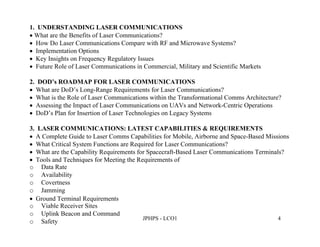
1. UNDERSTANDING LASER COMMUNICATIONS
 What are the Benefits of Laser Communications?
 How Do Laser Communications Compare with RF and Microwave Systems?
 Implementation Options
 Key Insights on Frequency Regulatory Issues
 Future Role of Laser Communications in Commercial, Military and Scientific Markets

2. DOD’s ROADMAP FOR LASER COMMUNICATIONS
 What are DoD’s Long-Range Requirements for Laser Communications?
 What is the Role of Laser Communications within the Transformational Comms Architecture?
 Assessing the Impact of Laser Communications on UAVs and Network-Centric Operations
 DoD’s Plan for Insertion of Laser Technologies on Legacy Systems

3. LASER COMMUNICATIONS: LATEST CAPABILITIES & REQUIREMENTS
 A Complete Guide to Laser Comms Capabilities for Mobile, Airborne and Space-Based Missions
 What Critical System Functions are Required for Laser Communications?
 What are the Capability Requirements for Spacecraft-Based Laser Communications Terminals?
 Tools and Techniques for Meeting the Requirements of
o Data Rate
o Availability
o Covertness
o Jamming
 Ground Terminal Requirements
o Viable Receiver Sites
o Uplink Beacon and Command
                                         JPHPS - LCO1                                    4
o Safety
4. LASER COMMUNICATION SYSTEM PROTOTYPES & PROGRAMS
 USAF/Boeing Gapfiller Wideband Laser Comm System---Future Central Node in Military Architectures
 DARPA’s TeraHertz Operational Reachback (THOR)---Meeting Data Req. for Mobile Environments
 Elliptica Transceiver---The Future Battlefield Commlink?
 Laser Communication Test and Evaluation Station (LTES)
 DARPA’s Multi-Access Laser Comm Head (MALCH): Simultaneous Lasercom to Multiple A/B Users

5. OPPORTUNITIES AND CHALLENGES IN LASER COMMUNICATIONS DEVELOPMENT
 Link Drivers--- Weather, Mobile or Stationary systems,
 Design Drivers--- Cost, Link Availability, Bit Rates, Bit Error Rates, Mil Specs
 Design Approaches--- Design to Spec, Design to Cost, System Architecture and Point to Point
 Where are the Opportunities in Laser Communications Architectures Development?
 Coping with the Lack of Bandwidth---How Can Industry Help?
 What are the Challenges and Solutions in Achieving Real-Time Global Connectivity?
 When Will Enhanced Survivability be Realized?
 Solving the Dilemma of Real-Time Intelligence/Targeting
 Beam Transmission: Making it Work
o Free-Space Optics- Overcoming Key Atmospheric Effects
§    Scintillation
§    Turbulence
§    Cloud Statistics
§    Background Light and Sky Brightness
§    Transmission
§    Seeing
§    Availability
o    Underwater Optics
                                                JPHPS - LCO1                                  5
o    Guided Wave Optics
6. EXPERT INSIGHTS ON MEASURING LASER COMMUNICATIONS PERFORMANCE
 Tools and Techniques for Establishing Requirements and Estimating Performance
 Key Performance Trade-offs for Laser Communications Systems
o Examining the Tradeoffs of Cost vs. Availability, Bit Rate, and Bit Error Rate
o Examining the Tradeoffs of Size/Weight vs. Cost, Availability, BR/BER, Mobility
o Examining the Tradeoffs of Power vs. Range, BR/BER, Availability
 Mass, Power, Volume and Cost Estimation
 Reliability and Quality Assurance
o Flight Qualification
o Environmental Tests
o Component Specifics (Lasers, Detectors, Optics)

7. UNDERSTANDING THE KEY COMPONENTS AND SUB-SYSTEMS
 Current Challenges and Future Capabilities in Laser Transmitters
 Why Modulation and Coding is Key for Successful System Performance
 Frequency/Wavelength Control for Signal-to-Noise Improvements
 Meeting the Requirements for Optical Channel Capacity
 The Real Impact of the Transmitter Telescope on System Performance
 Transcription Methods for Sending the Data
o Meeting the Requirements for Bit Rates and Bit Error Rates
 Which Receivers are Most Useful for Detecting Optical Signals
 Pointing and Tracking for Link Closure and Reduction of Drop-Outs
o Which Technologies Can Be Used for Link Closure
o How Can You Keep Your Bit Error Rates Low
                                      JPHPS - LCO1                           6
LASER COMMUNICATIONS- INTRO & OVERVIEW
•   Laser communications refers to the use of light produced by lasers in
    the near ultraviolet, visible, near, shortwave, and far infrared portions
    of the electromagnetic spectrum to communicate information.
•   In the course we will cover the science, engineering, and technology
    relevant to laser communications in the unguided mode, i.e. Not fiber
    optic communications. We will only show a few comparisons.
•   A wide range of laser communication systems can be developed, and a
    few have been over the years. We expect that as the needs for greater
    bandwidth (data rates), covertness, low probability-of-intercept, and
    freedom from jamming become more important, that more “free-space-
    optical comms systems will be put into service.
•   Commercial systems may be based on LEDs or Lasers. These can be
    surveyed on the internet. Military systems are frequently highly
    proprietary, or classified. Thus we will focus on the science,
    engineering and technology, and discuss specific military applications
    within the limits of unclassified data, and export limitations.

                                  JPHPS - LCO1                              7
LASER COMMS- INTRO/OVERVIEW CONT’D
•   The comm process in the Near Ultraviolet (NUV), Visible (Vis), Near
    InfraRed (NIR), Shortwave IR (SWIR), and Far or Long Wave IR (LWIR)
    differs significantly from that based on Radio Frequency (RF) or Fiber-
    Optic (FO) systems. The carrier frequencies are very large, but direct
    modulation is typically not feasible (exception is the CO2 laser). In
    addition, the comm channel is very dynamic.
•   For the higher frequencies (SWIR and higher frequencies), typically we
    need to use direct detection. For LWIR, we can use Coherent or
    Heterodyne detection. The potential for Coherent systems at shorter
    wavelengths exists, but is challenging.
•   The higher energy per photon requires a significantly higher beam power
    to communicate the same amount of data. Thus, most Laser Comms
    systems will Not operate well in broadcast mode, but are best used as point
    to point systems.


                                  JPHPS - LCO1                              8
LASER COMMS- INTRO/OVERVIEW CONT’D
•   Thus we will divide this course technically into systems that are coherent,
    and those that are incoherent. Further, we can divide the systems into ones
    that require a transmitter on both terminals, and ones that have a
    transmitter on only one end “retrocomms”. Other subdivisions include
    systems that have a common transmit/receive aperture (monostatic), and
    ones that use separate telescopes (bistatic).
    LASER COMMS ARCHITECTURES
    Coherent/Incoherent
    Monostatic/Bistatic
    Single Transmitter/ Multiple transmitters
    Repeaters


                                  JPHPS - LCO1                              9
JPHPS - LCO1   10
1         Transmitters – What transmitters can be used for each comm application?

1.1             Light Sources
1.1.1           Lasers
1.1.1.1         Gas
1.1.1.2         Solid State (crystals)
1.1.1.3         Diodes
1.1.2           LEDs, Lamps etc

1.2             Optical Properties of laser beams for use in optical communications
1.2.1           Laser Resonators
1.2.2           Laser Beams
1.2.2.1         Diffraction-Beam Spreading
1.2.2.2         Beam Divergence Control

1.3             Modulators for encoding of data
1.3.1           Electrical
1.3.2           Electro-Optical
1.3.3           Acousto-Optical
1.3.4           Absorption
1.3.5           Diffraction
                                         JPHPS - LCO1                                 11
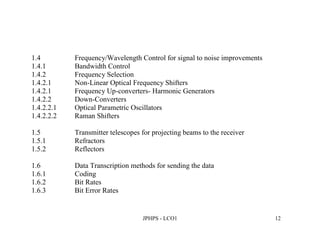
1.4         Frequency/Wavelength Control for signal to noise improvements
1.4.1       Bandwidth Control
1.4.2       Frequency Selection
1.4.2.1     Non-Linear Optical Frequency Shifters
1.4.2.1     Frequency Up-converters- Harmonic Generators
1.4.2.2     Down-Converters
1.4.2.2.1   Optical Parametric Oscillators
1.4.2.2.2   Raman Shifters

1.5         Transmitter telescopes for projecting beams to the receiver
1.5.1       Refractors
1.5.2       Reflectors

1.6         Data Transcription methods for sending the data
1.6.1       Coding
1.6.2       Bit Rates
1.6.3       Bit Error Rates


                                   JPHPS - LCO1                             12
2       Transmission of beams in the atmosphere, underwater and in fibers

2.1     Free Space Optics
2.1.1   Absorption
2.1.2   Scattering
2.1.3   Turbulence Beam Steering
2.1.4   Total transmission Losses

2.2     Underwater optics
2.2.1   Absorption
2.2.2   Scattering
2.3.3   Total transmission losses


2.3     Guided Wave Optics
2.3     Fiber-Optics Properties
2.3.1   Absorption
2.3.2   Scattering
2.3.3   Total Transmission Losses

                               JPHPS - LCO1                          13
3      Receivers for data

3.1    Receiver Telescope

3.2    Detectors

3.3.   Detector Electronics

4      Pointing and Tracking for link closure and reduction of drop-outs

4.1    Error Sources

4.2    Correction methods


                              JPHPS - LCO1                             14
5       Applications of Laser Communication Systems

5.1     Ground to Ground
5.1.1   Fixed
5.1.2   Mobile
5.1.3   Line-Of-Sight
5.1.4   Non-Line-Of-Sight

5.2     Ground to A/C

5.3     A/C to Ground

5.4     A/C to A/C

5.5     Ground to Sat
5.5.1   Low Earth Orbit
5.5.2   Medium Earth Orbit
5.5.3   Geo-stationary Earth Orbit
5.5.4   Long Range
        as above

5.6     Sat to Ground
        as above

5.7     Sat to Sat “Real Free Space”

5.8     Under-Water Fixed to Mobile
                                       JPHPS - LCO1   15
5.9     Under-Water Mobile to Fixed
6.0     Performance of Laser Communication Systems

6.1     Data Rate Requirements

6.2     Availability Requirements

6.3     Covertness

6.4     Jamming Prevention

6.5     Other User Needs
6.5.1   Cost
6.5.2   Size/Weight and Power
6.5.3   Eye-Safety

6.6     Feedback

7.0     Future Directions for Optical Communications


                                JPHPS - LCO1           16
LASER COMM
LINK MODEL
Major Parameters:
Power Transmitted Pt
Beam Angle b
Area of Receiver Ar
Range Z


         Rcvr
         Field
         Of
         Regard


                            Rcvr      Trans
                            FOV       FOI


                       JPHPS - LCO1           17
LCO2
 TRANSMITTERS
LASER COMMUNICATIONS
      A COURSE BY
  Dr. James Pierre Hauck

                           18
LASER COMMUNICATIONS
LASER TRANSMITTERS:
      GAS LASERS-
             C02
      SOLID STATE LASERS-
             Diode Pumped Yttrium Crystals (DPY)
             Diode lasers
             Laser Diode Arrays
             Er Fiber Lasers
             Quantum Cascade Lasers
      FREQUENCY/WAVELENGTH SHIFTERS-
             HARMONIC GENERATORS
             OTHER NLO SHIFTERS
                     JPHPS - LCO2                  19
LASER                              Wavelength (nm) Pav(W) Pp(W) RESEARCH DESIGN DEVELOPMENT ASSEMBLY TEST COMMENT
        Ar:Xe/EBSDL                              1,730            10^6           x         X           X                           with UCI
        Argon Ion                              400-550        20                           X           X                      X    with ALC
JPH     CO/DC:WGL
        CO2:Conventional
                                             5,000-5,500
                                             9,100-11,000
                                                              3
                                                              10
                                                                                X          X           X             X        X
                                                                                                                              X
                                                                                                                                   @ RI
                                                                                                                                   @RI

Laser   CO2/DC: WGL
        CO2/Pulsed:WGL
                                             9,100-11,000
                                             9,100-11,000
                                                           20-150
                                                              4   10^4
                                                                                X
                                                                                X
                                                                                           X
                                                                                           X
                                                                                                       X
                                                                                                       X
                                                                                                                     X
                                                                                                                     X
                                                                                                                              X
                                                                                                                              X
                                                                                                                                   @RI
                                                                                                                                   @RI
        CO2/TEA                              9,100-11,000     10  10^7          X          x           X             X        X    @RI
Exp.    Nd:YAG, Arc Lamp Pumped              1,064, 1,340  10-270               X          X           X             X        X    @SAIC
        Nd:Yttrium, Diode Pumped             1,048-1,064                        X          X           x                           @XES
        Nd:YAG, Flash Lamp Pumped                1,064        40  10^7          x          x                                  X    @SAIC
        Nd:PPLN                                  1,048                          x                                                  @XES
        Dye/Flashlamp pumped                   600-700       0.1  10^3          x          X           X             X        X    @UCI
        Erbium:YAG, FLP                          2,900        2   10^4          X          X           X             X        X    @PLS
        Excimer:XeCl:X-ray                        308         40  10^8          X          X           X             X        X    @NED/NRTC
        Excimer:KrF                               248         10  10^7          X                                             X    @NED
        Free Electron Laser                 10,000-100,000                      X          x           X                           with LLNL
        HeNe- Green                               524       0.001               X          X                                       @NED
        HeNe- Red                                 632       0.006               X          X           X             X        X    @RI, NED, etc.
        HF/DF                                2,100-3,800      10                X          x                                       @RI
        Ho:YAG                                   2,100        1                 X          X           x                           with JMAR
        Titanium Sapphire, FLP                 660-1100       20  10^5          X          X           X             X        X    @NED, GDLSL
        Titanium Sapphire, Laser Pumped        750-900        1                 X                                             x    @SAIC
        Cr:LiSAF/FLP                           750-900        2                 X                                                  @XES
        Cr:Al2O3 (Ruby)                           694               1           X                                                  @UCI
        GaAs                                   780-860       0.1    1           X                                             X    @GDLSL, Boe,
        GaAs Laser Diode Arrays                808, 860       20  10^3          X                      X                      X    @Boe, SEA
        GaN                                    370-480       0.03               x                                                  with Nichia
        InGaAs                               1,400-1,600     0.1                x                                                  various
        Optically Pumped Semiconductor         460, 480      0.04               x                                                  Coherent
        Quantum Cascade Lasers               3,000-16,000    0.1   0.2          x                                             x    QCL, Alpes
        Code:
        Ar = Argon
        Xe= Xenon
        YAG = Yttrium Aluminum Garnet
        Cr:LiSAF = Chromium:Lithium Strontium Aluminum Fluoride
        EBSDL = Electron Beam Sustained Discharge Laser
        X-ray = X-ray Preionized Laser
        X = significant hardware experience
        x = analysis, study or evaluation            JPHPS - LCO2                                                                 20
        WGL = WaveGuide Laser
        Note: This chart does not include laser wavelength conversion such has second harmonic generation, third harmonic generation, Raman, etc.
CANDIDATE LASER COMM TRANSMITTERS


LASER                      Wavelength (nm) Pav(W) Pp(W)
CO2/DC: WGL                   9,100-11,000   20-150
CO2/Pulsed:WGL                9,100-11,000      4     10^4
Nd:Yttrium, Diode Pumped      1,048-1,064
Nd:PPLN                           1,048
GaAs                            780-860       0.1      1
GaAs Laser Diode Arrays         808, 860       20     10^3
GaN                             370-480       0.03
InGaAs                        1,400-1,600     0.1
Quantum Cascade Lasers        3,000-16,000    0.1     0.2

                       JPHPS - LCO2                    21
LASER TRANSMITTER CHARACTERISTICS
•   Beam Quality - Require maximum illumination at the receiver, and good
    beam uniformity to achieve greatest range and SNR.
•   The amount the beam diverges is compared to the “diffraction limit”
       t = 2.4  (XDL) / Db = (XDL) dl where
           t = the full angular divergence of the transmitted beam (assumed circular)
            = the transmitter laser wavelength
         • XDL = the number of times diffraction limited
         • Db = the transmitter aperture diameter
     – Examples:
            = 1 m, XDL = 1, Db = 1 mm, t = 2.4 milliradians = 0.14o = 8.5 arcmin
            = 0.8 m, XDL = 25, Db = 20 mm, t = 2.4 milliradians = 0.14o = 8.5 arcmin
            = 10 m, XDL = 1, Db = 10 mm, t = 2.4 milliradians = 0.14o = 8.5 arcmin
•   The beam quality of low power gas lasers and diode pumped solid state
    lasers is usually nearly diffraction limited, while semiconductor diode
    lasers are many time diffraction limited.
•   The figure of merit for the transmitter is Radiance = Watts/area/solid angle
                                       JPHPS - LCO2                                       22
MORE LASER BEAM PARAMETERS
•   Beam Uniformity - Require beam uniformity to avoid “drop-outs”
•   The Power/Area = Irradiance I or M(W/m2 or W/cm2)
•   Uniformity  I / I = (Ipeak - Ivalley)/I average
•   The uniformity of the transmitted beam is determined by the number of
    transverse modes present in the beam, and optics quality. For a single
    transverse mode, a Gaussian beam profile may be obtained. For a
    large number of modes, a Super-Gaussian beam with a relatively flat
    top can be obtained. Beams with a small number of modes tend to be
    more non-uniform.
•   The number of transverse modes oscillating can be estimated from:
     – “Fresnel Number” = NF = Dl 2/ (4  L) = 25 Dl2 (mm)/ (um)/ L(cm)
     – Typically low Fresnel number lasers have low power output
     – Uniformity of the beam at the output, may not result in a uniform beam in
       the “far field”


                                  JPHPS - LCO2                                23
TRANSMITTER BRIGHTNESS (RADIANCE)
•   At the receiver, the quantity of interest is the irradiance, I(W/m2). The
    irradiance depends on the transmitter brightness in the far field
      – I(Z) = Io{( Db2/4)/[( Db2/4) + (t Z) 2/4]} ~ IoDb2/(t Z) 2 = L / Z 2
      – where L = Io Db2/ ( t 2 /4) = Pt / ( t 2 /4) is the brightness (radiance)
     – The transmitter brightness depends on the science and engineering of the laser
       source, and for each type has fundamental limits
     – Brighter transmitters provide better comm links with smaller transmit telescopes
•   Narrow linewidth of the laser can improve receiver signal to noise ratio as
    more of the background radiation can be filtered
     – Linewidth   or  f = 
     – Ultra-narrow (kHz to GHz) or ( f / f less than 10-6) can use atomic filters
     – Narrow (GHz to THz) can use optical bandpass filters
•   The combination of high radiance and narrow linewidth produces high
    spectral brightness, which makes the beam visible in ambient illumination


                                      JPHPS - LCO2                                      24
LCO3
OPTICAL MODULATORS
  LASER COMMUNICATIONS
        A COURSE BY
    Dr. James Pierre Hauck

           JPHPS - LC03      25
SIGNAL MODULATION

•   Modulation Devices
    – Electro-optic
    – Acousto-optic
    – Absorption band-edge
•   Modulation Formats
    – Frequency Modulation
    – Amplitude Modulation
    – Pulse Position Modulation
•   Coding
    –   On-off
    –   Non-return to zero
    –   Several others
    –   (multi-level coding inappropriate for Op Comms due to variable link loss


                                   JPHPS - LC03                                26
MODULATION AND DEMODULATION

•   Amplitude Modulation with On-off key coding is the most common
    because most Op Comms Systems are direct detection (NOT coherent)
•   Each time bin either contains a bit (pulse) or does not and is a 1 or 0
•   Sets of bits are sent to synchronization the clocks as the range varies

•   Frequency modulation can be used with coherent lasers (mainly CO2,
    but others may be feasible)
•   Frequency modulation has the best noise suppression, but is more
    difficult to implement with most laser systems.

•   Specialized AM modulation schemes can be utilized for retrocomms
    (more later)


                                JPHPS - LC03                             27
MODULATION ARCHITECTURES

•   Modulation can be accomplished either intra-cavity (IC-inside the laser
    resonator), or extra-cavity (EC- on the laser beam)
•   Intra-cavity modulation can be produced by modulating the gain or loss
•   Electro-optic (E/O) and acousto-optic (A/O) modulators can be used
    either intra-cavity or on the beam
•   E/O and A/O can both be used to produce either AM or FM
•   Usually, an IC modulator will require less drive voltage & power, but is
    more complex to implement and requires a higher gain laser


                                JPHPS - LC03                             28
Intra-cavity                  Extra-cavity


                         From synch bits


               JPHPS - LC03                  29
ELECTRO-OPTIC DEVICES

•   The Electro-optic modulator functions by rotating the plane of
    polarization of the light, such that a polarization dependent loss or
    polarization dependent transmission leads to amplitude modulation.
•   An alternative approach is to use the E/O device as a phase shifter
    intra-cavity, in which case it induces both a phase and frequency shift
    which then may lead to AM or FM


                                 JPHPS - LC03                             30
LASER BEAM MODULATORS CHOICES

ACOUSTO-OPTIC                ELECTRO-OPTIC
Lower insertion loss         Up to 6 dB loss
Higher speed                 Usually adequately fast
Lower voltage                Usually kV, but lower V feasible
Contrast up to 90%           Higher contrast up to 99.9%
Usually used for low power   Higher laser power
Small aperture               Larger aperture
Rugged materials             Adequately rugged
Easily AR coated             AR OK
AM or FM                     AM or FM
Used IC AM                   Used IC AM
Used EC FM                   Used IC FM

                        JPHPS - LC03                     31
M-ARY PULSE POSITION MODULATION
•   Information can be encoded by putting a pulse in each bin (Binary), if the
    transmitter can generate pulses at high Pulse Repetition Frequency (PRF). If
    the bin size is small (as limited by laser pulse length, atmospheric delays, and
    detector speed), but the laser PRF is limited, a hybrid approach called M-
    ARY Pulse Position Modulation (PPM), can be used.
•   Intensity M bins | | Td=dead time so that laser does not have to put pulses into two adjacent bins
•             |........ |......... |........ |....... |........
•             | T = 1/PRF |      | | bin size Tbin ; M*Tbin+Td = T
•   bits/sec = bit rate = BR = PRF*log2M,
•   for E = Emin, Power ~ PRF, BR/P = log2M,
•   so it is not very advantageous to use large M
•   example- Tatm = 10 us, Tbin = 10Tatm = 100 us, Td = 1 ms
Case       M          PRF        BR          BR/P         Comment
0          1          900         909        NA           Binary
1          2          833         833        1
2          8          555        1655        3
3          64         135         810        6
4          256         38         304        8
                                           JPHPS - LC03                                       32
MODLATORS SUMMARY
• Simplest modulator is direct (diodes)
• EO and AO are commonly used for DPY
• Absorption edge modulators seem attractive


                   JPHPS - LC03            33
LCO4
TELESCOPES AND
  DETECTORS
LASER COMMUNICATIONS
      A COURSE BY
  Dr. James Pierre Hauck
TELESCOPES AND DETECTORS
•   Telescopes-
     – Catoptric- reflective
     – Dioptric - refractive


•   Detectors
     –   Photodiodes
     –   Avalanche Photodiodes
     –   Photoconductors
     –   Photomultipliers
     –   Array Detectors


                                 JPHPS - LC04   35
BEAM PROPAGATION - FOUR CASES
•   1-True Free Space (in vacuum losses are beam spreading and optics)
•   2-Atmospheric (as above plus losses include absorption and scattering)
•   3-Underwater (as above, but may need to include surface loss)
•   4-Fibers
•   Absorption is due to atoms, molecules, particulates
•   Scattering is caused by atoms, molecules, particulates and refractive
    index variations
•   Beam losses can also result from beam directional changes caused by
    refractive index variations
•   Time dependent refractive index changes are called turbulence
•   Beam spreading losses can be controlled for short range, but may
    dominate for long range (such as GEO and interplanetary)
•   Absorption losses can be limited by choice of wavelength, but are
    rarely negligible
•   Scattering is ever-present, and extremely variable
                                JPHPS - LC05                            36
Fundamentals of FO
 Communications
Part 1
•   What is telecommunications?
•   Telecommunication concepts
•   Fiber-optic system concepts
•   Fiber system design concepts
What is communicated?
• Data
    – Telegrams
    – Computer data, telemetry, etc.
    – Internet e-mail, files, web pages
•   Voice: telephone, radio
•   Video: sound and images
•   All are encoded as signals
•   Systems are converging
Wavelength-division multiplexing
• Transmits signals at many wavelengths
  through one fiber
• Multiplies fiber capacity
• Distinct from time-division multiplexing
  – TDM interleaves slow signals to make one fast
    one
  – WDM sends multiple signals at similar speeds
    to increase capacity
  – DWDM = dense WDM
• Each wavelength is an optical channel
WDM Technologies
•   A beam comprised of a number of different wavelengths is incident on a
    reflective or transmissive mirror that allow a particular wavelength to be
    separated. This process is continued until each wavelength is on a separate
    optical path (see figure 15.8). This process can be performed one
    wavelength at a time, or in “blocks” as in figure 15.9.
•   An alternative to using MLD mirrors is to use Fiber Bragg Gratings, as
    shown in figure 15.10. Such an arrangement, picking off one wavelength at
    a time is referred to as a circulators.
•   Making the device work in both directions is shown in figure 15.11, and
    can be used to separate wavelengths in correlation with different physical
    locations.
•   Fused-Fiber Couplers are inherently wavelength sensitive, and can be used
    for WDM as shown in figure 15.12
•   A Mach-Zehnder Interleaver is another type of interferometer for
    combining or separating different wavelengths as shown in figure 15.13.
    The relationship for wavelength separation is shown on page 381.
        =c/2/n/L
     – a multistage interleaver is shown in figure 15.14
WDM system – Fig. 15.1
                                                                                        Receivers
Transmitters
                                                                                                   
                                                                                       

                                                                                                   
                                                                                        

                                                                                                   
                                                                                          
 
               Multiplexer                                              Demultiplexer
                                   Add/drop                             
 
                                               Multiplexer
                                                     

                                                                                                 
 
                                                                                              
                                                                                                   
                                         Drop        Add
                                                     
                                                                                              
                                                                                                   
 
                                                                                          
                                                                                                   
                                        Local      Local
                                          receiver   transmitter
System and Optical NetWorking
Part 2:
    Global networks and standards
•   Evolution of global networks
•   Circuit and packet switching
•   Transmission standards & hierarchy
•   Global network structure
Global Network services
• Telegraphy: now obsolete
• Telephony: standard, base of present
  telecommunications network
• Video: standard, often via satellite
• Data: growing tremendously with Internet
• Networks converge as services digitize
• Most services now digital
  – Video is an exception
Single-Channel System Design
Part 5:
          Fiber System Design
•   Design goals
•   Optical amplifiers & equalization
•   WDM
•   System bandwidth
•   Dispersion management
•   Nonlinear effects
•   Optical networking
•   Optical switching
Design goals
• Depend on application
• Long-haul systems
  – High-speed transmission
  – Maximum throughput over scarce fibers
  – Trade-offs favor expensive terminals
• Metro/Regional Systems
  – Fiber plant less costly
  – More terminals per fiber-km
  – Trade-offs favor reducing terminal costs
Optical Networking System
          Design
Optical Networking
•   Managing signals as optical channels
•   Add/drop single wavelength
•   Separate signals by optical channel
•   Switching signals by wavelength
•   Easier to manipulate than TDM channels
•   Improves granularity
•   Uses optical switching
•   Slowed by end of bubble
Standard wavelength bands
•   O-band   Original 1260-1360 nm
•   E-band   Extended 1360-1460 nm
•   S-band   Short     1460-1530 nm
•   C-band   Conventional 1530-1565 nm
•   L-band   Long      1565-1625 nm
•   U-band   Ultra-long 1625-1675 nm
Global Telecommunications
       Applications
Internet Access and
Local-Area Networks
Laser through air
You have enjoyed ATI's preview of
                  Laser Communications


    Please post your comments and questions to our blog:
        http://www.aticourses.com/blog/

     Sign-up for ATI's monthly Course Schedule Updates :
http://www.aticourses.com/email_signup_page.html

ATI Laser RADAR and Applications Training for Advanced Students Course Sampler

  • 1.
    Slides From ATIProfessional Development Short Course LASER COMMUNICATIONS Instructor: Dr. James Pierre Hauck ATI Course Schedule: http://www.ATIcourses.com/schedule.htm ATI's Laser Communications: http://www.aticourses.com/Laser_RADAR_and_Applications.htm
  • 2.
    www.ATIcourses.com Boost Your Skills 349 Berkshire Drive Riva, Maryland 21140 with On-Site Courses Telephone 1-888-501-2100 / (410) 965-8805 Tailored to Your Needs Fax (410) 956-5785 Email: ATI@ATIcourses.com The Applied Technology Institute specializes in training programs for technical professionals. Our courses keep you current in the state-of-the-art technology that is essential to keep your company on the cutting edge in today’s highly competitive marketplace. Since 1984, ATI has earned the trust of training departments nationwide, and has presented on-site training at the major Navy, Air Force and NASA centers, and for a large number of contractors. Our training increases effectiveness and productivity. Learn from the proven best. For a Free On-Site Quote Visit Us At: http://www.ATIcourses.com/free_onsite_quote.asp For Our Current Public Course Schedule Go To: http://www.ATIcourses.com/schedule.htm
  • 3.
    LASER COMMUNICATIONS  What are the Emerging Laser Communications Challenges for Mobile, Airborne and Space-Based Missions?  Future Opportunities in LaserCom Applications (ground-to-ground, satellite-to-satellite, ground-to- satellite and much more!)  Overcoming Challenges in LaserCom Development (bandwidth expansion, real-time global connectivity, survivability & more)  Measuring the Key Performance Tradeoffs (cost vs. size/weight vs. availability vs. power vs. range & more!)  Tools and Techniques for Meeting the Requirements of Data Rate, Availability, Covertness & Jamming 2
  • 4.
    1. UNDERSTANDING LASERCOMMUNICATIONS  What are the Benefits of Laser Communications?  How Do Laser Communications Compare with RF and Microwave Systems?  Implementation Options  Key Insights on Frequency Regulatory Issues  Future Role of Laser Communications in Commercial, Military and Scientific Markets 2. DOD’s ROADMAP FOR LASER COMMUNICATIONS  What are DoD’s Long-Range Requirements for Laser Communications?  What is the Role of Laser Communications within the Transformational Comms Architecture?  Assessing the Impact of Laser Communications on UAVs and Network-Centric Operations  DoD’s Plan for Insertion of Laser Technologies on Legacy Systems 3. LASER COMMUNICATIONS: LATEST CAPABILITIES & REQUIREMENTS  A Complete Guide to Laser Comms Capabilities for Mobile, Airborne and Space-Based Missions  What Critical System Functions are Required for Laser Communications?  What are the Capability Requirements for Spacecraft-Based Laser Communications Terminals?  Tools and Techniques for Meeting the Requirements of o Data Rate o Availability o Covertness o Jamming  Ground Terminal Requirements o Viable Receiver Sites o Uplink Beacon and Command JPHPS - LCO1 4 o Safety
  • 5.
    4. LASER COMMUNICATIONSYSTEM PROTOTYPES & PROGRAMS  USAF/Boeing Gapfiller Wideband Laser Comm System---Future Central Node in Military Architectures  DARPA’s TeraHertz Operational Reachback (THOR)---Meeting Data Req. for Mobile Environments  Elliptica Transceiver---The Future Battlefield Commlink?  Laser Communication Test and Evaluation Station (LTES)  DARPA’s Multi-Access Laser Comm Head (MALCH): Simultaneous Lasercom to Multiple A/B Users 5. OPPORTUNITIES AND CHALLENGES IN LASER COMMUNICATIONS DEVELOPMENT  Link Drivers--- Weather, Mobile or Stationary systems,  Design Drivers--- Cost, Link Availability, Bit Rates, Bit Error Rates, Mil Specs  Design Approaches--- Design to Spec, Design to Cost, System Architecture and Point to Point  Where are the Opportunities in Laser Communications Architectures Development?  Coping with the Lack of Bandwidth---How Can Industry Help?  What are the Challenges and Solutions in Achieving Real-Time Global Connectivity?  When Will Enhanced Survivability be Realized?  Solving the Dilemma of Real-Time Intelligence/Targeting  Beam Transmission: Making it Work o Free-Space Optics- Overcoming Key Atmospheric Effects § Scintillation § Turbulence § Cloud Statistics § Background Light and Sky Brightness § Transmission § Seeing § Availability o Underwater Optics JPHPS - LCO1 5 o Guided Wave Optics
  • 6.
    6. EXPERT INSIGHTSON MEASURING LASER COMMUNICATIONS PERFORMANCE  Tools and Techniques for Establishing Requirements and Estimating Performance  Key Performance Trade-offs for Laser Communications Systems o Examining the Tradeoffs of Cost vs. Availability, Bit Rate, and Bit Error Rate o Examining the Tradeoffs of Size/Weight vs. Cost, Availability, BR/BER, Mobility o Examining the Tradeoffs of Power vs. Range, BR/BER, Availability  Mass, Power, Volume and Cost Estimation  Reliability and Quality Assurance o Flight Qualification o Environmental Tests o Component Specifics (Lasers, Detectors, Optics) 7. UNDERSTANDING THE KEY COMPONENTS AND SUB-SYSTEMS  Current Challenges and Future Capabilities in Laser Transmitters  Why Modulation and Coding is Key for Successful System Performance  Frequency/Wavelength Control for Signal-to-Noise Improvements  Meeting the Requirements for Optical Channel Capacity  The Real Impact of the Transmitter Telescope on System Performance  Transcription Methods for Sending the Data o Meeting the Requirements for Bit Rates and Bit Error Rates  Which Receivers are Most Useful for Detecting Optical Signals  Pointing and Tracking for Link Closure and Reduction of Drop-Outs o Which Technologies Can Be Used for Link Closure o How Can You Keep Your Bit Error Rates Low JPHPS - LCO1 6
  • 7.
    LASER COMMUNICATIONS- INTRO& OVERVIEW • Laser communications refers to the use of light produced by lasers in the near ultraviolet, visible, near, shortwave, and far infrared portions of the electromagnetic spectrum to communicate information. • In the course we will cover the science, engineering, and technology relevant to laser communications in the unguided mode, i.e. Not fiber optic communications. We will only show a few comparisons. • A wide range of laser communication systems can be developed, and a few have been over the years. We expect that as the needs for greater bandwidth (data rates), covertness, low probability-of-intercept, and freedom from jamming become more important, that more “free-space- optical comms systems will be put into service. • Commercial systems may be based on LEDs or Lasers. These can be surveyed on the internet. Military systems are frequently highly proprietary, or classified. Thus we will focus on the science, engineering and technology, and discuss specific military applications within the limits of unclassified data, and export limitations. JPHPS - LCO1 7
  • 8.
    LASER COMMS- INTRO/OVERVIEWCONT’D • The comm process in the Near Ultraviolet (NUV), Visible (Vis), Near InfraRed (NIR), Shortwave IR (SWIR), and Far or Long Wave IR (LWIR) differs significantly from that based on Radio Frequency (RF) or Fiber- Optic (FO) systems. The carrier frequencies are very large, but direct modulation is typically not feasible (exception is the CO2 laser). In addition, the comm channel is very dynamic. • For the higher frequencies (SWIR and higher frequencies), typically we need to use direct detection. For LWIR, we can use Coherent or Heterodyne detection. The potential for Coherent systems at shorter wavelengths exists, but is challenging. • The higher energy per photon requires a significantly higher beam power to communicate the same amount of data. Thus, most Laser Comms systems will Not operate well in broadcast mode, but are best used as point to point systems. JPHPS - LCO1 8
  • 9.
    LASER COMMS- INTRO/OVERVIEWCONT’D • Thus we will divide this course technically into systems that are coherent, and those that are incoherent. Further, we can divide the systems into ones that require a transmitter on both terminals, and ones that have a transmitter on only one end “retrocomms”. Other subdivisions include systems that have a common transmit/receive aperture (monostatic), and ones that use separate telescopes (bistatic). LASER COMMS ARCHITECTURES Coherent/Incoherent Monostatic/Bistatic Single Transmitter/ Multiple transmitters Repeaters JPHPS - LCO1 9
  • 10.
  • 11.
    1 Transmitters – What transmitters can be used for each comm application? 1.1 Light Sources 1.1.1 Lasers 1.1.1.1 Gas 1.1.1.2 Solid State (crystals) 1.1.1.3 Diodes 1.1.2 LEDs, Lamps etc 1.2 Optical Properties of laser beams for use in optical communications 1.2.1 Laser Resonators 1.2.2 Laser Beams 1.2.2.1 Diffraction-Beam Spreading 1.2.2.2 Beam Divergence Control 1.3 Modulators for encoding of data 1.3.1 Electrical 1.3.2 Electro-Optical 1.3.3 Acousto-Optical 1.3.4 Absorption 1.3.5 Diffraction JPHPS - LCO1 11
  • 12.
    1.4 Frequency/Wavelength Control for signal to noise improvements 1.4.1 Bandwidth Control 1.4.2 Frequency Selection 1.4.2.1 Non-Linear Optical Frequency Shifters 1.4.2.1 Frequency Up-converters- Harmonic Generators 1.4.2.2 Down-Converters 1.4.2.2.1 Optical Parametric Oscillators 1.4.2.2.2 Raman Shifters 1.5 Transmitter telescopes for projecting beams to the receiver 1.5.1 Refractors 1.5.2 Reflectors 1.6 Data Transcription methods for sending the data 1.6.1 Coding 1.6.2 Bit Rates 1.6.3 Bit Error Rates JPHPS - LCO1 12
  • 13.
    2 Transmission of beams in the atmosphere, underwater and in fibers 2.1 Free Space Optics 2.1.1 Absorption 2.1.2 Scattering 2.1.3 Turbulence Beam Steering 2.1.4 Total transmission Losses 2.2 Underwater optics 2.2.1 Absorption 2.2.2 Scattering 2.3.3 Total transmission losses 2.3 Guided Wave Optics 2.3 Fiber-Optics Properties 2.3.1 Absorption 2.3.2 Scattering 2.3.3 Total Transmission Losses JPHPS - LCO1 13
  • 14.
    3 Receivers for data 3.1 Receiver Telescope 3.2 Detectors 3.3. Detector Electronics 4 Pointing and Tracking for link closure and reduction of drop-outs 4.1 Error Sources 4.2 Correction methods JPHPS - LCO1 14
  • 15.
    5 Applications of Laser Communication Systems 5.1 Ground to Ground 5.1.1 Fixed 5.1.2 Mobile 5.1.3 Line-Of-Sight 5.1.4 Non-Line-Of-Sight 5.2 Ground to A/C 5.3 A/C to Ground 5.4 A/C to A/C 5.5 Ground to Sat 5.5.1 Low Earth Orbit 5.5.2 Medium Earth Orbit 5.5.3 Geo-stationary Earth Orbit 5.5.4 Long Range as above 5.6 Sat to Ground as above 5.7 Sat to Sat “Real Free Space” 5.8 Under-Water Fixed to Mobile JPHPS - LCO1 15 5.9 Under-Water Mobile to Fixed
  • 16.
    6.0 Performance of Laser Communication Systems 6.1 Data Rate Requirements 6.2 Availability Requirements 6.3 Covertness 6.4 Jamming Prevention 6.5 Other User Needs 6.5.1 Cost 6.5.2 Size/Weight and Power 6.5.3 Eye-Safety 6.6 Feedback 7.0 Future Directions for Optical Communications JPHPS - LCO1 16
  • 17.
    LASER COMM LINK MODEL MajorParameters: Power Transmitted Pt Beam Angle b Area of Receiver Ar Range Z Rcvr Field Of Regard Rcvr Trans FOV FOI JPHPS - LCO1 17
  • 18.
    LCO2 TRANSMITTERS LASER COMMUNICATIONS A COURSE BY Dr. James Pierre Hauck 18
  • 19.
    LASER COMMUNICATIONS LASER TRANSMITTERS: GAS LASERS- C02 SOLID STATE LASERS- Diode Pumped Yttrium Crystals (DPY) Diode lasers Laser Diode Arrays Er Fiber Lasers Quantum Cascade Lasers FREQUENCY/WAVELENGTH SHIFTERS- HARMONIC GENERATORS OTHER NLO SHIFTERS JPHPS - LCO2 19
  • 20.
    LASER Wavelength (nm) Pav(W) Pp(W) RESEARCH DESIGN DEVELOPMENT ASSEMBLY TEST COMMENT Ar:Xe/EBSDL 1,730 10^6 x X X with UCI Argon Ion 400-550 20 X X X with ALC JPH CO/DC:WGL CO2:Conventional 5,000-5,500 9,100-11,000 3 10 X X X X X X @ RI @RI Laser CO2/DC: WGL CO2/Pulsed:WGL 9,100-11,000 9,100-11,000 20-150 4 10^4 X X X X X X X X X X @RI @RI CO2/TEA 9,100-11,000 10 10^7 X x X X X @RI Exp. Nd:YAG, Arc Lamp Pumped 1,064, 1,340 10-270 X X X X X @SAIC Nd:Yttrium, Diode Pumped 1,048-1,064 X X x @XES Nd:YAG, Flash Lamp Pumped 1,064 40 10^7 x x X @SAIC Nd:PPLN 1,048 x @XES Dye/Flashlamp pumped 600-700 0.1 10^3 x X X X X @UCI Erbium:YAG, FLP 2,900 2 10^4 X X X X X @PLS Excimer:XeCl:X-ray 308 40 10^8 X X X X X @NED/NRTC Excimer:KrF 248 10 10^7 X X @NED Free Electron Laser 10,000-100,000 X x X with LLNL HeNe- Green 524 0.001 X X @NED HeNe- Red 632 0.006 X X X X X @RI, NED, etc. HF/DF 2,100-3,800 10 X x @RI Ho:YAG 2,100 1 X X x with JMAR Titanium Sapphire, FLP 660-1100 20 10^5 X X X X X @NED, GDLSL Titanium Sapphire, Laser Pumped 750-900 1 X x @SAIC Cr:LiSAF/FLP 750-900 2 X @XES Cr:Al2O3 (Ruby) 694 1 X @UCI GaAs 780-860 0.1 1 X X @GDLSL, Boe, GaAs Laser Diode Arrays 808, 860 20 10^3 X X X @Boe, SEA GaN 370-480 0.03 x with Nichia InGaAs 1,400-1,600 0.1 x various Optically Pumped Semiconductor 460, 480 0.04 x Coherent Quantum Cascade Lasers 3,000-16,000 0.1 0.2 x x QCL, Alpes Code: Ar = Argon Xe= Xenon YAG = Yttrium Aluminum Garnet Cr:LiSAF = Chromium:Lithium Strontium Aluminum Fluoride EBSDL = Electron Beam Sustained Discharge Laser X-ray = X-ray Preionized Laser X = significant hardware experience x = analysis, study or evaluation JPHPS - LCO2 20 WGL = WaveGuide Laser Note: This chart does not include laser wavelength conversion such has second harmonic generation, third harmonic generation, Raman, etc.
  • 21.
    CANDIDATE LASER COMMTRANSMITTERS LASER Wavelength (nm) Pav(W) Pp(W) CO2/DC: WGL 9,100-11,000 20-150 CO2/Pulsed:WGL 9,100-11,000 4 10^4 Nd:Yttrium, Diode Pumped 1,048-1,064 Nd:PPLN 1,048 GaAs 780-860 0.1 1 GaAs Laser Diode Arrays 808, 860 20 10^3 GaN 370-480 0.03 InGaAs 1,400-1,600 0.1 Quantum Cascade Lasers 3,000-16,000 0.1 0.2 JPHPS - LCO2 21
  • 22.
    LASER TRANSMITTER CHARACTERISTICS • Beam Quality - Require maximum illumination at the receiver, and good beam uniformity to achieve greatest range and SNR. • The amount the beam diverges is compared to the “diffraction limit” t = 2.4  (XDL) / Db = (XDL) dl where t = the full angular divergence of the transmitted beam (assumed circular)  = the transmitter laser wavelength • XDL = the number of times diffraction limited • Db = the transmitter aperture diameter – Examples:  = 1 m, XDL = 1, Db = 1 mm, t = 2.4 milliradians = 0.14o = 8.5 arcmin  = 0.8 m, XDL = 25, Db = 20 mm, t = 2.4 milliradians = 0.14o = 8.5 arcmin  = 10 m, XDL = 1, Db = 10 mm, t = 2.4 milliradians = 0.14o = 8.5 arcmin • The beam quality of low power gas lasers and diode pumped solid state lasers is usually nearly diffraction limited, while semiconductor diode lasers are many time diffraction limited. • The figure of merit for the transmitter is Radiance = Watts/area/solid angle JPHPS - LCO2 22
  • 23.
    MORE LASER BEAMPARAMETERS • Beam Uniformity - Require beam uniformity to avoid “drop-outs” • The Power/Area = Irradiance I or M(W/m2 or W/cm2) • Uniformity  I / I = (Ipeak - Ivalley)/I average • The uniformity of the transmitted beam is determined by the number of transverse modes present in the beam, and optics quality. For a single transverse mode, a Gaussian beam profile may be obtained. For a large number of modes, a Super-Gaussian beam with a relatively flat top can be obtained. Beams with a small number of modes tend to be more non-uniform. • The number of transverse modes oscillating can be estimated from: – “Fresnel Number” = NF = Dl 2/ (4  L) = 25 Dl2 (mm)/ (um)/ L(cm) – Typically low Fresnel number lasers have low power output – Uniformity of the beam at the output, may not result in a uniform beam in the “far field” JPHPS - LCO2 23
  • 24.
    TRANSMITTER BRIGHTNESS (RADIANCE) • At the receiver, the quantity of interest is the irradiance, I(W/m2). The irradiance depends on the transmitter brightness in the far field – I(Z) = Io{( Db2/4)/[( Db2/4) + (t Z) 2/4]} ~ IoDb2/(t Z) 2 = L / Z 2 – where L = Io Db2/ ( t 2 /4) = Pt / ( t 2 /4) is the brightness (radiance) – The transmitter brightness depends on the science and engineering of the laser source, and for each type has fundamental limits – Brighter transmitters provide better comm links with smaller transmit telescopes • Narrow linewidth of the laser can improve receiver signal to noise ratio as more of the background radiation can be filtered – Linewidth   or  f =  – Ultra-narrow (kHz to GHz) or ( f / f less than 10-6) can use atomic filters – Narrow (GHz to THz) can use optical bandpass filters • The combination of high radiance and narrow linewidth produces high spectral brightness, which makes the beam visible in ambient illumination JPHPS - LCO2 24
  • 25.
    LCO3 OPTICAL MODULATORS LASER COMMUNICATIONS A COURSE BY Dr. James Pierre Hauck JPHPS - LC03 25
  • 26.
    SIGNAL MODULATION • Modulation Devices – Electro-optic – Acousto-optic – Absorption band-edge • Modulation Formats – Frequency Modulation – Amplitude Modulation – Pulse Position Modulation • Coding – On-off – Non-return to zero – Several others – (multi-level coding inappropriate for Op Comms due to variable link loss JPHPS - LC03 26
  • 27.
    MODULATION AND DEMODULATION • Amplitude Modulation with On-off key coding is the most common because most Op Comms Systems are direct detection (NOT coherent) • Each time bin either contains a bit (pulse) or does not and is a 1 or 0 • Sets of bits are sent to synchronization the clocks as the range varies • Frequency modulation can be used with coherent lasers (mainly CO2, but others may be feasible) • Frequency modulation has the best noise suppression, but is more difficult to implement with most laser systems. • Specialized AM modulation schemes can be utilized for retrocomms (more later) JPHPS - LC03 27
  • 28.
    MODULATION ARCHITECTURES • Modulation can be accomplished either intra-cavity (IC-inside the laser resonator), or extra-cavity (EC- on the laser beam) • Intra-cavity modulation can be produced by modulating the gain or loss • Electro-optic (E/O) and acousto-optic (A/O) modulators can be used either intra-cavity or on the beam • E/O and A/O can both be used to produce either AM or FM • Usually, an IC modulator will require less drive voltage & power, but is more complex to implement and requires a higher gain laser JPHPS - LC03 28
  • 29.
    Intra-cavity Extra-cavity From synch bits JPHPS - LC03 29
  • 30.
    ELECTRO-OPTIC DEVICES • The Electro-optic modulator functions by rotating the plane of polarization of the light, such that a polarization dependent loss or polarization dependent transmission leads to amplitude modulation. • An alternative approach is to use the E/O device as a phase shifter intra-cavity, in which case it induces both a phase and frequency shift which then may lead to AM or FM JPHPS - LC03 30
  • 31.
    LASER BEAM MODULATORSCHOICES ACOUSTO-OPTIC ELECTRO-OPTIC Lower insertion loss Up to 6 dB loss Higher speed Usually adequately fast Lower voltage Usually kV, but lower V feasible Contrast up to 90% Higher contrast up to 99.9% Usually used for low power Higher laser power Small aperture Larger aperture Rugged materials Adequately rugged Easily AR coated AR OK AM or FM AM or FM Used IC AM Used IC AM Used EC FM Used IC FM JPHPS - LC03 31
  • 32.
    M-ARY PULSE POSITIONMODULATION • Information can be encoded by putting a pulse in each bin (Binary), if the transmitter can generate pulses at high Pulse Repetition Frequency (PRF). If the bin size is small (as limited by laser pulse length, atmospheric delays, and detector speed), but the laser PRF is limited, a hybrid approach called M- ARY Pulse Position Modulation (PPM), can be used. • Intensity M bins | | Td=dead time so that laser does not have to put pulses into two adjacent bins • |........ |......... |........ |....... |........ • | T = 1/PRF | | | bin size Tbin ; M*Tbin+Td = T • bits/sec = bit rate = BR = PRF*log2M, • for E = Emin, Power ~ PRF, BR/P = log2M, • so it is not very advantageous to use large M • example- Tatm = 10 us, Tbin = 10Tatm = 100 us, Td = 1 ms Case M PRF BR BR/P Comment 0 1 900 909 NA Binary 1 2 833 833 1 2 8 555 1655 3 3 64 135 810 6 4 256 38 304 8 JPHPS - LC03 32
  • 33.
    MODLATORS SUMMARY • Simplestmodulator is direct (diodes) • EO and AO are commonly used for DPY • Absorption edge modulators seem attractive JPHPS - LC03 33
  • 34.
    LCO4 TELESCOPES AND DETECTORS LASER COMMUNICATIONS A COURSE BY Dr. James Pierre Hauck
  • 35.
    TELESCOPES AND DETECTORS • Telescopes- – Catoptric- reflective – Dioptric - refractive • Detectors – Photodiodes – Avalanche Photodiodes – Photoconductors – Photomultipliers – Array Detectors JPHPS - LC04 35
  • 36.
    BEAM PROPAGATION -FOUR CASES • 1-True Free Space (in vacuum losses are beam spreading and optics) • 2-Atmospheric (as above plus losses include absorption and scattering) • 3-Underwater (as above, but may need to include surface loss) • 4-Fibers • Absorption is due to atoms, molecules, particulates • Scattering is caused by atoms, molecules, particulates and refractive index variations • Beam losses can also result from beam directional changes caused by refractive index variations • Time dependent refractive index changes are called turbulence • Beam spreading losses can be controlled for short range, but may dominate for long range (such as GEO and interplanetary) • Absorption losses can be limited by choice of wavelength, but are rarely negligible • Scattering is ever-present, and extremely variable JPHPS - LC05 36
  • 37.
    Fundamentals of FO Communications
  • 38.
    Part 1 • What is telecommunications? • Telecommunication concepts • Fiber-optic system concepts • Fiber system design concepts
  • 39.
    What is communicated? •Data – Telegrams – Computer data, telemetry, etc. – Internet e-mail, files, web pages • Voice: telephone, radio • Video: sound and images • All are encoded as signals • Systems are converging
  • 40.
    Wavelength-division multiplexing • Transmitssignals at many wavelengths through one fiber • Multiplies fiber capacity • Distinct from time-division multiplexing – TDM interleaves slow signals to make one fast one – WDM sends multiple signals at similar speeds to increase capacity – DWDM = dense WDM • Each wavelength is an optical channel
  • 41.
    WDM Technologies • A beam comprised of a number of different wavelengths is incident on a reflective or transmissive mirror that allow a particular wavelength to be separated. This process is continued until each wavelength is on a separate optical path (see figure 15.8). This process can be performed one wavelength at a time, or in “blocks” as in figure 15.9. • An alternative to using MLD mirrors is to use Fiber Bragg Gratings, as shown in figure 15.10. Such an arrangement, picking off one wavelength at a time is referred to as a circulators. • Making the device work in both directions is shown in figure 15.11, and can be used to separate wavelengths in correlation with different physical locations. • Fused-Fiber Couplers are inherently wavelength sensitive, and can be used for WDM as shown in figure 15.12 • A Mach-Zehnder Interleaver is another type of interferometer for combining or separating different wavelengths as shown in figure 15.13. The relationship for wavelength separation is shown on page 381.  =c/2/n/L – a multistage interleaver is shown in figure 15.14
  • 42.
    WDM system –Fig. 15.1 Receivers Transmitters          Multiplexer Demultiplexer     Add/drop        Multiplexer               Drop Add         Local Local receiver transmitter
  • 43.
  • 44.
    Part 2: Global networks and standards • Evolution of global networks • Circuit and packet switching • Transmission standards & hierarchy • Global network structure
  • 45.
    Global Network services •Telegraphy: now obsolete • Telephony: standard, base of present telecommunications network • Video: standard, often via satellite • Data: growing tremendously with Internet • Networks converge as services digitize • Most services now digital – Video is an exception
  • 46.
  • 47.
    Part 5: Fiber System Design • Design goals • Optical amplifiers & equalization • WDM • System bandwidth • Dispersion management • Nonlinear effects • Optical networking • Optical switching
  • 48.
    Design goals • Dependon application • Long-haul systems – High-speed transmission – Maximum throughput over scarce fibers – Trade-offs favor expensive terminals • Metro/Regional Systems – Fiber plant less costly – More terminals per fiber-km – Trade-offs favor reducing terminal costs
  • 49.
  • 50.
    Optical Networking • Managing signals as optical channels • Add/drop single wavelength • Separate signals by optical channel • Switching signals by wavelength • Easier to manipulate than TDM channels • Improves granularity • Uses optical switching • Slowed by end of bubble
  • 51.
    Standard wavelength bands • O-band Original 1260-1360 nm • E-band Extended 1360-1460 nm • S-band Short 1460-1530 nm • C-band Conventional 1530-1565 nm • L-band Long 1565-1625 nm • U-band Ultra-long 1625-1675 nm
  • 52.
  • 53.
  • 54.
  • 55.
    You have enjoyedATI's preview of Laser Communications Please post your comments and questions to our blog: http://www.aticourses.com/blog/ Sign-up for ATI's monthly Course Schedule Updates : http://www.aticourses.com/email_signup_page.html