© aSup-2007
Central Tendency   
1
CENTRAL TENDENCY
Mean, Median, and Mode
© aSup-2007
Central Tendency   
2
OVERVIEW
 The general purpose of descriptive statistical
methods is to organize and summarize a set
score
 Perhaps the most common method for
summarizing and describing a distribution is
to find a single value that defines the average
score and can serve as a representative for the
entire distribution
 In statistics, the concept of an average or
representative score is called central tendency
© aSup-2007
Central Tendency   
3
OVERVIEW
 Central tendency has purpose to provide a
single summary figure that best describe the
central location of an entire distribution of
observation
 It also help simplify comparison of two or
more groups tested under different conditions
 There are three most commonly used in
education and the behavioral sciences: mode,
median, and arithmetic mean
© aSup-2007
Central Tendency   
4
The MODE
 A common meaning of mode is ‘fashionable’,
and it has much the same implication in
statistics
 In ungrouped distribution, the mode is the
score that occurs with the greatest frequency
 In grouped data, it is taken as the midpoint of
the class interval that contains the greatest
numbers of scores
 The symbol for the mode is Mo
© aSup-2007
Central Tendency   
5
The MEDIAN
 The median of a distribution is the point along
the scale of possible scores below which 50%
of the scores fall and is there another name for
P50
 Thus, the median is the value that divides the
distribution into halves
 It symbols is Mdn
© aSup-2007
Central Tendency   
6
The ARITHMETIC MEAN
 The arithmetic mean is the sum of all the
scores in the distribution divided by the total
number of scores
 Many people call this measure the average,
but we will avoid this term because it is
sometimes used indiscriminately for any
measure of central tendency
 For brevity, the arithmetic mean is usually
called the mean
© aSup-2007
Central Tendency   
7
The ARITHMETIC MEAN
 Some symbolism is needed to express the mean
mathematically. We will use the capital letter X as a
collective term to specify a particular set of score (be
sure to use capital letters; lower-case letters are used
in a different way)
 We identify an individual score in the distribution by
a subscript, such as X1 (the first score), X8 (the eighth
score), and so forth
 You remember that n stands for the number in a
sample and N for the number in a population
© aSup-2007
Central Tendency   
8
Properties of the Mean
 Unlike the other measures of central tendency,
the mean is responsive to the exact position of
reach score in the distribution
 Inspect the basic formula ΣX/n. Increasing or
decreasing the value of any score changes ΣX and
thus also change the value of the mean
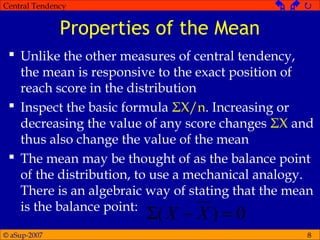
 The mean may be thought of as the balance point
of the distribution, to use a mechanical analogy.
There is an algebraic way of stating that the mean
is the balance point:
0)( =−Σ XX
© aSup-2007
Central Tendency   
9
Properties of the Mean
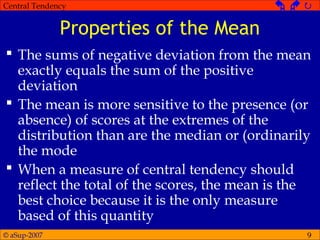
 The sums of negative deviation from the mean
exactly equals the sum of the positive
deviation
 The mean is more sensitive to the presence (or
absence) of scores at the extremes of the
distribution than are the median or (ordinarily
the mode
 When a measure of central tendency should
reflect the total of the scores, the mean is the
best choice because it is the only measure
based of this quantity
© aSup-2007
Central Tendency   
Characteristics of The Mean
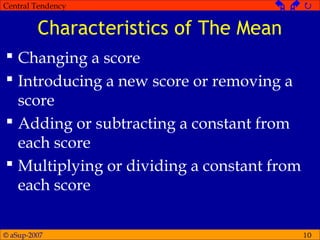
 Changing a score
 Introducing a new score or removing a
score
 Adding or subtracting a constant from
each score
 Multiplying or dividing a constant from
each score
10
© aSup-2007
Central Tendency   
11
The MEAN of Ungrouped Data
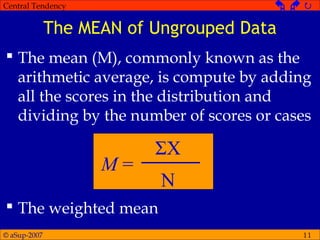
 The mean (M), commonly known as the
arithmetic average, is compute by adding
all the scores in the distribution and
dividing by the number of scores or cases
 The weighted mean
M =
ΣX
N
© aSup-2007
Central Tendency   
12
The MEAN of Grouped Data
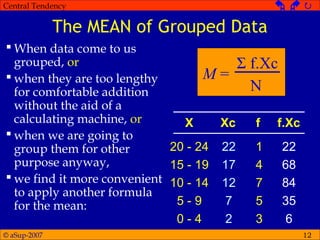
 When data come to us
grouped, or
 when they are too lengthy
for comfortable addition
without the aid of a
calculating machine, or
 when we are going to
group them for other
purpose anyway,
 we find it more convenient
to apply another formula
for the mean:
M =
Σ f.Xc
N
X Xc f f.Xc
20 - 24
15 - 19
10 - 14
5 - 9
0 - 4
22
17
12
7
2
1
4
7
5
3
22
68
84
35
6
© aSup-2007
Central Tendency   
13
The MEDIAN of Ungrouped Data
 Method 1: When N is an odd number
 list the score in order (lowest to highest),
and the median is the middle score in the list
 Method 2: When N is an even number
 list the score in order (lowest to highest),
and then locate the median by finding the
point halfway between the middle two scores
© aSup-2007
Central Tendency   
14
The MEDIAN of Ungrouped Data
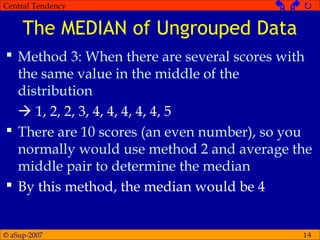
 Method 3: When there are several scores with
the same value in the middle of the
distribution
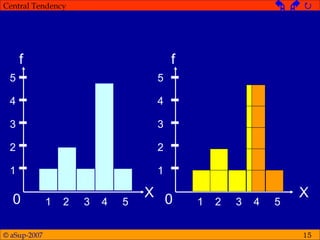
 1, 2, 2, 3, 4, 4, 4, 4, 4, 5
 There are 10 scores (an even number), so you
normally would use method 2 and average the
middle pair to determine the median
 By this method, the median would be 4
© aSup-2007
Central Tendency   
15
X0 1 2 3 4 5
5
4
3
2
1
f
X0 1 2 3 4 5
5
4
3
2
1
f
© aSup-2007
Central Tendency   
16
The MEDIAN of Grouped Data
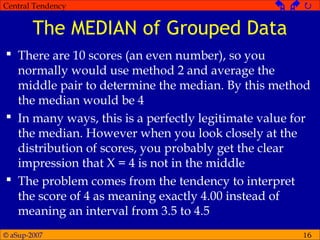
 There are 10 scores (an even number), so you
normally would use method 2 and average the
middle pair to determine the median. By this method
the median would be 4
 In many ways, this is a perfectly legitimate value for
the median. However when you look closely at the
distribution of scores, you probably get the clear
impression that X = 4 is not in the middle
 The problem comes from the tendency to interpret
the score of 4 as meaning exactly 4.00 instead of
meaning an interval from 3.5 to 4.5
© aSup-2007
Central Tendency   
17
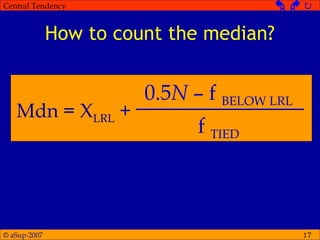
How to count the median?
Mdn = XLRL +
0.5N – f BELOW LRL
f TIED
© aSup-2007
Central Tendency   
18
THE MODE
 The word MODE means the most common
observation among a group of scores
 In a frequency distribution, the mode is the
score or category that has the greatest
frequency
© aSup-2007
Central Tendency   
19
SELECTING A MEASURE OF CENTRAL TENDENCY
 How do you decide which measure of central
tendency to use? The answer depends on
several factors
 Note that the mean is usually the preferred
measure of central tendency, because the mean
uses every score score in the distribution, it
typically produces a good representative value
 The goal of central tendency is to find the
single value that best represent the entire
distribution
© aSup-2007
Central Tendency   
20
SELECTING A MEASURE OF CENTRAL TENDENCY
 Besides being a good representative, the mean
has the added advantage of being closely
related to variance and standard deviation, the
most common measures of variability
 This relationship makes the mean a valuable
measure for purposes of inferential statistics
 For these reasons, and others, the mean
generally is considered to be the best of the
three measure of central tendency
© aSup-2007
Central Tendency   
21
SELECTING A MEASURE OF CENTRAL TENDENCY
 But there are specific situations in which it is
impossible to compute a mean or in which the
mean is not particularly representative
 It is in these condition that the mode an the
median are used
© aSup-2007
Central Tendency   
22
WHEN TO USE THE MEDIAN
1. Extreme scores or skewed distribution
When a distribution has a (few) extreme
score(s), score(s) that are very different in
value from most of the others, then the mean
may not be a good representative of the
majority of the distribution.
The problem comes from the fact that one or
two extreme values can have a large
influence and cause the mean displaced
© aSup-2007
Central Tendency   
23
WHEN TO USE THE MEDIAN
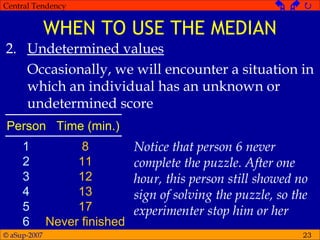
2. Undetermined values
Occasionally, we will encounter a situation in
which an individual has an unknown or
undetermined score
Person Time (min.)
1
2
3
4
5
6
8
11
12
13
17
Never finished
Notice that person 6 never
complete the puzzle. After one
hour, this person still showed no
sign of solving the puzzle, so the
experimenter stop him or her
© aSup-2007
Central Tendency   
24
WHEN TO USE THE MEDIAN
2. Undetermined values
There are two important point to be noted:
 The experimenter should not throw out this
individual’s score. The whole purpose to use a
sample is to gain a picture of population, and this
individual tells us about that part of the population
cannot solve this puzzle
 This person should not be given a score of X = 60
minutes. Even though the experimenter stopped the
individual after 1 hour, the person did not finish the
puzzle. The score that is recorded is the amount of
time needed to finish. For this individual, we do not
know how long this is
© aSup-2007
Central Tendency   
25
WHEN TO USE THE MEDIAN
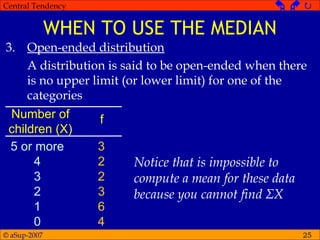
3. Open-ended distribution
A distribution is said to be open-ended when there
is no upper limit (or lower limit) for one of the
categories
Number of
children (X)
5 or more
4
3
2
1
0
3
2
2
3
6
4
Notice that is impossible to
compute a mean for these data
because you cannot find ΣX
f
© aSup-2007
Central Tendency   
26
WHEN TO USE THE MEDIAN
4. Ordinal scale
when score are measured on an ordinal scale,
the median is always appropriate and is
usually the preferred measure of central
tendency
© aSup-2007
Central Tendency   
27
WHEN TO USE THE MODE
 Nominal scales
Because nominal scales do not measure quantity, it is
impossible to compute a mean or a median for data
from a nominal scale
 Discrete variables  indivisible categories
 Describes shape
the mode identifies the location of the peak (s). If you
are told a set of exam score has a mean of 72 and a
mode of 80, you should have a better picture of the
distribution than would be available from mean
alone
© aSup-2007
Central Tendency   
28
CENTRAL TENDENCY AND THE SHAPE
OF THE DISTRIBUTION
 Because the mean, the median, and the mode
are all trying to measure the same thing
(central tendency), it is reasonable to expect
that these three values should be related
 There are situations in which all three
measures will have exactly the same or
different value
 The relationship among the mean, median,
and mode are determined by the shape of the
distribution
© aSup-2007
Central Tendency   
29
SYMMETRICAL DISTRIBUTION
SHAPE
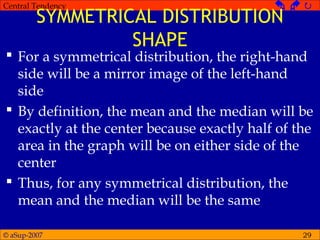
 For a symmetrical distribution, the right-hand
side will be a mirror image of the left-hand
side
 By definition, the mean and the median will be
exactly at the center because exactly half of the
area in the graph will be on either side of the
center
 Thus, for any symmetrical distribution, the
mean and the median will be the same
© aSup-2007
Central Tendency   
30
SYMMETRICAL DISTRIBUTION
SHAPE
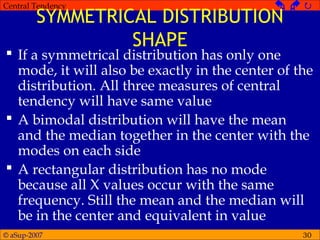
 If a symmetrical distribution has only one
mode, it will also be exactly in the center of the
distribution. All three measures of central
tendency will have same value
 A bimodal distribution will have the mean
and the median together in the center with the
modes on each side
 A rectangular distribution has no mode
because all X values occur with the same
frequency. Still the mean and the median will
be in the center and equivalent in value
© aSup-2007
Central Tendency   
31
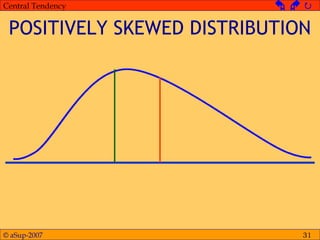
POSITIVELY SKEWED DISTRIBUTION
© aSup-2007
Central Tendency   
32
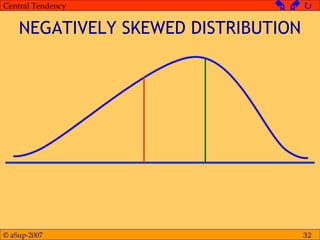
NEGATIVELY SKEWED DISTRIBUTION

Central tendency

  • 1.
    © aSup-2007 Central Tendency   1 CENTRAL TENDENCY Mean, Median, and Mode
  • 2.
    © aSup-2007 Central Tendency   2 OVERVIEW  The general purpose of descriptive statistical methods is to organize and summarize a set score  Perhaps the most common method for summarizing and describing a distribution is to find a single value that defines the average score and can serve as a representative for the entire distribution  In statistics, the concept of an average or representative score is called central tendency
  • 3.
    © aSup-2007 Central Tendency   3 OVERVIEW  Central tendency has purpose to provide a single summary figure that best describe the central location of an entire distribution of observation  It also help simplify comparison of two or more groups tested under different conditions  There are three most commonly used in education and the behavioral sciences: mode, median, and arithmetic mean
  • 4.
    © aSup-2007 Central Tendency   4 The MODE  A common meaning of mode is ‘fashionable’, and it has much the same implication in statistics  In ungrouped distribution, the mode is the score that occurs with the greatest frequency  In grouped data, it is taken as the midpoint of the class interval that contains the greatest numbers of scores  The symbol for the mode is Mo
  • 5.
    © aSup-2007 Central Tendency   5 The MEDIAN  The median of a distribution is the point along the scale of possible scores below which 50% of the scores fall and is there another name for P50  Thus, the median is the value that divides the distribution into halves  It symbols is Mdn
  • 6.
    © aSup-2007 Central Tendency   6 The ARITHMETIC MEAN  The arithmetic mean is the sum of all the scores in the distribution divided by the total number of scores  Many people call this measure the average, but we will avoid this term because it is sometimes used indiscriminately for any measure of central tendency  For brevity, the arithmetic mean is usually called the mean
  • 7.
    © aSup-2007 Central Tendency   7 The ARITHMETIC MEAN  Some symbolism is needed to express the mean mathematically. We will use the capital letter X as a collective term to specify a particular set of score (be sure to use capital letters; lower-case letters are used in a different way)  We identify an individual score in the distribution by a subscript, such as X1 (the first score), X8 (the eighth score), and so forth  You remember that n stands for the number in a sample and N for the number in a population
  • 8.
    © aSup-2007 Central Tendency   8 Properties of the Mean  Unlike the other measures of central tendency, the mean is responsive to the exact position of reach score in the distribution  Inspect the basic formula ΣX/n. Increasing or decreasing the value of any score changes ΣX and thus also change the value of the mean  The mean may be thought of as the balance point of the distribution, to use a mechanical analogy. There is an algebraic way of stating that the mean is the balance point: 0)( =−Σ XX
  • 9.
    © aSup-2007 Central Tendency   9 Properties of the Mean  The sums of negative deviation from the mean exactly equals the sum of the positive deviation  The mean is more sensitive to the presence (or absence) of scores at the extremes of the distribution than are the median or (ordinarily the mode  When a measure of central tendency should reflect the total of the scores, the mean is the best choice because it is the only measure based of this quantity
  • 10.
    © aSup-2007 Central Tendency   Characteristics of The Mean  Changing a score  Introducing a new score or removing a score  Adding or subtracting a constant from each score  Multiplying or dividing a constant from each score 10
  • 11.
    © aSup-2007 Central Tendency   11 The MEAN of Ungrouped Data  The mean (M), commonly known as the arithmetic average, is compute by adding all the scores in the distribution and dividing by the number of scores or cases  The weighted mean M = ΣX N
  • 12.
    © aSup-2007 Central Tendency   12 The MEAN of Grouped Data  When data come to us grouped, or  when they are too lengthy for comfortable addition without the aid of a calculating machine, or  when we are going to group them for other purpose anyway,  we find it more convenient to apply another formula for the mean: M = Σ f.Xc N X Xc f f.Xc 20 - 24 15 - 19 10 - 14 5 - 9 0 - 4 22 17 12 7 2 1 4 7 5 3 22 68 84 35 6
  • 13.
    © aSup-2007 Central Tendency   13 The MEDIAN of Ungrouped Data  Method 1: When N is an odd number  list the score in order (lowest to highest), and the median is the middle score in the list  Method 2: When N is an even number  list the score in order (lowest to highest), and then locate the median by finding the point halfway between the middle two scores
  • 14.
    © aSup-2007 Central Tendency   14 The MEDIAN of Ungrouped Data  Method 3: When there are several scores with the same value in the middle of the distribution  1, 2, 2, 3, 4, 4, 4, 4, 4, 5  There are 10 scores (an even number), so you normally would use method 2 and average the middle pair to determine the median  By this method, the median would be 4
  • 15.
    © aSup-2007 Central Tendency   15 X0 1 2 3 4 5 5 4 3 2 1 f X0 1 2 3 4 5 5 4 3 2 1 f
  • 16.
    © aSup-2007 Central Tendency   16 The MEDIAN of Grouped Data  There are 10 scores (an even number), so you normally would use method 2 and average the middle pair to determine the median. By this method the median would be 4  In many ways, this is a perfectly legitimate value for the median. However when you look closely at the distribution of scores, you probably get the clear impression that X = 4 is not in the middle  The problem comes from the tendency to interpret the score of 4 as meaning exactly 4.00 instead of meaning an interval from 3.5 to 4.5
  • 17.
    © aSup-2007 Central Tendency   17 How to count the median? Mdn = XLRL + 0.5N – f BELOW LRL f TIED
  • 18.
    © aSup-2007 Central Tendency   18 THE MODE  The word MODE means the most common observation among a group of scores  In a frequency distribution, the mode is the score or category that has the greatest frequency
  • 19.
    © aSup-2007 Central Tendency   19 SELECTING A MEASURE OF CENTRAL TENDENCY  How do you decide which measure of central tendency to use? The answer depends on several factors  Note that the mean is usually the preferred measure of central tendency, because the mean uses every score score in the distribution, it typically produces a good representative value  The goal of central tendency is to find the single value that best represent the entire distribution
  • 20.
    © aSup-2007 Central Tendency   20 SELECTING A MEASURE OF CENTRAL TENDENCY  Besides being a good representative, the mean has the added advantage of being closely related to variance and standard deviation, the most common measures of variability  This relationship makes the mean a valuable measure for purposes of inferential statistics  For these reasons, and others, the mean generally is considered to be the best of the three measure of central tendency
  • 21.
    © aSup-2007 Central Tendency   21 SELECTING A MEASURE OF CENTRAL TENDENCY  But there are specific situations in which it is impossible to compute a mean or in which the mean is not particularly representative  It is in these condition that the mode an the median are used
  • 22.
    © aSup-2007 Central Tendency   22 WHEN TO USE THE MEDIAN 1. Extreme scores or skewed distribution When a distribution has a (few) extreme score(s), score(s) that are very different in value from most of the others, then the mean may not be a good representative of the majority of the distribution. The problem comes from the fact that one or two extreme values can have a large influence and cause the mean displaced
  • 23.
    © aSup-2007 Central Tendency   23 WHEN TO USE THE MEDIAN 2. Undetermined values Occasionally, we will encounter a situation in which an individual has an unknown or undetermined score Person Time (min.) 1 2 3 4 5 6 8 11 12 13 17 Never finished Notice that person 6 never complete the puzzle. After one hour, this person still showed no sign of solving the puzzle, so the experimenter stop him or her
  • 24.
    © aSup-2007 Central Tendency   24 WHEN TO USE THE MEDIAN 2. Undetermined values There are two important point to be noted:  The experimenter should not throw out this individual’s score. The whole purpose to use a sample is to gain a picture of population, and this individual tells us about that part of the population cannot solve this puzzle  This person should not be given a score of X = 60 minutes. Even though the experimenter stopped the individual after 1 hour, the person did not finish the puzzle. The score that is recorded is the amount of time needed to finish. For this individual, we do not know how long this is
  • 25.
    © aSup-2007 Central Tendency   25 WHEN TO USE THE MEDIAN 3. Open-ended distribution A distribution is said to be open-ended when there is no upper limit (or lower limit) for one of the categories Number of children (X) 5 or more 4 3 2 1 0 3 2 2 3 6 4 Notice that is impossible to compute a mean for these data because you cannot find ΣX f
  • 26.
    © aSup-2007 Central Tendency   26 WHEN TO USE THE MEDIAN 4. Ordinal scale when score are measured on an ordinal scale, the median is always appropriate and is usually the preferred measure of central tendency
  • 27.
    © aSup-2007 Central Tendency   27 WHEN TO USE THE MODE  Nominal scales Because nominal scales do not measure quantity, it is impossible to compute a mean or a median for data from a nominal scale  Discrete variables  indivisible categories  Describes shape the mode identifies the location of the peak (s). If you are told a set of exam score has a mean of 72 and a mode of 80, you should have a better picture of the distribution than would be available from mean alone
  • 28.
    © aSup-2007 Central Tendency   28 CENTRAL TENDENCY AND THE SHAPE OF THE DISTRIBUTION  Because the mean, the median, and the mode are all trying to measure the same thing (central tendency), it is reasonable to expect that these three values should be related  There are situations in which all three measures will have exactly the same or different value  The relationship among the mean, median, and mode are determined by the shape of the distribution
  • 29.
    © aSup-2007 Central Tendency   29 SYMMETRICAL DISTRIBUTION SHAPE  For a symmetrical distribution, the right-hand side will be a mirror image of the left-hand side  By definition, the mean and the median will be exactly at the center because exactly half of the area in the graph will be on either side of the center  Thus, for any symmetrical distribution, the mean and the median will be the same
  • 30.
    © aSup-2007 Central Tendency   30 SYMMETRICAL DISTRIBUTION SHAPE  If a symmetrical distribution has only one mode, it will also be exactly in the center of the distribution. All three measures of central tendency will have same value  A bimodal distribution will have the mean and the median together in the center with the modes on each side  A rectangular distribution has no mode because all X values occur with the same frequency. Still the mean and the median will be in the center and equivalent in value
  • 31.
    © aSup-2007 Central Tendency   31 POSITIVELY SKEWED DISTRIBUTION
  • 32.
    © aSup-2007 Central Tendency   32 NEGATIVELY SKEWED DISTRIBUTION