TYPES OF CORRELATION
• Positive and negative correlation
• Linear and non-linear correlation
• Simple, partial and multiple correlations
• Real and spurious correlations
METHODS OF STUDYING CORRELATION
• Scatter diagram
• Karl Pearson’s coefficient of correlation
• Rank correlation method
METHODS OF STUDYING CORRELATION
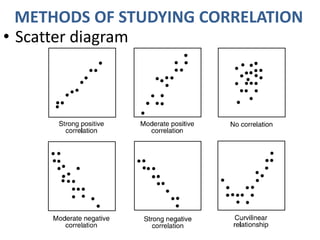
• Scatter diagram
METHODS OF STUDYING CORRELATION
Scatter diagram
Merits
• Very simple to study
• Easy to understand
• Extreme values don’t affect
Demerits
• Idea about direction not amount/degree
• Large number of observations
METHODS OF STUDYING CORRELATION
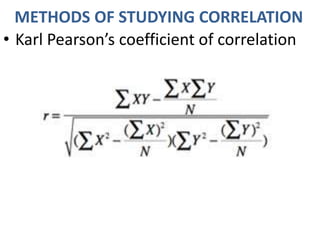
• Karl Pearson’s coefficient of correlation
METHODS OF STUDYING CORRELATION
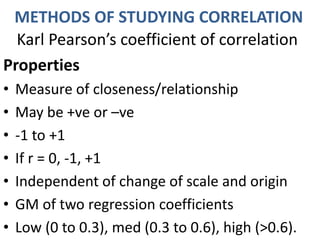
Karl Pearson’s coefficient of correlation
Properties
• Measure of closeness/relationship
• May be +ve or –ve
• -1 to +1
• If r = 0, -1, +1
• Independent of change of scale and origin
• GM of two regression coefficients
• Low (0 to 0.3), med (0.3 to 0.6), high (>0.6).
METHODS OF STUDYING CORRELATION
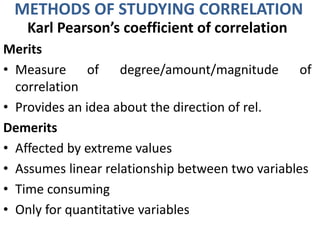
Karl Pearson’s coefficient of correlation
Merits
• Measure of degree/amount/magnitude of
correlation
• Provides an idea about the direction of rel.
Demerits
• Affected by extreme values
• Assumes linear relationship between two variables
• Time consuming
• Only for quantitative variables
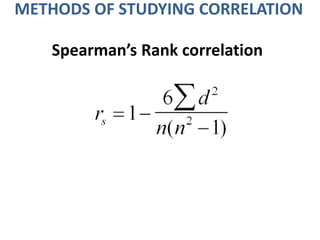
METHODS OF STUDYING CORRELATION
Spearman’s Rank correlation

Correlation analysis types and methods ppt

  • 1.
    TYPES OF CORRELATION •Positive and negative correlation • Linear and non-linear correlation • Simple, partial and multiple correlations • Real and spurious correlations
  • 2.
    METHODS OF STUDYINGCORRELATION • Scatter diagram • Karl Pearson’s coefficient of correlation • Rank correlation method
  • 3.
    METHODS OF STUDYINGCORRELATION • Scatter diagram
  • 4.
    METHODS OF STUDYINGCORRELATION Scatter diagram Merits • Very simple to study • Easy to understand • Extreme values don’t affect Demerits • Idea about direction not amount/degree • Large number of observations
  • 5.
    METHODS OF STUDYINGCORRELATION • Karl Pearson’s coefficient of correlation
  • 6.
    METHODS OF STUDYINGCORRELATION Karl Pearson’s coefficient of correlation Properties • Measure of closeness/relationship • May be +ve or –ve • -1 to +1 • If r = 0, -1, +1 • Independent of change of scale and origin • GM of two regression coefficients • Low (0 to 0.3), med (0.3 to 0.6), high (>0.6).
  • 7.
    METHODS OF STUDYINGCORRELATION Karl Pearson’s coefficient of correlation Merits • Measure of degree/amount/magnitude of correlation • Provides an idea about the direction of rel. Demerits • Affected by extreme values • Assumes linear relationship between two variables • Time consuming • Only for quantitative variables
  • 8.
    METHODS OF STUDYINGCORRELATION Spearman’s Rank correlation