Cellular level- cancer
therapy
Dr. P. Suganya
Assistant Professor
Departement of Biotechnology
Sri Klaiswari College(Autonomous), Sivakasi
Cancer
 It is a group of diseases characterized by uncontrolled cell
division leading to the growth of abnormal tissue / tumor
Cell Proliferation
 Cell multiplication in normal Physiological process
 To replace cells that have been shed as a part of their life cycle
(eg; skin, mucous membrane, GI tract, etc.)
Defect in Cellular Proliferation
 Cancer cells are characterized by the loss of contact
inhibition
Grow on top of one another and on top of or
between normal cells
 Cancer cells respond differently than normal cells to
intracellular signals regulating equilibrium
Divide indiscriminately and haphazardly
Defect in Cellular Proliferation
Once mutated, the cell can
Die
Recognize damage and repair itself
Survive and pass on damage
Surviving mutated cells have potential to become
malignant
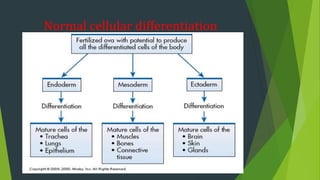
Normal cellular differentiation
Defect in Cellular Proliferation
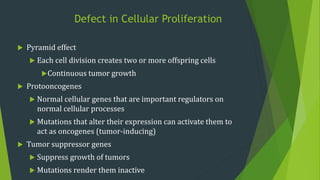
 Pyramid effect
 Each cell division creates two or more offspring cells
Continuous tumor growth
 Protooncogenes
 Normal cellular genes that are important regulators on
normal cellular processes
 Mutations that alter their expression can activate them to
act as oncogenes (tumor-inducing)
 Tumor suppressor genes
 Suppress growth of tumors
 Mutations render them inactive
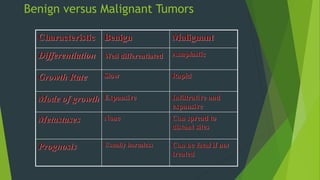
Benign versus Malignant Tumors
Characteristic Benign Malignant
Differentiation Well differentiated Anaplastic
Growth Rate Slow Rapid
Mode of growth Expansive Infiltrative and
expansive
Metastases None Can spread to
distant sites
Prognosis Usually harmless Can be fatal if not
treated
Development of Cancer
 Chemical, environmental, genetic,
immunologic, viral, or spontaneous in origin
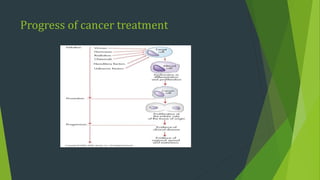
 Initiation
Mutation of genetic structure
Has potential to develop into clone of
neoplastic cells
Progress of cancer treatment
Development of Cancer
Promotion
Characterized by the reversible
proliferation of altered cells
Activities of promotion (e.g. obesity,
smoking, alcohol) are reversible
Latent period
Initial genetic alteration to clinical
evidence of cancer
Development of Cancer
Progression
Characterized by increased growth
rate of tumor as well as its
invasiveness and metastasis
Metastasis = spread of cancer from
primary (initial) site to distant site
Role of Immune System
 Immune response is to reject or destroy cancer cells if
perceived as non-self
May be inadequate as cancer cells arise from normal
human cells
 Some cancer cells have changes on their surface antigens
Tumor-associated antigens (TAAs)
Response to TAAs is termed immunologic surveillance
Lymphocytes continually check cell surfaces and detect
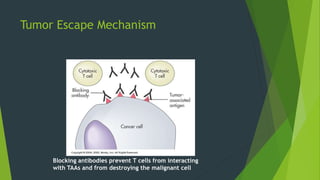
Tumor Escape Mechanism
Blocking antibodies prevent T cells from interacting
with TAAs and from destroying the malignant cell
Development of tolerance of immune system
Suppression of immune response to products
secreted by cancer cells
Induction of suppressor T cells
Blocking antibodies that bind TAAs
Classification of Cancer
 Anatomic Site Classification
Identified by
tissue origin
anatomic site
behavior of the tumor (benign vs.
malignant)
Anatomic Site Classification
Carcinomas originate from embryonal ectoderm and
endoderm
Sarcomas originate from embryonic mesoderm
Lymphomas and leukemias originate from
hepatopoietic system
Classification of Cancer
 Histologic Analysis Classification
Based on cellular appearance and differentation
Grade 1: Differ slightly from normal; well
differentiated
Grade 2: More abnormal; moderately
differentiated
Grade 3: Vert abnormal; poorly differentiated
Grade 4: Immature, primitive and
undifferentiated cells; difficult to determine cell
of origin
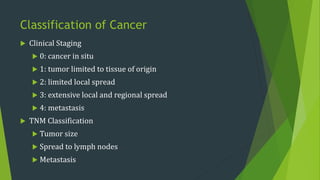
Classification of Cancer
 Clinical Staging
 0: cancer in situ
 1: tumor limited to tissue of origin
 2: limited local spread
 3: extensive local and regional spread
 4: metastasis
 TNM Classification
 Tumor size
 Spread to lymph nodes
 Metastasis
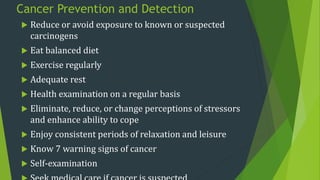
Cancer Prevention and Detection
 Reduce or avoid exposure to known or suspected
carcinogens
 Eat balanced diet
 Exercise regularly
 Adequate rest
 Health examination on a regular basis
 Eliminate, reduce, or change perceptions of stressors
and enhance ability to cope
 Enjoy consistent periods of relaxation and leisure
 Know 7 warning signs of cancer
 Self-examination
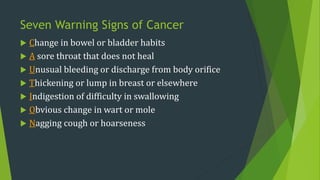
Seven Warning Signs of Cancer
 Change in bowel or bladder habits
 A sore throat that does not heal
 Unusual bleeding or discharge from body orifice
 Thickening or lump in breast or elsewhere
 Indigestion of difficulty in swallowing
 Obvious change in wart or mole
 Nagging cough or hoarseness
TYPES OF TUMOR
TYPES OF TUMORB
1.Benign
tumors
2. Malignant
tumors
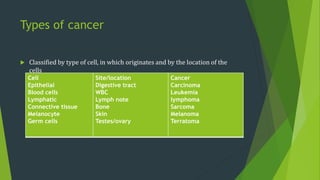
Types of cancer
 Classified by type of cell, in which originates and by the location of the
cells
Cell
Epithelial
Blood cells
Lymphatic
Connective tissue
Melanocyte
Germ cells
Site/location
Digestive tract
WBC
Lymph note
Bone
Skin
Testes/ovary
Cancer
Carcinoma
Leukemia
lymphoma
Sarcoma
Melanoma
Terratoma
ETIOLOGY OF CANCER
 physical
 Chemical
 Biological
 Environmental factors
 Hormones
 Genetics
 Mutation
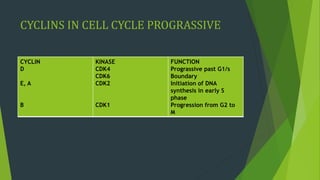
CYCLINS IN CELL CYCLE PROGRASSIVE
CYCLIN
D
E, A
B
KINASE
CDK4
CDK6
CDK2
CDK1
FUNCTION
Prograssive past G1/s
Boundary
Initiation of DNA
synthesis in early S
phase
Progression from G2 to
M
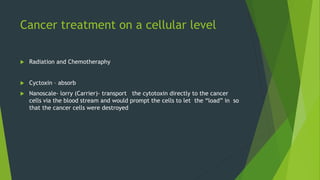
Cancer treatment on a cellular level
 Radiation and Chemotheraphy
 Cyctoxin – absorb
 Nanoscale- lorry (Carrier)- transport the cytotoxin directly to the cancer
cells via the blood stream and would prompt the cells to let the “load” in so
that the cancer cells were destroyed
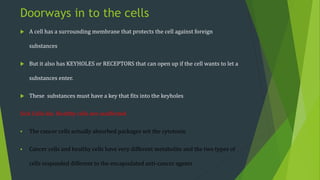
Doorways in to the cells
 A cell has a surrounding membrane that protects the cell against foreign
substances
 But it also has KEYHOLES or RECEPTORS that can open up if the cell wants to let a
substances enter.
 These substances must have a key that fits into the keyholes
Sick Cells die, Healthy cells are unaffected
 The cancer cells actually absorbed packages wit the cytotoxin
 Cancer cells and healthy cells have very different metabolite and the two types of
cells responded different to the encapsulated anti-cancer agents
 NPs (Nanoparticles) with the cytotoxin were absorbed by the cancer cells
 Metabolism of the cancer cells to change and the cells showed signs that
they were about to die.
 The healthy cells, meanwhile, do not show any evidences of absorbing the
packages with the cytotoxin.
 This suggests that the method can be used to send cytotoxin around the
body with reduced toxicity and could therefore be potentially safer for
healthy cells.
Diagnosis of Cancer
 Biopsy involves histologic examination by a pathologist of a piece of tissue
 Needle
 Incisional
 Excisional
Collaborative Care of Cancer
 Goals
 Cure
 Control
 Palliation
Major Treatment Modalities
 Surgery
 Radiation
 Chemotherapy
 Biologic Therapy
 Bone marrow or stem cell transplant
 Radiation therapy
Emission and distribution of energy through space
or material medium
Energy produced breaks bonds in DNA, leading to
death at time of reproduction
Affects both cancer as well as normal cells
Normal tissues are usually able to recover
Surgical therapy
to cure or control
Slow cancers are most amenable
Margin of normal tissue must surround tumor
 Radiation therapy
Teletherapy
Given via external beam from a machine
Most common
Brachytherapy
Radioactive material implanted in or close to
the tumor
Patient is radioactive
Precautions: time, distance, shielding
Chemotheraphy
 Goal is to reduce number of cancer cells in the tumor
site(s)
Several factors determine response of cancer cells
Cancer cells can escape death by staying in the G0
phase
Main problem is presence of drug- resistant
resting and noncycling cells
Chemotherapy effects on cells
 Cell cycle non-specific
 Cell cycle phase-specific
Chemotherapy:
Classification of Drugs
 Alkylating Agents
 Antimetabolites
 Anti-tumor antibiotics
 Plant Alkaloids
 Nitrosoureas
 Corticosteroids
 Hormone Therapy
Chemotherapy
Regional Administration
Delivery of drug directly into the tumor
sites
Higher concentrations can be delivered
with reduced systemic toxicity

Cellular level cancer therapy

  • 1.
    Cellular level- cancer therapy Dr.P. Suganya Assistant Professor Departement of Biotechnology Sri Klaiswari College(Autonomous), Sivakasi
  • 2.
    Cancer  It isa group of diseases characterized by uncontrolled cell division leading to the growth of abnormal tissue / tumor Cell Proliferation  Cell multiplication in normal Physiological process  To replace cells that have been shed as a part of their life cycle (eg; skin, mucous membrane, GI tract, etc.)
  • 3.
    Defect in CellularProliferation  Cancer cells are characterized by the loss of contact inhibition Grow on top of one another and on top of or between normal cells  Cancer cells respond differently than normal cells to intracellular signals regulating equilibrium Divide indiscriminately and haphazardly
  • 4.
    Defect in CellularProliferation Once mutated, the cell can Die Recognize damage and repair itself Survive and pass on damage Surviving mutated cells have potential to become malignant
  • 5.
  • 6.
    Defect in CellularProliferation  Pyramid effect  Each cell division creates two or more offspring cells Continuous tumor growth  Protooncogenes  Normal cellular genes that are important regulators on normal cellular processes  Mutations that alter their expression can activate them to act as oncogenes (tumor-inducing)  Tumor suppressor genes  Suppress growth of tumors  Mutations render them inactive
  • 7.
    Benign versus MalignantTumors Characteristic Benign Malignant Differentiation Well differentiated Anaplastic Growth Rate Slow Rapid Mode of growth Expansive Infiltrative and expansive Metastases None Can spread to distant sites Prognosis Usually harmless Can be fatal if not treated
  • 8.
    Development of Cancer Chemical, environmental, genetic, immunologic, viral, or spontaneous in origin  Initiation Mutation of genetic structure Has potential to develop into clone of neoplastic cells
  • 9.
  • 10.
    Development of Cancer Promotion Characterizedby the reversible proliferation of altered cells Activities of promotion (e.g. obesity, smoking, alcohol) are reversible Latent period Initial genetic alteration to clinical evidence of cancer
  • 11.
    Development of Cancer Progression Characterizedby increased growth rate of tumor as well as its invasiveness and metastasis Metastasis = spread of cancer from primary (initial) site to distant site
  • 12.
    Role of ImmuneSystem  Immune response is to reject or destroy cancer cells if perceived as non-self May be inadequate as cancer cells arise from normal human cells  Some cancer cells have changes on their surface antigens Tumor-associated antigens (TAAs) Response to TAAs is termed immunologic surveillance Lymphocytes continually check cell surfaces and detect
  • 13.
    Tumor Escape Mechanism Blockingantibodies prevent T cells from interacting with TAAs and from destroying the malignant cell
  • 14.
    Development of toleranceof immune system Suppression of immune response to products secreted by cancer cells Induction of suppressor T cells Blocking antibodies that bind TAAs
  • 15.
    Classification of Cancer Anatomic Site Classification Identified by tissue origin anatomic site behavior of the tumor (benign vs. malignant)
  • 16.
    Anatomic Site Classification Carcinomasoriginate from embryonal ectoderm and endoderm Sarcomas originate from embryonic mesoderm Lymphomas and leukemias originate from hepatopoietic system
  • 17.
    Classification of Cancer Histologic Analysis Classification Based on cellular appearance and differentation Grade 1: Differ slightly from normal; well differentiated Grade 2: More abnormal; moderately differentiated Grade 3: Vert abnormal; poorly differentiated Grade 4: Immature, primitive and undifferentiated cells; difficult to determine cell of origin
  • 18.
    Classification of Cancer Clinical Staging  0: cancer in situ  1: tumor limited to tissue of origin  2: limited local spread  3: extensive local and regional spread  4: metastasis  TNM Classification  Tumor size  Spread to lymph nodes  Metastasis
  • 19.
    Cancer Prevention andDetection  Reduce or avoid exposure to known or suspected carcinogens  Eat balanced diet  Exercise regularly  Adequate rest  Health examination on a regular basis  Eliminate, reduce, or change perceptions of stressors and enhance ability to cope  Enjoy consistent periods of relaxation and leisure  Know 7 warning signs of cancer  Self-examination
  • 20.
    Seven Warning Signsof Cancer  Change in bowel or bladder habits  A sore throat that does not heal  Unusual bleeding or discharge from body orifice  Thickening or lump in breast or elsewhere  Indigestion of difficulty in swallowing  Obvious change in wart or mole  Nagging cough or hoarseness
  • 21.
    TYPES OF TUMOR TYPESOF TUMORB 1.Benign tumors 2. Malignant tumors
  • 22.
    Types of cancer Classified by type of cell, in which originates and by the location of the cells Cell Epithelial Blood cells Lymphatic Connective tissue Melanocyte Germ cells Site/location Digestive tract WBC Lymph note Bone Skin Testes/ovary Cancer Carcinoma Leukemia lymphoma Sarcoma Melanoma Terratoma
  • 23.
    ETIOLOGY OF CANCER physical  Chemical  Biological  Environmental factors  Hormones  Genetics  Mutation
  • 24.
    CYCLINS IN CELLCYCLE PROGRASSIVE CYCLIN D E, A B KINASE CDK4 CDK6 CDK2 CDK1 FUNCTION Prograssive past G1/s Boundary Initiation of DNA synthesis in early S phase Progression from G2 to M
  • 25.
    Cancer treatment ona cellular level  Radiation and Chemotheraphy  Cyctoxin – absorb  Nanoscale- lorry (Carrier)- transport the cytotoxin directly to the cancer cells via the blood stream and would prompt the cells to let the “load” in so that the cancer cells were destroyed
  • 26.
    Doorways in tothe cells  A cell has a surrounding membrane that protects the cell against foreign substances  But it also has KEYHOLES or RECEPTORS that can open up if the cell wants to let a substances enter.  These substances must have a key that fits into the keyholes Sick Cells die, Healthy cells are unaffected  The cancer cells actually absorbed packages wit the cytotoxin  Cancer cells and healthy cells have very different metabolite and the two types of cells responded different to the encapsulated anti-cancer agents
  • 27.
     NPs (Nanoparticles)with the cytotoxin were absorbed by the cancer cells  Metabolism of the cancer cells to change and the cells showed signs that they were about to die.  The healthy cells, meanwhile, do not show any evidences of absorbing the packages with the cytotoxin.  This suggests that the method can be used to send cytotoxin around the body with reduced toxicity and could therefore be potentially safer for healthy cells.
  • 28.
    Diagnosis of Cancer Biopsy involves histologic examination by a pathologist of a piece of tissue  Needle  Incisional  Excisional
  • 29.
    Collaborative Care ofCancer  Goals  Cure  Control  Palliation
  • 30.
    Major Treatment Modalities Surgery  Radiation  Chemotherapy  Biologic Therapy  Bone marrow or stem cell transplant
  • 31.
     Radiation therapy Emissionand distribution of energy through space or material medium Energy produced breaks bonds in DNA, leading to death at time of reproduction Affects both cancer as well as normal cells Normal tissues are usually able to recover Surgical therapy to cure or control Slow cancers are most amenable Margin of normal tissue must surround tumor
  • 32.
     Radiation therapy Teletherapy Givenvia external beam from a machine Most common Brachytherapy Radioactive material implanted in or close to the tumor Patient is radioactive Precautions: time, distance, shielding
  • 33.
    Chemotheraphy  Goal isto reduce number of cancer cells in the tumor site(s) Several factors determine response of cancer cells Cancer cells can escape death by staying in the G0 phase Main problem is presence of drug- resistant resting and noncycling cells Chemotherapy effects on cells  Cell cycle non-specific  Cell cycle phase-specific
  • 34.
    Chemotherapy: Classification of Drugs Alkylating Agents  Antimetabolites  Anti-tumor antibiotics  Plant Alkaloids  Nitrosoureas  Corticosteroids  Hormone Therapy
  • 35.
    Chemotherapy Regional Administration Delivery ofdrug directly into the tumor sites Higher concentrations can be delivered with reduced systemic toxicity