Assessment & Management for the
patients with Cancer
1
Lesson Objectives
 Describe the incidence, survival, and mortality rates of
cancer across the globe.
 Describe the processes involved in the biology of cancer.
 Outline the stages of cancer development.
 Discuss the role of the nurse in the prevention,
detection, and diagnosis of cancer.
 Explain the use of surgery, chemotherapy, radiation
therapy in the treatment of cancer.
2
3
4
5
6
7
Cancer is defined as:
 A group of diseases characterized by uncontrolled
and unregulated growth of cells, invade, erode
and destroy near by cells.
 Cancer is often considered a disease of aging, with
most cases diagnosed in those over age 55 years.
 However, it occurs in people of all ages.
8
Cancer is defined as:
 People often think of the word cancer as describing single disease
with a single cause.
 There are over 200 cancers that can occur anywhere in the body.
9
10
11
Cancer (incidence, prevalence and
mortality)
 An estimated 1.7 million people in the United States are
diagnosed annually with invasive cancer.
 More men than women die from cancer-related deaths
each year.
 It is the second most common cause of death in the
United States.
 It is the leading cause of death of people 40 to 79 years
of age.
 Each year about 609,640 Americans are expected to die
because of cancer, which is more than 1600 people per
day.
12
Cancer (incidence, prevalence and
mortality)
 Is preventable (most types)
 80 – 90% are due to our habits and activities
 70 – 80 % cases are detected at late stage
when treatment is not possible
13
Cancer (incidence, prevalence and
mortality, WHO Report, 2021)
14
Origins of Cancer cells
 Carcinomas: constitute 90% of cancers, are cancers of
epithelial cells
 Sarcomas: are rare and consist of tumors of connective
tissues (connective tissue, muscle, bone etc.)
 Leukemia and lymphomas: constitutes 8% of tumors.
Sometimes referred to as liquid tumors.
 Leukemia arises from blood forming cells and lymphomas
arise from cells of the immune system (T and B cells).
15
Biology of cancer
 Two major dysfunctions present in the process
of cancer development are:
 Defective cell proliferation (growth)
 Defective cell differentiation (maturation)
16
Biology of Cancer (Defective cell
proliferation)
 Cell proliferation (from the time of cell birth to the time of
cell death) starts in the stem cell.
 The time from when a cell enters the cell cycle to when the
cell divides into 2 identical cells is called the generation time
of the cell.
 A mature cell continues to function until it degenerates and
dies.
 All the body’s cells are controlled by an intracellular
mechanism that determines when cell proliferation is
necessary.
 Under normal conditions proliferation equals cell
degeneration or death (apoptosis).
17
Biology of Cancer (Defective cell
proliferation)
 However, cancer cells respond differently from normal
cells to the intracellular signals that regulate cell
proliferation and death.
 The result is that the proliferation of the cancer cells is
indiscriminate and continuous.
 Sometimes they produce more than 2 cells at the time
of mitosis.
 In this way, there is continuous growth of a tumor
mass:1 × 2 × 4 × 8… This is termed the pyramid effect.
 The time needed for a tumor mass to double in size is
known as its doubling time.
18
Biology of Cancer (Defect in Cell
Differentiation)
 Cell differentiation is normally an orderly process that
progresses from a state of immaturity to a state of maturity.
 Because all body cells are derived from the fertilized ova, all
cells have the potential to perform all body functions.
 As cells differentiate, this potential is repressed, and the
mature cell can perform only specific functions.
 With cell differentiation, there is a stable and orderly phasing
out of cell potential.
 Under normal conditions, the differentiated cell is stable and
will not dedifferentiate, or return to its previous
undifferentiated state.
 If this process is disturbed cancer cells will start to develop.
19
Development of Cancer (phases)
 Initiation:
 Involves a mutation in the cell’s genetic structure.
 Carcinogens (substances that can cause cancer),
such as chemicals, physical factors, or biologic
agents, cause mutations in the cellular DNA.
 Normally, these alterations are reversed by DNA
repair mechanisms or the changes initiate
programmed cellular death (apoptosis) or cell
senescence.
20
Development of Cancer (phases)
 Promotion:
 Is characterized by the reversible proliferation of the
altered cells.
 An increase in the altered cell population further
increases the likelihood of more mutations.
 An important distinction between initiation and
promotion is that the activity of promoters is
reversible.
 This is a key concept in cancer prevention.
 Promoting factors include agents such as dietary
fat, obesity, cigarette smoking, and alcohol use.
21
Development of Cancer (phases)
 Progression is the last stage in the natural history of a
cancer.
 This stage is characterized by increased growth rate of the
tumor, increased invasiveness, and metastasis (spread
of the cancer to a distant site).
 Certain cancers have an affinity for a particular tissue or
organ as a site of metastasis (e.g., colon cancer often
spreads to the liver).
 Other cancers (e.g., melanoma) are unpredictable in their
pattern of metastasis.
 The most common sites of metastasis are lungs, liver,
bone, brain (including CSF), and adrenal glands.
22
Development of Cancer (phases)
 Metastasis is a multistep process.
 It begins with the rapid growth of the primary tumor.
 As the tumor increases in size, developing its own blood
supply is critical to its survival and growth.
 The process of the formation of blood vessels within the
tumor itself is termed tumor angiogenesis.
 It is facilitated by tumor angiogenesis factors made by
the cancer cells.
 Metastasis occurs either through Hematogenous or
lymphatic routes.
23
The pathogenesis of cancer metastasis
24
Cause
s
Benign Versus Malignant Neoplasms
(behavioral classification)
25
Benign Versus Malignant Neoplasms
26
Histologic Classification (Grading)
 Grade I: Cells differ slightly from normal cells (mild
dysplasia) and are well differentiated (low grade).
 Grade II: Cells are more abnormal (moderate dysplasia)
and moderately differentiated (intermediate grade).
 Grade III: Cells are very abnormal (severe dysplasia)
and poorly differentiated (high grade).
 Grade IV: Cells are immature, primitive (anaplasia), and
undifferentiated; cell of origin is hard to determine (high
grade).
 Grade X: Grade cannot be assessed.
27
Extent of Disease Classification
(Clinical Staging)
 Determines the anatomic extent of the malignant disease
process by stages:
 Stage 0: indicates that the cancer is where it started (in situ)
and hasn't spread
 Stage I: the cancer is small and hasn't spread anywhere else
 Stage II: the cancer has grown, but hasn't spread
 Stage III: the cancer is larger and may have spread to the
surrounding tissues and/or the lymph nodes.
 Stage IV: the cancer has spread from where it started to at
least one other body organ; also known as "secondary" or
"metastatic" cancer
28
Anatomic classifications of tumors
29
TNM Classification System
 The TNM classification system is used to determine
the anatomic extent of the disease involvement
according to 3 parameters:
 Tumor size and invasiveness (T),
 Presence or absence of regional spread to the
lymph nodes (N),
 Metastasis to distant organ sites (M)
 TNM staging cannot be applied to all cancers.
 For example, leukemia are not solid tumors and
cannot be staged.
30
TNM Classification systems
31
Staging vs TNM classifications
 Stage 0 Indicates carcinoma in situ = Tis, N0, M0.
 Stage I Localized cancer = T1-T2, N0, M0.
 Stage II Locally advanced cancer, early stages =
T2-T4, N0, M0.
 Stage III Locally advanced cancer, late stages =
T1-T4, N1-N3, M0.
 Stage IV Metastatic cancer = T1-T4, N1-N3, M1.
32
Possible Causes of Cancers
 Microorganisms
 Virus (11% of all Ca, E.g: HBV, HPV)
 Bacteria (H Pylori linked with gastric Ca)
 Physical/chemical agents (sun light, radiation,
tobacco, chronic irritation, industrial chemicals like
asbestos, limes,..)
 Genetic /familial factors (5-10% of all Ca)
 Life style factors (1/4-1/3 of all Ca)(diet (alcohol,
processed meats,..), obesity, physical inactivity)
 Hormonal agents,...and advancing age
33
Common sign/symptoms of Cancer in both
male/female
 Pain
 Weight loss without trying (almost 50% of the pt)
 Fatigue (even not improved during rest)
 Fever
 Changes on skin (moles or marks ....)
 Sore that does not heal
 Cough /hoarseness/ that does not go away
 Unusual bleeding
 Anemia
34
Common Signals of cancer
 Appetite loss
 Blood in the stool
 Blood in the urine
 Cough that doesn’t go away
 Extreme fatigue
 Fever that doesn’t go away
 Lump in the neck, swollen lymph nodes
 Night sweats
 Skin changes
 Trouble swallowing
35
Diagnosis of Cancer
 Clinical manifestations
 Ultrasounds to determine size
 CT scan with contrast (the golden standard)
 Genetic markers (like BRCA 1, BRCA 2,...)
 Tumor markers:
 CEA (carcinoembryonic antigen) general carcinogenic
antigen
 PSA (prostate specific antigen)
 CA-125 ovarian
 CA-25,27 breast
 CBC
 Liver function test, renal function test, ....etc
36
Cancer Management/Therapy/
37
Goals of cancer therapy
 Cure
 Refers to prolonged absence of detectable
disease
 Control
 When cure is unrealistic
 Prevent new cancer growth
 Palliation
 When cure or control is impossible
 Reduce side effects/symptoms of disease
38
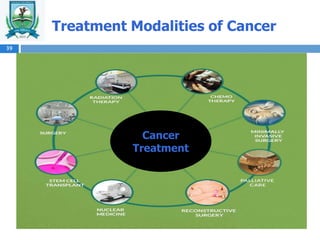
Treatment Modalities of Cancer
39
Cancer
Treatment
Treatment Modalities of Cancer
1. Surgery
 Is often the first line of choice for solid tumors, whenever
possible.
 Surgery may/may not be combined with other modalities.
 The size, type, location of tumor and factors such as age,
comorbid conditions of a patient are key determinant
factors in choosing surgery.
 In some cases where the primary tumor has not
metastasized surgery may be considered as curative
therapy.
40
Treatment Modalities of Cancer
 Types of surgery
 Curative surgery
 Involves local and wide /radical/ excision
 Prophylactic surgery
 Palliative surgery
 Reconstructive surgery (follows curative,
reconstruct morphology)
41
Treatment Modalities of Cancer
2. Radiation therapy
 High energy waves such as x-rays, gamma rays or electron
beams may be used to destroy or shrink tumor cells.
 May be offered prior to or following surgery or
chemotherapy. Can affect healthy cells.
 It can also be used for palliation to relieve symptoms of
pain caused by tumor lesions that are inoperable.
 The outcome of radiation therapy is dependent on several
factors such as dose, duration, mode of radiation delivered
and the properties of the tumor such as its molecular
properties, sensitivity to radiation, oxygenation, etc.
42
Treatment Modalities of Cancer
 Two types of ionizing radiation electromagnetic radiation
(x-rays and gamma rays) and particulate radiation
(electrons, beta particles, protons, neutrons, and alpha
particles) can be used to kill cells.
 The most lethal damage is the direct alteration of the
DNA molecule within the cells of both malignant
 Radiation can be administered externally (teletherapy)
(common one) or internally (brachytherapy)
43
Treatment Modalities of Cancer
44
Treatment Modalities of Cancer
3. Chemotherapy
 Are drugs that destroy or kill cancerous cells.
 Administered through different routes depending on
individual cancer cases.
 Can be given in combination with surgery and
radiation.
 Can affect healthy normal cells.
 The side effects may vary depending on the type of
drug, dose, duration and the nature of cancer, age
of the patient, etc.
45
Common types of chemotherapy
 Alkylating agents
 Ifosfamide, streptozocin, busulfan , ...
 Antimetabolites
 Cladribine, Hydroxyurea, Pentostatin, ...
 Antitumor antibiotic
 Dactinomycin, bleomycin, mithramycin,...
 Plant alkaloids (mitotic inhibitors)
 Ixabepilone, vinblastine ,....
 Hormonal agent
 Tamoxifen, anastrozole, letrozole, ....
 Immunotherapy
46
Treatment Modalities of Cancer
4. Targeted Therapy (precision medicine)
 These molecules are specifically tailored to target tumor cells.
 This may be used in conjunction with other cancer treatment modalities.
 It is important to note that, not every patient is a candidate for targeted
therapy. Cancers with tumors that express certain targets for this class of
drugs can only be treated using this therapy.
 Targeted therapy may work in one of the following ways:
 Trigger a patient’s own immune system to destroy cancer cells
(immunotherapy)
 May interfere with signals or proteins that prevent tumor cells from
dividing.
 Hormone therapy: they may be specifically used on hormones that
have receptors to hormones.
47
Treatment Modalities of Cancer
5. Palliative Care /Comfort Care/ /Support Care/
 Provides continuous care to improve quality of life, ease
symptoms of cancer treatment and provide psychological,
social and spiritual support.
 Begins during diagnosis and continues through treatment,
follow-up care and post-treatment management.
 All aspects of the patient will be comforted as needed.
48
Treatment Modalities of Cancer
6. Nuclear Medicine
 It’s rationale is to provide diagnosis using
radioactive isotopes of molecules.
 In cancers such as those affecting the thyroid
gland I-131 therapy (radioactive iodine) is used.
49
Treatment Modalities of Cancer
7. Intervention Radiology
 Uses minimally-invasive procedures
 Used in diagnosis as well as of cancer management.
 Image-guided, minimally invasive procedures such as radiofrequency
ablation, chemoembolization, trans-arterial catheterization (TAC), etc
are carried out with the help of MRI, CT, ultrasonography, fluoroscopy,
etc.
 The procedures of intervention radiology have provided new hope to
many patients who have unresectable tumors too.
 It has helped in reduced hospital time, minimizing the risk of post-
operation procedures and has improved the accuracy of cancer care.
50
Cancer Treatment Response
 Complete response (complete remission) is the
disappearance of all detectable malignant disease.
 Partial response: is decrease by more than 50% in
the sum of the products of the perpendicular diameters
of all measurable lesions.
 Stable disease: no increase in size of any lesion nor
the appearance of any new lesions.
 Progressive disease: means an increase by at least
25% in the sum of the products of the perpendicular
diameters of measurable lesion or the appearance of
new lesions.
51
Prevention of Cancer
 Primary prevention
 Secondary prevention
 Tertiary prevention
52
Primary prevention
 Reduce the risks of disease through health
promotion and risk reduction strategies
 Examples:
 Immunization (HBV.....Cervical Ca)
 Weight reduction for obese/ maintain ideal body
wt/
 Regular physical exercise /avoid sedentary lives/
 Choose whole grains, fruits, vegs,
 Avoid/minimize alcohols, processed/red meats...
 Provide safe and enjoyable environments
53
Secondary prevention
 Involves screening and early detection activities
that seek to identify precancerous lesions and
early-stage cancer in individuals who lack signs
and symptoms of cancer.
 Early detection reduces costs and morbidity
 E.g:
 Mammography for breast
 Pat test and HPV DNA test for cervix
54
Secondary prevention
 Why early detection is important ?
 Disease detected at early stage produces
better results on treatment and even cure
 Advanced disease shows poor result on
treatment
 Advanced disease leads to financial and
psychological burden
55
Tertiary prevention
 Focus on monitoring for and preventing
recurrence of the primary cancer as well as
screening for the development of second
malignancies in cancer survivors.
 Survivors may also develop second malignancies
not related to treatment but genetic mutations
related to inherited cancer syndromes,
environmental exposures, and lifestyle factors.
56
Thank you!
57

Lesson 8 Cancer.pptx

  • 1.
    Assessment & Managementfor the patients with Cancer 1
  • 2.
    Lesson Objectives  Describethe incidence, survival, and mortality rates of cancer across the globe.  Describe the processes involved in the biology of cancer.  Outline the stages of cancer development.  Discuss the role of the nurse in the prevention, detection, and diagnosis of cancer.  Explain the use of surgery, chemotherapy, radiation therapy in the treatment of cancer. 2
  • 3.
  • 4.
  • 5.
  • 6.
  • 7.
  • 8.
    Cancer is definedas:  A group of diseases characterized by uncontrolled and unregulated growth of cells, invade, erode and destroy near by cells.  Cancer is often considered a disease of aging, with most cases diagnosed in those over age 55 years.  However, it occurs in people of all ages. 8
  • 9.
    Cancer is definedas:  People often think of the word cancer as describing single disease with a single cause.  There are over 200 cancers that can occur anywhere in the body. 9
  • 10.
  • 11.
  • 12.
    Cancer (incidence, prevalenceand mortality)  An estimated 1.7 million people in the United States are diagnosed annually with invasive cancer.  More men than women die from cancer-related deaths each year.  It is the second most common cause of death in the United States.  It is the leading cause of death of people 40 to 79 years of age.  Each year about 609,640 Americans are expected to die because of cancer, which is more than 1600 people per day. 12
  • 13.
    Cancer (incidence, prevalenceand mortality)  Is preventable (most types)  80 – 90% are due to our habits and activities  70 – 80 % cases are detected at late stage when treatment is not possible 13
  • 14.
    Cancer (incidence, prevalenceand mortality, WHO Report, 2021) 14
  • 15.
    Origins of Cancercells  Carcinomas: constitute 90% of cancers, are cancers of epithelial cells  Sarcomas: are rare and consist of tumors of connective tissues (connective tissue, muscle, bone etc.)  Leukemia and lymphomas: constitutes 8% of tumors. Sometimes referred to as liquid tumors.  Leukemia arises from blood forming cells and lymphomas arise from cells of the immune system (T and B cells). 15
  • 16.
    Biology of cancer Two major dysfunctions present in the process of cancer development are:  Defective cell proliferation (growth)  Defective cell differentiation (maturation) 16
  • 17.
    Biology of Cancer(Defective cell proliferation)  Cell proliferation (from the time of cell birth to the time of cell death) starts in the stem cell.  The time from when a cell enters the cell cycle to when the cell divides into 2 identical cells is called the generation time of the cell.  A mature cell continues to function until it degenerates and dies.  All the body’s cells are controlled by an intracellular mechanism that determines when cell proliferation is necessary.  Under normal conditions proliferation equals cell degeneration or death (apoptosis). 17
  • 18.
    Biology of Cancer(Defective cell proliferation)  However, cancer cells respond differently from normal cells to the intracellular signals that regulate cell proliferation and death.  The result is that the proliferation of the cancer cells is indiscriminate and continuous.  Sometimes they produce more than 2 cells at the time of mitosis.  In this way, there is continuous growth of a tumor mass:1 × 2 × 4 × 8… This is termed the pyramid effect.  The time needed for a tumor mass to double in size is known as its doubling time. 18
  • 19.
    Biology of Cancer(Defect in Cell Differentiation)  Cell differentiation is normally an orderly process that progresses from a state of immaturity to a state of maturity.  Because all body cells are derived from the fertilized ova, all cells have the potential to perform all body functions.  As cells differentiate, this potential is repressed, and the mature cell can perform only specific functions.  With cell differentiation, there is a stable and orderly phasing out of cell potential.  Under normal conditions, the differentiated cell is stable and will not dedifferentiate, or return to its previous undifferentiated state.  If this process is disturbed cancer cells will start to develop. 19
  • 20.
    Development of Cancer(phases)  Initiation:  Involves a mutation in the cell’s genetic structure.  Carcinogens (substances that can cause cancer), such as chemicals, physical factors, or biologic agents, cause mutations in the cellular DNA.  Normally, these alterations are reversed by DNA repair mechanisms or the changes initiate programmed cellular death (apoptosis) or cell senescence. 20
  • 21.
    Development of Cancer(phases)  Promotion:  Is characterized by the reversible proliferation of the altered cells.  An increase in the altered cell population further increases the likelihood of more mutations.  An important distinction between initiation and promotion is that the activity of promoters is reversible.  This is a key concept in cancer prevention.  Promoting factors include agents such as dietary fat, obesity, cigarette smoking, and alcohol use. 21
  • 22.
    Development of Cancer(phases)  Progression is the last stage in the natural history of a cancer.  This stage is characterized by increased growth rate of the tumor, increased invasiveness, and metastasis (spread of the cancer to a distant site).  Certain cancers have an affinity for a particular tissue or organ as a site of metastasis (e.g., colon cancer often spreads to the liver).  Other cancers (e.g., melanoma) are unpredictable in their pattern of metastasis.  The most common sites of metastasis are lungs, liver, bone, brain (including CSF), and adrenal glands. 22
  • 23.
    Development of Cancer(phases)  Metastasis is a multistep process.  It begins with the rapid growth of the primary tumor.  As the tumor increases in size, developing its own blood supply is critical to its survival and growth.  The process of the formation of blood vessels within the tumor itself is termed tumor angiogenesis.  It is facilitated by tumor angiogenesis factors made by the cancer cells.  Metastasis occurs either through Hematogenous or lymphatic routes. 23
  • 24.
    The pathogenesis ofcancer metastasis 24 Cause s
  • 25.
    Benign Versus MalignantNeoplasms (behavioral classification) 25
  • 26.
  • 27.
    Histologic Classification (Grading) Grade I: Cells differ slightly from normal cells (mild dysplasia) and are well differentiated (low grade).  Grade II: Cells are more abnormal (moderate dysplasia) and moderately differentiated (intermediate grade).  Grade III: Cells are very abnormal (severe dysplasia) and poorly differentiated (high grade).  Grade IV: Cells are immature, primitive (anaplasia), and undifferentiated; cell of origin is hard to determine (high grade).  Grade X: Grade cannot be assessed. 27
  • 28.
    Extent of DiseaseClassification (Clinical Staging)  Determines the anatomic extent of the malignant disease process by stages:  Stage 0: indicates that the cancer is where it started (in situ) and hasn't spread  Stage I: the cancer is small and hasn't spread anywhere else  Stage II: the cancer has grown, but hasn't spread  Stage III: the cancer is larger and may have spread to the surrounding tissues and/or the lymph nodes.  Stage IV: the cancer has spread from where it started to at least one other body organ; also known as "secondary" or "metastatic" cancer 28
  • 29.
  • 30.
    TNM Classification System The TNM classification system is used to determine the anatomic extent of the disease involvement according to 3 parameters:  Tumor size and invasiveness (T),  Presence or absence of regional spread to the lymph nodes (N),  Metastasis to distant organ sites (M)  TNM staging cannot be applied to all cancers.  For example, leukemia are not solid tumors and cannot be staged. 30
  • 31.
  • 32.
    Staging vs TNMclassifications  Stage 0 Indicates carcinoma in situ = Tis, N0, M0.  Stage I Localized cancer = T1-T2, N0, M0.  Stage II Locally advanced cancer, early stages = T2-T4, N0, M0.  Stage III Locally advanced cancer, late stages = T1-T4, N1-N3, M0.  Stage IV Metastatic cancer = T1-T4, N1-N3, M1. 32
  • 33.
    Possible Causes ofCancers  Microorganisms  Virus (11% of all Ca, E.g: HBV, HPV)  Bacteria (H Pylori linked with gastric Ca)  Physical/chemical agents (sun light, radiation, tobacco, chronic irritation, industrial chemicals like asbestos, limes,..)  Genetic /familial factors (5-10% of all Ca)  Life style factors (1/4-1/3 of all Ca)(diet (alcohol, processed meats,..), obesity, physical inactivity)  Hormonal agents,...and advancing age 33
  • 34.
    Common sign/symptoms ofCancer in both male/female  Pain  Weight loss without trying (almost 50% of the pt)  Fatigue (even not improved during rest)  Fever  Changes on skin (moles or marks ....)  Sore that does not heal  Cough /hoarseness/ that does not go away  Unusual bleeding  Anemia 34
  • 35.
    Common Signals ofcancer  Appetite loss  Blood in the stool  Blood in the urine  Cough that doesn’t go away  Extreme fatigue  Fever that doesn’t go away  Lump in the neck, swollen lymph nodes  Night sweats  Skin changes  Trouble swallowing 35
  • 36.
    Diagnosis of Cancer Clinical manifestations  Ultrasounds to determine size  CT scan with contrast (the golden standard)  Genetic markers (like BRCA 1, BRCA 2,...)  Tumor markers:  CEA (carcinoembryonic antigen) general carcinogenic antigen  PSA (prostate specific antigen)  CA-125 ovarian  CA-25,27 breast  CBC  Liver function test, renal function test, ....etc 36
  • 37.
  • 38.
    Goals of cancertherapy  Cure  Refers to prolonged absence of detectable disease  Control  When cure is unrealistic  Prevent new cancer growth  Palliation  When cure or control is impossible  Reduce side effects/symptoms of disease 38
  • 39.
    Treatment Modalities ofCancer 39 Cancer Treatment
  • 40.
    Treatment Modalities ofCancer 1. Surgery  Is often the first line of choice for solid tumors, whenever possible.  Surgery may/may not be combined with other modalities.  The size, type, location of tumor and factors such as age, comorbid conditions of a patient are key determinant factors in choosing surgery.  In some cases where the primary tumor has not metastasized surgery may be considered as curative therapy. 40
  • 41.
    Treatment Modalities ofCancer  Types of surgery  Curative surgery  Involves local and wide /radical/ excision  Prophylactic surgery  Palliative surgery  Reconstructive surgery (follows curative, reconstruct morphology) 41
  • 42.
    Treatment Modalities ofCancer 2. Radiation therapy  High energy waves such as x-rays, gamma rays or electron beams may be used to destroy or shrink tumor cells.  May be offered prior to or following surgery or chemotherapy. Can affect healthy cells.  It can also be used for palliation to relieve symptoms of pain caused by tumor lesions that are inoperable.  The outcome of radiation therapy is dependent on several factors such as dose, duration, mode of radiation delivered and the properties of the tumor such as its molecular properties, sensitivity to radiation, oxygenation, etc. 42
  • 43.
    Treatment Modalities ofCancer  Two types of ionizing radiation electromagnetic radiation (x-rays and gamma rays) and particulate radiation (electrons, beta particles, protons, neutrons, and alpha particles) can be used to kill cells.  The most lethal damage is the direct alteration of the DNA molecule within the cells of both malignant  Radiation can be administered externally (teletherapy) (common one) or internally (brachytherapy) 43
  • 44.
  • 45.
    Treatment Modalities ofCancer 3. Chemotherapy  Are drugs that destroy or kill cancerous cells.  Administered through different routes depending on individual cancer cases.  Can be given in combination with surgery and radiation.  Can affect healthy normal cells.  The side effects may vary depending on the type of drug, dose, duration and the nature of cancer, age of the patient, etc. 45
  • 46.
    Common types ofchemotherapy  Alkylating agents  Ifosfamide, streptozocin, busulfan , ...  Antimetabolites  Cladribine, Hydroxyurea, Pentostatin, ...  Antitumor antibiotic  Dactinomycin, bleomycin, mithramycin,...  Plant alkaloids (mitotic inhibitors)  Ixabepilone, vinblastine ,....  Hormonal agent  Tamoxifen, anastrozole, letrozole, ....  Immunotherapy 46
  • 47.
    Treatment Modalities ofCancer 4. Targeted Therapy (precision medicine)  These molecules are specifically tailored to target tumor cells.  This may be used in conjunction with other cancer treatment modalities.  It is important to note that, not every patient is a candidate for targeted therapy. Cancers with tumors that express certain targets for this class of drugs can only be treated using this therapy.  Targeted therapy may work in one of the following ways:  Trigger a patient’s own immune system to destroy cancer cells (immunotherapy)  May interfere with signals or proteins that prevent tumor cells from dividing.  Hormone therapy: they may be specifically used on hormones that have receptors to hormones. 47
  • 48.
    Treatment Modalities ofCancer 5. Palliative Care /Comfort Care/ /Support Care/  Provides continuous care to improve quality of life, ease symptoms of cancer treatment and provide psychological, social and spiritual support.  Begins during diagnosis and continues through treatment, follow-up care and post-treatment management.  All aspects of the patient will be comforted as needed. 48
  • 49.
    Treatment Modalities ofCancer 6. Nuclear Medicine  It’s rationale is to provide diagnosis using radioactive isotopes of molecules.  In cancers such as those affecting the thyroid gland I-131 therapy (radioactive iodine) is used. 49
  • 50.
    Treatment Modalities ofCancer 7. Intervention Radiology  Uses minimally-invasive procedures  Used in diagnosis as well as of cancer management.  Image-guided, minimally invasive procedures such as radiofrequency ablation, chemoembolization, trans-arterial catheterization (TAC), etc are carried out with the help of MRI, CT, ultrasonography, fluoroscopy, etc.  The procedures of intervention radiology have provided new hope to many patients who have unresectable tumors too.  It has helped in reduced hospital time, minimizing the risk of post- operation procedures and has improved the accuracy of cancer care. 50
  • 51.
    Cancer Treatment Response Complete response (complete remission) is the disappearance of all detectable malignant disease.  Partial response: is decrease by more than 50% in the sum of the products of the perpendicular diameters of all measurable lesions.  Stable disease: no increase in size of any lesion nor the appearance of any new lesions.  Progressive disease: means an increase by at least 25% in the sum of the products of the perpendicular diameters of measurable lesion or the appearance of new lesions. 51
  • 52.
    Prevention of Cancer Primary prevention  Secondary prevention  Tertiary prevention 52
  • 53.
    Primary prevention  Reducethe risks of disease through health promotion and risk reduction strategies  Examples:  Immunization (HBV.....Cervical Ca)  Weight reduction for obese/ maintain ideal body wt/  Regular physical exercise /avoid sedentary lives/  Choose whole grains, fruits, vegs,  Avoid/minimize alcohols, processed/red meats...  Provide safe and enjoyable environments 53
  • 54.
    Secondary prevention  Involvesscreening and early detection activities that seek to identify precancerous lesions and early-stage cancer in individuals who lack signs and symptoms of cancer.  Early detection reduces costs and morbidity  E.g:  Mammography for breast  Pat test and HPV DNA test for cervix 54
  • 55.
    Secondary prevention  Whyearly detection is important ?  Disease detected at early stage produces better results on treatment and even cure  Advanced disease shows poor result on treatment  Advanced disease leads to financial and psychological burden 55
  • 56.
    Tertiary prevention  Focuson monitoring for and preventing recurrence of the primary cancer as well as screening for the development of second malignancies in cancer survivors.  Survivors may also develop second malignancies not related to treatment but genetic mutations related to inherited cancer syndromes, environmental exposures, and lifestyle factors. 56
  • 57.