
•
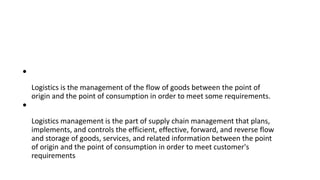
Logistics is the management of the flow of goods between the point of
origin and the point of consumption in order to meet some requirements.
•
Logistics management is the part of supply chain management that plans,
implements, and controls the efficient, effective, forward, and reverse flow
and storage of goods, services, and related information between the point
of origin and the point of consumption in order to meet customer's
requirements
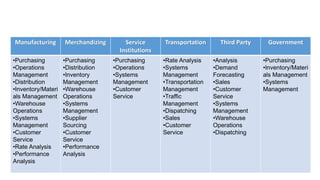
Manufacturing Merchandizing Service
Institutions
Transportation Third Party Government
•Purchasing
•Operations
Management
•Distribution
•Inventory/Materi
als Management
•Warehouse
Operations
•Systems
Management
•Customer
Service
•Rate Analysis
•Performance
Analysis
•Purchasing
•Distribution
•Inventory
Management
•Warehouse
Operations
•Systems
Management
•Supplier
Sourcing
•Customer
Service
•Performance
Analysis
•Purchasing
•Operations
•Systems
Management
•Customer
Service
•Rate Analysis
•Systems
Management
•Transportation
Management
•Traffic
Management
•Dispatching
•Sales
•Customer
Service
•Analysis
•Demand
Forecasting
•Sales
•Customer
Service
•Systems
Management
•Warehouse
Operations
•Dispatching
•Purchasing
•Inventory/Materi
als Management
•Systems
Management
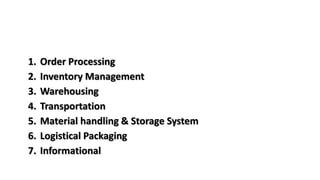
1. Order Processing
2. Inventory Management
3. Warehousing
4. Transportation
5. Material handling & Storage System
6. Logistical Packaging
7. Informational
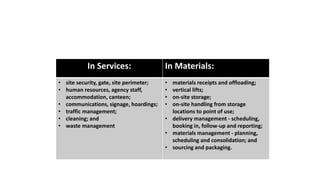
In Services: In Materials:
• site security, gate, site perimeter;
• human resources, agency staff,
accommodation, canteen;
• communications, signage, hoardings;
• traffic management;
• cleaning; and
• waste management
• materials receipts and offloading;
• vertical lifts;
• on-site storage;
• on-site handling from storage
locations to point of use;
• delivery management - scheduling,
booking in, follow-up and reporting;
• materials management - planning,
scheduling and consolidation; and
• sourcing and packaging.

What is logistics & logistics management

  • 1.
    • Logistics is themanagement of the flow of goods between the point of origin and the point of consumption in order to meet some requirements. • Logistics management is the part of supply chain management that plans, implements, and controls the efficient, effective, forward, and reverse flow and storage of goods, services, and related information between the point of origin and the point of consumption in order to meet customer's requirements
  • 2.
    Manufacturing Merchandizing Service Institutions TransportationThird Party Government •Purchasing •Operations Management •Distribution •Inventory/Materi als Management •Warehouse Operations •Systems Management •Customer Service •Rate Analysis •Performance Analysis •Purchasing •Distribution •Inventory Management •Warehouse Operations •Systems Management •Supplier Sourcing •Customer Service •Performance Analysis •Purchasing •Operations •Systems Management •Customer Service •Rate Analysis •Systems Management •Transportation Management •Traffic Management •Dispatching •Sales •Customer Service •Analysis •Demand Forecasting •Sales •Customer Service •Systems Management •Warehouse Operations •Dispatching •Purchasing •Inventory/Materi als Management •Systems Management
  • 4.
    1. Order Processing 2.Inventory Management 3. Warehousing 4. Transportation 5. Material handling & Storage System 6. Logistical Packaging 7. Informational
  • 5.
    In Services: InMaterials: • site security, gate, site perimeter; • human resources, agency staff, accommodation, canteen; • communications, signage, hoardings; • traffic management; • cleaning; and • waste management • materials receipts and offloading; • vertical lifts; • on-site storage; • on-site handling from storage locations to point of use; • delivery management - scheduling, booking in, follow-up and reporting; • materials management - planning, scheduling and consolidation; and • sourcing and packaging.