Arif Rahman – The Production Systems 1
Slide 14
Introduction to
Synchronous Manufacturing
Arif Rahman
Arif Rahman – The Production Systems
Synchronous manufacturing or synchronized
manufacturing refers to the entire
manufacturing processes working together in
harmony to achieve the goals of the firm.
It does not balance the capacity, but it balances the flow.
A bottleneck is a capacity constraint resource that has
the least capacity. As the weakest link, the bottleneck
limits the throughput of the system.
The bottleneck become a system’s constraint when its
capacity is less than demand placed on system.
Synchronous Manufacturing
2
Arif Rahman – The Production Systems
Workstations have different cycle time
Workstations produce in different batch size
The cycle time is different from takt time
The station is feeding more than one
subsequent stations
The station withdraws more than one preceding
stations
The bottleneck is not the gating operation
The losses may occur at the bottleneck
Imbalance (unbalanced) Capacity Problems
3
Arif Rahman – The Production Systems
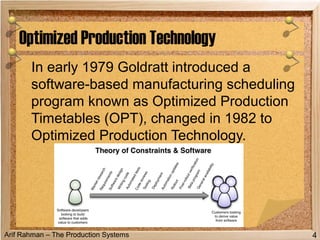
In early 1979 Goldratt introduced a
software-based manufacturing scheduling
program known as Optimized Production
Timetables (OPT), changed in 1982 to
Optimized Production Technology.
Optimized Production Technology
4
Arif Rahman – The Production Systems
Optimized Production Technology
A computer based
management system
used for production
planning and scheduling,
seeking the goal of
throughput maximization
through the following:
¤ Balanced flow, not capacity
¤ Minimization and/or
elimination of bottlenecks
¤ Variable lot sizes
5
Arif Rahman – The Production Systems
The Goal: To Make Money
Measures:
1.Net Profit
2.Return on Investment
3.Cash Flow
OPT Principles
6
Arif Rahman – The Production Systems
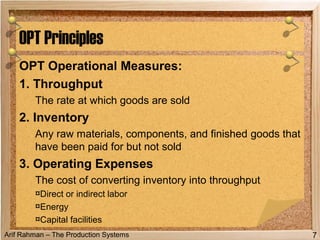
OPT Operational Measures:
1. Throughput
The rate at which goods are sold
2. Inventory
Any raw materials, components, and finished goods that
have been paid for but not sold
3. Operating Expenses
The cost of converting inventory into throughput
¤Direct or indirect labor
¤Energy
¤Capital facilities
OPT Principles
7
Arif Rahman – The Production Systems
OPT Principles
8
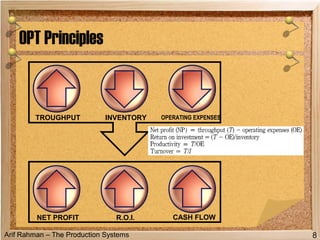
TROUGHPUT INVENTORY OPERATING EXPENSES
NET PROFIT R.O.I. CASH FLOW
Arif Rahman – The Production Systems
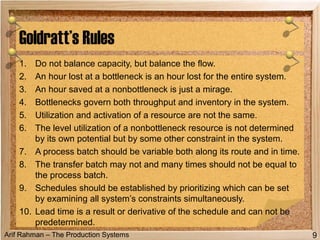
1. Do not balance capacity, but balance the flow.
2. An hour lost at a bottleneck is an hour lost for the entire system.
3. An hour saved at a nonbottleneck is just a mirage.
4. Bottlenecks govern both throughput and inventory in the system.
5. Utilization and activation of a resource are not the same.
6. The level utilization of a nonbottleneck resource is not determined
by its own potential but by some other constraint in the system.
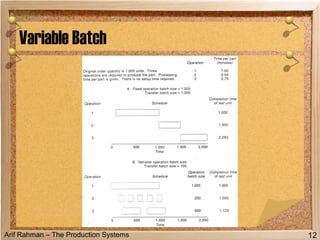
7. A process batch should be variable both along its route and in time.
8. The transfer batch may not and many times should not be equal to
the process batch.
9. Schedules should be established by prioritizing which can be set
by examining all system’s constraints simultaneously.
10. Lead time is a result or derivative of the schedule and can not be
predetermined.
Goldratt’s Rules
9
Arif Rahman – The Production Systems
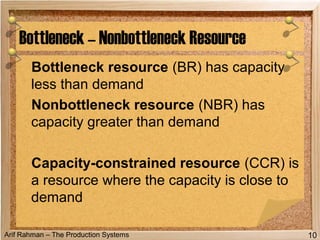
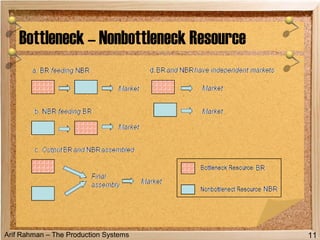
Bottleneck resource (BR) has capacity
less than demand
Nonbottleneck resource (NBR) has
capacity greater than demand
Capacity-constrained resource (CCR) is
a resource where the capacity is close to
demand
Bottleneck – Nonbottleneck Resource
10
Arif Rahman – The Production Systems
Bottleneck – Nonbottleneck Resource
11
Arif Rahman – The Production Systems
Variable Batch
12
Arif Rahman – The Production Systems
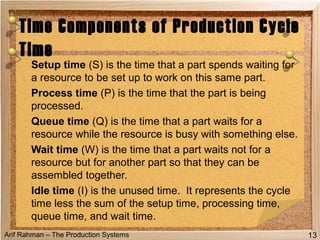
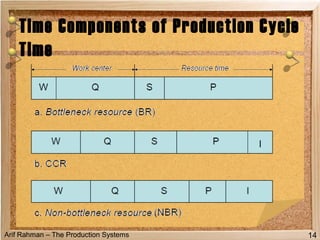
Setup time (S) is the time that a part spends waiting for
a resource to be set up to work on this same part.
Process time (P) is the time that the part is being
processed.
Queue time (Q) is the time that a part waits for a
resource while the resource is busy with something else.
Wait time (W) is the time that a part waits not for a
resource but for another part so that they can be
assembled together.
Idle time (I) is the unused time. It represents the cycle
time less the sum of the setup time, processing time,
queue time, and wait time.
Time Components of Production Cycle
Time
13
Arif Rahman – The Production Systems
Time Components of Production Cycle
Time
14
Arif Rahman – The Production Systems
VAT Analysis
15
Arif Rahman – The Production Systems
VAT analysis determines the general flow of
parts and products from raw materials to
finished products.
It conceptualizes an organization in terms of the
interaction of its individual component parts,
both products and processes.
The logical structure is the sequence of
operations through which each product must
pass in order to manufacture and assemble a
product or product family.
VAT Analysis
16
Arif Rahman – The Production Systems
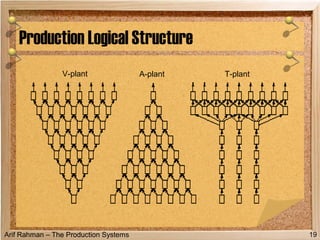
Three general categories of production logical
structures based on product variety funnel.
¤ The V logical structure starts with one or a few raw materials,
and the product expands into a number of different products as it
flows through its routings.
¤ The A logical structure is dominated by converging points. Many
raw materials are fabricated and assembled into a few finished
projects.
¤ The T logical structure consists of numerous similar finished
products assembled from common assemblies and
subassemblies.
Production Logical Structure
17
Arif Rahman – The Production Systems
Three general categories of production logical
structures based on production imbalance
capacity.
¤ The V logical structure starts with one or a few workstations,
which have large capacity, provide material for a number of
lower capacity workstations. Each preceding stations has
capacity greater than the subsequent stations.
¤ The A logical structure starts with many workstations, which
have limited capacity, provide material for some higher capacity
workstations. Each preceding stations has capacity less than the
subsequent stations.
¤ The T logical structure combines the V-type and the A-type.
Production Logical Structure
18
Arif Rahman – The Production Systems
Production Logical Structure
19
V-plant A-plant T-plant
Arif Rahman – The Production Systems
Once the general parts flow is determined, the
system control points (gating operations,
convergent points, divergent points, constraints,
and shipping points) can be identified and
managed.
This determination focuses management's
attention on a few control points where buffers
can be used to protect and to maximize
throughput.
The shape of the structure determines which
control points are utilized to manage production.
Determine the Logical Structure
20
Arif Rahman – The Production Systems
Five control points are used to manage the
process:
1) the constraint,
2) the points of divergence (where a part or material is
diverted to different routes in order to make different
products),
3) the points of convergence (where two or more parts
are combined in subassembly),
4) the gating operation (releases work into the shop),
5) the shipping operation.
Five Control Points
21
Arif Rahman – The Production Systems
The T structure focuses attention on the
constraint and the gating operation. The five-
step focusing process is used to manage the
constraint with a buffer placed before the
constraint to absorb variations in the process.
The output from the gating operation is tied to
the constraint; that is, since the constraint
controls the amount of throughput; the gating
operation cannot process more than the
constraint.
VAT Analysis
22
Arif Rahman – The Production Systems
The V structure also uses a buffer to protect the
constraint and the gating operation releases
orders at the same rate as the constraint as
seen in the T structure. However, an additional
control point exists in the V structure, the
divergent point. The divergent point is controlled
by a schedule derived from the shipping
schedule. This derivation prevents misallocation
of material to a product not currently in demand.
VAT Analysis
23
Arif Rahman – The Production Systems
The A structure also manages the constraint
and gating operation in a fashion similar to the T
structure. Any diverging points are scheduled in
accordance with the shipping schedule. In
addition, an assembly buffer is used to maintain
the flow into the convergent points. An additional
schedule based on the shipping schedule
(similar to that used in the V structure) is used to
keep capacity from being misallocated to the
wrong order.
VAT Analysis
24
Arif Rahman – The Production Systems
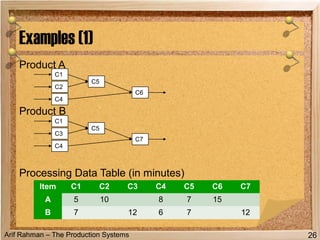
A factory produces two items, A and B. There are 7
workcells: C1, C2, C3, C4, C5, C6 and C7. Product A uses
C1, C2, C4, C5 and C6. Product B uses C1, C3, C4, C5
and C7. The process route can be seen in the following
figure. All setups are insignificant, its time is included in
process time. Process times of every part each workcell
are described in processing data table.
The demands are 800 units of product A and 550 units of
product B. The workcells operate 20 shifts/month (8
hours/shift). Determine:
1.The bottleneck(s)
2.Its (their) insufficient capacity
Examples (1)
25
Arif Rahman – The Production Systems
Product A
Product B
Processing Data Table (in minutes)
Examples (1)
26
Item C1 C2 C3 C4 C5 C6 C7
A 5 10 8 7 15
B 7 12 6 7 12
C1
C2
C4
C5
C6
C1
C3
C4
C5
C7
Arif Rahman – The Production Systems
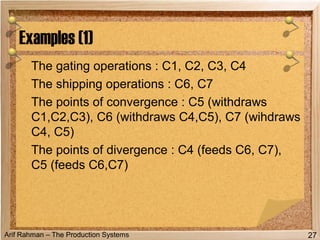
The gating operations : C1, C2, C3, C4
The shipping operations : C6, C7
The points of convergence : C5 (withdraws
C1,C2,C3), C6 (withdraws C4,C5), C7 (wihdraws
C4, C5)
The points of divergence : C4 (feeds C6, C7),
C5 (feeds C6,C7)
Examples (1)
27
Arif Rahman – The Production Systems
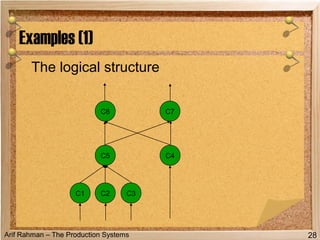
The logical structure
Examples (1)
28
C1 C2 C3
C5 C4
C6 C7
Arif Rahman – The Production Systems
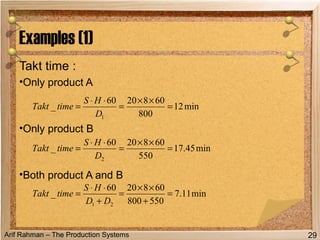
Takt time :
•Only product A
•Only product B
•Both product A and B
Examples (1)
29
min11.7
550800
6082060
_
21
=
+
××
=
+
⋅⋅
=
DD
HS
timeTakt
min12
800
6082060
_
1
=
××
=
⋅⋅
=
D
HS
timeTakt
min45.17
550
6082060
_
2
=
××
=
⋅⋅
=
D
HS
timeTakt
Arif Rahman – The Production Systems
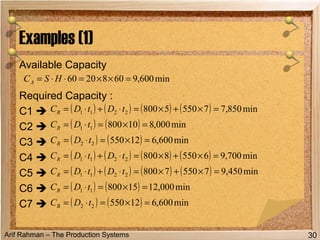
Available Capacity
Required Capacity :
C1 
C2 
C3 
C4 
C5 
C6 
C7 
Examples (1)
30
( ) ( ) ( ) ( ) min850,7755058002211 =×+×=⋅+⋅= tDtDCR
( ) ( ) min000,81080011 =×=⋅= tDCR
( ) ( ) min600,61255022 =×=⋅= tDCR
min600,96082060 =××=⋅⋅= HSCA
( ) ( ) ( ) ( ) min700,9655088002211 =×+×=⋅+⋅= tDtDCR
( ) ( ) ( ) ( ) min450,9755078002211 =×+×=⋅+⋅= tDtDCR
( ) ( ) min000,121580011 =×=⋅= tDCR
( ) ( ) min600,61255022 =×=⋅= tDCR
Arif Rahman – The Production Systems
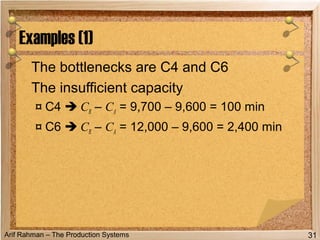
The bottlenecks are C4 and C6
The insufficient capacity
¤ C4  CR – CA = 9,700 – 9,600 = 100 min
¤ C6  CR – CA = 12,000 – 9,600 = 2,400 min
Examples (1)
31
Arif Rahman – The Production Systems
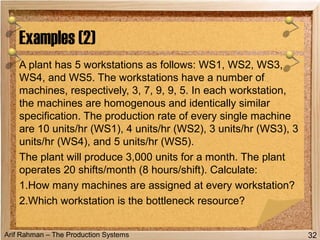
A plant has 5 workstations as follows: WS1, WS2, WS3,
WS4, and WS5. The workstations have a number of
machines, respectively, 3, 7, 9, 9, 5. In each workstation,
the machines are homogenous and identically similar
specification. The production rate of every single machine
are 10 units/hr (WS1), 4 units/hr (WS2), 3 units/hr (WS3), 3
units/hr (WS4), and 5 units/hr (WS5).
The plant will produce 3,000 units for a month. The plant
operates 20 shifts/month (8 hours/shift). Calculate:
1.How many machines are assigned at every workstation?
2.Which workstation is the bottleneck resource?
Examples (2)
32
Arif Rahman – The Production Systems
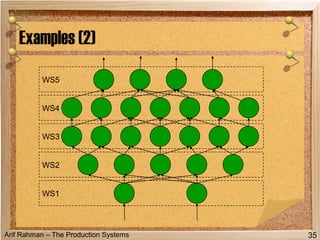
The gating operations : WS1
The shipping operations : WS5
The points of convergence : WS5
The points of divergence : WS1, WS2
Examples (2)
33
Arif Rahman – The Production Systems
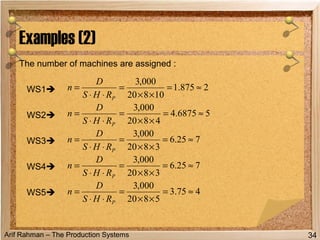
The number of machines are assigned :
WS1
WS2
WS3
WS4
WS5
Examples (2)
34
2875.1
10820
000,3
≈=
××
=
⋅⋅
=
PRHS
D
n
56875.4
4820
000,3
≈=
××
=
⋅⋅
=
PRHS
D
n
725.6
3820
000,3
≈=
××
=
⋅⋅
=
PRHS
D
n
725.6
3820
000,3
≈=
××
=
⋅⋅
=
PRHS
D
n
475.3
5820
000,3
≈=
××
=
⋅⋅
=
PRHS
D
n
Arif Rahman – The Production Systems
Examples (2)
35
WS1
WS2
WS3
WS4
WS5
Arif Rahman – The Production Systems
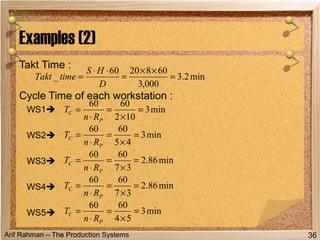
Takt Time :
Cycle Time of each workstation :
WS1
WS2
WS3
WS4
WS5
Examples (2)
36
min2.3
000,3
6082060
_ =
××
=
⋅⋅
=
D
HS
timeTakt
min3
102
6060
=
×
=
⋅
=
P
C
Rn
T
min3
45
6060
=
×
=
⋅
=
P
C
Rn
T
min86.2
37
6060
=
×
=
⋅
=
P
C
Rn
T
min86.2
37
6060
=
×
=
⋅
=
P
C
Rn
T
min3
54
6060
=
×
=
⋅
=
P
C
Rn
T
Arif Rahman – The Production Systems
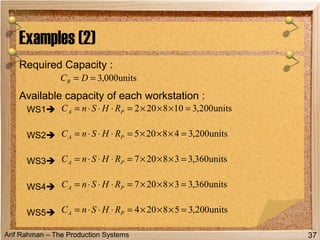
Required Capacity :
Available capacity of each workstation :
WS1
WS2
WS3
WS4
WS5
Examples (2)
37
units000,3== DCR
units200,3108202 =×××=⋅⋅⋅= PA RHSnC
units200,348205 =×××=⋅⋅⋅= PA RHSnC
units200,358204 =×××=⋅⋅⋅= PA RHSnC
units360,338207 =×××=⋅⋅⋅= PA RHSnC
Arif Rahman – The Production Systems
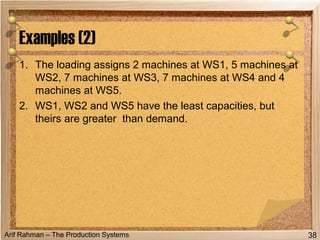
1. The loading assigns 2 machines at WS1, 5 machines at
WS2, 7 machines at WS3, 7 machines at WS4 and 4
machines at WS5.
2. WS1, WS2 and WS5 have the least capacities, but
theirs are greater than demand.
Examples (2)
38
Arif Rahman – The Production Systems
Drum Buffer Rope
39
Arif Rahman – The Production Systems
Drum-buffer-rope is a TOC production
application and the name given to the method
used to schedule the flow of materials in a TOC
facility.
The three elements :
¤ Drum
¤ Buffer
¤ Rope
Drum Buffer Rope
40
Arif Rahman – The Production Systems
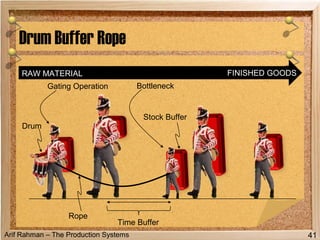
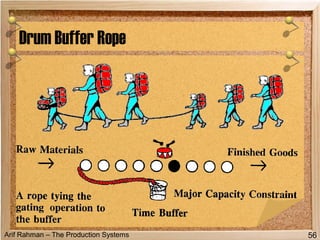
Drum Buffer Rope
41
Time Buffer
Drum
Stock Buffer
Rope
Gating Operation Bottleneck
RAW MATERIAL FINISHED GOODS
Arif Rahman – The Production Systems
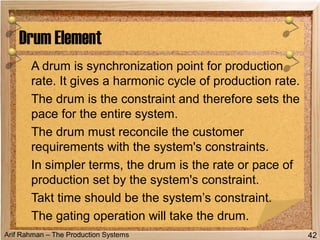
A drum is synchronization point for production
rate. It gives a harmonic cycle of production rate.
The drum is the constraint and therefore sets the
pace for the entire system.
The drum must reconcile the customer
requirements with the system's constraints.
In simpler terms, the drum is the rate or pace of
production set by the system's constraint.
Takt time should be the system’s constraint.
The gating operation will take the drum.
Drum Element
42
Arif Rahman – The Production Systems
A buffer includes time or materials that support
some protection against uncertainty so that the
system can stabilize throughput.
¤ A time buffer is the additional spare time allowed to
protect the system throughput from the internal
disruptions that are inherent in any process.
¤ A stock buffer is defined as inventories of specific
products that are held to improve the responsiveness
of the system to specific conditions.
The buffer aggregates the variation risk to give
safety allowance for throughput protection.
Buffer Element
43
Arif Rahman – The Production Systems
A rope is a communication process from the
constraint to the gating operation that controls
material released into the system.
The rope is devised according to the drum and
the weakest resources (capacity constraint
resources, CCR).
The rope ensures that non-capacity constraint
resources are subordinate to the constraint.
The rope is a schedule for releasing raw
materials to the floor.
Rope Element
44
Arif Rahman – The Production Systems
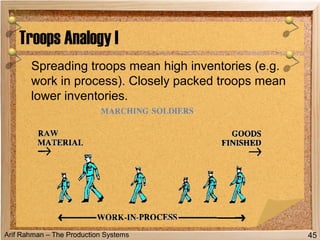
Spreading troops mean high inventories (e.g.
work in process). Closely packed troops mean
lower inventories.
Troops Analogy I
45
Arif Rahman – The Production Systems
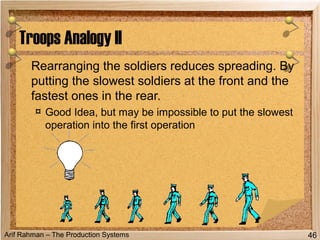
Rearranging the soldiers reduces spreading. By
putting the slowest soldiers at the front and the
fastest ones in the rear.
¤ Good Idea, but may be impossible to put the slowest
operation into the first operation
Troops Analogy II
46
Arif Rahman – The Production Systems
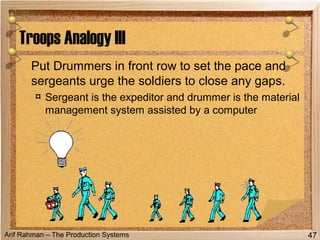
Put Drummers in front row to set the pace and
sergeants urge the soldiers to close any gaps.
¤ Sergeant is the expeditor and drummer is the material
management system assisted by a computer
Troops Analogy III
47
Arif Rahman – The Production Systems
“If a worker doesn’t have anything to do, let’s
find him something to do.”
¤ This mentality will cause workers to work at their own
paces.
Troops Analogy IV
48
Arif Rahman – The Production Systems
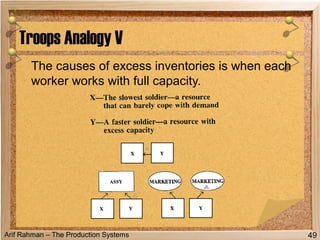
The causes of excess inventories is when each
worker works with full capacity.
Troops Analogy V
49
Arif Rahman – The Production Systems
Does the drum beat according to the constraints
of the plant or according to some unrealistic
assumptions, like:
¤ Infinite capacity
¤ Predetermined lead times
¤ Fixed, constant batch sizes
Troops Analogy VI
50
Arif Rahman – The Production Systems
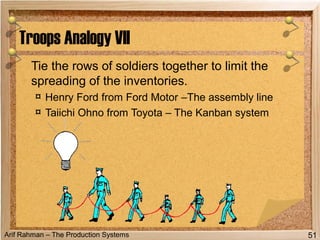
Tie the rows of soldiers together to limit the
spreading of the inventories.
¤ Henry Ford from Ford Motor –The assembly line
¤ Taiichi Ohno from Toyota – The Kanban system
Troops Analogy VII
51
Arif Rahman – The Production Systems
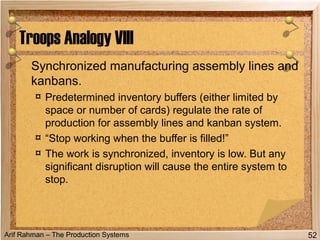
Synchronized manufacturing assembly lines and
kanbans.
¤ Predetermined inventory buffers (either limited by
space or number of cards) regulate the rate of
production for assembly lines and kanban system.
¤ “Stop working when the buffer is filled!”
¤ The work is synchronized, inventory is low. But any
significant disruption will cause the entire system to
stop.
Troops Analogy VIII
52
Arif Rahman – The Production Systems
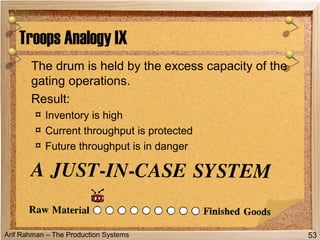
The drum is held by the excess capacity of the
gating operations.
Result:
¤ Inventory is high
¤ Current throughput is protected
¤ Future throughput is in danger
Troops Analogy IX
53
Arif Rahman – The Production Systems
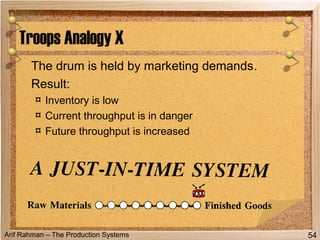
The drum is held by marketing demands.
Result:
¤ Inventory is low
¤ Current throughput is in danger
¤ Future throughput is increased
Troops Analogy X
54
Arif Rahman – The Production Systems
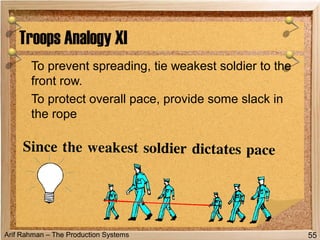
To prevent spreading, tie weakest soldier to the
front row.
To protect overall pace, provide some slack in
the rope
Troops Analogy XI
55
Arif Rahman – The Production Systems
Drum Buffer Rope
56
Arif Rahman – The Production Systems
A production line has 3 adjacent machines: A, B, C. Their
capacities are, respectively, 300, 200, 500 units/hour.
The demand is 1500 units every day. The production line
fulfill the demand for 8 hours. Sometimes, a minor
stoppage may occur at a single machine independently. It
takes for 20 minutes of resetting before it can run normally.
Determine:
1.The bottleneck.
2.The buffer at the bottleneck to cover inefficiency during
resetting since minor stoppage.
Examples (3)
57
Arif Rahman – The Production Systems
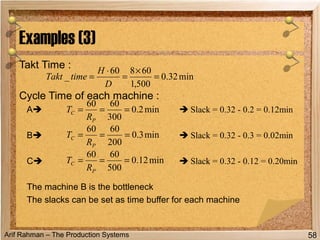
Takt Time :
Cycle Time of each machine :
A  Slack = 0.32 - 0.2 = 0.12min
B  Slack = 0.32 - 0.3 = 0.02min
C  Slack = 0.32 - 0.12 = 0.20min
The machine B is the bottleneck
The slacks can be set as time buffer for each machine
Examples (3)
58
min32.0
500,1
60860
_ =
×
=
⋅
=
D
H
timeTakt
min2.0
300
6060
===
P
C
R
T
min3.0
200
6060
===
P
C
R
T
min12.0
500
6060
===
P
C
R
T
Arif Rahman – The Production Systems
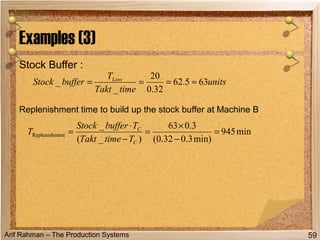
Stock Buffer :
Replenishment time to build up the stock buffer at Machine B
Examples (3)
59
units
timeTakt
T
bufferStock Loss
635.62
32.0
20
_
_ ≈===
min945
min)3.032.0(
3.063
)_(
_
entReplenishm =
−
×
=
−
⋅
=
C
C
TtimeTakt
TbufferStock
T
Arif Rahman – The Production Systems
Theory Of Constraints
(TOC)
60
Arif Rahman – The Production Systems
The Theory of Constraints (TOC) is a
management philosophy that views the strength
of any chain, process, or system is dependent
upon its weakest link.
TOC is systemic and strives to identify
constraints to system success and to effect the
changes necessary to remove them.
It was developed by Dr. Eliyahu Moshe Goldratt
in early 1979.
Theory Of Constraints
61
Arif Rahman – The Production Systems
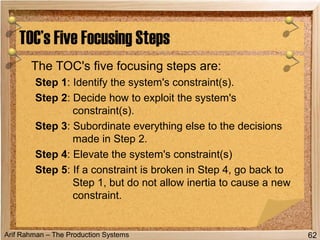
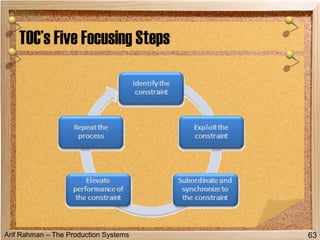
The TOC's five focusing steps are:
Step 1: Identify the system's constraint(s).
Step 2: Decide how to exploit the system's
constraint(s).
Step 3: Subordinate everything else to the decisions
made in Step 2.
Step 4: Elevate the system's constraint(s)
Step 5: If a constraint is broken in Step 4, go back to
Step 1, but do not allow inertia to cause a new
constraint.
TOC’s Five Focusing Steps
62
Arif Rahman – The Production Systems
TOC’s Five Focusing Steps
63
Arif Rahman – The Production Systems
Consider previous Example 1. Suppose the same
data from that example were applicable. The
insufficient capacity of bottleneck will be fulfilled by
stock buffer that is built up during overtime on the
previous day. Determine
1.Stock buffer at the bottleneck
2.Overtime required to build up stock buffer
3.The production schedule
Examples (4)
64
Arif Rahman – The Production Systems
According TOC’s Five Focusing Steps:
Step 1: Identify the system's constraint(s).
The first bottleneck is workcell C6 that has insufficient
capacity as follows
CR – CA = 12,000 – 9,600 = 2,400 min
Step 2: Decide how to exploit the system's constraint(s).
Since workcell C6 is the last operation (shipping operation)
of product A, then the insufficient capacity will be
conducted by overtime.
Overtime at C6 = 2,400 min ≈ 160 units product A
Examples (4)
65
Arif Rahman – The Production Systems
Step 3: Subordinate everything else to the decisions made
in Step 2.
The cycle time of workcell C6 is greater than the takt time.
In the reguler time it will produce 640 units and
in the overtime it will produce 160 units.
It needs 160 parts of both C4 and C5 as stock in the end of
reguler time.
Step 4: Elevate the system's constraint(s)
The total capacity of workcell C6, reguler and overtime, can
cover the demand. Workcell C6 is not a constraint.
Examples (4)
66
Arif Rahman – The Production Systems
Step 5: If a constraint is broken in Step 4, go back to Step
1, but do not allow inertia to cause a new
constraint.
Step 1: Identify the system's constraint(s).
The second bottleneck is workcell C4 that has insufficient
capacity as follows
CR – CA = 9,700 – 9,600 = 100 min
Examples (4)
67
Arif Rahman – The Production Systems
Step 2: Decide how to exploit the system's constraint(s).
Workcell C4 feeds C6 and C7. Because workcelll C6 runs
overtime for 160 units product A, then the
insufficient capacity of workcell C4 will be
conducted by overtime for feeding C6 (part of
product A).
Overtime at C4 = 100 min ≈ 12.5 parts of product A
Examples (4)
68
Arif Rahman – The Production Systems
Step 3: Subordinate everything else to the decisions made
in Step 2.
The cycle time of workcell C4, for part of product A, is
greater than the takt time.
In the reguler time it will produce 787.5 units and
in the overtime it will produce 12.5 units.
Since workcell C4 is gating operation, it needs available
material stock in the end of reguler time.
Step 4: Elevate the system's constraint(s)
The total capacity of workcell C4, reguler and overtime, can
cover the demand. Workcell C4 is not a constraint.
Examples (4)
69
Arif Rahman – The Production Systems
Step 5: If a constraint is broken in Step 4, go back to Step
1, but do not allow inertia to cause a new
constraint.
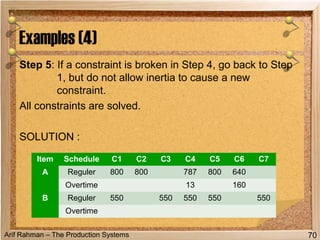
All constraints are solved.
SOLUTION :
Examples (4)
70
Item Schedule C1 C2 C3 C4 C5 C6 C7
A Reguler 800 800 787 800 640
Overtime 13 160
B Reguler 550 550 550 550 550
Overtime
Arif Rahman – The Production Systems
Logical Thinking Process
71
Arif Rahman – The Production Systems
The logical thinking process assists with working
through the change process by identifying the
following: what to change, what to change to,
and how to effect the change.
The logical thinking processes consist of logic
tools used to identify problems, then develop
and implement solutions.
These tools allow an organization to analyze and
to verbalize cause and effect.
Logical Thinking Process
72
Arif Rahman – The Production Systems
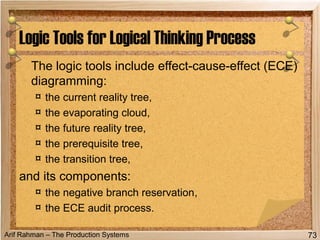
The logic tools include effect-cause-effect (ECE)
diagramming:
¤ the current reality tree,
¤ the evaporating cloud,
¤ the future reality tree,
¤ the prerequisite tree,
¤ the transition tree,
and its components:
¤ the negative branch reservation,
¤ the ECE audit process.
Logic Tools for Logical Thinking Process
73
Arif Rahman – The Production Systems
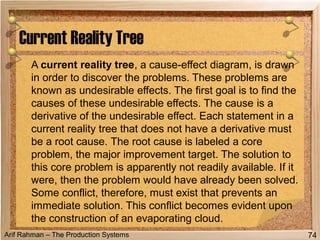
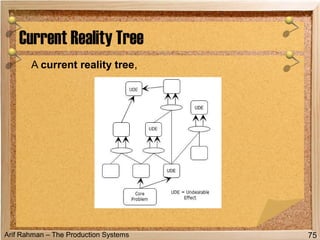
A current reality tree, a cause-effect diagram, is drawn
in order to discover the problems. These problems are
known as undesirable effects. The first goal is to find the
causes of these undesirable effects. The cause is a
derivative of the undesirable effect. Each statement in a
current reality tree that does not have a derivative must
be a root cause. The root cause is labeled a core
problem, the major improvement target. The solution to
this core problem is apparently not readily available. If it
were, then the problem would have already been solved.
Some conflict, therefore, must exist that prevents an
immediate solution. This conflict becomes evident upon
the construction of an evaporating cloud.
Current Reality Tree
74
Arif Rahman – The Production Systems
A current reality tree,
Current Reality Tree
75
Arif Rahman – The Production Systems
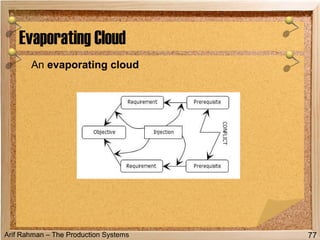
An evaporating cloud is a conflict-resolution tool. The
process begins with a statement of the desired objective,
one that is the opposite of the core problem. Then, the
prerequisites necessary to achieve the requirements are

listed. Any conflicts and assumptions that exist between
the prerequisites are verbalized. It has to solve by
removing the conflict; a compromise is not desirable.
The next move involves finding an injection, a
breakthrough idea that will evaporate the cloud. The
"evaporating" refers to the tool's ability to dissipate
conflict and to create a win-win solution.
Evaporating Cloud
76
Arif Rahman – The Production Systems
An evaporating cloud
Evaporating Cloud
77
Arif Rahman – The Production Systems
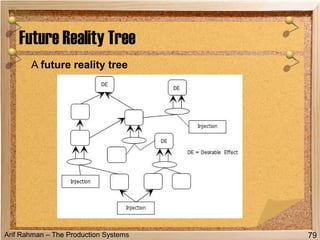
A future reality tree is another cause-effect diagram.
The tree starts with the proposed solution to the core
problem and delineates the injection(s) and the ensuing
desirable effects. The future reality tree is a "what if." It
provides the opportunity to evaluate and to improve a
solution before it is implemented. It is noted that one
should be careful not to allow the solution to cause new
undesirable effects.
Future Reality Tree
78
Arif Rahman – The Production Systems
A future reality tree
Future Reality Tree
79
Arif Rahman – The Production Systems
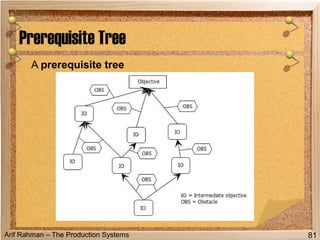
A prerequisite tree describes the implementation of the
injection(s) and is composed of an obstacle and an
intermediate objective. This diagram breaks the
implementation tasks into smaller increments, noting
expected obstacles and intermediate objectives whose
accomplishments will overcome the obstacles. The
intermediate objectives are sequenced, displaying the
necessary order of accomplishment and determining
which ones can be achieved in parallel. This tool is
powerful in that it does not ignore the obstacles. It uses
them, rather, as the main vehicle for this phase.
Prerequisite Tree
80
Arif Rahman – The Production Systems
A prerequisite tree
Prerequisite Tree
81
Arif Rahman – The Production Systems
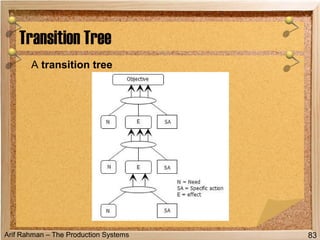
A transition tree or implementation plan is constructed.
This element presents a detailed description of the
gradually evolving change envisioned. This task forces
one to carefully examine which actions are really needed
and if they are sufficient to guarantee the required
change.
Transition Tree
82
Arif Rahman – The Production Systems
A transition tree
Transition Tree
83
Arif Rahman – The Production Systems 84
It’s end of slides…
… Any question ?
84

14 synchronous manufacturing

  • 1.
    Arif Rahman –The Production Systems 1 Slide 14 Introduction to Synchronous Manufacturing Arif Rahman
  • 2.
    Arif Rahman –The Production Systems Synchronous manufacturing or synchronized manufacturing refers to the entire manufacturing processes working together in harmony to achieve the goals of the firm. It does not balance the capacity, but it balances the flow. A bottleneck is a capacity constraint resource that has the least capacity. As the weakest link, the bottleneck limits the throughput of the system. The bottleneck become a system’s constraint when its capacity is less than demand placed on system. Synchronous Manufacturing 2
  • 3.
    Arif Rahman –The Production Systems Workstations have different cycle time Workstations produce in different batch size The cycle time is different from takt time The station is feeding more than one subsequent stations The station withdraws more than one preceding stations The bottleneck is not the gating operation The losses may occur at the bottleneck Imbalance (unbalanced) Capacity Problems 3
  • 4.
    Arif Rahman –The Production Systems In early 1979 Goldratt introduced a software-based manufacturing scheduling program known as Optimized Production Timetables (OPT), changed in 1982 to Optimized Production Technology. Optimized Production Technology 4
  • 5.
    Arif Rahman –The Production Systems Optimized Production Technology A computer based management system used for production planning and scheduling, seeking the goal of throughput maximization through the following: ¤ Balanced flow, not capacity ¤ Minimization and/or elimination of bottlenecks ¤ Variable lot sizes 5
  • 6.
    Arif Rahman –The Production Systems The Goal: To Make Money Measures: 1.Net Profit 2.Return on Investment 3.Cash Flow OPT Principles 6
  • 7.
    Arif Rahman –The Production Systems OPT Operational Measures: 1. Throughput The rate at which goods are sold 2. Inventory Any raw materials, components, and finished goods that have been paid for but not sold 3. Operating Expenses The cost of converting inventory into throughput ¤Direct or indirect labor ¤Energy ¤Capital facilities OPT Principles 7
  • 8.
    Arif Rahman –The Production Systems OPT Principles 8 TROUGHPUT INVENTORY OPERATING EXPENSES NET PROFIT R.O.I. CASH FLOW
  • 9.
    Arif Rahman –The Production Systems 1. Do not balance capacity, but balance the flow. 2. An hour lost at a bottleneck is an hour lost for the entire system. 3. An hour saved at a nonbottleneck is just a mirage. 4. Bottlenecks govern both throughput and inventory in the system. 5. Utilization and activation of a resource are not the same. 6. The level utilization of a nonbottleneck resource is not determined by its own potential but by some other constraint in the system. 7. A process batch should be variable both along its route and in time. 8. The transfer batch may not and many times should not be equal to the process batch. 9. Schedules should be established by prioritizing which can be set by examining all system’s constraints simultaneously. 10. Lead time is a result or derivative of the schedule and can not be predetermined. Goldratt’s Rules 9
  • 10.
    Arif Rahman –The Production Systems Bottleneck resource (BR) has capacity less than demand Nonbottleneck resource (NBR) has capacity greater than demand Capacity-constrained resource (CCR) is a resource where the capacity is close to demand Bottleneck – Nonbottleneck Resource 10
  • 11.
    Arif Rahman –The Production Systems Bottleneck – Nonbottleneck Resource 11
  • 12.
    Arif Rahman –The Production Systems Variable Batch 12
  • 13.
    Arif Rahman –The Production Systems Setup time (S) is the time that a part spends waiting for a resource to be set up to work on this same part. Process time (P) is the time that the part is being processed. Queue time (Q) is the time that a part waits for a resource while the resource is busy with something else. Wait time (W) is the time that a part waits not for a resource but for another part so that they can be assembled together. Idle time (I) is the unused time. It represents the cycle time less the sum of the setup time, processing time, queue time, and wait time. Time Components of Production Cycle Time 13
  • 14.
    Arif Rahman –The Production Systems Time Components of Production Cycle Time 14
  • 15.
    Arif Rahman –The Production Systems VAT Analysis 15
  • 16.
    Arif Rahman –The Production Systems VAT analysis determines the general flow of parts and products from raw materials to finished products. It conceptualizes an organization in terms of the interaction of its individual component parts, both products and processes. The logical structure is the sequence of operations through which each product must pass in order to manufacture and assemble a product or product family. VAT Analysis 16
  • 17.
    Arif Rahman –The Production Systems Three general categories of production logical structures based on product variety funnel. ¤ The V logical structure starts with one or a few raw materials, and the product expands into a number of different products as it flows through its routings. ¤ The A logical structure is dominated by converging points. Many raw materials are fabricated and assembled into a few finished projects. ¤ The T logical structure consists of numerous similar finished products assembled from common assemblies and subassemblies. Production Logical Structure 17
  • 18.
    Arif Rahman –The Production Systems Three general categories of production logical structures based on production imbalance capacity. ¤ The V logical structure starts with one or a few workstations, which have large capacity, provide material for a number of lower capacity workstations. Each preceding stations has capacity greater than the subsequent stations. ¤ The A logical structure starts with many workstations, which have limited capacity, provide material for some higher capacity workstations. Each preceding stations has capacity less than the subsequent stations. ¤ The T logical structure combines the V-type and the A-type. Production Logical Structure 18
  • 19.
    Arif Rahman –The Production Systems Production Logical Structure 19 V-plant A-plant T-plant
  • 20.
    Arif Rahman –The Production Systems Once the general parts flow is determined, the system control points (gating operations, convergent points, divergent points, constraints, and shipping points) can be identified and managed. This determination focuses management's attention on a few control points where buffers can be used to protect and to maximize throughput. The shape of the structure determines which control points are utilized to manage production. Determine the Logical Structure 20
  • 21.
    Arif Rahman –The Production Systems Five control points are used to manage the process: 1) the constraint, 2) the points of divergence (where a part or material is diverted to different routes in order to make different products), 3) the points of convergence (where two or more parts are combined in subassembly), 4) the gating operation (releases work into the shop), 5) the shipping operation. Five Control Points 21
  • 22.
    Arif Rahman –The Production Systems The T structure focuses attention on the constraint and the gating operation. The five- step focusing process is used to manage the constraint with a buffer placed before the constraint to absorb variations in the process. The output from the gating operation is tied to the constraint; that is, since the constraint controls the amount of throughput; the gating operation cannot process more than the constraint. VAT Analysis 22
  • 23.
    Arif Rahman –The Production Systems The V structure also uses a buffer to protect the constraint and the gating operation releases orders at the same rate as the constraint as seen in the T structure. However, an additional control point exists in the V structure, the divergent point. The divergent point is controlled by a schedule derived from the shipping schedule. This derivation prevents misallocation of material to a product not currently in demand. VAT Analysis 23
  • 24.
    Arif Rahman –The Production Systems The A structure also manages the constraint and gating operation in a fashion similar to the T structure. Any diverging points are scheduled in accordance with the shipping schedule. In addition, an assembly buffer is used to maintain the flow into the convergent points. An additional schedule based on the shipping schedule (similar to that used in the V structure) is used to keep capacity from being misallocated to the wrong order. VAT Analysis 24
  • 25.
    Arif Rahman –The Production Systems A factory produces two items, A and B. There are 7 workcells: C1, C2, C3, C4, C5, C6 and C7. Product A uses C1, C2, C4, C5 and C6. Product B uses C1, C3, C4, C5 and C7. The process route can be seen in the following figure. All setups are insignificant, its time is included in process time. Process times of every part each workcell are described in processing data table. The demands are 800 units of product A and 550 units of product B. The workcells operate 20 shifts/month (8 hours/shift). Determine: 1.The bottleneck(s) 2.Its (their) insufficient capacity Examples (1) 25
  • 26.
    Arif Rahman –The Production Systems Product A Product B Processing Data Table (in minutes) Examples (1) 26 Item C1 C2 C3 C4 C5 C6 C7 A 5 10 8 7 15 B 7 12 6 7 12 C1 C2 C4 C5 C6 C1 C3 C4 C5 C7
  • 27.
    Arif Rahman –The Production Systems The gating operations : C1, C2, C3, C4 The shipping operations : C6, C7 The points of convergence : C5 (withdraws C1,C2,C3), C6 (withdraws C4,C5), C7 (wihdraws C4, C5) The points of divergence : C4 (feeds C6, C7), C5 (feeds C6,C7) Examples (1) 27
  • 28.
    Arif Rahman –The Production Systems The logical structure Examples (1) 28 C1 C2 C3 C5 C4 C6 C7
  • 29.
    Arif Rahman –The Production Systems Takt time : •Only product A •Only product B •Both product A and B Examples (1) 29 min11.7 550800 6082060 _ 21 = + ×× = + ⋅⋅ = DD HS timeTakt min12 800 6082060 _ 1 = ×× = ⋅⋅ = D HS timeTakt min45.17 550 6082060 _ 2 = ×× = ⋅⋅ = D HS timeTakt
  • 30.
    Arif Rahman –The Production Systems Available Capacity Required Capacity : C1  C2  C3  C4  C5  C6  C7  Examples (1) 30 ( ) ( ) ( ) ( ) min850,7755058002211 =×+×=⋅+⋅= tDtDCR ( ) ( ) min000,81080011 =×=⋅= tDCR ( ) ( ) min600,61255022 =×=⋅= tDCR min600,96082060 =××=⋅⋅= HSCA ( ) ( ) ( ) ( ) min700,9655088002211 =×+×=⋅+⋅= tDtDCR ( ) ( ) ( ) ( ) min450,9755078002211 =×+×=⋅+⋅= tDtDCR ( ) ( ) min000,121580011 =×=⋅= tDCR ( ) ( ) min600,61255022 =×=⋅= tDCR
  • 31.
    Arif Rahman –The Production Systems The bottlenecks are C4 and C6 The insufficient capacity ¤ C4  CR – CA = 9,700 – 9,600 = 100 min ¤ C6  CR – CA = 12,000 – 9,600 = 2,400 min Examples (1) 31
  • 32.
    Arif Rahman –The Production Systems A plant has 5 workstations as follows: WS1, WS2, WS3, WS4, and WS5. The workstations have a number of machines, respectively, 3, 7, 9, 9, 5. In each workstation, the machines are homogenous and identically similar specification. The production rate of every single machine are 10 units/hr (WS1), 4 units/hr (WS2), 3 units/hr (WS3), 3 units/hr (WS4), and 5 units/hr (WS5). The plant will produce 3,000 units for a month. The plant operates 20 shifts/month (8 hours/shift). Calculate: 1.How many machines are assigned at every workstation? 2.Which workstation is the bottleneck resource? Examples (2) 32
  • 33.
    Arif Rahman –The Production Systems The gating operations : WS1 The shipping operations : WS5 The points of convergence : WS5 The points of divergence : WS1, WS2 Examples (2) 33
  • 34.
    Arif Rahman –The Production Systems The number of machines are assigned : WS1 WS2 WS3 WS4 WS5 Examples (2) 34 2875.1 10820 000,3 ≈= ×× = ⋅⋅ = PRHS D n 56875.4 4820 000,3 ≈= ×× = ⋅⋅ = PRHS D n 725.6 3820 000,3 ≈= ×× = ⋅⋅ = PRHS D n 725.6 3820 000,3 ≈= ×× = ⋅⋅ = PRHS D n 475.3 5820 000,3 ≈= ×× = ⋅⋅ = PRHS D n
  • 35.
    Arif Rahman –The Production Systems Examples (2) 35 WS1 WS2 WS3 WS4 WS5
  • 36.
    Arif Rahman –The Production Systems Takt Time : Cycle Time of each workstation : WS1 WS2 WS3 WS4 WS5 Examples (2) 36 min2.3 000,3 6082060 _ = ×× = ⋅⋅ = D HS timeTakt min3 102 6060 = × = ⋅ = P C Rn T min3 45 6060 = × = ⋅ = P C Rn T min86.2 37 6060 = × = ⋅ = P C Rn T min86.2 37 6060 = × = ⋅ = P C Rn T min3 54 6060 = × = ⋅ = P C Rn T
  • 37.
    Arif Rahman –The Production Systems Required Capacity : Available capacity of each workstation : WS1 WS2 WS3 WS4 WS5 Examples (2) 37 units000,3== DCR units200,3108202 =×××=⋅⋅⋅= PA RHSnC units200,348205 =×××=⋅⋅⋅= PA RHSnC units200,358204 =×××=⋅⋅⋅= PA RHSnC units360,338207 =×××=⋅⋅⋅= PA RHSnC units360,338207 =×××=⋅⋅⋅= PA RHSnC
  • 38.
    Arif Rahman –The Production Systems 1. The loading assigns 2 machines at WS1, 5 machines at WS2, 7 machines at WS3, 7 machines at WS4 and 4 machines at WS5. 2. WS1, WS2 and WS5 have the least capacities, but theirs are greater than demand. Examples (2) 38
  • 39.
    Arif Rahman –The Production Systems Drum Buffer Rope 39
  • 40.
    Arif Rahman –The Production Systems Drum-buffer-rope is a TOC production application and the name given to the method used to schedule the flow of materials in a TOC facility. The three elements : ¤ Drum ¤ Buffer ¤ Rope Drum Buffer Rope 40
  • 41.
    Arif Rahman –The Production Systems Drum Buffer Rope 41 Time Buffer Drum Stock Buffer Rope Gating Operation Bottleneck RAW MATERIAL FINISHED GOODS
  • 42.
    Arif Rahman –The Production Systems A drum is synchronization point for production rate. It gives a harmonic cycle of production rate. The drum is the constraint and therefore sets the pace for the entire system. The drum must reconcile the customer requirements with the system's constraints. In simpler terms, the drum is the rate or pace of production set by the system's constraint. Takt time should be the system’s constraint. The gating operation will take the drum. Drum Element 42
  • 43.
    Arif Rahman –The Production Systems A buffer includes time or materials that support some protection against uncertainty so that the system can stabilize throughput. ¤ A time buffer is the additional spare time allowed to protect the system throughput from the internal disruptions that are inherent in any process. ¤ A stock buffer is defined as inventories of specific products that are held to improve the responsiveness of the system to specific conditions. The buffer aggregates the variation risk to give safety allowance for throughput protection. Buffer Element 43
  • 44.
    Arif Rahman –The Production Systems A rope is a communication process from the constraint to the gating operation that controls material released into the system. The rope is devised according to the drum and the weakest resources (capacity constraint resources, CCR). The rope ensures that non-capacity constraint resources are subordinate to the constraint. The rope is a schedule for releasing raw materials to the floor. Rope Element 44
  • 45.
    Arif Rahman –The Production Systems Spreading troops mean high inventories (e.g. work in process). Closely packed troops mean lower inventories. Troops Analogy I 45
  • 46.
    Arif Rahman –The Production Systems Rearranging the soldiers reduces spreading. By putting the slowest soldiers at the front and the fastest ones in the rear. ¤ Good Idea, but may be impossible to put the slowest operation into the first operation Troops Analogy II 46
  • 47.
    Arif Rahman –The Production Systems Put Drummers in front row to set the pace and sergeants urge the soldiers to close any gaps. ¤ Sergeant is the expeditor and drummer is the material management system assisted by a computer Troops Analogy III 47
  • 48.
    Arif Rahman –The Production Systems “If a worker doesn’t have anything to do, let’s find him something to do.” ¤ This mentality will cause workers to work at their own paces. Troops Analogy IV 48
  • 49.
    Arif Rahman –The Production Systems The causes of excess inventories is when each worker works with full capacity. Troops Analogy V 49
  • 50.
    Arif Rahman –The Production Systems Does the drum beat according to the constraints of the plant or according to some unrealistic assumptions, like: ¤ Infinite capacity ¤ Predetermined lead times ¤ Fixed, constant batch sizes Troops Analogy VI 50
  • 51.
    Arif Rahman –The Production Systems Tie the rows of soldiers together to limit the spreading of the inventories. ¤ Henry Ford from Ford Motor –The assembly line ¤ Taiichi Ohno from Toyota – The Kanban system Troops Analogy VII 51
  • 52.
    Arif Rahman –The Production Systems Synchronized manufacturing assembly lines and kanbans. ¤ Predetermined inventory buffers (either limited by space or number of cards) regulate the rate of production for assembly lines and kanban system. ¤ “Stop working when the buffer is filled!” ¤ The work is synchronized, inventory is low. But any significant disruption will cause the entire system to stop. Troops Analogy VIII 52
  • 53.
    Arif Rahman –The Production Systems The drum is held by the excess capacity of the gating operations. Result: ¤ Inventory is high ¤ Current throughput is protected ¤ Future throughput is in danger Troops Analogy IX 53
  • 54.
    Arif Rahman –The Production Systems The drum is held by marketing demands. Result: ¤ Inventory is low ¤ Current throughput is in danger ¤ Future throughput is increased Troops Analogy X 54
  • 55.
    Arif Rahman –The Production Systems To prevent spreading, tie weakest soldier to the front row. To protect overall pace, provide some slack in the rope Troops Analogy XI 55
  • 56.
    Arif Rahman –The Production Systems Drum Buffer Rope 56
  • 57.
    Arif Rahman –The Production Systems A production line has 3 adjacent machines: A, B, C. Their capacities are, respectively, 300, 200, 500 units/hour. The demand is 1500 units every day. The production line fulfill the demand for 8 hours. Sometimes, a minor stoppage may occur at a single machine independently. It takes for 20 minutes of resetting before it can run normally. Determine: 1.The bottleneck. 2.The buffer at the bottleneck to cover inefficiency during resetting since minor stoppage. Examples (3) 57
  • 58.
    Arif Rahman –The Production Systems Takt Time : Cycle Time of each machine : A  Slack = 0.32 - 0.2 = 0.12min B  Slack = 0.32 - 0.3 = 0.02min C  Slack = 0.32 - 0.12 = 0.20min The machine B is the bottleneck The slacks can be set as time buffer for each machine Examples (3) 58 min32.0 500,1 60860 _ = × = ⋅ = D H timeTakt min2.0 300 6060 === P C R T min3.0 200 6060 === P C R T min12.0 500 6060 === P C R T
  • 59.
    Arif Rahman –The Production Systems Stock Buffer : Replenishment time to build up the stock buffer at Machine B Examples (3) 59 units timeTakt T bufferStock Loss 635.62 32.0 20 _ _ ≈=== min945 min)3.032.0( 3.063 )_( _ entReplenishm = − × = − ⋅ = C C TtimeTakt TbufferStock T
  • 60.
    Arif Rahman –The Production Systems Theory Of Constraints (TOC) 60
  • 61.
    Arif Rahman –The Production Systems The Theory of Constraints (TOC) is a management philosophy that views the strength of any chain, process, or system is dependent upon its weakest link. TOC is systemic and strives to identify constraints to system success and to effect the changes necessary to remove them. It was developed by Dr. Eliyahu Moshe Goldratt in early 1979. Theory Of Constraints 61
  • 62.
    Arif Rahman –The Production Systems The TOC's five focusing steps are: Step 1: Identify the system's constraint(s). Step 2: Decide how to exploit the system's constraint(s). Step 3: Subordinate everything else to the decisions made in Step 2. Step 4: Elevate the system's constraint(s) Step 5: If a constraint is broken in Step 4, go back to Step 1, but do not allow inertia to cause a new constraint. TOC’s Five Focusing Steps 62
  • 63.
    Arif Rahman –The Production Systems TOC’s Five Focusing Steps 63
  • 64.
    Arif Rahman –The Production Systems Consider previous Example 1. Suppose the same data from that example were applicable. The insufficient capacity of bottleneck will be fulfilled by stock buffer that is built up during overtime on the previous day. Determine 1.Stock buffer at the bottleneck 2.Overtime required to build up stock buffer 3.The production schedule Examples (4) 64
  • 65.
    Arif Rahman –The Production Systems According TOC’s Five Focusing Steps: Step 1: Identify the system's constraint(s). The first bottleneck is workcell C6 that has insufficient capacity as follows CR – CA = 12,000 – 9,600 = 2,400 min Step 2: Decide how to exploit the system's constraint(s). Since workcell C6 is the last operation (shipping operation) of product A, then the insufficient capacity will be conducted by overtime. Overtime at C6 = 2,400 min ≈ 160 units product A Examples (4) 65
  • 66.
    Arif Rahman –The Production Systems Step 3: Subordinate everything else to the decisions made in Step 2. The cycle time of workcell C6 is greater than the takt time. In the reguler time it will produce 640 units and in the overtime it will produce 160 units. It needs 160 parts of both C4 and C5 as stock in the end of reguler time. Step 4: Elevate the system's constraint(s) The total capacity of workcell C6, reguler and overtime, can cover the demand. Workcell C6 is not a constraint. Examples (4) 66
  • 67.
    Arif Rahman –The Production Systems Step 5: If a constraint is broken in Step 4, go back to Step 1, but do not allow inertia to cause a new constraint. Step 1: Identify the system's constraint(s). The second bottleneck is workcell C4 that has insufficient capacity as follows CR – CA = 9,700 – 9,600 = 100 min Examples (4) 67
  • 68.
    Arif Rahman –The Production Systems Step 2: Decide how to exploit the system's constraint(s). Workcell C4 feeds C6 and C7. Because workcelll C6 runs overtime for 160 units product A, then the insufficient capacity of workcell C4 will be conducted by overtime for feeding C6 (part of product A). Overtime at C4 = 100 min ≈ 12.5 parts of product A Examples (4) 68
  • 69.
    Arif Rahman –The Production Systems Step 3: Subordinate everything else to the decisions made in Step 2. The cycle time of workcell C4, for part of product A, is greater than the takt time. In the reguler time it will produce 787.5 units and in the overtime it will produce 12.5 units. Since workcell C4 is gating operation, it needs available material stock in the end of reguler time. Step 4: Elevate the system's constraint(s) The total capacity of workcell C4, reguler and overtime, can cover the demand. Workcell C4 is not a constraint. Examples (4) 69
  • 70.
    Arif Rahman –The Production Systems Step 5: If a constraint is broken in Step 4, go back to Step 1, but do not allow inertia to cause a new constraint. All constraints are solved. SOLUTION : Examples (4) 70 Item Schedule C1 C2 C3 C4 C5 C6 C7 A Reguler 800 800 787 800 640 Overtime 13 160 B Reguler 550 550 550 550 550 Overtime
  • 71.
    Arif Rahman –The Production Systems Logical Thinking Process 71
  • 72.
    Arif Rahman –The Production Systems The logical thinking process assists with working through the change process by identifying the following: what to change, what to change to, and how to effect the change. The logical thinking processes consist of logic tools used to identify problems, then develop and implement solutions. These tools allow an organization to analyze and to verbalize cause and effect. Logical Thinking Process 72
  • 73.
    Arif Rahman –The Production Systems The logic tools include effect-cause-effect (ECE) diagramming: ¤ the current reality tree, ¤ the evaporating cloud, ¤ the future reality tree, ¤ the prerequisite tree, ¤ the transition tree, and its components: ¤ the negative branch reservation, ¤ the ECE audit process. Logic Tools for Logical Thinking Process 73
  • 74.
    Arif Rahman –The Production Systems A current reality tree, a cause-effect diagram, is drawn in order to discover the problems. These problems are known as undesirable effects. The first goal is to find the causes of these undesirable effects. The cause is a derivative of the undesirable effect. Each statement in a current reality tree that does not have a derivative must be a root cause. The root cause is labeled a core problem, the major improvement target. The solution to this core problem is apparently not readily available. If it were, then the problem would have already been solved. Some conflict, therefore, must exist that prevents an immediate solution. This conflict becomes evident upon the construction of an evaporating cloud. Current Reality Tree 74
  • 75.
    Arif Rahman –The Production Systems A current reality tree, Current Reality Tree 75
  • 76.
    Arif Rahman –The Production Systems An evaporating cloud is a conflict-resolution tool. The process begins with a statement of the desired objective, one that is the opposite of the core problem. Then, the prerequisites necessary to achieve the requirements are listed. Any conflicts and assumptions that exist between the prerequisites are verbalized. It has to solve by removing the conflict; a compromise is not desirable. The next move involves finding an injection, a breakthrough idea that will evaporate the cloud. The "evaporating" refers to the tool's ability to dissipate conflict and to create a win-win solution. Evaporating Cloud 76
  • 77.
    Arif Rahman –The Production Systems An evaporating cloud Evaporating Cloud 77
  • 78.
    Arif Rahman –The Production Systems A future reality tree is another cause-effect diagram. The tree starts with the proposed solution to the core problem and delineates the injection(s) and the ensuing desirable effects. The future reality tree is a "what if." It provides the opportunity to evaluate and to improve a solution before it is implemented. It is noted that one should be careful not to allow the solution to cause new undesirable effects. Future Reality Tree 78
  • 79.
    Arif Rahman –The Production Systems A future reality tree Future Reality Tree 79
  • 80.
    Arif Rahman –The Production Systems A prerequisite tree describes the implementation of the injection(s) and is composed of an obstacle and an intermediate objective. This diagram breaks the implementation tasks into smaller increments, noting expected obstacles and intermediate objectives whose accomplishments will overcome the obstacles. The intermediate objectives are sequenced, displaying the necessary order of accomplishment and determining which ones can be achieved in parallel. This tool is powerful in that it does not ignore the obstacles. It uses them, rather, as the main vehicle for this phase. Prerequisite Tree 80
  • 81.
    Arif Rahman –The Production Systems A prerequisite tree Prerequisite Tree 81
  • 82.
    Arif Rahman –The Production Systems A transition tree or implementation plan is constructed. This element presents a detailed description of the gradually evolving change envisioned. This task forces one to carefully examine which actions are really needed and if they are sufficient to guarantee the required change. Transition Tree 82
  • 83.
    Arif Rahman –The Production Systems A transition tree Transition Tree 83
  • 84.
    Arif Rahman –The Production Systems 84 It’s end of slides… … Any question ? 84