Process Selection, Design &
Analysis
by- Ajinkya Dighe
Swaraj Kaskar
Naayesha Katkar
Noopur Koli
Contents
• Process Selection
▫ Project
▫ Job
▫ Batch
▫ Assembly Line
• Process Design
• Phases of Process Design
• Process Analysis
Process Selection
• Process Selection refers to the way an organization
chooses to produce its good or services.
• It takes into account
▫ selection of technology,
▫ capacity planning,
▫ layout of facilities, and
▫ design of work systems.
Project shop
• In a project, the inputs are brought to the project
location as they are needed; there is no flow in
the process.
• Example: building construction
Job shop
• Companies choosing a job process often bid for
work. Typically, they make products to order
and don't produce them ahead of time. The
specific needs of the next customer are
unknown, and the timing of repeat orders from
the same customer is unpredictable. Each new
order is handled as a single unit--as a job.
Batch Shop
• Products are produced in batches, for example,
to fill specific customer orders. A batch process
executes different production runs for different
products. The disadvantage is the setup time
required to change from one product to the
other, but the advantage is that some flexibility
in product mix can be achieved
Assembly Line
• An assembly line processes work in fixed
sequence. However, the assembly line connects
the activities and paces them, for example, with
a conveyor belt. A good example of an assembly
line is an automobile plant.
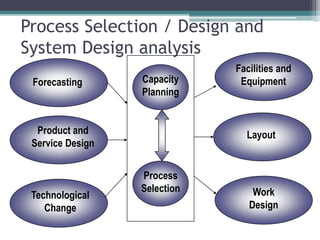
Process Selection / Design and
System Design analysis
Forecasting
Product and
Service Design
Technological
Change
Capacity
Planning
Process
Selection
Facilities and
Equipment
Layout
Work
Design
• FORECAST
▫ Forecast is a statement about the future value.
▫ Better those predictions more informed the
decisions are.
• PRODUCT AND SERVICE DESIGN
▫ Translate customer wants and needs into
products.
▫ Formulate cost targets.
▫ Formulate quality goals.
• Technological change
▫ Process selection also involves introducing the
advancements in the equipments.
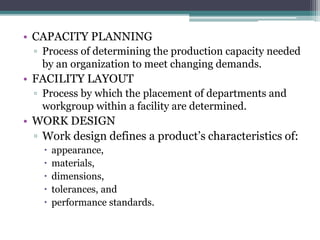
• CAPACITY PLANNING
▫ Process of determining the production capacity needed
by an organization to meet changing demands.
• FACILITY LAYOUT
▫ Process by which the placement of departments and
workgroup within a facility are determined.
• WORK DESIGN
▫ Work design defines a product’s characteristics of:
 appearance,
 materials,
 dimensions,
 tolerances, and
 performance standards.
Process design
• Product design – the process of defining all of
the companies product characteristics
• Product design is concerned with form and
functions of a product. It refers to the
arrangement of elements or parts that
collectively form a product.
Various aspects in product design
• Design for function:
• Design for making:
• Design for selling:
Process Analysis
• Process analysis is the documentation and
detailed understanding of how work is
performed and how it can be redesigned
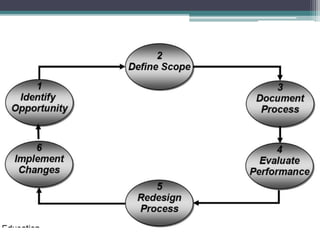
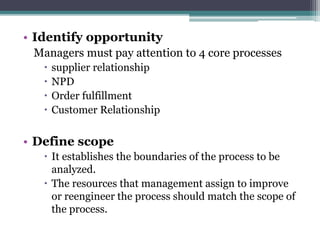
• Identify opportunity
Managers must pay attention to 4 core processes
 supplier relationship
 NPD
 Order fulfillment
 Customer Relationship
• Define scope
 It establishes the boundaries of the process to be
analyzed.
 The resources that management assign to improve
or reengineer the process should match the scope of
the process.
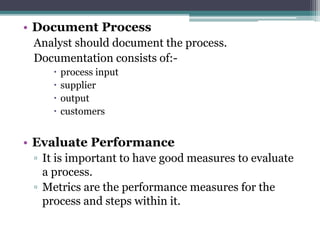
• Document Process
Analyst should document the process.
Documentation consists of:-
 process input
 supplier
 output
 customers
• Evaluate Performance
▫ It is important to have good measures to evaluate
a process.
▫ Metrics are the performance measures for the
process and steps within it.
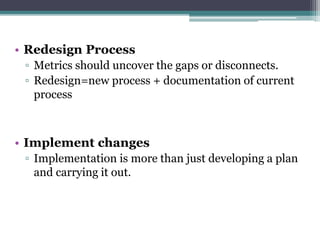
• Redesign Process
▫ Metrics should uncover the gaps or disconnects.
▫ Redesign=new process + documentation of current
process
• Implement changes
▫ Implementation is more than just developing a plan
and carrying it out.
A Systematic Approach to Process Analysis
• Suggestion system
• Design team
• Metrics
• Flowcharts
• Service Blueprint
Thank You

Process selection, design & analysis

  • 1.
    Process Selection, Design& Analysis by- Ajinkya Dighe Swaraj Kaskar Naayesha Katkar Noopur Koli
  • 2.
    Contents • Process Selection ▫Project ▫ Job ▫ Batch ▫ Assembly Line • Process Design • Phases of Process Design • Process Analysis
  • 3.
    Process Selection • ProcessSelection refers to the way an organization chooses to produce its good or services. • It takes into account ▫ selection of technology, ▫ capacity planning, ▫ layout of facilities, and ▫ design of work systems.
  • 4.
    Project shop • Ina project, the inputs are brought to the project location as they are needed; there is no flow in the process. • Example: building construction
  • 5.
    Job shop • Companieschoosing a job process often bid for work. Typically, they make products to order and don't produce them ahead of time. The specific needs of the next customer are unknown, and the timing of repeat orders from the same customer is unpredictable. Each new order is handled as a single unit--as a job.
  • 6.
    Batch Shop • Productsare produced in batches, for example, to fill specific customer orders. A batch process executes different production runs for different products. The disadvantage is the setup time required to change from one product to the other, but the advantage is that some flexibility in product mix can be achieved
  • 7.
    Assembly Line • Anassembly line processes work in fixed sequence. However, the assembly line connects the activities and paces them, for example, with a conveyor belt. A good example of an assembly line is an automobile plant.
  • 8.
    Process Selection /Design and System Design analysis Forecasting Product and Service Design Technological Change Capacity Planning Process Selection Facilities and Equipment Layout Work Design
  • 9.
    • FORECAST ▫ Forecastis a statement about the future value. ▫ Better those predictions more informed the decisions are. • PRODUCT AND SERVICE DESIGN ▫ Translate customer wants and needs into products. ▫ Formulate cost targets. ▫ Formulate quality goals. • Technological change ▫ Process selection also involves introducing the advancements in the equipments.
  • 10.
    • CAPACITY PLANNING ▫Process of determining the production capacity needed by an organization to meet changing demands. • FACILITY LAYOUT ▫ Process by which the placement of departments and workgroup within a facility are determined. • WORK DESIGN ▫ Work design defines a product’s characteristics of:  appearance,  materials,  dimensions,  tolerances, and  performance standards.
  • 11.
    Process design • Productdesign – the process of defining all of the companies product characteristics • Product design is concerned with form and functions of a product. It refers to the arrangement of elements or parts that collectively form a product.
  • 12.
    Various aspects inproduct design • Design for function: • Design for making: • Design for selling:
  • 13.
    Process Analysis • Processanalysis is the documentation and detailed understanding of how work is performed and how it can be redesigned
  • 15.
    • Identify opportunity Managersmust pay attention to 4 core processes  supplier relationship  NPD  Order fulfillment  Customer Relationship • Define scope  It establishes the boundaries of the process to be analyzed.  The resources that management assign to improve or reengineer the process should match the scope of the process.
  • 16.
    • Document Process Analystshould document the process. Documentation consists of:-  process input  supplier  output  customers • Evaluate Performance ▫ It is important to have good measures to evaluate a process. ▫ Metrics are the performance measures for the process and steps within it.
  • 17.
    • Redesign Process ▫Metrics should uncover the gaps or disconnects. ▫ Redesign=new process + documentation of current process • Implement changes ▫ Implementation is more than just developing a plan and carrying it out.
  • 18.
    A Systematic Approachto Process Analysis • Suggestion system • Design team • Metrics • Flowcharts • Service Blueprint
  • 19.

Editor's Notes

  • #4 Process Selection refers to the way an organization chooses to produce its good or services. It takes into account selection of technology, capacity planning, layout of facilities, and design of work systems. Process selection is a natural extension after selection of new products and services.
  • #5 Project: In a project, the inputs are brought to the project location as they are needed; there is no flow in the process.The firm brings together the resources as needed, coordinating them using project management techniques.Since there is no flow of product - the quantity produced usually is equal to one.Example: building construction
  • #12 Designing new product and getting them to the market is the challenging job faced by most of the manufacturers in this competitive market. Customers demands are changing rapidly so it is the main responsibility of manufacturers to add the customers’ specifications in the product and deliver it to them in lowest cost. Definitions ::Product design is concerned with form and functions of a product. It refers to the arrangement of elements or parts that collectively form a product. Product design specifies which materials are to be used, determines and tolerances, defines the appearance of the product and sets standards for performance. An organization can gain a competitive edge through designs that brings new ideas to the market quickly, do a better job of satisfying customer needs, or are easier to manufacture, use and repair the existing products.
  • #13 Design for function: A product must perform the function which its customers expects it to do. If a product is designed by taking its functional features in to account, then it will create satisfied customers, and will further lead to having more repeat customers. The factors which are to be considered for functional design are strengths and wearbility of the product and its components. Design for making: A product design that solves the functional problem smoothly, but is impossible to manufacture, is of no use. Attention must be given to materials, fastening devices, etc., while designing a product. The hardness of the material specified at the design stage must be within the permitted range while machining. Making use of standard parts in an important aspect of product design. Also, operational convenience of the machineries must be taken into account at the design stage. Design for selling: A product that functions well and is easy to make, but is wanted by no one in the market is of no avail. It makes no differences whether the product is a per or aero plane, it has to sell itself to the customers. The features like, appearance and convenience, depending on the customers needs, are to be considered. So, engineers, designers, psychologist and workers need to work together to design a better product and deliver it to the market.
  • #19 Suggestion system: a voluntary system by which employees submit their ideas on process improvements. Design team: A group of knowledgeable, team-oriented individuals who work at one or more steps in the process, do the process analysis and make the necessary changes. Metrics: Performance measures that are established for a process and the steps within it. Flowcharts: A diagram that traces the flow of information, customers, equipment, or materials through the various steps of a process. Service Blueprint: A special flowchart of a service process that shows which steps have high customer contact (line of visibility)