Presented by:-
Nnisarg Kalyani (08)
Paresh Parmar (19)
Aamir Patel (20)
Yash Shah (38)
Sanket Vyas (55)
PRODUCTION FACILITIES
AND FUNCTIONS
 Introduction
 Production facilities
 Determinants of facilities
 Factors involved in facilities
 Plant location
 Plant layout
 Production system
 Types of production system
 Intermittent production system
 Continuous production system
 Toyota production system
 JIT
 Case study
 Conclusion
CONTENTS
 Production Facilities and Systems are the important
aspects of the production management.
 Production Facilities allows the smooth
transformation of the inputs into the outputs i.e.
manufacturing process with all the required
machinery tools manpower etc.
 While Production Systems ensures that there is the
proper methods, arrangements, procedure is adopted
to produce different types of goods or services.
INTRODUCTION
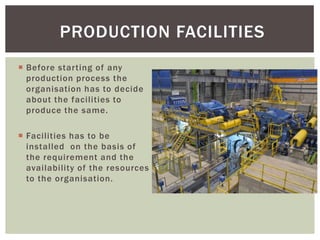
 Before starting of any
production process the
organisation has to decide
about the facilities to
produce the same.
 Facilities has to be
installed on the basis of
the requirement and the
availability of the resources
to the organisation.
PRODUCTION FACILITIES
Production facilities required by the organisation is
decided by the following :
 Types of product
 Production quantity
 Market
 Product demand
 Competitors for the product
 Location
 Product variety
DETERMINANTS OF PRODUCTION
FACILITIES
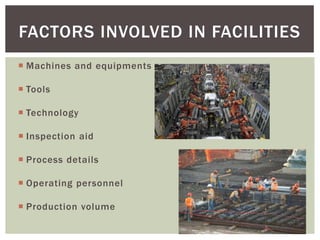
 Machines and equipments
 Tools
 Technology
 Inspection aid
 Process details
 Operating personnel
 Production volume
FACTORS INVOLVED IN FACILITIES
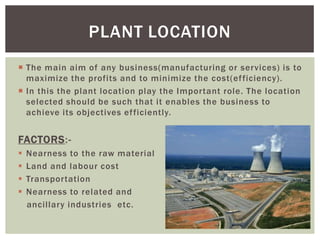
 The main aim of any business(manufacturing or services) is to
maximize the profits and to minimize the cost(efficiency).
 In this the plant location play the Important role. The location
selected should be such that it enables the business to
achieve its objectives efficiently.
FACTORS:-
 Nearness to the raw material
 Land and labour cost
 Transportation
 Nearness to related and
ancillary industries etc.
PLANT LOCATION
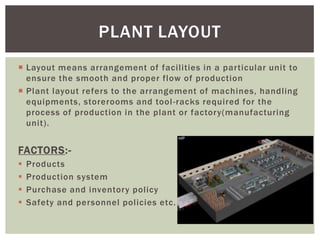
 Layout means arrangement of facilities in a particular unit to
ensure the smooth and proper flow of production
 Plant layout refers to the arrangement of machines, handling
equipments, storerooms and tool-racks required for the
process of production in the plant or factory(manufacturing
unit).
FACTORS:-
 Products
 Production system
 Purchase and inventory policy
 Safety and personnel policies etc.
PLANT LAYOUT
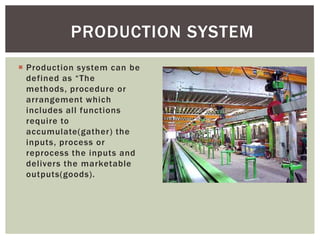
 Production system can be
defined as “The
methods, procedure or
arrangement which
includes all functions
require to
accumulate(gather) the
inputs, process or
reprocess the inputs and
delivers the marketable
outputs(goods).
PRODUCTION SYSTEM
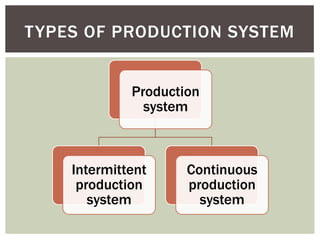
Production
system
Intermittent
production
system
Continuous
production
system
TYPES OF PRODUCTION SYSTEM
 Intermittent means something that starts (initiates) and stops
(halts) at irregular (unfixed) intervals (time gaps).
 In the intermittent production system, goods are produced
based on customer's orders. These goods are produced on a
small scale. The flow of production is intermittent (irregular).
INTERMITTENT PRODUCTION
SYSTEM
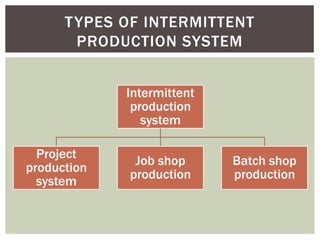
Intermittent
production
system
Project
production
system
Job shop
production
Batch shop
production
TYPES OF INTERMITTENT
PRODUCTION SYSTEM
 Here, in project production flows, company accepts a
single, complex order or contract. The order must be
completed within a given period of time and at an estimated
cost.
CHARACTERISTICS:-
 Requirement of resources varies
 Many agencies are involved
 Delays takes place
 Scheduling takes time
(A)PROJECT PRODUCTION
SYSTEM
 Here, in jobbing production flows, company accepts a contract
to produce either one or few units of a product strictly as per
specifications given by the customer. The product is produced
within a given period and at a fixed cost. This cost is fixed at
the time of signing the contract.
CHARACTERISTICS
 Production in small lots
 Production according to customer specification
 Skilled labour
 Disproportionate manufacturing cycle time
(B)JOB SHOP PRODUCTION
 In batch production flows, the production schedule is decided
according to specific orders or are based on the demand
forecasts.
 Here, the production of items takes place in lots or batches.
A product is divided into different jobs.
CHARACTERISTICS
 Made and stocked until demand
 General purpose machines
 Needs production planning and control
 Possibility of large work-in-progress
(C)BATCH PRODUCTION SYSTEM
 Continuous means something that operates constantly
without any irregularities or frequent halts.
 In the continuous production system, goods are produced
constantly as per demand forecast. Goods are produced on a
large scale for stocking and selling. They are not produced on
customer's orders.
CONTINUOUS PRODUCTION
SYSTEM
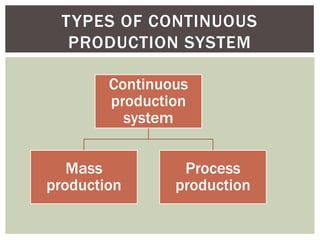
Continuous
production
system
Mass
production
Process
production
TYPES OF CONTINUOUS
PRODUCTION SYSTEM
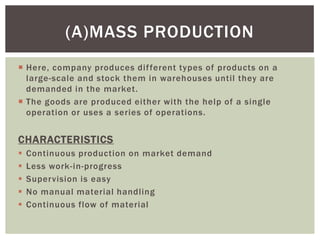
 Here, company produces different types of products on a
large-scale and stock them in warehouses until they are
demanded in the market.
 The goods are produced either with the help of a single
operation or uses a series of operations.
CHARACTERISTICS
 Continuous production on market demand
 Less work-in-progress
 Supervision is easy
 No manual material handling
 Continuous flow of material
(A)MASS PRODUCTION
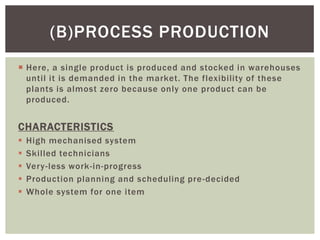
 Here, a single product is produced and stocked in warehouses
until it is demanded in the market. The flexibility of these
plants is almost zero because only one product can be
produced.
CHARACTERISTICS
 High mechanised system
 Skilled technicians
 Very-less work-in-progress
 Production planning and scheduling pre-decided
 Whole system for one item
(B)PROCESS PRODUCTION
 The Toyota Production System (TPS) is an integrated socio-
technical system, developed by Toyota, that comprises its
management philosophy and practices. The system was
developed between 1948 and 1975. The techniques that were
introduced in Toyota production system are:-
 Poke-yoke
 JIDOKA
 Just-in-time
 Kanban-cards
TOYOTA PRODUCTION SYSTEM
 Just-in-time(JIT) means
right parts needed in the
assembly line reaches the
assembly at the right time
and right amount.
 Just in time (JIT) is a
production strategy that
strives to improve a
business return on
investment by reducing in-
process inventory and
associated carrying costs.
JUST IN TIME
 Product cost
 Quality
 Design
 Productivity and flexibility
 Administrative efficiency
BENEFITS OF JIT
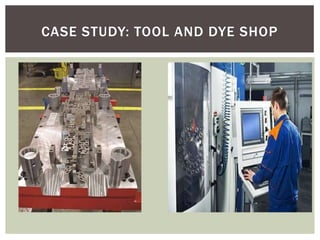
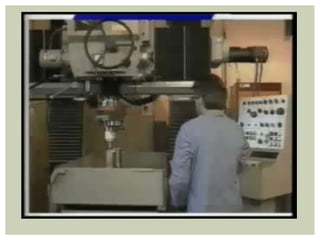
CASE STUDY: TOOL AND DYE SHOP
 To carry out any production
process availability of the
required facilities is
necessary.
 System to be installed on
the basis of the
requirement of the product.
CONCLUSION
Production System and Production Facilities

Production System and Production Facilities

  • 1.
    Presented by:- Nnisarg Kalyani(08) Paresh Parmar (19) Aamir Patel (20) Yash Shah (38) Sanket Vyas (55) PRODUCTION FACILITIES AND FUNCTIONS
  • 2.
     Introduction  Productionfacilities  Determinants of facilities  Factors involved in facilities  Plant location  Plant layout  Production system  Types of production system  Intermittent production system  Continuous production system  Toyota production system  JIT  Case study  Conclusion CONTENTS
  • 3.
     Production Facilitiesand Systems are the important aspects of the production management.  Production Facilities allows the smooth transformation of the inputs into the outputs i.e. manufacturing process with all the required machinery tools manpower etc.  While Production Systems ensures that there is the proper methods, arrangements, procedure is adopted to produce different types of goods or services. INTRODUCTION
  • 4.
     Before startingof any production process the organisation has to decide about the facilities to produce the same.  Facilities has to be installed on the basis of the requirement and the availability of the resources to the organisation. PRODUCTION FACILITIES
  • 5.
    Production facilities requiredby the organisation is decided by the following :  Types of product  Production quantity  Market  Product demand  Competitors for the product  Location  Product variety DETERMINANTS OF PRODUCTION FACILITIES
  • 6.
     Machines andequipments  Tools  Technology  Inspection aid  Process details  Operating personnel  Production volume FACTORS INVOLVED IN FACILITIES
  • 7.
     The mainaim of any business(manufacturing or services) is to maximize the profits and to minimize the cost(efficiency).  In this the plant location play the Important role. The location selected should be such that it enables the business to achieve its objectives efficiently. FACTORS:-  Nearness to the raw material  Land and labour cost  Transportation  Nearness to related and ancillary industries etc. PLANT LOCATION
  • 8.
     Layout meansarrangement of facilities in a particular unit to ensure the smooth and proper flow of production  Plant layout refers to the arrangement of machines, handling equipments, storerooms and tool-racks required for the process of production in the plant or factory(manufacturing unit). FACTORS:-  Products  Production system  Purchase and inventory policy  Safety and personnel policies etc. PLANT LAYOUT
  • 9.
     Production systemcan be defined as “The methods, procedure or arrangement which includes all functions require to accumulate(gather) the inputs, process or reprocess the inputs and delivers the marketable outputs(goods). PRODUCTION SYSTEM
  • 10.
  • 11.
     Intermittent meanssomething that starts (initiates) and stops (halts) at irregular (unfixed) intervals (time gaps).  In the intermittent production system, goods are produced based on customer's orders. These goods are produced on a small scale. The flow of production is intermittent (irregular). INTERMITTENT PRODUCTION SYSTEM
  • 12.
  • 13.
     Here, inproject production flows, company accepts a single, complex order or contract. The order must be completed within a given period of time and at an estimated cost. CHARACTERISTICS:-  Requirement of resources varies  Many agencies are involved  Delays takes place  Scheduling takes time (A)PROJECT PRODUCTION SYSTEM
  • 14.
     Here, injobbing production flows, company accepts a contract to produce either one or few units of a product strictly as per specifications given by the customer. The product is produced within a given period and at a fixed cost. This cost is fixed at the time of signing the contract. CHARACTERISTICS  Production in small lots  Production according to customer specification  Skilled labour  Disproportionate manufacturing cycle time (B)JOB SHOP PRODUCTION
  • 15.
     In batchproduction flows, the production schedule is decided according to specific orders or are based on the demand forecasts.  Here, the production of items takes place in lots or batches. A product is divided into different jobs. CHARACTERISTICS  Made and stocked until demand  General purpose machines  Needs production planning and control  Possibility of large work-in-progress (C)BATCH PRODUCTION SYSTEM
  • 16.
     Continuous meanssomething that operates constantly without any irregularities or frequent halts.  In the continuous production system, goods are produced constantly as per demand forecast. Goods are produced on a large scale for stocking and selling. They are not produced on customer's orders. CONTINUOUS PRODUCTION SYSTEM
  • 17.
  • 18.
     Here, companyproduces different types of products on a large-scale and stock them in warehouses until they are demanded in the market.  The goods are produced either with the help of a single operation or uses a series of operations. CHARACTERISTICS  Continuous production on market demand  Less work-in-progress  Supervision is easy  No manual material handling  Continuous flow of material (A)MASS PRODUCTION
  • 19.
     Here, asingle product is produced and stocked in warehouses until it is demanded in the market. The flexibility of these plants is almost zero because only one product can be produced. CHARACTERISTICS  High mechanised system  Skilled technicians  Very-less work-in-progress  Production planning and scheduling pre-decided  Whole system for one item (B)PROCESS PRODUCTION
  • 20.
     The ToyotaProduction System (TPS) is an integrated socio- technical system, developed by Toyota, that comprises its management philosophy and practices. The system was developed between 1948 and 1975. The techniques that were introduced in Toyota production system are:-  Poke-yoke  JIDOKA  Just-in-time  Kanban-cards TOYOTA PRODUCTION SYSTEM
  • 21.
     Just-in-time(JIT) means rightparts needed in the assembly line reaches the assembly at the right time and right amount.  Just in time (JIT) is a production strategy that strives to improve a business return on investment by reducing in- process inventory and associated carrying costs. JUST IN TIME
  • 22.
     Product cost Quality  Design  Productivity and flexibility  Administrative efficiency BENEFITS OF JIT
  • 23.
    CASE STUDY: TOOLAND DYE SHOP
  • 25.
     To carryout any production process availability of the required facilities is necessary.  System to be installed on the basis of the requirement of the product. CONCLUSION