CELLULAR MANUFACTURING
What is Cellular Manufacturing ?
• A lean manufacturing approach that helps companies build a
variety of products with as little waste as possible
• Equipment and workstations arranged in a sequence that
supports smooth material flow through the process, with
minimal transport or delay
• Derived from the word Cell
• A Manufacturing Cell consists of people and machines or
workstations required for performing the process steps
• For example - if a process for a product requires cutting,
followed by drilling and finishing, the cell would include the
equipment for performing those steps, arranged in that order
• Helps companies achieve two important goals of lean:
– One-piece flow
– High-variety production
One Piece Flow
• One-piece flow is the state that exists when products move
through a manufacturing process one unit at a time, at a rate
determined by the needs of the customer
• The opposite of one-piece flow is large-lot production
– Goods produced in large lots build delays into the process
– No items can move on to the next process until all items in
the lot have been processed
– The larger the lot, the longer the items sit and wait
between steps
• One-piece flow is an ideal state
• In daily operation, it is not always possible or desirable to
process items just one at a time
The important thing is to promote continuous flow of products,
with the least amount of delay and waiting
High-Variety Production
 In the early days, a company could produce one type of product
• Customers would buy it even if it wasn’t exactly what they liked
 Today customers expect variety and customization
• Specific quantities delivered at a specific time
 If your company is not flexible enough to serve their needs
customers will go to your competitor
 Cellular manufacturing offers flexibility to give customers the variety
they want
• By grouping similar products into families that can be processed on
same equipment in the same sequence
• Encourages companies to shorten changeover time between
products
• Eliminates a major reason for large-lot production
One-Piece Flow Vs. Large-Lot
Production
CMS & Group Technology(GT)
• CMS layout are based on recognizing similarities in
products – similarities in geometry, size, materials
and processing requirements
• This similar products are collected – “Grouped”
instead of being treated as individuals
• Leads to product families that visit similar
equipment and populate their ‘cells’ production
schedule
• Simpler setups like in a Job shop can follow and the
workers become multifunctional and responsible for
all aspects of a product – and its quality
• Cells can be scheduled to produce synchronously
bringing the various sub-assemblies in as needed at
final assembly with greater variety built in
Traditional Processes
• Based on FUNCTIONAL approach
• ‘Job Shop’ mentality
• Pushed in Batches
• Very little visibility & linkages
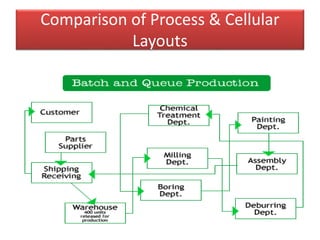
Comparison of Process & Cellular
Layouts
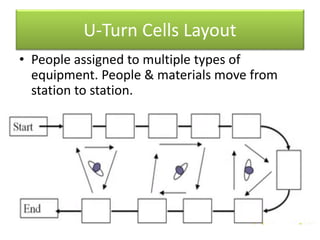
U-Turn Cells Layout
• People assigned to multiple types of
equipment. People & materials move from
station to station.
Clustering Techniques: the
Fundamental Issue in Cell
Development
• We cluster parts to build part families
– Part Families visit cells
– Part Families share set-up ideas and equipment
(Family Fixtures)
– Part Families follow the same (or similar) process
routing
– These are the ideas and activities that offer
reported benefits
Clustering Techniques: The
Fundamental Issue in Cell
Development
• We cluster Machines to build cells:
– Cells lead to Flow Mathematics
– Cells contain all equipment needed to produce a part
family
– Cells allow development of Multi-functional workers
– Cells hold work teams responsible for production and
quality “They Empower” the workers
• Empowered to set internal schedules
• Empowered to assign tasks
• Empowered to train and rotate jobs
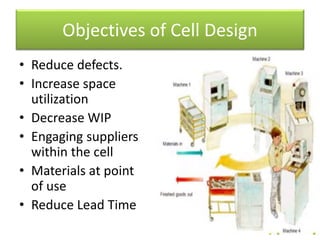
Objectives of Cell Design
• Reduce defects.
• Increase space
utilization
• Decrease WIP
• Engaging suppliers
within the cell
• Materials at point
of use
• Reduce Lead Time
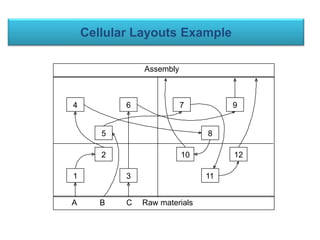
12
1
2
3
4
5
6 7
8
9
10
11
A B C Raw materials
Assembly
Cellular Layouts Example
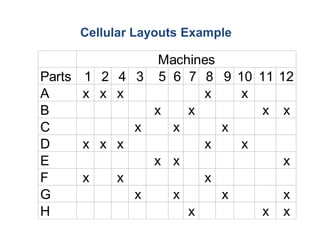
Parts 1 2 3 4 5 6 7 8 9 10 11 12
A x x x x x
B x x x x
C x x x
D x x x x x
E x x x
F x x x
G x x x x
H x x x
Machines
Cellular Layouts Example
Parts 1 2 4 3 5 6 7 8 9 10 11 12
A x x x x x
B x x x x
C x x x
D x x x x x
E x x x
F x x x
G x x x x
H x x x
Machines
Cellular Layouts Example
Parts 1 2 4 3 5 6 7 8 9 10 11 12
A x x x x x
D x x x x x
B x x x x
C x x x
E x x x
F x x x
G x x x x
H x x x
Machines
Cellular Layouts Example
Parts 1 2 4 8 3 5 6 7 9 10 11 12
A x x x x x
D x x x x x
B x x x x
C x x x
E x x x
F x x x
G x x x x
H x x x
Machines
Cellular Layouts Example
Parts 1 2 4 8 3 5 6 7 9 10 11 12
A x x x x x
D x x x x x
F x x x
B x x x x
C x x x
E x x x
G x x x x
H x x x
Machines
Cellular Layouts Example
Parts 1 2 4 8 10 3 5 6 7 9 11 12
A x x x x x
D x x x x x
F x x x
B x x x x
C x x x
E x x x
G x x x x
H x x x
Machines
Cellular Layouts Example
Parts 1 2 4 8 10 3 6 9 5 7 11 12
A x x x x x
D x x x x x
F x x x
C x x x
G x x x x
B x x x x
E x x x
H x x x
Machines
Cellular Layouts Example
12
12 3
4
5
6
7
8 910
11
A BCRaw materials
Cell1
Cell 2 Cell 3
Assembly
Cellular Layouts Example
Each of A, B, C now visits only one area, minimizing jumping.
Benefits of Cellular Manufacturing
• Promoting one-piece flow through cellular manufacturing
can help make your company more competitive
• Cut costly transport and delay from the manufacturing
process
• Shortens the production lead time
– Serves customer needs
– Gives an earlier return on the investment in the product
• Saves space in the factory
– Can be used for other value-adding purposes
• Promotes continuous improvement
– By forcing solutions to problems that block low-inventory
production
Disadvantages of Cellular
Manufacturing
• Sometimes cells may not be formed because of
inadequate part families.
• Some cells may have a high volume of production and
others very low. This results in poorly balanced cells
• When volume of production changes, number of
workers are adjusted and workers are reassigned to
various cells. To cope with this type of reassignments,
workers must be multi-skilled and cross-trained.
• Sometimes, machines are duplicated in different cells.
This increases capital investment.
Cellular Manufacturing

Cellular Manufacturing

  • 1.
  • 2.
    What is CellularManufacturing ? • A lean manufacturing approach that helps companies build a variety of products with as little waste as possible • Equipment and workstations arranged in a sequence that supports smooth material flow through the process, with minimal transport or delay • Derived from the word Cell • A Manufacturing Cell consists of people and machines or workstations required for performing the process steps • For example - if a process for a product requires cutting, followed by drilling and finishing, the cell would include the equipment for performing those steps, arranged in that order • Helps companies achieve two important goals of lean: – One-piece flow – High-variety production
  • 3.
    One Piece Flow •One-piece flow is the state that exists when products move through a manufacturing process one unit at a time, at a rate determined by the needs of the customer • The opposite of one-piece flow is large-lot production – Goods produced in large lots build delays into the process – No items can move on to the next process until all items in the lot have been processed – The larger the lot, the longer the items sit and wait between steps • One-piece flow is an ideal state • In daily operation, it is not always possible or desirable to process items just one at a time The important thing is to promote continuous flow of products, with the least amount of delay and waiting
  • 4.
    High-Variety Production  Inthe early days, a company could produce one type of product • Customers would buy it even if it wasn’t exactly what they liked  Today customers expect variety and customization • Specific quantities delivered at a specific time  If your company is not flexible enough to serve their needs customers will go to your competitor  Cellular manufacturing offers flexibility to give customers the variety they want • By grouping similar products into families that can be processed on same equipment in the same sequence • Encourages companies to shorten changeover time between products • Eliminates a major reason for large-lot production
  • 5.
    One-Piece Flow Vs.Large-Lot Production
  • 6.
    CMS & GroupTechnology(GT) • CMS layout are based on recognizing similarities in products – similarities in geometry, size, materials and processing requirements • This similar products are collected – “Grouped” instead of being treated as individuals • Leads to product families that visit similar equipment and populate their ‘cells’ production schedule • Simpler setups like in a Job shop can follow and the workers become multifunctional and responsible for all aspects of a product – and its quality • Cells can be scheduled to produce synchronously bringing the various sub-assemblies in as needed at final assembly with greater variety built in
  • 7.
    Traditional Processes • Basedon FUNCTIONAL approach • ‘Job Shop’ mentality • Pushed in Batches • Very little visibility & linkages
  • 8.
    Comparison of Process& Cellular Layouts
  • 10.
    U-Turn Cells Layout •People assigned to multiple types of equipment. People & materials move from station to station.
  • 11.
    Clustering Techniques: the FundamentalIssue in Cell Development • We cluster parts to build part families – Part Families visit cells – Part Families share set-up ideas and equipment (Family Fixtures) – Part Families follow the same (or similar) process routing – These are the ideas and activities that offer reported benefits
  • 12.
    Clustering Techniques: The FundamentalIssue in Cell Development • We cluster Machines to build cells: – Cells lead to Flow Mathematics – Cells contain all equipment needed to produce a part family – Cells allow development of Multi-functional workers – Cells hold work teams responsible for production and quality “They Empower” the workers • Empowered to set internal schedules • Empowered to assign tasks • Empowered to train and rotate jobs
  • 13.
    Objectives of CellDesign • Reduce defects. • Increase space utilization • Decrease WIP • Engaging suppliers within the cell • Materials at point of use • Reduce Lead Time
  • 14.
    12 1 2 3 4 5 6 7 8 9 10 11 A BC Raw materials Assembly Cellular Layouts Example
  • 15.
    Parts 1 23 4 5 6 7 8 9 10 11 12 A x x x x x B x x x x C x x x D x x x x x E x x x F x x x G x x x x H x x x Machines Cellular Layouts Example
  • 16.
    Parts 1 24 3 5 6 7 8 9 10 11 12 A x x x x x B x x x x C x x x D x x x x x E x x x F x x x G x x x x H x x x Machines Cellular Layouts Example
  • 17.
    Parts 1 24 3 5 6 7 8 9 10 11 12 A x x x x x D x x x x x B x x x x C x x x E x x x F x x x G x x x x H x x x Machines Cellular Layouts Example
  • 18.
    Parts 1 24 8 3 5 6 7 9 10 11 12 A x x x x x D x x x x x B x x x x C x x x E x x x F x x x G x x x x H x x x Machines Cellular Layouts Example
  • 19.
    Parts 1 24 8 3 5 6 7 9 10 11 12 A x x x x x D x x x x x F x x x B x x x x C x x x E x x x G x x x x H x x x Machines Cellular Layouts Example
  • 20.
    Parts 1 24 8 10 3 5 6 7 9 11 12 A x x x x x D x x x x x F x x x B x x x x C x x x E x x x G x x x x H x x x Machines Cellular Layouts Example
  • 21.
    Parts 1 24 8 10 3 6 9 5 7 11 12 A x x x x x D x x x x x F x x x C x x x G x x x x B x x x x E x x x H x x x Machines Cellular Layouts Example
  • 22.
    12 12 3 4 5 6 7 8 910 11 ABCRaw materials Cell1 Cell 2 Cell 3 Assembly Cellular Layouts Example Each of A, B, C now visits only one area, minimizing jumping.
  • 23.
    Benefits of CellularManufacturing • Promoting one-piece flow through cellular manufacturing can help make your company more competitive • Cut costly transport and delay from the manufacturing process • Shortens the production lead time – Serves customer needs – Gives an earlier return on the investment in the product • Saves space in the factory – Can be used for other value-adding purposes • Promotes continuous improvement – By forcing solutions to problems that block low-inventory production
  • 24.
    Disadvantages of Cellular Manufacturing •Sometimes cells may not be formed because of inadequate part families. • Some cells may have a high volume of production and others very low. This results in poorly balanced cells • When volume of production changes, number of workers are adjusted and workers are reassigned to various cells. To cope with this type of reassignments, workers must be multi-skilled and cross-trained. • Sometimes, machines are duplicated in different cells. This increases capital investment.