PROCUREMENT
Procurement is the acquisition of goods,
services or works from an outside external
source. It is favorable that the goods, services or
works are appropriate and that they are procured
at the best possible cost to meet the needs of the
purchaser in terms of quality and quantity, time,
and location. Corporations and public bodies
often define processes intended to promote fair
and open competition for their business while
minimizing exposure to fraud and collusion.
CONSIDERATIONS OF PROCUREMENT
 Speed
 Cost
 Quality
 Specific Project Constraints
 Risk
 Asset Ownership
 Financing
PROCUREMENT IN PUBLIC SECTOR
Public sector organizations use procurement for
contracts to achieve benefits such as increased
efficiency and cost savings (faster and cheaper) in
government procurement and improved
transparency (to reduce corruption) in procurement
services. E-procurement in the public sector has
seen rapid growth in recent years.
E-PROCUREMENT SYSTEM
An e-procurement system manages tenders through
a web site. This can be accessed anywhere
globally and has greatly improved the accessibility
of tenders. An example is the System for
Acquisition Management (SAM), which on July 30,
2013 combined information from the former Central
Contractor Registration and Online Representations
and Certifications Application (ORCA), in the United
States.
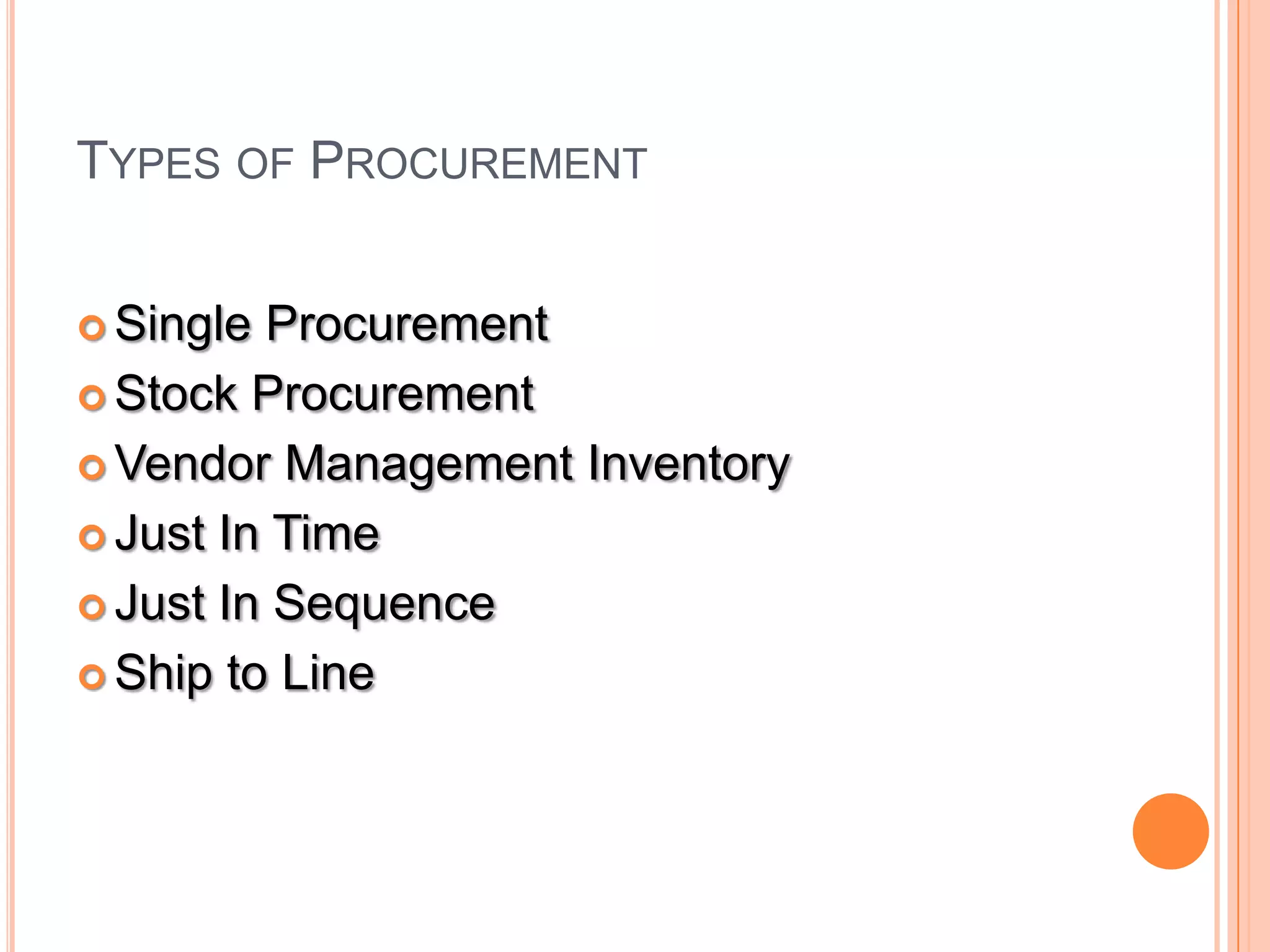
TYPES OF PROCUREMENT
 Single Procurement
 Stock Procurement
 Vendor Management Inventory
 Just In Time
 Just In Sequence
 Ship to Line
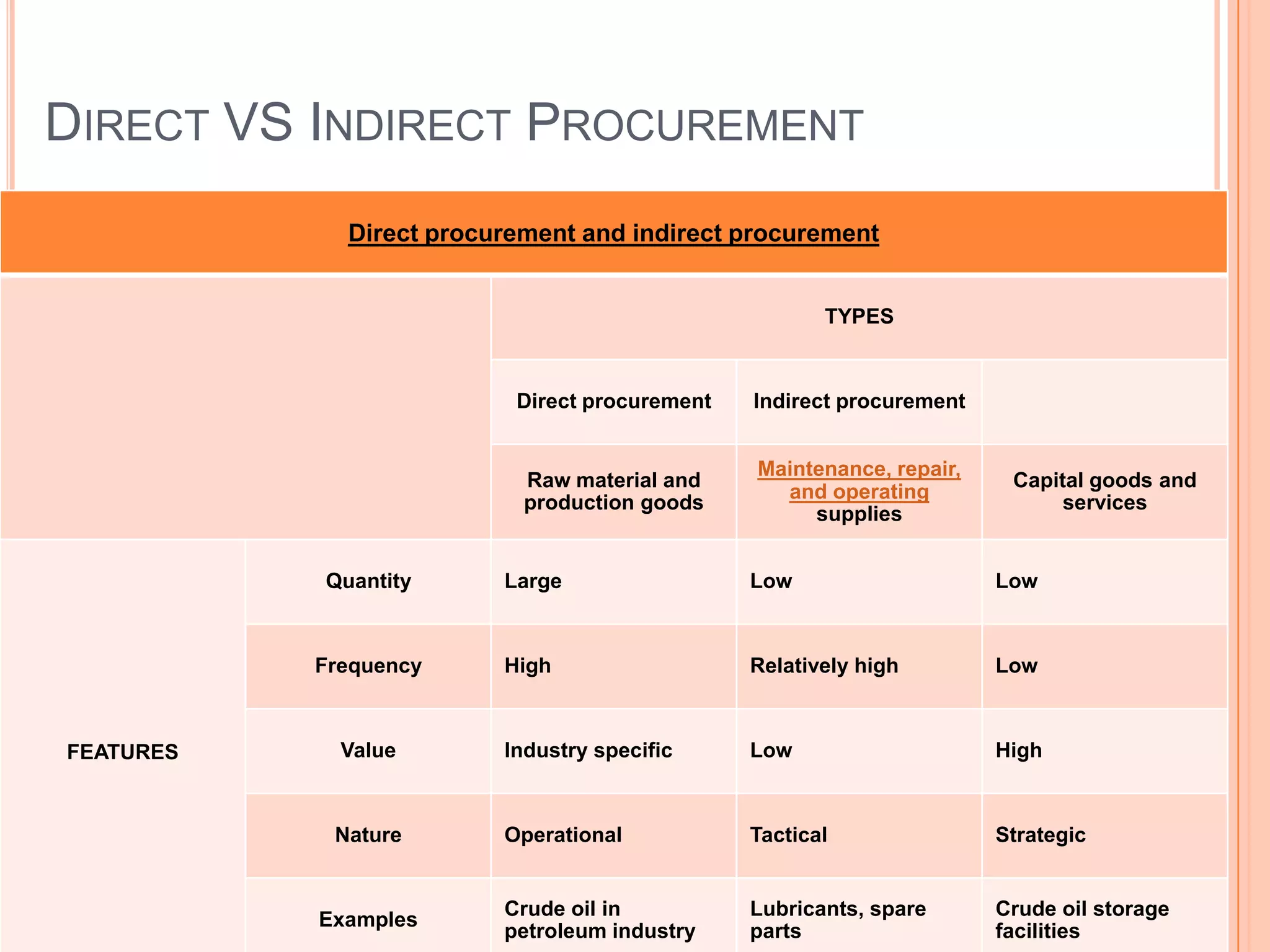
DIRECT VS INDIRECT PROCUREMENT
Direct procurement and indirect procurement
TYPES
Direct procurement Indirect procurement
Raw material and
production goods
Maintenance, repair,
and operating
supplies
Capital goods and
services
FEATURES
Quantity Large Low Low
Frequency High Relatively high Low
Value Industry specific Low High
Nature Operational Tactical Strategic
Examples
Crude oil in
petroleum industry
Lubricants, spare
parts
Crude oil storage
facilities
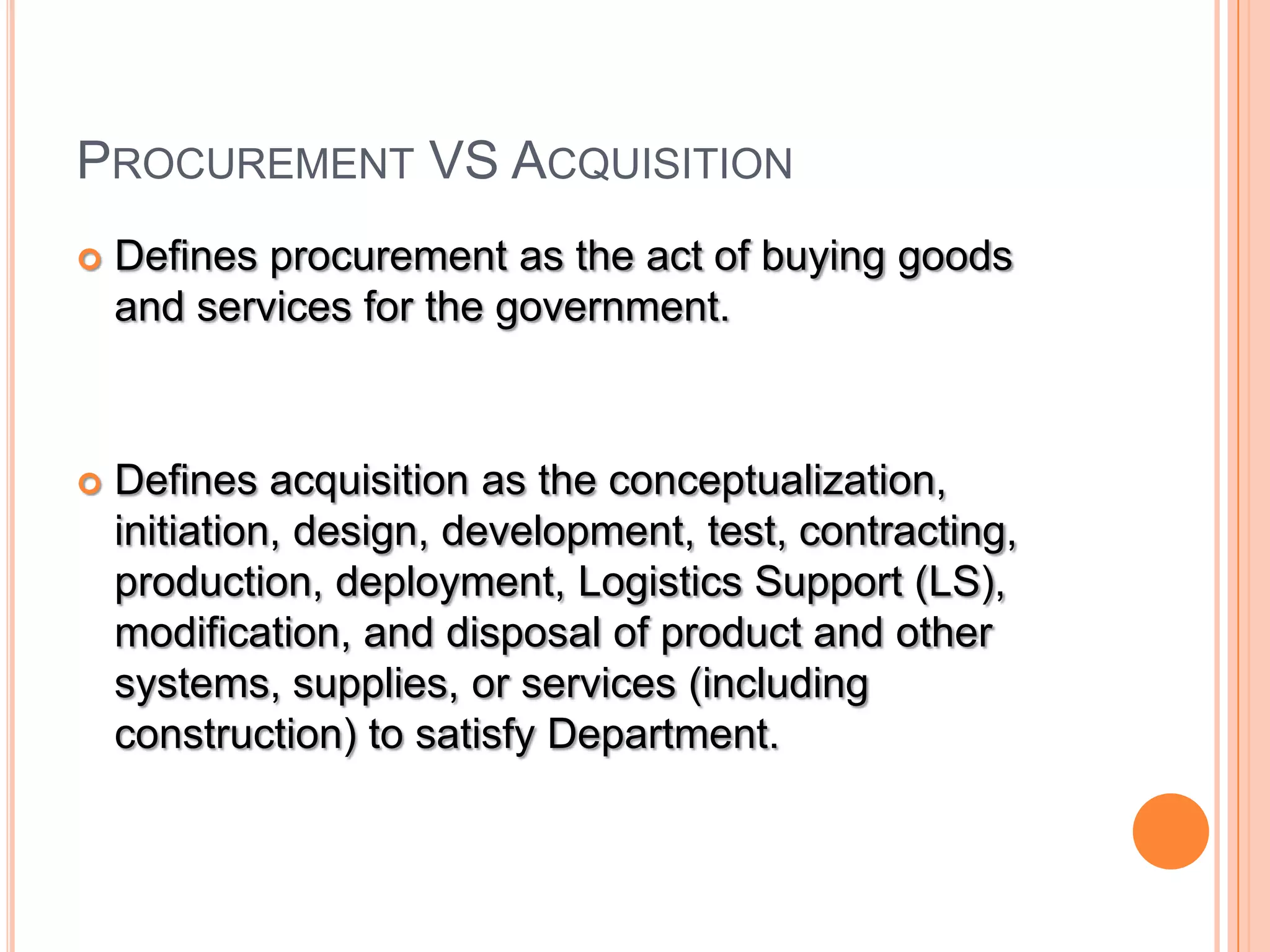
PROCUREMENT VS ACQUISITION
 Defines procurement as the act of buying goods
and services for the government.
 Defines acquisition as the conceptualization,
initiation, design, development, test, contracting,
production, deployment, Logistics Support (LS),
modification, and disposal of product and other
systems, supplies, or services (including
construction) to satisfy Department.
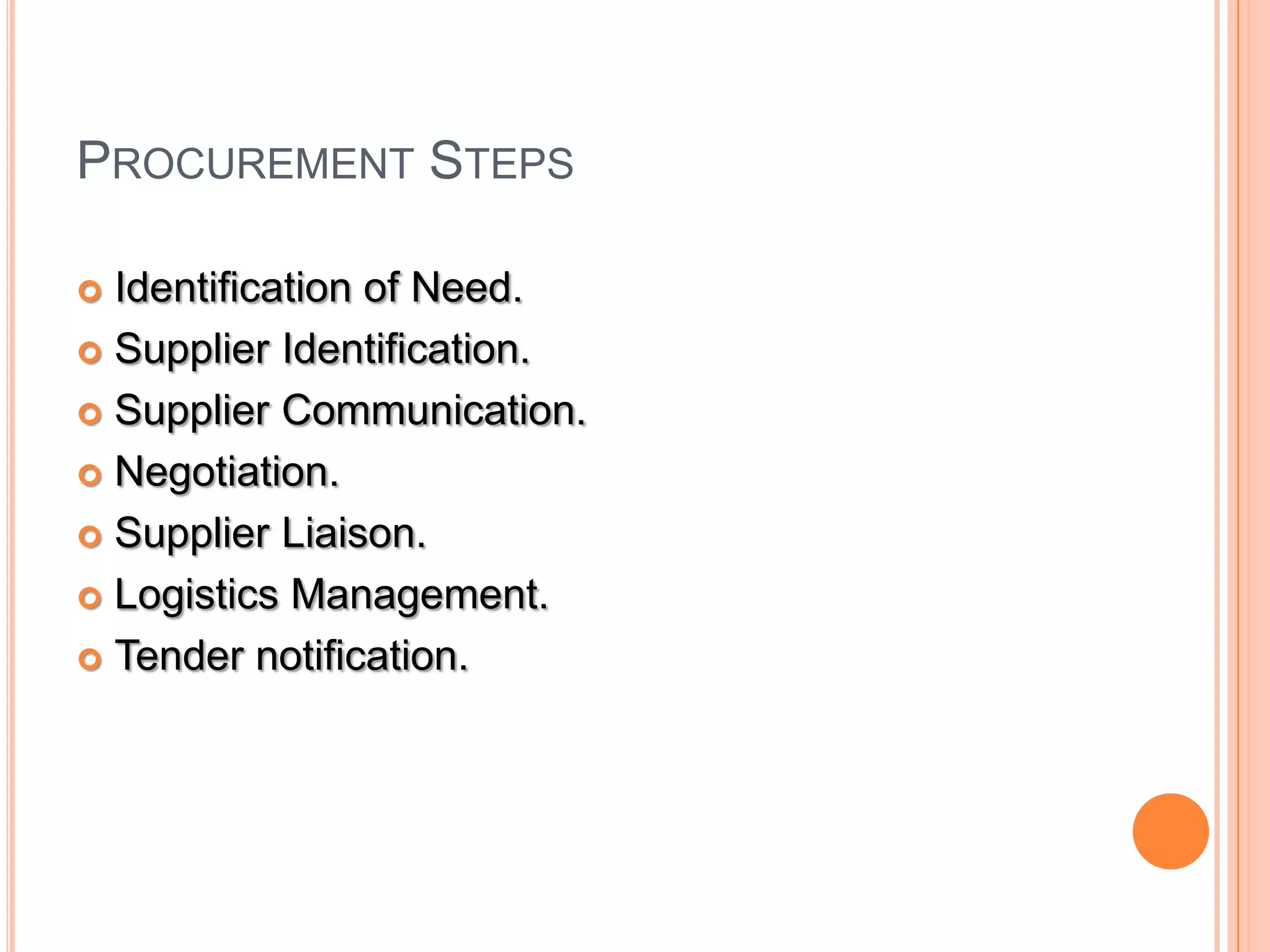
PROCUREMENT STEPS
 Identification of Need.
 Supplier Identification.
 Supplier Communication.
 Negotiation.
 Supplier Liaison.
 Logistics Management.
 Tender notification.
PUBLIC PROCUREMENT
 Government procurement
Public procurement generally is an important sector
of the economy. In Europe, public procurement
accounts for 16.3% of the Community GDP.
 Green public procurement
In Green public procurement (GPP), contracting
authorities and entities take environmental issues
into account when tendering for goods or services.
The goal is to reduce the impact of the procurement
on human health and the environment.
ALTERNATIVE PROCUREMENT PROCEDURES
There are several alternatives to tendering which are
available in formal procurement. One system which has
gained increasing momentum in the construction
industry and among developing economies is the
Selection in planning process which enables project
developers and equipment purchasers to make
significant changes to their requirements with relative
ease. The SIP process also enables vendors and
contractors to respond with greater accuracy and
competitiveness as a result of the generally longer lead
times they are afforded.
PROCUREMENT FRAUDS
Procurement fraud can be defined as dishonestly
obtaining an advantage, avoiding an obligation or
causing a loss to public property or various means
during procurement process by public servants,
contractors or any other person involved in the
procurement. An example is the kickback, whereby
a dishonest agent of the supplier pays a dishonest
agent of the purchaser to select the supplier's bid,
often at an inflated price.

What is Procurement

  • 1.
    PROCUREMENT Procurement is theacquisition of goods, services or works from an outside external source. It is favorable that the goods, services or works are appropriate and that they are procured at the best possible cost to meet the needs of the purchaser in terms of quality and quantity, time, and location. Corporations and public bodies often define processes intended to promote fair and open competition for their business while minimizing exposure to fraud and collusion.
  • 2.
    CONSIDERATIONS OF PROCUREMENT Speed  Cost  Quality  Specific Project Constraints  Risk  Asset Ownership  Financing
  • 3.
    PROCUREMENT IN PUBLICSECTOR Public sector organizations use procurement for contracts to achieve benefits such as increased efficiency and cost savings (faster and cheaper) in government procurement and improved transparency (to reduce corruption) in procurement services. E-procurement in the public sector has seen rapid growth in recent years.
  • 4.
    E-PROCUREMENT SYSTEM An e-procurementsystem manages tenders through a web site. This can be accessed anywhere globally and has greatly improved the accessibility of tenders. An example is the System for Acquisition Management (SAM), which on July 30, 2013 combined information from the former Central Contractor Registration and Online Representations and Certifications Application (ORCA), in the United States.
  • 5.
    TYPES OF PROCUREMENT Single Procurement  Stock Procurement  Vendor Management Inventory  Just In Time  Just In Sequence  Ship to Line
  • 6.
    DIRECT VS INDIRECTPROCUREMENT Direct procurement and indirect procurement TYPES Direct procurement Indirect procurement Raw material and production goods Maintenance, repair, and operating supplies Capital goods and services FEATURES Quantity Large Low Low Frequency High Relatively high Low Value Industry specific Low High Nature Operational Tactical Strategic Examples Crude oil in petroleum industry Lubricants, spare parts Crude oil storage facilities
  • 7.
    PROCUREMENT VS ACQUISITION Defines procurement as the act of buying goods and services for the government.  Defines acquisition as the conceptualization, initiation, design, development, test, contracting, production, deployment, Logistics Support (LS), modification, and disposal of product and other systems, supplies, or services (including construction) to satisfy Department.
  • 8.
    PROCUREMENT STEPS  Identificationof Need.  Supplier Identification.  Supplier Communication.  Negotiation.  Supplier Liaison.  Logistics Management.  Tender notification.
  • 9.
    PUBLIC PROCUREMENT  Governmentprocurement Public procurement generally is an important sector of the economy. In Europe, public procurement accounts for 16.3% of the Community GDP.  Green public procurement In Green public procurement (GPP), contracting authorities and entities take environmental issues into account when tendering for goods or services. The goal is to reduce the impact of the procurement on human health and the environment.
  • 10.
    ALTERNATIVE PROCUREMENT PROCEDURES Thereare several alternatives to tendering which are available in formal procurement. One system which has gained increasing momentum in the construction industry and among developing economies is the Selection in planning process which enables project developers and equipment purchasers to make significant changes to their requirements with relative ease. The SIP process also enables vendors and contractors to respond with greater accuracy and competitiveness as a result of the generally longer lead times they are afforded.
  • 11.
    PROCUREMENT FRAUDS Procurement fraudcan be defined as dishonestly obtaining an advantage, avoiding an obligation or causing a loss to public property or various means during procurement process by public servants, contractors or any other person involved in the procurement. An example is the kickback, whereby a dishonest agent of the supplier pays a dishonest agent of the purchaser to select the supplier's bid, often at an inflated price.