Cells
   How their
discovery led to
the Cell Theory
History
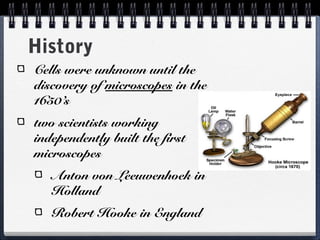
Cells were unknown until the
discovery of microscopes in the
1650’s
two scientists working
independently built the first
microscopes
   Anton von Leeuwenhoek in
   Holland
   Robert Hooke in England
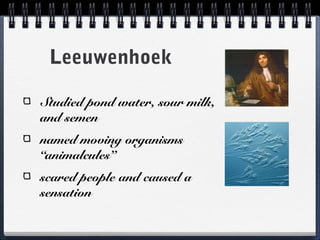
Leeuwenhoek

Studied pond water, sour milk,
and semen
named moving organisms
“animalcules”
scared people and caused a
sensation
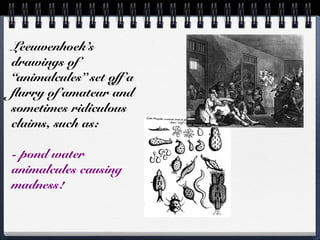
Leeuwenhoek’s
drawings of
“animalcules” set off a
flurry of amateur and
sometimes ridiculous
claims, such as:

- pond water
animalcules causing
madness!
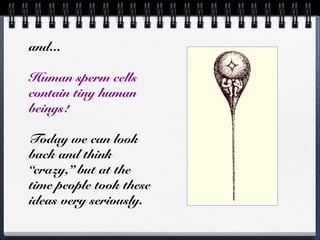
and...

Human sperm cells
contain tiny human
beings!

Today we can look
back and think
“crazy,” but at the
time people took these
ideas very seriously.
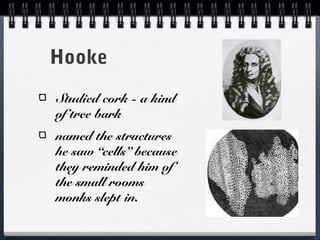
Hooke
Studied cork - a kind
of tree bark
named the structures
he saw “cells” because
they reminded him of
the small rooms
monks slept in.
Definition of Cell
•   A cell is the smallest unit that is
    capable of performing life
    functions.
•   A cell is the basic unit of life.
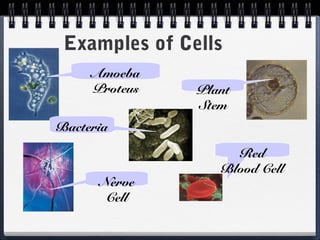
Examples of Cells
     Amoeba
     Proteus   Plant
               Stem
Bacteria

                    Red
                  Blood Cell
      Nerve
       Cell
The Cell Theory
   The cell theory has three parts:
      All living things contain at least one
      cell
      Cells are the smallest working units
      of all living things.
      Cells can only come from pre-existing
      cells through cell division (meiosis)
The cell theory-a closer look
   All living things contain at least one cell
      Many scientists working after Hooke
      and Leeuwenhoek observed different
      plants and animals
      Each of them noted that no matter
      what they observed, if it was alive it
      had cells.
Cells are the smallest working units of
all living things.
   Scientists (Theodor Schawnn
   &Matthias Schleiden) quickly
   realized that when cells were
   dissected or broken open they died
   This meant that whatever “life” is, it
   is something that happens inside cells
Cells can only come from pre-existing
cells through cell division
   does not answer the question of where
   the first cell came from or how it
   came to be.
   has not been disproved yet- no
   scientist has ever built a living cell
   from nonliving organic molecules
Spontaneous Generation


 From pre-historic times to about 1850,
 most people believed that under the right
 conditions, living things could
 spontaneously appear from non-living
 material.
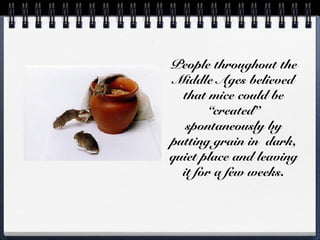
People throughout the
 Middle Ages believed
  that mice could be
        “created”
   spontaneously by
putting grain in dark,
quiet place and leaving
  it for a few weeks.
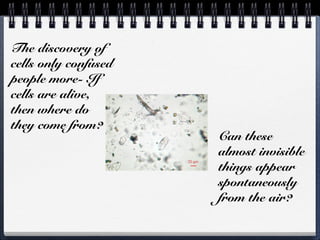
The discovery of
cells only confused
people more- If
cells are alive,
then where do
they come from?
                      Can these
                      almost invisible
                      things appear
                      spontaneously
                      from the air?
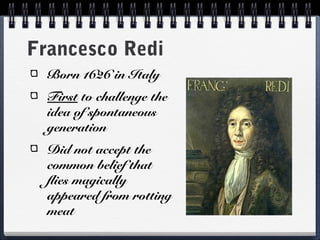
Francesco Redi
  Born 1626 in Italy
  First to challenge the
  idea of spontaneous
  generation
  Did not accept the
  common belief that
  flies magically
  appeared from rotting
  meat
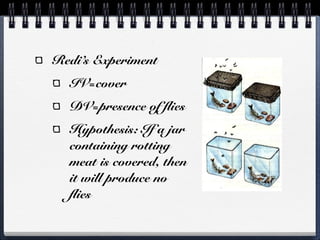
Redi’s Experiment
  IV=cover
  DV=presence of flies
  Hypothesis: If a jar
  containing rotting
  meat is covered, then
  it will produce no
  flies
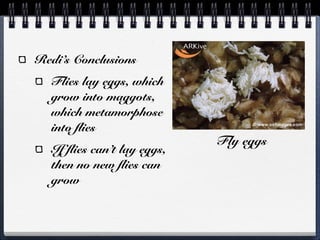
Redi’s Conclusions
  Flies lay eggs, which
  grow into maggots,
  which metamorphose
  into flies
                             Fly eggs
  If flies can’t lay eggs,
  then no new flies can
  grow
Objections to Redi
Many people rejected Redi’s claim that
flies do not spontaneously generate
Their reasoning:
   “sealing the jar closed prevented a
   magical essence from entering the
   rotting meat and brining it to life”
   “Scientists seek only to challenge belief
   systems and stir things up”
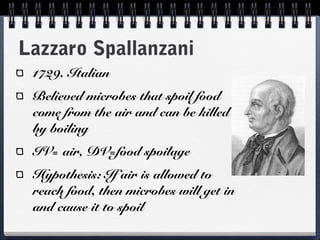
Lazzaro Spallanzani
 1729. Italian
 Believed microbes that spoil food
 come from the air and can be killed
 by boiling
 IV= air, DV=food spoilage
 Hypothesis: If air is allowed to
 reach food, then microbes will get in
 and cause it to spoil
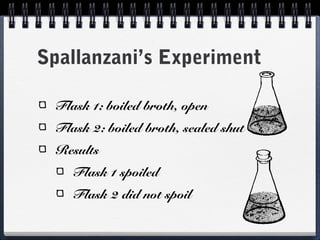
Spallanzani’s Experiment

  Flask 1: boiled broth, open
  Flask 2: boiled broth, sealed shut
  Results
     Flask 1 spoiled
     Flask 2 did not spoil
Objections to Spallanzani

 Sealing the flask shut
 blocked the entrance of a
 magical life force in the air
 from getting to the broth.
 Since few people had seen
 these microbes, few people
 believed him.
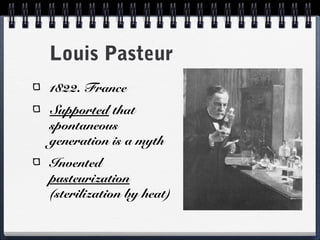
Louis Pasteur
1822. France
Supported that
spontaneous
generation is a myth
Invented
pasteurization
(sterilization by heat)
Pasteur’s Experiment
An improvement on Spallanzani’s work
Used special “swan-neck flasks” that allowed
air in but kept bacteria out
IV= bacteria, DV=spoiling broth
Hypothesis; If boiled broth is kept free of
bacteria, then it will not spoil even if air can
reach it.
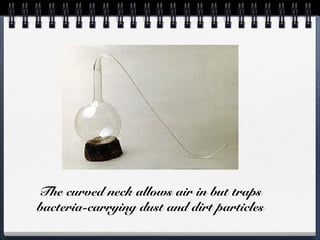
The curved neck allows air in but traps
bacteria-carrying dust and dirt particles
Spontaneous generation is
dead!
  Redi didn’t believe in it, and did an
  experiment using flies
  Spallanzani didn’t believe in it, and
  experimented with broth
  Pasteur disproved it conclusively with
  his open-air yet spoilage free flasks.
Pasteur is the father of
modern microbiology
supported the last part of the cell theory:
cells only come from pre-existing cells
identified yeasts as the microbes that
change grape juice into wine
showed that heat can be used to sterilize
foods and preserve them in sealed glass
containers, and later cans.
The cell theory is one of the
most important theories in
biology.

  All living things contain at least one cell
  Cells are the smallest living units of matter
  Cells can only come from pre-existing cells
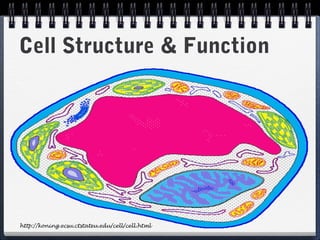
Cell Structure & Function


http://koning.ecsu.ctstateu.edu/cell/cell.html
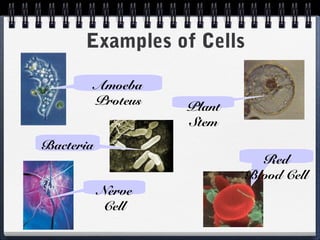
Examples of Cells

           Amoeba
           Proteus   Plant
                     Stem
Bacteria
                               Red
                             Blood Cell
           Nerve
            Cell
Two Types of Cells

•   Prokaryotic
•   Eukaryotic
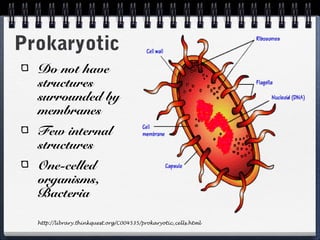
Prokaryotic
  Do not have
  structures
  surrounded by
  membranes
  Few internal
  structures
  One-celled
  organisms,
  Bacteria

  http://library.thinkquest.org/C004535/prokaryotic_cells.html
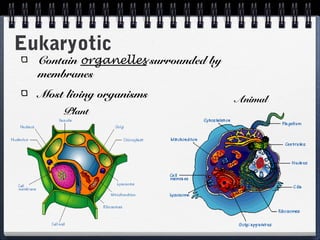
Eukaryotic
  Contain organelles surrounded by
  membranes
  Most living organisms              Animal
      Plant
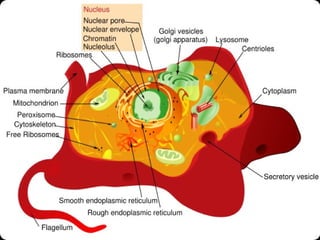
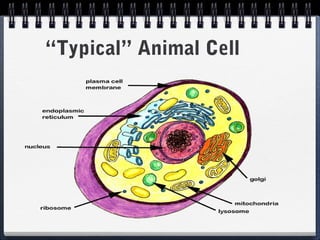
“Typical” Animal Cell
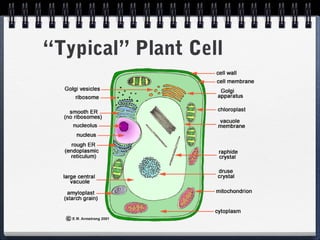
“Typical” Plant Cell
Cell Parts

Organelles
Surrounding the Cell
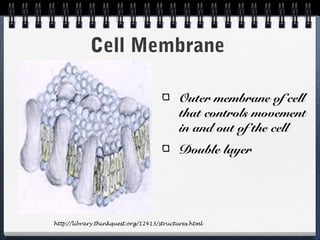
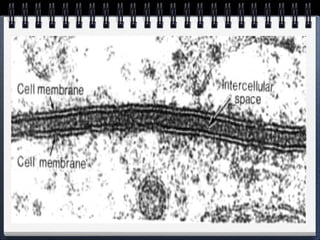
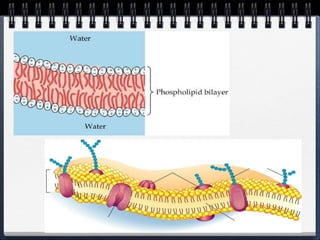
Cell Membrane

                                           Outer membrane of cell
                                           that controls movement
                                           in and out of the cell
                                           Double layer


http://library.thinkquest.org/12413/structures.html
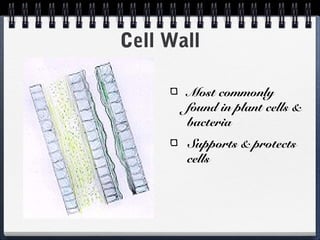
Cell Wall

       Most commonly
       found in plant cells &
       bacteria
       Supports & protects
       cells
Inside the Cell
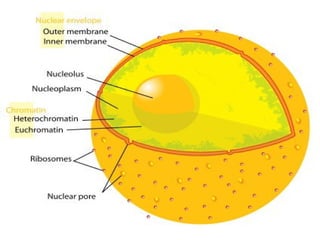
Nucleus
Directs cell activities
Separated from cytoplasm by nuclear
membrane
Contains genetic material - DNA
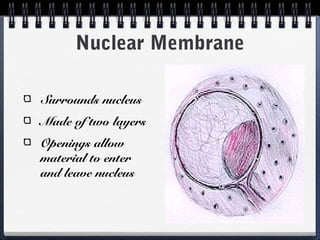
Nuclear Membrane

Surrounds nucleus
Made of two layers
Openings allow
material to enter
and leave nucleus
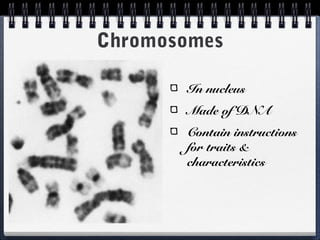
Chromosomes

       In nucleus
       Made of DNA
       Contain instructions
       for traits &
       characteristics
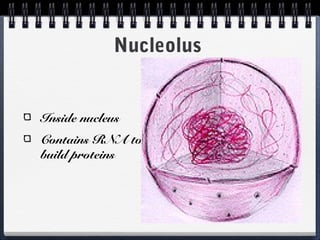
Nucleolus


Inside nucleus
Contains RNA to
build proteins
Cytoplasm


Gel-like mixture
Surrounded by cell membrane
Contains hereditary material
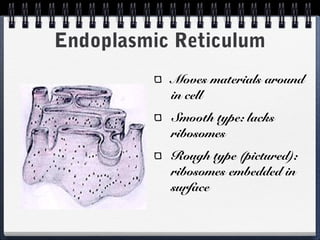
Endoplasmic Reticulum
           Moves materials around
           in cell
           Smooth type: lacks
           ribosomes
           Rough type (pictured):
           ribosomes embedded in
           surface
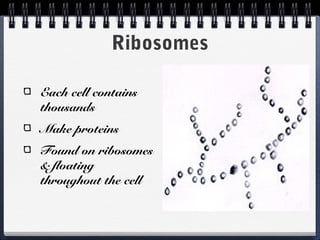
Ribosomes

Each cell contains
thousands
Make proteins
Found on ribosomes
& floating
throughout the cell
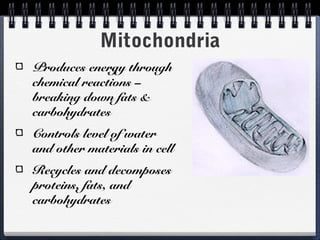
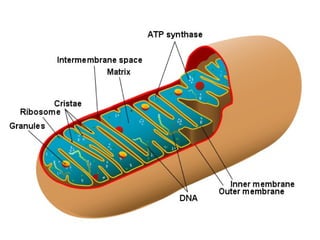
Mitochondria
Produces energy through
chemical reactions –
breaking down fats &
carbohydrates
Controls level of water
and other materials in cell
Recycles and decomposes
proteins, fats, and
carbohydrates
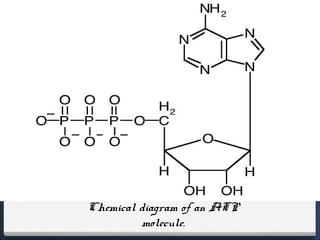
Chemical diagram of an ATP
         molecule.
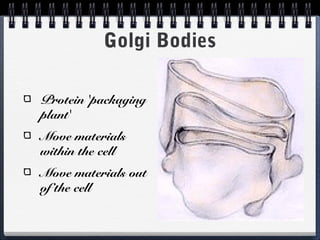
Golgi Bodies

Protein 'packaging
plant'
Move materials
within the cell
Move materials out
of the cell
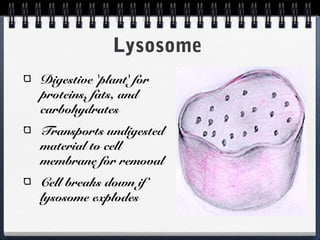
Lysosome
Digestive 'plant' for
proteins, fats, and
carbohydrates
Transports undigested
material to cell
membrane for removal
Cell breaks down if
lysosome explodes
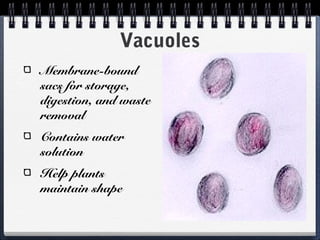
Vacuoles
Membrane-bound
sacs for storage,
digestion, and waste
removal
Contains water
solution
Help plants
maintain shape
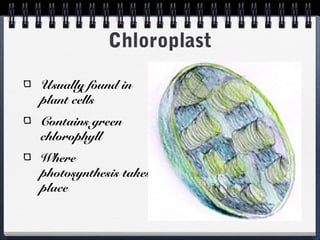
Chloroplast

Usually found in
plant cells
Contains green
chlorophyll
Where
photosynthesis takes
place

All about cells

  • 1.
    Cells How their discovery led to the Cell Theory
  • 3.
    History Cells were unknownuntil the discovery of microscopes in the 1650’s two scientists working independently built the first microscopes Anton von Leeuwenhoek in Holland Robert Hooke in England
  • 4.
    Leeuwenhoek Studied pond water,sour milk, and semen named moving organisms “animalcules” scared people and caused a sensation
  • 5.
    Leeuwenhoek’s drawings of “animalcules” setoff a flurry of amateur and sometimes ridiculous claims, such as: - pond water animalcules causing madness!
  • 6.
    and... Human sperm cells containtiny human beings! Today we can look back and think “crazy,” but at the time people took these ideas very seriously.
  • 7.
    Hooke Studied cork -a kind of tree bark named the structures he saw “cells” because they reminded him of the small rooms monks slept in.
  • 8.
    Definition of Cell • A cell is the smallest unit that is capable of performing life functions. • A cell is the basic unit of life.
  • 9.
    Examples of Cells Amoeba Proteus Plant Stem Bacteria Red Blood Cell Nerve Cell
  • 10.
    The Cell Theory The cell theory has three parts: All living things contain at least one cell Cells are the smallest working units of all living things. Cells can only come from pre-existing cells through cell division (meiosis)
  • 11.
    The cell theory-acloser look All living things contain at least one cell Many scientists working after Hooke and Leeuwenhoek observed different plants and animals Each of them noted that no matter what they observed, if it was alive it had cells.
  • 12.
    Cells are thesmallest working units of all living things. Scientists (Theodor Schawnn &Matthias Schleiden) quickly realized that when cells were dissected or broken open they died This meant that whatever “life” is, it is something that happens inside cells
  • 13.
    Cells can onlycome from pre-existing cells through cell division does not answer the question of where the first cell came from or how it came to be. has not been disproved yet- no scientist has ever built a living cell from nonliving organic molecules
  • 14.
    Spontaneous Generation Frompre-historic times to about 1850, most people believed that under the right conditions, living things could spontaneously appear from non-living material.
  • 15.
    People throughout the Middle Ages believed that mice could be “created” spontaneously by putting grain in dark, quiet place and leaving it for a few weeks.
  • 16.
    The discovery of cellsonly confused people more- If cells are alive, then where do they come from? Can these almost invisible things appear spontaneously from the air?
  • 17.
    Francesco Redi Born 1626 in Italy First to challenge the idea of spontaneous generation Did not accept the common belief that flies magically appeared from rotting meat
  • 18.
    Redi’s Experiment IV=cover DV=presence of flies Hypothesis: If a jar containing rotting meat is covered, then it will produce no flies
  • 19.
    Redi’s Conclusions Flies lay eggs, which grow into maggots, which metamorphose into flies Fly eggs If flies can’t lay eggs, then no new flies can grow
  • 20.
    Objections to Redi Manypeople rejected Redi’s claim that flies do not spontaneously generate Their reasoning: “sealing the jar closed prevented a magical essence from entering the rotting meat and brining it to life” “Scientists seek only to challenge belief systems and stir things up”
  • 21.
    Lazzaro Spallanzani 1729.Italian Believed microbes that spoil food come from the air and can be killed by boiling IV= air, DV=food spoilage Hypothesis: If air is allowed to reach food, then microbes will get in and cause it to spoil
  • 22.
    Spallanzani’s Experiment Flask 1: boiled broth, open Flask 2: boiled broth, sealed shut Results Flask 1 spoiled Flask 2 did not spoil
  • 23.
    Objections to Spallanzani Sealing the flask shut blocked the entrance of a magical life force in the air from getting to the broth. Since few people had seen these microbes, few people believed him.
  • 24.
    Louis Pasteur 1822. France Supportedthat spontaneous generation is a myth Invented pasteurization (sterilization by heat)
  • 25.
    Pasteur’s Experiment An improvementon Spallanzani’s work Used special “swan-neck flasks” that allowed air in but kept bacteria out IV= bacteria, DV=spoiling broth Hypothesis; If boiled broth is kept free of bacteria, then it will not spoil even if air can reach it.
  • 26.
    The curved neckallows air in but traps bacteria-carrying dust and dirt particles
  • 27.
    Spontaneous generation is dead! Redi didn’t believe in it, and did an experiment using flies Spallanzani didn’t believe in it, and experimented with broth Pasteur disproved it conclusively with his open-air yet spoilage free flasks.
  • 28.
    Pasteur is thefather of modern microbiology supported the last part of the cell theory: cells only come from pre-existing cells identified yeasts as the microbes that change grape juice into wine showed that heat can be used to sterilize foods and preserve them in sealed glass containers, and later cans.
  • 29.
    The cell theoryis one of the most important theories in biology. All living things contain at least one cell Cells are the smallest living units of matter Cells can only come from pre-existing cells
  • 30.
    Cell Structure &Function http://koning.ecsu.ctstateu.edu/cell/cell.html
  • 31.
    Examples of Cells Amoeba Proteus Plant Stem Bacteria Red Blood Cell Nerve Cell
  • 32.
    Two Types ofCells • Prokaryotic • Eukaryotic
  • 33.
    Prokaryotic Donot have structures surrounded by membranes Few internal structures One-celled organisms, Bacteria http://library.thinkquest.org/C004535/prokaryotic_cells.html
  • 34.
    Eukaryotic Containorganelles surrounded by membranes Most living organisms Animal Plant
  • 35.
  • 36.
  • 38.
  • 39.
  • 40.
    Cell Membrane Outer membrane of cell that controls movement in and out of the cell Double layer http://library.thinkquest.org/12413/structures.html
  • 43.
    Cell Wall Most commonly found in plant cells & bacteria Supports & protects cells
  • 44.
  • 45.
    Nucleus Directs cell activities Separatedfrom cytoplasm by nuclear membrane Contains genetic material - DNA
  • 46.
    Nuclear Membrane Surrounds nucleus Madeof two layers Openings allow material to enter and leave nucleus
  • 47.
    Chromosomes In nucleus Made of DNA Contain instructions for traits & characteristics
  • 48.
  • 49.
    Cytoplasm Gel-like mixture Surrounded bycell membrane Contains hereditary material
  • 50.
    Endoplasmic Reticulum Moves materials around in cell Smooth type: lacks ribosomes Rough type (pictured): ribosomes embedded in surface
  • 51.
    Ribosomes Each cell contains thousands Makeproteins Found on ribosomes & floating throughout the cell
  • 52.
    Mitochondria Produces energy through chemicalreactions – breaking down fats & carbohydrates Controls level of water and other materials in cell Recycles and decomposes proteins, fats, and carbohydrates
  • 54.
    Chemical diagram ofan ATP molecule.
  • 55.
    Golgi Bodies Protein 'packaging plant' Movematerials within the cell Move materials out of the cell
  • 56.
    Lysosome Digestive 'plant' for proteins,fats, and carbohydrates Transports undigested material to cell membrane for removal Cell breaks down if lysosome explodes
  • 57.
    Vacuoles Membrane-bound sacs for storage, digestion,and waste removal Contains water solution Help plants maintain shape
  • 58.
    Chloroplast Usually found in plantcells Contains green chlorophyll Where photosynthesis takes place