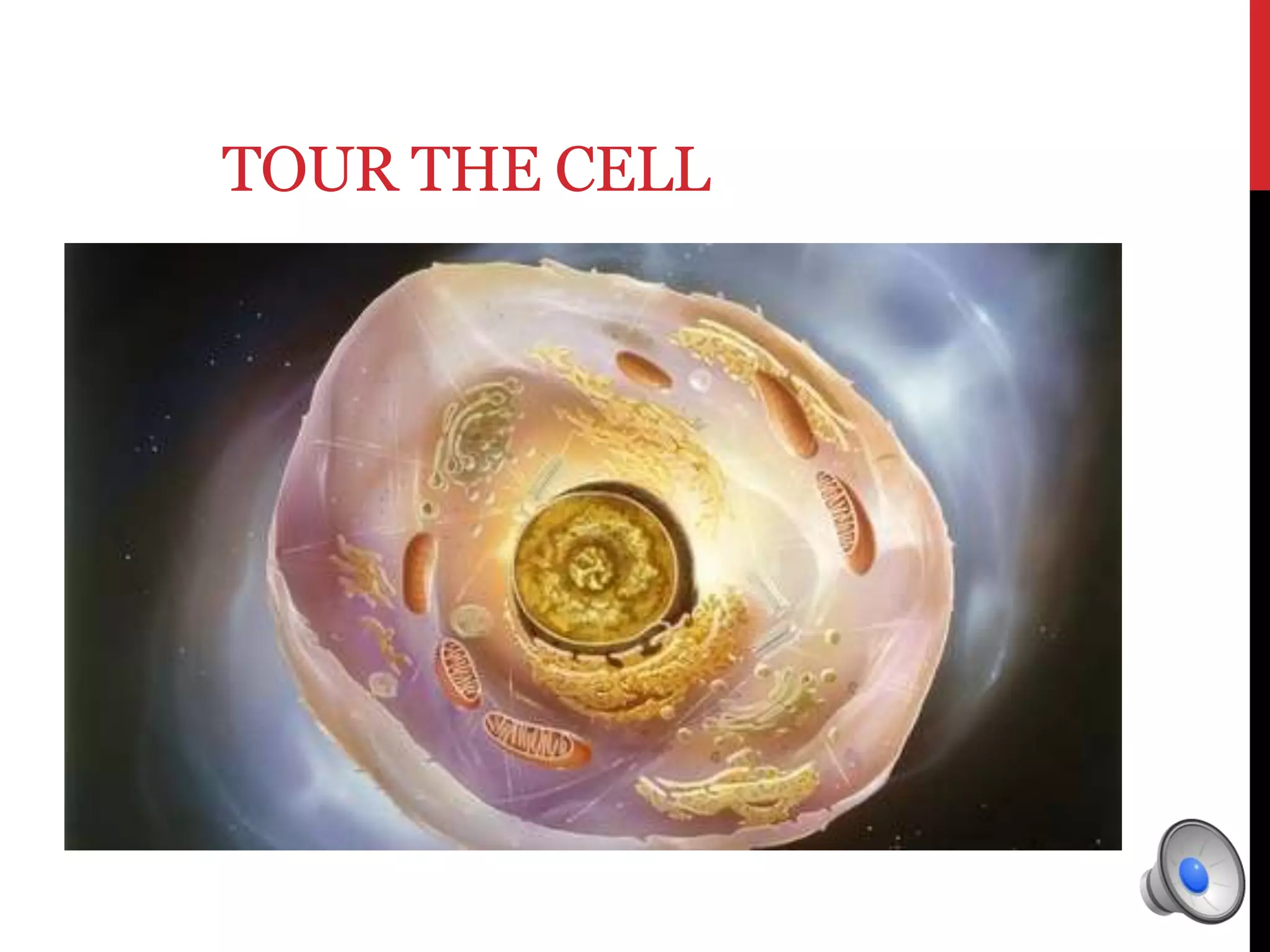
TOUR THE CELL
OVERVIEW: THE FUNDAMENTAL
UNITS OF LIFE
• All organisms are made of cells
• The cell is the simplest unit of matter that is
alive
• Cell structure is correlated to cellular function
(STRUCTURE DETERMINES FUNCTION!)
• All cells are related by their descent from
earlier cells (Pre-existing cells)
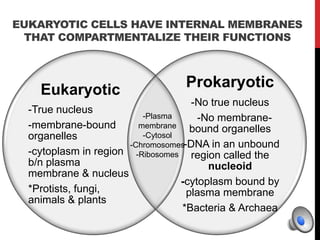
EUKARYOTIC CELLS HAVE INTERNAL MEMBRANES
THAT COMPARTMENTALIZE THEIR FUNCTIONS
Eukaryotic
-True nucleus
-membrane-bound
organelles
-cytoplasm in region
b/n plasma
membrane & nucleus
*Protists, fungi,
animals & plants
Prokaryotic
-No true nucleus
-No membrane-
bound organelles
-DNA in an unbound
region called the
nucleoid
-cytoplasm bound by
plasma membrane
*Bacteria & Archaea
-Plasma
membrane
-Cytosol
-Chromosomes
-Ribosomes
Fimbriae
Bacterial
chromosome
A typical
rod-shaped
bacterium
(a)
Nucleoid
Ribosomes
Plasma
membrane
Cell wall
Capsule
Flagella
FIGURE6.5-CAMPBELL BIOLOGY9TH
EDITION
Prokaryotic Cell
(Bacterial Cell)
EUKARYOTIC CELLS
A eukaryotic cell has internal membranes that
partition the cell into organelles
Plant and animal cells have MOST of the same
organelles
ENDOPLASMIC RETICULUM (ER)
Rough
ER
Smooth
ER
Nuclear
envelope
Nucleolus
Chromatin
Plasma
membrane
Ribosomes
Golgi apparatus
LysosomeMitochondrion
Peroxisome
Microvilli
Microtubules
Intermediate filaments
Microfilaments
Centrosome
CYTOSKELETON:
Flagellum NUCLEUS
NUCLEUS
Nuclear
envelope
Nucleolus
Chromatin
Golgi
apparatus
Mitochondrion
Peroxisome
Plasma membrane
Cell wall
Wall of adjacent cell
Plasmodesmata
Chloroplast
Microtubules
Intermediate
filaments
Microfilaments
CYTOSKELETON
Central vacuole
Ribosomes
Smooth
endoplasmic
reticulum
Rough
endoplasmic
reticulum
FIGURE 6.8C
The plasma membrane is SEMI-PERMEABLE
• The plasma membrane is a SELECTIVE BARRIER
that allows certain molecules to move in and out
of the cell
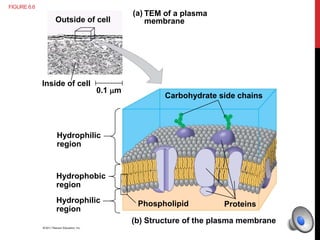
FIGURE 6.6
Outside of cell
Inside of cell
0.1 m
(a) TEM of a plasma
membrane
Hydrophilic
region
Hydrophobic
region
Hydrophilic
region
Carbohydrate side chains
ProteinsPhospholipid
(b) Structure of the plasma membrane
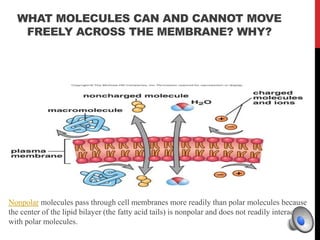
WHAT MOLECULES CAN AND CANNOT MOVE
FREELY ACROSS THE MEMBRANE? WHY?
Nonpolar molecules pass through cell membranes more readily than polar molecules because
the center of the lipid bilayer (the fatty acid tails) is nonpolar and does not readily interact
with polar molecules.
PROTEIN FACTORIES
Ribosomes use the information from the DNA to make
proteins
• Ribosomes are like “factories”
• Site of protein synthesis
Ribosomes are located in the cytosol as free ribosomes or attached to
the rough endoplasmic reticulum
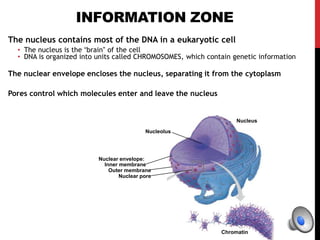
INFORMATION ZONE
The nucleus contains most of the DNA in a eukaryotic cell
• The nucleus is the “brain” of the cell
• DNA is organized into units called CHROMOSOMES, which contain genetic information
The nuclear envelope encloses the nucleus, separating it from the cytoplasm
Pores control which molecules enter and leave the nucleus
Chromatin
Nucleus
Nucleolus
Nuclear envelope:
Inner membrane
Outer membrane
Nuclear pore
BIOSYNTHETIC FACTORY OR CONVEYOR BELT
The endoplasmic reticulum (ER) accounts for
more than half of the total membrane in many
eukaryotic cells
The ER membrane is continuous with the
nuclear envelope
There are two distinct regions of ER
• Smooth ER, which lacks ribosomes
• Rough ER, surface is studded with ribosomes
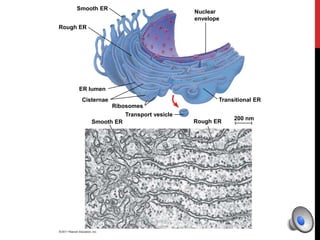
Smooth ER
Rough ER
ER lumen
Cisternae
Ribosomes
Smooth ER
Transport vesicle
Transitional ER
Rough ER
200 nm
Nuclear
envelope
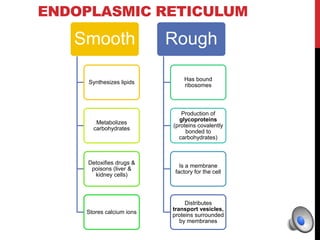
ENDOPLASMIC RETICULUM
Smooth
Synthesizes lipids
Metabolizes
carbohydrates
Detoxifies drugs &
poisons (liver &
kidney cells)
Stores calcium ions
Rough
Has bound
ribosomes
Production of
glycoproteins
(proteins covalently
bonded to
carbohydrates)
Is a membrane
factory for the cell
Distributes
transport vesicles,
proteins surrounded
by membranes
SHIPPING AND
RECEIVING CENTER
The Golgi apparatus consists of flattened
membranous sacs called cisternae
Functions of the Golgi apparatus
• Modifies products of the ER
• Manufactures certain macromolecules
• Sorts and packages materials into transport
vesicles
GARBAGE DISPOSAL OR JANITORS
• A lysosome is a membranous sac of
hydrolytic enzymes that can digest
macromolecules
• Lysosomal enzymes work best in the
acidic environment inside the lysosome
VACUOLE: WATER HOLE
A plant cell or fungal cell may have one or
several vacuoles, derived from endoplasmic
reticulum and Golgi apparatus
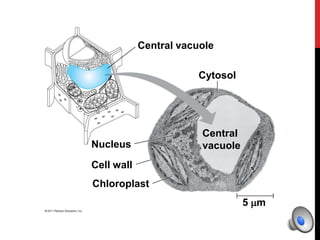
Central vacuoles, found in many mature plant
cells, hold organic compounds and water
Central vacuole
Cytosol
Nucleus
Cell wall
Chloroplast
Central
vacuole
5 m
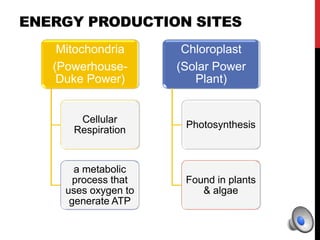
ENERGY PRODUCTION SITES
Mitochondria
(Powerhouse-
Duke Power)
Cellular
Respiration
a metabolic
process that
uses oxygen to
generate ATP
Chloroplast
(Solar Power
Plant)
Photosynthesis
Found in plants
& algae
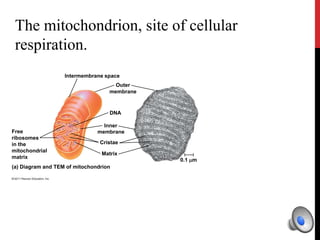
Intermembrane space
Outer
membrane
DNA
Inner
membrane
Cristae
Matrix
Free
ribosomes
in the
mitochondrial
matrix
(a) Diagram and TEM of mitochondrion
0.1 m
Mitochondrial
DNA
Nuclear DNA
Mitochondria
10 m
The mitochondrion, site of cellular
respiration.
CHLOROPLASTS: CAPTURE OF LIGHT
ENERGY
Chloroplasts contain the green pigment
chlorophyll, as well as enzymes and
other molecules that function in
photosynthesis
Chloroplasts are found in leaves and
other green organs of plants and in algae
Chloroplast structure includes
Thylakoids, membranous sacs, stacked to
form a granum
Stroma, the internal fluid
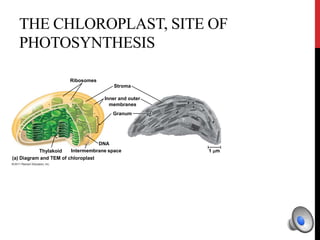
Ribosomes
Stroma
Inner and outer
membranes
Granum
1 mIntermembrane spaceThylakoid
(a) Diagram and TEM of chloroplast
Chloroplasts
(red)
50 m
DNA
THE CHLOROPLAST, SITE OF
PHOTOSYNTHESIS
CELL WALLS OF PLANTS
Animal cells DO NOT have cell walls
• Plants, Prokaryotes, Fungi, and some Protists have
cell walls
The cell wall protects the plant cell, maintains
its shape, and prevents excessive uptake of
water
Plant cell walls are made of cellulose fibers
CREATE A MIND MAP OF THE
CELL STRUCTURES FOUND IN A
TYPICAL EUKARYOTIC CELL

Cell Structure and Function

  • 1.
  • 2.
    OVERVIEW: THE FUNDAMENTAL UNITSOF LIFE • All organisms are made of cells • The cell is the simplest unit of matter that is alive • Cell structure is correlated to cellular function (STRUCTURE DETERMINES FUNCTION!) • All cells are related by their descent from earlier cells (Pre-existing cells)
  • 3.
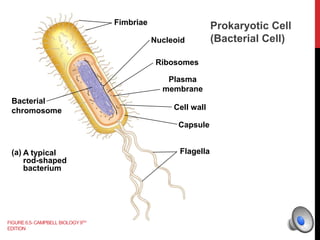
    EUKARYOTIC CELLS HAVEINTERNAL MEMBRANES THAT COMPARTMENTALIZE THEIR FUNCTIONS Eukaryotic -True nucleus -membrane-bound organelles -cytoplasm in region b/n plasma membrane & nucleus *Protists, fungi, animals & plants Prokaryotic -No true nucleus -No membrane- bound organelles -DNA in an unbound region called the nucleoid -cytoplasm bound by plasma membrane *Bacteria & Archaea -Plasma membrane -Cytosol -Chromosomes -Ribosomes
  • 4.
  • 5.
    EUKARYOTIC CELLS A eukaryoticcell has internal membranes that partition the cell into organelles Plant and animal cells have MOST of the same organelles
  • 6.
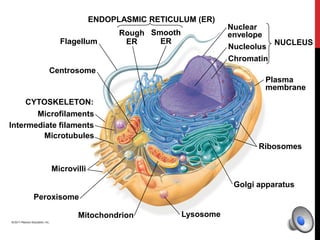
    ENDOPLASMIC RETICULUM (ER) Rough ER Smooth ER Nuclear envelope Nucleolus Chromatin Plasma membrane Ribosomes Golgiapparatus LysosomeMitochondrion Peroxisome Microvilli Microtubules Intermediate filaments Microfilaments Centrosome CYTOSKELETON: Flagellum NUCLEUS
  • 7.
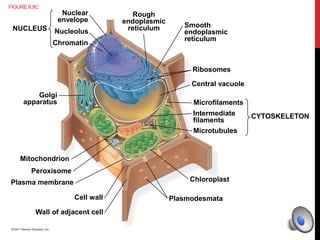
    NUCLEUS Nuclear envelope Nucleolus Chromatin Golgi apparatus Mitochondrion Peroxisome Plasma membrane Cell wall Wallof adjacent cell Plasmodesmata Chloroplast Microtubules Intermediate filaments Microfilaments CYTOSKELETON Central vacuole Ribosomes Smooth endoplasmic reticulum Rough endoplasmic reticulum FIGURE 6.8C
  • 8.
    The plasma membraneis SEMI-PERMEABLE • The plasma membrane is a SELECTIVE BARRIER that allows certain molecules to move in and out of the cell
  • 9.
    FIGURE 6.6 Outside ofcell Inside of cell 0.1 m (a) TEM of a plasma membrane Hydrophilic region Hydrophobic region Hydrophilic region Carbohydrate side chains ProteinsPhospholipid (b) Structure of the plasma membrane
  • 10.
    WHAT MOLECULES CANAND CANNOT MOVE FREELY ACROSS THE MEMBRANE? WHY? Nonpolar molecules pass through cell membranes more readily than polar molecules because the center of the lipid bilayer (the fatty acid tails) is nonpolar and does not readily interact with polar molecules.
  • 11.
    PROTEIN FACTORIES Ribosomes usethe information from the DNA to make proteins • Ribosomes are like “factories” • Site of protein synthesis Ribosomes are located in the cytosol as free ribosomes or attached to the rough endoplasmic reticulum
  • 12.
    INFORMATION ZONE The nucleuscontains most of the DNA in a eukaryotic cell • The nucleus is the “brain” of the cell • DNA is organized into units called CHROMOSOMES, which contain genetic information The nuclear envelope encloses the nucleus, separating it from the cytoplasm Pores control which molecules enter and leave the nucleus Chromatin Nucleus Nucleolus Nuclear envelope: Inner membrane Outer membrane Nuclear pore
  • 13.
    BIOSYNTHETIC FACTORY ORCONVEYOR BELT The endoplasmic reticulum (ER) accounts for more than half of the total membrane in many eukaryotic cells The ER membrane is continuous with the nuclear envelope There are two distinct regions of ER • Smooth ER, which lacks ribosomes • Rough ER, surface is studded with ribosomes
  • 14.
    Smooth ER Rough ER ERlumen Cisternae Ribosomes Smooth ER Transport vesicle Transitional ER Rough ER 200 nm Nuclear envelope
  • 15.
    ENDOPLASMIC RETICULUM Smooth Synthesizes lipids Metabolizes carbohydrates Detoxifiesdrugs & poisons (liver & kidney cells) Stores calcium ions Rough Has bound ribosomes Production of glycoproteins (proteins covalently bonded to carbohydrates) Is a membrane factory for the cell Distributes transport vesicles, proteins surrounded by membranes
  • 16.
    SHIPPING AND RECEIVING CENTER TheGolgi apparatus consists of flattened membranous sacs called cisternae Functions of the Golgi apparatus • Modifies products of the ER • Manufactures certain macromolecules • Sorts and packages materials into transport vesicles
  • 17.
    GARBAGE DISPOSAL ORJANITORS • A lysosome is a membranous sac of hydrolytic enzymes that can digest macromolecules • Lysosomal enzymes work best in the acidic environment inside the lysosome
  • 18.
    VACUOLE: WATER HOLE Aplant cell or fungal cell may have one or several vacuoles, derived from endoplasmic reticulum and Golgi apparatus Central vacuoles, found in many mature plant cells, hold organic compounds and water
  • 19.
  • 20.
    ENERGY PRODUCTION SITES Mitochondria (Powerhouse- DukePower) Cellular Respiration a metabolic process that uses oxygen to generate ATP Chloroplast (Solar Power Plant) Photosynthesis Found in plants & algae
  • 21.
    Intermembrane space Outer membrane DNA Inner membrane Cristae Matrix Free ribosomes in the mitochondrial matrix (a)Diagram and TEM of mitochondrion 0.1 m Mitochondrial DNA Nuclear DNA Mitochondria 10 m The mitochondrion, site of cellular respiration.
  • 22.
    CHLOROPLASTS: CAPTURE OFLIGHT ENERGY Chloroplasts contain the green pigment chlorophyll, as well as enzymes and other molecules that function in photosynthesis Chloroplasts are found in leaves and other green organs of plants and in algae Chloroplast structure includes Thylakoids, membranous sacs, stacked to form a granum Stroma, the internal fluid
  • 23.
    Ribosomes Stroma Inner and outer membranes Granum 1mIntermembrane spaceThylakoid (a) Diagram and TEM of chloroplast Chloroplasts (red) 50 m DNA THE CHLOROPLAST, SITE OF PHOTOSYNTHESIS
  • 24.
    CELL WALLS OFPLANTS Animal cells DO NOT have cell walls • Plants, Prokaryotes, Fungi, and some Protists have cell walls The cell wall protects the plant cell, maintains its shape, and prevents excessive uptake of water Plant cell walls are made of cellulose fibers
  • 25.
    CREATE A MINDMAP OF THE CELL STRUCTURES FOUND IN A TYPICAL EUKARYOTIC CELL

Editor's Notes

  • #2 Within cells there is an intricate network of organelles that all have unique functions. These organelles allow the cell to function properly.