
The integument
by
Syafiqa Al-Azua Binti
I’d like to talk about
• How many layers are there in the
skin ?
• What are these layers made of ?
• What are their significant
functions ?
But.
What is this …. 

SKIN?
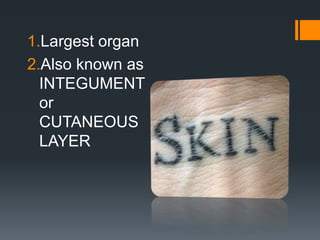
1.Largest organ
2.Also known as
INTEGUMENT
or
CUTANEOUS
LAYER
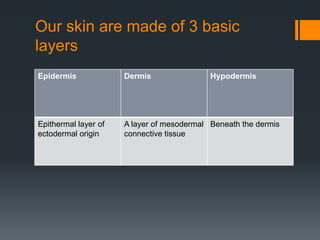
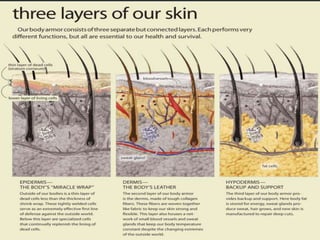
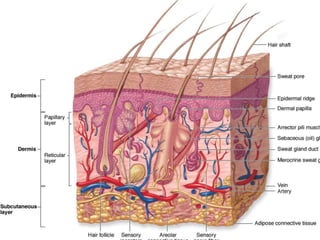
Our skin are made of 3 basic
layers
Epidermis

Dermis

Hypodermis

Epithermal layer of
ectodermal origin

A layer of mesodermal Beneath the dermis
connective tissue
1st skin layer- Epidermis
 Outermost layer of the skin
 Have 4 different types of cells
 But mainly are STRATIFIED SQUAMOUS KERATINIZED
EPITHILIUM – composed of cells called keratinocytes
 The other NON-KERATINOCYTE CELLS

pigment-producing melanocytes

antigen-producing langerhans cells

tactile merkel cells
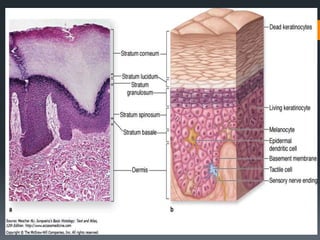
Layers of epidermis
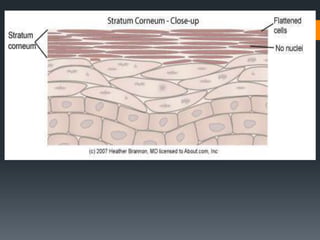
 Stratum corneum
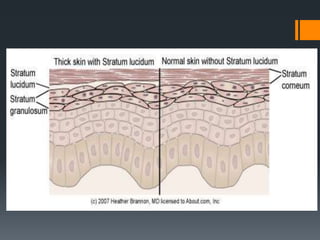
 Stratum lucidum
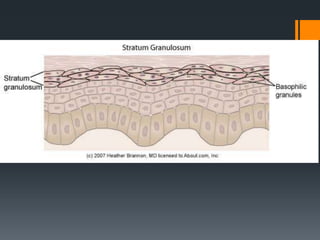
 Stratum granulosum – the granular layer
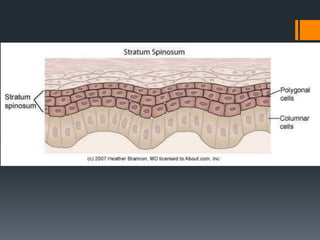
 Stratum spinosum – the spinous layer
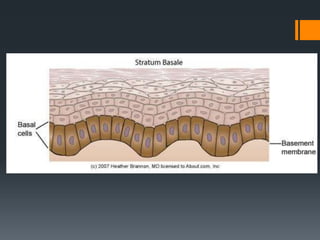
 Stratum basale – the basal layer
WHAT IT DOES -

COMPONENTS –

• Supports epidermis & binds it to the hypodermis
• Site for epidermal derivatives (e.g: hair follicles &
glands)

• irregular in shape & has many projections called Dermal
Papillae.
• Have abundance of nerve supply

DERMIS

Have BASEMENT MEMBRANE
• located in between the epidermis’s stratum basale &
dermis’s papillary layer.
• Composed of Basal Lamina and Reticular Lamina
• Important for nutrients to pass through from the
vascular dermis into the avascular epidermis.

Consists of 2 layers with indistinct
boundaries
• OUTERMOST PAPILLARY LAYER
• Constitutes the major parts of the dermis
• Functions : produce anchoring – to be inserted into
basal lamina for the binding of dermis and epidermis
• DEEPER RETICULAR LAYER
• Thicker & composed of irregular dense CT
• Has more fibers than cells
• Present of elastic fiber to provide elasticityu
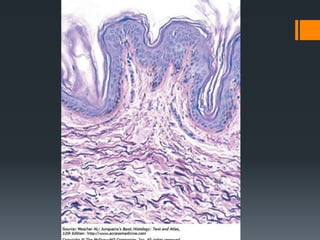
Dermal papillae
• Projections of dermal layers into the epidermis.
• Interlock with epidermal pegs
• It is more numerous in skin that is subjected to frequent
pressure. HOW???
 By increasing the epidermal-dermal junction
HypoDermis
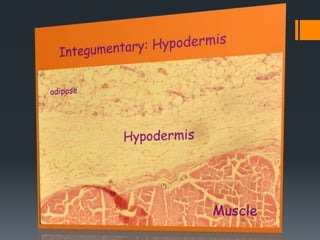
1. Consists of loose connective tissue – e.g: fat cells /
adipocytes (vary in number according to different region
of the body & vary in size according to the nutritional
state)
2. Binds the skin loosely to the subjacent organs - This
enable the skin to slide over them.
3. Have an extensive vascular supply – promote rapid
uptake of insulin / drug injected into the tissue.
module 2-Body Tissue (The integument)

module 2-Body Tissue (The integument)

  • 1.
  • 2.
    I’d like totalk about • How many layers are there in the skin ? • What are these layers made of ? • What are their significant functions ?
  • 3.
    But. What is this….  SKIN?
  • 4.
    1.Largest organ 2.Also knownas INTEGUMENT or CUTANEOUS LAYER
  • 5.
    Our skin aremade of 3 basic layers Epidermis Dermis Hypodermis Epithermal layer of ectodermal origin A layer of mesodermal Beneath the dermis connective tissue
  • 8.
    1st skin layer-Epidermis  Outermost layer of the skin  Have 4 different types of cells  But mainly are STRATIFIED SQUAMOUS KERATINIZED EPITHILIUM – composed of cells called keratinocytes  The other NON-KERATINOCYTE CELLS  pigment-producing melanocytes  antigen-producing langerhans cells  tactile merkel cells
  • 9.
    Layers of epidermis Stratum corneum  Stratum lucidum  Stratum granulosum – the granular layer  Stratum spinosum – the spinous layer  Stratum basale – the basal layer
  • 16.
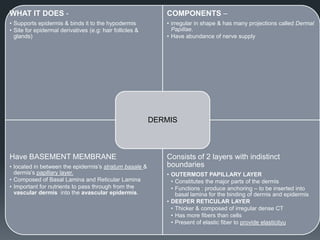
    WHAT IT DOES- COMPONENTS – • Supports epidermis & binds it to the hypodermis • Site for epidermal derivatives (e.g: hair follicles & glands) • irregular in shape & has many projections called Dermal Papillae. • Have abundance of nerve supply DERMIS Have BASEMENT MEMBRANE • located in between the epidermis’s stratum basale & dermis’s papillary layer. • Composed of Basal Lamina and Reticular Lamina • Important for nutrients to pass through from the vascular dermis into the avascular epidermis. Consists of 2 layers with indistinct boundaries • OUTERMOST PAPILLARY LAYER • Constitutes the major parts of the dermis • Functions : produce anchoring – to be inserted into basal lamina for the binding of dermis and epidermis • DEEPER RETICULAR LAYER • Thicker & composed of irregular dense CT • Has more fibers than cells • Present of elastic fiber to provide elasticityu
  • 17.
    Dermal papillae • Projectionsof dermal layers into the epidermis. • Interlock with epidermal pegs • It is more numerous in skin that is subjected to frequent pressure. HOW???  By increasing the epidermal-dermal junction
  • 19.
    HypoDermis 1. Consists ofloose connective tissue – e.g: fat cells / adipocytes (vary in number according to different region of the body & vary in size according to the nutritional state) 2. Binds the skin loosely to the subjacent organs - This enable the skin to slide over them. 3. Have an extensive vascular supply – promote rapid uptake of insulin / drug injected into the tissue.