Phylum
Mollusca
1
General Characteristics
 50,000 or more species of molluscs.
 They share 3 major sets of characteristics:
 Body enclosed by a mantle that secretes a shell
made of calcium or some other stiff structure.
 A mantle cavity between the mantle and the
internal organs; the anus, reproductive, and
excretory ducts open into the mantle cavity.
 A ventral, muscular foot that is highly modified
among the various groups of molluscs.
2
General Characteristics Cont’d
 Free-living, multicellular animals
 Invertebrates (lack a backbone)
 Unsegmented
 Have a true coelom
 Bilateral symmetry
 Simple to complex nervous system
3
Habitats & Niches
 Some mollusc habitats include:
 Marine (mostly)
 Freshwater (a few)
 Land (a few)
 Mollusc niches (life-style):
 Most live on the ocean bottom and are mostly sedentary
 Some are free-swimming (the cephalopods)
4
The six major mollusc classes
 Those 6 classes are:
 Monoplacophora (mono=single; placo=shell; phora=bearing)
 Ex. Neopilina
 Aplacophora (a=without)
 Ex. Neomenia
 Polyplacophora (poly=many)
 Ex. Chitons
 Gastropoda (gastro=body cavity; poda=foot)
 Ex. Common garden snail, abalone, turban snail
 Scaphopoda
 Ex. Dentalium
 Cephalopoda (cephalo=dealing with head; poda=foot)
 Ex. Squid, octopus, etc.
5
Shell in Mollusca
The soft, unsegmented bodies of mollusk is
covered by hard and calcareous shell which
acts as protective covering.
Shell may be external or internal
Study of mollucscan shell called conchology.
6
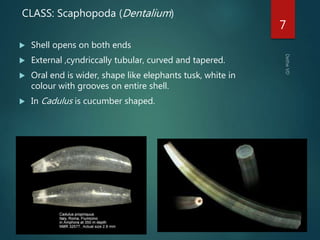
CLASS: Scaphopoda (Dentalium)
 Shell opens on both ends
 External ,cyndriccally tubular, curved and tapered.
 Oral end is wider, shape like elephants tusk, white in
colour with grooves on entire shell.
 In Cadulus is cucumber shaped.
7
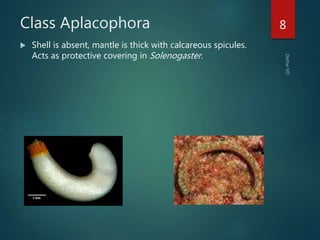
Class Aplacophora
 Shell is absent, mantle is thick with calcareous spicules.
Acts as protective covering in Solenogaster.
8
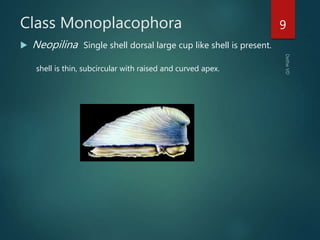
Class Monoplacophora
 Neopilina Single shell dorsal large cup like shell is present.
shell is thin, subcircular with raised and curved apex.
9
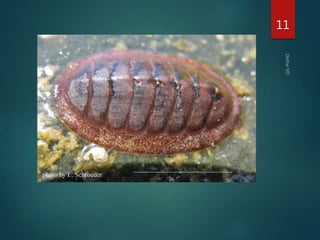
Class Polyplacophora
 Chitons are the only genus in the class Polyplacophora.
 Their specific characteristics:
 Posses a shell that consists of 8 overlapping plates.
 Overlapping calcareous plates forms a solid armour covering the
dorsal surface.
 The cephalic and anal shell plates are keeled middorsally .
10
11
Class Gastropoda
 Most popular class of molluscs.
 Consists of snails and snail-like creatures.
 Specific characteristics:
 They have a dorsally located shell (often coiled).
 Shell is composed of single piece that is univalved and spirally
coiled.
 The shell has elongated form and hollow cone spirally coiled
around central axis called columella.
 A single coil of shell round the axis is called whorl.
 Dextral shell: aperture in right side and coling anticlockwise.
 Sinistral: left aperture coilingclockwise.
12
13
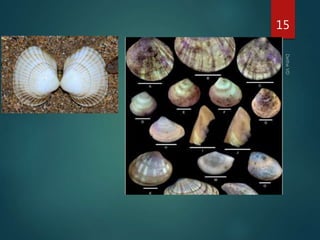
Class Bivalvia (Pelecypoda)
 Specific Characteristics:
 They have no head.
 They have two shells held together by powerful muscles.
 They have a ventrally located foot that sticks out between the two
valves.
 Habitats include: marine and freshwater.
 They tend to burrow into soft mud or sand or attach to rocks or
other shells.
 Large gills are used for respiration and filter feeding.
 Food is trapped by mucus on the gills and moved by cilia.
Water enters and exits through siphons.
14
15
Class Cephalopoda
 Contains the largest molluscs.
 Specific Characteristics:
 May lack a shell (like an octopus)
 Shell may be reduced to a stiffening rod (like the squid or nautilus)
 The foot is highly modified to form a group of tentacles around the
mouth.
 They are found in deep and shallow waters along many coasts.
 Squids & Nautilus are free-swimming and move very quickly.
Octopuses are found among rocks or crawling on the bottom of the
ocean.
 Complex brain, two lateral eyes, excellent eyesight.
16
17
18
19

Phylum : Mollusca

  • 1.
  • 2.
    General Characteristics  50,000or more species of molluscs.  They share 3 major sets of characteristics:  Body enclosed by a mantle that secretes a shell made of calcium or some other stiff structure.  A mantle cavity between the mantle and the internal organs; the anus, reproductive, and excretory ducts open into the mantle cavity.  A ventral, muscular foot that is highly modified among the various groups of molluscs. 2
  • 3.
    General Characteristics Cont’d Free-living, multicellular animals  Invertebrates (lack a backbone)  Unsegmented  Have a true coelom  Bilateral symmetry  Simple to complex nervous system 3
  • 4.
    Habitats & Niches Some mollusc habitats include:  Marine (mostly)  Freshwater (a few)  Land (a few)  Mollusc niches (life-style):  Most live on the ocean bottom and are mostly sedentary  Some are free-swimming (the cephalopods) 4
  • 5.
    The six majormollusc classes  Those 6 classes are:  Monoplacophora (mono=single; placo=shell; phora=bearing)  Ex. Neopilina  Aplacophora (a=without)  Ex. Neomenia  Polyplacophora (poly=many)  Ex. Chitons  Gastropoda (gastro=body cavity; poda=foot)  Ex. Common garden snail, abalone, turban snail  Scaphopoda  Ex. Dentalium  Cephalopoda (cephalo=dealing with head; poda=foot)  Ex. Squid, octopus, etc. 5
  • 6.
    Shell in Mollusca Thesoft, unsegmented bodies of mollusk is covered by hard and calcareous shell which acts as protective covering. Shell may be external or internal Study of mollucscan shell called conchology. 6
  • 7.
    CLASS: Scaphopoda (Dentalium) Shell opens on both ends  External ,cyndriccally tubular, curved and tapered.  Oral end is wider, shape like elephants tusk, white in colour with grooves on entire shell.  In Cadulus is cucumber shaped. 7
  • 8.
    Class Aplacophora  Shellis absent, mantle is thick with calcareous spicules. Acts as protective covering in Solenogaster. 8
  • 9.
    Class Monoplacophora  NeopilinaSingle shell dorsal large cup like shell is present. shell is thin, subcircular with raised and curved apex. 9
  • 10.
    Class Polyplacophora  Chitonsare the only genus in the class Polyplacophora.  Their specific characteristics:  Posses a shell that consists of 8 overlapping plates.  Overlapping calcareous plates forms a solid armour covering the dorsal surface.  The cephalic and anal shell plates are keeled middorsally . 10
  • 11.
  • 12.
    Class Gastropoda  Mostpopular class of molluscs.  Consists of snails and snail-like creatures.  Specific characteristics:  They have a dorsally located shell (often coiled).  Shell is composed of single piece that is univalved and spirally coiled.  The shell has elongated form and hollow cone spirally coiled around central axis called columella.  A single coil of shell round the axis is called whorl.  Dextral shell: aperture in right side and coling anticlockwise.  Sinistral: left aperture coilingclockwise. 12
  • 13.
  • 14.
    Class Bivalvia (Pelecypoda) Specific Characteristics:  They have no head.  They have two shells held together by powerful muscles.  They have a ventrally located foot that sticks out between the two valves.  Habitats include: marine and freshwater.  They tend to burrow into soft mud or sand or attach to rocks or other shells.  Large gills are used for respiration and filter feeding.  Food is trapped by mucus on the gills and moved by cilia. Water enters and exits through siphons. 14
  • 15.
  • 16.
    Class Cephalopoda  Containsthe largest molluscs.  Specific Characteristics:  May lack a shell (like an octopus)  Shell may be reduced to a stiffening rod (like the squid or nautilus)  The foot is highly modified to form a group of tentacles around the mouth.  They are found in deep and shallow waters along many coasts.  Squids & Nautilus are free-swimming and move very quickly. Octopuses are found among rocks or crawling on the bottom of the ocean.  Complex brain, two lateral eyes, excellent eyesight. 16
  • 17.
  • 18.
  • 19.