Rohit Mondal
B.Sc(Life Science) 3rd yr
Sri Aurobindo College
DSE-Cell and Molecular biology
CELL CYCLE & DIVISION
(A GENERALIZED OVERVIEW)
Content :-
 What is a cell ?
Definition & History
 The Cell theory
 Cell cycle & division
Definition and introduction
 Types of Cell division
 Phases of the Cell cycle
 Interphase
G1-phase, S-phase, G2-
phase
 M-phase
Mitosis and its stages
Diff b/w Plant & Animal
mitosis
Similarities b/w plant &
animal mitosis
Significance of Mitosis
 Meiosis :
Its stages (Meiosis1&
Meiosis2)
Diff. b/w Meiosis1 and
Meiosis2
Significance of Meiosis
What is a Cell ?
 Cell is the basic structural and functional unit of life.
 Robert hooke (1665) is credited for the discovery of cell.
He observed a honey comb like pattern in very thin slice of
cork.This honey comb like structure consisted of a very
thick wall enclosing box-like compartments for which he
coined the term “cellulae” for the first time.
 In 1665 Robert Hooke in his “Micrographia” described the
thickend cell walls of dead cells in cork.
 Later on A.Van Leeuwenhoek
(1632-1723) improved microscope
lens system by grinding and obs.
various unicellular organism etc.
Some typical Plant, Animal & Bacterial
cell
Cell theory
 Cell Theory was formulated by Scheleiden and Schwann, and was
modified by Rudolf Virchow.
 M.J Scheleiden , a German botanist in 1838 stated that “All plants are
formed of one or more cell”. T. Schwann , a German zoologist in 1839
stated that “All animals are formed of cells , have nuclei and are
enclosed by thin cell membrane instead of thick cell wall as found in
plant cells”. Schwann proposed the hypothesis that the bodies of animal
and plant are composed of cells and their products.
But their theory about cell did not explain as to how new cells are formed.
Observation to Cell Theory :-
i.Scheleiden said that new cell were formed inside old ones from the
nucleus.This concept was later on found to be wrong by Hugo V. Mohl &
K.Nageli
ii. Another wrong point in the theory was quoted by Schwann who said
that cell could be spontaneously generated by a process analogous to
crystal formation.
Later on Rudolf Virchow (1885) , a German physiologist
proposed “Theory of Cell lineage” which states “Omnis
Cellula a cellula” which means that new cells are formed
from the pre-existing cells and not de novo . This was
further supported by Louis Pastuer in 1862 that life
originates from the pre-existing life (Biogenesis)
Hence, The Modified Cell theory States.
 (A) All living organisms are composed of cells and
products of cells.
 (B) All cells arise from pre-existing cells.
Cell Cycle & Division
 Definition : The sequence of events by which a cell
duplicates its genome, synthesizes the other constituents
of the cell and eventually divides into two daughter cells.
The growth and development
of every living organism depends on the multiplication of
its cell.
 In unicellular org. , cell division is the means of
reproduction and by this process two or more new
individuals arise from the mother cell.
 In prokaryotic cells , cell growth and DNA replication take
place throughout most of the cell cycles and duplicated
chromosomes are distributed to daughter cell in
association with plasma membrane
 In eukaryotic cell, the cell cycle is more complex and
consist of four discrete phases i.e.
 Cell growth
 DNA replication
 Distribution of duplicated chromosomes to daughter
cells
 Cell division
 In multicellular organism, new individuals develops from
a single primordial cell , the zygote
Organism grow and repair themselves through the
medium of cell division .The cell increases in size as a
result of growth, which is the characteristic feature of all
living organism.
After attaining maximum growth , the cell begin to divide.
Types of Cell division
 Three kinds of cell- division occur in animal:
 Mitosis- It takes place regularly in ordinary
(somatic) cells of the body.
 Meiosis- It occurs in germ cells in gonads and
result in gamete formation.
 Amitosis – It is rare and of little importance, and
occur in some primitive acellular organism,
involving a sort of mass division of the nucleus.
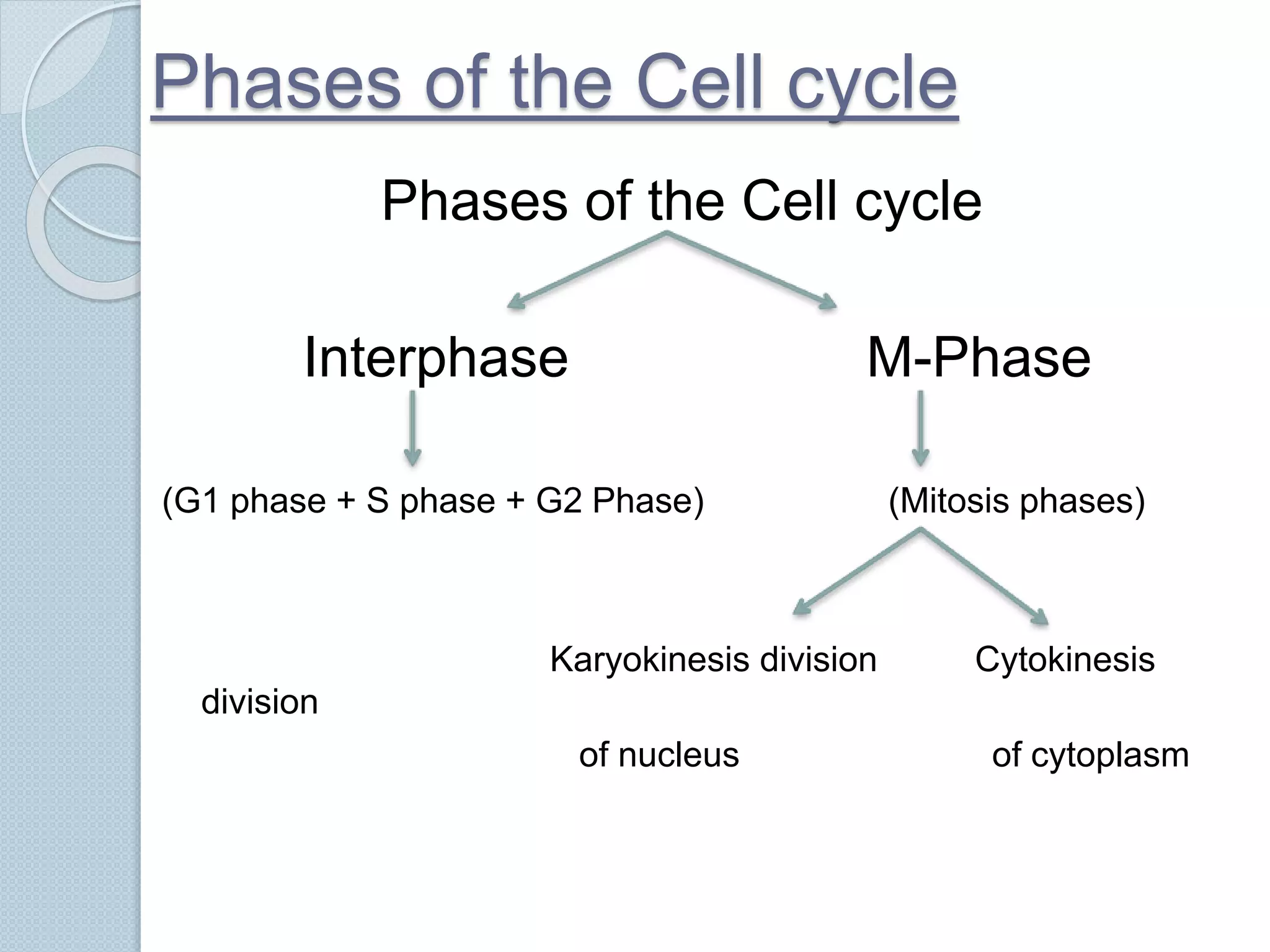
Phases of the Cell cycle
Interphase M-Phase
(G1 phase + S phase + G2 Phase) (Mitosis phases)
Karyokinesis division Cytokinesis
division
of nucleus of cytoplasm
Phases of Cell cycle
Interphase : (Resting/Preparative
Phase)
 Interphase is the phase between two successive cell
division. It is metabolically very active phase, because
of biosynthesis of a no. of molecule. It generally cover
over 95% of the total duration of cell cycle. Though it is
called resting phase, but it the time when the cell is
preparing for cell division by undergoing cell growth and
DNA replication
 It is divided into the following sub stages :-
 G1 Phase : Cell metabolically active and grows continuously
but does not replicate DNA
 S Phase : DNA synthesis occurs, DNA content increases
from 2C
to 4C but the number of chromosomes remains
same
i.e., 2n.
 G2 Phase : Proteins are synthesized in preparation for
mitosis
G1- Phase : First growth period
 It is also called as the post-mitotic phase and is the period
between the end of the mitosis and the start of DNA
synthesis
 It is the longest phase of interphase where maximum
increase in cell size occurs.
 During this phase, the cell is metabolically active &
continuously grow but does not replicates & synthesize
its DNA. And in this phase , various enzymes and
substrates necessary for DNA synthesis are produced .
Therefore G1 phase is marked by the synthesis of RNA
and protein molecule.
 In human cell the G1 phase might last about 11 hr.
Go- phase : Quiescent stage
 Some cells in the adult animals do not appear to exhibit
division (e.g., heart cell , nerve cell) and many other cells
divide only occasionally , as and when required to
replace cells that have been lost because of injury or cell
death (e.g., skin fibroblasts as well as cells of many
internal organ like liver , kidney and lungs). These cells
do not divide further and exit G1 phase to enter an
inactive stage called quiescent stage(Go) of the cell cycle
. Cells in this stage remain metabolically active , but no
longer proliferate unless called on to do so by
appropriate extracellular signal. Hence , this exit from cell
cycle may be temporary or permanent.
S-phase : Synthetic phase
 In this phase , DNA molecule of each chromosomes
replicates by the synthesis of a new DNA molecule on the
template of of the existing DNA .
 The cell retain the original diploid (2n) chromosome
number but now has duplicate set of gene .
 The cell has double the amount (4C) of DNA present in
the original diploid cell (2n)
 Synthesis of histone protein also occur . Duplication of
centriole occur here
 This period varies from 6-8 hrs. duration in cultured
human cell and without this synthetic phase, no cell
division will occur
G2-phase : Second growth
period
 It is also called as pre-mitotic phase characterized by
increased nuclear volume .
 G2-phase is basically the interval between the end of
DNA synthesis and the start of mitosis.
 During G2 a cell contain two times (4C) the amount of
DNA present in the original diploid cell(2C). Following
mitosis the daughter cells again enter the G1 period and
have a DNA content equivalent of 2C.
 In this phase duplication of mitochondria, chloroplast
occurs. The spindle protein are also synthesized in this
phase .
 r-RNA and m-RNA all are synthesized in this phase and
continues.
 This phase has an average duration of (2-4) hr.
M-phase : The Mitotic phase
 It represent the most dramatic phase , when the actual cell
division or mitosis occurs.
 It starts with the nuclear division , corresponding to the
separation of daughter chromosomes (Karyokinesis) and
usually ends with division of the cytoplasm (Cytokinesis).
 In the 24 hour average duration of cell cycle of a human cell,
cell division ,i.e. M-phase proper lasts for only about an hour
Mitosis : The Equational division
 The exact replication of a parent cell into two daughter cell that
ate identical to each other as well as their parent cell
 Since the number of chromosomes in the parent and progeny
cells is the same, it is called as equational division.
 Discovery : It was discovered in plant cell by a German
biologist Strasburger(1875 A.D.) and in animal cells (in Triturus)
by another German biologist W. Flemming (1879 A.A.). Term
“Mitosis” was given by Flemming (1882 A.D.).
 Occurrence : It occur in both somatic cells as well as germ cells
of the gonad . In plants mitosis occurs in the meristematic cell
and cambial cell .
 Mitosis is divided into four substages viz.
a. Prophase c. Anaphase
b. Metaphase d. Telophase
Successive stages of Mitosis
Microscopic view of Mitosis in Plant cell
Difference b/w Mitosis in Animal cell v/s plant cell
Animal Cell
• Animal mitosis is a part of
animal cell division where
replicated chromosomes are
separated into two, daughter
nuclei .
• Animal cell become rounded
before cell division.
• A specific hormone that
induces mitosis cannot be
identified .
• Centrosomes are formed.
• Mitotic apparatus consists of
asters.
• Spindle is amphiastral .
• Centriole organises mitotic
spindle.
Plant Cell
• Plant mitosis is a part of plant
cell division where replicated
chromosomes are separated into
two , daughter nuclei.
• Shape of plant cell do not
change before cell division.
• Cytokinin is the type of hormone
that induces mitosis .
• Centrosomes are not formed.
• Mitotic apparatus lacks asters.
• Spindle is anastral.
• Do not contain centriole
• Occurs in the meristem &
cambium.
Difference b/w Mitosis in Animal cell v/s plant cell
Similarities between plant and animal
mitosis
 Both animal and plant mitosis occur to increase the number of
cells in the body, to repair body tissues, and to regenerate
body parts.
 Both processes occur in four major steps:
prophase,metaphase, anaphase, and telophase.
 Both animal mitosis and plant mitosis are followed by
cytoplasmic division.
 During prophase, the chromosome condensation occurs in
both animal and plant mitosis.
 The breakdown of the nuclear envelope occurs in the
prometaphase. Individual chromosomes also move the
metaphase plate. The spindle attaches to the chromosomes as
well.
 Individual chromosomes are arranged on the metaphase plate
during metaphase.
 Sister chromatids move towards the opposite poles during
anaphase.
Significance of Mitosis
 In mitosis, DNA duplication in cell and the daughter cell
inherit an identical gene composition and contain the
same no. of chromosome as the parent cell.
 Somatic cell of a multicellular organism arise from a
single cell by mitotic division ,
 Body growth of a multicellular organism and replacement
of its lost cell are accomplished through mitosis. Blood
cell, intestinal cell and skin cell are regularly replaced in
large no. by mitosis of respective parent cell. Thus cell
repair is a very significant contribution of mitosis
 It is a method of restoring nucleocytoplasmic ratio as cell
growth result in disturbing the ratio between nucleus and
cytoplasm.
 It helps in a continuous growth of plant throughout their
life
Meiosis :The Reductional division
 Specialized kind of cell division which occurs in the
Germ cell that reduces the chromosomes number by
half. Hence it is called reductional division.
 Occurs during gametogenesis in plants and animals.
 Involves two sequential cycles of nuclear and cell
division called Meiosis Iand Meiosis II.
 It results in 4 haploid daughter cells.
 Interphase occurs prior to meiosis which is similar to
interphase of mitosis except the S phase is prolonged
 Meiosis was first demonstrated by Benden and first
described by Winiwarter. Term meiosis waqs given by
Farmer and Moore
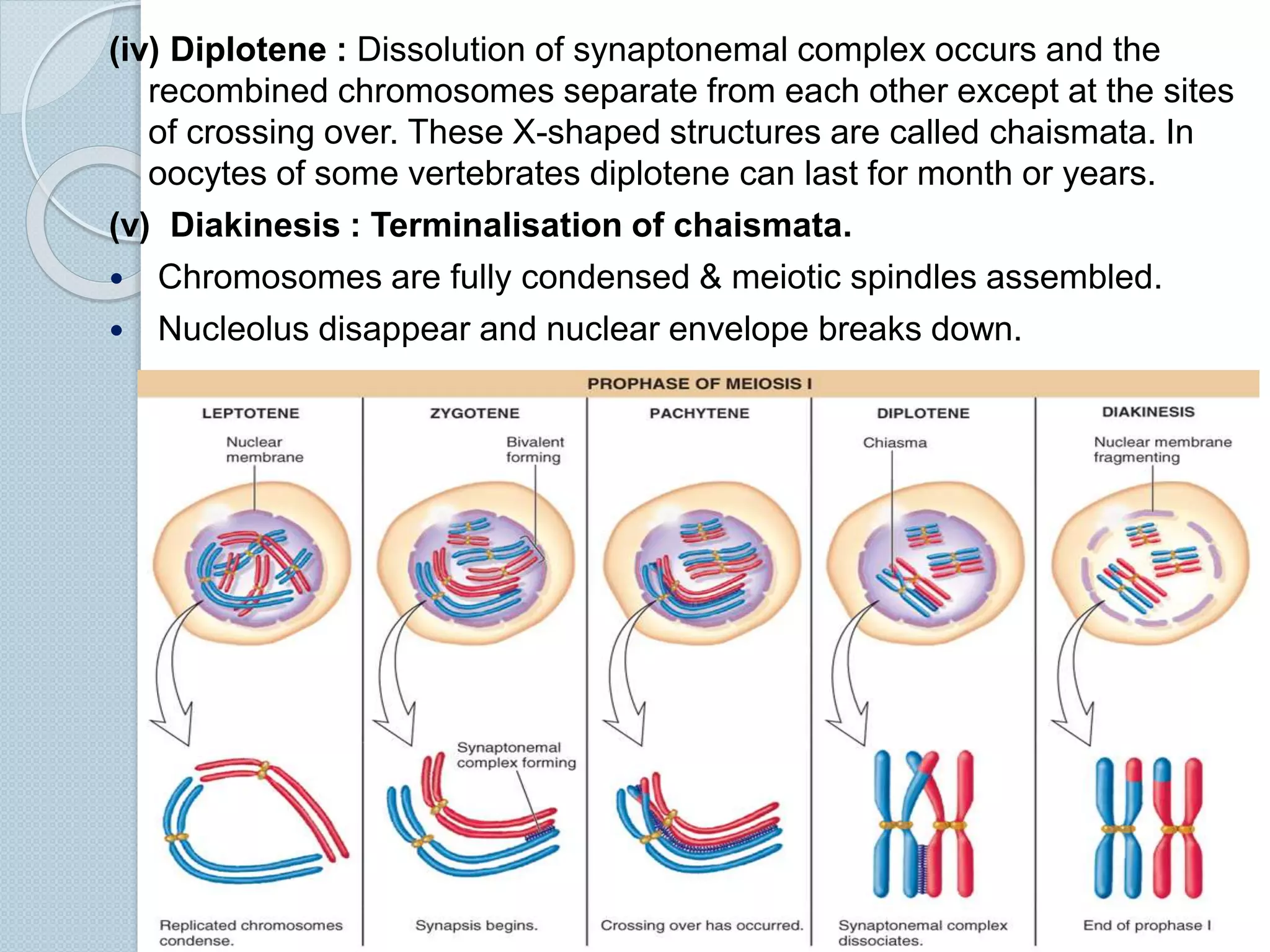
Stages in Meiosis1
Prophase1of meoisis1 :
(i) Leptotene :
 Chromosomes make their appearance as single stranded
structures.
 Compaction of chromosomes continues.
(ii) Zygotene :
 Homologous chromosomes start pairing and this process of
association is called synapsis.
 Chromosomal synapsis is accompanied by formation of
synaptone-mal complex.
 Complex formed by a pair of synapsed homologous
chromosomes is
called bivalent or tetrad.
(iii) Pachytene :
 Crossing over occurs between non-sister chromatids of
homologous chromosomes. The enzymes involved in the
process is ‘recombinase’. Recombination between homologous
chromosomes is completed. Exchange of genetic material.
(iv) Diplotene : Dissolution of synaptonemal complex occurs and the
recombined chromosomes separate from each other except at the sites
of crossing over. These X-shaped structures are called chaismata. In
oocytes of some vertebrates diplotene can last for month or years.
(v) Diakinesis : Terminalisation of chaismata.
 Chromosomes are fully condensed & meiotic spindles assembled.
 Nucleolus disappear and nuclear envelope breaks down.
Metaphase I :
 Bivalent chromosomes align on the equatorial plate.
 Microtubules from opposite poles of the spindle attach to the
pair of homologous chromosomes.
Anaphase I :
 Homologous chromosomes, separate while chromatids
remain associated at their centromeres.
Telophase I :
 Nuclear membrane and nucleus reappear.
 Cytokinesis follows (diad of cells).
 Interkinesis : Stage between two meiotic divisions, (meiosis
I and meiosis II) generally short lived.
Stages in Meiosis 2
 Meiosis II: (It resembles the normal mitosis).
Prophase II
 Nuclear membrane disappears.
 Chromosomes again become compact.
Metapahse II
 Chromosomes align at the equator.
 Microtubules from opposite poles of spindle get attached to
kinetochores of
sister chromatids.
Anaphase II
 Simultaneous splitting of the centromere of each chromosome,
allowing
them to move towards opposite poles of the cell.
Telophase II
 Two groups of chromosomes get enclosed by a nuclear envelope.
 Cytokinesis follows resulting in the formation of tetrad of cells i.e., 4
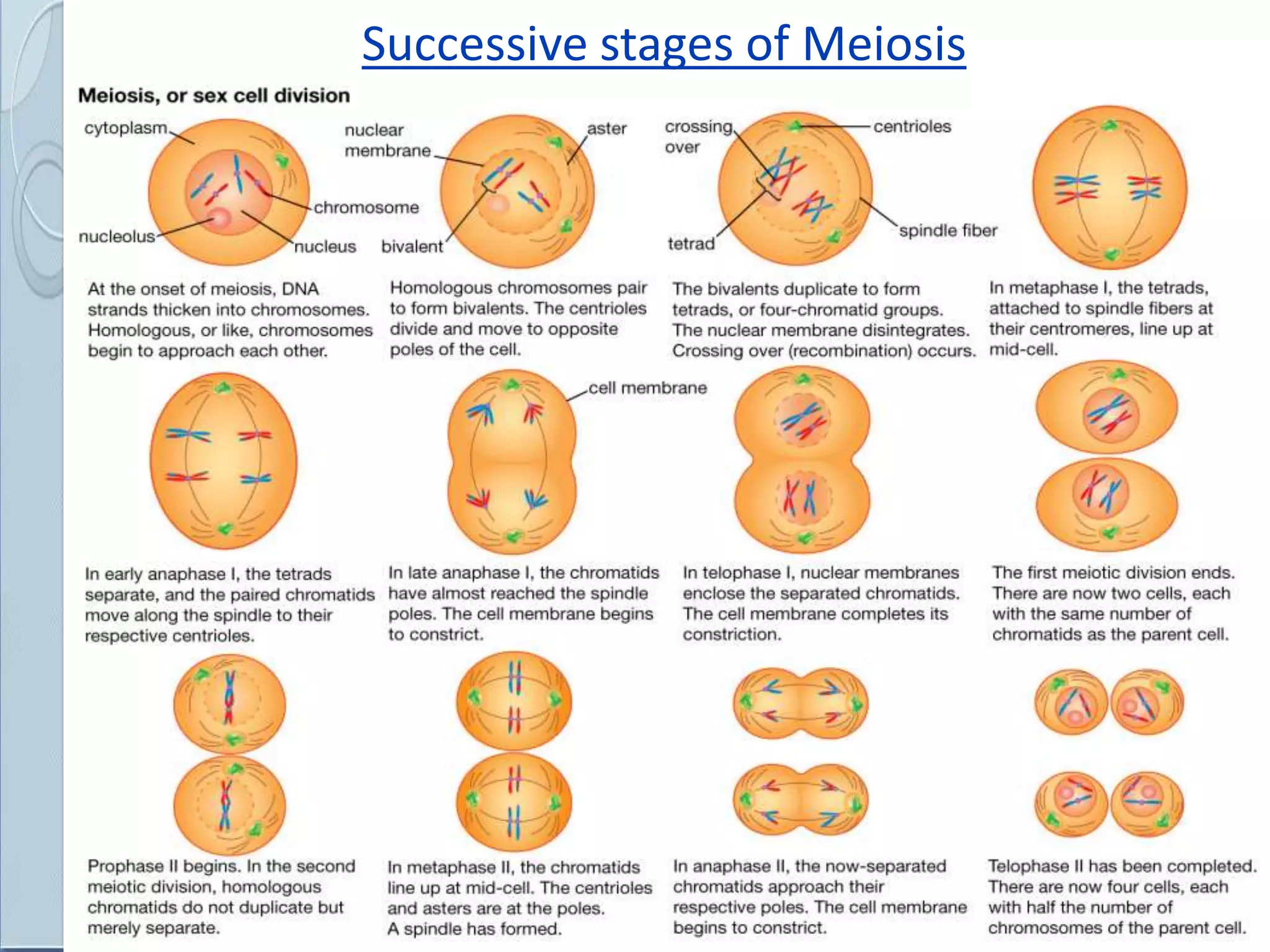
Successive stages of Meiosis
Difference b/w Meiosis1 and Meiosis2
Meiosis 1
• It is heterotypic or reduction
division.
• The chromosomes remain
in the replicated state.
• The no. of chromosome is
reduced to half i.e. from
diploid to haploid state.
• Crossing over occurs which
makes the two chromatids
of chromosomes different.
• It is complicated and long
duration division.
• An interphase having both
growth phases and s-phase
precedes meiosis1.
Meiosis 2
• It is homotypic or equational
division.
• The two chromatids of a
replicated chromosomes
seperate.
• The no. of chromosomes
remain the same i.e. from
haploid to haploid state.
• The generally different
chromatids of a chromosomes
are separated.
• It is simple and short duration
division.
• The interphase has only growth
Significance of Meiosis
1. Formation of gametes : In sexually reproducing
organisms.
2. Genetic variability : Variations are very important for
evolution.
3. Maintenance of chromosomal number : By
reducing the chromosome number in gametes.
Chromosomal number is restored by fertilisation of
gametes.
 kk

Cell cycle and division

  • 1.
    Rohit Mondal B.Sc(Life Science)3rd yr Sri Aurobindo College DSE-Cell and Molecular biology CELL CYCLE & DIVISION (A GENERALIZED OVERVIEW)
  • 2.
    Content :-  Whatis a cell ? Definition & History  The Cell theory  Cell cycle & division Definition and introduction  Types of Cell division  Phases of the Cell cycle  Interphase G1-phase, S-phase, G2- phase  M-phase Mitosis and its stages Diff b/w Plant & Animal mitosis Similarities b/w plant & animal mitosis Significance of Mitosis  Meiosis : Its stages (Meiosis1& Meiosis2) Diff. b/w Meiosis1 and Meiosis2 Significance of Meiosis
  • 3.
    What is aCell ?  Cell is the basic structural and functional unit of life.  Robert hooke (1665) is credited for the discovery of cell. He observed a honey comb like pattern in very thin slice of cork.This honey comb like structure consisted of a very thick wall enclosing box-like compartments for which he coined the term “cellulae” for the first time.  In 1665 Robert Hooke in his “Micrographia” described the thickend cell walls of dead cells in cork.  Later on A.Van Leeuwenhoek (1632-1723) improved microscope lens system by grinding and obs. various unicellular organism etc.
  • 4.
    Some typical Plant,Animal & Bacterial cell
  • 5.
    Cell theory  CellTheory was formulated by Scheleiden and Schwann, and was modified by Rudolf Virchow.  M.J Scheleiden , a German botanist in 1838 stated that “All plants are formed of one or more cell”. T. Schwann , a German zoologist in 1839 stated that “All animals are formed of cells , have nuclei and are enclosed by thin cell membrane instead of thick cell wall as found in plant cells”. Schwann proposed the hypothesis that the bodies of animal and plant are composed of cells and their products. But their theory about cell did not explain as to how new cells are formed. Observation to Cell Theory :- i.Scheleiden said that new cell were formed inside old ones from the nucleus.This concept was later on found to be wrong by Hugo V. Mohl & K.Nageli ii. Another wrong point in the theory was quoted by Schwann who said that cell could be spontaneously generated by a process analogous to crystal formation.
  • 6.
    Later on RudolfVirchow (1885) , a German physiologist proposed “Theory of Cell lineage” which states “Omnis Cellula a cellula” which means that new cells are formed from the pre-existing cells and not de novo . This was further supported by Louis Pastuer in 1862 that life originates from the pre-existing life (Biogenesis) Hence, The Modified Cell theory States.  (A) All living organisms are composed of cells and products of cells.  (B) All cells arise from pre-existing cells.
  • 7.
    Cell Cycle &Division  Definition : The sequence of events by which a cell duplicates its genome, synthesizes the other constituents of the cell and eventually divides into two daughter cells. The growth and development of every living organism depends on the multiplication of its cell.  In unicellular org. , cell division is the means of reproduction and by this process two or more new individuals arise from the mother cell.  In prokaryotic cells , cell growth and DNA replication take place throughout most of the cell cycles and duplicated chromosomes are distributed to daughter cell in association with plasma membrane
  • 8.
     In eukaryoticcell, the cell cycle is more complex and consist of four discrete phases i.e.  Cell growth  DNA replication  Distribution of duplicated chromosomes to daughter cells  Cell division  In multicellular organism, new individuals develops from a single primordial cell , the zygote Organism grow and repair themselves through the medium of cell division .The cell increases in size as a result of growth, which is the characteristic feature of all living organism. After attaining maximum growth , the cell begin to divide.
  • 9.
    Types of Celldivision  Three kinds of cell- division occur in animal:  Mitosis- It takes place regularly in ordinary (somatic) cells of the body.  Meiosis- It occurs in germ cells in gonads and result in gamete formation.  Amitosis – It is rare and of little importance, and occur in some primitive acellular organism, involving a sort of mass division of the nucleus.
  • 10.
    Phases of theCell cycle Phases of the Cell cycle Interphase M-Phase (G1 phase + S phase + G2 Phase) (Mitosis phases) Karyokinesis division Cytokinesis division of nucleus of cytoplasm
  • 11.
  • 12.
    Interphase : (Resting/Preparative Phase) Interphase is the phase between two successive cell division. It is metabolically very active phase, because of biosynthesis of a no. of molecule. It generally cover over 95% of the total duration of cell cycle. Though it is called resting phase, but it the time when the cell is preparing for cell division by undergoing cell growth and DNA replication  It is divided into the following sub stages :-  G1 Phase : Cell metabolically active and grows continuously but does not replicate DNA  S Phase : DNA synthesis occurs, DNA content increases from 2C to 4C but the number of chromosomes remains same i.e., 2n.  G2 Phase : Proteins are synthesized in preparation for mitosis
  • 13.
    G1- Phase :First growth period  It is also called as the post-mitotic phase and is the period between the end of the mitosis and the start of DNA synthesis  It is the longest phase of interphase where maximum increase in cell size occurs.  During this phase, the cell is metabolically active & continuously grow but does not replicates & synthesize its DNA. And in this phase , various enzymes and substrates necessary for DNA synthesis are produced . Therefore G1 phase is marked by the synthesis of RNA and protein molecule.  In human cell the G1 phase might last about 11 hr.
  • 14.
    Go- phase :Quiescent stage  Some cells in the adult animals do not appear to exhibit division (e.g., heart cell , nerve cell) and many other cells divide only occasionally , as and when required to replace cells that have been lost because of injury or cell death (e.g., skin fibroblasts as well as cells of many internal organ like liver , kidney and lungs). These cells do not divide further and exit G1 phase to enter an inactive stage called quiescent stage(Go) of the cell cycle . Cells in this stage remain metabolically active , but no longer proliferate unless called on to do so by appropriate extracellular signal. Hence , this exit from cell cycle may be temporary or permanent.
  • 15.
    S-phase : Syntheticphase  In this phase , DNA molecule of each chromosomes replicates by the synthesis of a new DNA molecule on the template of of the existing DNA .  The cell retain the original diploid (2n) chromosome number but now has duplicate set of gene .  The cell has double the amount (4C) of DNA present in the original diploid cell (2n)  Synthesis of histone protein also occur . Duplication of centriole occur here  This period varies from 6-8 hrs. duration in cultured human cell and without this synthetic phase, no cell division will occur
  • 16.
    G2-phase : Secondgrowth period  It is also called as pre-mitotic phase characterized by increased nuclear volume .  G2-phase is basically the interval between the end of DNA synthesis and the start of mitosis.  During G2 a cell contain two times (4C) the amount of DNA present in the original diploid cell(2C). Following mitosis the daughter cells again enter the G1 period and have a DNA content equivalent of 2C.  In this phase duplication of mitochondria, chloroplast occurs. The spindle protein are also synthesized in this phase .  r-RNA and m-RNA all are synthesized in this phase and continues.  This phase has an average duration of (2-4) hr.
  • 18.
    M-phase : TheMitotic phase  It represent the most dramatic phase , when the actual cell division or mitosis occurs.  It starts with the nuclear division , corresponding to the separation of daughter chromosomes (Karyokinesis) and usually ends with division of the cytoplasm (Cytokinesis).  In the 24 hour average duration of cell cycle of a human cell, cell division ,i.e. M-phase proper lasts for only about an hour
  • 19.
    Mitosis : TheEquational division  The exact replication of a parent cell into two daughter cell that ate identical to each other as well as their parent cell  Since the number of chromosomes in the parent and progeny cells is the same, it is called as equational division.  Discovery : It was discovered in plant cell by a German biologist Strasburger(1875 A.D.) and in animal cells (in Triturus) by another German biologist W. Flemming (1879 A.A.). Term “Mitosis” was given by Flemming (1882 A.D.).  Occurrence : It occur in both somatic cells as well as germ cells of the gonad . In plants mitosis occurs in the meristematic cell and cambial cell .  Mitosis is divided into four substages viz. a. Prophase c. Anaphase b. Metaphase d. Telophase
  • 22.
  • 23.
    Microscopic view ofMitosis in Plant cell
  • 24.
    Difference b/w Mitosisin Animal cell v/s plant cell Animal Cell • Animal mitosis is a part of animal cell division where replicated chromosomes are separated into two, daughter nuclei . • Animal cell become rounded before cell division. • A specific hormone that induces mitosis cannot be identified . • Centrosomes are formed. • Mitotic apparatus consists of asters. • Spindle is amphiastral . • Centriole organises mitotic spindle. Plant Cell • Plant mitosis is a part of plant cell division where replicated chromosomes are separated into two , daughter nuclei. • Shape of plant cell do not change before cell division. • Cytokinin is the type of hormone that induces mitosis . • Centrosomes are not formed. • Mitotic apparatus lacks asters. • Spindle is anastral. • Do not contain centriole • Occurs in the meristem & cambium.
  • 25.
    Difference b/w Mitosisin Animal cell v/s plant cell
  • 26.
    Similarities between plantand animal mitosis  Both animal and plant mitosis occur to increase the number of cells in the body, to repair body tissues, and to regenerate body parts.  Both processes occur in four major steps: prophase,metaphase, anaphase, and telophase.  Both animal mitosis and plant mitosis are followed by cytoplasmic division.  During prophase, the chromosome condensation occurs in both animal and plant mitosis.  The breakdown of the nuclear envelope occurs in the prometaphase. Individual chromosomes also move the metaphase plate. The spindle attaches to the chromosomes as well.  Individual chromosomes are arranged on the metaphase plate during metaphase.  Sister chromatids move towards the opposite poles during anaphase.
  • 27.
    Significance of Mitosis In mitosis, DNA duplication in cell and the daughter cell inherit an identical gene composition and contain the same no. of chromosome as the parent cell.  Somatic cell of a multicellular organism arise from a single cell by mitotic division ,  Body growth of a multicellular organism and replacement of its lost cell are accomplished through mitosis. Blood cell, intestinal cell and skin cell are regularly replaced in large no. by mitosis of respective parent cell. Thus cell repair is a very significant contribution of mitosis  It is a method of restoring nucleocytoplasmic ratio as cell growth result in disturbing the ratio between nucleus and cytoplasm.  It helps in a continuous growth of plant throughout their life
  • 28.
    Meiosis :The Reductionaldivision  Specialized kind of cell division which occurs in the Germ cell that reduces the chromosomes number by half. Hence it is called reductional division.  Occurs during gametogenesis in plants and animals.  Involves two sequential cycles of nuclear and cell division called Meiosis Iand Meiosis II.  It results in 4 haploid daughter cells.  Interphase occurs prior to meiosis which is similar to interphase of mitosis except the S phase is prolonged  Meiosis was first demonstrated by Benden and first described by Winiwarter. Term meiosis waqs given by Farmer and Moore
  • 29.
    Stages in Meiosis1 Prophase1ofmeoisis1 : (i) Leptotene :  Chromosomes make their appearance as single stranded structures.  Compaction of chromosomes continues. (ii) Zygotene :  Homologous chromosomes start pairing and this process of association is called synapsis.  Chromosomal synapsis is accompanied by formation of synaptone-mal complex.  Complex formed by a pair of synapsed homologous chromosomes is called bivalent or tetrad. (iii) Pachytene :  Crossing over occurs between non-sister chromatids of homologous chromosomes. The enzymes involved in the process is ‘recombinase’. Recombination between homologous chromosomes is completed. Exchange of genetic material.
  • 30.
    (iv) Diplotene :Dissolution of synaptonemal complex occurs and the recombined chromosomes separate from each other except at the sites of crossing over. These X-shaped structures are called chaismata. In oocytes of some vertebrates diplotene can last for month or years. (v) Diakinesis : Terminalisation of chaismata.  Chromosomes are fully condensed & meiotic spindles assembled.  Nucleolus disappear and nuclear envelope breaks down.
  • 31.
    Metaphase I : Bivalent chromosomes align on the equatorial plate.  Microtubules from opposite poles of the spindle attach to the pair of homologous chromosomes. Anaphase I :  Homologous chromosomes, separate while chromatids remain associated at their centromeres. Telophase I :  Nuclear membrane and nucleus reappear.  Cytokinesis follows (diad of cells).  Interkinesis : Stage between two meiotic divisions, (meiosis I and meiosis II) generally short lived.
  • 32.
    Stages in Meiosis2  Meiosis II: (It resembles the normal mitosis). Prophase II  Nuclear membrane disappears.  Chromosomes again become compact. Metapahse II  Chromosomes align at the equator.  Microtubules from opposite poles of spindle get attached to kinetochores of sister chromatids. Anaphase II  Simultaneous splitting of the centromere of each chromosome, allowing them to move towards opposite poles of the cell. Telophase II  Two groups of chromosomes get enclosed by a nuclear envelope.  Cytokinesis follows resulting in the formation of tetrad of cells i.e., 4
  • 33.
  • 34.
    Difference b/w Meiosis1and Meiosis2 Meiosis 1 • It is heterotypic or reduction division. • The chromosomes remain in the replicated state. • The no. of chromosome is reduced to half i.e. from diploid to haploid state. • Crossing over occurs which makes the two chromatids of chromosomes different. • It is complicated and long duration division. • An interphase having both growth phases and s-phase precedes meiosis1. Meiosis 2 • It is homotypic or equational division. • The two chromatids of a replicated chromosomes seperate. • The no. of chromosomes remain the same i.e. from haploid to haploid state. • The generally different chromatids of a chromosomes are separated. • It is simple and short duration division. • The interphase has only growth
  • 35.
    Significance of Meiosis 1.Formation of gametes : In sexually reproducing organisms. 2. Genetic variability : Variations are very important for evolution. 3. Maintenance of chromosomal number : By reducing the chromosome number in gametes. Chromosomal number is restored by fertilisation of gametes.
  • 36.