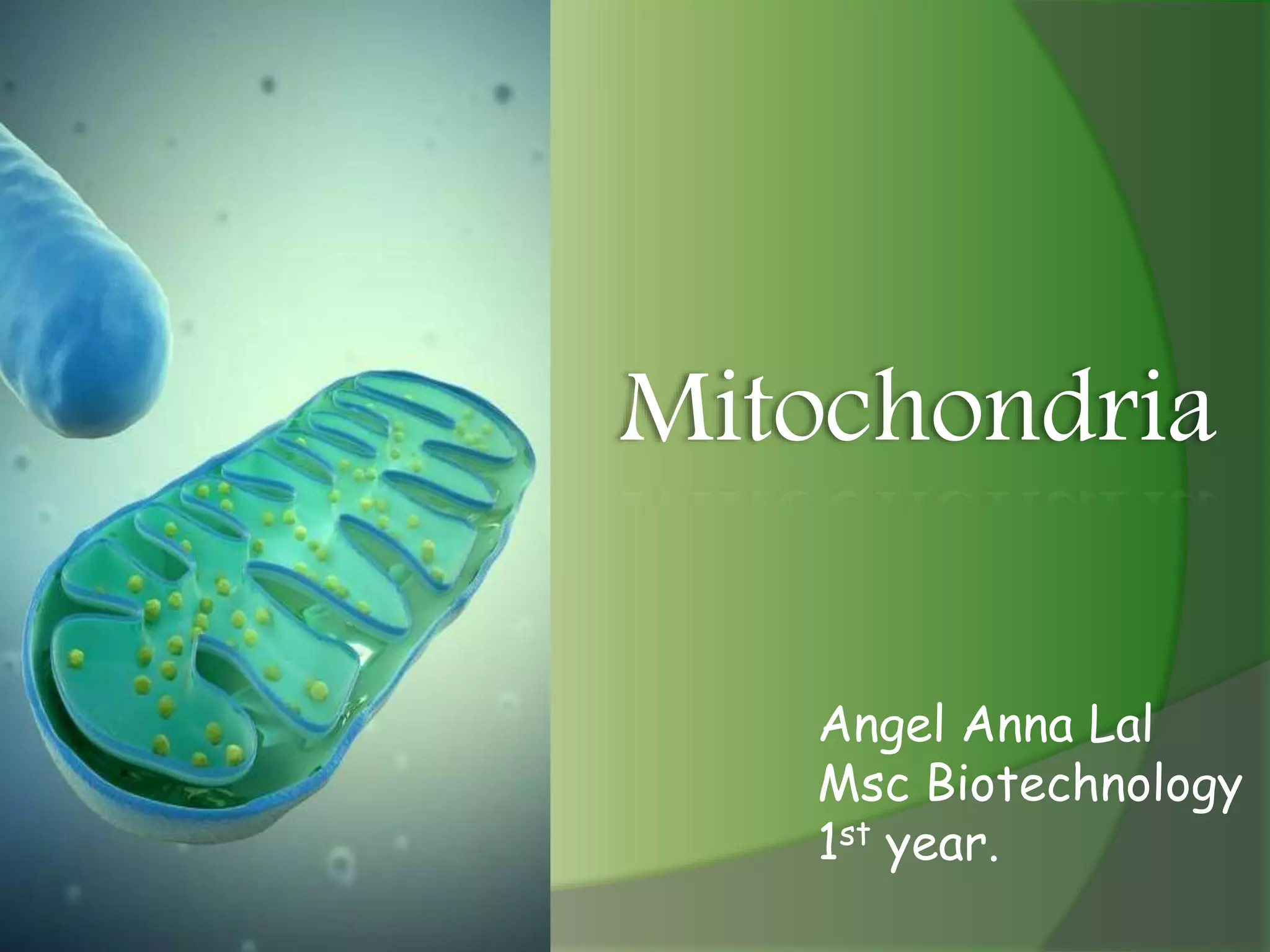
Mitochondria
Angel Anna Lal
Msc Biotechnology
1st year.
INTRODUCTION
 The mitochondrion (plural mitochond
ria) .[greek];
 It is a double membrane-
bound organelle found eukaryotic
cells.
 mito= thread
chondrion = granule like
 Found in cytoplasm of the cell.
 Power house of cell.
 First observed by Richard Altman
(1894).
 Term mitochondria was coined by
Carl Benda (1898).
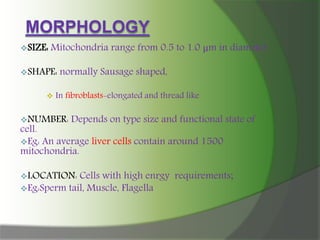
SIZE: Mitochondria range from 0.5 to 1.0 μm in diameter.
SHAPE: normally Sausage shaped,
 In fibroblasts-elongated and thread like
NUMBER: Depends on type size and functional state of
cell.
Eg: An average liver cells contain around 1500
mitochondria.
LOCATION: Cells with high enrgy requirements;
Eg:Sperm tail, Muscle, Flagella
In most animals ,
oozyte mitochondria [maternal] are the only
mitochondria that is inherited
.
Spermatazoa mitochondria [paternal] also
enters oocyte during fetilization,but destroyed
during early embryonic development.
Mechanism not yet ellucidated.
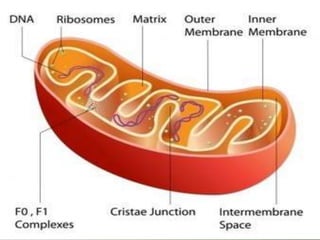
1. Outer Membrane
2. Intermembrane Space
3. Inner Membrane
4. Cristae
5. Matrix
OUTER MEMBRANE
 Simple phospholipid bilayer.
 It encloses the mitochondrion.
 Containing protein structures called porins.
 Ions, nutrient molecules, ATP, ADP, etc. can pass through the outer membrane
with ease.
INNER MEMBRANE
 Is freely permeable only to oxygen, carbon dioxide, and water.
 Contains complexes of the ETC, the ATP synthase complex, and transport
proteins.
 Presence of sophisticated ion transporters exist.
 Several antiport systems exist, allowing exchange of anions between
the cytosol and the mitochondrial matrix.
 It is devoid of cholesterol and rich in phospholipid & cardiolipin.
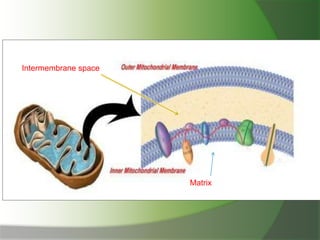
Intermembrane space
Matrix
the space between inner membrane and outer membrane {O
cavity}
It has high proton concentration.
The space between inner and outer memebrane is approx
70 angstrom.
Conc is same as that of the cytosol.
CRISTAE
Are folds of inner mitochondrial membrane.
Stalked particles or inner membrane spheres: cristae is
covered with this inner membrane spheres called stalked
particles or knobs or heads.
They contain protein called F1 portion & F0 portion. For
ATP synthesis and ATO oxidation.
MITOCHONDRIAL MATRIX:
Gel like consistency
Dense ,homogenous
2/3rd of total protein of mitochondria
 Mitochondria have: - enzymes
-ribosomes
-DNA
-mRNA
-granules
-fibrils
-tubules.
Major enzymes include enzymes involved in:
-Synthesis of nucleic acid and proteins
-Fatty acid oxidation
-TCA CYCLE (except succinate dehydrogenase)
MITOCHONDRIAL DNA (mt DNA):
Double stranded, covalently closed,
circular molecule.
Occurs in multiple copies.
Most usually remains attached to inner
mitochondrial membrane.
Stores biological info required for growth
and multiplication of mitochondria.
Can undergo replication and duplication.
 Human mt DNA 2 rRNA
22 tRNA
Not absolutely autonomous depends on
nuclear DNA.[partially autonomous]
FUNCTIONS OF MITOCHONDRIA:
Energy transducer of the cell- synthesis of ATP
Kreb’s cycle in matrix
ETC system
Phosphorylating system- ATPase
Extra mitochondrial inheritance:
mtDNA contains plasma genes (extra chromosomal genes)
Transmitted from mother to the offspring
Synthesis of mtDNA, RNA, protein.
 Bring about gene expression through gene duplication
transcription and translation.
Synthesis 13 different polypeptides in human.
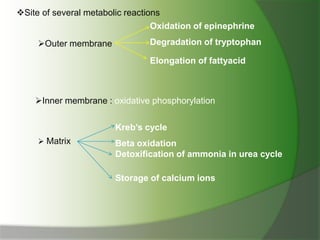
Site of several metabolic reactions
Outer membrane
Oxidation of epinephrine
Degradation of tryptophan
Elongation of fattyacid
Inner membrane : oxidative phosphorylation
 Matrix
Kreb’s cycle
Beta oxidation
Detoxification of ammonia in urea cycle
Storage of calcium ions
OTHER FUNCTIONS:
 production of heat ( non shivering thermogenesis).
[ The unharnessed potential energy of proton-electrochemical
gradient produced during ETC is released as heat.]
Role in apoptosis ( programmed cell death).
Synthesis of estrogen and testosterone.
Role in neurotransmitter metabolism.
Role on cholesterol metabolism.
Cell mitochondria ppt

Cell mitochondria ppt

  • 1.
    Mitochondria Angel Anna Lal MscBiotechnology 1st year.
  • 2.
    INTRODUCTION  The mitochondrion(plural mitochond ria) .[greek];  It is a double membrane- bound organelle found eukaryotic cells.  mito= thread chondrion = granule like  Found in cytoplasm of the cell.  Power house of cell.  First observed by Richard Altman (1894).  Term mitochondria was coined by Carl Benda (1898).
  • 4.
    SIZE: Mitochondria rangefrom 0.5 to 1.0 μm in diameter. SHAPE: normally Sausage shaped,  In fibroblasts-elongated and thread like NUMBER: Depends on type size and functional state of cell. Eg: An average liver cells contain around 1500 mitochondria. LOCATION: Cells with high enrgy requirements; Eg:Sperm tail, Muscle, Flagella
  • 5.
    In most animals, oozyte mitochondria [maternal] are the only mitochondria that is inherited . Spermatazoa mitochondria [paternal] also enters oocyte during fetilization,but destroyed during early embryonic development. Mechanism not yet ellucidated.
  • 6.
    1. Outer Membrane 2.Intermembrane Space 3. Inner Membrane 4. Cristae 5. Matrix
  • 8.
    OUTER MEMBRANE  Simplephospholipid bilayer.  It encloses the mitochondrion.  Containing protein structures called porins.  Ions, nutrient molecules, ATP, ADP, etc. can pass through the outer membrane with ease. INNER MEMBRANE  Is freely permeable only to oxygen, carbon dioxide, and water.  Contains complexes of the ETC, the ATP synthase complex, and transport proteins.  Presence of sophisticated ion transporters exist.  Several antiport systems exist, allowing exchange of anions between the cytosol and the mitochondrial matrix.  It is devoid of cholesterol and rich in phospholipid & cardiolipin.
  • 9.
  • 10.
    the space betweeninner membrane and outer membrane {O cavity} It has high proton concentration. The space between inner and outer memebrane is approx 70 angstrom. Conc is same as that of the cytosol. CRISTAE Are folds of inner mitochondrial membrane. Stalked particles or inner membrane spheres: cristae is covered with this inner membrane spheres called stalked particles or knobs or heads. They contain protein called F1 portion & F0 portion. For ATP synthesis and ATO oxidation.
  • 11.
    MITOCHONDRIAL MATRIX: Gel likeconsistency Dense ,homogenous 2/3rd of total protein of mitochondria  Mitochondria have: - enzymes -ribosomes -DNA -mRNA -granules -fibrils -tubules. Major enzymes include enzymes involved in: -Synthesis of nucleic acid and proteins -Fatty acid oxidation -TCA CYCLE (except succinate dehydrogenase)
  • 12.
    MITOCHONDRIAL DNA (mtDNA): Double stranded, covalently closed, circular molecule. Occurs in multiple copies. Most usually remains attached to inner mitochondrial membrane. Stores biological info required for growth and multiplication of mitochondria. Can undergo replication and duplication.  Human mt DNA 2 rRNA 22 tRNA Not absolutely autonomous depends on nuclear DNA.[partially autonomous]
  • 13.
    FUNCTIONS OF MITOCHONDRIA: Energytransducer of the cell- synthesis of ATP Kreb’s cycle in matrix ETC system Phosphorylating system- ATPase Extra mitochondrial inheritance: mtDNA contains plasma genes (extra chromosomal genes) Transmitted from mother to the offspring Synthesis of mtDNA, RNA, protein.  Bring about gene expression through gene duplication transcription and translation. Synthesis 13 different polypeptides in human.
  • 14.
    Site of severalmetabolic reactions Outer membrane Oxidation of epinephrine Degradation of tryptophan Elongation of fattyacid Inner membrane : oxidative phosphorylation  Matrix Kreb’s cycle Beta oxidation Detoxification of ammonia in urea cycle Storage of calcium ions
  • 15.
    OTHER FUNCTIONS:  productionof heat ( non shivering thermogenesis). [ The unharnessed potential energy of proton-electrochemical gradient produced during ETC is released as heat.] Role in apoptosis ( programmed cell death). Synthesis of estrogen and testosterone. Role in neurotransmitter metabolism. Role on cholesterol metabolism.