Cell Division – Mitosis By Anna Purna http:// purnasrinivas.weebly.com http:// purnasrinivas.webs.com
Cell Division – Mitosis How does a multicellular organism develop from a single cell?
What is Cell Division? It is a small segment of a large cell cycle  A parent cell divides into two or more daughter cells  The type of cell division in Eukaryotes – Mitosis Corresponding type in prokaryotes – Binary fission Eukaryotes also show a second kind of cell division - Meiosis
Types of Cell Division – Brief Description Mitosis –   Takes place in eukaryotes Parent cell divides into daughter cells Daughter cells are capable of dividing further Binary fission - Takes place in prokaryotes This is a method of asexual reproduction  A single bacterium cell produces a colony of cells which are genetically equal
Types of Cell Division – Brief Description Meiosis- Second kind of cell division in eukaryotes It produces gametes. Gametes help in reproduction after fertilization.
Why do Cells Divide? Single-celled organisms divide to reproduce. Cell division in multicellular organism enables the organism to grow larger while the cells remain small.  To repair worn out tissues. Some cells of multicellular organisms must divide to produce sex cells known as gametes.
Types of cells Somatic cell –  Cells which have a diploid number of chromosomes. Gametic cell – Cells which have a haploid set of chromosomes. Homologous Chromosomes Two similar chromosomes in a diploid organism are known as homologus chromosomes. Out of such homologus pair of chromosomes one is inherited from father and the other from mother.
Cell Cycle An ordered set of events resulting into cell’s growth and division into two daughter cells.  In eukaryotes the cell cycle is divided into two brief periods- Interphase – The cell grows The genetic material- DNA duplicates The cell accumulates nutrients needed for Mitosis Mitosis During this stage the cell splits into two daughter cells
Interphase Stage of a Cell Cycle Longest part of the cell cycle  Most of the cells are observed to be in this stage Cell prepares itself for cell division The stages in the interphase of a cell cycle are G1-S-G2
Changes During the G1 or GAP1 phase  It is the first phase of interphase  It is also known as growth phase Just after the cytokinesis the cells are small and have a very low amount of ATP. The biosynthetic activities of the cell, which had been considerably slowed down during M phase, resume at a high rate Synthesis of various enzymes which are needed for DNA replication takes place
Changes During the S or Synthetic Phase   Replication of DNA Each chromosome has divided into two sister chromatids. RNA transcription is low Protein synthesis is low Changes During the G2 or GAP2 Phase Replication of DNA is an energy draining process so to compensate the loss of energy the cell enters a second growth phase. In this stage it acquires energy which is stored for the mitosis Increase in biosynthetic activities Production of microtubules
Resting or G0 Phase Cells which have temporarily or reversibly stopped dividing are said to have entered into quiescent or senescent state.  Neurons after mitosis enter into the G1 phase of the next round and then they enter into quiescent G0 state. Completely differentiated cells. Works as an alternative measure for the cells who’s DNA has become damaged.
 
Regulation of the Cell Cycle An uncontrolled cell division leads to cancer hence the regulatory factors which control the cell division are- Cdk (cyclin dependent kinase)- Controls the switching of the cell from G1 to S or G2 to M. MPF (Maturation Promoting Factor) -Triggers progression through the cell cycle. P53 – It is a protein that functions to block the cell cycle if the DNA is damaged.  P27- It is a protein that binds to cyclin and cdk blocking entry into S phase.
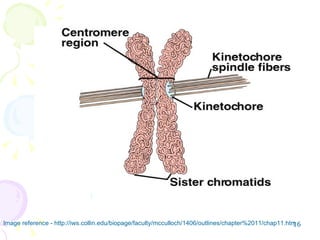
Areas of Chromosomes Kinetochore   During mitosis microtubules of the spindle apparatus get attached to the point known as kinetochore.  It is a protein structure which lies on the outer sides of the centromere . Chromatids   Chromosomes replicate such that two molecules of DNA are produced.  Replicated DNA along with histone proteins is known as chromatids. Centromere   It is the region of chromosome where both chromatids are in contact with each other. This region is found in the middle of the chromososme
Image reference - http://iws.collin.edu/biopage/faculty/mcculloch/1406/outlines/chapter%2011/chap11.htm
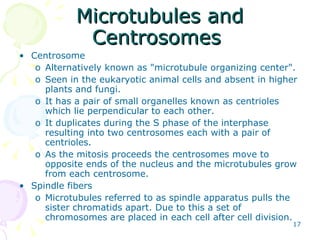
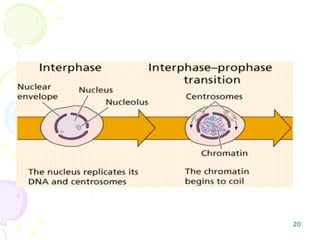
Microtubules and Centrosomes  Centrosome Alternatively known as "microtubule organizing center". Seen in the eukaryotic animal cells and absent in higher plants and fungi.  It has a pair of small organelles known as centrioles which lie perpendicular to each other. It duplicates during the S phase of the interphase resulting into two centrosomes each with a pair of centrioles. As the mitosis proceeds the centrosomes move to opposite ends of the nucleus and the microtubules grow from each centrosome. Spindle fibers Microtubules referred to as spindle apparatus pulls the sister chromatids apart. Due to this a set of chromosomes are placed in each cell after cell division.
Fig 1 reference - http://bio-ggs.blogspot.com/2009/12/meet-chickens-fluorescnet-microscopy.html Fig 2 reference -  http:// psychology.wikia.com/index.php?title = Mitosis&&cb =9395&fbconnected=1
Mitosis The term mitosis was coined by Walther Flemming in the early 1880s from the Greek word for thread. A single cell splits into two genetically identical cells. Daughter cells have the same number of chromosomes as that of the parent cell. Cells can be haploid, diploid or polyploid (containing more than two sets of chromosomes) It takes place in 4 stages. Image reference - http://chloe1220.wordpress.com/category/uncategorized/
 
Prophase Loosely coiled chromatin within a normal cell gets highly condensed . Formation of highly organized structures known as chromosomes. Nuclear envelope dissolves followed by the disappearance of the nucleus. Nucleolus disappears. Duplicated centrosomes containing a pair of centrioles start migrating towards the opposite ends of the cell. Spindle fibers made up of microtubules start originating from the centrosomes.
Prometaphase The nuclear membrane dissolves completely making the onset of prometaphase. The microtubules originating from the centrioles invade the nuclear space. Proteins get attached to the centromeres forming Kinetochores. Microtubules get attached to the kinetochores. Image reference -  file:///D:/Purna/Bkup/collection/wiziq/Sample%20papers/biobookmito.html
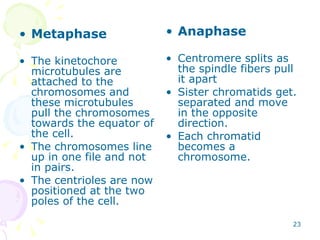
Metaphase The kinetochore microtubules are attached to the chromosomes and these microtubules pull the chromosomes towards the equator of the cell. The chromosomes line up in one file and not in pairs. The centrioles are now positioned at the two poles of the cell. Anaphase Centromere splits as the spindle fibers pull it apart Sister chromatids get. separated and move in the opposite direction. Each chromatid becomes a chromosome.
Image reference -  file:///D:/Purna/Bkup/collection/wiziq/Sample%20papers/biobookmito.html
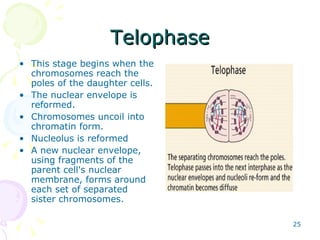
Telophase This stage begins when the chromosomes reach the poles of the daughter cells. The nuclear envelope is reformed. Chromosomes uncoil into chromatin form. Nucleolus is reformed A new nuclear envelope, using fragments of the parent cell's nuclear membrane, forms around each set of separated sister chromosomes.
Cytokinesis Splitting of cytoplasm and allocation of organelles into each new cell. Mitosis involves division of nucleus. Cytokinesis is a separate process which begins at the same time as telophase. It begins with the formation of a cleavage furrow between the two newly formed nuclei. Image reference – http://iws.collin.edu/biopage/faculty/mcculloch/1406/outlines/chapter%2011/Ar14e-6.JPG
Differences in Mitosis within Plant and Animal Cells Absent, and so spindle fibers arise from free microtubules, that assemble in one point. Present and they send out spindle fibers. Centrioles The Golgi apparatus sends vesicles filled with polysaccharides to the equator region. These vesicles fuse and form the cell plate. The cell plate develops into a cell wall by the addition of cellulose, pectin and other tough polysaccharides.  Constriction of the cell membrane and the appearance of a cleavage furrow that increases in indention until the two cells separate completely. Cytokinesis  Plant cell Animal cell Feature
Function of Mitosis Increase in number of cells leading to growth  Repair of damaged tissues Asexual reproduction in some animals like amoeba. Vegetative reproduction in plants. Cell division also keeps cells small. In sexual reproduction, the first stages of gametogenesis (spermatogenesis and oogenesis) involve mitosis in order to increase the number of cells that will go into meiosis. A negative side to cell division is that uncontrollable mitosis results in cancer or tumors.
Summary of the class A cell divides into two or more daughter cells during cell division. A cell division cycle is broadly divided into Interphase and Mitosis. The stages in the interphase of a cell cycle are G1-S-G2. Mitosis takes place in four stages. The four stages are prophase, metaphase, anaphase and telophase. Cytokinesis is the ultimate step during which cytoplasm of the parent cell divides.
Thank you

Cell division – mitosis

  • 1.
    Cell Division –Mitosis By Anna Purna http:// purnasrinivas.weebly.com http:// purnasrinivas.webs.com
  • 2.
    Cell Division –Mitosis How does a multicellular organism develop from a single cell?
  • 3.
    What is CellDivision? It is a small segment of a large cell cycle A parent cell divides into two or more daughter cells The type of cell division in Eukaryotes – Mitosis Corresponding type in prokaryotes – Binary fission Eukaryotes also show a second kind of cell division - Meiosis
  • 4.
    Types of CellDivision – Brief Description Mitosis – Takes place in eukaryotes Parent cell divides into daughter cells Daughter cells are capable of dividing further Binary fission - Takes place in prokaryotes This is a method of asexual reproduction A single bacterium cell produces a colony of cells which are genetically equal
  • 5.
    Types of CellDivision – Brief Description Meiosis- Second kind of cell division in eukaryotes It produces gametes. Gametes help in reproduction after fertilization.
  • 6.
    Why do CellsDivide? Single-celled organisms divide to reproduce. Cell division in multicellular organism enables the organism to grow larger while the cells remain small. To repair worn out tissues. Some cells of multicellular organisms must divide to produce sex cells known as gametes.
  • 7.
    Types of cellsSomatic cell – Cells which have a diploid number of chromosomes. Gametic cell – Cells which have a haploid set of chromosomes. Homologous Chromosomes Two similar chromosomes in a diploid organism are known as homologus chromosomes. Out of such homologus pair of chromosomes one is inherited from father and the other from mother.
  • 8.
    Cell Cycle Anordered set of events resulting into cell’s growth and division into two daughter cells. In eukaryotes the cell cycle is divided into two brief periods- Interphase – The cell grows The genetic material- DNA duplicates The cell accumulates nutrients needed for Mitosis Mitosis During this stage the cell splits into two daughter cells
  • 9.
    Interphase Stage ofa Cell Cycle Longest part of the cell cycle Most of the cells are observed to be in this stage Cell prepares itself for cell division The stages in the interphase of a cell cycle are G1-S-G2
  • 10.
    Changes During theG1 or GAP1 phase It is the first phase of interphase It is also known as growth phase Just after the cytokinesis the cells are small and have a very low amount of ATP. The biosynthetic activities of the cell, which had been considerably slowed down during M phase, resume at a high rate Synthesis of various enzymes which are needed for DNA replication takes place
  • 11.
    Changes During theS or Synthetic Phase Replication of DNA Each chromosome has divided into two sister chromatids. RNA transcription is low Protein synthesis is low Changes During the G2 or GAP2 Phase Replication of DNA is an energy draining process so to compensate the loss of energy the cell enters a second growth phase. In this stage it acquires energy which is stored for the mitosis Increase in biosynthetic activities Production of microtubules
  • 12.
    Resting or G0Phase Cells which have temporarily or reversibly stopped dividing are said to have entered into quiescent or senescent state. Neurons after mitosis enter into the G1 phase of the next round and then they enter into quiescent G0 state. Completely differentiated cells. Works as an alternative measure for the cells who’s DNA has become damaged.
  • 13.
  • 14.
    Regulation of theCell Cycle An uncontrolled cell division leads to cancer hence the regulatory factors which control the cell division are- Cdk (cyclin dependent kinase)- Controls the switching of the cell from G1 to S or G2 to M. MPF (Maturation Promoting Factor) -Triggers progression through the cell cycle. P53 – It is a protein that functions to block the cell cycle if the DNA is damaged. P27- It is a protein that binds to cyclin and cdk blocking entry into S phase.
  • 15.
    Areas of ChromosomesKinetochore During mitosis microtubules of the spindle apparatus get attached to the point known as kinetochore. It is a protein structure which lies on the outer sides of the centromere . Chromatids Chromosomes replicate such that two molecules of DNA are produced. Replicated DNA along with histone proteins is known as chromatids. Centromere It is the region of chromosome where both chromatids are in contact with each other. This region is found in the middle of the chromososme
  • 16.
    Image reference -http://iws.collin.edu/biopage/faculty/mcculloch/1406/outlines/chapter%2011/chap11.htm
  • 17.
    Microtubules and Centrosomes Centrosome Alternatively known as "microtubule organizing center". Seen in the eukaryotic animal cells and absent in higher plants and fungi. It has a pair of small organelles known as centrioles which lie perpendicular to each other. It duplicates during the S phase of the interphase resulting into two centrosomes each with a pair of centrioles. As the mitosis proceeds the centrosomes move to opposite ends of the nucleus and the microtubules grow from each centrosome. Spindle fibers Microtubules referred to as spindle apparatus pulls the sister chromatids apart. Due to this a set of chromosomes are placed in each cell after cell division.
  • 18.
    Fig 1 reference- http://bio-ggs.blogspot.com/2009/12/meet-chickens-fluorescnet-microscopy.html Fig 2 reference - http:// psychology.wikia.com/index.php?title = Mitosis&&cb =9395&fbconnected=1
  • 19.
    Mitosis The termmitosis was coined by Walther Flemming in the early 1880s from the Greek word for thread. A single cell splits into two genetically identical cells. Daughter cells have the same number of chromosomes as that of the parent cell. Cells can be haploid, diploid or polyploid (containing more than two sets of chromosomes) It takes place in 4 stages. Image reference - http://chloe1220.wordpress.com/category/uncategorized/
  • 20.
  • 21.
    Prophase Loosely coiledchromatin within a normal cell gets highly condensed . Formation of highly organized structures known as chromosomes. Nuclear envelope dissolves followed by the disappearance of the nucleus. Nucleolus disappears. Duplicated centrosomes containing a pair of centrioles start migrating towards the opposite ends of the cell. Spindle fibers made up of microtubules start originating from the centrosomes.
  • 22.
    Prometaphase The nuclearmembrane dissolves completely making the onset of prometaphase. The microtubules originating from the centrioles invade the nuclear space. Proteins get attached to the centromeres forming Kinetochores. Microtubules get attached to the kinetochores. Image reference - file:///D:/Purna/Bkup/collection/wiziq/Sample%20papers/biobookmito.html
  • 23.
    Metaphase The kinetochoremicrotubules are attached to the chromosomes and these microtubules pull the chromosomes towards the equator of the cell. The chromosomes line up in one file and not in pairs. The centrioles are now positioned at the two poles of the cell. Anaphase Centromere splits as the spindle fibers pull it apart Sister chromatids get. separated and move in the opposite direction. Each chromatid becomes a chromosome.
  • 24.
    Image reference - file:///D:/Purna/Bkup/collection/wiziq/Sample%20papers/biobookmito.html
  • 25.
    Telophase This stagebegins when the chromosomes reach the poles of the daughter cells. The nuclear envelope is reformed. Chromosomes uncoil into chromatin form. Nucleolus is reformed A new nuclear envelope, using fragments of the parent cell's nuclear membrane, forms around each set of separated sister chromosomes.
  • 26.
    Cytokinesis Splitting ofcytoplasm and allocation of organelles into each new cell. Mitosis involves division of nucleus. Cytokinesis is a separate process which begins at the same time as telophase. It begins with the formation of a cleavage furrow between the two newly formed nuclei. Image reference – http://iws.collin.edu/biopage/faculty/mcculloch/1406/outlines/chapter%2011/Ar14e-6.JPG
  • 27.
    Differences in Mitosiswithin Plant and Animal Cells Absent, and so spindle fibers arise from free microtubules, that assemble in one point. Present and they send out spindle fibers. Centrioles The Golgi apparatus sends vesicles filled with polysaccharides to the equator region. These vesicles fuse and form the cell plate. The cell plate develops into a cell wall by the addition of cellulose, pectin and other tough polysaccharides. Constriction of the cell membrane and the appearance of a cleavage furrow that increases in indention until the two cells separate completely. Cytokinesis Plant cell Animal cell Feature
  • 28.
    Function of MitosisIncrease in number of cells leading to growth Repair of damaged tissues Asexual reproduction in some animals like amoeba. Vegetative reproduction in plants. Cell division also keeps cells small. In sexual reproduction, the first stages of gametogenesis (spermatogenesis and oogenesis) involve mitosis in order to increase the number of cells that will go into meiosis. A negative side to cell division is that uncontrollable mitosis results in cancer or tumors.
  • 29.
    Summary of theclass A cell divides into two or more daughter cells during cell division. A cell division cycle is broadly divided into Interphase and Mitosis. The stages in the interphase of a cell cycle are G1-S-G2. Mitosis takes place in four stages. The four stages are prophase, metaphase, anaphase and telophase. Cytokinesis is the ultimate step during which cytoplasm of the parent cell divides.
  • 30.

Editor's Notes

  • #18 Asters grow out of the centrosome during cellular division and they function in guiding the split chromosomes to opposite sides of the cell. The aster is thought to serve as a brace for the functioning of the spindle fibers. 2)Microtubule assembly in plants is initiated by 'microtubule-organizing centers' (MTOC), which consist of 'peri-centriolar material', including - tubulin, and are distributed around the nuclear envelope.